


1 Samuel 23:23
Bible text: King James Version (1769 Blayney text) · Public domain
Bible text: King James Version with Strong's numbers · Public domain
Bible text: Berean Standard Bible · Public domain
Bible text: American Standard Version (1901) · Public domain
Bible text: World English Bible, Messianic edition · Public domain
Bible text: Geneva Bible (1599) · Public domain
Bible text: Young's Literal Translation · Public domain
- וּרְאוּu·re·'Uand seeH7200Conj-w ¦ V-Qal-Imp-2mpVerb Qal Imperative 2nd Plural Masculineוּandרְאוּsee
- וּדְעוּu·de·'Uand knowH3045Conj-w ¦ V-Qal-Imp-2mpVerb Qal Imperative 2nd Plural Masculineוּandדְעוּknow
- מִכֹּלmi·Kolfrom allH3605Prep-m ¦ N-mscNoun Singular Masculine Constructמִfromכֹּלall
- הַמַּחֲבֹאִיםha·ma·cha·vo·'Imthe hiding placesH4224Art ¦ N-mpNoun Plural Masculine Absoluteהַtheמַּחֲבֹאִיםhiding places
- אֲשֶׁר'a·SherwhereH834RelParticle Relative
- יִתְחַבֵּאyit·cha·Be'he hides himselfH2244V-Hithpael-Imperf-3msVerb Hithpael Imperfect 3rd Singular Masculine
- שָׁםShamthereH8033AdvAdverb
- וְשַׁבְתֶּםve·shav·Temand you will returnH7725Conj-w ¦ V-Qal-ConsecPerf-2mpVerb Qal Consecutive Perfect 2nd Plural Masculineוְandשַׁבְתֶּםyou will return
- אֵלַי'e·Laito meH413Prep ¦ 1csPreposition Definiteאֵלַtoיme
- אֶל'eltoH413PrepPreposition
- נָכוֹןna·Khona certain [thing]H3559V-Niphal-Prtcpl-msVerb Niphal Participle Singular Masculine Absolute
- וְהָלַכְתִּיve·ha·lakh·Tiand I will goH1980Conj-w ¦ V-Qal-ConsecPerf-1csVerb Qal Consecutive Perfect 1st Singular common genderוְandהָלַכְתִּיI will go
- אִתְּכֶם'i·te·Khemwith youH854Prep ¦ 2mpPreposition Definiteאִתְּwithכֶםyou
- וְהָיָהve·ha·Yahand it will beH1961Conj-w ¦ V-Qal-ConsecPerf-3msVerb Qal Consecutive Perfect 3rd Singular Masculineוְandהָיָהit will be
- אִם'imifH518PrtParticle Conditional
- יֶשְׁנוֹyesh·Nothere heH3426Adj-csc ¦ 3msAdjective Numerical Singular common gender Constructיֶשְׁנthereוֹhe
- בָאָרֶץva·'A·retz[is] in the landH776Prep-b ¦ N-fsNoun Singular Feminine Absoluteבָ[is] in theאָרֶץland
- וְחִפַּשְׂתִּיve·chi·pas·Tiand I will search outH2664Conj-w ¦ V-Piel-ConsecPerf-1csVerb Piel Consecutive Perfect 1st Singular common genderוְandחִפַּשְׂתִּיI will search out
- אֹתוֹ'o·To<obj.> himH853DirObjM ¦ 3msParticle Object Indicatorאֹת<obj.>וֹhim
- בְּכֹלbe·Kholamong allH3605Prep-b ¦ N-mscNoun Singular Masculine Constructבְּamongכֹלall
- אַלְפֵי'al·Fei[the] thousands ofH505N-cpcNoun Plural common gender Construct
- יְהוּדָהye·hu·DahJudahH3063N-properNoun Proper Location
English is a literal word-by-word gloss of the Hebrew, not the KJV's wording. Why?
This is the original text the KJV's translators worked from — each Hebrew word with its own literal English meaning in this verse, prepared by scholars at Tyndale House, Cambridge. The KJV translates whole sentences, not word by word, so its wording differs: one Hebrew word can become several English words, and the KJV may choose “the LORD” where the gloss reads “Yahweh”. Both are faithful — they answer different questions. For the KJV's own rendering, switch to the KJV text.
Details
See on the biblical-era map
Study this verse
Public-domain commentary
Matthew Henry
From his Commentary on the Whole Bible. Henry comments on passages, not single verses — this entry covers 1 Samuel 23:19–29.
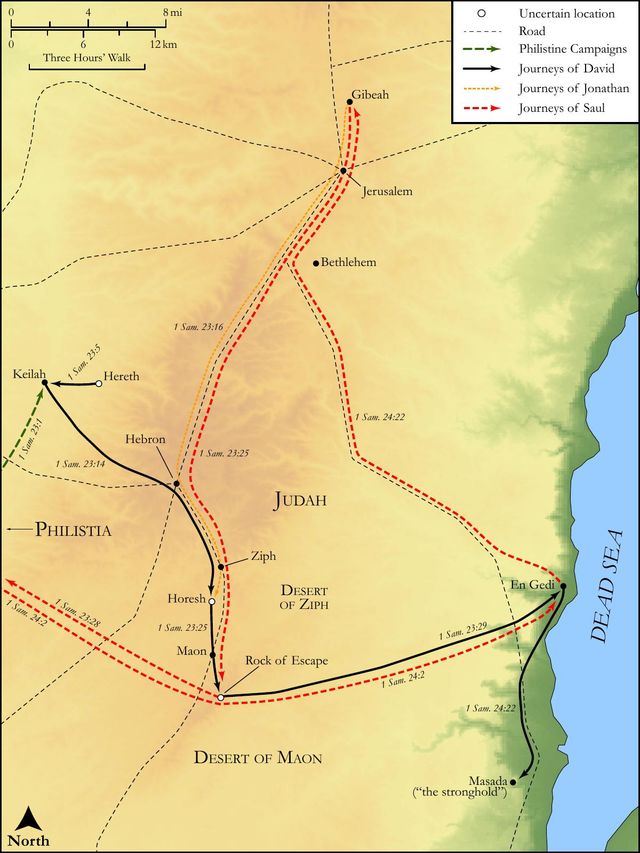
Here, 1. The Ziphites offer their service to Saul, to betray David to him, Sa1 23:19, Sa1 23:20. He was sheltering himself in the wilderness of Ziph (Sa1 23:14, Sa1 23:15), putting the more confidence in the people of that country because they were of his own tribe. They had reason to think themselves happy that they had an opportunity of serving one who was the ornament of their tribe and was likely to be much more so, who was so far from plundering the country, or giving it any disturbance with his troops, that he was ready to protect it and to them all the good offices that there was occasion for. But, to ingratiate themselves with Saul, they went to him, and not only informed him very particularly where David quartered (Sa1 23:19), but invited him to come with his forces into their country in pursuit of him, and promised to deliver him into his hand, Sa1 23:20. Saul had not sent to examine or threaten them, but of their own accord, and even without asking a reward (as Judas did - What will you give me?), they offered to betray David to him who, they knew, thirsted after his blood. 2. Saul thankfully receives their information, and gladly lays hold of the opportunity of hunting David in their wilderness, in hopes to make a prey of him at length. He intimates to them how kindly he took it (Sa1 23:21): Blessed be you of the Lord (so near is God to his mouth, though far from his heart), for you have compassion on me. It seems he looked upon himself as a miserable man and an object of pity; his own envy and ill-nature made him so, otherwise he might have been easy and have needed no man's compassion. He likewise insinuates the little concern that the generality of his people showed for him. "You have compassion on me, which others have not." Saul gives them instructions to search more particularly for his haunts (Sa1 23:22), "for" (says he) "I hear he deals very subtilely," representing him as a man crafty to do mischief, whereas all his subtlety was to secure himself. It was strange that Saul did not go down with them immediately, but he hoped by their means to set his game with the more certainty, and thus divine Providence gave David time to shift for himself. But the Ziphites had laid their spies upon all the places where he was likely to be discovered, and therefore Saul might come and seize him if he was in the land, Sa1 23:23. New he thought himself sure of his prey and pleased himself with the thoughts of devouring it. 3. The imminent peril that David was now brought into. Upon intelligence that the Ziphites had betrayed him, he retired from the hill of Hachilah to the wilderness of Maon (Sa1 23:24), and at this time he penned the 54th Psalm, as appears by the title, wherein he calls the Ziphites strangers, though they were Israelites, because they used him barbarously; but he puts himself under the divine protection: "Behold, God is my helper, and then all shall be well" Saul, having got intelligence of him, pursued him closely (Sa1 23:25), till he came so near him that there was but a mountain between them (Sa1 23:26), David and his men on one side of the mountain flying and Saul and his men on the other side pursuing, David in fear and Saul in hope. But this mountain was an emblem of the divine Providence coming between David and the destroyer, like the pillar of cloud between the Israelites and the Egyptians. David was concealed by this mountain and Saul confounded by it. David now flees as a bird to his mountain (Psa 11:1) and finds God to him as the shadow of a great rock. Saul hoped with his numerous forces to enclose David, and compass him in and his men; but the ground did not prove convenient for his design, and so it failed. A new name was given to the place in remembrance of this (Sa1 23:28): Selah-hammah-lekoth - the rock of division, because it divided between Saul and David. 4. The deliverance of David out of this danger. Providence gave Saul a diversion, when he was just ready to lay hold of David; notice was brought him that the Philistines were invading the land (Sa1 23:27), probably that part of the land where his own estate lay, which would be seized, or at least spoiled, by the invaders; for the little notice he took of Keilah's distress and David's relief of it, in the beginning of this chapter, gives us cause to suspect that he would not now have left pursuing David, and gone to oppose the Philistines, if some private interests of his own had not been at stake. However it was, he found himself under a necessity of going against the Philistines (Sa1 23:28), and by this means David was delivered when he was on the brink of destruction. Saul was disappointed of his prey, and God was glorified as David's wonderful protector. When the Philistines invaded the land they were far from intending any kindness to David by it, yet the overruling providence of God, which orders all events and the times of them, made it very serviceable to him. The wisdom of God is never at a loss for ways and means to preserve his people. As this Saul was diverted, so another Saul was converted, just then when he was breathing out threatenings and slaughter against the saints of the Lord, Act 9:1. 5. David, having thus escaped, took shelter in some natural fortresses, which he found in the wilderness of En-gedi, Sa1 23:29. And this Dr. Lightfoot thinks was the wilderness of Judah, in which David was when he penned Psa 63:1-11, which breathes as much pious and devout affection as almost any of his psalms; for in all places and in all conditions he still kept up his communion with God.
Historical interpretation
Historical reception
1 surviving comment on this verse from the historical church.
But if he also hides himself in the ground, etc. The ground is the fruitful mind of the chosen ones through works of faith; which, when visited and drenched by God and multiplied, the most proud investigator boasts of searching it, because not only in the openness of work or confession but also in the very secret of faith and intimate love, he may be able to take Christ from His worshippers. But if, he says, he shall even hide himself in the ground, I will search him out among the thousands of Judah. As if he openly says: But if the people of Christians shall, by our reducing them to such a few or to such poverty, come to the point where, having taken away the confidence of preaching, the solemnities of celebrating, publicly gathering meetings, and at least professing they are Christians, they scarcely dare worship Christ as if hidden in the very recesses of their hearts, there and from thence little by little, with the abundant company of persecutors as well as explorers, I will strive to exterminate Him. For I have innumerable Judahites, that is, bands of divine praise or confession, by which I may easily quench the rash undertakings of all those who think otherwise. This can also be taken simply, because sometimes Christians have been dragged out from crypts and hiding places to be led to death for Christ.
Continue studying 1 Samuel 23:23 across the web’s major study libraries — every link below opens this exact verse, chapter, or book on the destination site.
Read & Compare
 BibleGatewayThis verse in more than 200 translations and 70 languages.
 Bible.comThe YouVersion reader — hundreds of translations, reading plans, and highlights.
 ESV.orgCrossway's official English Standard Version reader.
 NET BibleThe NET translation with 60,000+ translators' notes on every rendering decision.
 STEP BibleTyndale House's free study tool — original text, vocabulary, and scholarly resources.
 BibliaLogos Bible Software's free web reader.
 USCCBThe New American Bible (Revised Edition) with the U.S. bishops' study notes.
Commentaries
 BibleHub CommentariesDozens of classic commentaries on this verse, gathered on one page.
 StudyLightMore than 100 commentary sets — the largest collection on the web.
 BibleRefPlain-English commentary on what this verse means, verse by verse.
 Enduring WordDavid Guzik's free commentary on this chapter, widely used by Bible teachers.
 Bible Study ToolsVerse commentary alongside Greek and Hebrew study aids.
Original Language & Research
- BibleHub InterlinearThe verse word by word — original language, transliteration, and English.
- BibleHub LexiconEvery word's original-language definition and Strong's entry.
 Blue Letter BibleDeep-study tools — Strong's numbers, concordance, and word studies.
 SefariaThe Hebrew text with Rashi and centuries of Jewish commentary.
Sermons, Hymns & Audio


TrulyRandomVerse is not affiliated with these sites and doesn’t control their content. They’re linked because they’re genuinely useful.
Summary
First Samuel 23:23 encapsulates King Saul's relentless, obsessive, and meticulously planned pursuit of David, his perceived rival, following a betrayal by the Ziphites. This verse reveals the profound depth of Saul's paranoia and his willingness to commit vast resources to hunt David "throughout all the thousands of Judah," underscoring the intense, life-or-death struggle between the reigning monarch and God's anointed successor, all while highlighting David's precarious position and God's unfailing providence in preserving His chosen one.
Context
ShowHideLiterary Context
This verse is deeply embedded within a protracted and perilous period of David's life as a fugitive, constantly fleeing King Saul's escalating and relentless pursuit. Immediately preceding this passage, the Ziphites, inhabitants of the wilderness region, betray David's specific hiding place to Saul, informing him that David is in the wilderness of Ziph, specifically "in the strongholds in Horesh, on the hill of Hachilah, which is south of Jeshimon" 1 Samuel 23:19. Saul's subsequent response in 1 Samuel 23:20-21 expresses his fervent gratitude and blessing for their loyalty, setting the immediate stage for the detailed, strategic instructions he issues in verse 23. This entire episode follows closely on the heels of David's narrow escape from Keilah 1 Samuel 23:1-13, where he was almost entrapped by Saul, vividly demonstrating the continuous and life-threatening danger he faced. The overarching narrative flow of this section of 1 Samuel powerfully emphasizes Saul's spiraling paranoia and David's unwavering reliance on divine guidance and miraculous escapes, highlighting the stark contrast between human malice and divine protection.
Historical & Cultural Context
The geographical setting for this intense pursuit is the wilderness of Judah, a rugged, desolate, and largely uninhabited region characterized by its numerous caves, wadis, and natural strongholds. This terrain made it an ideal, albeit harsh, environment for fugitives like David and his band of men, offering both concealment and strategic advantages for guerrilla-style evasion. The Ziphite territory, specifically, was known for its sparse population and challenging topography. As the reigning king, Saul commanded significant military resources, including a standing army and intelligence networks, enabling him to mobilize large forces and demand detailed reconnaissance from local populations. The cultural expectation in ancient Israel was unwavering loyalty to the monarch. The Ziphites' betrayal of David, a fellow Israelite and God's anointed (though not yet recognized by Saul), underscores the intense political pressure and pervasive fear that Saul's increasingly tyrannical reign instilled among his subjects. The mention of "thousands" (Hebrew: אַלְפֵי, 'alphei) in ancient Israel often referred to tribal subdivisions, clans, or military units, indicating a comprehensive and systematic search across all societal and geographical segments of Judah, reflecting the king's absolute authority and reach.
Key Themes
ShowHideThis passage powerfully illustrates several core theological and narrative themes. Firstly, Saul's Obsession and Ruthlessness is paramount; his words reveal a single-minded, almost pathological determination to eliminate David, whom he views as an existential threat to his throne and legacy. This obsession, deeply rooted in envy, fear, and a refusal to acknowledge God's sovereign will, stands in stark contrast to David's character, particularly when David later spares Saul's life out of reverence for God's anointing. Secondly, David's Vulnerability and God's Providence is a recurring and central motif throughout this entire period of David's life. Despite Saul's fervent pursuit, the treachery of others, and seemingly insurmountable odds, David is continually protected and delivered by God, underscoring the precariousness of his situation yet simultaneously demonstrating God's sovereign hand in preserving His anointed one for future kingship, as seen in 1 Samuel 23:14. Finally, the Nature of Betrayal is starkly highlighted by the Ziphites' willingness to hand over David, a fellow Israelite and God's chosen, for Saul's favor. This act serves as a grim example of human treachery and self-interest, echoing the broader theme of human sinfulness and the corrupting influence of fear and power found throughout the Old Testament narrative.
Exposition and Analysis
ShowHideKey Word Analysis
ShowHideThis noun (H4224), appearing in the plural in the verse, refers to "a refuge" or "hiding place." It vividly portrays David's precarious existence as a hunted fugitive, forced to seek shelter in the wilderness's natural crevices and secret spots. Saul's demand to "take knowledge of all the lurking places" underscores his meticulous intelligence-gathering, aiming to leave no potential refuge unsearched. It highlights the desperate nature of David's existence and the comprehensive scope of Saul's hunt.
Derived from the root H3559, meaning "to be erect," "to set up," or "to render sure/firm," this word in its noun form (often translated 'certainty' or 'firmness') emphasizes Saul's demand for absolutely verified and reliable intelligence. He is not content with rumors or vague reports; he requires precise, confirmed information about David's exact whereabouts before committing his forces, reflecting his desperate and meticulous planning. This speaks to the high stakes involved and Saul's deep paranoia.
This term (H505), while literally meaning "a thousand," often refers in ancient Israel to tribal subdivisions, clans, or military units. Saul's declaration, "I will search him out throughout all the thousands of Judah," signifies his intent to scour every segment of society and every geographical corner within the tribal territory of Judah. It conveys the vastness of the resources and the comprehensive determination he is willing to commit to David's capture, leaving no stone unturned in his relentless pursuit.
Verse Breakdown
ShowHide"See therefore, and take knowledge of all the lurking places where he hideth himself"
This is Saul's direct and urgent command to the Ziphites, instructing them to engage in thorough reconnaissance. He demands meticulous observation and the gathering of precise intelligence on every potential hiding spot David might be utilizing. This reveals Saul's strategic thinking, his insistence on thoroughness, and his reliance on local informants to achieve his objective.
"and come ye again to me with the certainty"
Saul demands verified, accurate, and absolutely reliable information. He is not interested in mere speculation or vague reports but requires firm, confirmed intelligence before he will act. This clause underscores his deep paranoia and his need for absolute assurance, reflecting the high stakes and the desperate nature of his pursuit of David.
"and I will go with you"
This declaration reveals the profound depth of Saul's personal commitment and the intensity of his obsession. He is not merely delegating the task but intends to personally lead the hunt, demonstrating his unwavering resolve and the absolute priority he places on David's capture. This also subtly implies a degree of distrust, as he wants to ensure the Ziphites' full cooperation and verify their information firsthand.
"and it shall come to pass, if he be in the land, that I will search him out throughout all the thousands of Judah"
This is Saul's ultimate vow and a powerful statement of his absolute determination. He pledges to conduct an exhaustive, region-wide search, leaving no part of Judah unexplored, if David is indeed within its borders. This highlights the vast resources he is willing to commit and the single-mindedness of his pursuit, emphasizing his resolve to eliminate David at any cost, demonstrating the full extent of his vengeful obsession.
Literary Devices
ShowHideThe passage employs several potent literary devices to convey its dramatic intensity and underlying theological truths. Irony is profoundly prominent, as Saul, the reigning king, is consumed by the hunt for David, who is God's chosen and anointed successor, whose eventual ascension to the throne is divinely ordained and thus inevitable. Saul's meticulous planning and vast resources are ultimately rendered futile against God's sovereign will, creating a tragic and dramatic tension that permeates the narrative. The phrase "throughout all the thousands of Judah" can be seen as hyperbole, emphasizing the extreme extent of Saul's resolve and the comprehensive, almost impossible, nature of the search he envisions, even if a literal scouring of every single clan was logistically impossible. This intensifies the portrayal of his obsessive determination. Furthermore, the relentless pursuit itself serves as a powerful foreshadowing of Saul's eventual downfall; his rejection of God's will and his descent into paranoia and violence ultimately lead to his tragic demise, while David's repeated miraculous escapes and divine protection foreshadow his ultimate triumph and rightful kingship. The narrative also presents a stark contrast between Saul's human-driven, vengeful pursuit and David's humble reliance on divine providence and protection, highlighting the fundamental difference between earthly power wielded for self-preservation and God's sovereign plan unfolding through His chosen servant.
Theological and Thematic Connections
ShowHideThis verse powerfully illustrates the clash between human will and divine purpose. Saul's desperate and meticulous hunt for David, despite all his resources, determination, and the treachery of informants, ultimately proves futile because God's protective hand is upon David. This narrative underscores the profound theological truth that God's plans cannot be thwarted by human opposition, no matter how powerful, persistent, or well-resourced. It highlights the theme of God's unwavering faithfulness to His promises, even when His chosen one faces overwhelming danger, betrayal, and seemingly insurmountable odds. David's experience in the wilderness, constantly on the run, yet miraculously preserved, serves as a powerful testament to God's protective sovereignty over those He has called and anointed. It also serves as a cautionary tale about the destructive power of envy, paranoia, and a refusal to submit to God's will, as tragically exemplified by Saul's decline into madness and eventual demise.
Reflection and Application
ShowHideThe story of Saul's relentless pursuit of David, culminating in this verse, offers profound and enduring lessons for contemporary believers. It serves as a powerful reminder that even when facing overwhelming opposition, betrayal from unexpected sources, and relentless pursuit from those who wish us harm, God remains absolutely faithful to His promises. David's experience is a vivid testament to God being our ever-present refuge and strength in times of trouble, demonstrating that divine providence can miraculously intervene and turn seemingly impossible situations around. For those feeling hunted, betrayed, unjustly targeted, or overwhelmed by life's adversaries, this narrative offers profound hope that God's protective hand is sovereign over all human machinations and malicious intent. Conversely, Saul's tragic descent into paranoia and obsession serves as a solemn cautionary tale about the destructive power of unchecked envy, unbridled ambition, and a stubborn refusal to submit to God's ultimate authority. It warns against allowing bitterness, fear, and a desire for control to consume one's heart, leading to actions that are not only wicked but ultimately self-defeating. We are called to trust implicitly in God's perfect timing and His divine anointing on others, rather than striving in our own strength or seeking to destroy those whom God has chosen or those we perceive as rivals.
Questions for Reflection
ShowHideFAQ
ShowHideWhy was Saul so determined to catch David?
ShowHideSaul's determination stemmed from a complex and potent mix of fear, envy, and a profound sense of threatened kingship. God had explicitly rejected Saul as king due to his repeated disobedience 1 Samuel 15:23, and Samuel had secretly anointed David as his successor 1 Samuel 16:13. Saul perceived David's growing popularity, military success, and undeniable divine favor as a direct, existential threat to his throne, his legacy, and his very life. His intense paranoia, exacerbated by an evil spirit that tormented him 1 Samuel 16:14, led him to believe that David was actively plotting against him, even though David repeatedly demonstrated his loyalty and profound respect for Saul's anointing by God.
What does "thousands of Judah" mean in this context?
ShowHideThe phrase "thousands of Judah" (Hebrew: אַלְפֵי יְهוּדָה, 'alphei Yehudah) refers to the comprehensive and exhaustive scope of Saul's intended search. While the term "thousands" (Hebrew: ʼeleph) can literally mean large numbers of people or military units, in this specific context, it broadly signifies all the clans, families, and geographical subdivisions within the tribal territory of Judah. Saul's intent was to scour every corner, every community, and every segment of society within Judah, leaving no potential hiding place or source of information unexplored in his relentless hunt for David. It powerfully emphasizes the vast resources, meticulous effort, and unwavering determination he was willing to commit to capturing David.
Did Saul ever succeed in catching David?
ShowHideNo, despite Saul's relentless, obsessive, and often desperate pursuit, he never succeeded in capturing David. Time and again, David was miraculously protected and delivered by God's providence, often narrowly escaping Saul's traps or being saved by unforeseen circumstances, such as Saul being called away to fight the Philistines 1 Samuel 23:27-28. David even had multiple clear opportunities to kill Saul but steadfastly refused to lay a hand on the Lord's anointed 1 Samuel 24:1-7. David's ultimate ascension to the throne was a profound testament to God's faithfulness and sovereignty, demonstrating that His divine plan cannot be thwarted by human effort, malice, or evasion.
Christ-Centered Fulfillment
ShowHideThe relentless pursuit of David by Saul, as meticulously depicted in 1 Samuel 23:23, powerfully foreshadows the ultimate "hunted" one: Jesus Christ. Just as Saul, the reigning king, sought with obsessive determination to eliminate David, God's anointed successor, so too did the earthly powers of Herod, the religious establishment (Pharisees and Sadducees), and the Roman Empire conspire to destroy Jesus, the true King of Israel and the Son of God. Herod's murderous attempt to kill the infant Jesus Matthew 2:13-18 mirrors Saul's homicidal intent against David, demonstrating the profound futility of human efforts to thwart divine decree. The meticulous planning and vast resources Saul committed to finding David find their ultimate parallel in the determined efforts of those who sought to trap Jesus in His words Luke 11:53-54 and ultimately to crucify Him. However, just as David's life was miraculously preserved by God's sovereign hand for his appointed kingship, so too was Jesus's "capture" and crucifixion not a triumph of human malice but the preordained, central act of God's redemptive plan. His death was a willing, atoning sacrifice John 10:18, and His glorious resurrection Romans 1:4 and enthronement at the right hand of God Hebrews 1:3 could not be thwarted by any earthly power or any "thousands of Judah." The narrative of Saul's futile hunt for David thus becomes a profound theological type, illustrating humanity's impotent attempts to oppose God's ultimate plan of salvation and the eternal establishment of His Kingdom through Christ, the true and everlasting King.