


1 Samuel 23:24
Bible text: King James Version (1769 Blayney text) · Public domain
Bible text: Berean Standard Bible · Public domain
Bible text: American Standard Version (1901) · Public domain
Bible text: World English Bible, Messianic edition · Public domain
Bible text: Geneva Bible (1599) · Public domain
Bible text: Young's Literal Translation · Public domain
- וַיָּקוּמוּvai·ya·Ku·muand they aroseH6965Conj-w ¦ V-Qal-ConsecImperf-3mpVerb Qal Consecutive Imperfect 3rd Plural Masculineוַandיָּקוּמוּthey arose
- וַיֵּלְכוּvai·ye·le·Khuand they wentH1980Conj-w ¦ V-Qal-ConsecImperf-3mpVerb Qal Consecutive Imperfect 3rd Plural Masculineוַandיֵּלְכוּthey went
- זִיפָהZi·fahZiph towardsH2128N-proper ¦ SfxNoun Proper LocationזִיפָZiphהtowards
- לִפְנֵיlif·Nei<to> beforeH6440Prep-l ¦ N-mpcNoun Plural Masculine Constructלִ<to>פְנֵיbefore
- שָׁאוּלsha·'UlSaulH7586N-proper-mNoun Proper Masculine
- וְדָוִדve·da·Vidand DavidH1732Conj-w ¦ N-proper-mNoun Proper MasculineוְandדָוִדDavid
- וַאֲנָשָׁיוva·'a·na·Shavand his menH582Conj-w ¦ N-mpc ¦ 3msNoun Plural Masculine Constructוַandאֲנָשָׁיmenוhis
- בְּמִדְבַּרbe·mid·Bar[were] in [the] wilderness ofH4057Prep-b ¦ N-mscNoun Singular Masculine Constructבְּ[were] inמִדְבַּר[the] wilderness of
- מָעוֹןma·'OnMaonH4584N-properNoun Proper Location
- בָּעֲרָבָהba·'a·ra·Vahin the ArabahH6160Prep-b ¦ N-properNoun Proper Locationבָּin theעֲרָבָהArabah
- אֶל'eltoH413PrepPreposition
- יְמִיןye·Min[the] south ofH3225N-fscNoun Singular Feminine Construct
- הַיְשִׁימוֹןhay·shi·Mon<the> JeshimonH3452Art ¦ N-properNoun Proper Locationהַ<the>יְשִׁימוֹןJeshimon
English is a literal word-by-word gloss of the Hebrew, not the KJV's wording. Why?
This is the original text the KJV's translators worked from — each Hebrew word with its own literal English meaning in this verse, prepared by scholars at Tyndale House, Cambridge. The KJV translates whole sentences, not word by word, so its wording differs: one Hebrew word can become several English words, and the KJV may choose “the LORD” where the gloss reads “Yahweh”. Both are faithful — they answer different questions. For the KJV's own rendering, switch to the KJV text.
Details
See on the biblical-era map
Study this verse
Public-domain commentary
Matthew Henry
From his Commentary on the Whole Bible. Henry comments on passages, not single verses — this entry covers 1 Samuel 23:19–29.
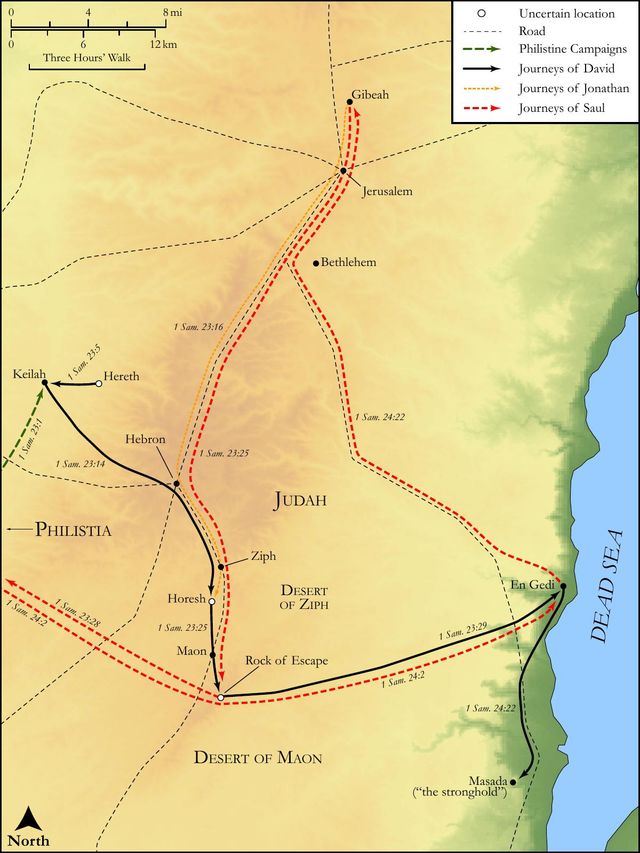
Here, 1. The Ziphites offer their service to Saul, to betray David to him, Sa1 23:19, Sa1 23:20. He was sheltering himself in the wilderness of Ziph (Sa1 23:14, Sa1 23:15), putting the more confidence in the people of that country because they were of his own tribe. They had reason to think themselves happy that they had an opportunity of serving one who was the ornament of their tribe and was likely to be much more so, who was so far from plundering the country, or giving it any disturbance with his troops, that he was ready to protect it and to them all the good offices that there was occasion for. But, to ingratiate themselves with Saul, they went to him, and not only informed him very particularly where David quartered (Sa1 23:19), but invited him to come with his forces into their country in pursuit of him, and promised to deliver him into his hand, Sa1 23:20. Saul had not sent to examine or threaten them, but of their own accord, and even without asking a reward (as Judas did - What will you give me?), they offered to betray David to him who, they knew, thirsted after his blood. 2. Saul thankfully receives their information, and gladly lays hold of the opportunity of hunting David in their wilderness, in hopes to make a prey of him at length. He intimates to them how kindly he took it (Sa1 23:21): Blessed be you of the Lord (so near is God to his mouth, though far from his heart), for you have compassion on me. It seems he looked upon himself as a miserable man and an object of pity; his own envy and ill-nature made him so, otherwise he might have been easy and have needed no man's compassion. He likewise insinuates the little concern that the generality of his people showed for him. "You have compassion on me, which others have not." Saul gives them instructions to search more particularly for his haunts (Sa1 23:22), "for" (says he) "I hear he deals very subtilely," representing him as a man crafty to do mischief, whereas all his subtlety was to secure himself. It was strange that Saul did not go down with them immediately, but he hoped by their means to set his game with the more certainty, and thus divine Providence gave David time to shift for himself. But the Ziphites had laid their spies upon all the places where he was likely to be discovered, and therefore Saul might come and seize him if he was in the land, Sa1 23:23. New he thought himself sure of his prey and pleased himself with the thoughts of devouring it. 3. The imminent peril that David was now brought into. Upon intelligence that the Ziphites had betrayed him, he retired from the hill of Hachilah to the wilderness of Maon (Sa1 23:24), and at this time he penned the 54th Psalm, as appears by the title, wherein he calls the Ziphites strangers, though they were Israelites, because they used him barbarously; but he puts himself under the divine protection: "Behold, God is my helper, and then all shall be well" Saul, having got intelligence of him, pursued him closely (Sa1 23:25), till he came so near him that there was but a mountain between them (Sa1 23:26), David and his men on one side of the mountain flying and Saul and his men on the other side pursuing, David in fear and Saul in hope. But this mountain was an emblem of the divine Providence coming between David and the destroyer, like the pillar of cloud between the Israelites and the Egyptians. David was concealed by this mountain and Saul confounded by it. David now flees as a bird to his mountain (Psa 11:1) and finds God to him as the shadow of a great rock. Saul hoped with his numerous forces to enclose David, and compass him in and his men; but the ground did not prove convenient for his design, and so it failed. A new name was given to the place in remembrance of this (Sa1 23:28): Selah-hammah-lekoth - the rock of division, because it divided between Saul and David. 4. The deliverance of David out of this danger. Providence gave Saul a diversion, when he was just ready to lay hold of David; notice was brought him that the Philistines were invading the land (Sa1 23:27), probably that part of the land where his own estate lay, which would be seized, or at least spoiled, by the invaders; for the little notice he took of Keilah's distress and David's relief of it, in the beginning of this chapter, gives us cause to suspect that he would not now have left pursuing David, and gone to oppose the Philistines, if some private interests of his own had not been at stake. However it was, he found himself under a necessity of going against the Philistines (Sa1 23:28), and by this means David was delivered when he was on the brink of destruction. Saul was disappointed of his prey, and God was glorified as David's wonderful protector. When the Philistines invaded the land they were far from intending any kindness to David by it, yet the overruling providence of God, which orders all events and the times of them, made it very serviceable to him. The wisdom of God is never at a loss for ways and means to preserve his people. As this Saul was diverted, so another Saul was converted, just then when he was breathing out threatenings and slaughter against the saints of the Lord, Act 9:1. 5. David, having thus escaped, took shelter in some natural fortresses, which he found in the wilderness of En-gedi, Sa1 23:29. And this Dr. Lightfoot thinks was the wilderness of Judah, in which David was when he penned Psa 63:1-11, which breathes as much pious and devout affection as almost any of his psalms; for in all places and in all conditions he still kept up his communion with God.
Historical interpretation
Four Centuries of Reception
3 surviving comments on this verse. Each one is dated, so this reads as a timeline rather than a list.
Select a marker to jump to its quote. Markers stagger vertically where authors wrote within a few decades of each other.
This is what happened to Paul. For the potency of the light suddenly surprised his feeble eyes and injured them. But the greatness of the voice brought low his strength and entered his ears and opened them.… For the voice did not plough up the ears, as the light injured the eyeballs. Why? But because it was necessary that he should hear but not see. Therefore the doors of hearing were opened by the voice as by a key: but the doors of sight were shut by the light that should open them. Why then was it necessary that he should hear? Clearly because by that voice our Lord was able to reveal himself as being persecuted by Saul. For he was not able to show himself by sight as being persecuted; for there was no way whereby this should be, that the son of David should be seen fleeing and Saul pursuing after him. For this happened in very deed with that first Saul and with the first David. The one was pursuing; the other was being persecuted; they both of them saw and were seen, each by the other. But here the ear alone could hear of the persecution of the Son of David; the eye could not see that he was being persecuted.
But they rising up went to Ziph before Saul. Rightly the Ziphites who lay in wait for David are said to have gone to Ziph before Saul, because indeed the schismatics or heretics, the closer they are to Jews or pagans, having been admitted inside, the more wickedly and as if earlier they deprive the Church of its fruit. Which too in the times of the Antichrist, with the Jews raising greater persecutions than others, it will mainly happen in the Church, and daily it continues happening, would that we did not know. Finally, Judas, where he was received more inwardly, where he became the leader and known to the Lord, together with Him was taking sweet food, there he more mightily raised his heel against Him.
But David and his men were in the wilderness of Maon, etc. Maon is interpreted as dwelling. Jeshimon means bringing death. Generally, however, the faithful, having obtained Christ as their leader, rejoice to thirst for the eternal homeland, which the waterless places of the desert signify; they long with burning desire for the dwelling of heavenly blessedness, which the name Maon, that is Hab, suggests; they know to hope for eternal life from death endured for God, which the name Jeshimon figuratively expresses. But they cannot yet perfectly transcend the vast fields of earthly thoughts. Yet when the storm of persecution arises, the mind at once, humbling itself by casting aside all things of this world, gathers itself to the most fortified rock of faith, and with its feet secured upon this rock, and its steps directed, it now joyfully moves more sweetly in the heavenlies and burns to sing the song of new hope and joy more fervently, which is, after having taken to the refuge of the rock, David and his companions dwelling in the wilderness of Maon. For the same desert of Maon, the same dwelling, not only signifies the desire for the perpetual mansion because of the height burned by heat; but also because the desert takes its name from desertion, it indicates the very dwelling of heavenly rest, which man once deserted. Finally, in the parable of the Gospel, the Good Shepherd, having left the ninety-nine sheep in the desert, goes to seek the one that had wandered (Luke 15). In this very desert David moves as a leader, and those endowed with the grace of Christ can say: "But our citizenship is in heaven" (Philippians 3).
Continue studying 1 Samuel 23:24 across the web’s major study libraries — every link below opens this exact verse, chapter, or book on the destination site.
Read & Compare
 BibleGatewayThis verse in more than 200 translations and 70 languages.
 Bible.comThe YouVersion reader — hundreds of translations, reading plans, and highlights.
 ESV.orgCrossway's official English Standard Version reader.
 NET BibleThe NET translation with 60,000+ translators' notes on every rendering decision.
 STEP BibleTyndale House's free study tool — original text, vocabulary, and scholarly resources.
 BibliaLogos Bible Software's free web reader.
 USCCBThe New American Bible (Revised Edition) with the U.S. bishops' study notes.
Commentaries
 BibleHub CommentariesDozens of classic commentaries on this verse, gathered on one page.
 StudyLightMore than 100 commentary sets — the largest collection on the web.
 BibleRefPlain-English commentary on what this verse means, verse by verse.
 Enduring WordDavid Guzik's free commentary on this chapter, widely used by Bible teachers.
 Bible Study ToolsVerse commentary alongside Greek and Hebrew study aids.
Original Language & Research
- BibleHub InterlinearThe verse word by word — original language, transliteration, and English.
- BibleHub LexiconEvery word's original-language definition and Strong's entry.
 Blue Letter BibleDeep-study tools — Strong's numbers, concordance, and word studies.
 SefariaThe Hebrew text with Rashi and centuries of Jewish commentary.
Sermons, Hymns & Audio


TrulyRandomVerse is not affiliated with these sites and doesn’t control their content. They’re linked because they’re genuinely useful.
Summary
1 Samuel 23:24 starkly illustrates the escalating peril faced by David as King Saul's relentless pursuit reached a critical intensity. Following the treacherous betrayal by the Ziphites, Saul's forces advanced directly towards David's known hiding place. The verse precisely locates David and his loyal men in the desolate "wilderness of Maon," specifically "in the plain on the south of Jeshimon," underscoring their extreme vulnerability and exposed position, mere moments away from what appeared to be inevitable capture, thereby setting the stage for a dramatic and miraculous divine intervention.
Context
ShowHideLiterary Context
This verse is deeply embedded within a highly dramatic and suspenseful narrative in 1 Samuel, depicting David's life as a fugitive from King Saul. Having been divinely anointed by Samuel as the future king of Israel, as recorded in 1 Samuel 16:13, David became the singular object of Saul's escalating paranoia, jealousy, and murderous intent. Chapter 23 specifically chronicles David's series of narrow escapes, beginning with his deliverance of Keilah and subsequent flight from that city to avoid betrayal, detailed in 1 Samuel 23:1-13. This is immediately followed by the Ziphites' initial act of treachery, informing Saul of David's whereabouts in the wilderness of Ziph, a development covered in 1 Samuel 23:14-23. Verse 24 marks the immediate and dire consequence of this betrayal, showing Saul's direct and rapid movement to capture David, thereby intensifying the narrative tension to a breaking point just before God's decisive and miraculous intervention, which unfolds in 1 Samuel 23:27-28.
Historical & Cultural Context
David's period of flight and persecution unfolds during a tumultuous era of significant political instability and moral decline within Israel under the reign of King Saul. Saul's kingship was progressively failing, marked by his repeated disobedience to divine commands and subsequent rejection by God, while David was simultaneously gaining recognition and favor as God's chosen successor. The "wilderness" regions of Judah, such as Ziph, Maon, and Jeshimon, were characteristically rugged, barren, and sparsely populated areas. While these natural landscapes offered a degree of concealment for fugitives like David, they also presented immense challenges for survival and rendered David highly vulnerable to betrayal by local inhabitants, as tragically demonstrated by the Ziphites. During this period, tribal loyalties were generally strong, but the overriding imperatives of self-preservation and allegiance to the reigning king could, and often did, supersede these loyalties, leading to acts of treachery. The meticulous geographical descriptions provided in the text are not merely incidental background; rather, they serve to underscore the stark physical reality of David's desperate situation and the alarming precision of Saul's pursuit, thereby emphasizing the truly imminent danger David faced.
Key Themes
ShowHideThis verse powerfully contributes to several overarching and profound themes woven throughout the book of 1 Samuel. Firstly, it vividly highlights the relentless pursuit and intense persecution David endured, underscoring King Saul's irrational, obsessive, and ultimately self-destructive desire to eliminate his divinely appointed rival. Secondly, the verse profoundly emphasizes David's extreme vulnerability and his absolute dependence on God's sovereign protection. Despite being God's anointed one, David was humanly exposed, relying on desolate and unforgiving terrain for refuge rather than fortified cities or a powerful army. This precarious existence powerfully showcases the theme of divine providence—God's active, faithful, and meticulous hand in preserving His chosen servant even in the face of overwhelming odds and seemingly insurmountable human opposition. The precise geographical details also serve to heighten the narrative tension and sense of imminent danger, meticulously setting the stage for God's miraculous and perfectly timed intervention, a recurring theme throughout David's early life that consistently demonstrates God's unwavering faithfulness to His promises despite human weakness, treachery, and opposition, echoing the sentiment found in Psalm 18:1-3.
Exposition and Analysis
ShowHideKey Word Analysis
ShowHideFrom the same root as "residence" or "dwelling place," this name is ironically applied to a wilderness area. Maon was a town located in the hill country of Judah, southeast of Hebron, known for its surrounding wilderness. David's presence "in the wilderness of Maon" starkly emphasizes his lack of a secure, permanent dwelling, highlighting his precarious fugitive status. The proximity of the town of Maon to this wilderness area suggests a region that, while desolate, was still within the sphere of human activity and thus vulnerable to discovery, contrasting sharply with its literal meaning of "habitation."
This Hebrew term literally translates to "a desolation," "the desert," or "the wilderness." It refers to a specific, notoriously barren, and rugged region within the Judean wilderness, frequently associated with harsh, uninhabitable terrain. Its inclusion here ("the plain on the south of Jeshimon") emphasizes the extreme and desolate conditions in which David was living—a place of utter desolation, yet paradoxically, also a place of temporary refuge from his relentless enemies. This stark environment reflects the potential spiritual and emotional desolation David might have experienced during this period of intense persecution, while simultaneously pointing to God's remarkable ability to provide safety even in the most unlikely and unforgiving places.
Verse Breakdown
ShowHide"And they arose, and went to Ziph before Saul"
This opening clause describes the immediate and decisive action taken by the Ziphites following their treacherous betrayal of David's location. "They arose" indicates their prompt and deliberate movement, suggesting a sense of urgency and commitment to their task. "Went to Ziph before Saul" implies that they either met Saul there to provide him with direct guidance, or they returned to Ziph to prepare for Saul's arrival, effectively acting as Saul's scouts or an advance party. This action highlights the Ziphites' active collaboration with Saul, demonstrating their loyalty to the reigning king over any potential solidarity with David, who was also from the tribe of Judah. It underscores the organized, determined, and rapidly closing nature of Saul's pursuit.
"but David and his men [were] in the wilderness of Maon"
This phrase introduces a stark and crucial contrast ("but") to the advancing forces of Saul. While Saul was moving with purpose and precision towards a known location, David and his men were situated in a "wilderness," emphasizing their exposed, precarious, and nomadic existence. The "wilderness of Maon" specifically denotes a desolate, uncultivated, and rugged region, offering natural concealment but also presenting harsh living conditions and making sustained habitation challenging. This detail underscores David's profound vulnerability, as he was relying solely on the rugged terrain for protection rather than human fortifications, strategic advantage, or military strength.
"in the plain on the south of Jeshimon"
This exceptionally precise geographical detail further narrows David's exact location, thereby emphasizing the extreme and alarming proximity between David and Saul's forces. "The plain" (Hebrew: ʻărâbâh, often referring to an arid plain or steppe) identifies a specific type of terrain. "South of Jeshimon" places them in a highly identifiable and confined area within the broader wilderness, indicating that Saul was closing in with alarming accuracy and speed. This detailed mapping of David's precise position significantly heightens the narrative tension, making the subsequent divine intervention all the more dramatic, unexpected, and truly miraculous.
Literary Devices
ShowHideThe verse masterfully employs several potent literary devices to convey its urgent message and heighten the narrative's impact. Geographical Realism is paramount, with the precise naming of Ziph, Maon, and Jeshimon grounding the narrative in a tangible, perilous reality. This specificity is not merely descriptive but functions powerfully to heighten the Tension, creating an acute sense of imminent danger by illustrating just how alarmingly close Saul was to capturing David. The strategic use of the conjunction "but" introduces a strong Contrast between Saul's organized, relentless, and well-resourced pursuit and David's vulnerable, fugitive, and exposed state, emphasizing the vast disparity in their power and resources. Furthermore, the verse acts as significant Foreshadowing, meticulously setting the stage for the dramatic and miraculous divine intervention that immediately follows in the narrative, where God orchestrates a Philistine invasion to distract Saul, thereby miraculously saving David.
Theological and Thematic Connections
ShowHide1 Samuel 23:24 stands as a profound illustration of divine providence actively at work amidst intense human persecution. David, God's chosen and anointed king, is depicted at his most vulnerable, hunted like an animal in the desolate and unforgiving wilderness. Yet, it is precisely in this moment of extreme peril and apparent hopelessness that God's protective hand is most vividly evident. The relentless pursuit by Saul, driven by irrational jealousy and a desperate desire to thwart God's sovereign plan, is ultimately rendered futile by God's perfect and timely intervention. This narrative provides deep reassurance to believers that even when surrounded by powerful enemies and facing seemingly insurmountable odds, God remains utterly faithful to His promises, meticulously orchestrating circumstances to protect His people and fulfill His divine purposes. It powerfully underscores that true security and ultimate deliverance are not found in human strength, strategic advantage, or escape plans, but in absolute and unwavering dependence on the Lord.
Reflection and Application
ShowHideDavid's harrowing experience in the wilderness of Maon resonates deeply with the universal human condition, particularly for those who feel "hunted" or cornered by life's relentless circumstances—whether by persistent opposition, overwhelming anxiety, seasons of profound desolation, or the weight of unjust persecution. This verse serves as a powerful reminder that even when we are at our most exposed and vulnerable, seemingly trapped or cornered by our adversaries, God's watchful eye is intimately upon us. David's reliance on the harsh, unyielding wilderness for refuge points to a profound and counter-intuitive trust in God's unconventional and often unexpected ways of protection and deliverance. It challenges us, as modern believers, to look beyond our immediate circumstances and human-centric solutions, to recognize that God's deliverance frequently comes in unexpected forms and often at the eleventh hour, just when all hope seems lost. In our own "wilderness" seasons, this passage profoundly encourages us to persevere with unwavering faith, knowing that our God is not distant or detached but intimately involved in our struggles, perfectly capable of turning the tide even when all human hope seems to vanish, and that His timing is always perfect and sovereign.
Questions for Reflection
ShowHideFAQ
ShowHideWhat happened immediately after this verse, and how was David saved?
ShowHideImmediately following this verse, the narrative tension in 1 Samuel reaches its absolute peak. Saul and his men had successfully closed in on David, having surrounded him on one side of the mountain while David and his men were on the other, making David's capture seem utterly inevitable. However, just as Saul was about to seize David, a messenger arrived with urgent and unexpected news: "Haste thee, and come; for the Philistines have invaded the land" (1 Samuel 23:27). This sudden and perfectly timed Philistine invasion forced Saul to immediately abandon his relentless pursuit of David and return to defend Israel against this new threat. This dramatic event is famously referred to as "the Rock of Escape" or "Sela Hammahlekoth" (1 Samuel 23:28), highlighting God's miraculous, sovereign, and perfectly timed intervention to protect His anointed servant, demonstrating His ultimate control over human plans and external circumstances.
Christ-Centered Fulfillment
ShowHideThe relentless pursuit of David in 1 Samuel 23:24, his profound vulnerability in the desolate wilderness, and his ultimate divine deliverance powerfully foreshadow the life, suffering, and ultimate triumph of Jesus Christ. Like David, Jesus was God's chosen King, the true Anointed One, yet He too faced relentless persecution from those who sought to thwart God's redemptive plan. From His infancy, when King Herod sought to kill Him, necessitating flight to Egypt, as recorded in Matthew 2:13-15, to His public ministry where He was constantly hounded, opposed, and plotted against by religious leaders, Jesus lived a life of profound vulnerability and exposure. He truly entered the "wilderness" of human suffering and desolation, being "despised and rejected by men, a man of sorrows and acquainted with grief," as prophesied in Isaiah 53:3. Yet, like David, Jesus was ultimately protected by His Heavenly Father's sovereign hand until His appointed time for sacrifice. His ultimate "capture" and crucifixion were not a defeat but a willing, redemptive act, through which He conquered sin, death, and the power of the grave. For believers, Jesus is the ultimate refuge and deliverer in our own wilderness experiences; He understands our trials and vulnerabilities perfectly because He experienced them fully, as emphasized in Hebrews 4:15. His victory on the cross assures us that in Him, we too can overcome the world and its opposition, for He has already triumphed over all spiritual and earthly adversaries, reigning eternally as the true King of Kings and Lord of Lords.