


1 Samuel 23:25
Bible text: King James Version (1769 Blayney text) · Public domain
Bible text: King James Version with Strong's numbers · Public domain
Bible text: Berean Standard Bible · Public domain
Bible text: American Standard Version (1901) · Public domain
Bible text: World English Bible, Messianic edition · Public domain
Bible text: Geneva Bible (1599) · Public domain
Bible text: Young's Literal Translation · Public domain
- וַיֵּלֶךְvai·Ye·lekhand he wentH1980Conj-w ¦ V-Qal-ConsecImperf-3msVerb Qal Consecutive Imperfect 3rd Singular Masculineוַandיֵּלֶךְhe went
- שָׁאוּלsha·'UlSaulH7586N-proper-mNoun Proper Masculine
- וַאֲנָשָׁיוva·'a·na·Shavand his menH582Conj-w ¦ N-mpc ¦ 3msNoun Plural Masculine Constructוַandאֲנָשָׁיmenוhis
- לְבַקֵּשׁle·va·Keshto seek [him]H1245Prep-l ¦ V-Piel-InfVerb Piel Infinitive Constructלְtoבַקֵּשׁseek [him]
- וַיַּגִּדוּvai·ya·Gi·duand people toldH5046Conj-w ¦ V-Hiphil-ConsecImperf-3mpVerb Hiphil Consecutive Imperfect 3rd Plural Masculineוַandיַּגִּדוּpeople told
- לְדָוִדle·da·Vidto DavidH1732Prep-l ¦ N-proper-mNoun Proper MasculineלְtoדָוִדDavid
- וַיֵּרֶדvai·Ye·redand he went downH3381Conj-w ¦ V-Qal-ConsecImperf-3msVerb Qal Consecutive Imperfect 3rd Singular Masculineוַandיֵּרֶדhe went down
- הַסֶּלַעha·Se·la'the rockH5553Art ¦ N-msNoun Singular Masculine Absoluteהַtheסֶּלַעrock
- וַיֵּשֶׁבvai·Ye·shevand he remainedH3427Conj-w ¦ V-Qal-ConsecImperf-3msVerb Qal Consecutive Imperfect 3rd Singular Masculineוַandיֵּשֶׁבhe remained
- בְּמִדְבַּרbe·mid·Barin [the] wilderness ofH4057Prep-b ¦ N-mscNoun Singular Masculine Constructבְּinמִדְבַּר[the] wilderness of
- מָעוֹןma·'onMaonH4584N-properNoun Proper Location
- וַיִּשְׁמַעvai·yish·Ma'and he heardH8085Conj-w ¦ V-Qal-ConsecImperf-3msVerb Qal Consecutive Imperfect 3rd Singular Masculineוַandיִּשְׁמַעhe heard
- שָׁאוּלsha·'UlSaulH7586N-proper-mNoun Proper Masculine
- וַיִּרְדֹּףvai·yir·Dofand he pursuedH7291Conj-w ¦ V-Qal-ConsecImperf-3msVerb Qal Consecutive Imperfect 3rd Singular Masculineוַandיִּרְדֹּףhe pursued
- אַחֲרֵי'a·cha·reiafterH310Adj-mpcAdjective Numerical Plural Masculine Construct
- דָוִדda·VidDavidH1732N-proper-mNoun Proper Masculine
- מִדְבַּרmid·Bar[the] wilderness ofH4057N-mscNoun Singular Masculine Construct
- מָעוֹןma·'onMaonH4584N-properNoun Proper Location
English is a literal word-by-word gloss of the Hebrew, not the KJV's wording. Why?
This is the original text the KJV's translators worked from — each Hebrew word with its own literal English meaning in this verse, prepared by scholars at Tyndale House, Cambridge. The KJV translates whole sentences, not word by word, so its wording differs: one Hebrew word can become several English words, and the KJV may choose “the LORD” where the gloss reads “Yahweh”. Both are faithful — they answer different questions. For the KJV's own rendering, switch to the KJV text.
Details
See on the biblical-era map
Study this verse
Public-domain commentary
Matthew Henry
From his Commentary on the Whole Bible. Henry comments on passages, not single verses — this entry covers 1 Samuel 23:19–29.
Here, 1. The Ziphites offer their service to Saul, to betray David to him, Sa1 23:19, Sa1 23:20. He was sheltering himself in the wilderness of Ziph (Sa1 23:14, Sa1 23:15), putting the more confidence in the people of that country because they were of his own tribe. They had reason to think themselves happy that they had an opportunity of serving one who was the ornament of their tribe and was likely to be much more so, who was so far from plundering the country, or giving it any disturbance with his troops, that he was ready to protect it and to them all the good offices that there was occasion for. But, to ingratiate themselves with Saul, they went to him, and not only informed him very particularly where David quartered (Sa1 23:19), but invited him to come with his forces into their country in pursuit of him, and promised to deliver him into his hand, Sa1 23:20. Saul had not sent to examine or threaten them, but of their own accord, and even without asking a reward (as Judas did - What will you give me?), they offered to betray David to him who, they knew, thirsted after his blood. 2. Saul thankfully receives their information, and gladly lays hold of the opportunity of hunting David in their wilderness, in hopes to make a prey of him at length. He intimates to them how kindly he took it (Sa1 23:21): Blessed be you of the Lord (so near is God to his mouth, though far from his heart), for you have compassion on me. It seems he looked upon himself as a miserable man and an object of pity; his own envy and ill-nature made him so, otherwise he might have been easy and have needed no man's compassion. He likewise insinuates the little concern that the generality of his people showed for him. "You have compassion on me, which others have not." Saul gives them instructions to search more particularly for his haunts (Sa1 23:22), "for" (says he) "I hear he deals very subtilely," representing him as a man crafty to do mischief, whereas all his subtlety was to secure himself. It was strange that Saul did not go down with them immediately, but he hoped by their means to set his game with the more certainty, and thus divine Providence gave David time to shift for himself. But the Ziphites had laid their spies upon all the places where he was likely to be discovered, and therefore Saul might come and seize him if he was in the land, Sa1 23:23. New he thought himself sure of his prey and pleased himself with the thoughts of devouring it. 3. The imminent peril that David was now brought into. Upon intelligence that the Ziphites had betrayed him, he retired from the hill of Hachilah to the wilderness of Maon (Sa1 23:24), and at this time he penned the 54th Psalm, as appears by the title, wherein he calls the Ziphites strangers, though they were Israelites, because they used him barbarously; but he puts himself under the divine protection: "Behold, God is my helper, and then all shall be well" Saul, having got intelligence of him, pursued him closely (Sa1 23:25), till he came so near him that there was but a mountain between them (Sa1 23:26), David and his men on one side of the mountain flying and Saul and his men on the other side pursuing, David in fear and Saul in hope. But this mountain was an emblem of the divine Providence coming between David and the destroyer, like the pillar of cloud between the Israelites and the Egyptians. David was concealed by this mountain and Saul confounded by it. David now flees as a bird to his mountain (Psa 11:1) and finds God to him as the shadow of a great rock. Saul hoped with his numerous forces to enclose David, and compass him in and his men; but the ground did not prove convenient for his design, and so it failed. A new name was given to the place in remembrance of this (Sa1 23:28): Selah-hammah-lekoth - the rock of division, because it divided between Saul and David. 4. The deliverance of David out of this danger. Providence gave Saul a diversion, when he was just ready to lay hold of David; notice was brought him that the Philistines were invading the land (Sa1 23:27), probably that part of the land where his own estate lay, which would be seized, or at least spoiled, by the invaders; for the little notice he took of Keilah's distress and David's relief of it, in the beginning of this chapter, gives us cause to suspect that he would not now have left pursuing David, and gone to oppose the Philistines, if some private interests of his own had not been at stake. However it was, he found himself under a necessity of going against the Philistines (Sa1 23:28), and by this means David was delivered when he was on the brink of destruction. Saul was disappointed of his prey, and God was glorified as David's wonderful protector. When the Philistines invaded the land they were far from intending any kindness to David by it, yet the overruling providence of God, which orders all events and the times of them, made it very serviceable to him. The wisdom of God is never at a loss for ways and means to preserve his people. As this Saul was diverted, so another Saul was converted, just then when he was breathing out threatenings and slaughter against the saints of the Lord, Act 9:1. 5. David, having thus escaped, took shelter in some natural fortresses, which he found in the wilderness of En-gedi, Sa1 23:29. And this Dr. Lightfoot thinks was the wilderness of Judah, in which David was when he penned Psa 63:1-11, which breathes as much pious and devout affection as almost any of his psalms; for in all places and in all conditions he still kept up his communion with God.
Historical interpretation
Four Centuries of Reception
2 surviving comments on this verse. Each one is dated, so this reads as a timeline rather than a list.
Select a marker to jump to its quote. Markers stagger vertically where authors wrote within a few decades of each other.
This is what happened to Paul. For the potency of the light suddenly surprised his feeble eyes and injured them. But the greatness of the voice brought low his strength and entered his ears and opened them.… For the voice did not plough up the ears, as the light injured the eyeballs. Why? But because it was necessary that he should hear but not see. Therefore the doors of hearing were opened by the voice as by a key: but the doors of sight were shut by the light that should open them. Why then was it necessary that he should hear? Clearly because by that voice our Lord was able to reveal himself as being persecuted by Saul. For he was not able to show himself by sight as being persecuted; for there was no way whereby this should be, that the son of David should be seen fleeing and Saul pursuing after him. For this happened in very deed with that first Saul and with the first David. The one was pursuing; the other was being persecuted; they both of them saw and were seen, each by the other. But here the ear alone could hear of the persecution of the Son of David; the eye could not see that he was being persecuted.
When Saul heard this, he pursued David, etc. These things specifically regard the Jewish persecutor, who, upon hearing of the faith and devotion of believers, persecutes them on earth, while they with the whole intention of their minds look towards the heavens, himself believing that Christ will come in the flesh, which they have already learned has come. For this is Saul proceeding on one side of the mountain, and David and his men staying on the other side; these ones empty of Christ, hastening with perverted hope towards Christ yet to be incarnate; those ones having already received, by the grace of Christ the author, the sacraments of the Christian faith in which they would be saved. For he is the mountain of the house of the Lord prepared on the summit of the mountains, upon which a city set cannot be hidden (Isa. II). Nor is it surprising if they despair of being able to escape carnally from their enemies, to whom it was not said, “Do not fear, for you will not be killed by your enemies” (Matt. X); but, he says, “Do not fear those who kill the body, but cannot kill the soul” (Matt. X). Yet sometimes those in despair are delivered from enemies even at present, like the three boys from the furnace, Daniel from the lions' den, like Paul and Silas, and the very prince of the apostles himself (Acts V): but also elsewhere, all the apostles from prison together; as indeed many later martyrs of great praise and glory in Christ and the Church. Hence it is rightly added:
Continue studying 1 Samuel 23:25 across the web’s major study libraries — every link below opens this exact verse, chapter, or book on the destination site.
Read & Compare
 BibleGatewayThis verse in more than 200 translations and 70 languages.
 Bible.comThe YouVersion reader — hundreds of translations, reading plans, and highlights.
 ESV.orgCrossway's official English Standard Version reader.
 NET BibleThe NET translation with 60,000+ translators' notes on every rendering decision.
 STEP BibleTyndale House's free study tool — original text, vocabulary, and scholarly resources.
 BibliaLogos Bible Software's free web reader.
 USCCBThe New American Bible (Revised Edition) with the U.S. bishops' study notes.
Commentaries
 BibleHub CommentariesDozens of classic commentaries on this verse, gathered on one page.
 StudyLightMore than 100 commentary sets — the largest collection on the web.
 BibleRefPlain-English commentary on what this verse means, verse by verse.
 Enduring WordDavid Guzik's free commentary on this chapter, widely used by Bible teachers.
 Bible Study ToolsVerse commentary alongside Greek and Hebrew study aids.
Original Language & Research
- BibleHub InterlinearThe verse word by word — original language, transliteration, and English.
- BibleHub LexiconEvery word's original-language definition and Strong's entry.
 Blue Letter BibleDeep-study tools — Strong's numbers, concordance, and word studies.
 SefariaThe Hebrew text with Rashi and centuries of Jewish commentary.
Sermons, Hymns & Audio


TrulyRandomVerse is not affiliated with these sites and doesn’t control their content. They’re linked because they’re genuinely useful.
Summary
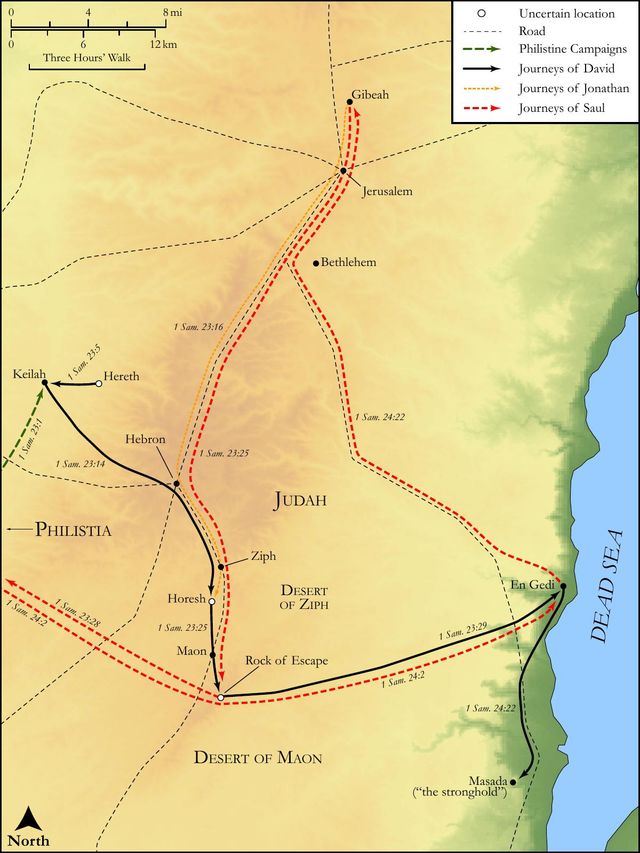
1 Samuel 23:25 vividly portrays a pivotal moment in King Saul's relentless and obsessive pursuit of David, the anointed future king of Israel. This verse details Saul's determined effort to track David and his men, David's strategic retreat into the rugged terrain of the wilderness of Maon upon receiving intelligence, and Saul's immediate, unyielding continuation of the chase into the very same desolate region. It underscores David's precarious existence as a fugitive, constantly on the move, yet subtly hints at the divine providence that would consistently deliver him from Saul's grasp.
Context
ShowHideLiterary Context
This verse is situated within a larger narrative arc (1 Samuel 19-26) that chronicles David's desperate flight from Saul's escalating jealousy and murderous intent. Specifically, it follows the treacherous betrayal by the Ziphites, who twice informed Saul of David's hiding places in their territory. David had just escaped Keilah and was moving through various strongholds in the wilderness. Verse 25 sets the stage for the dramatic climax of this particular chase, which culminates in David's miraculous escape at the "Rock of Escape" or "Sela Hammahlekoth" in 1 Samuel 23:26-28. The immediate narrative flow emphasizes Saul's unwavering obsession and David's constant need for vigilance and strategic movement to survive.
Historical & Cultural Context
The events unfold in the Judean wilderness, a region characterized by its harsh, arid landscape, deep wadis (valleys), caves, and rocky outcrops that provided natural hiding places for fugitives and outlaws. Maon was a town in the southern part of Judah, and its surrounding "wilderness" (Hebrew: midbar) was a desolate, uncultivated area, ideal for evading a large pursuing army. Saul, as king, commanded significant resources, including a standing army and a network of informants, as evidenced by the Ziphites' actions. David, though anointed, was a fugitive, relying on a small band of loyal followers and his wits. The cultural context includes the concept of a king's absolute authority and the severe consequences of perceived rebellion, even if unjust. Saul's actions also reflect the deep-seated paranoia that had gripped him, likely exacerbated by the evil spirit mentioned in 1 Samuel 16:14.
Key Themes
ShowHideThe verse powerfully contributes to several overarching themes in 1 Samuel. Relentless Persecution is vividly portrayed by Saul's unwavering pursuit, highlighting his deep-seated animosity and psychological torment, as seen in his repeated attempts to kill David (e.g., 1 Samuel 19:9-10). David's constant movement and reliance on "a rock" underscore his Vulnerability and Strategic Prudence, demonstrating his active efforts to evade capture while trusting in God. Most profoundly, though not explicitly stated in this single verse, the broader narrative of David's flight consistently points to Divine Providence and Protection. Despite overwhelming odds and Saul's vast resources, David repeatedly escapes, a testament to God's faithfulness to His chosen one, echoing themes found in psalms like Psalm 18:2 where God is called a "rock and fortress." This ongoing deliverance reinforces the theme of God's sovereign hand guiding the succession of kingship in Israel.
Exposition and Analysis
ShowHideKey Word Analysis
ShowHideThis primitive root signifies an active, intensive, and often deliberate search or inquiry, specifically "to search out (by any method, specifically in worship or prayer)." In this context, it emphasizes Saul's determined and focused effort to find David, indicating not a casual search but a relentless, almost obsessive hunt driven by a singular purpose. It highlights the king's personal involvement and the gravity of the pursuit.
This term refers to a craggy cliff, a large rock formation, or a natural stronghold, rather than a mere stone. David's choice to "come down into a rock" signifies his strategic use of the natural landscape for protection, seeking refuge in a place that offered natural fortification and concealment against a superior force. It speaks to the rugged, defensive topography of the Judean wilderness.
This word describes a pasture, an open field where cattle are driven, or by implication, a desert. It denotes an uncultivated, sparsely populated, often arid region, distinct from fertile land. David's abode in the "wilderness of Maon" underscores the desolate nature of his existence as a fugitive, highlighting the harsh environment he navigated while constantly on the run from Saul's relentless pursuit.
Verse Breakdown
ShowHide"Saul also and his men went to seek [him]."
This opening clause immediately establishes the primary antagonist and his objective. The phrase "Saul also" indicates his personal and unwavering commitment to the pursuit, suggesting a continuation of his obsessive hunt. The mention of "his men" implies a significant force, emphasizing the overwhelming odds against David and the king's vast resources dedicated to this singular goal. The verb "seek" conveys a deliberate, determined, and intense effort to locate and capture David.
"And they told David: wherefore he came down into a rock, and abode in the wilderness of Maon."
This segment reveals David's intelligence network, indicating he was not without sources of information regarding Saul's movements. Upon receiving this critical intel ("they told David"), he acts decisively and strategically. His movement "down into a rock" suggests seeking a defensible position, likely a cave or a natural fortress within the rugged terrain, to gain a tactical advantage or concealment. His "abode" (staying) in the wilderness of Maon signifies a temporary, chosen refuge in a desolate area, highlighting his transient and precarious existence as a fugitive.
"And when Saul heard [that], he pursued after David in the wilderness of Maon."
This final clause reiterates Saul's relentless nature. The phrase "when Saul heard [that]" indicates his immediate reaction to new information, showing his constant vigilance and readiness to continue the chase. The repetition of "pursued after David in the wilderness of Maon" emphasizes the intensity and geographical focus of the hunt, underscoring the cat-and-mouse game playing out in this specific, harsh landscape. It highlights Saul's unwavering determination to capture David, following him into the very stronghold David had chosen.
Literary Devices
ShowHideThe verse employs several literary devices to enhance its dramatic impact and thematic depth. Repetition is evident in the repeated mention of "the wilderness of Maon," which emphasizes the specific, harsh geographical setting where this intense pursuit takes place, reinforcing the idea of a prolonged, desperate chase. There is a subtle Irony in David's seeking refuge in "Maon," a name meaning "dwelling" or "habitation," while he is a homeless fugitive, constantly on the move due to Saul's hostility. The phrase "came down into a rock" serves as Foreshadowing for the miraculous escape that immediately follows in the narrative, where David is saved at "the Rock of Escape" (1 Samuel 23:26-28). This also creates a Contrast between Saul's overwhelming power and David's vulnerability, yet hints at David's strategic cunning and reliance on the natural environment for survival. The vivid description of Saul's pursuit and David's flight also contributes to a sense of Suspense, keeping the reader engaged in the outcome of this dangerous encounter.
Theological and Thematic Connections
ShowHide1 Samuel 23:25, though a brief snapshot, is profoundly theological in its implications, serving as a powerful testament to God's unwavering providence amidst human hostility. It illustrates the divine protection extended to God's anointed, even when human circumstances seem dire and overwhelming. David's ability to constantly evade Saul, despite the king's vast resources and relentless pursuit, is not merely a result of his own cunning but a clear demonstration of God's sovereign hand at work, preserving His chosen vessel for the future of Israel. This verse underscores the theme that God's plans cannot be thwarted by human opposition, no matter how powerful or persistent. It also highlights the spiritual battle underlying the physical conflict, where Saul's actions are driven by a spirit of paranoia and rebellion against God's will, while David's reliance on God, even in flight, exemplifies faith under duress.
Reflection and Application
ShowHideThis verse offers profound insights into enduring periods of intense pressure, unjust persecution, or relentless opposition in our own lives. Like David, we may find ourselves in situations where adversaries seem overwhelming, resources are scarce, and the path forward is unclear. David's response—receiving intelligence, acting prudently, and seeking refuge in a "rock"—serves as a model for navigating such trials. It teaches us that while we are called to exercise wisdom and utilize the resources available to us, our ultimate trust and security must rest in God's sovereign protection. The fact that David consistently survived Saul's determined efforts reminds us that God is faithful to His promises and will preserve His people, even in the most desperate circumstances. This passage encourages perseverance, reminding us that even in the wilderness, God provides a "dwelling" and a "rock" of refuge for those who trust in Him. It calls us to remain vigilant, discerning, and prayerfully responsive to God's leading, even when the path is fraught with danger.
Questions for Reflection
ShowHideFAQ
ShowHideWhy was Saul so obsessed with pursuing David?
ShowHideSaul's obsession stemmed from a complex mix of jealousy, paranoia, and a deep-seated fear of losing his kingdom. After God had rejected Saul as king and anointed David (1 Samuel 15:23 and 1 Samuel 16:13), an evil spirit tormented him (1 Samuel 16:14). David's popularity, military success, and divine favor were perceived by Saul as direct threats to his throne and legacy. This fear consumed him, leading to an irrational and relentless pursuit, viewing David not just as a rival but as an enemy of the state who must be eliminated.
How did David manage to know Saul's movements and evade him so consistently?
ShowHideDavid's consistent evasion of Saul was a combination of divine protection, his own strategic acumen, and an informal intelligence network. The text often states that "they told David" (as in 1 Samuel 23:25). This suggests he had loyal informants, perhaps sympathetic locals, or even spies within Saul's camp or among his own growing band of followers who kept him abreast of Saul's plans. Additionally, David's intimate knowledge of the rugged Judean wilderness, combined with his military experience, allowed him to choose defensible positions and move strategically, making him a difficult target for Saul's larger, less agile forces. Ultimately, the narrative attributes his survival to God's sovereign hand.
What is the significance of David seeking refuge in "a rock" in the wilderness of Maon?
ShowHideThe "rock" (Hebrew: sela') signifies a natural fortress, a craggy cliff, or a cave system common in the Judean wilderness. For David, it represented a strategic defensive position, offering concealment and a tactical advantage against a larger pursuing force. The wilderness of Maon, despite its name meaning "dwelling," was a desolate, rugged area, ideal for a fugitive seeking to evade capture. The significance lies in David's practical wisdom in utilizing the natural environment for protection, while simultaneously highlighting his vulnerable state as a man without a fixed home. The "rock" also foreshadows the dramatic escape at the "Rock of Escape" (1 Samuel 23:26-28), emphasizing God's consistent provision of refuge for His anointed, often through natural means.
Christ-Centered Fulfillment
ShowHideThe relentless pursuit of David by King Saul in 1 Samuel 23:25 serves as a profound Old Testament type, foreshadowing the unjust persecution and suffering of Jesus Christ. Just as Saul, the reigning king, sought to destroy David, God's anointed future king, so too did the religious and political authorities of Jesus's day relentlessly pursue and ultimately crucify the true King of Israel, the Lamb of God who takes away the sin of the world. David's flight into the wilderness and his reliance on "a rock" for refuge prefigures Christ's own periods of withdrawal into desolate places (Matthew 4:1) and His ultimate reliance on the Father's will and protection. While David found temporary refuge in physical rocks, Jesus is the ultimate spiritual Rock of our salvation, the cornerstone rejected by men but chosen by God. David's eventual deliverance and establishment as king, despite overwhelming odds, points to Christ's resurrection and ascension, where He was vindicated by God and seated at the right hand of the Father, reigning eternally over His kingdom, a kingdom that cannot be shaken by any earthly pursuit or opposition (Hebrews 12:28).