


1 Samuel 23:26
Bible text: King James Version (1769 Blayney text) · Public domain
Bible text: King James Version with Strong's numbers · Public domain
Bible text: Berean Standard Bible · Public domain
Bible text: American Standard Version (1901) · Public domain
Bible text: World English Bible, Messianic edition · Public domain
Bible text: Geneva Bible (1599) · Public domain
Bible text: Young's Literal Translation · Public domain
- וַיֵּלֶךְvai·Ye·lekhand he wentH1980Conj-w ¦ V-Qal-ConsecImperf-3msVerb Qal Consecutive Imperfect 3rd Singular Masculineוַandיֵּלֶךְhe went
- שָׁאוּלsha·'UlSaulH7586N-proper-mNoun Proper Masculine
- מִצַּדmi·Tzadfrom [the] side ofH6654Prep-m ¦ N-mscNoun Singular Masculine Constructמִfromצַּד[the] side of
- הָהָרha·Harthe mountainH2022Art ¦ N-msNoun Singular Masculine Absoluteהָtheהָרmountain
- מִזֶּהmi·Zehfrom thisH2088Prep-m ¦ PrtParticle Demonstrativeמִfromזֶּהthis
- וְדָוִדve·da·Vidand DavidH1732Conj-w ¦ N-proper-mNoun Proper MasculineוְandדָוִדDavid
- וַאֲנָשָׁיוva·'a·na·Shavand his menH582Conj-w ¦ N-mpc ¦ 3msNoun Plural Masculine Constructוַandאֲנָשָׁיmenוhis
- מִצַּדmi·Tzad[were] from [the] side ofH6654Prep-m ¦ N-mscNoun Singular Masculine Constructמִ[were] fromצַּד[the] side of
- הָהָרha·Harthe mountainH2022Art ¦ N-msNoun Singular Masculine Absoluteהָtheהָרmountain
- מִזֶּהmi·Zehfrom thisH2088Prep-m ¦ PrtParticle Demonstrativeמִfromזֶּהthis
- וַיְהִיvay·Hiand he wasH1961Conj-w ¦ V-Qal-ConsecImperf-3msVerb Qal Consecutive Imperfect 3rd Singular Masculineוַandיְהִיhe was
- דָוִדda·VidDavidH1732N-proper-mNoun Proper Masculine
- נֶחְפָּזnech·Pazhurrying awayH2648V-Niphal-Prtcpl-msVerb Niphal Participle Singular Masculine Absolute
- לָלֶכֶתla·Le·khetto goH1980Prep-l ¦ V-Qal-InfVerb Qal Infinitive Constructלָtoלֶכֶתgo
- מִפְּנֵיmi·pe·Neifrom beforeH6440Prep-m ¦ N-mpcNoun Plural Masculine Constructמִfromפְּנֵיbefore
- שָׁאוּלsha·'UlSaulH7586N-proper-mNoun Proper Masculine
- וְשָׁאוּלve·sha·'Uland SaulH7586Conj-w ¦ N-proper-mNoun Proper MasculineוְandשָׁאוּלSaul
- וַאֲנָשָׁיוva·'a·na·Shavand his menH582Conj-w ¦ N-mpc ¦ 3msNoun Plural Masculine Constructוַandאֲנָשָׁיmenוhis
- עֹטְרִים'o·te·Rim[were] surroundingH5849V-Qal-Prtcpl-mpVerb Qal Participle Plural Masculine Absolute
- אֶל'el<to>H413PrepPreposition
- דָּוִדda·VidDavidH1732N-proper-mNoun Proper Masculine
- וְאֶלve·'eland <to>H413Conj-w ¦ PrepPrepositionוְandאֶל<to>
- אֲנָשָׁיו'a·na·Shavhis menH582N-mpc ¦ 3msNoun Plural Masculine Constructאֲנָשָׁיmenוhis
- לְתָפְשָׂםle·ta·fe·Samto catch themH8610Prep-l ¦ V-Qal-Inf ¦ 3mpVerb Qal Infinitive Constructלְtoתָפְשָׂcatchםthem
English is a literal word-by-word gloss of the Hebrew, not the KJV's wording. Why?
This is the original text the KJV's translators worked from — each Hebrew word with its own literal English meaning in this verse, prepared by scholars at Tyndale House, Cambridge. The KJV translates whole sentences, not word by word, so its wording differs: one Hebrew word can become several English words, and the KJV may choose “the LORD” where the gloss reads “Yahweh”. Both are faithful — they answer different questions. For the KJV's own rendering, switch to the KJV text.
Details
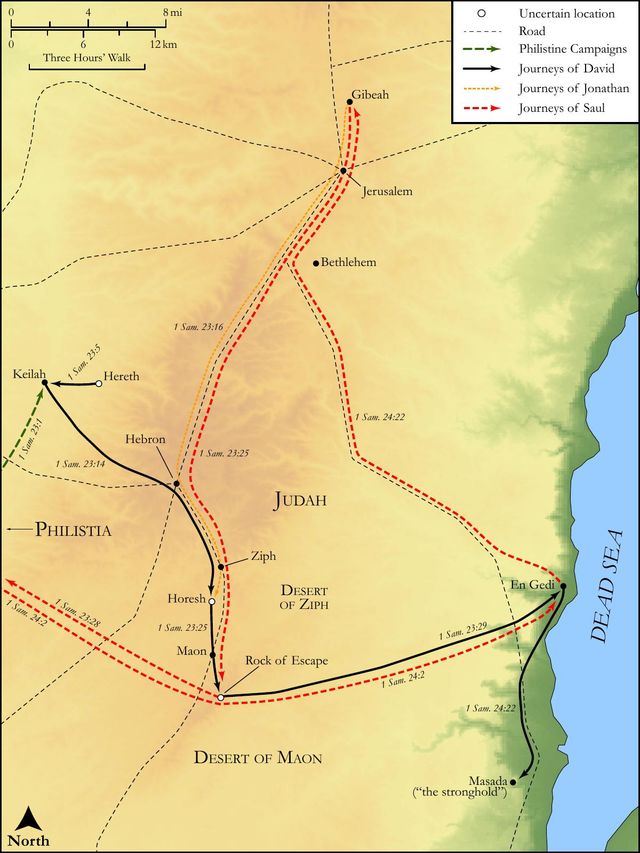
See on the biblical-era map
Study this verse
Public-domain commentary
Matthew Henry
From his Commentary on the Whole Bible. Henry comments on passages, not single verses — this entry covers 1 Samuel 23:19–29.
Here, 1. The Ziphites offer their service to Saul, to betray David to him, Sa1 23:19, Sa1 23:20. He was sheltering himself in the wilderness of Ziph (Sa1 23:14, Sa1 23:15), putting the more confidence in the people of that country because they were of his own tribe. They had reason to think themselves happy that they had an opportunity of serving one who was the ornament of their tribe and was likely to be much more so, who was so far from plundering the country, or giving it any disturbance with his troops, that he was ready to protect it and to them all the good offices that there was occasion for. But, to ingratiate themselves with Saul, they went to him, and not only informed him very particularly where David quartered (Sa1 23:19), but invited him to come with his forces into their country in pursuit of him, and promised to deliver him into his hand, Sa1 23:20. Saul had not sent to examine or threaten them, but of their own accord, and even without asking a reward (as Judas did - What will you give me?), they offered to betray David to him who, they knew, thirsted after his blood. 2. Saul thankfully receives their information, and gladly lays hold of the opportunity of hunting David in their wilderness, in hopes to make a prey of him at length. He intimates to them how kindly he took it (Sa1 23:21): Blessed be you of the Lord (so near is God to his mouth, though far from his heart), for you have compassion on me. It seems he looked upon himself as a miserable man and an object of pity; his own envy and ill-nature made him so, otherwise he might have been easy and have needed no man's compassion. He likewise insinuates the little concern that the generality of his people showed for him. "You have compassion on me, which others have not." Saul gives them instructions to search more particularly for his haunts (Sa1 23:22), "for" (says he) "I hear he deals very subtilely," representing him as a man crafty to do mischief, whereas all his subtlety was to secure himself. It was strange that Saul did not go down with them immediately, but he hoped by their means to set his game with the more certainty, and thus divine Providence gave David time to shift for himself. But the Ziphites had laid their spies upon all the places where he was likely to be discovered, and therefore Saul might come and seize him if he was in the land, Sa1 23:23. New he thought himself sure of his prey and pleased himself with the thoughts of devouring it. 3. The imminent peril that David was now brought into. Upon intelligence that the Ziphites had betrayed him, he retired from the hill of Hachilah to the wilderness of Maon (Sa1 23:24), and at this time he penned the 54th Psalm, as appears by the title, wherein he calls the Ziphites strangers, though they were Israelites, because they used him barbarously; but he puts himself under the divine protection: "Behold, God is my helper, and then all shall be well" Saul, having got intelligence of him, pursued him closely (Sa1 23:25), till he came so near him that there was but a mountain between them (Sa1 23:26), David and his men on one side of the mountain flying and Saul and his men on the other side pursuing, David in fear and Saul in hope. But this mountain was an emblem of the divine Providence coming between David and the destroyer, like the pillar of cloud between the Israelites and the Egyptians. David was concealed by this mountain and Saul confounded by it. David now flees as a bird to his mountain (Psa 11:1) and finds God to him as the shadow of a great rock. Saul hoped with his numerous forces to enclose David, and compass him in and his men; but the ground did not prove convenient for his design, and so it failed. A new name was given to the place in remembrance of this (Sa1 23:28): Selah-hammah-lekoth - the rock of division, because it divided between Saul and David. 4. The deliverance of David out of this danger. Providence gave Saul a diversion, when he was just ready to lay hold of David; notice was brought him that the Philistines were invading the land (Sa1 23:27), probably that part of the land where his own estate lay, which would be seized, or at least spoiled, by the invaders; for the little notice he took of Keilah's distress and David's relief of it, in the beginning of this chapter, gives us cause to suspect that he would not now have left pursuing David, and gone to oppose the Philistines, if some private interests of his own had not been at stake. However it was, he found himself under a necessity of going against the Philistines (Sa1 23:28), and by this means David was delivered when he was on the brink of destruction. Saul was disappointed of his prey, and God was glorified as David's wonderful protector. When the Philistines invaded the land they were far from intending any kindness to David by it, yet the overruling providence of God, which orders all events and the times of them, made it very serviceable to him. The wisdom of God is never at a loss for ways and means to preserve his people. As this Saul was diverted, so another Saul was converted, just then when he was breathing out threatenings and slaughter against the saints of the Lord, Act 9:1. 5. David, having thus escaped, took shelter in some natural fortresses, which he found in the wilderness of En-gedi, Sa1 23:29. And this Dr. Lightfoot thinks was the wilderness of Judah, in which David was when he penned Psa 63:1-11, which breathes as much pious and devout affection as almost any of his psalms; for in all places and in all conditions he still kept up his communion with God.
Historical interpretation
Four Centuries of Reception
2 surviving comments on this verse. Each one is dated, so this reads as a timeline rather than a list.
Select a marker to jump to its quote. Markers stagger vertically where authors wrote within a few decades of each other.
This is what happened to Paul. For the potency of the light suddenly surprised his feeble eyes and injured them. But the greatness of the voice brought low his strength and entered his ears and opened them.… For the voice did not plough up the ears, as the light injured the eyeballs. Why? But because it was necessary that he should hear but not see. Therefore the doors of hearing were opened by the voice as by a key: but the doors of sight were shut by the light that should open them. Why then was it necessary that he should hear? Clearly because by that voice our Lord was able to reveal himself as being persecuted by Saul. For he was not able to show himself by sight as being persecuted; for there was no way whereby this should be, that the son of David should be seen fleeing and Saul pursuing after him. For this happened in very deed with that first Saul and with the first David. The one was pursuing; the other was being persecuted; they both of them saw and were seen, each by the other. But here the ear alone could hear of the persecution of the Son of David; the eye could not see that he was being persecuted.
And so Saul and his men surrounded David like a crown, etc. For, with the Lord Savior protecting His faithful, very often those who, out of fear of God, did not want to act, were compelled by the consideration of human peace or some other advantage to cease from tearing them apart. Therefore, the faith of Christ, upon which His Church is built, rightly prevails against the gates of hell (Matthew XVI); it is called the dividing rock because it wonderfully defends His often despairing followers in the present and separates those who hope for future reward from the perpetual turmoil of men. Whether these things happened in modern times or are believed to happen in the future under the Antichrist, let the reader see and consider, not without tears, something worthy of tears, how much the state of the Church deteriorates daily to worse things, or to say it more mildly, to weaker deeds. The city of Nobe, due to receiving David with all his men, suffered martyrdom, which is to render good fruit through patience. Ceila, saved by David along with its citizens from the enemy, lost its savior because it did not fear to betray him at the imminent moment of persecution; and this is to receive the seed of the word with joy but immediately stumble when tribulation arises because of the word (Matthew XIII; Luke VIII). The Ziphites, upon discovering that David was staying nearby, not only did not invite him to themselves, but also volunteered to betray him, not to avoid danger, but to gain the friendship of Saul, plotting to track his ways and overthrow his steps; and these are those who, according to the recalled parable of the Lord, hear the word, but the worry of this age and the deceitfulness of riches choke the word, and it becomes unfruitful. I do not follow this reasoning as if I did not believe that even today there exist and will always exist many perfected in faith and truth; but because I see that, for the most part, the times are now approaching that were predicted long ago, in which, with iniquity abounding, the love of many will grow cold (Matthew XXIV). The title of the fifty-third Psalm, remembering the reading and betrayal by the Ziphites, is as follows: For the end, in songs, understanding of David, when the Ziphites came and said to Saul: "Is not David hidden among us?" Which, to explain briefly, denotes that the psalm is spoken in the end, in the person of Christ. For Christ is the end of the law for righteousness to everyone who believes (Romans X). In songs, in great distress, yet the Psalmist declares the same song with rejoicing according to the one who said: "But we also glory in tribulation" (Romans V). For it seems to me that the psalms inscribed in songs always declare the joy of the singer amidst adversities. The understanding of David shows that David, obsessed with anguish, but also unexpectedly delivered, understood that the body of the true David, of which he himself was a member, would suffer from the wicked, how great the grace of his Redeemer was, to be often delivered at present, and always crowned in the future. But what is said at the beginning of the same psalm: "O God, save me by your name, and in your strength, deliver me," is what David seeks in this reading, refuge in the rock. And for this reason, it is called the dividing rock because of the beginning of deliverance. For the fathers drank from the spiritual rock that followed them. And the rock was Christ.
Continue studying 1 Samuel 23:26 across the web’s major study libraries — every link below opens this exact verse, chapter, or book on the destination site.
Read & Compare
 BibleGatewayThis verse in more than 200 translations and 70 languages.
 Bible.comThe YouVersion reader — hundreds of translations, reading plans, and highlights.
 ESV.orgCrossway's official English Standard Version reader.
 NET BibleThe NET translation with 60,000+ translators' notes on every rendering decision.
 STEP BibleTyndale House's free study tool — original text, vocabulary, and scholarly resources.
 BibliaLogos Bible Software's free web reader.
 USCCBThe New American Bible (Revised Edition) with the U.S. bishops' study notes.
Commentaries
 BibleHub CommentariesDozens of classic commentaries on this verse, gathered on one page.
 StudyLightMore than 100 commentary sets — the largest collection on the web.
 BibleRefPlain-English commentary on what this verse means, verse by verse.
 Enduring WordDavid Guzik's free commentary on this chapter, widely used by Bible teachers.
 Bible Study ToolsVerse commentary alongside Greek and Hebrew study aids.
Original Language & Research
- BibleHub InterlinearThe verse word by word — original language, transliteration, and English.
- BibleHub LexiconEvery word's original-language definition and Strong's entry.
 Blue Letter BibleDeep-study tools — Strong's numbers, concordance, and word studies.
 SefariaThe Hebrew text with Rashi and centuries of Jewish commentary.
Sermons, Hymns & Audio


TrulyRandomVerse is not affiliated with these sites and doesn’t control their content. They’re linked because they’re genuinely useful.
Summary
1 Samuel 23:26 vividly portrays a moment of extreme peril for David, as King Saul's relentless pursuit culminates in a near-total encirclement in the wilderness. The verse dramatically depicts the physical proximity of the two parties, with Saul's forces strategically positioned to capture David and his men, forcing David into a desperate and urgent flight to escape the tightening net of his pursuer. This intense scene underscores David's vulnerability and the depth of Saul's obsession, setting the stage for a critical divine intervention.
Context
ShowHideLiterary Context
This verse is situated within a prolonged and intense period of persecution of David by King Saul, immediately following the Ziphites' betrayal of David's hiding place to Saul. The narrative in 1 Samuel 23 meticulously details David's strategic movements, his consistent inquiries of the Lord (e.g., 1 Samuel 23:2), and Saul's persistent tracking. Verse 26, specifically, marks the dramatic climax of this pursuit, depicting the physical closing in of Saul's forces after David had fled from Keilah and sought refuge first in the Wilderness of Ziph, and subsequently the Wilderness of Maon. The precise geographical detail of "this side of the mountain" and "that side of the mountain" powerfully emphasizes the immediate, almost tangible, proximity of the two camps, creating immense narrative tension that is resolved only by the sudden and providential divine diversion described in 1 Samuel 23:27.
Historical & Cultural Context
The relentless pursuit of David by Saul reflects the turbulent political and social dynamics of early Israelite monarchy. Saul, the first anointed king, viewed David, God's chosen successor, as an existential threat to his throne, a perception fueled by intense jealousy and a deteriorating mental and spiritual state (1 Samuel 16:14). The wilderness areas of Judah, such as Ziph and Maon, were rugged, sparsely populated regions characterized by caves and difficult terrain, making them ideal for hiding but also for ambushes. The concept of "compassing" or surrounding was a common military tactic employed to trap and eliminate an enemy, highlighting the existential threat David faced. Furthermore, the betrayal by the Ziphites (1 Samuel 23:19) underscores the precariousness of David's situation, where local loyalties could shift, placing him in constant danger and forcing him to rely solely on divine protection.
Key Themes
ShowHideThis verse powerfully contributes to several overarching themes in the book of Samuel. Firstly, it highlights the theme of Imminent Danger and Divine Deliverance, showing David at his most vulnerable, seemingly cornered, only to be miraculously rescued by God's providential intervention. Secondly, it further illustrates Saul's Obsessive and Irrational Pursuit, demonstrating the extent of his paranoia and his single-minded determination to destroy David, even at the expense of his kingly duties and the welfare of Israel. This contrasts sharply with David's consistent reliance on God's guidance and protection. Thirdly, the verse underscores Human Vulnerability and God's Sovereignty. Despite David's anointing and the divine promise of the throne, he is portrayed as a human experiencing genuine fear and desperation, emphasizing that even God's chosen ones face dire circumstances. Yet, God remains ultimately in control, orchestrating events for His purposes, as seen in the broader narrative of David's rise to power.
Exposition and Analysis
ShowHideKey Word Analysis
ShowHideThe Hebrew verb חָפַז (châphaz) means "to start up suddenly," implying "to hasten away" or "to fear" and "tremble." In this context, it denotes a strong sense of urgency and even panic on David's part. This is not a leisurely retreat but a desperate, rapid movement driven by the immediate and overwhelming threat of capture. It highlights David's human reaction to extreme danger, underscoring his vulnerability despite his divine calling.
The Hebrew verb עָטַר (ʻâṭar) means "to encircle (for attack or protection)" or "to crown." Here, it vividly describes the military maneuver of Saul's forces, indicating a complete encirclement of David and his men. This is not merely a pursuit but a tactical maneuver designed to cut off all escape routes, emphasizing the dire and seemingly inescapable predicament David faced. The word conveys a sense of being hemmed in, leaving no room for evasion and making the subsequent divine intervention all the more striking.
Verse Breakdown
ShowHide"And Saul went on this side of the mountain, and David and his men on that side of the mountain:"
This clause sets the immediate geographical scene, emphasizing the extreme proximity of Saul and David. They are separated only by a single mountain, indicating that they are within sight or hearing of each other, or at least in very close range. This physical closeness heightens the tension, illustrating how close David was to being apprehended. It also suggests a strategic positioning, with both parties keenly aware of the other's presence.
"and David made haste to get away for fear of Saul;"
This part of the verse reveals David's immediate reaction and motivation. His "haste" (from châphaz) is a direct, urgent response to the imminent threat posed by Saul. It underscores his genuine fear and the desperate urgency of his situation. Despite his faith and anointing, David is portrayed as a human being facing overwhelming odds, relying on swift movement for survival.
"for Saul and his men compassed David and his men round about to take them."
This final clause provides the explicit reason for David's haste and reveals the full extent of the danger. The word "compassed" (from ʻâṭar) confirms that Saul's forces had successfully encircled David's group, leaving them with no apparent escape route. The explicit purpose, "to take them," leaves no doubt about Saul's intention: capture and likely execution. This paints a picture of complete entrapment, making the subsequent divine intervention all the more miraculous.
Literary Devices
ShowHideThe verse employs several powerful literary devices to convey its dramatic intensity. Suspense is paramount, as the reader is brought to the precipice of David's capture, creating a palpable sense of dread and anticipation. The precise geographical detail of "this side... and that side of the mountain" contributes to this by creating a vivid, almost cinematic, image of the two parties closing in on each other, enhancing the immediate Proximity and the feeling of a net tightening. There is also an element of Irony, as Saul, the anointed king, is relentlessly pursuing the one whom God has chosen to replace him, a futile endeavor against divine decree. Furthermore, the verse serves as Foreshadowing, setting the stage for the miraculous divine intervention in the very next verse (1 Samuel 23:27), where a Philistine raid divers Saul, highlighting God's sovereign control over seemingly impossible circumstances.
Theological and Thematic Connections
ShowHide1 Samuel 23:26 stands as a powerful testament to the reality of divine protection amidst overwhelming human vulnerability. It illustrates that even those divinely chosen and promised a glorious future are not exempt from moments of extreme fear and peril. David's desperate flight and near-capture underscore the truth that God's deliverance often comes at the eleventh hour, not necessarily by removing the threat entirely, but by orchestrating circumstances in ways humanly unforeseen. This verse highlights God's faithfulness to His covenant promises, demonstrating His active involvement in the lives of His servants, even when their enemies seem to have the upper hand. It reminds believers that God's sovereignty is not a passive force but an active, intervening power that works all things for the good of those who love Him and are called according to His purpose.
Reflection and Application
ShowHide1 Samuel 23:26 offers profound insights for believers navigating their own seasons of intense pressure and perceived entrapment. Like David, we may find ourselves "compassed" by challenges—whether financial crises, relational conflicts, health struggles, or spiritual attacks—feeling cornered with no apparent escape. This verse validates the human experience of fear and desperation in such moments, reminding us that even great figures of faith experienced genuine vulnerability. Yet, it implicitly points to the God who is greater than our circumstances, who often allows us to reach the brink of despair so that His deliverance might be undeniably clear. It encourages us to persevere in faith, to "make haste" in seeking God's will and way out, and to trust that even when the net seems to be tightening, God remains sovereign, capable of orchestrating unexpected interventions. Our response in such times should be one of continued reliance on Him, knowing that He is our ultimate refuge and deliverer.
Questions for Reflection
ShowHideFAQ
ShowHideWhy was Saul so obsessed with pursuing David, even to this extreme extent?
ShowHideSaul's relentless obsession with David stemmed from a complex mix of jealousy, paranoia, and a deep-seated insecurity about his kingship. After David's victory over Goliath, the women's song, "Saul has slain his thousands, and David his ten thousands" (1 Samuel 18:7), ignited Saul's envy. This was compounded by the fact that God's Spirit had departed from Saul and come upon David (1 Samuel 16:13-14). Saul perceived David as a direct threat to his throne and legacy, believing that David was conspiring against him, despite David's repeated demonstrations of loyalty. His pursuit was not rational but driven by a spiritual and psychological torment that consumed him, leading him to prioritize eliminating David over all other kingly duties, even defending Israel from its enemies like the Philistines.
Christ-Centered Fulfillment
ShowHideThe dramatic scene of David's near-capture in 1 Samuel 23:26 powerfully foreshadows the ultimate "hunted" figure: Jesus Christ. David, God's anointed king-in-waiting, was relentlessly pursued by a jealous, insecure earthly king, mirroring how Jesus, the true King of Israel and the Son of God, was hunted by the religious and political authorities of His day, who perceived Him as a threat to their power and traditions (John 11:47-50). Just as David was "compassed round about to take them," Jesus was ultimately surrounded by His enemies, betrayed, and led to the cross, seemingly trapped and defeated (Matthew 26:47-50). However, David's deliverance in the wilderness, orchestrated by God through an external diversion, points to the greater deliverance and ultimate victory of Christ. While David was saved from physical capture to reign as king, Jesus willingly submitted to capture and death, not to be saved from it, but to achieve a far greater salvation for humanity—conquering sin and death itself (Hebrews 2:14-15). Thus, David's near-miss in the wilderness serves as a poignant type, pointing to the Lamb of God who takes away the sin of the world, who, though "compassed" by the forces of evil, ultimately triumphed, bringing eternal deliverance to all who believe.