


1 Samuel 23:2
Bible text: King James Version (1769 Blayney text) · Public domain
Bible text: King James Version with Strong's numbers · Public domain
Bible text: Berean Standard Bible · Public domain
Bible text: American Standard Version (1901) · Public domain
Bible text: World English Bible, Messianic edition · Public domain
Bible text: Geneva Bible (1599) · Public domain
Bible text: Young's Literal Translation · Public domain
- וַיִּשְׁאַלvai·yish·'Aland he enquiredH7592Conj-w ¦ V-Qal-ConsecImperf-3msVerb Qal Consecutive Imperfect 3rd Singular Masculineוַandיִּשְׁאַלhe enquired
- דָּוִדda·VidDavidH1732N-proper-mNoun Proper Masculine
- בַּיהוָהba·Yah·wehby YahwehH3068Prep-b ¦ N-properNoun Proper TitleבַּbyיהוָהYahweh
- לֵאמֹרle·Mor<to> sayingH559Prep-l ¦ V-Qal-InfVerb Qal Infinitive Constructלֵ<to>אמֹרsaying
- הַאֵלֵךְha·'e·Lekh¿ will I goH1980Interrog ¦ V-Qal-Imperf-1csVerb Qal Imperfect 1st Singular common genderהַ¿אֵלֵךְwill I go
- וְהִכֵּיתִיve·hi·Kei·tiand will I strike?H5221Conj-w ¦ V-Hiphil-ConsecPerf-1csVerb Hiphil Consecutive Perfect 1st Singular common genderוְandהִכֵּיתִיwill I strike?
- בַּפְּלִשְׁתִּיםba·pe·lish·Tim<in> the PhilistinesH6430Prep-b ¦ N-mpNoun Gentilic Plural Masculine Absoluteבַּ<in> theפְּלִשְׁתִּיםPhilistines
- הָאֵלֶּהha·'E·leh<the> theseH428Art ¦ PrtParticle Demonstrativeהָ<the>אֵלֶּהthese
- וַיֹּאמֶרvai·Yo·merand he saidH559Conj-w ¦ V-Qal-ConsecImperf-3msVerb Qal Consecutive Imperfect 3rd Singular Masculineוַandיֹּאמֶרhe said
- יְהוָהYah·wehYahwehH3068N-properNoun Proper Title
- אֶל'eltoH413PrepPreposition
- דָּוִדda·VidDavidH1732N-proper-mNoun Proper Masculine
- לֵךְlekhgoH1980V-Qal-Imp-2msVerb Qal Imperative 2nd Singular Masculine
- וְהִכִּיתָve·hi·Ki·taand you will strikeH5221Conj-w ¦ V-Hiphil-ConsecPerf-2msVerb Hiphil Consecutive Perfect 2nd Singular Masculineוְandהִכִּיתָyou will strike
- בַפְּלִשְׁתִּיםva·pe·lish·Tim<in> the PhilistinesH6430Prep-b ¦ N-mpNoun Gentilic Plural Masculine Absoluteבַ<in> theפְּלִשְׁתִּיםPhilistines
- וְהוֹשַׁעְתָּve·ho·sha'·Taand you will deliverH3467Conj-w ¦ V-Hiphil-ConsecPerf-2msVerb Hiphil Consecutive Perfect 2nd Singular Masculineוְandהוֹשַׁעְתָּyou will deliver
- אֶת'et<obj.>H853DirObjMParticle Object Indicator
- קְעִילָהke·'i·LahKeilahH7084N-properNoun Proper Location
English is a literal word-by-word gloss of the Hebrew, not the KJV's wording. Why?
This is the original text the KJV's translators worked from — each Hebrew word with its own literal English meaning in this verse, prepared by scholars at Tyndale House, Cambridge. The KJV translates whole sentences, not word by word, so its wording differs: one Hebrew word can become several English words, and the KJV may choose “the LORD” where the gloss reads “Yahweh”. Both are faithful — they answer different questions. For the KJV's own rendering, switch to the KJV text.
Details
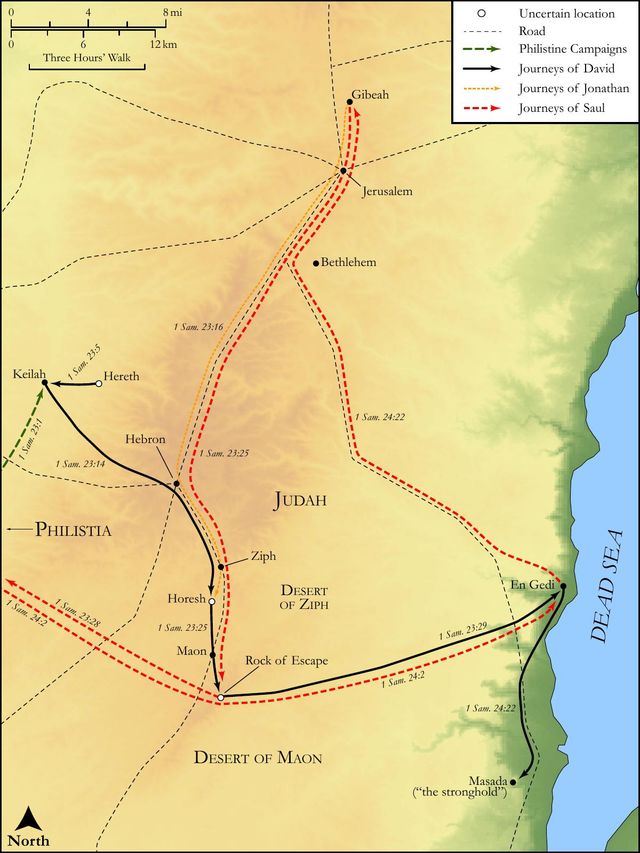
See on the biblical-era map
Study this verse
Public-domain commentary
Matthew Henry
From his Commentary on the Whole Bible. Henry comments on passages, not single verses — this entry covers 1 Samuel 23:1–6. His two-level outline is real structure in the source text, so it is rendered as structure.
Now we find why the prophet Gad (by divine direction, no doubt) ordered David to go into the land of Judah, Sa1 22:5. It was that, since Saul neglected the public safety, he might take care of it, notwithstanding the ill treatment that was given him; for he must render good for evil, and therein be a type of him who not only ventured his life, but laid down his life, for those that were his enemies.
I.Tidings are brought to David, as to the patron and protector of his country's liberties, that the Philistines had made a descent upon the city of Keilah and plundered the country thereabouts, Sa1 23:1. Probably it was the departure both of God and David from Saul that encouraged the Philistines to make this incursion. When princes begin to persecute God's people and ministers, let them expect no other than vexation on all sides. The way for any country to be quiet is to let God's church be quiet in it. If Saul fight against David, the Philistines shall fight against his country.
II.David is forward enough to come in for their relief, but is willing to enquire of the Lord concerning it. Here is an instance,
1.Of David's generosity and public-spiritedness. Though his head and hands were full of his own business, and he had enough to do, with the little force he had, to secure himself, yet he was concerned for the safety of his country and could not sit still to see that ravaged: nay, though Saul, whose business it was to guard the borders of his land, hated him and sought his life, yet he was willing, to the utmost of his power, to serve him and his interests against the common enemy, and bravely abhorred the thought of sacrificing the common welfare to his private revenge. Those are unlike to David who sullenly decline to do good because they have not been so well considered as they deserved for the services they have done.
2.Of David's piety and regard to God. He enquired of the Lord by the prophet Gad; for it should seem (by Sa1 23:6) that Abiathar came not to him with the ephod till he was in Keilah. His enquiry is, Shall I go and smite these Philistines? He enquires both concerning the duty (whether he might lawfully take Saul's work out of his hand, and act without a commission from him) and concerning the event, whether he might safely venture against such a force as the Philistines had with such a handful of men at his feet, and such a dangerous enemy as Saul was at his back. It is our duty, and will be our case and comfort, whatever happens, to acknowledge God in all our ways and to seek direction from him.
III.God appointed him once and again to go against the Philistines, and promised him success:
Go, and smite the Philistines, Sa1 23:2. His men opposed it, Sa1 23:3. No sooner did he begin to have soldiers of his own than he found it hard enough to manage them. They objected that they had enemies enough among their own countrymen, they needed not to make the Philistines their enemies. Their hearts failed them when they only apprehended themselves in danger from Saul's band of pursuers, much more when they came to engage the Philistine-armies. To satisfy them, therefore, he enquired of the Lord again, and now received, not only a full commission, which would warrant him to fight though he had no orders from Saul (Arise, go down to Keilah), but also a full assurance of victory: I will deliver the Philistines into thy hand, Sa1 23:4. This was enough to animate the greatest coward he had in his regiment.
IV.He went accordingly against the Philistines, routed them, and rescued Keilah, (Sa1 23:5), and it should seem he made a sally into the country of the Philistines, for he carried off their cattle by way of reprisal for the wrong they did to the men of Keilah in robbing their threshing-floors. Here notice is taken (Sa1 23:6) that it was while David remained in Keilah, after he had cleared it of the Philistines, that Abiathar came to him with the ephod in his hand, that is, the high priest's ephod, in which the urim and thummin were. It was a great comfort to David, in his banishment, that when he could not go to the house of God he had some of the choicest treasures of that house brought to him, the high priest and his breast-plate of judgment.
Historical interpretation
Historical reception
1 surviving comment on this verse from the historical church.
Shall I go and strike these Philistines? etc. Because David almost always in the Scriptures, when taken mystically, signifies the Lord Christ, but sometimes in his members, sometimes in himself; rightly at this place, where he consulted the Lord whether he should attack and conquer the enemies, it is understood to be referred to the person of his members, that is, his faithful ones, who sometimes, sorrowful over the known destruction of the faithless by those close to them, consulting the oracles of divine Scripture, inquire what should be done about these things. For also above, where it is announced to the same David that Keilah is being attacked by the Philistines, it can not unreasonably signify that any of the faithful often show the dangers of temptations in the world to equally more perfect faithful ones of Christ, perceiving that they themselves are not sufficient to overcome them. Indeed, those more perfect and strong-handed teachers of the Churches, immediately scrutinizing the testimonies of the Scriptures, find that they must have compassion and succor the oppressed, and by breaking the effort of the malign spirits, discover that the crowd suffering from long temptation is to be saved; but to the often fearful weaker ones due to imminent persecution, the reading of divine words, once consulted, promptly reveals that they should not fear those who kill the body (Matt. X), but rise from their sloth by doing the right, going to the oppressed by preaching useful things, and conquering the oppressors by exorcizing. For there are those who, under the threat of persecutions, scarcely dare to openly profess the faith with which they have been imbued; how much less do they presume to undertake the war against the legions of malign spirits by calling others to the faith or by solidifying them in the faith? And what does it signify, typically, when the men of David say to him: Behold, here in Judea we are afraid, how much more if we go to Keilah against the legions of the Philistines? unless it is the fearful response of the weak listeners to the spiritual teachers preparing themselves for the work of the word: Behold, within the domestic walls of the Church we fear to freely defend the confession of the paternal faith, which Judea signifies; how much more, if we go to those who have either never known the way of truth, or have deserted it having known it, instructing them with the word of salvation, shall we not unquestionably expose ourselves to greater dangers by beginning to challenge the powers of the air in battle? But the Lord does not omit to raise their weakness and fear by the frequent words of His Gospel, and to strengthen them with the confidence in prayer. And this is what follows: For I will deliver the Philistines into your hand. In the world you will have tribulation, but be of good cheer, I have overcome the world (John XVI).
Continue studying 1 Samuel 23:2 across the web’s major study libraries — every link below opens this exact verse, chapter, or book on the destination site.
Read & Compare
 BibleGatewayThis verse in more than 200 translations and 70 languages.
 Bible.comThe YouVersion reader — hundreds of translations, reading plans, and highlights.
 ESV.orgCrossway's official English Standard Version reader.
 NET BibleThe NET translation with 60,000+ translators' notes on every rendering decision.
 STEP BibleTyndale House's free study tool — original text, vocabulary, and scholarly resources.
 BibliaLogos Bible Software's free web reader.
 USCCBThe New American Bible (Revised Edition) with the U.S. bishops' study notes.
Commentaries
 BibleHub CommentariesDozens of classic commentaries on this verse, gathered on one page.
 StudyLightMore than 100 commentary sets — the largest collection on the web.
 BibleRefPlain-English commentary on what this verse means, verse by verse.
 Enduring WordDavid Guzik's free commentary on this chapter, widely used by Bible teachers.
 Bible Study ToolsVerse commentary alongside Greek and Hebrew study aids.
Original Language & Research
- BibleHub InterlinearThe verse word by word — original language, transliteration, and English.
- BibleHub LexiconEvery word's original-language definition and Strong's entry.
 Blue Letter BibleDeep-study tools — Strong's numbers, concordance, and word studies.
 SefariaThe Hebrew text with Rashi and centuries of Jewish commentary.
Sermons, Hymns & Audio


TrulyRandomVerse is not affiliated with these sites and doesn’t control their content. They’re linked because they’re genuinely useful.
Summary
1 Samuel 23:2 powerfully illustrates David's unwavering commitment to divine guidance amidst profound personal peril, revealing his character as a leader who consistently prioritizes God's will and the welfare of His people above self-preservation. Despite being a fugitive from King Saul, David consults the LORD regarding the Philistine threat to Keilah, receiving a clear command to intervene, which underscores God's active involvement in the affairs of His chosen servants and His profound compassion for Israel.
Context
ShowHideLiterary Context
This verse is situated during a tumultuous and pivotal period in David's life, following his anointing as king but preceding his actual enthronement. He is a fugitive, relentlessly pursued by King Saul, who views him as a rival to the throne. David has gathered a band of loyal followers (around 600 men by this point, as seen in the account of David's men) and is living in caves and strongholds, constantly on the move to evade Saul's forces. News reaches David that the Philistines, Israel's long-standing enemies, are attacking Keilah, a city in the territory of Judah, and plundering their threshing floors. This situation presents a profound dilemma for David: should he, an outlaw with limited resources, risk exposing himself and his men to come to the aid of his countrymen, or should he prioritize his own safety? His decision to inquire of the LORD in this verse initiates a sequence of events that further demonstrates his reliance on God and God's faithfulness to him, even as Saul continues his relentless pursuit in the subsequent verses of 1 Samuel 23.
Historical & Cultural Context
The Philistines were a formidable military power, occupying the southwestern coastal plain of Canaan and frequently encroaching upon Israelite territory. Their attacks on "threshing floors" were economically devastating, as these were vital communal areas where grain was separated from chaff, representing the very sustenance of the community. Keilah was a fortified city in the Shephelah region of Judah, a strategic location. The practice of "inquiring of the LORD" was a recognized means of seeking divine guidance in ancient Israel, often performed through a priest using the Urim and Thummim (sacred lots associated with the ephod) or through a prophet. This act signifies a formal, spiritual consultation, indicating a deep-seated belief in God's active involvement in human affairs and His willingness to provide direction. David's consistent adherence to this practice stands in stark contrast to King Saul's later abandonment of seeking God's will, as tragically depicted in Saul's failed inquiry.
Key Themes
ShowHideThis verse contributes significantly to several major themes within 1 Samuel and the broader biblical narrative. Firstly, it highlights Seeking Divine Guidance, portraying David as a leader who consistently prioritizes God's direction before making critical decisions, even when facing immediate danger. This contrasts sharply with Saul's increasingly self-reliant and disobedient reign. Secondly, it underscores God's Active Involvement and Sovereignty, as the LORD provides a direct, unambiguous answer, demonstrating His intimate concern for His people and His willingness to guide those who genuinely seek Him. Thirdly, the passage emphasizes Faith and Obedience, as David is prepared to act upon God's command despite the inherent risks of engaging the formidable Philistines and revealing his location to Saul. This act of faith demonstrates his trust in God's protection and provision. Finally, it powerfully illustrates God's Compassion for His People, as the command to "save Keilah" reveals God's desire for justice and deliverance from oppression, using David, even in his fugitive state, as an instrument of His salvation for the people of Judah. This foreshadows David's role as the divinely appointed king and shepherd of Israel, a theme that resonates throughout the book of 1 Samuel.
Exposition and Analysis
ShowHideKey Word Analysis
ShowHideThis verb signifies a formal, deliberate act of seeking counsel or an oracle, often in a spiritual context from a divine source. It implies a posture of dependence and submission to a higher authority. The root of this word is ironically the same as King Saul's name (Sha'ul), creating a subtle yet profound contrast: David consistently "inquires" of the LORD, while Saul, whose very name means "asked for," ultimately fails to seek God's will, leading to his downfall.
This is the covenant name of God, revealing Him as the self-existent, faithful, and personal God who keeps His promises. David's inquiry is not to a generic deity but to the specific God of Israel, with whom he has a personal relationship and who has made promises concerning his future kingship. God's direct response using this name reinforces His covenant faithfulness and active presence in David's life and the life of His people.
This verb means to deliver, to rescue, or to bring salvation. It implies intervention from a state of distress or danger. In this context, God commands David to "save Keilah," indicating His desire for the physical deliverance of His people from their oppressors. This word carries significant theological weight, pointing to God as the ultimate Deliverer and foreshadowing the greater salvation that would come through the Davidic line.
Verse Breakdown
ShowHide"Therefore David enquired of the LORD, saying, Shall I go and smite these Philistines?"
This opening clause highlights David's immediate and instinctive turn to God in a moment of crisis and moral dilemma. The "therefore" connects it to the news of Keilah's distress, indicating that David's first impulse was not self-preservation or strategic planning based on human wisdom, but rather seeking divine counsel. His question is direct and specific, reflecting a genuine desire for clear direction regarding a dangerous military undertaking. It demonstrates his recognition of God's sovereignty over military outcomes and his dependence on divine authorization.
"And the LORD said unto David, Go, and smite the Philistines, and save Keilah."
This second clause records God's swift, unambiguous, and affirmative response. The divine command is twofold: to "smite the Philistines" (a military offensive) and to "save Keilah" (a protective, redemptive act for His people). This demonstrates God's active involvement in the daily affairs of His people, His compassion for their suffering, and His willingness to empower David, even in his fugitive state, to act as His instrument of deliverance. The clarity of the command leaves no room for doubt, demanding immediate obedience.
Literary Devices
ShowHideThe passage effectively employs Contrast by juxtaposing David's consistent and earnest inquiry of the LORD with King Saul's increasing spiritual alienation and ultimate failure to seek God's will. This highlights David's character as a man after God's own heart, even in his outlaw status, and underscores the spiritual decline of Saul. The narrative also features clear Divine Dialogue, presenting a direct, unmediated communication between God and David, which emphasizes God's personal involvement and His accessibility to those who genuinely seek Him. Furthermore, there is an element of Foreshadowing in David's role as a deliverer of God's people from their enemies, which anticipates his future role as king and the ultimate deliverer, the Messiah, who would come from his lineage. The Irony of an outlaw acting more righteously and effectively for the welfare of Israel than the reigning king is also subtly present.
Theological and Thematic Connections
ShowHide1 Samuel 23:2 profoundly illustrates the indispensable nature of seeking divine guidance in all aspects of life, particularly when faced with significant decisions or moral dilemmas. It underscores God's character as a compassionate, sovereign, and communicative Lord who is intimately involved in the lives of His people and desires their well-being. David's example teaches that true leadership, even in its nascent and unconventional forms, is rooted in humble dependence on God's wisdom and authority, rather than human strength or strategic acumen. This passage affirms that God not only hears but also responds, providing clear direction to those who genuinely seek His will, thereby empowering them to act in faith for His purposes and the good of others.
Reflection and Application
ShowHideDavid's immediate turn to the LORD in 1 Samuel 23:2 offers a timeless blueprint for navigating life's complexities and crises. In an age where self-reliance and immediate gratification often dictate decisions, David's example calls us to pause, humble ourselves, and prioritize seeking God's counsel above all else. This isn't merely about asking for advice, but about a deep-seated trust that God's wisdom is superior to our own, and His plans are ultimately for our good and the good of those around us. Furthermore, the passage challenges us to consider our willingness to obey God's clear commands, even when they involve personal risk, inconvenience, or stepping outside our comfort zones, as David did in facing the Philistines and exposing himself to Saul's pursuit. Our faith is truly tested not just in seeking, but in the subsequent act of obedience, trusting that God will provide the necessary strength and protection to accomplish His purposes.
Questions for Reflection
ShowHideFAQ
ShowHideHow did David inquire of the LORD in this instance?
ShowHideWhile the specific method isn't explicitly detailed in this verse, the phrase "enquired of the LORD" typically refers to a formal consultation, most commonly through priestly means. In David's case, this would involve Abiathar, the priest who had joined him, utilizing the ephod which contained the Urim and Thummim (see Abiathar Brings the Ephod to David). These were sacred lots used to discern God's will by yielding a "yes" or "no" answer, or providing clear direction, as seen here. It was a recognized and legitimate way for the leader of Israel to receive divine oracle.
Why was Keilah important enough for David to risk his life and his men's lives?
ShowHideKeilah was a fortified city in the territory of Judah, David's own tribe. The Philistines were plundering its threshing floors, which meant they were destroying the city's food supply and livelihood, effectively starving the inhabitants. For David, even as a fugitive, the welfare of God's people was paramount. His willingness to defend Keilah demonstrated his commitment to his people and his future role as their shepherd-king, contrasting sharply with Saul's self-centered reign. It was an act of faith and compassion, trusting God to protect him even as he acted to protect others. This aligns with the broader narrative of David's heart for God's people.
What does this verse tell us about God's character?
ShowHideThis verse reveals several key aspects of God's character. Firstly, it shows His active involvement in human affairs and His compassion for the suffering of His people. He hears their cries (implied by the Philistine attack) and provides a means of deliverance. Secondly, it highlights His faithfulness to His chosen servants, like David, providing clear guidance and empowering them to fulfill His purposes. Thirdly, it underscores His sovereignty, as He directs human actions to achieve His will, even using an outlawed leader to bring salvation. God is not distant but intimately concerned and actively engaged in the lives of those who seek Him, as He promised in Jeremiah 29:13.
Christ-Centered Fulfillment
ShowHide1 Samuel 23:2, with David inquiring of the LORD and being sent to "save Keilah," powerfully foreshadows the ultimate Deliverer, Jesus Christ. David, though flawed, acts as a type of the Messiah, putting his life at risk to rescue God's people from their enemies. Just as David sought and received divine instruction to undertake a dangerous mission of salvation, so too did Jesus perfectly embody obedience to His Father's will. From the very beginning, Jesus' mission was to save his people from their sins. He consistently declared that His will was perfectly aligned with the Father's, stating, "For I have come down from heaven, not to do my own will but to do the will of him who sent me" (Jesus' Will is the Father's Will). Unlike David, who inquired and then obeyed, Jesus, as the Son, perfectly knew and perfectly executed the Father's redemptive plan, even to the point of death on a cross. He is the true Lamb of God, who takes away the sin of the world!, the one who learned obedience through what he suffered, ultimately accomplishing salvation not just for a city, but for all humanity, delivering us from the ultimate enemy, sin and death. His deliverance is eternal, securing us from the power of darkness and transferring us into the kingdom of His beloved Son (Colossians 1:13).