


1 Samuel 23:4
Bible text: King James Version (1769 Blayney text) · Public domain
Bible text: King James Version with Strong's numbers · Public domain
Bible text: Berean Standard Bible · Public domain
Bible text: American Standard Version (1901) · Public domain
Bible text: World English Bible, Messianic edition · Public domain
Bible text: Geneva Bible (1599) · Public domain
Bible text: Young's Literal Translation · Public domain
- וַיּוֹסֶףvai·Yo·sefand he repeatedH3254Conj-w ¦ V-Hiphil-ConsecImperf-3msVerb Hiphil Consecutive Imperfect 3rd Singular Masculineוַandיּוֹסֶףhe repeated
- עוֹדodagainH5750Adj-msAdjective Numerical Singular Masculine Absolute
- דָּוִדda·VidDavidH1732N-proper-mNoun Proper Masculine
- לִשְׁאֹלlish·'Olto enquireH7592Prep-l ¦ V-Qal-InfVerb Qal Infinitive Constructלִtoשְׁאֹלenquire
- בַּיהוָהba·Yah·wehby YahwehH3068Prep-b ¦ N-properNoun Proper TitleבַּbyיהוָהYahweh
- וַיַּעֲנֵהוּvai·ya·'a·Ne·huand he answered himH6030Conj-w ¦ V-Qal-ConsecImperf-3ms ¦ 3msVerb Qal Consecutive Imperfect 3rd Singular Masculineוַandיַּעֲנֵhe answeredהוּhim
- יְהוָהYah·wehYahwehH3068N-properNoun Proper Title
- וַיֹּאמֶרvai·Yo·merand he saidH559Conj-w ¦ V-Qal-ConsecImperf-3msVerb Qal Consecutive Imperfect 3rd Singular Masculineוַandיֹּאמֶרhe said
- קוּםkumariseH6965V-Qal-Imp-2msVerb Qal Imperative 2nd Singular Masculine
- רֵדredgo downH3381V-Qal-Imp-2msVerb Qal Imperative 2nd Singular Masculine
- קְעִילָהke·'i·LahKeilahH7084N-properNoun Proper Location
- כִּיkiforH3588PrtParticle Conditional
- אֲנִי'a·NiIH589Pro-1csPronoun Personal 1st Singular common gender
- נֹתֵןno·Ten[am] about to giveH5414V-Qal-Prtcpl-msVerb Qal Participle Singular Masculine Absolute
- אֶת'et<obj.>H853DirObjMParticle Object Indicator
- פְּלִשְׁתִּיםpe·lish·Tim[the] PhilistinesH6430N-mpNoun Gentilic Plural Masculine Absolute
- בְּיָדֶךָbe·ya·De·khain your handH3027Prep-b ¦ N-csc ¦ 2msNoun Singular common gender Constructבְּinיָדֶhandךָyour
English is a literal word-by-word gloss of the Hebrew, not the KJV's wording. Why?
This is the original text the KJV's translators worked from — each Hebrew word with its own literal English meaning in this verse, prepared by scholars at Tyndale House, Cambridge. The KJV translates whole sentences, not word by word, so its wording differs: one Hebrew word can become several English words, and the KJV may choose “the LORD” where the gloss reads “Yahweh”. Both are faithful — they answer different questions. For the KJV's own rendering, switch to the KJV text.
Details
See on the biblical-era map
Study this verse
Public-domain commentary
Matthew Henry
From his Commentary on the Whole Bible. Henry comments on passages, not single verses — this entry covers 1 Samuel 23:1–6. His two-level outline is real structure in the source text, so it is rendered as structure.
Now we find why the prophet Gad (by divine direction, no doubt) ordered David to go into the land of Judah, Sa1 22:5. It was that, since Saul neglected the public safety, he might take care of it, notwithstanding the ill treatment that was given him; for he must render good for evil, and therein be a type of him who not only ventured his life, but laid down his life, for those that were his enemies.
I.Tidings are brought to David, as to the patron and protector of his country's liberties, that the Philistines had made a descent upon the city of Keilah and plundered the country thereabouts, Sa1 23:1. Probably it was the departure both of God and David from Saul that encouraged the Philistines to make this incursion. When princes begin to persecute God's people and ministers, let them expect no other than vexation on all sides. The way for any country to be quiet is to let God's church be quiet in it. If Saul fight against David, the Philistines shall fight against his country.
II.David is forward enough to come in for their relief, but is willing to enquire of the Lord concerning it. Here is an instance,
1.Of David's generosity and public-spiritedness. Though his head and hands were full of his own business, and he had enough to do, with the little force he had, to secure himself, yet he was concerned for the safety of his country and could not sit still to see that ravaged: nay, though Saul, whose business it was to guard the borders of his land, hated him and sought his life, yet he was willing, to the utmost of his power, to serve him and his interests against the common enemy, and bravely abhorred the thought of sacrificing the common welfare to his private revenge. Those are unlike to David who sullenly decline to do good because they have not been so well considered as they deserved for the services they have done.
2.Of David's piety and regard to God. He enquired of the Lord by the prophet Gad; for it should seem (by Sa1 23:6) that Abiathar came not to him with the ephod till he was in Keilah. His enquiry is, Shall I go and smite these Philistines? He enquires both concerning the duty (whether he might lawfully take Saul's work out of his hand, and act without a commission from him) and concerning the event, whether he might safely venture against such a force as the Philistines had with such a handful of men at his feet, and such a dangerous enemy as Saul was at his back. It is our duty, and will be our case and comfort, whatever happens, to acknowledge God in all our ways and to seek direction from him.
III.God appointed him once and again to go against the Philistines, and promised him success:
Go, and smite the Philistines, Sa1 23:2. His men opposed it, Sa1 23:3. No sooner did he begin to have soldiers of his own than he found it hard enough to manage them. They objected that they had enemies enough among their own countrymen, they needed not to make the Philistines their enemies. Their hearts failed them when they only apprehended themselves in danger from Saul's band of pursuers, much more when they came to engage the Philistine-armies. To satisfy them, therefore, he enquired of the Lord again, and now received, not only a full commission, which would warrant him to fight though he had no orders from Saul (Arise, go down to Keilah), but also a full assurance of victory: I will deliver the Philistines into thy hand, Sa1 23:4. This was enough to animate the greatest coward he had in his regiment.
IV.He went accordingly against the Philistines, routed them, and rescued Keilah, (Sa1 23:5), and it should seem he made a sally into the country of the Philistines, for he carried off their cattle by way of reprisal for the wrong they did to the men of Keilah in robbing their threshing-floors. Here notice is taken (Sa1 23:6) that it was while David remained in Keilah, after he had cleared it of the Philistines, that Abiathar came to him with the ephod in his hand, that is, the high priest's ephod, in which the urim and thummin were. It was a great comfort to David, in his banishment, that when he could not go to the house of God he had some of the choicest treasures of that house brought to him, the high priest and his breast-plate of judgment.
Continue studying 1 Samuel 23:4 across the web’s major study libraries — every link below opens this exact verse, chapter, or book on the destination site.
Read & Compare
 BibleGatewayThis verse in more than 200 translations and 70 languages.
 Bible.comThe YouVersion reader — hundreds of translations, reading plans, and highlights.
 ESV.orgCrossway's official English Standard Version reader.
 NET BibleThe NET translation with 60,000+ translators' notes on every rendering decision.
 STEP BibleTyndale House's free study tool — original text, vocabulary, and scholarly resources.
 BibliaLogos Bible Software's free web reader.
 USCCBThe New American Bible (Revised Edition) with the U.S. bishops' study notes.
Commentaries
 BibleHub CommentariesDozens of classic commentaries on this verse, gathered on one page.
 StudyLightMore than 100 commentary sets — the largest collection on the web.
 BibleRefPlain-English commentary on what this verse means, verse by verse.
 Enduring WordDavid Guzik's free commentary on this chapter, widely used by Bible teachers.
 Bible Study ToolsVerse commentary alongside Greek and Hebrew study aids.
Original Language & Research
- BibleHub InterlinearThe verse word by word — original language, transliteration, and English.
- BibleHub LexiconEvery word's original-language definition and Strong's entry.
 Blue Letter BibleDeep-study tools — Strong's numbers, concordance, and word studies.
 SefariaThe Hebrew text with Rashi and centuries of Jewish commentary.
Sermons, Hymns & Audio


TrulyRandomVerse is not affiliated with these sites and doesn’t control their content. They’re linked because they’re genuinely useful.
Summary
Amidst the perilous life of an outlaw, David, though pursued by King Saul, exemplifies profound spiritual leadership by persistently seeking the Lord's divine counsel regarding the Philistine attack on Keilah. This pivotal verse records God's clear and affirmative response, commanding David to proceed to Keilah with an unwavering promise of victory, assuring him that the Philistines would be decisively delivered into his hand, thereby transforming a dangerous military venture into a divinely commissioned and guaranteed triumph.
Context
ShowHideLiterary Context
The narrative of 1 Samuel 23 opens with David, now a fugitive from King Saul's relentless pursuit, receiving news of the Philistines' aggression against the Judean city of Keilah, specifically plundering its threshing floors. This direct attack on a city within Judah, David's own people, immediately stirs him to action. Prior to this verse, David had already inquired of the LORD about intervening in Keilah (1 Samuel 23:2). However, his men, understandably fearful of both Saul's ongoing vendetta and the formidable Philistine threat, expressed significant apprehension, as detailed in 1 Samuel 23:3. This collective doubt and reluctance among his followers prompted David to seek divine counsel "yet again," not out of personal uncertainty, but likely to solidify the conviction of his men and ensure unified, God-ordained action, demonstrating his pastoral leadership.
Historical & Cultural Context
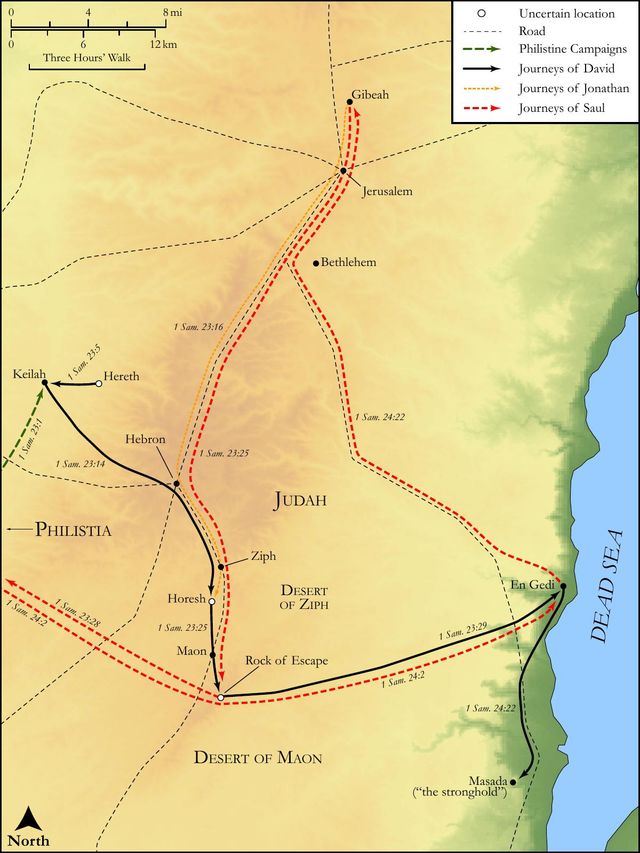
At this point in his life, David is living as an anointed but unrecognized king, an outlaw constantly fleeing the jealous and paranoid King Saul. Keilah itself was a fortified city situated in the Shephelah, a strategic lowlands region that served as a buffer zone between the Judean hills and the Philistine coastal plain. Its location made it particularly vulnerable to Philistine raids, which were common occurrences as they sought to plunder resources and assert dominance over Israelite territory. The Philistines were a long-standing and formidable enemy of Israel, often possessing superior military technology. David's decision to defend Keilah, despite his own precarious position and lack of official authority, highlights his unwavering commitment to protecting God's people, even when it put him at immense personal risk. His repeated inquiry of the Lord almost certainly involved the use of the ephod with the Urim and Thummim, sacred objects brought by Abiathar the priest (1 Samuel 22:20-23), which served as a recognized means of seeking direct divine oracle in ancient Israel.
Key Themes
ShowHideThis verse powerfully illustrates several enduring themes woven throughout the book of 1 Samuel and the broader biblical narrative. David's persistent inquiry highlights the theme of Persistent Prayer and Divine Guidance, showcasing a leader who consistently prioritizes God's will above personal safety, human logic, or the fears of his followers. The Lord's direct and unequivocal response, "Arise, go down to Keilah; for I will deliver the Philistines into thine hand," strongly emphasizes God's Active Sovereignty and Intervention in the affairs of His people and His chosen servant. This divine promise of victory, despite the overwhelming odds and human apprehension, underscores the theme of Divine Promise and Deliverance, transforming a risky military endeavor into a divinely guaranteed success. Furthermore, David's subsequent obedience, despite the fears of his men, exemplifies Faith and Obedience in the Face of Adversity, a hallmark of his spiritual character and a recurring motif in his journey towards kingship, echoing his earlier courageous victory over Goliath in 1 Samuel 17.
Exposition and Analysis
ShowHideKey Word Analysis
ShowHideThis verb (H7592) signifies more than a casual question; it denotes a formal, earnest, and often solemn seeking of divine counsel, typically through priestly means such as the Urim and Thummim (as David likely utilized via Abiathar, the priest who joined him earlier). It implies a deep spiritual discipline, a profound recognition of God's ultimate authority, and a humble dependence on His wisdom in guiding human affairs, especially in matters of life and death or national significance. David's repeated use of this action underscores his consistent reliance on God.
The verb "natan" (H5414) means "to give," "to place," or "to put." In this context, it carries the strong connotation of "delivering into the hand," signifying a complete and decisive victory where the enemy is utterly defeated and brought under the control of the victor. It is a divine assurance of success, indicating that God Himself will actively orchestrate the defeat of the Philistines and hand them over to David. This is not merely permission to fight, but a promise of certain, divinely accomplished triumph.
This common Hebrew noun (H3027) refers to the physical hand, but it is used with immense figurative latitude to denote power, authority, control, possession, and means. When God promises to "deliver the Philistines into thine hand," it signifies a complete transfer of power and control. David will not merely fight the Philistines; he will possess them, having absolute dominion over them as a result of God's direct intervention. It emphasizes the totality of the promised victory and David's divinely appointed authority in this specific mission.
Verse Breakdown
ShowHide"Then David enquired of the LORD yet again."
This clause highlights David's persistent and unwavering commitment to seeking divine guidance. The phrase "yet again" is crucial, emphasizing that this was not his first inquiry regarding Keilah, but a renewed plea, likely prompted by the fear and reluctance of his men (1 Samuel 23:3). It underscores David's spiritual maturity and his pastoral concern for his followers, prioritizing God's confirmed will over human apprehension or logical expediency.
"And the LORD answered him and said,"
This signifies the immediacy, clarity, and personal nature of God's communication. The Lord's response is direct and unambiguous, demonstrating His active involvement in David's life and His willingness to guide His faithful servants. This direct answer validates David's persistent seeking and provides the necessary assurance and conviction for him and his men to proceed.
"Arise, go down to Keilah;"
This is a direct divine command, providing specific, actionable instruction for David's next course of action. "Arise" implies immediate and decisive movement, while "go down" indicates the geographical descent from David's current hiding place in the wilderness to the city of Keilah. This command removes all doubt about the legitimacy and divine approval of the mission, giving David the authority he needs to lead.
"for I will deliver the Philistines into thine hand."
This is the crucial divine promise of victory, the ultimate assurance that undergirds the command. God Himself guarantees the outcome, taking full responsibility for the success of the mission. This promise transforms a perilous military venture into a divinely ordained and guaranteed triumph, providing immense encouragement, confidence, and courage to David and his fearful men, assuring them that the battle is the Lord's.
Literary Devices
ShowHideThe passage employs several potent literary devices to convey its profound message. The Repetition of David "enquiring of the LORD" (first in 1 Samuel 23:2 and then "yet again" in this verse) powerfully highlights David's consistent spiritual discipline, his unwavering reliance on divine guidance, and his patient leadership in the face of human doubt, serving as a compelling model for the reader. The Lord's response functions as a Divine Oracle, a direct, authoritative communication from God, which carries absolute weight, truth, and certainty. This oracle is also a significant form of Foreshadowing, as God's promise to "deliver the Philistines into thine hand" not only guarantees immediate victory at Keilah but also subtly points forward to David's future role as king, where he would consistently defeat Israel's enemies, including the Philistines, establishing peace and security for the nation under God's sovereign hand.
Theological and Thematic Connections
ShowHideThis verse profoundly illustrates the principle of divine guidance and intervention in the lives of God's servants. David's persistent and humble inquiry, even when facing fear and opposition from his own men, underscores the paramount importance of seeking God's will above all else, especially in times of crisis. God's immediate, clear, and unequivocal response demonstrates His active sovereignty, His intimate involvement in the affairs of His people, and His unwavering faithfulness to those who trust in Him. The promise of deliverance is not merely a military advantage but a profound theological statement of God's covenant loyalty and His commitment to protect His people, even through unconventional means and through His chosen, though imperfect, instruments. This narrative reinforces the enduring truth that true leadership, particularly in moments of great peril, is rooted in absolute dependence on God's wisdom and power, rather than solely on human strength, strategic prowess, or popular opinion.
Reflection and Application
ShowHideDavid's example in 1 Samuel 23:4 offers timeless lessons for believers navigating the complexities and uncertainties of life. In moments of doubt, fear, or when confronted with decisions that seem fraught with peril and opposition, our first and repeated impulse should be to "enquire of the LORD." This is not a sign of weakness or indecision, but rather of profound spiritual strength, humility, and wisdom, acknowledging God's ultimate sovereignty and perfect plan. Even when our circumstances appear illogical, or when those around us express apprehension and doubt, God's clear word, once received, provides the necessary conviction, courage, and direction to move forward. This passage profoundly encourages us to cultivate a habit of persistent prayer, patient waiting, and unwavering reliance on God's guidance, trusting that when He commands, He also empowers, provides, and ultimately ensures the means for victory, transforming our greatest challenges into powerful opportunities for His glory and the advancement of His purposes.
Questions for Reflection
ShowHideFAQ
ShowHideWhy did David inquire of the LORD "yet again" if he had already received an answer?
ShowHideDavid had indeed inquired of the Lord previously in 1 Samuel 23:2, and God had explicitly told him to go to Keilah. However, 1 Samuel 23:3 reveals that David's men were deeply fearful and expressed their apprehension, saying, "Behold, we be afraid here in Judah: how much more then if we come to Keilah against the armies of the Philistines?" Their fear and reluctance likely caused David, as a wise and pastoral leader, to seek a second, confirming word from the Lord. This was not due to David's personal doubt, but rather a strategic and compassionate act to reassure his fearful followers, solidify their conviction, and unite them in a divinely sanctioned mission. It demonstrates David's wisdom in leadership, ensuring that his men were convinced of God's will before leading them into a dangerous situation.
How did David "enquire of the LORD"?
ShowHideIn the Old Testament, "enquiring of the LORD" often involved specific priestly means and sacred instruments. David had Abiathar the priest with him, who had brought the ephod (a priestly garment) when he fled to David (1 Samuel 22:20-23). The ephod typically contained the Urim and Thummim, two objects used for discerning God's will, often by casting lots to receive a "yes" or "no" answer, or through direct divine revelation in response to specific questions. While the exact method is not detailed in this verse, it is highly probable that David sought God's counsel through Abiathar using these sacred instruments, which provided a clear and authoritative verbal response from God, as explicitly stated in this verse.
What is the significance of God's direct promise, "I will deliver the Philistines into thine hand"?
ShowHideThis direct promise is profoundly significant and transformative. It elevates a potentially suicidal military venture into a divinely guaranteed triumph. It signifies God's active involvement, sovereign power, and personal commitment, assuring David that the victory would not be by his own strength, military prowess, or strategic genius, but by God's direct and decisive intervention. This promise serves as an immense source of encouragement and confidence for David and his men, validating their obedience and providing the necessary faith to confront a formidable enemy. It underscores God's faithfulness to His chosen servant and His unwavering commitment to protect His people from their enemies, a recurring theme throughout Israel's history, as seen in the victories granted to Joshua in Joshua 10:8 and the ultimate deliverance of Israel from Egypt's hand.
Christ-Centered Fulfillment
ShowHide1 Samuel 23:4, with its depiction of David's persistent reliance on divine guidance and God's powerful promise of deliverance, finds its ultimate and perfect fulfillment in Jesus Christ. David, though a man after God's own heart, was a flawed and imperfect deliverer, continually seeking God's will to lead Israel to victory over their physical enemies. Christ, however, is the perfect Son who always did the will of the Father, declaring, "I always do what pleases him" (John 8:29). Where David received promises of physical deliverance from earthly foes, Christ embodies the ultimate spiritual deliverance, triumphing decisively over sin, death, and the principalities and powers of darkness through His sacrificial death on the cross and His glorious resurrection (Colossians 2:15). The assurance, "I will deliver the Philistines into thine hand," foreshadows the far greater victory Christ won for all humanity, delivering us from the hand of our greatest adversary, Satan, and freeing us from the bondage of fear and death (Hebrews 2:14-15). Believers, empowered by the Holy Spirit, are now called to follow the perfect example of Christ, who perfectly submitted to the Father's will, and through Him, we too receive spiritual guidance and participate in His ongoing victory over the forces of evil, knowing that "in all these things we are more than conquerors through him who loved us" (Romans 8:37).