


1 Samuel 28:6
Bible text: King James Version (1769 Blayney text) · Public domain
Bible text: Berean Standard Bible · Public domain
Bible text: American Standard Version (1901) · Public domain
Bible text: World English Bible, Messianic edition · Public domain
Bible text: Geneva Bible (1599) · Public domain
Bible text: Young's Literal Translation · Public domain
- וַיִּשְׁאַלvai·yish·'Aland he enquiredH7592Conj-w ¦ V-Qal-ConsecImperf-3msVerb Qal Consecutive Imperfect 3rd Singular Masculineוַandיִּשְׁאַלhe enquired
- שָׁאוּלsha·'UlSaulH7586N-proper-mNoun Proper Masculine
- בַּיהוָהba·Yah·wehby YahwehH3068Prep-b ¦ N-properNoun Proper TitleבַּbyיהוָהYahweh
- וְלֹאve·Lo'and notH3808Conj-w ¦ NegParticle Negativeוְandלֹאnot
- עָנָהוּ'a·Na·huhe answered himH6030V-Qal-Perf-3ms ¦ 3msVerb Qal Perfect 3rd Singular Masculineעָנָhe answeredהוּhim
- יְהוָהYah·wehYahwehH3068N-properNoun Proper Title
- גַּםgamneitherH1571AdvAdverb
- בַּחֲלֹמוֹתba·cha·lo·Motby <the> dreamsH2472Prep-b ¦ N-fpNoun Plural Feminine Absoluteבַּby <the>חֲלֹמוֹתdreams
- גַּםgamnorH1571AdvAdverb
- בָּאוּרִיםba·'u·Rimby <the> UrimH224Prep-b ¦ N-mpNoun Title Plural Masculine Absoluteבָּby <the>אוּרִיםUrim
- גַּםgamnorH1571AdvAdverb
- בַּנְּבִיאִםba·ne·vi·'Imby <the> prophetsH5030Prep-b ¦ N-mpNoun Plural Masculine Absoluteבַּby <the>נְּבִיאִםprophets
English is a literal word-by-word gloss of the Hebrew, not the KJV's wording. Why?
This is the original text the KJV's translators worked from — each Hebrew word with its own literal English meaning in this verse, prepared by scholars at Tyndale House, Cambridge. The KJV translates whole sentences, not word by word, so its wording differs: one Hebrew word can become several English words, and the KJV may choose “the LORD” where the gloss reads “Yahweh”. Both are faithful — they answer different questions. For the KJV's own rendering, switch to the KJV text.
Details
See on the biblical-era map
Study this verse
Public-domain commentary
Matthew Henry
From his Commentary on the Whole Bible. Henry comments on passages, not single verses — this entry covers 1 Samuel 28:1–6. His two-level outline is real structure in the source text, so it is rendered as structure.
Here is, I. The design of the Philistines against Israel. They resolved to fight them, Sa1 28:1. If the Israelites had not forsaken God, there would have been no Philistines remaining to molest them; if Saul had not forsaken him, they would by this time have been put out of all danger by them. The Philistines took an opportunity to make this attempt when they had David among them, whom they feared more than Saul and all his forces.
II.The expectation Achish had of assistance from David in this war, and the encouragement David gave him to expect it:
"Thou shalt go with me to battle," says Achish. "If I protect thee, I may demand service from thee;" and he will think himself happy if he may have such a man as David on his side, who prospered whithersoever he went. David gave him an ambiguous answer: "We will see what will be done; it will be time enough to talk of that hereafter; but surely thou shalt know what thy servant can do" (Sa1 28:2), that is, "I will consider in what post I may be best able to serve thee, if thou wilt but give me leave to choose it." Thus he keeps himself free from a promise to serve him and yet keeps up his expectation of it; for Achish took it in no other sense than as an engagement to assist him, and promised him, thereupon, that he would make him captain of the guards, protector, or prime-minister of state.
III.The drawing of the armies, on both sides, into the field (Sa1 28:4):
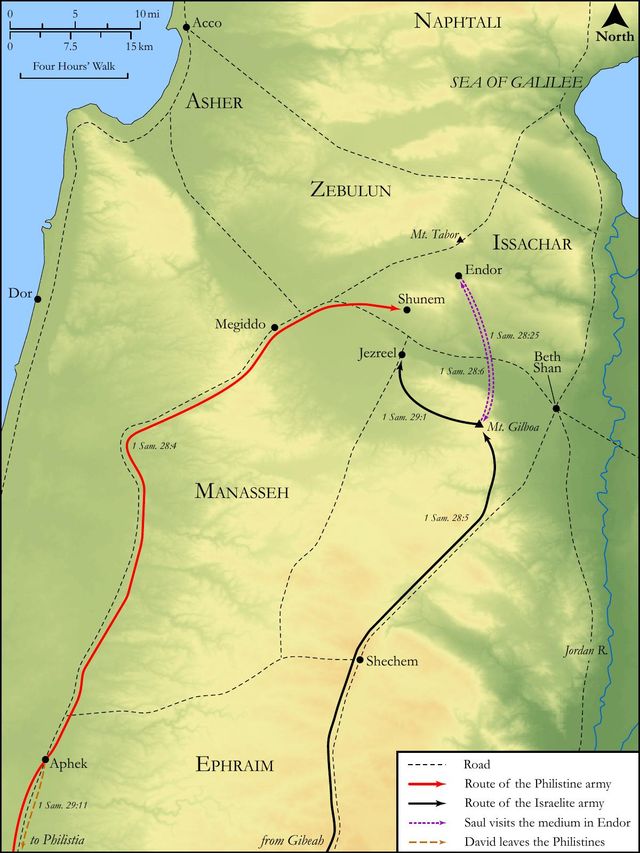
The Philistines pitched in Shunem, which was in the tribe of Issachar, a great way north from their country. The land of Israel, it seems, was ill-guarded, when the Philistines could march their army into the very heart of the country. Saul, while he pursued David, left his people naked and exposed. On some of the adjacent mountains of Gilboa Saul mustered his forces, and prepared to engage the Philistines, which he had little heart to do now that the Spirit of the Lord had departed from him.
IV.The terror Saul was in, and the loss he was at, upon this occasion:
He saw the host of the Philistines, and by his own view of them, and the intelligence his spies brought him, he perceived they were more numerous, better armed, and in better heart, than his own were, which made him afraid, so that his heart greatly trembled, Sa1 28:5. Had he kept close to God, he needed not have been afraid at the sight of an army of Philistines; but now that he had provoked God to forsake him his interest failed, his armies dwindled and looked mean, and, which was worse, his spirits failed him, his heart sunk within him, a guilty conscience made him tremble at the shaking of a leaf. Now he remembered the guilty blood of the Amalekites which he had spared, and the innocent blood of the priests which he had spilt. His sins were set in order before his eyes, which put him into confusion, embarrassed all his counsels, robbed him of all his courage, and produced in him a certain fearful looking for of judgment and fiery indignation. Note, Troubles are terrors to the children of disobedience. In this distress Saul enquired of the Lord, Sa1 28:6. Need drives those to God who in the day of their prosperity slighted his oracles and altars. Lord, in trouble have they visited thee, Isa 26:16. Did ever any seek the Lord and not find him? Yes, Saul did; the Lord answered him not, took no notice either of his petitions or of his enquiries; gave him no directions what to do, nor any encouragement to hope that he would be with him. Should he be enquired of at all by such a one as Saul? Eze 14:3. No, he could not expect an answer of peace, for,
1.He enquired in such a manner that it was as if he had not enquired at all. Therefore it is said (Ch1 10:14), He enquired not of the Lord; for he did it faintly and coldly, and with a secret design, if God did not answer him, to consult the devil. He did not enquire in faith, but with a double unstable mind.
2.He enquired of the Lord when it was too late, when the days of his probation were over and he was finally rejected. Seek the Lord while he may be found, for there is a time when he will not be found.
3.He had forfeited the benefit of all the methods of enquiry. Could he that hated and persecuted Samuel and David, who were both prophets, expect to be answered by prophets? Could he that had slain the high priest, expect to be answered by Urim? Or could he that had sinned away the Spirit of grace, expect to be answered by dreams? No. Be not deceived, God is not mocked.
V.The mention of some things that had happened a good while ago, to introduce the following story, Sa1 28:3.
1.The death of Samuel. Samuel was dead, which made the Philistines the more bold and Saul the more afraid; for, had Samuel been alive, Saul probably thought that his presence and countenance, his good advice and good prayers, would have availed him in his distress.
2.Saul's edict against witchcraft. He had put the laws in execution against those that had familiar spirits, who must not be suffered to live, Exo 22:18. Some think that he did this in the beginning of his reign, while he was under Samuel's influence; others think that it was lately done, for it is spoken of here (Sa1 28:9) as a late edict. Perhaps when Saul was himself troubled with an evil spirit he suspected that he was bewitched, and, for that reason, cut off all that had familiar spirits. Many seem zealous against sin, when they themselves are any way hurt by it (they will inform against swearers if they swear at them, or against drunkards if in their drink they abuse them), who otherwise have no concern for the glory of God, nor any dislike of sin as sin. However it was commendable in Saul thus to use his power for the terror and restraint of these evil-doers. Note, Many seem enemies to sin in others, while they indulge it in themselves. Saul will drive the devil out of his kingdom, and yet harbour him in his heart, by envy and malice.
Continue studying 1 Samuel 28:6 across the web’s major study libraries — every link below opens this exact verse, chapter, or book on the destination site.
Read & Compare
 BibleGatewayThis verse in more than 200 translations and 70 languages.
 Bible.comThe YouVersion reader — hundreds of translations, reading plans, and highlights.
 ESV.orgCrossway's official English Standard Version reader.
 NET BibleThe NET translation with 60,000+ translators' notes on every rendering decision.
 STEP BibleTyndale House's free study tool — original text, vocabulary, and scholarly resources.
 BibliaLogos Bible Software's free web reader.
 USCCBThe New American Bible (Revised Edition) with the U.S. bishops' study notes.
Commentaries
 BibleHub CommentariesDozens of classic commentaries on this verse, gathered on one page.
 StudyLightMore than 100 commentary sets — the largest collection on the web.
 BibleRefPlain-English commentary on what this verse means, verse by verse.
 Enduring WordDavid Guzik's free commentary on this chapter, widely used by Bible teachers.
 Bible Study ToolsVerse commentary alongside Greek and Hebrew study aids.
Original Language & Research
- BibleHub InterlinearThe verse word by word — original language, transliteration, and English.
- BibleHub LexiconEvery word's original-language definition and Strong's entry.
 Blue Letter BibleDeep-study tools — Strong's numbers, concordance, and word studies.
 SefariaThe Hebrew text with Rashi and centuries of Jewish commentary.
Sermons, Hymns & Audio


TrulyRandomVerse is not affiliated with these sites and doesn’t control their content. They’re linked because they’re genuinely useful.
Summary
1 Samuel 28:6 vividly portrays King Saul's desperate and formal attempt to seek divine guidance as the formidable Philistine army amassed for battle, only to be met with absolute and profound silence from the LORD. This complete lack of response—neither through traditional dreams, the sacred Urim, nor the established prophetic office—underscores God's definitive withdrawal from Saul, a direct and severe consequence of the king's persistent rebellion, spiritual estrangement, and unrepentant heart. The verse marks a critical and tragic turning point in Saul's reign, highlighting the devastating judgment of divine silence and precipitating his desperate descent into forbidden practices.
Context
ShowHideLiterary Context
This verse is strategically placed within the latter part of 1 Samuel, a narrative arc that meticulously chronicles King Saul's tragic decline and God's ultimate rejection of him as king. Immediately preceding 1 Samuel 28:6, 1 Samuel 28:5 describes Saul's profound fear and terror upon seeing the vast Philistine encampment at Shunem. This fear is exacerbated by the recent death of Samuel (1 Samuel 25:1), the revered prophet through whom God had frequently communicated with Saul and the nation. Saul's inquiry of the LORD in this verse is therefore an act of profound desperation, a last-ditch effort to secure divine counsel before a seemingly insurmountable battle. The LORD's absolute silence in response to Saul's inquiry directly sets the stage for the king's subsequent, and ultimately fatal, decision to consult the medium at Endor (1 Samuel 28:7), revealing the depth of his spiritual abandonment and his willingness to transgress divine law in his terror. This sequence highlights the irreversible nature of God's rejection of Saul and the king's escalating spiritual depravity.
Historical & Cultural Context
The period of the early Israelite monarchy, as depicted in 1 Samuel, was characterized by ongoing existential conflicts with surrounding nations, particularly the Philistines, who posed a significant and persistent threat to Israel's territorial integrity, national identity, and religious purity. Kings like Saul were not only expected to lead their people in battle but, more crucially, to seek and obey divine guidance before major engagements, as their authority derived from God. In ancient Israel, legitimate and divinely sanctioned means of divine communication included prophetic pronouncements (through figures like Samuel), dreams (often conveying warnings or instructions), and the Urim and Thummim, sacred objects used by the high priest in conjunction with the ephod to discern God's will, often for yes/no answers or specific directives. Critically, the Mosaic Law explicitly and repeatedly prohibited consulting mediums, necromancers, and other illicit sources of divination (Deuteronomy 18:10-12; Leviticus 19:31). This prohibition underscored the LORD's exclusive authority as the sole, ultimate, and trustworthy source of truth and guidance for His covenant people. Saul's actions in this chapter, encompassing both his legitimate inquiry and his subsequent forbidden act, must be understood against this backdrop of established religious practice, divine command, and the severe consequences of their violation.
Key Themes
ShowHide1 Samuel 28:6 powerfully illustrates the profound theme of divine silence as a severe form of judgment. Saul's persistent disobedience, culminating in his definitive rejection by God as king (1 Samuel 15:23), had irrevocably severed his covenant relationship with the LORD. God's absolute refusal to answer him highlights the devastating consequences of persistent rebellion, an unrepentant heart, and a king who had effectively abandoned his divine mandate. This verse also underscores the crucial theme of legitimate versus illegitimate means of seeking God's will. By explicitly listing the traditional, divinely ordained avenues of divine communication—dreams, Urim, and prophets—the text emphatically conveys that God had completely withdrawn His presence and counsel from Saul through all established and permissible channels. This complete withdrawal drives Saul to an act of desperate and forbidden consultation, thereby intensifying the overarching theme of spiritual decline and the tragic, self-destructive consequences of abandoning God's ways and seeking guidance outside His will. The verse also subtly touches on the theme of God's sovereignty, demonstrating that even a king's desperate pleas cannot force God to speak when He has chosen to remain silent as an act of judgment.
Exposition and Analysis
ShowHideKey Word Analysis
ShowHideThis verb (H7592) denotes a formal, deliberate act of seeking counsel, an oracle, or an authoritative answer, often from a divine source. It implies a conscious and earnest effort to ascertain God's will, particularly in matters of national importance or battle strategy. The use of shâʼal here indicates that Saul was not merely praying casually but was attempting to engage in the established, legitimate process of seeking divine guidance, highlighting the gravity of his situation and his recognition, however belated and motivated by fear, of his desperate need for God's direction. The root carries a sense of requesting or demanding, underscoring the king's posture.
This phrase, specifically the verb ʻânâh (H6030) used with the negative particle, conveys an absolute and unequivocal silence. The verb ʻânâh means "to respond" or "to heed," implying attention and a reply. The negation makes it clear that there was no response whatsoever, signifying a complete and deliberate cessation of divine communication. This silence is not passive indifference but an active, sovereign withdrawal of God's presence and counsel, serving as a profound and active judgment on Saul's unrepentant heart and severed relationship with the LORD. It signifies a divine refusal to engage.
This term (H224), a plural of a word meaning "lights," refers to one of two sacred objects (the other being Thummim) associated with the high priest's breastplate. These objects were used for discerning God's will, often in a yes/no fashion, serving as an oracular means of divine communication. The exact nature of the Urim and Thummim is debated, but they were a legitimate, divinely ordained means of receiving guidance for the nation. God's refusal to answer by ʼÛwrîym indicates that even the mechanical or procedural means of divine communication, typically accessible through the priesthood, were closed off to Saul, further emphasizing the completeness and finality of God's withdrawal.
Verse Breakdown
ShowHide"And when Saul enquired of the LORD,"
This opening clause establishes King Saul's desperate action in the face of overwhelming Philistine military might. Gripped by profound fear, Saul turns to the LORD, acknowledging, at least outwardly, the traditional and necessary need for divine intervention and guidance in such a critical national crisis. This inquiry represents a formal attempt to use legitimate channels of communication, even though his relationship with God was severely fractured due by his persistent disobedience. It is a moment of last-resort seeking.
"the LORD answered him not,"
This is the pivotal and most impactful declaration of the verse. It directly states God's resolute and absolute silence, a stark and terrifying contrast to the LORD's previous interactions with Saul and the expected norm for a king seeking divine counsel. This "no answer" is a powerful theological statement, signifying God's active judgment and complete withdrawal from a king who had repeatedly disobeyed, rejected, and grieved His commands. It underscores that the relationship was broken beyond immediate repair.
"neither by dreams,"
Dreams were a common and accepted method through which God communicated with individuals in the Old Testament, often conveying warnings, instructions, or revelations about the future. God's refusal to speak to Saul through dreams indicates that even in the private, subconscious realm, where God might subtly impress His will, divine communication was entirely withheld, leaving Saul without any personal or intuitive sense of God's direction.
"nor by Urim,"
The Urim (and Thummim) were sacred objects used by the high priest to obtain direct divine guidance, typically for specific, pressing questions requiring a clear yes or no. The fact that this priestly and institutional means of inquiry also yielded no response implies that even the formal, procedural channels of communication were closed off to Saul. This may have been due to Saul's alienation from the legitimate priesthood (as Abiathar had fled with David), or simply God's sovereign choice to remain silent through this avenue as well, emphasizing the comprehensive nature of His judgment.
"nor by prophets."
Prophets served as God's direct spokespersons, delivering His messages, warnings, and instructions to the people and their leaders. Samuel, the primary prophet of Saul's early reign, was dead, and no other prophet was raised up or willing to speak to Saul on God's behalf. This signifies the complete closure of the most direct, personal, and authoritative form of divine communication, leaving Saul utterly isolated from any divine voice or counsel, sealing his spiritual abandonment.
Literary Devices
ShowHideThe verse employs several powerful literary devices to convey its profound and tragic message. Repetition is evident in the repeated negative phrasing, "neither by dreams, nor by Urim, nor by prophets," which emphatically underscores the absolute and comprehensive nature of God's silence. This triple negation highlights that every legitimate and traditional avenue of divine communication was closed to Saul, accentuating the severity of his spiritual isolation and God's complete withdrawal. There is also a strong sense of Juxtaposition, vividly contrasting Saul's desperate "enquired of the LORD" with the LORD's unyielding and terrifying "answered him not." This stark opposition heightens the drama and the tragic reality of Saul's estranged and broken relationship with God. Furthermore, the verse functions as powerful Foreshadowing, signaling Saul's impending doom and tragic end. God's silence is presented as a definitive divine verdict, indicating that Saul has been abandoned and will face the Philistines without any divine aid or counsel, directly setting the stage for his ultimate defeat and death in the subsequent chapter. The lack of divine guidance inevitably pushes Saul to seek illicit means, further solidifying his tragic trajectory and sealing his fate.
Theological and Thematic Connections
ShowHide1 Samuel 28:6 serves as a stark theological warning about the severe consequences of persistent disobedience and a broken covenant relationship with God. God's silence is not merely an absence of words but an active and deliberate judgment, a profound withdrawal of His presence, favor, and guiding counsel from a heart that has continually rebelled against Him. This verse powerfully underscores the biblical principle that intimacy and communication with God are predicated on a posture of humility, repentance, and obedience. When humanity hardens its heart against God's revealed will, it risks severing the very lifeline of divine counsel, comfort, and protection, leading to spiritual desolation, desperate choices, and ultimately, self-destruction. Saul's experience demonstrates that God will not be manipulated or forced to speak when His righteous judgment dictates silence.
Reflection and Application
ShowHideThe profound and terrifying silence that met Saul's desperate inquiry in 1 Samuel 28:6 offers a sober and critical reflection for believers today. It serves as a powerful reminder that while God is always omnipresent, His active communication, comforting presence, and guiding direction can indeed be hindered or seemingly withdrawn by unconfessed sin, a persistent pattern of disobedience, or a hardened heart. This passage challenges us to deeply examine the state of our own hearts and the quality of our relationship with God. Are we living in a manner that fosters open, unhindered communication with our Heavenly Father, or are there areas of unrepentant rebellion, compromise, or neglect that might be creating a spiritual chasm between us and His voice? God's primary means of communication with us today is through His inspired Word, the Bible, illuminated by the indwelling Holy Spirit, and through fervent, humble prayer. We are called to diligently and consistently engage with these legitimate avenues, seeking His wisdom and direction with a heart prepared to listen, obey, and repent, rather than resorting to worldly, ungodly, or desperate solutions when faced with fear, uncertainty, or overwhelming circumstances. Saul's tragic story stands as a powerful cautionary tale, urging us to prioritize a right relationship with God above all else, ensuring that our spiritual ears remain open and attuned to His life-giving voice.
Questions for Reflection
ShowHideFAQ
ShowHideWhy did God stop answering Saul?
ShowHideGod stopped answering Saul primarily because of Saul's persistent, escalating, and unrepentant disobedience to the LORD's explicit commands, which constituted a profound breach of his covenant responsibilities as king. Saul had repeatedly rebelled against God's instructions, most notably in his failure to utterly destroy the Amalekites and their livestock as commanded (1 Samuel 15), which led to God's definitive rejection of him as king (1 Samuel 15:23). God's silence was a direct and severe consequence of this broken covenant relationship, signifying His judicial withdrawal of His presence, favor, and guidance from a king who had chosen his own will and self-preservation over God's. It was a profound form of divine judgment, indicating that Saul had exhausted God's patience and forfeited the right to divine counsel through legitimate means.
Christ-Centered Fulfillment
ShowHideThe profound and terrifying silence encountered by King Saul in 1 Samuel 28:6 stands in stark and glorious contrast to God's ultimate, perfect, and eternally open communication through Jesus Christ. While Saul, a disobedient and rejected king, found every legitimate avenue of divine counsel closed, humanity now has full, unhindered, and perpetual access to God through the Son. Jesus is the Word made flesh, the complete, final, and most glorious revelation of God, far surpassing the temporary and partial communications through dreams, Urim, or ancient prophets. As the greatest Prophet, He speaks God's truth directly, perfectly, and with ultimate authority, fulfilling all prophetic expectations. As our Great High Priest, He offers a new and living way to approach God's throne of grace with confidence (Hebrews 4:16), an access that the Urim and the Old Covenant priesthood could only dimly foreshadow. And as the King of kings and Lord of lords, He establishes a new covenant where God's Spirit dwells within believers, guiding them into all truth (John 16:13) and enabling continuous communion. Saul's desperate and ultimately futile search for a word from God, which tragically led him to forbidden practices, highlights humanity's inherent and desperate need for divine guidance. In Christ, this fundamental need is met eternally and perfectly; He is the living Word, the ultimate answer, and the open door to an intimate and unbreakable communion with God, ensuring that those who are in Him will never experience the terrifying silence of divine abandonment that Saul endured.