


1 Samuel 28:5
Bible text: King James Version (1769 Blayney text) · Public domain
Bible text: Berean Standard Bible · Public domain
Bible text: American Standard Version (1901) · Public domain
Bible text: World English Bible, Messianic edition · Public domain
Bible text: Geneva Bible (1599) · Public domain
Bible text: Young's Literal Translation · Public domain
- וַיַּרְאvai·Yar'and he sawH7200Conj-w ¦ V-Qal-ConsecImperf-3msVerb Qal Consecutive Imperfect 3rd Singular Masculineוַandיַּרְאhe saw
- שָׁאוּלsha·'UlSaulH7586N-proper-mNoun Proper Masculine
- אֶת'et<obj.>H853DirObjMParticle Object Indicator
- מַחֲנֵהma·cha·Neh[the] camp ofH4264N-fscNoun Singular Feminine Construct
- פְלִשְׁתִּיםfe·lish·Tim[the] PhilistinesH6430N-mpNoun Gentilic Plural Masculine Absolute
- וַיִּרָאvai·yi·Ra'and he was afraidH3372Conj-w ¦ V-Qal-ConsecImperf-3msVerb Qal Consecutive Imperfect 3rd Singular Masculineוַandיִּרָאhe was afraid
- וַיֶּחֱרַדvai·ye·che·Radand it trembledH2729Conj-w ¦ V-Qal-ConsecImperf-3msVerb Qal Consecutive Imperfect 3rd Singular Masculineוַandיֶּחֱרַדit trembled
- לִבּוֹli·Bohis heartH3820N-msc ¦ 3msNoun Singular Masculine Constructלִבּheartוֹhis
- מְאֹדme·'OdexceedinglyH3966Adj-msAdjective Numerical Singular Masculine Absolute
English is a literal word-by-word gloss of the Hebrew, not the KJV's wording. Why?
This is the original text the KJV's translators worked from — each Hebrew word with its own literal English meaning in this verse, prepared by scholars at Tyndale House, Cambridge. The KJV translates whole sentences, not word by word, so its wording differs: one Hebrew word can become several English words, and the KJV may choose “the LORD” where the gloss reads “Yahweh”. Both are faithful — they answer different questions. For the KJV's own rendering, switch to the KJV text.
Details
See on the biblical-era map
Study this verse
Public-domain commentary
Matthew Henry
From his Commentary on the Whole Bible. Henry comments on passages, not single verses — this entry covers 1 Samuel 28:1–6. His two-level outline is real structure in the source text, so it is rendered as structure.
Here is, I. The design of the Philistines against Israel. They resolved to fight them, Sa1 28:1. If the Israelites had not forsaken God, there would have been no Philistines remaining to molest them; if Saul had not forsaken him, they would by this time have been put out of all danger by them. The Philistines took an opportunity to make this attempt when they had David among them, whom they feared more than Saul and all his forces.
II.The expectation Achish had of assistance from David in this war, and the encouragement David gave him to expect it:
"Thou shalt go with me to battle," says Achish. "If I protect thee, I may demand service from thee;" and he will think himself happy if he may have such a man as David on his side, who prospered whithersoever he went. David gave him an ambiguous answer: "We will see what will be done; it will be time enough to talk of that hereafter; but surely thou shalt know what thy servant can do" (Sa1 28:2), that is, "I will consider in what post I may be best able to serve thee, if thou wilt but give me leave to choose it." Thus he keeps himself free from a promise to serve him and yet keeps up his expectation of it; for Achish took it in no other sense than as an engagement to assist him, and promised him, thereupon, that he would make him captain of the guards, protector, or prime-minister of state.
III.The drawing of the armies, on both sides, into the field (Sa1 28:4):
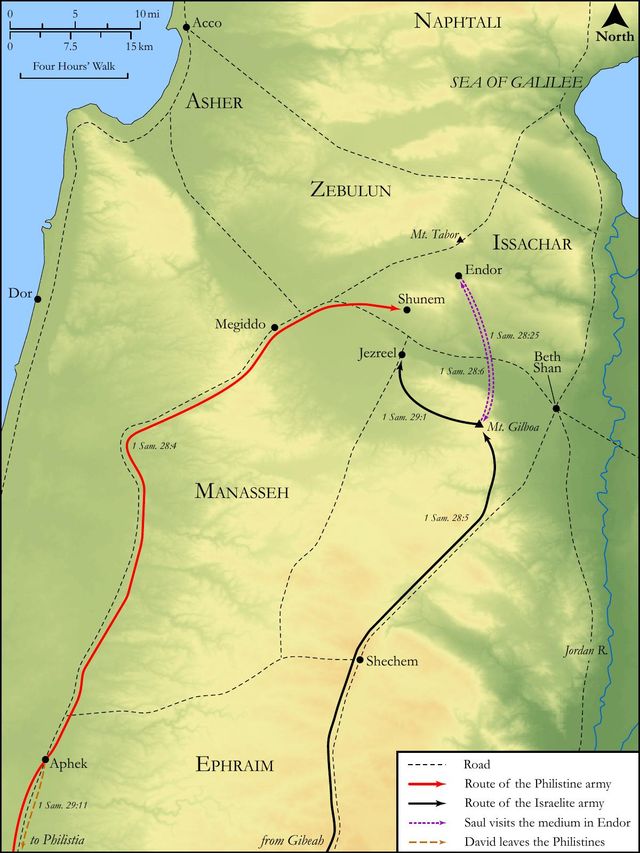
The Philistines pitched in Shunem, which was in the tribe of Issachar, a great way north from their country. The land of Israel, it seems, was ill-guarded, when the Philistines could march their army into the very heart of the country. Saul, while he pursued David, left his people naked and exposed. On some of the adjacent mountains of Gilboa Saul mustered his forces, and prepared to engage the Philistines, which he had little heart to do now that the Spirit of the Lord had departed from him.
IV.The terror Saul was in, and the loss he was at, upon this occasion:
He saw the host of the Philistines, and by his own view of them, and the intelligence his spies brought him, he perceived they were more numerous, better armed, and in better heart, than his own were, which made him afraid, so that his heart greatly trembled, Sa1 28:5. Had he kept close to God, he needed not have been afraid at the sight of an army of Philistines; but now that he had provoked God to forsake him his interest failed, his armies dwindled and looked mean, and, which was worse, his spirits failed him, his heart sunk within him, a guilty conscience made him tremble at the shaking of a leaf. Now he remembered the guilty blood of the Amalekites which he had spared, and the innocent blood of the priests which he had spilt. His sins were set in order before his eyes, which put him into confusion, embarrassed all his counsels, robbed him of all his courage, and produced in him a certain fearful looking for of judgment and fiery indignation. Note, Troubles are terrors to the children of disobedience. In this distress Saul enquired of the Lord, Sa1 28:6. Need drives those to God who in the day of their prosperity slighted his oracles and altars. Lord, in trouble have they visited thee, Isa 26:16. Did ever any seek the Lord and not find him? Yes, Saul did; the Lord answered him not, took no notice either of his petitions or of his enquiries; gave him no directions what to do, nor any encouragement to hope that he would be with him. Should he be enquired of at all by such a one as Saul? Eze 14:3. No, he could not expect an answer of peace, for,
1.He enquired in such a manner that it was as if he had not enquired at all. Therefore it is said (Ch1 10:14), He enquired not of the Lord; for he did it faintly and coldly, and with a secret design, if God did not answer him, to consult the devil. He did not enquire in faith, but with a double unstable mind.
2.He enquired of the Lord when it was too late, when the days of his probation were over and he was finally rejected. Seek the Lord while he may be found, for there is a time when he will not be found.
3.He had forfeited the benefit of all the methods of enquiry. Could he that hated and persecuted Samuel and David, who were both prophets, expect to be answered by prophets? Could he that had slain the high priest, expect to be answered by Urim? Or could he that had sinned away the Spirit of grace, expect to be answered by dreams? No. Be not deceived, God is not mocked.
V.The mention of some things that had happened a good while ago, to introduce the following story, Sa1 28:3.
1.The death of Samuel. Samuel was dead, which made the Philistines the more bold and Saul the more afraid; for, had Samuel been alive, Saul probably thought that his presence and countenance, his good advice and good prayers, would have availed him in his distress.
2.Saul's edict against witchcraft. He had put the laws in execution against those that had familiar spirits, who must not be suffered to live, Exo 22:18. Some think that he did this in the beginning of his reign, while he was under Samuel's influence; others think that it was lately done, for it is spoken of here (Sa1 28:9) as a late edict. Perhaps when Saul was himself troubled with an evil spirit he suspected that he was bewitched, and, for that reason, cut off all that had familiar spirits. Many seem zealous against sin, when they themselves are any way hurt by it (they will inform against swearers if they swear at them, or against drunkards if in their drink they abuse them), who otherwise have no concern for the glory of God, nor any dislike of sin as sin. However it was commendable in Saul thus to use his power for the terror and restraint of these evil-doers. Note, Many seem enemies to sin in others, while they indulge it in themselves. Saul will drive the devil out of his kingdom, and yet harbour him in his heart, by envy and malice.
Continue studying 1 Samuel 28:5 across the web’s major study libraries — every link below opens this exact verse, chapter, or book on the destination site.
Read & Compare
 BibleGatewayThis verse in more than 200 translations and 70 languages.
 Bible.comThe YouVersion reader — hundreds of translations, reading plans, and highlights.
 ESV.orgCrossway's official English Standard Version reader.
 NET BibleThe NET translation with 60,000+ translators' notes on every rendering decision.
 STEP BibleTyndale House's free study tool — original text, vocabulary, and scholarly resources.
 BibliaLogos Bible Software's free web reader.
 USCCBThe New American Bible (Revised Edition) with the U.S. bishops' study notes.
Commentaries
 BibleHub CommentariesDozens of classic commentaries on this verse, gathered on one page.
 StudyLightMore than 100 commentary sets — the largest collection on the web.
 BibleRefPlain-English commentary on what this verse means, verse by verse.
 Enduring WordDavid Guzik's free commentary on this chapter, widely used by Bible teachers.
 Bible Study ToolsVerse commentary alongside Greek and Hebrew study aids.
Original Language & Research
- BibleHub InterlinearThe verse word by word — original language, transliteration, and English.
- BibleHub LexiconEvery word's original-language definition and Strong's entry.
 Blue Letter BibleDeep-study tools — Strong's numbers, concordance, and word studies.
 SefariaThe Hebrew text with Rashi and centuries of Jewish commentary.
Sermons, Hymns & Audio


TrulyRandomVerse is not affiliated with these sites and doesn’t control their content. They’re linked because they’re genuinely useful.
Summary
1 Samuel 28:5 powerfully encapsulates the profound psychological and spiritual crisis of King Saul as he confronts the formidable Philistine army. This verse marks a pivotal and tragic moment in Saul's reign, vividly illustrating the debilitating fear and utter despair that grip a leader estranged from God. His "greatly trembled heart" is depicted not merely as a physical reaction but as a deep spiritual malaise, indicative of a king who has lost divine favor, prophetic counsel, and, consequently, all hope in the face of overwhelming odds. It sets the stage for Saul's desperate and forbidden attempt to consult the dead, highlighting the ultimate, dire consequences of persistent disobedience and spiritual isolation.
Context
ShowHideLiterary Context
This verse serves as the immediate precursor to one of the most dramatic and tragic episodes in Saul's life: his desperate and illicit consultation with the medium of Endor. Chapter 28 opens with the Philistines gathering their forces at Shunem, while Israel encamps at Gilboa, setting the scene for a decisive battle. The narrative of 1 Samuel has consistently highlighted Saul's spiritual and moral decline since his definitive rejection by God in 1 Samuel 15. The death of Samuel, God's primary prophet and Saul's former mentor, has left a profound spiritual void, depriving Saul of legitimate divine counsel. Critically, 1 Samuel 28:6 explicitly states that God had ceased to answer Saul, neither by dreams, nor by Urim, nor by prophets. This divine silence, coupled with the overwhelming military threat, amplifies Saul's terror, driving him to seek forbidden counsel and demonstrating the tragic depths of his spiritual desperation and abandonment.
Historical & Cultural Context
The Philistines were a persistent and formidable enemy of Israel throughout the period of the Judges and the early monarchy. Known for their superior iron weaponry and organized military structure, they frequently posed an existential threat, often dominating Israelite territories and suppressing their ability to forge iron (1 Samuel 13:19-22). The setting at Shunem and Gilboa places the Philistine army in a strategic position, threatening the heartland of Israel and setting the stage for a critical confrontation. Culturally, kings in Israel were expected to lead their armies with courage, valor, and, most importantly, divine backing, as the elders had asked for a king who would "go out before us, and fight our battles." Saul's visible fear and trembling would have been a profound sign of weakness, a stark contrast to the ideal of a divinely appointed leader who inspires confidence and relies on God for victory. In ancient Israel, seeking divine counsel through legitimate means (prophets, Urim and Thummim, dreams) was paramount, making Saul's inability to receive such guidance and his subsequent turn to a medium a grave transgression against Mosaic Law, strictly prohibited in Deuteronomy 18:10-12.
Key Themes
ShowHideThe verse powerfully contributes to several overarching themes in 1 Samuel. Firstly, it underscores the consequences of disobedience and divine rejection. Saul's profound fear is a direct and palpable outcome of his estrangement from God, demonstrating that without God's empowering presence and guiding counsel, even a king becomes utterly vulnerable and incapable. Secondly, it highlights the peril of leadership without divine counsel. Saul, once chosen and empowered by God, now faces an existential threat without the spiritual resources necessary to lead, illustrating the immense burden and ultimate futility of self-reliance in the face of insurmountable challenges. Thirdly, it emphasizes the theme of divine silence and human desperation. God's refusal to answer Saul, a direct consequence of his persistent rebellion, drives the king to forbidden practices, revealing the tragic depths to which a person can sink when cut off from legitimate divine communication. This episode serves as a stark contrast to the faith and courage exemplified by figures like David, who consistently sought the Lord's will and guidance before action, as seen in 1 Samuel 23:2.
Exposition and Analysis
ShowHideKey Word Analysis
ShowHideThis common Hebrew verb signifies a wide range of emotions, from reverential awe (as in "the fear of the Lord") to intense, debilitating fear or terror. In this context, it denotes a profound and paralyzing fear that grips Saul. It is a natural human reaction to a perceived overwhelming threat, but for a king, especially one who should rely on divine strength, it indicates a significant spiritual and psychological breakdown, a loss of kingly fortitude.
In biblical thought, the "heart" is far more than just a physical organ; it is considered the seat of one's intellect, emotions, will, and moral character—the very core of a person's being. When Saul's "heart" is described as trembling, it signifies a complete collapse of his inner resolve, courage, and mental composure, indicating a deep-seated spiritual and emotional crisis, not merely a superficial fright.
This word is stronger and more visceral than "afraid," describing a deep, inward shaking, quaking, or agitation. It conveys a profound sense of dread, terror, or alarm, often associated with a sudden, overwhelming fright that affects one physically and emotionally. The use of this term emphasizes the uncontrollable, visceral nature of Saul's reaction, indicating the depth of his internal turmoil and the complete loss of his composure and kingly fortitude. The adverb "greatly" (H3966, mᵉʼôd) intensifies this internal shaking, underscoring the profound and overwhelming nature of his terror.
Verse Breakdown
ShowHide"And when Saul saw the host of the Philistines"
This clause establishes the immediate external trigger for Saul's internal state. The "host" (Hebrew: machăneh) refers to a large, organized military encampment or army. The sheer visual presence, numerical superiority, and presumed strength of the Philistine army immediately instill terror in Saul, highlighting the overwhelming nature of the threat he perceived and the gravity of the impending conflict.
"he was afraid"
This describes Saul's initial, direct, and immediate emotional response. It is a straightforward declaration of his fear, setting the stage for the more intense and visceral description that follows. This fear is not just a fleeting emotion but a pervasive state that begins to consume him.
"and his heart greatly trembled"
This is the climax of the verse, providing a vivid, almost visceral, description of Saul's internal condition. As noted in the key word analysis, the "heart" (Hebrew: lêb) represents the core of his being—his intellect, emotions, and will. Thus, Saul's "heart greatly trembled" signifies a complete breakdown of his inner fortitude; his courage, resolve, and hope are shattered. The adverb "greatly" (Hebrew: mᵉʼôd), meaning "very much" or "exceedingly," intensifies the verb "trembled," emphasizing the profound, overwhelming, and debilitating nature of his terror, which has seized his very soul.
Literary Devices
ShowHide1 Samuel 28:5 employs several potent Literary Devices to convey Saul's desperate and tragic state. Pathos is powerfully evident, as the verse evokes a sense of profound pity and sympathy for Saul's debilitating fear, even though it is presented as a direct consequence of his own persistent disobedience and spiritual estrangement from God. The stark description of his "greatly trembled heart" creates a deep sense of tragedy for a king once anointed by God and empowered by His Spirit. Hyperbole is utilized in the phrase "greatly trembled," emphasizing the extreme and overwhelming nature of his fear, suggesting it was far beyond ordinary apprehension and bordered on a complete psychological collapse. This intense description also serves as potent Foreshadowing, hinting at the tragic events that are about to unfold, particularly Saul's desperate and illicit consultation with the medium of Endor, which ultimately precipitates his demise and seals his fate. Furthermore, there is a subtle but profound Irony at play: the king chosen by God, meant to lead Israel with divine strength and courage, is now utterly paralyzed by fear, standing in stark contrast to the fearless leaders like David who consistently trusted in the Lord and found strength in His presence.
Theological and Thematic Connections
ShowHideSaul's profound fear and trembling in the face of the Philistine army serve as a stark theological commentary on the devastating consequences of spiritual estrangement from God. His terror is not merely a psychological reaction to military might but a profound spiritual symptom of a heart that has lost its vital connection to the divine source of strength, courage, wisdom, and peace. When God withdraws His presence and counsel due to persistent disobedience and rebellion, human reliance is exposed as utterly insufficient, leading inevitably to despair, paralysis, and a complete breakdown of inner fortitude. This verse powerfully illustrates that true security, unwavering courage, and lasting peace are found not in military strength, human leadership, or self-reliance alone, but in a right, obedient, and trusting relationship with the Almighty. It is God's presence that dispels fear, grants unwavering resolve, and provides an anchor for the soul even in the direst and most overwhelming circumstances.
Reflection and Application
ShowHideSaul's experience in 1 Samuel 28:5 offers a profound and sobering reflection for believers today. His "greatly trembled heart" is a vivid and poignant portrayal of the human condition when separated from divine grace, guidance, and empowering presence. It serves as a stark reminder that true courage, inner peace, and steadfastness are not inherent human qualities but are gifts cultivated and sustained through a living, obedient, and dependent relationship with God. When we drift from God's commands, neglect His Word, or cease to earnestly seek His counsel, we become vulnerable to the overwhelming anxieties, fears, and pressures of the world, much like Saul facing the formidable Philistines without divine backing. This verse challenges us to continually examine the state of our own hearts, ensuring that our reliance is firmly placed on God, for it is in His presence that we find the strength to face our own "Philistines"—the challenges, temptations, uncertainties, and spiritual battles of life—without succumbing to debilitating fear. It underscores the vital importance of maintaining open, consistent communication with God through prayer, diligent study of Scripture, and seeking wise, godly counsel, so that when trials inevitably come, our hearts may be steadfast, anchored in faith, rather than trembling in despair.
Questions for Reflection
ShowHideFAQ
ShowHideWhy was Saul so afraid, given he was a king and a warrior?
ShowHideSaul's profound fear in 1 Samuel 28:5 was not merely a natural reaction to a strong enemy but stemmed from a deeper, more critical spiritual crisis. While he was indeed a warrior and the king of Israel, his courage and leadership were intrinsically tied to God's favor and empowering presence. The narrative clearly states that God had rejected Saul due to his persistent disobedience and rebellion (1 Samuel 15:23), and crucially, God had ceased to answer him by any legitimate means—neither by dreams, nor by Urim, nor by prophets (1 Samuel 28:6). Without divine guidance, assurance, or blessing, Saul was left to face an overwhelming military threat entirely in his own strength, which proved utterly insufficient. His fear was amplified by his spiritual isolation, the knowledge that he had forfeited God's empowering presence, and the absence of legitimate divine counsel, leading to a profound sense of despair, vulnerability, and impending doom.
Christ-Centered Fulfillment
ShowHideSaul's trembling heart in 1 Samuel 28:5 stands in stark and illuminating contrast to the unwavering resolve and perfect peace found in Jesus Christ, who is the ultimate fulfillment of faithful leadership, divine presence, and courageous obedience. Saul's fear was a direct consequence of his disobedience and God's withdrawal of counsel, leaving him isolated, vulnerable, and ultimately doomed. In radical contrast, Jesus, the perfectly obedient Son, never experienced such divine abandonment. Even in the face of the ultimate "host"—the full weight of human sin, the power of death, and the forces of spiritual darkness—Jesus faced His trials with resolute courage and steadfast purpose, not with a trembling heart. His anguish in Gethsemane (Luke 22:42-44) was not born of fear for Himself or a lack of divine presence, but of the immense, crushing weight of bearing the world's sin and the impending separation from the Father, yet He submitted perfectly to the Father's will. Through His sacrificial death and glorious resurrection, Christ conquered the very sources of fear, despair, and spiritual isolation that plagued Saul, offering believers a new covenant where God's presence is not withdrawn but is eternally secured through the indwelling Holy Spirit (John 14:16-18). Unlike Saul, who desperately sought forbidden counsel in his spiritual bankruptcy, believers in Christ have constant, unhindered access to the true Prophet, Priest, and King, who intercedes for them at the right hand of God (Hebrews 7:25) and whose perfect love casts out all fear (1 John 4:18). In Him, we find the courage, strength, and abiding peace that Saul so desperately lacked, for He is our ever-present refuge and strength in times of trouble (Psalm 46:1).