


1 Samuel 28:1
Bible text: King James Version (1769 Blayney text) · Public domain
Bible text: King James Version with Strong's numbers · Public domain
Bible text: Berean Standard Bible · Public domain
Bible text: American Standard Version (1901) · Public domain
Bible text: World English Bible, Messianic edition · Public domain
Bible text: Geneva Bible (1599) · Public domain
Bible text: Young's Literal Translation · Public domain
- וַיְהִיvay·Hiand it wasH1961Conj-w ¦ V-Qal-ConsecImperf-3msVerb Qal Consecutive Imperfect 3rd Singular Masculineוַandיְהִיit was
- בַּיָּמִיםbai·ya·Mimin the daysH3117Prep-b ¦ N-mpNoun Plural Masculine Absoluteבַּin theיָּמִיםdays
- הָהֵםha·Hem<the> thoseH1992Art ¦ Pro-3mpPronoun Personal 3rd Plural Masculineהָ<the>הֵםthose
- וַיִּקְבְּצוּvai·yik·be·Tzuand they gathered togetherH6908Conj-w ¦ V-Qal-ConsecImperf-3mpVerb Qal Consecutive Imperfect 3rd Plural Masculineוַandיִּקְבְּצוּthey gathered together
- פְלִשְׁתִּיםfe·lish·Tim[the] PhilistinesH6430N-mpNoun Gentilic Plural Masculine Absolute
- אֶת'et<obj.>H853DirObjMParticle Object Indicator
- מַחֲנֵיהֶםma·cha·nei·Hemtheir armiesH4264N-msc ¦ 3mpNoun Singular Masculine Constructמַחֲנֵיarmiesהֶםtheir
- לַצָּבָאla·tza·Va'for <the> warH6635Prep-l ¦ N-msNoun Singular Masculine Absoluteלַfor <the>צָּבָאwar
- לְהִלָּחֵםle·hi·la·Chemto fightH3898Prep-l ¦ V-Niphal-InfVerb Niphal Infinitive Constructלְtoהִלָּחֵםfight
- בְּיִשְׂרָאֵלbe·Yis·ra·'Elagainst IsraelH3478Prep-b ¦ N-properNoun Proper LocationבְּagainstיִשְׂרָאֵלIsrael
- וַיֹּאמֶרvai·Yo·merand he saidH559Conj-w ¦ V-Qal-ConsecImperf-3msVerb Qal Consecutive Imperfect 3rd Singular Masculineוַandיֹּאמֶרhe said
- אָכִישׁ'a·KhishAchishH397N-proper-mNoun Proper Masculine
- אֶל'eltoH413PrepPreposition
- דָּוִדda·VidDavidH1732N-proper-mNoun Proper Masculine
- יָדֹעַya·Do·a'certainly <to know>H3045V-Qal-InfAbsVerb Qal Infinitive Absolute
- תֵּדַעte·Da'you will knowH3045V-Qal-Imperf-2msVerb Qal Imperfect 2nd Singular Masculine
- כִּיkithatH3588PrtParticle Conditional
- אִתִּי'i·Tiwith meH854Prep ¦ 1csPreposition Definiteאִתִּwithיme
- תֵּצֵאte·Tze'you will go outH3318V-Qal-Imperf-2msVerb Qal Imperfect 2nd Singular Masculine
- בַמַּחֲנֶהva·ma·cha·Nehin the campH4264Prep-b ¦ N-fsNoun Singular Feminine Absoluteבַin theמַּחֲנֶהcamp
- אַתָּה'a·TahyouH859Pro-2msPronoun Personal 2nd Singular Masculine
- וַאֲנָשֶׁיךָva·'a·na·Shei·khaand your menH582Conj-w ¦ N-mpc ¦ 2msNoun Plural Masculine Constructוַandאֲנָשֶׁיmenךָyour
English is a literal word-by-word gloss of the Hebrew, not the KJV's wording. Why?
This is the original text the KJV's translators worked from — each Hebrew word with its own literal English meaning in this verse, prepared by scholars at Tyndale House, Cambridge. The KJV translates whole sentences, not word by word, so its wording differs: one Hebrew word can become several English words, and the KJV may choose “the LORD” where the gloss reads “Yahweh”. Both are faithful — they answer different questions. For the KJV's own rendering, switch to the KJV text.
Details
See on the biblical-era map
Study this verse
Public-domain commentary
Matthew Henry
From his Commentary on the Whole Bible. Henry comments on passages, not single verses — this entry covers 1 Samuel 28:1–6. His two-level outline is real structure in the source text, so it is rendered as structure.
Here is, I. The design of the Philistines against Israel. They resolved to fight them, Sa1 28:1. If the Israelites had not forsaken God, there would have been no Philistines remaining to molest them; if Saul had not forsaken him, they would by this time have been put out of all danger by them. The Philistines took an opportunity to make this attempt when they had David among them, whom they feared more than Saul and all his forces.
II.The expectation Achish had of assistance from David in this war, and the encouragement David gave him to expect it:
"Thou shalt go with me to battle," says Achish. "If I protect thee, I may demand service from thee;" and he will think himself happy if he may have such a man as David on his side, who prospered whithersoever he went. David gave him an ambiguous answer: "We will see what will be done; it will be time enough to talk of that hereafter; but surely thou shalt know what thy servant can do" (Sa1 28:2), that is, "I will consider in what post I may be best able to serve thee, if thou wilt but give me leave to choose it." Thus he keeps himself free from a promise to serve him and yet keeps up his expectation of it; for Achish took it in no other sense than as an engagement to assist him, and promised him, thereupon, that he would make him captain of the guards, protector, or prime-minister of state.
III.The drawing of the armies, on both sides, into the field (Sa1 28:4):
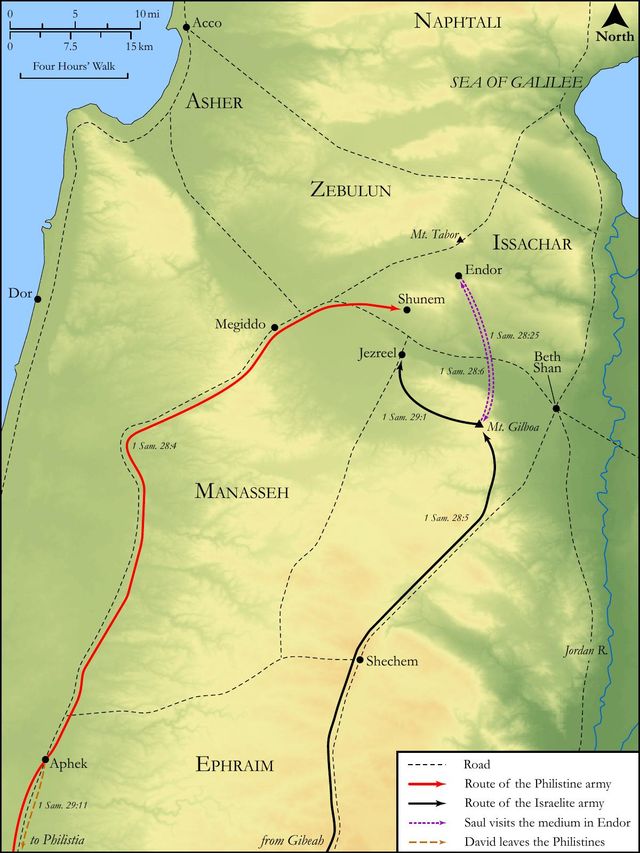
The Philistines pitched in Shunem, which was in the tribe of Issachar, a great way north from their country. The land of Israel, it seems, was ill-guarded, when the Philistines could march their army into the very heart of the country. Saul, while he pursued David, left his people naked and exposed. On some of the adjacent mountains of Gilboa Saul mustered his forces, and prepared to engage the Philistines, which he had little heart to do now that the Spirit of the Lord had departed from him.
IV.The terror Saul was in, and the loss he was at, upon this occasion:
He saw the host of the Philistines, and by his own view of them, and the intelligence his spies brought him, he perceived they were more numerous, better armed, and in better heart, than his own were, which made him afraid, so that his heart greatly trembled, Sa1 28:5. Had he kept close to God, he needed not have been afraid at the sight of an army of Philistines; but now that he had provoked God to forsake him his interest failed, his armies dwindled and looked mean, and, which was worse, his spirits failed him, his heart sunk within him, a guilty conscience made him tremble at the shaking of a leaf. Now he remembered the guilty blood of the Amalekites which he had spared, and the innocent blood of the priests which he had spilt. His sins were set in order before his eyes, which put him into confusion, embarrassed all his counsels, robbed him of all his courage, and produced in him a certain fearful looking for of judgment and fiery indignation. Note, Troubles are terrors to the children of disobedience. In this distress Saul enquired of the Lord, Sa1 28:6. Need drives those to God who in the day of their prosperity slighted his oracles and altars. Lord, in trouble have they visited thee, Isa 26:16. Did ever any seek the Lord and not find him? Yes, Saul did; the Lord answered him not, took no notice either of his petitions or of his enquiries; gave him no directions what to do, nor any encouragement to hope that he would be with him. Should he be enquired of at all by such a one as Saul? Eze 14:3. No, he could not expect an answer of peace, for,
1.He enquired in such a manner that it was as if he had not enquired at all. Therefore it is said (Ch1 10:14), He enquired not of the Lord; for he did it faintly and coldly, and with a secret design, if God did not answer him, to consult the devil. He did not enquire in faith, but with a double unstable mind.
2.He enquired of the Lord when it was too late, when the days of his probation were over and he was finally rejected. Seek the Lord while he may be found, for there is a time when he will not be found.
3.He had forfeited the benefit of all the methods of enquiry. Could he that hated and persecuted Samuel and David, who were both prophets, expect to be answered by prophets? Could he that had slain the high priest, expect to be answered by Urim? Or could he that had sinned away the Spirit of grace, expect to be answered by dreams? No. Be not deceived, God is not mocked.
V.The mention of some things that had happened a good while ago, to introduce the following story, Sa1 28:3.
1.The death of Samuel. Samuel was dead, which made the Philistines the more bold and Saul the more afraid; for, had Samuel been alive, Saul probably thought that his presence and countenance, his good advice and good prayers, would have availed him in his distress.
2.Saul's edict against witchcraft. He had put the laws in execution against those that had familiar spirits, who must not be suffered to live, Exo 22:18. Some think that he did this in the beginning of his reign, while he was under Samuel's influence; others think that it was lately done, for it is spoken of here (Sa1 28:9) as a late edict. Perhaps when Saul was himself troubled with an evil spirit he suspected that he was bewitched, and, for that reason, cut off all that had familiar spirits. Many seem zealous against sin, when they themselves are any way hurt by it (they will inform against swearers if they swear at them, or against drunkards if in their drink they abuse them), who otherwise have no concern for the glory of God, nor any dislike of sin as sin. However it was commendable in Saul thus to use his power for the terror and restraint of these evil-doers. Note, Many seem enemies to sin in others, while they indulge it in themselves. Saul will drive the devil out of his kingdom, and yet harbour him in his heart, by envy and malice.
Historical interpretation
Historical reception
1 surviving comment on this verse from the historical church.
And Achis said to David: Knowing now, know, etc. Which is clearly that all Catholics propose to combat the erring by reproving, reasoning, or remembering the words of Scripture, to say to the Lord: God, you know our foolishness and weakness (Psalm LXVIII), for without you we can do nothing, provide us with aid as we struggle, may your holy ones grant us the help of their intercession; and whoever of them authored the holy Scriptures by your inspiration, may they provide us with the secrets of spiritual knowledge by which we may overcome the carnal.
Continue studying 1 Samuel 28:1 across the web’s major study libraries — every link below opens this exact verse, chapter, or book on the destination site.
Read & Compare
 BibleGatewayThis verse in more than 200 translations and 70 languages.
 Bible.comThe YouVersion reader — hundreds of translations, reading plans, and highlights.
 ESV.orgCrossway's official English Standard Version reader.
 NET BibleThe NET translation with 60,000+ translators' notes on every rendering decision.
 STEP BibleTyndale House's free study tool — original text, vocabulary, and scholarly resources.
 BibliaLogos Bible Software's free web reader.
 USCCBThe New American Bible (Revised Edition) with the U.S. bishops' study notes.
Commentaries
 BibleHub CommentariesDozens of classic commentaries on this verse, gathered on one page.
 StudyLightMore than 100 commentary sets — the largest collection on the web.
 BibleRefPlain-English commentary on what this verse means, verse by verse.
 Enduring WordDavid Guzik's free commentary on this chapter, widely used by Bible teachers.
 Bible Study ToolsVerse commentary alongside Greek and Hebrew study aids.
Original Language & Research
- BibleHub InterlinearThe verse word by word — original language, transliteration, and English.
- BibleHub LexiconEvery word's original-language definition and Strong's entry.
 Blue Letter BibleDeep-study tools — Strong's numbers, concordance, and word studies.
 SefariaThe Hebrew text with Rashi and centuries of Jewish commentary.
Sermons, Hymns & Audio


TrulyRandomVerse is not affiliated with these sites and doesn’t control their content. They’re linked because they’re genuinely useful.
Summary
1 Samuel 28:1 dramatically opens with the formidable Philistine armies mobilizing for a decisive war against Israel, immediately thrusting David into an agonizing moral and spiritual dilemma. Having found refuge with King Achish of Gath through a period of strategic deception, David now faces Achish's unwavering command to join the Philistine forces in this impending conflict. This verse not only sets the stage for a pivotal battle that will profoundly impact the declining reign of King Saul but also highlights David's precarious position, forcing him to confront the unthinkable prospect of fighting against his own people and the Lord's anointed, all while underscoring the unfolding narrative of God's sovereign protection over His chosen king.
Context
ShowHideLiterary Context
This verse serves as a crucial narrative pivot, immediately following David's extended, sixteen-month sojourn in Philistine territory under the protection of King Achish of Gath, as meticulously detailed in 1 Samuel 27. During this period, David cleverly deceived Achish, leading the Philistine king to believe that David was raiding Israelite or allied territories, when in fact he was attacking traditional enemies of Israel like the Geshurites, Girzites, and Amalekites, ensuring no survivors to expose his ruse (1 Samuel 27:8-9). This strategic deception earned David Achish's complete trust and confidence, culminating in the king's firm expectation that David and his formidable contingent of men would join the Philistine army in their major offensive against Israel. The narrative then dramatically shifts in the subsequent verses to Saul's desperate and forbidden consultation with the medium of Endor (1 Samuel 28:7-25), highlighting the spiritual and moral bankruptcy of his kingship in stark contrast to David's complex but ultimately divinely guided path.
Historical & Cultural Context
The Philistines represented a persistent and formidable adversary to Israel throughout the era of the Judges and the nascent monarchy. Known for their superior military organization and iron weaponry, their presence along the coastal plain and their frequent incursions into the Israelite highlands posed a constant existential threat to Israel's sovereignty and security. Gath, one of the five primary Philistine city-states, was a significant military power. Among the Philistines and Israel alike, warfare was often total, requiring the mobilization of all available fighting men, and kings like Achish expected absolute loyalty from their servants or those under their protection. David's precarious situation is thus culturally understandable: refusing Achish's command could mean the immediate loss of his refuge, the safety of his men and their families, and potentially his life, while complying would entail an unthinkable act of treason against his own nation and, more significantly, against the God of Israel.
Key Themes
ShowHide1 Samuel 28:1 introduces and reinforces several crucial themes that resonate throughout the book of Samuel. Firstly, it underscores the escalating conflict between Israel and the Philistines, a recurring motif that will tragically culminate in the death of King Saul and his sons on Mount Gilboa (1 Samuel 31). Secondly, the verse vividly highlights David's profound moral and spiritual predicament, caught between his pragmatic loyalty to Achish, who had provided him sanctuary, and his ultimate allegiance to God and the nation of Israel. This dilemma powerfully illustrates the complexities of living by faith in a fallen world, where even righteous individuals can find themselves in deeply compromising situations, as seen in David's initial decision to flee to Philistia (1 Samuel 27:1). Thirdly, and most significantly, the verse subtly points to the overarching theme of divine providence and sovereignty. While David's situation appears humanly impossible and ethically unresolvable, the subsequent narrative in 1 Samuel 29 reveals God's miraculous intervention to prevent David from having to fight against Israel, thereby demonstrating God's unwavering faithfulness to His chosen one, even amidst David's strategic compromises. This difficult situation ultimately serves to further God's purposes for David and the establishment of His kingdom.
Exposition and Analysis
ShowHideKey Word Analysis
ShowHideThis Hebrew verb (H6908) signifies a deliberate and comprehensive collection or assembly, often with a military connotation of mustering troops. Here, it emphasizes the full mobilization of the Philistine forces, indicating a major, concerted military campaign rather than a mere skirmish or border raid. It conveys the seriousness and scale of the impending conflict, highlighting the existential threat posed to Israel. The Philistines were not merely accumulating, but actively organizing their "armies" (machăneh, H4264) for a decisive engagement.
This term (H6635) refers to military service, an army, or a host, and by extension, the act of waging war or a campaign. Its use here reinforces that the Philistines were preparing for a full-scale, decisive battle aimed at conquering or subjugating Israel, not just a localized conflict. It sets a tone of grave conflict and high stakes, underscoring the strategic importance of this mobilization.
While literally meaning "to know" (H3045), in this context, especially with the imperative "Know thou," it functions as a strong, authoritative declaration or command. Achish is not posing a question or seeking David's opinion; he is stating an undeniable fact and issuing a direct, non-negotiable order. This conveys Achish's absolute certainty in David's loyalty and his expectation of immediate and unquestioning compliance, leaving David with no apparent room for refusal or negotiation.
Verse Breakdown
ShowHide"And it came to pass in those days, that the Philistines gathered their armies together for warfare, to fight with Israel."
This opening clause establishes the setting and the primary antagonist. The transitional phrase "in those days" signals a significant new development in the overarching narrative of Saul's reign and David's rise. The Philistines, Israel's formidable and perennial enemies, are depicted as actively and decisively preparing for a major military engagement. Their purpose is explicitly stated: "to fight with Israel," underscoring the direct, hostile, and national intent of this massive mobilization. This immediately establishes the gravity of the situation and the looming, existential threat to the Israelite nation.
"And Achish said unto David, Know thou assuredly, that thou shalt go out with me to battle, thou and thy men."
This second clause introduces David's personal crisis and the immediate dilemma he faces. King Achish, having been thoroughly deceived by David's feigned raids against Israelite territories, expresses his absolute trust and expectation in David's loyalty. The command "Know thou assuredly" is a powerful imperative, leaving no doubt about Achish's firm resolve and the non-negotiable nature of his order. David is not merely invited but commanded to join the Philistine ranks, along with his entire contingent of six hundred men. This places David in an impossible ethical and spiritual bind: comply and fight against his own people and the Lord's anointed, or defy the king who has provided him refuge and risk his life, the lives of his men, and the safety of their families.
Literary Devices
ShowHideThe verse employs several potent literary devices that heighten its dramatic impact and underscore its theological significance. Foreshadowing is prominently featured, as the Philistine mobilization immediately signals a major, impending conflict that will have profound and tragic consequences, ultimately leading to the death of King Saul and the transition of power. There is also significant Irony in David's predicament: having been divinely anointed as Israel's future king, he is now commanded by a pagan king to fight against Israel alongside its most formidable enemies. This situation creates a powerful Dilemma for David, a classic narrative device that builds intense tension and explores profound themes of loyalty, integrity, and divine providence. The seemingly inescapable trap David finds himself in underscores the complexity of his character, the ethical ambiguities of his strategic choices, and, ultimately, the sovereign hand of God at work even in seemingly impossible circumstances to protect His chosen one and advance His divine plan.
Theological and Thematic Connections
ShowHide1 Samuel 28:1 profoundly illustrates the tension between human agency and divine sovereignty, particularly as it plays out in the life of God's chosen servant. David's predicament highlights the ethical complexities that can arise from strategic compromises, even when made under duress or for perceived safety. While David's flight to Achish was a pragmatic response to Saul's relentless pursuit, it ultimately led him to a situation where his loyalty to God and Israel was severely tested. This verse sets the stage for God's miraculous intervention, demonstrating that even when His people find themselves in seemingly impossible or compromising situations, His providential hand can deliver them and work all things for His ultimate purposes. It reminds us that God is not bound by human dilemmas and can orchestrate events to protect His plans and His people, often in ways we cannot foresee.
Reflection and Application
ShowHide1 Samuel 28:1 presents a powerful scenario that invites deep reflection on the nature of difficult choices, the consequences of compromise, and the unwavering faithfulness of God. David's situation, caught between a powerful pagan patron and his national and spiritual loyalties, mirrors the complex ethical dilemmas believers often face in a world that demands compromise. It prompts us to consider the long-term consequences of our "temporary" solutions or strategic alliances, especially when they move us closer to environments or relationships that could potentially compromise our core values or allegiances to Christ. Yet, the broader narrative also offers immense comfort: even when we find ourselves in a seemingly inescapable bind, God remains sovereign. He can open a way where there seems to be none, demonstrating His faithfulness to those who ultimately trust in Him, even when their human path has been imperfect. This verse challenges us to cultivate a deeper reliance on God's providence, trusting that He can deliver us from situations that appear humanly impossible, and to strive for integrity and unwavering allegiance to Christ even when under immense pressure.
Questions for Reflection
ShowHideFAQ
ShowHideWhy was David with the Philistines in the first place, and why did Achish trust him?
ShowHideDavid fled to the Philistine city of Gath and sought refuge with King Achish because he was relentlessly pursued by King Saul, who sought to kill him (1 Samuel 27:1). This was a desperate act, as the Philistines were Israel's bitter enemies. Achish trusted David because David had cunningly deceived him. For sixteen months, David pretended to raid Israelite towns or their allies, bringing back plunder to Achish and claiming it was from Judah or the Negev of the Jerahmeelites and Kenites (1 Samuel 27:8-12). In reality, David was attacking Israel's traditional enemies (Geshurites, Girzites, Amalekites) and killing everyone to prevent his deception from being discovered. Achish believed David had made himself "utterly odious" to Israel and would therefore be his servant forever (1 Samuel 27:12), making him a seemingly valuable and loyal ally in the impending war against Israel.
Christ-Centered Fulfillment
ShowHide1 Samuel 28:1, with David's seemingly impossible dilemma and subsequent divine deliverance, powerfully foreshadows the ultimate and perfect obedience of Christ, who faced a far greater "warfare" on behalf of humanity. David, caught in a compromised position due to his strategic choices, was miraculously delivered by God from having to fight against his own people. This divine intervention points to Jesus, the true Son of David, who willingly entered the ultimate conflict against sin, death, and the powers of darkness, not by fleeing or deception, but by perfect, unwavering obedience to His Father's will. Unlike David, who was in a precarious ethical position, Jesus faced the "warfare" of the cross with absolute integrity and divine purpose, becoming the Lamb of God who takes away the sin of the world. His suffering and death were not a compromise but a deliberate act of love and redemption, a perfect fulfillment of the Father's will (Philippians 2:8). In Christ, believers find deliverance from the impossible dilemmas of sin and death, for He has already fought and won the decisive battle, securing eternal victory and offering true refuge that never leads to compromise, but to life abundant and eternal in perfect communion with God.