


1 Samuel 29:1
Bible text: King James Version (1769 Blayney text) · Public domain
Bible text: King James Version with Strong's numbers · Public domain
Bible text: Berean Standard Bible · Public domain
Bible text: American Standard Version (1901) · Public domain
Bible text: World English Bible, Messianic edition · Public domain
Bible text: Geneva Bible (1599) · Public domain
Bible text: Young's Literal Translation · Public domain
- וַיִּקְבְּצוּvai·yik·be·Tzuand they gatheredH6908Conj-w ¦ V-Qal-ConsecImperf-3mpVerb Qal Consecutive Imperfect 3rd Plural Masculineוַandיִּקְבְּצוּthey gathered
- פְלִשְׁתִּיםfe·lish·Tim[the] PhilistinesH6430N-mpNoun Gentilic Plural Masculine Absolute
- אֶת'et<obj.>H853DirObjMParticle Object Indicator
- כָּלkolallH3605N-mscNoun Singular Masculine Construct
- מַחֲנֵיהֶםma·cha·nei·Hemtheir armiesH4264N-msc ¦ 3mpNoun Singular Masculine Constructמַחֲנֵיarmiesהֶםtheir
- אֲפֵקָה'a·Fe·kahAphek towardsH663N-proper ¦ SfxNoun Proper LocationאֲפֵקָAphekהtowards
- וְיִשְׂרָאֵלve·Yis·ra·'Eland IsraelH3478Conj-w ¦ N-properNoun Proper LocationוְandיִשְׂרָאֵלIsrael
- חֹנִיםcho·Nim[were] encampedH2583V-Qal-Prtcpl-mpVerb Qal Participle Plural Masculine Absolute
- בַּעַיִןba·'A·yinat the springH5869Prep-b ¦ N-fsNoun Singular Feminine Absoluteבַּat theעַיִןspring
- אֲשֶׁר'a·SherwhichH834RelParticle Relative
- בְּיִזְרְעֶאלbe·yiz·re·'El[is] in JezreelH3157Prep-b ¦ N-properNoun Proper Locationבְּ[is] inיִזְרְעֶאלJezreel
English is a literal word-by-word gloss of the Hebrew, not the KJV's wording. Why?
This is the original text the KJV's translators worked from — each Hebrew word with its own literal English meaning in this verse, prepared by scholars at Tyndale House, Cambridge. The KJV translates whole sentences, not word by word, so its wording differs: one Hebrew word can become several English words, and the KJV may choose “the LORD” where the gloss reads “Yahweh”. Both are faithful — they answer different questions. For the KJV's own rendering, switch to the KJV text.
Details
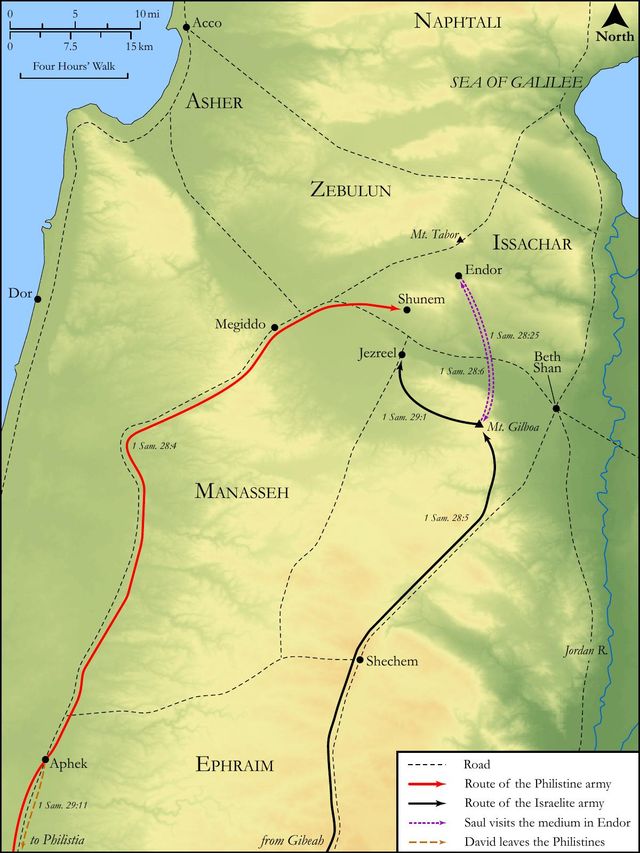
See on the biblical-era map
Study this verse
Public-domain commentary
Matthew Henry
From his Commentary on the Whole Bible. Henry comments on passages, not single verses — this entry covers 1 Samuel 29:1–5.
Here is, I. The great strait that David was in, which we may suppose he himself was aware of, though we read not of his asking advice from God, nor of any project of his own to get clear of it. The two armies of the Philistines and the Israelites were encamped and ready to engage, Sa1 29:1. Achish, who had been kind to David, had obliged him to come himself and bring the forces he had into his service. David came accordingly, and, upon a review of the army, was found with Achish, in the post assigned him in the rear, Sa1 29:2. Now, 1. If, when the armies engaged, he should retire, and quit his post, he would fall under the indelible reproach, not only of cowardice and treachery, but of base ingratitude to Achish, who had been his protector and benefactor and had reposed a confidence in him, and from whom he had received a very honourable commission. Such an unprincipled thing as this he could by no means persuade himself to do. 2. If he should, as was expected from him, fight for the Philistines against Israel, he would incur the imputation of being an enemy to the Israel of God and a traitor to his country, would make his own people hate him, and unanimously oppose his coming to the crown, as unworthy the name of an Israelite, much more the honour and trust of a king of Israel, when he had fought against them under the banner of the uncircumcised. If Saul should be killed (as it proved he was) in this engagement, the fault would be laid at David's door, as if he had killed him. So that on each side there seemed to be both sin and scandal. This was the strait he was in; and a great strait it was to a good man, greater to see sin before him than to see trouble. Into this strait he brought himself by his own unadvisedness, in quitting the land of Judah, and going among the uncircumcised. It is strange if those that associate themselves with wicked people, and grow intimate with them, come off without guilt, or grief, or both. What he himself proposed to do does not appear. Perhaps he designed to act only as keeper to the king's head, the post assigned him (Sa1 28:2) and not to do any thing offensively against Israel. But it would have been very hard to come so near the brink of sin and not to fall in. Therefore, though God might justly have left him in this difficulty, to chastise him for his folly, yet, because his heart was upright with him, he would not suffer him to be tempted above what he was able, but with the temptation made a way for him to escape, Co1 10:13.
II.A door opened for his deliverance out of this strait.
God inclined the hearts of the princes of the Philistines to oppose his being employed in the battle, and to insist upon his being dismissed. Thus their enmity befriended him, when no friend he had was capable of doing him such a kindness. 1. It was a proper question which they asked, upon the mustering of the forces, "What do these Hebrews here? Sa1 29:3. What confidence can we put in them, or what service can we expect from them?" A Hebrew is out of his place, and, if he has the spirit of a Hebrew, is out of his element, when he is in the camp of the Philistines, and deserves to be made uneasy there. David used to hate the congregation of evil doers, however he came now to be among them, Psa 26:5. It was an honourable testimony which Achish, on this occasion, gave to David. He looked upon him as a refugee, that fled from a wrongful prosecution in his own country, and had put himself under his protection, whom therefore he was obliged, in justice, to take care of, and thought he might in prudence employ; "for (says he) he has been with me these days, or these years," that is, a considerable time, many days at his court and a year or two in his country, and he never found any fault in him, nor saw any cause to distrust his fidelity, or to think any other than that he had heartily come over to him. By this it appears that David had conducted himself with a great deal of caution, and had prudently concealed the affection he still retained for his own people. We have need to walk in wisdom towards those that are without, to keep our mouth when the wicked is before us, and to be upon the reserve. 3. Yet the princes are peremptory in it, that he must be sent home; and they give good reasons for their insisting on it. (1.) Because he had been an old enemy to the Philistines; witness what was sung in honour of his triumphs over them: Saul slew his thousands, and David his ten thousands, Sa1 29:5. "It will be a reproach to us to harbour and trust so noted a destroyer of our people; nor can it be thought that he will now act heartily against Saul who then acted so vigorously with him and for him." Who would be fond of popular praise or applause when, even that may, another time, be turned against a man to his reproach? (2.) Because he might be a most dangerous enemy to them, and do them more mischief then all Saul's army could (Sa1 29:4): "He may in the battle be an adversary to us, and surprise us with an attack in the rear, while their army charges us in the front; and we have reason to think he will do so, that, by betraying us, he may reconcile himself to his master. Who can trust a man who, besides his affection to his country, will think it his interest to be false to us?" It is dangerous to put confidence in a reconciled enemy.
Historical interpretation
Historical reception
1 surviving comment on this verse from the historical church.
But also Israel encamped by the fountain, etc. The fountain which was in Jezreel, that is, in the seed of God, indicates the baptismal washing, by which the children of the Church are regenerated through the grace of the Holy Spirit. If therefore you understand the unbelieving Jews, or the heretics worse than unbelievers, figured in the name of Israel, both place their treacherous camps over the fountain of renewing grace; one through pride by despising it, the other through heresy by violating it.
Continue studying 1 Samuel 29:1 across the web’s major study libraries — every link below opens this exact verse, chapter, or book on the destination site.
Read & Compare
 BibleGatewayThis verse in more than 200 translations and 70 languages.
 Bible.comThe YouVersion reader — hundreds of translations, reading plans, and highlights.
 ESV.orgCrossway's official English Standard Version reader.
 NET BibleThe NET translation with 60,000+ translators' notes on every rendering decision.
 STEP BibleTyndale House's free study tool — original text, vocabulary, and scholarly resources.
 BibliaLogos Bible Software's free web reader.
 USCCBThe New American Bible (Revised Edition) with the U.S. bishops' study notes.
Commentaries
 BibleHub CommentariesDozens of classic commentaries on this verse, gathered on one page.
 StudyLightMore than 100 commentary sets — the largest collection on the web.
 BibleRefPlain-English commentary on what this verse means, verse by verse.
 Enduring WordDavid Guzik's free commentary on this chapter, widely used by Bible teachers.
 Bible Study ToolsVerse commentary alongside Greek and Hebrew study aids.
Original Language & Research
- BibleHub InterlinearThe verse word by word — original language, transliteration, and English.
- BibleHub LexiconEvery word's original-language definition and Strong's entry.
 Blue Letter BibleDeep-study tools — Strong's numbers, concordance, and word studies.
 SefariaThe Hebrew text with Rashi and centuries of Jewish commentary.
Sermons, Hymns & Audio


TrulyRandomVerse is not affiliated with these sites and doesn’t control their content. They’re linked because they’re genuinely useful.
Summary
1 Samuel 29:1 meticulously details the strategic positioning of two formidable armies, setting the stage for a climactic confrontation that will irrevocably alter the course of Israelite history. This verse precisely locates the Philistine forces at Aphek and the Israelite encampment by a critical fountain in Jezreel, immediately establishing the geographical and military parameters of the impending battle. It underscores the immense tension and the precarious circumstances surrounding King Saul's final days, while simultaneously highlighting the complex and morally challenging predicament faced by David, who at this moment is dwelling as Achish's servant among the Philistines.
Context
ShowHideLiterary Context
This verse serves as a crucial narrative hinge, immediately following the chilling and divinely condemned account of Saul's desperate consultation with the medium at Endor, where he received a definitive prophecy of his impending death and the transfer of his kingdom to David. The shift to the Philistine mobilization in 1 Samuel 29:1 directly links this divine judgment to the earthly means of its execution. Simultaneously, it plunges David, who has been residing as a loyal servant of Achish, king of Gath, since 1 Samuel 27:1, into an acute moral and military dilemma. This intricate setup directly precedes David's providential dismissal by the Philistine lords in 1 Samuel 29:2-11, thereby preventing him from fighting against his own people. The entire chapter functions as the immediate and dramatic prelude to the tragic Battle of Mount Gilboa and the deaths of Saul and his sons, comprehensively narrated in 1 Samuel 31.
Historical & Cultural Context
The Philistines, a formidable "Sea Peoples" group who had established a powerful pentapolis along the southwestern coast of Canaan, were the primary geopolitical rivals of Israel during the early monarchy. Their selection of Aphek as a gathering point was deeply strategic and historically resonant. Aphek, a known Philistine stronghold on the coastal plain, had previously been the site of a devastating Philistine victory over Israel, culminating in the capture of the Ark of the Covenant. This choice signaled their intent for a decisive, overwhelming engagement, leveraging past successes. Conversely, the Israelites, under Saul, positioned themselves by a "fountain" in Jezreel. The Valley of Jezreel, also known as the Esdraelon Valley or the Plain of Megiddo (biblically, Armageddon), is a vast, fertile, and strategically vital plain. It served as a major east-west thoroughfare and was historically a frequent battleground due to its accessibility and resources. The presence of a 'fountain' or natural spring was absolutely critical for supplying water to a large army, underscoring the practicalities of ancient military logistics and indicating a well-chosen defensive or staging ground for the impending conflict.
Key Themes
ShowHideThis verse masterfully introduces and reinforces several foundational themes that permeate the narrative of 1 Samuel. Firstly, it powerfully establishes the Impending Climactic Conflict, signaling the culmination of the protracted and often bitter struggle between Israel and the Philistines, a conflict that has largely defined Saul's turbulent reign and will ultimately lead to his demise. Secondly, it subtly but profoundly underscores Divine Sovereignty and Providence; even amidst the chaotic movements of armies, the intricate political maneuvering of David, and the seemingly human-driven strategies, the narrative implicitly asserts God's ultimate control. This decisive battle, though initiated by human aggression and military strategy, is portrayed as an integral part of God's overarching plan to transition leadership from Saul to David, thereby fulfilling His prophetic declarations and promises (compare 1 Samuel 15:28). Finally, the verse meticulously sets the stage for David's Unenviable Predicament and profound moral dilemma. As the servant of Achish, he is expected to fight alongside the Philistines against his own people, showcasing the depths of his exile from Saul's court and the complex, often agonizing, web of loyalties he is forced to navigate.
Exposition and Analysis
ShowHideKey Word Analysis
ShowHideA patrial term referring to the inhabitants of Pelesheth, the Philistine region. This powerful, non-Semitic people, originating from the Aegean, had settled on the coastal plain of Canaan and were Israel's most formidable adversaries during the period of the Judges and early monarchy. Their presence here signifies a major, unified military threat to Israel.
A primitive root meaning "to grasp, i.e., collect." This verb emphasizes the deliberate and comprehensive mobilization of the Philistine forces, indicating a full-scale assembly of "all their armies" for a decisive engagement. It suggests a unified and formidable military effort.
Derived from the root "to encamp," this noun refers to an encampment of travelers or troops, and by extension, an army or host. The use of the plural "armies" ("all their armies") highlights the vast scale and unified nature of the Philistine military might, underscoring the gravity of the threat they posed to Israel.
A primitive root meaning "to incline," and by implication, "to decline (of the slanting rays of evening)"; specifically, "to pitch a tent" or "to encamp." This verb describes the Israelites' action of establishing their military camp, indicating their readiness for battle and their chosen defensive position.
Literally meaning "eye," this word is commonly used by analogy to refer to a natural spring or well, as the "eye" of the landscape. For an army, access to a reliable water source was paramount for survival and sustained operations, making its mention here a crucial detail of military logistics.
Meaning "God will sow," this name refers to a significant valley in northern Israel, stretching from the Jordan Valley to the Mediterranean coast. It was a strategically vital and fertile plain, frequently serving as a battleground. Its name carries a subtle theological resonance, hinting at divine action or judgment even amidst human conflict.
Verse Breakdown
ShowHide"Now the Philistines gathered together all their armies to Aphek"
This opening clause immediately establishes the primary antagonist and the formidable scale of the impending conflict. The phrase "all their armies" emphasizes the unified and overwhelming power of the Philistines, indicating a full-scale mobilization aimed at a decisive engagement. Their convergence at Aphek, a location with historical significance for their past victories over Israel, signals their strategic intent and confidence in achieving another triumph.
"and the Israelites pitched by a fountain which [is] in Jezreel"
This second clause introduces the opposing force, Israel, and their chosen defensive or staging position. The verb "pitched" denotes the establishment of a military camp, signifying their readiness for the confrontation. The specific mention of a "fountain" highlights the critical logistical need for a reliable water source to sustain a large army, indicating a well-chosen and practical site. Jezreel, a well-known and strategically vital valley, precisely pinpoints the battleground, setting the immediate geographical context for the narrative's climax.
Literary Devices
ShowHideThe verse effectively employs Juxtaposition by immediately placing the two opposing armies and their respective strategic locations in direct relation to each other. The Philistines gather at Aphek, a site associated with their past triumphs over Israel, while the Israelites position themselves in Jezreel, a fertile valley symbolic of Israel's heartland. This creates a powerful sense of tension and anticipation, highlighting the impending collision. Furthermore, the verse functions as Foreshadowing, signaling the inevitability of a major, decisive battle. The comprehensive mobilization of both armies at these specific, historically significant locations strongly hints at the climactic nature of the coming confrontation, which will ultimately determine the fate of Saul's kingdom and pave the way for David's ascendancy. The careful geographical naming also provides a sense of Realism, grounding the narrative in tangible, identifiable locations that were historically significant battlegrounds.
Theological and Thematic Connections
ShowHide1 Samuel 29:1 serves as a profound theological statement on God's overarching sovereignty, even amidst the apparent chaos of human conflict and the intricate political maneuvering of nations. While armies gather according to human strategy and military might, the narrative implicitly asserts that God is orchestrating these events to fulfill His divine purposes, specifically the transfer of the kingdom from Saul to David. This battle, though seemingly a military confrontation driven by Philistine aggression and Israelite defense, is ultimately a vehicle for God's judgment on Saul's persistent disobedience and the establishment of His chosen king. It underscores the biblical truth that human might, strategic advantage, and numerical superiority are ultimately subordinate to the Lord's will, and that no human counsel or power can thwart His sovereign plans. The stage is set not merely for a battle between armies, but for the unfolding of God's redemptive history.
Reflection and Application
ShowHideThis verse, with its vivid depiction of two armies poised for a decisive battle and David caught in an impossible dilemma, offers profound and enduring lessons for contemporary believers. It reminds us that life often presents us with our own "battlegrounds"—situations of intense conflict, profound uncertainty, or deep moral ambiguity. Like David, we may find ourselves in circumstances where our loyalties are tested, our convictions challenged, and the path forward seems unclear or fraught with compromise. In such moments, the narrative subtly points to God's unseen hand, orchestrating events even when we cannot fully perceive His purpose or the ultimate outcome. This calls us to cultivate a deep and unwavering trust in God's sovereignty, recognizing that He is actively at work even in the most chaotic and challenging seasons of our lives. It also prompts us to reflect on our own preparedness, both spiritually and practically, for the challenges we face, and to diligently seek divine wisdom when navigating complex ethical choices, confident that God can deliver us from seemingly impossible predicaments and guide us according to His perfect will.
Questions for Reflection
ShowHideFAQ
ShowHideWhy was Aphek a significant gathering point for the Philistines, and Jezreel for the Israelites?
ShowHideAphek was a strategically important Philistine city, often serving as a staging ground for their military campaigns due to its location on the coastal plain, which provided excellent access to major trade routes and allowed for the easy movement of large armies. It was also the site of a major Philistine victory against Israel in 1 Samuel 4:1-11, where the Ark of the Covenant was captured and Israel suffered a devastating defeat. Its selection for this battle in 1 Samuel 29:1 not only served a practical military purpose but also likely carried significant psychological weight, reminding both sides of past Philistine dominance and signaling their intent for another decisive and potentially overwhelming victory over Israel. Jezreel, on the other hand, was a vital agricultural and strategic valley in northern Israel. Its choice by the Israelites, specifically "by a fountain," highlights the critical need for a reliable water source for a large army, a primary logistical consideration in ancient warfare. The valley itself was a well-known and frequently used battleground due to its open terrain and accessibility, making it a logical place for the Israelite forces to encamp and prepare for defense or engagement.
Christ-Centered Fulfillment
ShowHideThe gathering of armies in 1 Samuel 29:1, setting the stage for the end of Saul's reign and the ushering in of David's kingship, powerfully foreshadows the final collision of kingdoms and the establishment of God's eternal kingdom through Jesus Christ. Just as the Philistines gathered their forces to confront Israel, humanity, under the dominion of sin and spiritual darkness, stood in rebellion against God. However, the true decisive battle was not fought with swords and spears on an earthly plain, but on the cross, where Christ, the greater Son of David, confronted and triumphed over the spiritual powers of darkness. Colossians 2:15 profoundly declares that Jesus "disarmed the rulers and authorities and put them to open shame, by triumphing over them in him." The death of Saul, paving the way for David's kingship, prefigures the death and resurrection of Christ, which inaugurated His eternal reign. Unlike David's morally complex predicament of being caught between loyalties, Jesus faced the ultimate impossible situation, bearing the sin of the world and conquering death itself, emerging victorious over the grave (compare Hebrews 2:14-15). The ultimate victory is not achieved through human armies or strategic locations, but through the Lamb of God, who, as the victorious warrior of Revelation 19:11-16, will one day return to establish His kingdom fully, a kingdom not of this world (as declared in John 18:36), bringing true and lasting peace and justice.