


1 Kings 20:30
Bible text: King James Version (1769 Blayney text) · Public domain
Bible text: King James Version with Strong's numbers · Public domain
Bible text: Berean Standard Bible · Public domain
Bible text: American Standard Version (1901) · Public domain
Bible text: World English Bible, Messianic edition · Public domain
Bible text: Geneva Bible (1599) · Public domain
Bible text: Young's Literal Translation · Public domain
- וַיָּנֻסוּvai·ya·Nu·suand they fledH5127Conj-w ¦ V-Qal-ConsecImperf-3mpVerb Qal Consecutive Imperfect 3rd Plural Masculineוַandיָּנֻסוּthey fled
- הַנּוֹתָרִיםha·no·ta·Rimthe [ones who] remainedH3498Art ¦ V-Niphal-Prtcpl-mpVerb Niphal Participle Plural Masculine Absoluteהַtheנּוֹתָרִים[ones who] remained
- אֲפֵקָה'a·fe·KahAphek towardsH663N-proper ¦ SfxNoun Proper LocationאֲפֵקָAphekהtowards
- אֶל'elintoH413PrepPreposition
- הָעִירha·'Irthe cityH5892Art ¦ N-fsNoun Singular Feminine Absoluteהָtheעִירcity
- וַתִּפֹּלva·ti·Poland it fellH5307Conj-w ¦ V-Qal-ConsecImperf-3fsVerb Qal Consecutive Imperfect 3rd Singular Feminineוַandתִּפֹּלit fell
- הַחוֹמָהha·cho·Mahthe wallH2346Art ¦ N-fsNoun Singular Feminine Absoluteהַtheחוֹמָהwall
- עַל'alonH5921PrepPreposition
- עֶשְׂרִים'es·RimtwentyH6242N-mpNoun Plural Masculine Absolute
- וְשִׁבְעָהve·shiv·'Ahand sevenH7651Conj-w ¦ N-csNoun Singular common gender Absoluteוְandשִׁבְעָהseven
- אֶלֶף'E·lefthousandH505N-csNoun Singular common gender Absolute
- אִישׁ'ishmanH376N-msNoun Singular Masculine Absolute
- הַנּוֹתָרִיםha·no·ta·Rimwho remainedH3498Art ¦ V-Niphal-Prtcpl-mpVerb Niphal Participle Plural Masculine Absoluteהַwhoנּוֹתָרִיםremained
- וּבֶןu·venand BenH1130Conj-w ¦ N-proper-mNoun Proper MasculineוּandבֶןBen
- הֲדַדha·DadHadadH1130N-proper-mNoun Proper Masculine
- נָסNashe fledH5127V-Qal-Perf-3msVerb Qal Perfect 3rd Singular Masculine
- וַיָּבֹאvai·ya·Vo'and he wentH935Conj-w ¦ V-Qal-ConsecImperf-3msVerb Qal Consecutive Imperfect 3rd Singular Masculineוַandיָּבֹאhe went
- אֶל'elintoH413PrepPreposition
- הָעִירha·'Irthe cityH5892Art ¦ N-fsNoun Singular Feminine Absoluteהָtheעִירcity
- חֶדֶרChe·dera roomH2315N-msNoun Singular Masculine Absolute
- בְּחָדֶרbe·Cha·derin a roomH2315Prep-b ¦ N-msNoun Singular Masculine Absoluteבְּinחָדֶרa room
English is a literal word-by-word gloss of the Hebrew, not the KJV's wording. Why?
This is the original text the KJV's translators worked from — each Hebrew word with its own literal English meaning in this verse, prepared by scholars at Tyndale House, Cambridge. The KJV translates whole sentences, not word by word, so its wording differs: one Hebrew word can become several English words, and the KJV may choose “the LORD” where the gloss reads “Yahweh”. Both are faithful — they answer different questions. For the KJV's own rendering, switch to the KJV text.
Details
See on the biblical-era maps
Study this verse
Public-domain commentary
Matthew Henry
From his Commentary on the Whole Bible. Henry comments on passages, not single verses — this entry covers 1 Kings 20:22–30. His two-level outline is real structure in the source text, so it is rendered as structure.
We have here an account of another successful campaign which Ahab, by divine aid, made against the Syrians, in which he gave them a greater defeat than in the former. Strange! Ahab idolatrous and yet victorious, a persecutor and yet a conqueror! God has wise and holy ends in suffering wicked men to prosper, and glorifies his own name thereby.
I.Ahab is admonished by a prophet to prepare for another war, Kg1 20:22.
It should seem, he was now secure, and looked but a little way before him. Those that are careless of their souls are often as careless of their outwards affairs; but the prophet (to whom God made known the following counsels of the Syrians) told him they would renew their attempt at the return of the year, hoping to retrieve the honour they had lost and be avenged for the blow they had received. He therefore bade him strengthen himself, put himself into a posture of defence, and be ready to give them a warm reception. God had decreed the end, but Ahab must use the means, else he tempts God: "Help thyself, strengthen thyself, and God will help and strengthen thee." The enemies of God's Israel are restless in their malice, and, though they may take some breathing-time for themselves, yet they are still breathing out threatenings and slaughter against the church. It concerns us always to expect assaults from our spiritual enemies, and therefore to mark and see what we do.
II.Ben-hadad is advised by those about him concerning the operations of the next campaign.
1.They advised him to change his ground, Kg1 20:23. They took it for granted that it was not Israel, but Israel's gods, that beat them (so great a regard was then universally had to invisible powers); but they speak very ignorantly of Jehovah - that he was many, whereas he is one and his name one, - that he was their God only, a local deity, peculiar to that nation, whereas he is the Creator and ruler of all the world, - and that he was a God of the hills only, because David their great prophet had said, I will lift up my eyes to the hills whence cometh my help (Psa 121:1), and that his foundation was in the holy mountain (Psa 87:1; Psa 78:54), and much was said of his holy hill (Psa 15:1; Psa 24:3); supposing him altogether such a one as their imaginary deities, they fancied he was confined to his hills, and could not or would not come down from them, and therefore an army in the valley would be below his cognizance and from under his protection. Thus vain were the Gentiles in their imaginations concerning God, so wretchedly were their foolish hearts darkened, and, professing themselves to be wise, they became fools.
2.They advised him to change his officers (Kg1 20:24, Kg1 20:25), not to employ the kings, who were commanders by birth, but captains rather, who were commanders by merit, who were inured to war, would not affect to make a show like the kings, but would go through with business. Let every man be employed in that which he is brought up to and used to, and preferred to that which he is fit for. Syria, it seems, was rich and populous, when it could furnish recruits sufficient, after so great a defeat, horse for horse, chariot for chariot.
III.Both armies take the field.
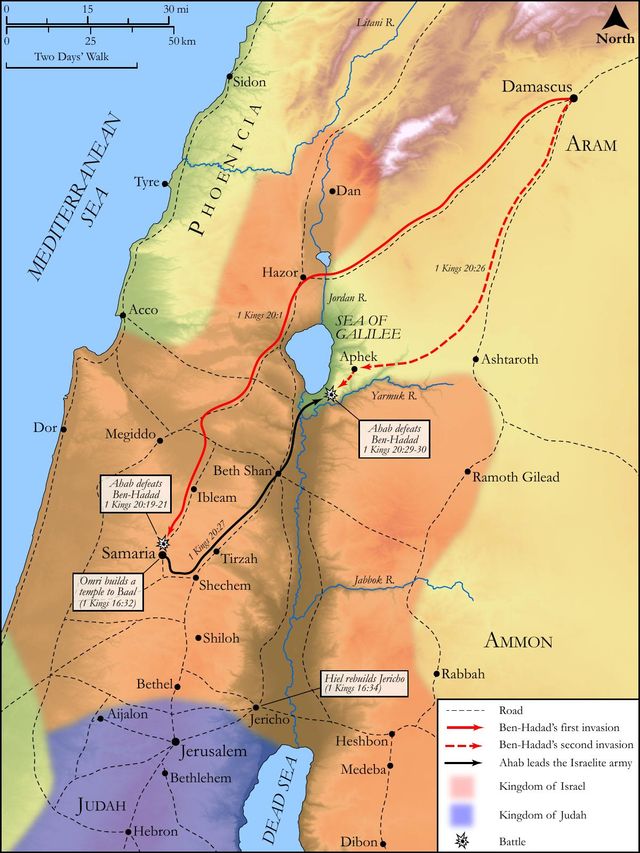
Ben-hadad, with his Syrians, encamps near Aphek, in the tribe of Asher. It is probable that Asher was a city in his own possession, one of those which his father had won (Kg1 20:34), and the country about it was flat and level, and fit for his purpose, Kg1 20:26. Ahab, with his forces, posted himself at some distance over against them, Kg1 20:27. The disproportion of numbers was very remarkable. The children of Israel, who were cantoned in two battalions, looked like two little flocks of kids, their numbers small, their equipage mean, and the figure they made contemptible; but the Syrians filled the country with their numbers, their noise, their chariots, their carriages, and their baggage.
IV.Ahab is encouraged to fight the Syrians, notwithstanding their advantages and confidence.
A man of God is sent to him, to tell him that this numerous army shall all be delivered into his hand (Kg1 20:28), but not for his sake; be it known to him, he is utterly unworthy for whom God will do this. God would not do it because Ahab had praised God or prayed to him (we do not read that he did either), but because the Syrians had blasphemed God, and had said, He is the God of the hills and not of the valleys; therefore God will do it in his own vindication, and to preserve the honour of his own name. If the Syrians had said, "Ahab and his people have forgotten their God, and so put themselves out of his protection, and therefore we may venture to attack them," God would probably have delivered Israel into their hands; but when they go upon a presumption so very injurious to the divine omnipotence, and the honour of him who is Lord of all hosts, not only in hills and valleys, but in heaven and earth, which they are willingly ignorant of, they shall be undeceived, at the expense of that vast army which is so much their pride and confidence.
V.After the armies had faced one another seven days (the Syrians, it is likely, boasting, and the Israelites trembling), they engaged, and the Syrians were totally routed, 100,000 men slain by the sword of Israel in the field of battle (Kg1 20:29), and 27,000 men, that thought themselves safe under the walls of Aphek, a fortified city (from the walls of which the shooters might annoy the enemy if they pursued them, Sa2 11:24), found their bane where they hoped for protection: the wall fell upon them, probably overthrown by an earthquake, and, the cities of Canaan being walled up to heaven, it reached a great way, and they were all killed, or hurt, or overwhelmed with dismay. Ben-hadad, who thought his city Aphek would hold out against the conquerors, finding it thus unwalled, and the remnant of his forces dispirited and dispersed, had nothing but secresy to rely upon for safety, and therefore hid himself in a chamber within a chamber, lest the pursuers should seize him. See how the greatest confidence often ends in the greatest cowardice. "Now is the God of Israel the God of the valleys or no?" He shall know now that he is forced into an inner chamber to hide himself, see Kg1 22:25.
Historical interpretation
Historical reception
3 surviving comments on this verse. Each one is dated, so this reads as a timeline rather than a list.
Select a marker to jump to its quote. Markers stagger vertically where authors wrote within a few decades of each other.
Here the Scripture relates the two battles of the king of Israel against the Arameans, at which we have already hinted, and the twin slaughters of the Arameans, of which the second caused the death of 127, men, as God took his revenge on the impious voice of the Arameans, who said about the true God worshiped by the Israelites, “The Lord is a god of the hills, but he is not a god of the valleys.”
Thus the saints go up to the Lord, the wicked go down to sin; the saints are on the mountains, the guilty in the valleys. “For he is the God of the mountains and not the God of the valleys.” Those who dwelt in the houses of the plain where God does not dwell could not have the house of God within them, for this is the house that God sought from them so that they might build up themselves and rear within themselves the temple of God from living stones of faith. He did not want buildings made with earthen walls or wooden roofs, for the hand of an enemy would have been able to overthrow them. He wanted that temple that is built in human hearts, to whom it might be said, “You are the temple of God,” in which the Lord Jesus might dwell and from there set out to redeem all humankind. There also could be prepared a sacred chamber in the womb of the Virgin where the King of heaven might live and a human body become the temple of God, which, though it was destroyed, might yet be restored to life on the third day.
Did not the Lord wish Ben-hadad, king of Syria, whom besides countless thousands of his own people, thirty-two kings and armies of the same number of kings served, to be conquered by a few foot soldiers of the princes in order that he who was the author of such victory would be acknowledged?
Continue studying 1 Kings 20:30 across the web’s major study libraries — every link below opens this exact verse, chapter, or book on the destination site.
Read & Compare
 BibleGatewayThis verse in more than 200 translations and 70 languages.
 Bible.comThe YouVersion reader — hundreds of translations, reading plans, and highlights.
 ESV.orgCrossway's official English Standard Version reader.
 NET BibleThe NET translation with 60,000+ translators' notes on every rendering decision.
 STEP BibleTyndale House's free study tool — original text, vocabulary, and scholarly resources.
 BibliaLogos Bible Software's free web reader.
 USCCBThe New American Bible (Revised Edition) with the U.S. bishops' study notes.
Commentaries
 BibleHub CommentariesDozens of classic commentaries on this verse, gathered on one page.
 StudyLightMore than 100 commentary sets — the largest collection on the web.
 BibleRefPlain-English commentary on what this verse means, verse by verse.
 Enduring WordDavid Guzik's free commentary on this chapter, widely used by Bible teachers.
 Bible Study ToolsVerse commentary alongside Greek and Hebrew study aids.
Original Language & Research
- BibleHub InterlinearThe verse word by word — original language, transliteration, and English.
- BibleHub LexiconEvery word's original-language definition and Strong's entry.
 Blue Letter BibleDeep-study tools — Strong's numbers, concordance, and word studies.
 SefariaThe Hebrew text with Rashi and centuries of Jewish commentary.
Sermons, Hymns & Audio


TrulyRandomVerse is not affiliated with these sites and doesn’t control their content. They’re linked because they’re genuinely useful.
Summary
First Kings 20:30 delivers the dramatic climax to the second confrontation between Israel and Aram, detailing the catastrophic divine judgment upon the Syrian forces. Following their decisive rout in battle, the remnants of Ben-Hadad's army sought desperate refuge within the fortified city of Aphek. However, in a stunning act of divine intervention, a city wall miraculously collapsed upon twenty-seven thousand men, utterly annihilating them. This event powerfully asserts God's absolute sovereignty over all creation, nations, and human defenses, demonstrating His power extends beyond any perceived geographical or military limitations. Concurrently, it portrays the profound humiliation and desperate flight of King Ben-Hadad, who, despite his earlier arrogance, is reduced to hiding in the most secluded part of the city.
Context
ShowHideLiterary Context
This verse serves as the climactic and devastating conclusion to the second major battle between Israel and Aram (Syria), as detailed in 1 Kings 20. The chapter initiates with the audacious and arrogant demands of Ben-Hadad upon King Ahab, which are met with a divinely orchestrated, improbable victory for Israel against overwhelming odds in the first engagement (1 Kings 20:1-21). Undeterred, Ben-Hadad's advisors, misinterpreting Israel's God as merely a "god of the hills," convinced him to regroup and engage Israel on the plains, believing they could secure victory there (1 Kings 20:23-25). However, a prophet again intervened, assuring King Ahab of God's direct involvement and explicitly declaring the Lord's universal dominion as God of both hills and valleys, thereby directly challenging pagan notions of localized deities (1 Kings 20:28). The subsequent battle (1 Kings 20:29) resulted in a massive rout of the Syrian army, setting the stage for the final, supernatural act of judgment described in 1 Kings 20:30, which underscores God's absolute power and the futility of human defiance.
Historical & Cultural Context
The ongoing conflict between Israel and Aram (Syria) was a defining geopolitical struggle during the Omride dynasty, with both kingdoms vying for control over vital trade routes and fertile territories in the Levant. Aphek, likely identified with Tel Aphek (Antipatris) in the Sharon plain, was a strategically crucial fortified city, frequently serving as a battleground due to its commanding location. In ancient warfare, walled cities were indispensable as places of refuge and defense for retreating armies. The Aramean belief in "gods of the hills" versus "gods of the valleys" reflects a widespread religious worldview among the nations where deities were often associated with specific geographical domains, natural phenomena, or tribal affiliations. The dramatic collapse of a city wall, especially on such a massive scale and immediately following a military defeat, would have been universally interpreted by both Israelites and Arameans as an unmistakable and direct act of divine intervention, powerfully demonstrating the supreme, unchallengeable power of Israel's God over all creation and all other deities.
Key Themes
ShowHide1 Kings 20:30 profoundly reinforces several foundational themes woven throughout 1 Kings. Central to this passage is the theme of Divine Sovereignty and Judgment. God's direct, miraculous intervention, causing the wall to fall, unequivocally asserts His absolute control over natural forces and His ability to execute judgment against those who defy Him, irrespective of their military might or strategic advantage. This directly refutes the Aramean's limited understanding of God, affirming His Universal Authority over all creation. The verse also starkly illustrates the Fragility of Human Power and Pride. Ben-Hadad, initially portrayed as boastful and arrogant (1 Kings 20:10), is utterly humiliated, reduced to hiding in fear, serving as a vivid example of the biblical proverb that "pride goes before destruction, and a haughty spirit before a fall" (Proverbs 16:18). Finally, it powerfully underscores God's Faithfulness to His People, even when their king, Ahab, is far from righteous, as God acts to vindicate His own name and demonstrate His unparalleled power to both Israel and the surrounding nations.
Exposition and Analysis
ShowHideKey Word Analysis
ShowHideThis place name (H663), meaning "fortress" or "stronghold," refers to a significant fortified city, likely the one in the Sharon plain. Its mention here is deeply ironic; what was intended as a secure refuge for the routed Syrian army became the very site of their catastrophic, divinely orchestrated destruction. This highlights the futility of human defenses when confronted by God's judgment and underscores that no human-made fortification can withstand His sovereign will.
The Hebrew word (H2346) refers to a protective wall, typically one surrounding a city. In this context, the sudden and complete collapse of such a massive structure upon twenty-seven thousand men is presented not as a natural disaster but as a direct, supernatural act of God. It signifies the breaking down of human barriers and the undeniable demonstration of divine power, emphasizing that God's authority extends even over the most formidable human constructions.
This word (H2315) denotes an apartment or inner room, often the most private and secure part of a dwelling. The phrase "inner chamber" (חֶדֶר בְּחָדֶר, ḥeḏer bəḥāḏer in the Hebrew text) idiomatically emphasizes the innermost, most secluded, and presumably safest part of a building. Ben-Hadad's desperate flight to such a hidden place starkly contrasts his earlier public displays of power and arrogance, vividly illustrating his complete humiliation, fear, and the utter loss of his royal dignity in the face of God's overwhelming judgment.
Verse Breakdown
ShowHide"But the rest fled to Aphek, into the city;"
This clause describes the immediate aftermath of the decisive battle, where the surviving Syrian soldiers, having been utterly routed by Israel's forces, instinctively sought the traditional refuge offered by a fortified city. Aphek, a well-known stronghold, represented their logical, albeit ultimately futile, destination for safety and regrouping.
"and [there] a wall fell upon twenty and seven thousand of the men [that were] left."
This is the dramatic and pivotal moment of divine intervention. The collapse of the city wall is presented as a direct, supernatural act, not a random or accidental occurrence. The staggering number of casualties—twenty-seven thousand—serves to underscore the immense scale of God's judgment and the absolute completeness of the Syrian defeat, far exceeding what human armies alone could achieve. It is a powerful, undeniable demonstration of God's sovereign power over natural elements and His ability to destroy an enemy even within their supposed sanctuary.
"And Benhadad fled, and came into the city, into an an inner chamber."
This final clause focuses on the personal humiliation of the Syrian king. Ben-Hadad, who began the chapter with boastful arrogance and overwhelming military might, is now depicted in a state of abject fear and utter disgrace. His flight into the "inner chamber" signifies his desperate attempt to escape capture, divine judgment, and public shame, highlighting the complete and devastating reversal of his fortunes at the hand of the Almighty God.
Literary Devices
ShowHide1 Kings 20:30 masterfully employs several potent Literary Devices. Irony is profoundly evident, as Aphek, a city designed as an impenetrable fortress and a place of refuge, becomes the site of catastrophic, divinely orchestrated destruction, transforming sanctuary into a death trap for thousands of Syrian soldiers. This serves as a dramatic Divine Intervention or Miracle, unequivocally showcasing God's direct and absolute control over creation, directly challenging the Aramean's limited, localized understanding of deity. The verse also utilizes powerful Contrast, juxtaposing the immense power and unbridled pride of the Syrian army and its king at the chapter's outset with their utter annihilation and Ben-Hadad's desperate, humiliating retreat to an "inner chamber" at its conclusion. This stark contrast highlights the profound Fragility of Human Power when confronted by the overwhelming force of divine sovereignty. Furthermore, the falling wall itself can be seen as potent Symbolism, representing the collapse of human defiance and the undeniable, universal authority of God.
Theological and Thematic Connections
ShowHideThe profound theological message embedded in 1 Kings 20:30 centers on the absolute and universal sovereignty of God. It stands as a powerful and unequivocal rebuttal to any notion of a limited deity, demonstrating beyond doubt that the Lord is not merely a "god of the hills" but the omnipotent God of all creation, possessing supreme power over armies, kings, and even the very structures of the earth. This dramatic event serves as a profound vindication of God's holy name and His unwavering covenant faithfulness, serving as a potent reminder to both Israel and the nations that true power resides not in human might, strategic advantage, or fortified defenses, but solely in the sovereign will and decree of the Almighty. The swift and devastating judgment upon the Arameans, culminating in the miraculous collapse of the wall, powerfully underscores God's active and decisive involvement in human history, executing justice and humbling the proud.
Reflection and Application
ShowHideThe dramatic events recounted in 1 Kings 20:30 offer profound and enduring lessons for believers today. We are powerfully reminded that God's omnipotence is not confined by human understanding, geographical boundaries, or the perceived limitations of our circumstances. Just as He demonstrated His absolute sovereignty over the formidable Aramean army and the city wall, He remains sovereign over every intricate detail of our lives, our most daunting challenges, and the vast global landscape. This truth should instill in us an unshakeable sense of trust and confidence, knowing that the God who actively fights for His people is supremely capable of achieving His divine purposes through means far beyond our human comprehension or expectation. Furthermore, the utter humiliation of Ben-Hadad serves as a timeless and sobering warning against the perils of pride and defiance toward God. Whether manifested in our personal ambitions, our professional pursuits, or our spiritual walk, unwavering humility before the Almighty is paramount. True security, lasting peace, and genuine victory are found not in self-reliance, worldly strength, or strategic cunning, but in humbly acknowledging God's ultimate authority and wholeheartedly submitting to His perfect will.
Questions for Reflection
ShowHideFAQ
ShowHideWas the falling wall a natural event or divine intervention?
ShowHideWhile it is theoretically possible for city walls to collapse due to structural weakness or seismic activity, the biblical narrative in 1 Kings 20 strongly presents this event as a direct, miraculous act of divine intervention. Its timing is crucial: it occurs precisely when the Syrian army is seeking refuge, immediately following a prophet's explicit declaration that God would demonstrate His universal power, not merely as a "god of the hills" but as the God of the valleys as well (1 Kings 20:28). The sheer scale of the collapse, resulting in the death of twenty-seven thousand men, further points to a supernatural rather than a purely accidental cause. It serves as a dramatic and undeniable fulfillment of God's promise to humble Ben-Hadad and unequivocally vindicate His own name and authority.
Why did God allow such a massive loss of life?
ShowHideThe massive loss of life, particularly the twenty-seven thousand crushed by the wall, is depicted in the biblical text as a severe act of divine judgment against the Arameans. This judgment was provoked by Ben-Hadad's arrogant defiance of God and his advisors' blasphemous assertion that Israel's God was limited to certain geographical domains (1 Kings 20:23). God's actions here underscore His absolute sovereignty over all nations and His unwavering willingness to execute justice against those who challenge His authority, mock His power, and oppress His chosen people. It also served to demonstrate unequivocally to Israel, and to the surrounding pagan nations, that the Lord is the one true God, without geographical or situational limitations, and that His power is absolute and irresistible.
What is the significance of Ben-Hadad hiding in an "inner chamber"?
ShowHideBen-Hadad's retreat to an "inner chamber" (1 Kings 20:30) is profoundly significant. It serves as a dramatic and stark contrast to his earlier public arrogance, boastful threats, and displays of overwhelming military might (1 Kings 20:10). The "inner chamber" (חֶדֶר בְּחָדֶר, ḥeḏer bəḥāḏer) signifies the most secluded, private, and presumably secure part of a building, emphasizing his desperate attempt to escape capture, public shame, and the full weight of his defeat. It vividly illustrates the complete reversal of his fortunes, the fragility of human power and pride, and the extent of his utter humiliation when confronted by the overwhelming power and righteous judgment of God.
Christ-Centered Fulfillment
ShowHideWhile 1 Kings 20:30 portrays a dramatic and decisive act of God's judgment against a defiant earthly kingdom, its ultimate fulfillment and deeper theological meaning are profoundly illuminated in the person and redemptive work of Jesus Christ. The demonstration of God's absolute sovereignty over all creation, even extending to the miraculous collapse of city walls, powerfully foreshadows the ultimate and supreme authority vested in Christ, who declared, "All authority in heaven and on earth has been given to me" (Matthew 28:18). The crushing defeat of Ben-Hadad and his arrogant army, culminating in the king's humiliating retreat, prefigures Christ's decisive and eternal victory over all spiritual powers and principalities, including the formidable enemies of sin, death, and the devil. Just as the physical wall of Aphek collapsed under divine judgment, so too did the spiritual strongholds of evil and the barriers of sin collapse at the cross, where Christ "disarmed the powers and authorities, he made a public spectacle of them, triumphing over them by the cross" (Colossians 2:15). The desperate hiding of Ben-Hadad in an inner chamber finds its ultimate contrast in Christ, who, far from hiding, openly conquered and now reigns gloriously, inviting all humanity to find eternal refuge not in a collapsing city, but in His eternal kingdom. He is the Lamb of God who takes away the sin of the world and the victorious King of kings and Lord of lords, offering true security and salvation to all who believe.