


Daniel 4:37
- כְּעַןke·'AnnowH3705AdvAdverb
- אֲנָה'a·NahIH576Pro-1csPronoun Personal 1st Singular common gender
- נְבוּכַדְנֶצַּרne·vu·khad·ne·TzarNebuchadnezzarH5020N-proper-mNoun Proper Masculine
- מְשַׁבַּחme·sha·Bach[am] praisingH7624V-Pael-Prtcpl-msVerb Pael Participle Singular Masculine Absolute
- וּמְרוֹמֵםu·me·ro·Memand [am] lifting upH7313Conj-w ¦ V-Piel-Prtcpl-msVerb Piel Participle Singular Masculine Absoluteוּandמְרוֹמֵם[am] lifting up
- וּמְהַדַּרu·me·ha·Darand [am] glorifyingH1922Conj-w ¦ V-Piel-Prtcpl-msVerb Piel Participle Singular Masculine Absoluteוּandמְהַדַּר[am] glorifying
- לְמֶלֶךְle·Me·lekh<obj.> [the] king ofH4430Prep-l ¦ N-cscNoun Singular common gender Constructלְ<obj.>מֶלֶךְ[the] king of
- שְׁמַיָּאshe·mai·Ya'heavens theH8065N-mp ¦ ArtNoun Plural Masculine Definiteשְׁמַיָּheavensאthe
- דִּיdiwhoH1768ConjConjunction
- כָלkholallH3606N-cscNoun Singular common gender Construct
- מַעֲבָדוֹהִיma·'a·va·Do·hihis deedsH4567N-mpc ¦ 3msNoun Plural Masculine Constructמַעֲבָדוֹdeedsהִיhis
- קְשֹׁטke·Shot[are] truthH7187N-csNoun Singular common gender Absolute
- וְאֹרְחָתֵהּve·'o·re·cha·Tehand his waysH735Conj-w ¦ N-fpc ¦ 3msNoun Plural Feminine Constructוְandאֹרְחָתֵwaysהּhis
- דִּיןDin[are] justiceH1780N-csNoun Singular common gender Absolute
- וְדִיve·Diand [those] whoH1768Conj-w ¦ ConjConjunctionוְandדִי[those] who
- מַהְלְכִיןmah·le·Khin[are] walkingH1981V-Haphel-Prtcpl-mpVerb Haphel Participle Plural Masculine Absolute
- בְּגֵוָהbe·ge·Vahin prideH1467Prep-b ¦ N-fsNoun Singular Feminine Absoluteבְּinגֵוָהpride
- יָכִלya·Khil[he is] ableH3202V-Peal-Prtcpl-msVerb Peal Participle Singular Masculine Absolute
- לְהַשְׁפָּלָהle·hash·pa·Lahto bring lowH8214Prep-l ¦ V-Hiphil-InfVerb Hiphil Infinitive Constructלְtoהַשְׁפָּלָהbring low
English is a literal word-by-word gloss of the Hebrew, not the KJV's wording. Why?
This is the original text the KJV's translators worked from — each Hebrew word with its own literal English meaning in this verse, prepared by scholars at Tyndale House, Cambridge. The KJV translates whole sentences, not word by word, so its wording differs: one Hebrew word can become several English words, and the KJV may choose “the LORD” where the gloss reads “Yahweh”. Both are faithful — they answer different questions. For the KJV's own rendering, switch to the KJV text.
Details
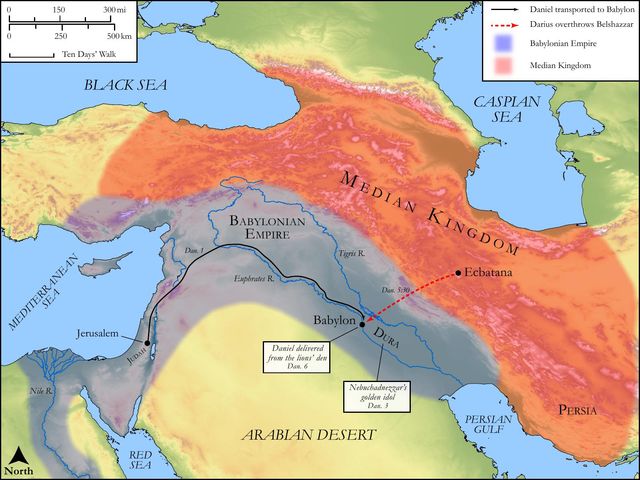
See on the biblical-era map
Study this verse
Public-domain commentary
Matthew Henry
From his Commentary on the Whole Bible. Henry comments on passages, not single verses — this entry covers Daniel 4:34–37. His two-level outline is real structure in the source text, so it is rendered as structure.
We have here Nebuchadnezzar's recovery from his distraction, and his return to his right mind, at the end of the days prefixed, that is, of the seven years. So long he continued a monument of God's justice and a trophy of his victory over the children of pride, and he was made more so by being struck mad than if he had been in an instant struck dead with a thunderbolt; yet it was a mercy to him that he was kept alive, for while there is life there is hope that we may yet praise God, as he did here: At the end of the days (says he), I lifted up my eyes unto heaven (Dan 4:34), looked no longer down towards the earth as a beast, but begun to look up as a man. Os homini sublime dedit - Heaven gave to man an erect countenance. But there was more in it than this; he looked up as a devout man, as a penitent, as a humble petitioner for mercy, being perhaps never till now made sensible of his own misery. And now,
I.He has the use of his reason so far restored to him that with it he glorifies God, and humbles himself under his mighty hand.
He was told that he should continue in that forlorn case till he should know that the Most High rules, and here we have him brought to the knowledge of this: My understanding returned to me, and I blessed the Most High. Note, Those may justly be reckoned void of understanding that do not bless and praise God; nor do men ever rightly use their reason till they begin to be religious, nor live as men till they live to the glory of God. As reason is the substratum or subject of religion (so that creatures which have no reason are not capable of religion), so religion is the crown and glory of reason, and we have our reason in vain, and shall one day wish we had never had it, if we do not glorify God with it. This was the first act of Nebuchadnezzar's returning reason; and, when this became the employment of it, he was then, and not till then, qualified for all the other enjoyments of it. And till he was for a great while disabled to exercise it in other things he never was brought to apply it to this, which is the great end for which our reason is given us. His folly was the means whereby he became wise; he was not recovered by his dream of this judgment (that was soon forgotten like a dream), but he is made to feel it, and then his ear is opened to discipline. To bring him to himself, he must first be beside himself. And by this it appears that what good thoughts there were in his mind, and what good work was wrought there, were not of himself (for he was not his own man), but it was the gift of God. Let us see what Nebuchadnezzar is now at length effectually brought to the acknowledgment of; and we may learn from it what to believe concerning God.
1.That the most high God lives for ever, and his being knows neither change nor period, for he has it of himself. His flatterers often complimented him with, O king! live for ever. But he is now convinced that no king lives for ever, but the God of Israel only, who is still the same.
2.That his kingdom is like himself, everlasting, and his dominion from generation to generation; there is no succession, no revolution, in his kingdom. As he lives, so he reigns, for ever, and of his government there is no end.
3.That all nations before him are as nothing. He has no need of them; he makes no account of them. The greatest of men, in comparison with him, are less than nothing. Those that think highly of God think meanly of themselves.
4.That his kingdom is universal, and both the armies of heaven and the inhabitants of the earth are his subjects, and under his check and control. Both angels and men are employed by him, and are accountable to him; the highest angel is not above his command, nor the meanest of the children of men beneath his cognizance. The angels of heaven are his armies, the inhabitants of the earth his tenants.
5.That his power is irresistible, and his sovereignty uncontrollable, for he does according to his will, according to his design and purpose, according to his decree and counsel; whatever he pleases that he does; whatever he appoints that he performs; and none can resist his will, change his counsel, nor stay his hand, nor say unto him, What doest thou? None can arraign his proceedings, enquire into the meaning of them, nor demand a reason for them. Woe to him that strives with his Maker, that says to him, What doest thou? Or, Why doest thou so?
6.That every thing which God does is well done: His works are truth, for they all agree with his word. His ways are judgment, both wise and righteous, exactly consonant to the rules both of prudence and equity, and no fault is to be found with them.
7.That he has power to humble the haughtiest of his enemies that act in contradiction to him or competition with him: Those that walk in pride he is able to abuse (Dan 4:37); he is able to deal with those that are most confident of their own sufficiency to contend with him.
II.He has the use of his reason so far restored to him as with it to re-enjoy himself, and the pleasures of his re-established prosperity (Dan 4:36): At the same time my reason returned to me; he had said before (Dan 4:34) that his understanding returned to him, and here he mentions it again, for the use of our reason is a mercy we can never be sufficiently thankful for. Now his lords sought to him; he did not need to seek to them, and they soon perceived, not only that he had recovered his reason and was fit to rule, but that he had recovered it with advantage, and was more fit to rule than ever. It is probable that the dream and the interpretation of it were well known, and much talked of, at court; and the former part of the prediction being fulfilled, that he should go distracted, they doubted not but that, according to the prediction, he should come to himself again at seven years' end, and, in confidence of that, when the time had expired they were ready to receive him; and then his honour and brightness returned to him, the same that he had before his madness seized him. He is now established in his kingdom as firmly as if there had been no interruption given him. He becomes a fool, that he may be wise, wiser than ever; and he that but the other day was in the depth of disgrace and ignominy has now excellent majesty added to him, beyond what he had when he went from kingdom to kingdom conquering and to conquer. Note,
1.When men are brought to honour God, particularly by a penitent confession of sin and a believing acknowledgment of his sovereignty, then, and not till then, they may expect that God will put honour upon them, will not only restore them to the dignity they lost by the sin of the first Adam, but add excellent majesty to them from the righteousness and grace of the second Adam.
2.Afflictions shall last no longer than till they have done the work for which they were sent. When this prince is brought to own God's dominion over himself.
3.All the accounts we take and give of God's dealing with us ought to conclude with praises to him. When Nebuchadnezzar is restored to his kingdom he praises, and extols, and honours the King of heaven (Dan 4:37), before he applies himself to his secular business. Therefore we have our reason, that we may be in a capacity of praising him, and therefore our prosperity, that we may have cause to praise him.
It was not long after this that Nebuchadnezzar ended his life and reign. Abydenus, quoted by Eusebius (Prap. Evang. 1.9), reports, from the tradition of the Chaldeans, that upon his death-bed he foretold the taking of Babylon by Cyrus. Whether he continued in the same good mind that here he seems to have been in we are not told, nor does any thing appear to the contrary but that he did: and, if so great a blasphemer and persecutor did find mercy, he was not the last. And, if our charity may reach so far as to hope he did, we must admire free grace, by which he lost his wits for a while that he might save his soul for ever.
Historical interpretation
Historical reception
3 surviving comments on this verse. Each one is dated, so this reads as a timeline rather than a list.
Select a marker to jump to its quote. Markers stagger vertically where authors wrote within a few decades of each other.
Through that punishment, which he inflicted on me, [God] showed that he gives back to each one his properties with justice and impartiality and humiliates those who walk in arrogance; and as he mortified me, who was too full of myself and behaved arrogantly, so he will break the audacity of people similar to me with similar consideration.
Verse 37. "'Now therefore I, Nebuchadnezzar, do praise, magnify and glorify the King of heaven, for all His works are true and His ways are judgment, and He is able to humble those who walk in pride.'" Nebuchadnezzar understood the reason why he had suffered in seven years' punishment, and for that reason he humbled himself, since he had exalted himself against God.
Having had experience of misfortune and then being rid of it, I sing the praises of the one who to my advantage brought on me one condition and the other in his great wisdom. I know he is the King of heaven and Lord of all, acting in truth, governing everything justly and capable of humbling those behaving haughtily.
Continue studying Daniel 4:37 across the web’s major study libraries — every link below opens this exact verse, chapter, or book on the destination site.
Read & Compare
 BibleGatewayThis verse in more than 200 translations and 70 languages.
 Bible.comThe YouVersion reader — hundreds of translations, reading plans, and highlights.
 ESV.orgCrossway's official English Standard Version reader.
 NET BibleThe NET translation with 60,000+ translators' notes on every rendering decision.
 STEP BibleTyndale House's free study tool — original text, vocabulary, and scholarly resources.
 BibliaLogos Bible Software's free web reader.
 USCCBThe New American Bible (Revised Edition) with the U.S. bishops' study notes.
Commentaries
 BibleHub CommentariesDozens of classic commentaries on this verse, gathered on one page.
 StudyLightMore than 100 commentary sets — the largest collection on the web.
 BibleRefPlain-English commentary on what this verse means, verse by verse.
 Enduring WordDavid Guzik's free commentary on this chapter, widely used by Bible teachers.
 Bible Study ToolsVerse commentary alongside Greek and Hebrew study aids.
Original Language & Research
- BibleHub InterlinearThe verse word by word — original language, transliteration, and English.
- BibleHub LexiconEvery word's original-language definition and Strong's entry.
 Blue Letter BibleDeep-study tools — Strong's numbers, concordance, and word studies.
 SefariaThe Hebrew text with Rashi and centuries of Jewish commentary.
Sermons, Hymns & Audio


TrulyRandomVerse is not affiliated with these sites and doesn’t control their content. They’re linked because they’re genuinely useful.
Summary
Daniel 4:37 stands as the triumphant capstone of King Nebuchadnezzar's profound spiritual journey, marking his complete transformation from an arrogant despot to a humble worshipper of the Most High God. This verse encapsulates his unequivocal public declaration of the absolute sovereignty, unwavering truth, and righteous judgment of the "King of heaven," acknowledging God's unique power to humble the proud and exalt the lowly. It serves as an enduring testament to divine authority, showcasing God's ability to reveal His character and establish His rule even through the most powerful earthly monarchs, ultimately leading them to a genuine confession of His supreme dominion.
Context
ShowHideLiterary Context
Daniel 4:37 provides the climactic conclusion to Nebuchadnezzar's personal testimony, which comprises the entirety of Daniel chapter 4. The chapter opens with the king's own account of a disturbing dream involving a towering tree that was cut down, leaving only a stump. Daniel, God's prophet, interpreted this dream as a direct divine warning to Nebuchadnezzar, prophesying a period of severe humbling where he would be driven from human society and live like a beast for "seven times," until he acknowledged the Most High's dominion over all earthly kingdoms, as detailed in Daniel 4:25. The narrative then vividly recounts the fulfillment of this prophecy, as Nebuchadnezzar indeed suffered a period of mental illness and degradation. His miraculous restoration to sanity and kingship is immediately followed by his dramatic declaration of praise to God, which begins in Daniel 4:34 and culminates in the profound confession of verse 37, thereby solidifying the chapter's overarching message of divine sovereignty and the humbling of human pride.
Historical & Cultural Context
Nebuchadnezzar II reigned as the most formidable monarch of the Neo-Babylonian Empire from 605-562 BC. His reign was characterized by extensive military conquests, including the infamous destruction of Jerusalem and the subsequent exile of the Judeans. Babylon itself, under his rule, became a legendary city, renowned for architectural marvels like the Hanging Gardens, its immense walls, and the grand ziggurat, all of which served as tangible symbols of Nebuchadnezzar's immense power and self-glorifying ambition. In the polytheistic societies of the ancient Near East, kings were frequently regarded as divine representatives or even deities themselves, and their decrees held absolute authority. Within this cultural milieu, where human achievement and imperial might were celebrated as ultimate, Nebuchadnezzar's public confession of the God of Israel as the "King of heaven" was an exceptionally radical and counter-cultural act. It signified a profound shift from the prevailing pagan worldview to the recognition of monotheistic divine supremacy, a concept that fundamentally challenged the established Babylonian religious and political order.
Key Themes
ShowHideThe preeminent theme of Daniel chapter 4, powerfully underscored by Daniel 4:37, is the absolute sovereignty of God over all earthly rulers and kingdoms. Nebuchadnezzar's personal ordeal vividly illustrates that no human power, however immense or seemingly invincible, can ultimately withstand or usurp the will of the Most High. Intricately linked to this is the theme of the humbling of human pride, as the king's egregious self-exaltation is directly met with divine judgment, demonstrating the biblical principle that "God resists the proud, but gives grace to the humble" as articulated in James 4:6. The verse further highlights God's unwavering truth and righteous judgment, affirming that His character is utterly consistent, and His actions are always just and purposeful, even when they involve severe discipline. Finally, the narrative powerfully showcases the transformative power of divine intervention, as Nebuchadnezzar transitions from arrogant self-sufficiency to genuine reverence, illustrating that true wisdom and ultimate restoration are found only through acknowledging God's supreme authority, a truth he begins to grasp in Daniel 4:34-35.
Exposition and Analysis
ShowHideKey Word Analysis
ShowHideCorresponding to the Hebrew shâbach, this Aramaic term signifies "to adulate" or "to adore." In this context, it denotes Nebuchadnezzar's act of offering profound worship, commendation, and glorification to God, moving beyond mere intellectual acknowledgment to a deep, heartfelt expression of reverence and admiration for His divine character and mighty deeds.
Corresponding to the Hebrew gêvâh, this word denotes "exaltation" or, figuratively, "arrogance." It refers to an inflated sense of self-importance, a haughty disposition that attributes success, power, and achievement solely to one's own abilities rather than to divine provision or sovereignty. Nebuchadnezzar's entire transformative journey is a direct divine confrontation with this very sin.
Corresponding to the Hebrew shâfêl, this term means "to depress or sink," or figuratively, "to humiliate." It describes God's active and sovereign role in bringing low those who are proud, stripping them of their self-exalted status, power, and dignity. This action serves to demonstrate His ultimate authority and the utter futility of human arrogance in the face of divine power.
Verse Breakdown
ShowHide"Now I Nebuchadnezzar praise and extol and honour the King of heaven,"
This opening clause marks a profound and dramatic pivot in the king's life. The emphatic "Now" (Aramaic: kᵉʻan) highlights the immediate and radical change in Nebuchadnezzar's perspective and disposition following his restoration. The triple declaration—praise (shᵉbach), extol (rûwm), and honour (hădar)—underscores the depth, sincerity, and comprehensive nature of his newfound reverence and worship. He is no longer glorifying himself or the pagan deities of Babylon, but rather the "King of heaven" (Aramaic: Melek Shamayin), a title that explicitly acknowledges God's supreme and transcendent authority not merely over earthly kingdoms, but over the entire cosmos, thereby transcending and nullifying all earthly and pagan powers.
"all whose works [are] truth, and his ways judgment:"
This clause articulates the foundational attributes of the "King of heaven" that Nebuchadnezzar has come to understand through his humbling experience. "All whose works are truth" (Aramaic: qᵉshôwṭ) declares God's actions and decrees as utterly reliable, faithful, consistent with His character, and free from any deception, error, or caprice. His "ways" (Aramaic: ʼôrach), referring to His dealings, governance, and moral principles, are "judgment" (Aramaic: dîyn), meaning they are characterized by perfect justice, absolute righteousness, and unwavering equity. This signifies Nebuchadnezzar's recognition that God's rule is not arbitrary or capricious but is immutably founded upon perfect moral principles, even when it involves severe and humbling discipline.
"and those that walk in pride he is able to abase."
This final, concluding statement serves as both a theological summary of Nebuchadnezzar's personal, lived experience and a universal, timeless principle of divine governance. "Those that walk in pride" (Aramaic: hălak bᵉgêvâh) describes a lifestyle, a habitual disposition, characterized by arrogance, self-sufficiency, and a refusal to acknowledge God's supremacy. The potent phrase "he is able to abase" (Aramaic: yᵉkêl lishpâl) highlights God's omnipotence and His sovereign prerogative to humble, bring low, or degrade anyone who exalts themselves against Him, thereby demonstrating unequivocally that no human power, no matter how formidable, can ultimately withstand His divine will. This serves as both a solemn warning to the arrogant and a powerful testament to God's ultimate authority over all creation.
Literary Devices
ShowHideDaniel 4:37 is rich in literary devices that powerfully amplify its profound theological message. The most prominent is Personal Testimony, as the entire chapter, culminating in this verse, is presented as Nebuchadnezzar's own first-person, confessional account of his humbling and subsequent spiritual transformation. This narrative technique lends immense authenticity, immediacy, and persuasive power to the king's declaration. Parallelism is evident in the phrase "all whose works are truth, and his ways judgment," where "works" structurally parallels "ways" and "truth" parallels "judgment," effectively emphasizing the consistent, harmonious, and righteous nature of God's character and actions. There is also a strong Contrast established between Nebuchadnezzar's former state of rampant pride and God's sovereign ability to "abase" him, highlighting the stark opposition between human arrogance and divine supremacy. The use of a Triad in "praise and extol and honour" emphasizes the comprehensive, fervent, and wholehearted nature of the king's newfound worship. Finally, the verse functions as a powerful Climax to the narrative of Nebuchadnezzar's transformation, providing a definitive, public statement of his newfound faith and profound understanding of God's ultimate and unchallengeable authority.
Theological and Thematic Connections
ShowHideDaniel 4:37 encapsulates profound theological truths about God's immutable character and His active interaction with humanity, particularly those in positions of power. It unequivocally underscores the absolute and unchallengeable sovereignty of God, demonstrating that He is the supreme ruler over all earthly kingdoms and meticulously orchestrates the destinies of even the most powerful monarchs. Nebuchadnezzar's dramatic humbling serves as a vivid, historical illustration of divine justice against human pride, affirming the timeless biblical principle that God actively resists the arrogant but graciously exalts the humble. The king's declaration that God's "works are truth, and his ways judgment" speaks to the inherent righteousness, reliability, and moral perfection of God's character, assuring believers that His actions are always just, His decrees are always faithful, and His promises are always true, even when His methods involve severe discipline for the ultimate purpose of bringing about repentance, recognition of His supremacy, and spiritual transformation.
Reflection and Application
ShowHideDaniel 4:37 offers timeless and profoundly relevant lessons for every individual, irrespective of their social standing or sphere of influence. For those entrusted with positions of authority, it serves as a stark and sobering reminder that all power is ultimately delegated by God and is therefore accountable to Him. True leadership, consequently, must be characterized not by self-exaltation or autocratic rule, but by genuine humility and a constant recognition of divine sovereignty. For all believers, this verse powerfully underscores the inherent danger of pride, a sin that God actively opposes and is perfectly able to bring low. It issues a compelling call for us to cultivate a spirit of profound humility, acknowledging that our achievements, our talents, our very breath, and indeed all good things are undeserved gifts from the hand of God. When we choose to walk in humility, we align ourselves with God's divine will and open ourselves to His abounding grace and ultimate exaltation in His perfect timing. Furthermore, Nebuchadnezzar's transformative testimony encourages us to place our unwavering trust in God's perfect truth and righteous judgment, even when His ways seem difficult, mysterious, or involve painful discipline. His actions are always purposeful, aiming to draw us closer to Him, refine our character, and ultimately reveal His righteous and loving nature.
Questions for Reflection
ShowHideFAQ
ShowHideWhat does "King of heaven" mean in this context?
ShowHideThe title "King of heaven" (Aramaic: Melek Shamayin) is profoundly significant in this context. It represents Nebuchadnezzar's complete and radical theological shift from worshipping the multitude of pagan deities, who were typically associated with specific earthly domains or limited cosmic powers, to recognizing the one true God as the supreme, universal, and transcendent ruler. This title emphasizes God's absolute sovereignty not only over earthly kingdoms and the affairs of humanity but also over the entire celestial realm, signifying His ultimate and unrivaled authority over all creation. It highlights that no power, whether earthly or spiritual, can compare to Him, a truth powerfully demonstrated by Nebuchadnezzar's humbling experience and subsequent restoration, as detailed in Daniel 4:34-36.
How does Nebuchadnezzar's experience relate to the biblical teaching on pride?
ShowHideNebuchadnezzar's experience in Daniel 4 is a quintessential biblical narrative, serving as a powerful, real-life illustration of the inherent dangers of pride and God's unwavering opposition to it. His profound self-exaltation and his failure to acknowledge God's ultimate sovereignty directly led to his severe humbling, precisely as prophesied by Daniel in Daniel 4:25. The verse explicitly states that God "is able to abase" those who "walk in pride." This narrative aligns perfectly with broader biblical themes and explicit teachings found throughout Scripture, such as Proverbs 16:18, which famously warns that "Pride goes before destruction, and a haughty spirit before a fall," and James 4:6, which unequivocally declares that "God resists the proud, but gives grace to the humble." Nebuchadnezzar's story thus serves as a vivid, historical demonstration of these timeless spiritual truths.
Christ-Centered Fulfillment
ShowHideDaniel 4:37, though firmly rooted in the Old Testament narrative, finds profound and ultimate Christ-centered fulfillment in the person and redemptive work of Jesus Christ. Nebuchadnezzar's declaration of the "King of heaven" points forward to Jesus, who is the true and ultimate King of heaven, reigning not merely by divine decree but by His very divine nature, as eternally affirmed in John 1:1-3. While Nebuchadnezzar was sovereignly humbled because of his immense pride, Christ, the very King of glory, chose to humble Himself, willingly taking "the form of a servant, being born in the likeness of men" (Philippians 2:7). His "works" were perfectly "truth," for He Himself declared, "I am the way, the truth, and the life" (John 14:6), embodying absolute fidelity and reality. Furthermore, His "ways" were always "judgment," not in the sense of condemnation for the repentant, but in upholding divine righteousness, establishing true justice, and fulfilling God's redemptive plan through His atoning sacrifice on the cross. Ultimately, Jesus, who possessed the divine power to "abase" the proud, instead allowed Himself to be utterly abased on the cross, enduring the ultimate humiliation, only to be supremely exalted by God the Father, receiving "the name that is above every name" (Philippians 2:8-9). Thus, Nebuchadnezzar's testimony of God's sovereignty and His ability to humble the proud foreshadows the greater, more glorious truth that in Christ, God's ultimate power is revealed not only in righteous judgment but supremely in redemptive humility, offering boundless grace and eternal life to all who, like the transformed Nebuchadnezzar, acknowledge His supreme Kingship and humble themselves before Him (Matthew 23:12).