


Daniel 4:34
- וְלִקְצָתve·lik·Tzatand to [the] end ofH7118Conj-w ¦ Prep-l ¦ N-cscNoun Singular common gender Constructוְandלִtoקְצָת[the] end of
- יוֹמַיָּהyo·mai·Yah'days theH3118N-mp ¦ ArtNoun Plural Masculine Definiteיוֹמַיָּdaysהthe
- אֲנָה'a·NahIH576Pro-1csPronoun Personal 1st Singular common gender
- נְבוּכַדְנֶצַּרne·vu·khad·ne·TzarNebuchadnezzarH5020N-proper-mNoun Proper Masculine
- עַיְנַי'ay·Naimy eyeH5870N-mpc ¦ 1csNoun Plural Masculine Constructעַיְנַeyeיmy
- לִשְׁמַיָּאlish·mai·Ya'to heavens theH8065Prep-l ¦ N-mp ¦ ArtNoun Plural Masculine Definiteלִtoשְׁמַיָּheavensאthe
- נִטְלֵתnit·LetI liftedH5191V-Peal-Perf-1csVerb Peal Perfect 1st Singular common gender
- וּמַנְדְּעִיu·man·de·'Iand my understandingH4486Conj-w ¦ N-csc ¦ 1csNoun Singular common gender Constructוּandמַנְדְּעִunderstandingיmy
- עֲלַי'a·Laion meH5922Prep ¦ 1csPrepositionעֲלַonיme
- יְתוּבye·Tuvit returnedH8421V-Peal-Imperf-3msVerb Peal Imperfect 3rd Singular Masculine
- וּלְעִלָּאָהu·le·'i·la·ya'and <obj.> Most High theH5943Conj-w ¦ Prep-l ¦ Adj-cs ¦ ArtAdjective Singular common gender Definiteוּandלְ<obj.>עִלָּאָMost Highהthe
- בָּרְכֵתba·re·KhetI blessedH1289V-Pael-Perf-1csVerb Pael Perfect 1st Singular common gender
- וּלְחַיu·le·Chaiand <obj.> [the] [one] living ofH2417Conj-w ¦ Prep-l ¦ Adj-cscAdjective Singular common gender Constructוּandלְ<obj.>חַי[the] [one] living of
- עָלְמָא'al·Ma'<the> perpetuityH5957N-cs ¦ ArtNoun Singular common gender Definiteעָלְמָ<the>אperpetuity
- שַׁבְּחֵתsha·be·ChetI praisedH7624V-Pael-Perf-1csVerb Pael Perfect 1st Singular common gender
- וְהַדְּרֵתve·ha·de·Retand I glorifiedH1922Conj-w ¦ V-Piel-Perf-1csVerb Piel Perfect 1st Singular common genderוְandהַדְּרֵתI glorified
- דִּיdithatH1768ConjConjunction
- שָׁלְטָנֵהּshal·ta·Nehhis dominionH7985N-csc ¦ 3msNoun Singular common gender Constructשָׁלְטָנֵdominionהּhis
- שָׁלְטָןshal·Tan[is] a dominion ofH7985N-cscNoun Singular common gender Construct
- עָלַם'a·LamperpetuityH5957N-csNoun Singular common gender Absolute
- וּמַלְכוּתֵהּu·mal·khu·Tehand his kingdomH4437Conj-w ¦ N-fsc ¦ 3msNoun Singular Feminine Constructוּandמַלְכוּתֵkingdomהּhis
- עִם'im[is] withH5974PrepPreposition
- דָּרdargenerationH1859N-csNoun Singular common gender Absolute
- וְדָרve·Darand generationH1859Conj-w ¦ N-csNoun Singular common gender Absoluteוְandדָרgeneration
English is a literal word-by-word gloss of the Hebrew, not the KJV's wording. Why?
This is the original text the KJV's translators worked from — each Hebrew word with its own literal English meaning in this verse, prepared by scholars at Tyndale House, Cambridge. The KJV translates whole sentences, not word by word, so its wording differs: one Hebrew word can become several English words, and the KJV may choose “the LORD” where the gloss reads “Yahweh”. Both are faithful — they answer different questions. For the KJV's own rendering, switch to the KJV text.
Details
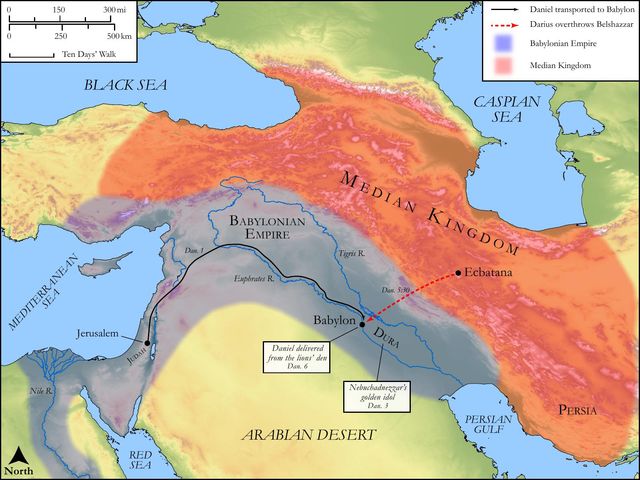
See on the biblical-era map
Study this verse
Public-domain commentary
Matthew Henry
From his Commentary on the Whole Bible. Henry comments on passages, not single verses — this entry covers Daniel 4:34–37. His two-level outline is real structure in the source text, so it is rendered as structure.
We have here Nebuchadnezzar's recovery from his distraction, and his return to his right mind, at the end of the days prefixed, that is, of the seven years. So long he continued a monument of God's justice and a trophy of his victory over the children of pride, and he was made more so by being struck mad than if he had been in an instant struck dead with a thunderbolt; yet it was a mercy to him that he was kept alive, for while there is life there is hope that we may yet praise God, as he did here: At the end of the days (says he), I lifted up my eyes unto heaven (Dan 4:34), looked no longer down towards the earth as a beast, but begun to look up as a man. Os homini sublime dedit - Heaven gave to man an erect countenance. But there was more in it than this; he looked up as a devout man, as a penitent, as a humble petitioner for mercy, being perhaps never till now made sensible of his own misery. And now,
I.He has the use of his reason so far restored to him that with it he glorifies God, and humbles himself under his mighty hand.
He was told that he should continue in that forlorn case till he should know that the Most High rules, and here we have him brought to the knowledge of this: My understanding returned to me, and I blessed the Most High. Note, Those may justly be reckoned void of understanding that do not bless and praise God; nor do men ever rightly use their reason till they begin to be religious, nor live as men till they live to the glory of God. As reason is the substratum or subject of religion (so that creatures which have no reason are not capable of religion), so religion is the crown and glory of reason, and we have our reason in vain, and shall one day wish we had never had it, if we do not glorify God with it. This was the first act of Nebuchadnezzar's returning reason; and, when this became the employment of it, he was then, and not till then, qualified for all the other enjoyments of it. And till he was for a great while disabled to exercise it in other things he never was brought to apply it to this, which is the great end for which our reason is given us. His folly was the means whereby he became wise; he was not recovered by his dream of this judgment (that was soon forgotten like a dream), but he is made to feel it, and then his ear is opened to discipline. To bring him to himself, he must first be beside himself. And by this it appears that what good thoughts there were in his mind, and what good work was wrought there, were not of himself (for he was not his own man), but it was the gift of God. Let us see what Nebuchadnezzar is now at length effectually brought to the acknowledgment of; and we may learn from it what to believe concerning God.
1.That the most high God lives for ever, and his being knows neither change nor period, for he has it of himself. His flatterers often complimented him with, O king! live for ever. But he is now convinced that no king lives for ever, but the God of Israel only, who is still the same.
2.That his kingdom is like himself, everlasting, and his dominion from generation to generation; there is no succession, no revolution, in his kingdom. As he lives, so he reigns, for ever, and of his government there is no end.
3.That all nations before him are as nothing. He has no need of them; he makes no account of them. The greatest of men, in comparison with him, are less than nothing. Those that think highly of God think meanly of themselves.
4.That his kingdom is universal, and both the armies of heaven and the inhabitants of the earth are his subjects, and under his check and control. Both angels and men are employed by him, and are accountable to him; the highest angel is not above his command, nor the meanest of the children of men beneath his cognizance. The angels of heaven are his armies, the inhabitants of the earth his tenants.
5.That his power is irresistible, and his sovereignty uncontrollable, for he does according to his will, according to his design and purpose, according to his decree and counsel; whatever he pleases that he does; whatever he appoints that he performs; and none can resist his will, change his counsel, nor stay his hand, nor say unto him, What doest thou? None can arraign his proceedings, enquire into the meaning of them, nor demand a reason for them. Woe to him that strives with his Maker, that says to him, What doest thou? Or, Why doest thou so?
6.That every thing which God does is well done: His works are truth, for they all agree with his word. His ways are judgment, both wise and righteous, exactly consonant to the rules both of prudence and equity, and no fault is to be found with them.
7.That he has power to humble the haughtiest of his enemies that act in contradiction to him or competition with him: Those that walk in pride he is able to abuse (Dan 4:37); he is able to deal with those that are most confident of their own sufficiency to contend with him.
II.He has the use of his reason so far restored to him as with it to re-enjoy himself, and the pleasures of his re-established prosperity (Dan 4:36): At the same time my reason returned to me; he had said before (Dan 4:34) that his understanding returned to him, and here he mentions it again, for the use of our reason is a mercy we can never be sufficiently thankful for. Now his lords sought to him; he did not need to seek to them, and they soon perceived, not only that he had recovered his reason and was fit to rule, but that he had recovered it with advantage, and was more fit to rule than ever. It is probable that the dream and the interpretation of it were well known, and much talked of, at court; and the former part of the prediction being fulfilled, that he should go distracted, they doubted not but that, according to the prediction, he should come to himself again at seven years' end, and, in confidence of that, when the time had expired they were ready to receive him; and then his honour and brightness returned to him, the same that he had before his madness seized him. He is now established in his kingdom as firmly as if there had been no interruption given him. He becomes a fool, that he may be wise, wiser than ever; and he that but the other day was in the depth of disgrace and ignominy has now excellent majesty added to him, beyond what he had when he went from kingdom to kingdom conquering and to conquer. Note,
1.When men are brought to honour God, particularly by a penitent confession of sin and a believing acknowledgment of his sovereignty, then, and not till then, they may expect that God will put honour upon them, will not only restore them to the dignity they lost by the sin of the first Adam, but add excellent majesty to them from the righteousness and grace of the second Adam.
2.Afflictions shall last no longer than till they have done the work for which they were sent. When this prince is brought to own God's dominion over himself.
3.All the accounts we take and give of God's dealing with us ought to conclude with praises to him. When Nebuchadnezzar is restored to his kingdom he praises, and extols, and honours the King of heaven (Dan 4:37), before he applies himself to his secular business. Therefore we have our reason, that we may be in a capacity of praising him, and therefore our prosperity, that we may have cause to praise him.
It was not long after this that Nebuchadnezzar ended his life and reign. Abydenus, quoted by Eusebius (Prap. Evang. 1.9), reports, from the tradition of the Chaldeans, that upon his death-bed he foretold the taking of Babylon by Cyrus. Whether he continued in the same good mind that here he seems to have been in we are not told, nor does any thing appear to the contrary but that he did: and, if so great a blasphemer and persecutor did find mercy, he was not the last. And, if our charity may reach so far as to hope he did, we must admire free grace, by which he lost his wits for a while that he might save his soul for ever.
Historical interpretation
Historical reception
2 surviving comments on this verse. Each one is dated, so this reads as a timeline rather than a list.
Select a marker to jump to its quote. Markers stagger vertically where authors wrote within a few decades of each other.
“My reason returned to me,” that is, I was made again master of my own mind, and certainly returned to my senses. “I blessed the Most High, who does what he wills,” that is, who with his divinity and will rules and administrates not only the affairs of human beings, whom he fashioned from clay, but also those of the spiritual powers, whom he placed in heaven.
Verse 34. "'I, Nebuchadnezzar, lifted mine eyes toward heaven, and my intelligence returned to me.'" Had he not raised his eyes towards heaven, he would not have regained his former intelligence. Moreover, when he says that his intelligence returned to him, he shows that he had lost not his outward appearance but only his mind.
"'And His kingdom is from generation to generation.'" If we accept this expression in the Scriptures, "From generation to generation," as simply for what it is, then it unquestionably means "for all time to come." But if, on the other hand, "generation and generation" signifies (as we have often asserted) two generations, that of the Law and that of the Gospel, the question comes up as to how Nebuchadnezzar would have known of the unrevealed secrets ("sacraments") of God. But perhaps we might say this, that after he raised his eyes towards heaven and received back his former estate and exalted and blessed the ever-living God, he would not have failed to know this secret also.
Continue studying Daniel 4:34 across the web’s major study libraries — every link below opens this exact verse, chapter, or book on the destination site.
Read & Compare
 BibleGatewayThis verse in more than 200 translations and 70 languages.
 Bible.comThe YouVersion reader — hundreds of translations, reading plans, and highlights.
 ESV.orgCrossway's official English Standard Version reader.
 NET BibleThe NET translation with 60,000+ translators' notes on every rendering decision.
 STEP BibleTyndale House's free study tool — original text, vocabulary, and scholarly resources.
 BibliaLogos Bible Software's free web reader.
 USCCBThe New American Bible (Revised Edition) with the U.S. bishops' study notes.
Commentaries
 BibleHub CommentariesDozens of classic commentaries on this verse, gathered on one page.
 StudyLightMore than 100 commentary sets — the largest collection on the web.
 BibleRefPlain-English commentary on what this verse means, verse by verse.
 Enduring WordDavid Guzik's free commentary on this chapter, widely used by Bible teachers.
 Bible Study ToolsVerse commentary alongside Greek and Hebrew study aids.
Original Language & Research
- BibleHub InterlinearThe verse word by word — original language, transliteration, and English.
- BibleHub LexiconEvery word's original-language definition and Strong's entry.
 Blue Letter BibleDeep-study tools — Strong's numbers, concordance, and word studies.
 SefariaThe Hebrew text with Rashi and centuries of Jewish commentary.
Sermons, Hymns & Audio


TrulyRandomVerse is not affiliated with these sites and doesn’t control their content. They’re linked because they’re genuinely useful.
Summary
Daniel 4:34 marks the dramatic climax of King Nebuchadnezzar's divinely ordained humbling, detailing his restoration to sanity and his profound recognition of God's supreme and eternal sovereignty. After a period of living as an animal due to his immense pride, the king lifts his eyes to heaven, signifying a turning point where his understanding returns, leading him to praise and honor the Most High God, whose dominion is everlasting and whose kingdom endures through all generations. This verse encapsulates a powerful testimony to God's absolute authority over all earthly powers and His ability to humble the proud and restore the repentant.
Context
ShowHideLiterary Context
Daniel 4 presents a unique narrative within the book, as it is largely written as a personal testimony from King Nebuchadnezzar himself, recounting his dream, its interpretation by Daniel, and its terrifying fulfillment. The preceding verses detail Nebuchadnezzar's dream of a great tree cut down, symbolizing his impending judgment and temporary madness (Daniel 4:10-17). Daniel's interpretation explicitly states that this judgment would last "seven times" until the king acknowledged that "the most High ruleth in the kingdom of men" (Daniel 4:25). The king's subsequent period of insanity (Daniel 4:28-33) serves as the direct precursor to verse 34, which describes the precise moment of his restoration and profound spiritual awakening, bringing the narrative arc of divine judgment and humbling to its intended, redemptive conclusion.
Historical & Cultural Context
Nebuchadnezzar II was the most powerful ruler of the Neo-Babylonian Empire (605-562 BC), renowned for his military conquests (including the destruction of Jerusalem and the exile of Judah) and vast building projects (such as the Hanging Gardens). In ancient Near Eastern cultures, kings were often seen as divine or divinely appointed, embodying the strength and wisdom of their gods. Nebuchadnezzar's monumental pride, evident in his declaration "Is not this great Babylon, that I have built for the house of the kingdom by the might of my power, and for the honour of my majesty?" (Daniel 4:30), was a direct affront to the one true God. His humbling was a public demonstration to a polytheistic world that the God of Israel was supreme, capable of bringing down even the mightiest human sovereign, and that true power belonged to Him alone, not to any earthly king or their pantheon of gods.
Key Themes
ShowHideDaniel 4:34 powerfully articulates several core themes found throughout the book of Daniel. The most prominent is God's Absolute Sovereignty, demonstrating that His rule extends over all nations and their rulers, even the most powerful (as seen in Daniel 2:21). This verse also highlights the theme of Divine Judgment and Humiliation, showing how God actively intervenes to humble the proud and self-exalted, proving that "pride goeth before destruction, and a haughty spirit before a fall" (Proverbs 16:18). Conversely, it showcases Divine Restoration and Grace, as Nebuchadnezzar's understanding is returned upon his acknowledgment of God, illustrating that true repentance and submission lead to God's favor. Finally, the verse underscores the Contrast Between Earthly and Heavenly Kingdoms, emphasizing the fleeting nature of human empires against the eternal and unshakeable kingdom of God, a theme central to Daniel's prophetic visions (e.g., Daniel 7).
Exposition and Analysis
ShowHideKey Word Analysis
ShowHideThis word (H4486) refers to wisdom, intelligence, or reason. Its return to Nebuchadnezzar signifies not merely the cessation of his madness, but a profound spiritual and intellectual clarity. It implies a restoration of his rational faculties coupled with a new, divinely imparted insight into the true nature of sovereignty and power, moving beyond his previous self-delusion and into a realm of genuine spiritual comprehension.
This term (H1289), corresponding to the Hebrew "barak," means to kneel and, by implication, to bless God as an act of adoration. For Nebuchadnezzar, it represents a complete reversal of his former pride. Instead of exalting himself, he now prostrates himself in humble worship, acknowledging God's inherent worthiness and supreme authority. This is an act of profound reverence and submission, marking a dramatic shift in his spiritual posture.
This word (H7985) denotes empire, absolute power, or authority, whether abstractly or concretely. Nebuchadnezzar's declaration that God's dominion is "an everlasting dominion" directly contrasts with his own fleeting earthly power. It highlights the timeless, unchallengeable, and universal nature of God's rule, which transcends all human kingdoms and generations, asserting His ultimate and unassailable authority.
Verse Breakdown
ShowHide"And at the end of the days I Nebuchadnezzar lifted up mine eyes unto heaven,"
This phrase marks the culmination of the "seven times" of judgment, indicating the divinely appointed duration of his humbling. The act of "lifting up mine eyes unto heaven" is a symbolic gesture of seeking divine intervention, acknowledging a higher power, and turning away from earthly self-focus. It signifies a profound shift from prideful introspection to humble, outward-looking recognition of God's transcendence and sovereignty.
"and mine understanding returned unto me,"
This is the immediate, miraculous consequence of his turning to heaven. The restoration of his "understanding" (intellect and reason) is not merely a medical recovery from madness but a spiritual enlightenment. He now comprehends the truth about God's absolute sovereignty, which he had previously denied or ignored in his self-exaltation.
"and I blessed the most High, and I praised and honoured him that liveth for ever,"
This clause describes Nebuchadnezzar's immediate and profound response to his restored understanding: worship. He "blessed" (adored), "praised" (adulated), and "honoured" (magnified) God. The titles "the most High" and "him that liveth for ever" underscore God's supreme position and eternal nature, standing in stark contrast to the mortality and limitations of human rulers, including Nebuchadnezzar himself.
"whose dominion [is] an everlasting dominion, and his kingdom [is] from generation to generation:"
This is the theological core of Nebuchadnezzar's confession and the central truth he has learned. He explicitly declares God's absolute and eternal sovereignty. His "dominion" (authority) is not temporary like human empires but "everlasting," and His "kingdom" endures "from generation to generation," signifying its timelessness, unchallengeable nature, and universal scope. This statement is a direct echo of Daniel's earlier interpretations of God's kingdom.
Literary Devices
ShowHideDaniel 4:34 employs several powerful literary devices to convey its transformative message. Contrast is central, vividly juxtaposing Nebuchadnezzar's initial self-exalting pride (Daniel 4:30) with his subsequent humble adoration of God. This stark difference highlights the profound and transformative power of divine intervention. The act of "lifting up mine eyes unto heaven" serves as potent Symbolism, representing a decisive shift from an earthly, self-centered perspective to a heavenly, God-centered one. It is a visual metaphor for spiritual awakening and a turning toward the divine source of all power. Furthermore, there is a profound Irony in the narrative: the most powerful king on earth is reduced to the state of an animal, only to regain his humanity and true understanding by acknowledging the One who is truly sovereign. This reversal underscores the theme that God opposes the proud but gives grace to the humble. The repetitive phrasing of "everlasting dominion" and "from generation to generation" uses Emphasis to underscore the eternal and unchanging nature of God's rule, reinforcing its absolute and timeless quality.
Theological and Thematic Connections
ShowHideDaniel 4:34 serves as a profound theological statement on the nature of God's sovereignty, demonstrating that no earthly power, however mighty, can stand against His ultimate authority. It reveals God's active involvement in human history, humbling the proud and exalting the humble, not out of caprice, but to reveal His glory and establish His eternal dominion. Nebuchadnezzar's transformation is a testament to God's redemptive power, showing that even the most hardened and arrogant hearts can be changed when confronted with divine truth. This pivotal moment in the king's life underscores the biblical principle that true wisdom begins with the fear of the Lord and the acknowledgment of His supreme rule over all creation and every human endeavor.
Reflection and Application
ShowHideThe profound transformation of King Nebuchadnezzar in Daniel 4:34 offers timeless lessons for every individual. His journey from self-exaltation to humble adoration reminds us that true understanding and lasting peace are found not in asserting our own will or power, but in acknowledging God's supreme authority over our lives and circumstances. In a world that often celebrates self-made success and human achievement, this verse calls us to a posture of humility, recognizing that every good gift and every perfect gift comes from above. It provides immense comfort, assuring us that even amidst global chaos or personal trials, God's eternal kingdom and dominion remain unshaken, offering a secure anchor for our souls. Moreover, Nebuchadnezzar's restoration is a powerful beacon of hope, demonstrating that no one is beyond the reach of God's transforming grace, and that genuine repentance and a turning to Him can lead to profound spiritual and personal renewal.
Questions for Reflection
ShowHideFAQ
ShowHideDid Nebuchadnezzar truly convert to monotheism, or was this just a temporary recognition of God's power?
ShowHideWhile the text does not explicitly state that Nebuchadnezzar became a monotheistic worshiper in the same sense as Daniel, his declaration in Daniel 4:34-37 is a profound and unequivocal acknowledgment of the Most High God's absolute and eternal sovereignty, surpassing all other gods and earthly powers. He blesses, praises, and honors Him, attributing to Him an everlasting dominion and an unshakeable kingdom. This is a public, kingly decree, not a private thought. The depth of his confession, particularly in contrast to his previous pride and polytheistic background, strongly suggests a genuine and lasting spiritual transformation, recognizing the God of Israel as the supreme deity. His final words in Daniel 4:37 serve as a powerful testament to this change.
Christ-Centered Fulfillment
ShowHideDaniel 4:34, with Nebuchadnezzar's dramatic acknowledgment of God's everlasting dominion, powerfully foreshadows the ultimate and eternal kingdom of Jesus Christ. Just as Nebuchadnezzar, the mightiest earthly king, was humbled to recognize a higher power, so too does the New Testament reveal that all earthly authority ultimately bows before the reign of the Lord Jesus Christ. Nebuchadnezzar's temporary madness and restoration prefigure the profound humbling of the Son of God, who, though "in the form of God, thought it not robbery to be equal with God: But made himself of no reputation, and took upon him the form of a servant" (Philippians 2:6-7). Unlike Nebuchadnezzar's kingdom, which was temporal, Christ's dominion is truly "an everlasting dominion" that "shall not be destroyed" (Daniel 7:14). His kingdom, inaugurated at His first coming and fully realized at His return, is "from generation to generation," encompassing all ages and all peoples (Revelation 11:15). Nebuchadnezzar's confession of God's eternal rule thus serves as a prophetic echo of the universal and unending reign of the true King, Jesus Christ, to whom all honor, praise, and glory are due.