


Daniel 4:33
Bible text: King James Version (1769 Blayney text) · Public domain
Bible text: King James Version with Strong's numbers · Public domain
Bible text: Berean Standard Bible · Public domain
Bible text: American Standard Version (1901) · Public domain
Bible text: World English Bible, Messianic edition · Public domain
Bible text: Geneva Bible (1599) · Public domain
Bible text: Young's Literal Translation · Public domain
- בַּהּbahat itPrep-b ¦ 3fsSuffix Personal 3rd Singular Feminineבַּatהּit
- שַׁעֲתָאsha·'a·Ta'moment theH8160N-fs ¦ ArtNoun Singular Feminine Definiteשַׁעֲתָmomentאthe
- מִלְּתָאmi·le·Ta'word theH4406N-fs ¦ ArtNoun Singular Feminine Definiteמִלְּתָwordאthe
- סָפַתSa·fatit was fulfilledH5487V-Peal-Perf-3fsVerb Peal Perfect 3rd Singular Feminine
- עַל'alonH5922PrepPreposition
- נְבוּכַדְנֶצַּרne·vu·khad·ne·TzarNebuchadnezzarH5020N-proper-mNoun Proper Masculine
- וּמִןu·minand away fromH4481Conj-w ¦ PrepPrepositionוּandמִןaway from
- אֲנָשָׁא'a·na·Sha'<the> humankindH606N-cs ¦ ArtNoun Singular common gender Definiteאֲנָשָׁ<the>אhumankind
- טְרִידte·Ridhe was chasedH2957V-Peil-Perf-3msVerb Peil Perfect 3rd Singular Masculine
- וְעִשְׂבָּאve·'is·Ba'and <the> grassH6211Conj-w ¦ N-cs ¦ ArtNoun Singular common gender Definiteוְandעִשְׂבָּ<the>אgrass
- כְתוֹרִיןkhe·to·Rinlike oxenH8450Prep-k ¦ N-mpNoun Plural Masculine Absoluteכְlikeתוֹרִיןoxen
- יֵאכֻלye·Khulhe ateH399V-Peal-Imperf-3msVerb Peal Imperfect 3rd Singular Masculine
- וּמִטַּלu·mi·Taland from [the] dew ofH2920Conj-w ¦ Prep-m ¦ N-cscNoun Singular common gender Constructוּandמִfromטַּל[the] dew of
- שְׁמַיָּאshe·mai·Ya'heavens theH8065N-mp ¦ ArtNoun Plural Masculine Definiteשְׁמַיָּheavensאthe
- גִּשְׁמֵהּgish·Mehhis bodyH1655N-csc ¦ 3msNoun Singular common gender Constructגִּשְׁמֵbodyהּhis
- יִצְטַבַּעyitz·ta·Ba'it became wetH6647V-Hitpaal-Imperf-3msVerb Hitpaal Imperfect 3rd Singular Masculine
- עַד'aduntilH5705PrepPreposition
- דִּיdithatH1768ConjConjunction
- שַׂעְרֵהּsa'·Rehhis hairH8177N-csc ¦ 3msNoun Singular common gender Constructשַׂעְרֵhairהּhis
- כְּנִשְׁרִיןke·nish·Rinlike eaglesH5403Prep-k ¦ N-mpNoun Plural Masculine Absoluteכְּlikeנִשְׁרִיןeagles
- רְבָהre·Vahit grew longH7236V-Peal-Perf-3msVerb Peal Perfect 3rd Singular Masculine
- וְטִפְרוֹהִיve·tif·Ro·hiand his nailsH2953Conj-w ¦ N-mpc ¦ 3msNoun Plural Masculine Constructוְandטִפְרוֹnailsהִיhis
- כְצִפְּרִיןkhe·tzi·pe·Rin[were] like birdsH6853Prep-k ¦ N-mpNoun Plural Masculine Absoluteכְ[were] likeצִפְּרִיןbirds
English is a literal word-by-word gloss of the Hebrew, not the KJV's wording. Why?
This is the original text the KJV's translators worked from — each Hebrew word with its own literal English meaning in this verse, prepared by scholars at Tyndale House, Cambridge. The KJV translates whole sentences, not word by word, so its wording differs: one Hebrew word can become several English words, and the KJV may choose “the LORD” where the gloss reads “Yahweh”. Both are faithful — they answer different questions. For the KJV's own rendering, switch to the KJV text.
Details
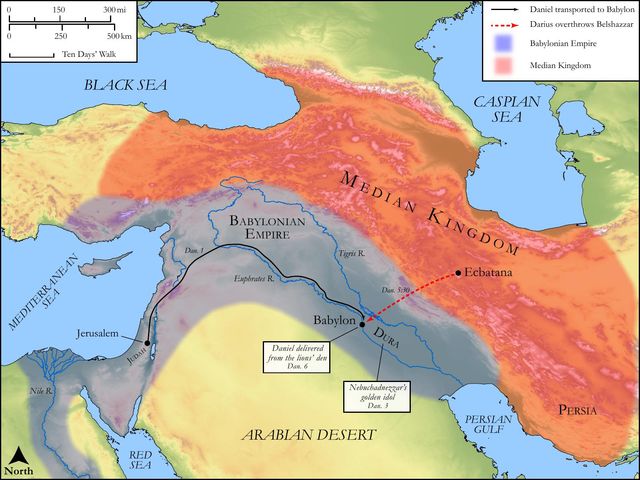
See on the biblical-era map
Study this verse
Public-domain commentary
Matthew Henry
From his Commentary on the Whole Bible. Henry comments on passages, not single verses — this entry covers Daniel 4:28–33. His three-level outline is real structure in the source text, so it is rendered as structure.
We have here Nebuchadnezzar's dream accomplished, and Daniel's application of it to him justified and confirmed. How he took it we are not told, whether he was pleased with Daniel or displeased; but here we have,
I.God's patience with him:
All this came upon him, but not till twelve months after (Dan 4:29), so long there was a lengthening of his tranquility, though it does not appear that he broke off his sins, or showed any mercy to the poor captives, for this was still God's quarrel with him, that he opened not the house of his prisoners, Isa 14:17. Daniel having counselled him to repent, God so far confirmed his word that he gave him space to repent; he let him alone this year also, this one year more, before he brought this judgment upon him. Note, God is long-suffering with provoking sinners, because he is not willing that any should perish, but that all should come to repentance, Pe2 3:9.
II.His pride, and haughtiness, and abuse of that patience.
He walked in the palace of the kingdom of Babylon, in pomp and pride, pleasing himself with the view of that vast city, which, with all the territories thereunto belonging, was under his command, and he said, either to himself or to those about him, perhaps some foreigners to whom he was showing his kingdom and the glory of it, Is not this great Babylon? Yes, it is great, of vast extent, no less that forty-five miles compass within the walls. It is full of inhabitants, and they are full of wealth. It is a golden city, and that is enough to proclaim it great, Isa 14:4. See the grandeur of the houses, walls, towers, and public edifices. Every thing in Babylon he thinks looks great; "and this great Babylon I have built." Babylon was built many ages before he was born, but because he fortified and beautified it, and we may suppose much of it was rebuilt during his long and prosperous reign, he boasts that he has built it, as Augustus Caesar boasted concerning Rome, Lateritiam inveni, marmoream reliqui - I found it brick, but I left it marble. He boasts that he built it for the house of the kingdom, that is, the metropolis of his empire. This vast city, compared with the countries that belonged to his dominions, was but as one house. He built it with the assistance of his subjects, yet boasts that he did it by the might of his power; he built it for his security and convenience, yet, as if he had no occasion for it, boasts that he built it purely for the honour of his majesty. Note, Pride and self-conceitedness are sins that most easily beset great men, who have great things in the world. They are apt to take the glory to themselves which is due to God only.
III.His punishment for his pride.
When he was thus strutting, and vaunting himself, and adoring his own shadow, while the proud word was in the king's mouth the powerful word came from heaven, by which he was immediately deprived,
1.Of his honour as a king: The kingdom has departed from thee. When he thought he had erected impregnable bulwarks for the preserving of his kingdom, now, in an instant, it has departed from him; when he thought it so well guarded that none could take it from him, behold, it departs of itself. As soon as he becomes utterly incapable to manage it, it is of course taken out of his hands.
2.He is deprived of his honour as a man. He loses his reason, and by that means loses his dominion: They shall drive thee from men, Dan 4:32. And it was fulfilled (Dan 4:33): he was driven from men the same hour. On a sudden he fell stark mad, distracted in the highest degree that ever any man was. His understanding and memory were gone, and all the faculties of a rational soul broken, so that he became a perfect brute in the shape of a man. He went naked, and on all four, like a brute, did himself shun the society of reasonable creatures and run wild into the fields and woods, and was driven out by his own servants, who, after some time of trial, despairing of his return to his right mind, abandoned him, and looked after him no more. He had not the spirit of a beast of prey (that of the royal lion), but of the abject and less honourable species, for he was made to eat grass as oxen; and, probably, he did not speak with human voice, but lowed like an ox. Some think that his body was all covered with hair; however, the hair of his head and beard, being never cut nor combed, grew like eagles feathers, and his nails like birds' claws. Let us pause a little, and view this miserable spectacle; and let us receive instruction from it.
(1.)Let us see here what a mercy it is to have the use of our reason, how thankful we ought to be for it, and how careful we ought to be not to do any thing which may either provoke God or may have a natural tendency to put us out of the possession of our own souls. Let us learn how to value our own reason, and to pity the case of those that are under the prevailing power of melancholy or distraction, or are delirious, and to be very tender in our censures of them and conduct towards them, for it is a trial common to men, and a case which, some time or other, may be our own.
(2.)Let us see here the vanity of human glory and greatness. Is this Nebuchadnezzar the Great? What this despicable animal that is meaner than the poorest beggar? Is this he that looked so glorious on the throne, so formidable in the camp, that had politics enough to subdue and govern kingdoms, and now has not so much sense as to keep his own clothes on his back? Is this the man that made the earth to tremble, that did shake kingdoms? Isa 14:16. Never let the wise man then glory in his wisdom, nor the mighty man in his strength.
(3.)Let us see here how God resists the proud, and delights to abase them and put contempt upon them. Nebuchadnezzar would be more than a man, and therefore God justly makes him less than a man, and puts him upon a level with the beasts who set up for a rival with his Maker. See Job 40:11-13.
Historical interpretation
Historical reception
1 surviving comment on this verse from the historical church.
By all this it suggested his condition of neglect and carelessness: bereft of divine providence, he was not even a recipient of care from his own—wife, children and family; instead, like a wild animal he kept frequenting uninhabited places, filling his stomach with the food of brute beasts.
Continue studying Daniel 4:33 across the web’s major study libraries — every link below opens this exact verse, chapter, or book on the destination site.
Read & Compare
 BibleGatewayThis verse in more than 200 translations and 70 languages.
 Bible.comThe YouVersion reader — hundreds of translations, reading plans, and highlights.
 ESV.orgCrossway's official English Standard Version reader.
 NET BibleThe NET translation with 60,000+ translators' notes on every rendering decision.
 STEP BibleTyndale House's free study tool — original text, vocabulary, and scholarly resources.
 BibliaLogos Bible Software's free web reader.
 USCCBThe New American Bible (Revised Edition) with the U.S. bishops' study notes.
Commentaries
 BibleHub CommentariesDozens of classic commentaries on this verse, gathered on one page.
 StudyLightMore than 100 commentary sets — the largest collection on the web.
 BibleRefPlain-English commentary on what this verse means, verse by verse.
 Enduring WordDavid Guzik's free commentary on this chapter, widely used by Bible teachers.
 Bible Study ToolsVerse commentary alongside Greek and Hebrew study aids.
Original Language & Research
- BibleHub InterlinearThe verse word by word — original language, transliteration, and English.
- BibleHub LexiconEvery word's original-language definition and Strong's entry.
 Blue Letter BibleDeep-study tools — Strong's numbers, concordance, and word studies.
 SefariaThe Hebrew text with Rashi and centuries of Jewish commentary.
Sermons, Hymns & Audio


TrulyRandomVerse is not affiliated with these sites and doesn’t control their content. They’re linked because they’re genuinely useful.
Summary
Daniel 4:33 records the precise and immediate fulfillment of God's judgment upon King Nebuchadnezzar, transforming him from the mighty ruler of Babylon into an animalistic state. This verse dramatically illustrates the absolute sovereignty of the Most High God over all earthly power, demonstrating that even the most exalted human authority is utterly dependent on and subject to divine will. It marks the climax of Nebuchadnezzar's humiliation, a direct consequence of his unbridled pride and refusal to acknowledge God's dominion, serving as a powerful object lesson for all who would claim self-sufficiency apart from the divine.
Context
ShowHideLiterary Context
Daniel 4:33 serves as the climactic fulfillment of the prophetic dream and its interpretation detailed earlier in the chapter. Immediately preceding this verse, King Nebuchadnezzar, filled with self-adulation, boasts about his magnificent kingdom, built by his "mighty power" and for "the honour of [his] majesty" as recorded in Daniel 4:30. This act of profound pride directly triggers the divine judgment that Daniel had warned him about, as recorded in Daniel 4:25-27. The phrase "The same hour" in verse 33 emphasizes the instantaneous and undeniable nature of God's intervention, highlighting the direct cause-and-effect relationship between the king's hubris and his sudden downfall, leaving no room for doubt about the divine origin of his affliction. This swift retribution underscores the immediate consequences of defying the Most High.
Historical & Cultural Context
Nebuchadnezzar was the most powerful monarch of his time, ruling the Neo-Babylonian Empire, which had conquered Judah and exiled its people. Among the nations, kings often claimed divine lineage or divine favor, seeing themselves as supreme arbiters of their realms. Babylon itself was a symbol of human achievement and power, with its impressive architecture and military might, often boasting of its impregnable walls and Hanging Gardens. Within this context, Nebuchadnezzar's public humiliation was an unprecedented event, designed to shatter the prevalent notion of absolute human authority and to demonstrate to a pagan world, through its most prominent leader, that there is a God in heaven who truly rules over the kingdoms of men. This divine intervention challenged the very foundations of pagan kingship and polytheistic beliefs, asserting monotheistic supremacy.
Key Themes
ShowHideThis verse powerfully underscores several central themes within the book of Daniel and the broader biblical narrative. Foremost is Divine Sovereignty, asserting God's absolute control over human affairs and earthly rulers, as explicitly stated in Daniel 4:17. The immediate and dramatic judgment on Nebuchadnezzar highlights the Consequences of Pride, serving as a stark warning against self-exaltation and the failure to acknowledge God as the source of all power and blessing. This theme is echoed throughout Scripture, such as in Proverbs 16:18 and James 4:6. Furthermore, the verse initiates the theme of Humiliation as a Prerequisite for Restoration, as Nebuchadnezzar's profound degradation is the necessary precursor to his eventual repentance and re-establishment on the throne, detailed in Daniel 4:34-37. This divine discipline, though severe, ultimately served a redemptive purpose.
Exposition and Analysis
ShowHideKey Word Analysis
ShowHideThis word, derived from a root meaning "a look," signifies a precise, immediate moment or a glance of time. Its use here emphasizes the swiftness and directness of God's judgment. The "same hour" underscores that the fulfillment of the prophecy was not a gradual decline but an instantaneous, divinely orchestrated event, leaving no doubt about its supernatural origin and the direct connection to Nebuchadnezzar's boast. It highlights the immediate and decisive nature of divine intervention.
Corresponding to the Hebrew root for "to expel" or "to chase away," this term implies a forceful removal or being cast out. It vividly describes Nebuchadnezzar's involuntary and violent expulsion from human society and royal authority. It suggests a complete and sudden separation from his former life, status, and environment, highlighting the severity and totality of his divine punishment, signifying a loss of both physical place and mental faculty.
While primarily meaning "body," the Strong's data notes a peculiar sense, possibly related to the idea of "hard rain" or "storm." This subtle nuance might allude to the physical exposure and degradation of Nebuchadnezzar's body, which was "wet with the dew of heaven," enduring the elements like an animal rather than being sheltered in royal comfort. It emphasizes the complete physical manifestation of his humiliation, stripped of all royal adornment and protection, subjected to the harsh realities of nature.
Verse Breakdown
ShowHide"The same hour was the thing fulfilled upon Nebuchadnezzar"
This opening clause establishes the immediate and undeniable execution of the divine decree. The "thing" refers to the specific prophecy given by Daniel regarding Nebuchadnezzar's seven years of madness and animalistic existence. The emphasis on "the same hour" highlights God's perfect timing and the direct causality between the king's prideful boast and the instantaneous onset of his judgment, leaving no room for human intervention or natural explanation.
"and he was driven from men"
This signifies Nebuchadnezzar's complete social ostracization and profound loss of human reason. He was no longer fit for human society, indicating a profound mental and behavioral regression from a rational king to a wild, untamed creature. This expulsion underscores the loss of his human dignity, his regal status, and his very identity as a human being.
"and did eat grass as oxen"
This clause vividly describes his animalistic behavior. Eating grass, the common food of cattle, is a powerful image of his degradation, symbolizing his loss of human diet, intelligence, and self-awareness. He was reduced to the level of a beast, fulfilling the prophecy that he would live "with the beasts of the field," demonstrating the utter reversal of his former royal lifestyle.
"and his body was wet with the dew of heaven"
This detail emphasizes his exposure to the elements, further illustrating his complete abandonment of human comforts and his forced existence in the wild. His body, once adorned in royal robes and protected within a palace, was now subjected to the harsh realities of nature, mirroring his loss of protection, privilege, and personal care.
"till his hairs were grown like eagles' [feathers], and his nails like birds' [claws]"
This final descriptive phrase paints a stark picture of his physical transformation over time, indicating the duration of his affliction. The imagery of "eagles' feathers" and "birds' claws" conveys wild, untamed growth, indicating a complete neglect of personal hygiene and a regression to a primal, unkempt state. This hyper-realistic imagery underscores the severity and prolonged nature of his divinely imposed affliction, making his transformation utterly unmistakable and visually horrifying.
Literary Devices
ShowHideDaniel 4:33 employs several powerful Literary Devices to convey the depth of Nebuchadnezzar's humiliation. The most prominent is Imagery, which paints a vivid and visceral picture of the king's transformation: "eat grass as oxen," "body was wet with the dew of heaven," "hairs were grown like eagles' [feathers]," and "nails like birds' [claws]." This rich sensory language allows the reader to viscerally experience the king's degradation and the severity of his plight. The pervasive use of Simile ("as oxen," "like eagles' [feathers]," "like birds' [claws]") explicitly compares Nebuchadnezzar's behavior and physical appearance to animals, underscoring his complete loss of human dignity, reason, and control. There is also a strong element of Irony in the king's fate; the one who boasted of his magnificent kingdom and power is reduced to the lowest form of existence, highlighting the stark contrast between human pride and divine sovereignty. The swiftness indicated by "The same hour" also functions as Dramatic Pacing, emphasizing the immediate and undeniable consequence of his pride and the omnipotence of God's decree.
Theological and Thematic Connections
ShowHideDaniel 4:33 profoundly illustrates God's absolute and unchallengeable sovereignty over all earthly kingdoms and rulers. It serves as a powerful theological statement that no human authority, however vast or impressive, can stand against the will of the Most High. Nebuchadnezzar's dramatic fall is a divine object lesson, demonstrating that pride precedes destruction and that true power resides not in human might but in humble submission to God. This narrative reinforces the biblical principle that God "removes kings and sets up kings" as stated in Daniel 2:21, and that He is able to abase those who walk in pride, ultimately exalting the humble. The king's suffering, though severe, was a necessary crucible for his spiritual transformation, leading to his eventual acknowledgment of God's eternal dominion and a profound shift in his worldview.
Reflection and Application
ShowHideThe vivid account of Nebuchadnezzar's humbling in Daniel 4:33 offers a timeless and profound lesson for all people, especially those entrusted with leadership or influence. It serves as a stark reminder that all authority, talent, and success ultimately derive from God. When we attribute our achievements solely to our own strength, wisdom, or effort, we fall into the same trap of pride that ensnared Nebuchadnezzar. This verse challenges us to cultivate a spirit of humility, acknowledging God's hand in every blessing and circumstance. It calls us to recognize that true security and lasting honor come not from self-exaltation, but from a reverent and dependent relationship with the Almighty. By learning from Nebuchadnezzar's painful experience, we are encouraged to proactively humble ourselves before God, giving Him the glory due His name, thereby avoiding the painful, corrective lessons that pride inevitably brings. This narrative compels us to constantly examine our hearts for any trace of self-sufficiency that might obscure God's rightful place as the source of all good.
Questions for Reflection
ShowHideFAQ
ShowHideWhat was Nebuchadnezzar's specific affliction described in this verse?
ShowHideDaniel 4:33 describes Nebuchadnezzar's affliction as a complete and instantaneous transformation from a human king to an animal-like state. He was "driven from men," indicating social isolation and a profound loss of human reason, and began to "eat grass as oxen," adopting the diet and behavior of cattle. His body was exposed to the elements, becoming "wet with the dew of heaven," and his physical appearance regressed dramatically, with his "hairs were grown like eagles' [feathers], and his nails like birds' [claws]." This condition is often interpreted by scholars as a form of clinical lycanthropy or zoanthropy, a rare psychological disorder where a person believes they are an animal and behaves accordingly, though in Nebuchadnezzar's case, it was divinely imposed and perfectly fulfilled the prophecy given in Daniel 4:25.
Why did God inflict such a severe punishment on Nebuchadnezzar?
ShowHideGod inflicted this severe punishment on Nebuchadnezzar as a direct consequence of his profound pride and his failure to acknowledge God's supreme sovereignty. Despite Daniel's clear interpretation of his dream and warning to humble himself and show mercy to the poor as stated in Daniel 4:27, Nebuchadnezzar continued in his self-exaltation. This culminated in his boast about his own power and glory in Daniel 4:30, which immediately preceded his judgment. The punishment was designed to teach him, and all who would hear his story, that "the Most High ruleth in the kingdom of men, and giveth it to whomsoever he will" (Daniel 4:25). It was a humbling necessary for his eventual repentance and restoration, demonstrating that God alone is the source of all authority and blessing.
Christ-Centered Fulfillment
ShowHideThe dramatic humbling of Nebuchadnezzar in Daniel 4:33, though a historical event, powerfully foreshadows and contrasts with the ultimate display of divine sovereignty and humility found in Jesus Christ. Nebuchadnezzar, a proud earthly king, was brought low by divine judgment to learn humility and acknowledge God's rule. In stark contrast, Jesus, the eternal King of kings and Lord of lords, willingly humbled Himself not through compulsion but through perfect love. He "made himself of no reputation, and took upon him the form of a servant, and was made in the likeness of men" (Philippians 2:7). While Nebuchadnezzar was driven from men to become like a beast, Christ, though fully God, entered human frailty, enduring rejection and suffering, even unto death on a cross (Philippians 2:8). His humiliation was not a punishment for pride, but a redemptive act to reconcile humanity to God, demonstrating the depths of divine love and obedience. Just as Nebuchadnezzar was eventually restored to his throne after acknowledging God, Christ, after His ultimate act of humility and sacrifice, was "highly exalted, and given a name which is above every name" (Philippians 2:9), and He will return to reign forever as the true King of all (Revelation 19:16). Thus, Nebuchadnezzar's story, a testament to God's power to humble the proud, ultimately points to the infinitely greater humility of Christ, through whom God's kingdom is established forever, not by force, but by grace and self-sacrificial love.