


Daniel 5:5
Bible text: King James Version (1769 Blayney text) · Public domain
Bible text: King James Version with Strong's numbers · Public domain
Bible text: Berean Standard Bible · Public domain
Bible text: American Standard Version (1901) · Public domain
Bible text: World English Bible, Messianic edition · Public domain
Bible text: Geneva Bible (1599) · Public domain
Bible text: Young's Literal Translation · Public domain
- בַּהּbahat itPrep-b ¦ 3fsSuffix Personal 3rd Singular Feminineבַּatהּit
- שַׁעֲתָהsha·'a·Tah'moment theH8160N-fs ¦ ArtNoun Singular Feminine Definiteשַׁעֲתָmomentהthe
- נְפַקָהne·fa·kuthey went forthH5312V-Peal-Perf-3fpVerb Peal Perfect 3rd Plural Feminine
- אֶצְבְּעָן'etz·be·'AnfingersH677N-fpNoun Plural Feminine Absolute
- דִּיdiofH1768ConjConjunction
- יַדyada hand ofH3028N-cscNoun Singular common gender Construct
- אֱנָשׁ'e·Nasha humanH606N-csNoun Singular common gender Absolute
- וְכָתְבָןve·kha·te·Vanand [they were] writingH3790Conj-w ¦ V-Qal-Prtcpl-fpVerb Qal Participle Plural Feminine Absoluteוְandכָתְבָן[they were] writing
- לָקֳבֵלlo·ko·Vel<to> beforeH6903Prep-l ¦ N-cscNoun Singular common gender Constructלָ<to>קֳבֵלbefore
- נֶבְרַשְׁתָּאnev·rash·Ta'candlestick theH5043N-fs ¦ ArtNoun Singular Feminine Definiteנֶבְרַשְׁתָּcandlestickאthe
- עַל'alonH5922PrepPreposition
- גִּירָאgi·Ra'plaster theH1528N-cs ¦ ArtNoun Singular common gender Definiteגִּירָplasterאthe
- דִּיdiofH1768ConjConjunction
- כְתַלkhe·Tal[the] wall ofH3797N-cscNoun Singular common gender Construct
- הֵיכְלָאheikh·La'palace theH1965N-cs ¦ ArtNoun Singular common gender Definiteהֵיכְלָpalaceאthe
- דִּיdiofH1768ConjConjunction
- מַלְכָּאmal·Ka'king theH4430N-cs ¦ ArtNoun Singular common gender Definiteמַלְכָּkingאthe
- וּמַלְכָּאu·mal·Ka'and king theH4430Conj-w ¦ N-cs ¦ ArtNoun Singular common gender Definiteוּandמַלְכָּkingאthe
- חָזֵהcha·Zeh[was] seeingH2370V-Peal-Prtcpl-msVerb Peal Participle Singular Masculine Absolute
- פַּסpas[the] palm ofH6447N-cscNoun Singular common gender Construct
- יְדָהye·Dah'hand theH3028N-cs ¦ ArtNoun Singular common gender Definiteיְדָhandהthe
- דִּיdiwhichH1768ConjConjunction
- כָתְבָהkha·te·Vah[was] writingH3790V-Peal-Prtcpl-fsVerb Peal Participle Singular Feminine Absolute
English is a literal word-by-word gloss of the Hebrew, not the KJV's wording. Why?
This is the original text the KJV's translators worked from — each Hebrew word with its own literal English meaning in this verse, prepared by scholars at Tyndale House, Cambridge. The KJV translates whole sentences, not word by word, so its wording differs: one Hebrew word can become several English words, and the KJV may choose “the LORD” where the gloss reads “Yahweh”. Both are faithful — they answer different questions. For the KJV's own rendering, switch to the KJV text.
Details
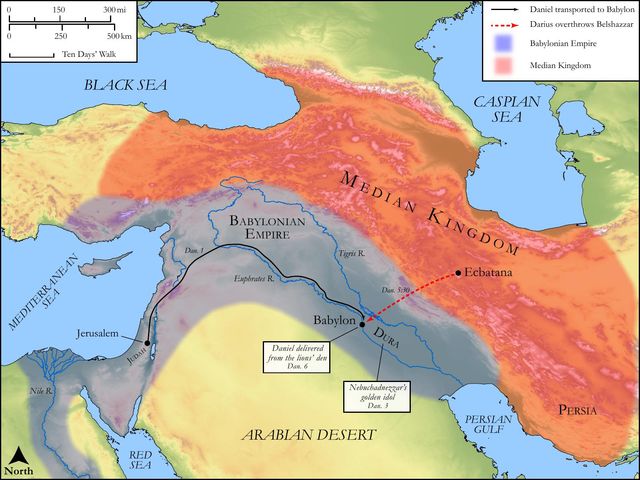
See on the biblical-era map
Study this verse
Public-domain commentary
Matthew Henry
From his Commentary on the Whole Bible. Henry comments on passages, not single verses — this entry covers Daniel 5:1–9. His two-level outline is real structure in the source text, so it is rendered as structure.
We have here Belshazzar the king very gay, but all of a sudden very gloomy, and in straits in the fulness of his sufficiency. See how he affronts God, and God affrights him; and wait what will be the issue of this contest; and whether he that hardened his heart against God prospered.
I.See how the king affronted God, and put contempt upon him.
He made a great feast, or banquet of wine; probably it was some anniversary solemnity, in honour off his birthday or coronation-day, or in honour of some of their idols. Historians say that Cyrus, who was now with his army besieging Babylon, knew of this feast, and presuming that they then would be off their guard, somno vinoque sepulti - buried in sleep and wine, took that opportunity to attack the city, and so with the more ease made himself master of it. Belshazzar upon this occasion invited a thousand of his lords to come and drink with him. Perhaps they were such as had signalized themselves in defense of the city against the besiegers; or these were his great council of war, with whom, when they had well drunk, he would advise what was further to be done. And they were to look upon it as a great favour that he drank wine before them, for it was the pride of those eastern kings to be seldom seen. He drank wine before them, for he made this feast, as Ahasuerus did, to show the honour of his majesty. Now in this sumptuous feast,
1.He put an affront upon the providence of God and bade defiance to his judgments. His city was now besieged; a powerful enemy was at his gates; his life and kingdom lay at stake. In all this the hand of the Lord had gone out against him, and by it he called him to weeping, and mourning, and girding with sackcloth. God's voice cried in the city, as Jonah to Nineveh, Yet forty days, or fewer, and Babylon shall be destroyed. He should therefore, like the king of Nineveh, have proclaimed a fast; but, as one resolved to walk contrary to God, he proclaims a feast, and behold joy and gladness, slaying oxen, killing sheep, eating flesh, and drinking wine, as if he dared the Almighty to do his worst, Isa 22:12, Isa 22:13. To show how little fear he had of being forced to surrender, for want of provisions, he spent thus extravagantly. Note, Security and sensuality are sad presages of approaching ruin. Those that will not be warned by judgments of God may expect to be wounded by them.
2.He put an affront upon the temple of God, and bade defiance to his sanctuary, Dan 5:2. While he tasted the wine, he commanded to bring the vessels of the temple, that they might drink in them. When he tasted how rich and fine the wine was, "O," said he, "it is a pity but we should have holy vessels to drink such delicious wine as this in," which was looked upon as a piece of wit, and, to carry on the humour, the vessels of the temple were immediately sent for. Nay, there seems to have been something more in it than a frolic, and that it was done in a malicious despite to the God of Israel. The heart of his people was very much upon these sacred vessels, as appears from Jer 27:16, Jer 27:18. Their principal care, at their return, was about these, Ezr 1:7. Now, we may suppose, they had an expectation of their deliverance approaching, reckoning the seventy years of their captivity near a period; and some of them might perhaps have given out some words to that purport, that shortly they should have the vessels of the sanctuary restored to them, in defiance of which Belshazzar here proclaims them to be his own, will keep them in store no longer, but will make use of them among his own plate. Note, That mirth is sinful indeed, and fills the measure of men's iniquity apace, which profanes sacred things and jests with them. This ripened Babylon for ruin - that no songs would serve them but the songs of Zion (Psa 137:3), no vessels but the vessels of the sanctuary. Let those who thus sacrilegiously alienate what is dedicated to God and his honour know that he will not be mocked.
3.He put an affront upon God himself, and bade defiance to his deity; for they drank wine, and praised the gods of gold and silver, Dan 5:4. They gave that glory to images, the work of their own hands and creatures of their own fancy, which is due to the true and living God only. They praised them either with sacrifices offered to them or with songs sung in honour of them. When their heads were giddy, and their hearts merry, with wine, they were in the fittest frame to praise the gods of gold and silver, wood and stone; for one would think that men in their senses, who had the command of a clear and sober thought, could not be guilty of so gross an absurdity; they must be intoxicated ere they could be so infatuated. Drunken worshippers, who are not men, but beasts, are the most proper for the service of dunghill deities, that are not gods, but devils. They have erred through wine, Isa 27:7. They drank wine, and praised their idol-gods, as if they had been the founders of their feast and the givers of all good things to them. Or, when they were drinking wine, they praised their gods by drinking healths to them; and the king drank wine before them (Dan 5:1), that is, he began the health, first to this god, and then to the other, till they went through the bead-roll or farrago of them, those of wood and stone not excepted. Note, Immorality and impiety, vice and profaneness, strengthen the hands and advance the interests one of another. Drunken frolics were an introduction to idolatry, and then idolatrous healths were a shoeing-horn to further drunkenness.
II.See how God affrighted the king, and struck a terror upon him.
Belshazzar and his lords are in the midst of their revels, the cups going round apace, and all upon the merry pin, drinking confusion, it may be, to Cyrus and his army, and roaring out huzzas, in confidence of the speedy raising of the siege; but the hour had come when that must be fulfilled which had been long ago said of the king of Babylon, when his city should be besieged by the Persians and Medes, Isa 21:2-4. The night of my pleasures has he turned into fear to me. The mirth of this ball at court must be spoiled, and a damp cast upon their jollity, though the king himself be master of the revels; immediately, when God speaks the word, we have him and all his guests in the utmost confusion, and the end of their mirth is heaviness.
1.There appear the fingers of a man's hand writing on the plaster of the wall, before the king's face (Dan 5:5), "the angel Gabriel," say the rabbin, "directing these fingers and writing by them." "That divine hand" (says a rabbi of our own, Dr. Lightfoot) "that had written the two tables for a law to his people now writes the doom of Babel and Belshazzar upon the wall." Here was nothing sent to frighten them which made a noise, or threatened their lives, no claps of thunder nor flashes of lightning, no destroying angel with his sword drawn in his hand, only a pen in the hand, writing upon the wall, over-against the candlestick, where they might all see it by the light of their own candle. Note, God's written word is sufficient to put the proudest boldest sinners into a fright, when he is pleased to give it the setting on. The king saw the part of the hand that wrote, but saw not the person whose hand it was, which made the thing more frightful. Note, What we see of God, the part of the hand that writes in the book of the creatures and the book of the scriptures (Lo, these are parts of his ways, Job 26:14), may serve to possess us with awful thoughts concerning that of God which we do not see. If this be the finger of God, what is his arm made bare? And what is he?
2.The king is immediately seized with a panic fear (Dan 5:6): His countenance was changed (his colour went and came); the joints of his loins were loosed, so that he had no strength in them, but was struck with a pain in his back, as is usual in a great fright; his knees smote one against another, so violently did he tremble like an aspen leaf. But what was the matter? Why is he in such a fright? He perceives not what is written, and how does he know but it may be some happy presage of deliverance to him and to his kingdom? But the business was his thoughts troubled him; his own guilty conscience flew in his face, and told him that he had no reason to expect any good news from Heaven, and that the hand of an angel could write nothing but terror to him. He that knew himself liable to the justice of God immediately concluded this to be an arrest in his name, a summons to appear before him. Note, God can soon awaken the most secure and make the heart of the stoutest sinner to tremble; and there needs no more to do it than to let loose his own thoughts upon him; they will soon play the tyrant, and give him trouble enough.
3.The wise men of Babylon are immediately called in, to see what they can make of this writing upon the wall, Dan 5:7. The king cried aloud, as one in haste, as one in earnest, to bring the whole college of magicians, to try if they can read this writing, and show the interpretation of it; for the king and all his lords cannot pretend to it, it is out of their sphere. The study of divine revelation (such as they had, or thought they had) and converse with the world of spirits were by the heathen confined to one profession, and no other meddled with it; but what is written to us by the finger of God is legible to all; whoever will may read the mind of God in the scriptures. To engage these wise men to exert the utmost of their skill in this matter, and provoke them to an emulation in the attempt, he promised that whoever would give him a satisfactory account of this writing should be dignified with the highest honours of the court. He knew what these pretenders to wisdom aimed at, and what would please them, and therefore promised them a scarlet robe and a gold chain, glorious things in the eyes of those that know no better. Nay, he should be primus par regni - chief minister of state, the third ruler in the kingdom, next to the king and his heir apparent.
4.The king is disappointed in his expectations from them; they can none of them read the writing, much less interpret it (Dan 5:8), which increases the king's confusion, Dan 5:9. He likes the thing yet worse and worse, and fears that mischief is towards him. His lords also, that had been partners with him in his jollity, are now sharers with him in his terrors; they also were astonished at their wits' end; and neither their numbers nor their refreshment by wine would serve to keep up their spirits. The reason why the wise men could not read the writing was not because it was written in any language or characters unknown to them, but God either cast a mist before their eyes or put such confusion upon their spirits that they could not read it, that the honour of expounding this mystical writing might be reserved for Daniel. Note, The terror of an awakened convinced conscience may justly be increased by the utter insufficiency of all creatures to give it ease or satisfaction.
Historical interpretation
Historical reception
2 surviving comments on this verse. Each one is dated, so this reads as a timeline rather than a list.
Select a marker to jump to its quote. Markers stagger vertically where authors wrote within a few decades of each other.
Verse 5. "At that same hour some fingers appeared as if they were of a human hand, writing something over against the lampstand upon the surface of the wall of the king's palace. And the king watched the joints of the hand as it wrote." He puts it nicely when he says, "At that same hour," just as we earlier read concerning Nebuchadnezzar, "While the saying was yet in the king's mouth." This was in order that the offender might recognize that his punishment was not inflicted upon him for any other reason but his blasphemy.
But as for the circumstance that the fingers seemed to be writing on the wall over against the lampstand, this was to avoid having the hand and the written matter appear at too great a distance from the light (to be clearly visible). And the fingers wrote upon the wall of the royal palace in order that the king might understand that the inscription concerned himself.
Since, you see, he had sung the praises of the idols, deprived as they were of any power to move, and had scorned the God of all, the Lord of all gives him a lesson in his invisible and incorporeal nature by letting him see only fingers writing, the purpose being to instruct him that he would not even see them were it not that he personally had provided the occasion of need.
Continue studying Daniel 5:5 across the web’s major study libraries — every link below opens this exact verse, chapter, or book on the destination site.
Read & Compare
 BibleGatewayThis verse in more than 200 translations and 70 languages.
 Bible.comThe YouVersion reader — hundreds of translations, reading plans, and highlights.
 ESV.orgCrossway's official English Standard Version reader.
 NET BibleThe NET translation with 60,000+ translators' notes on every rendering decision.
 STEP BibleTyndale House's free study tool — original text, vocabulary, and scholarly resources.
 BibliaLogos Bible Software's free web reader.
 USCCBThe New American Bible (Revised Edition) with the U.S. bishops' study notes.
Commentaries
 BibleHub CommentariesDozens of classic commentaries on this verse, gathered on one page.
 StudyLightMore than 100 commentary sets — the largest collection on the web.
 BibleRefPlain-English commentary on what this verse means, verse by verse.
 Enduring WordDavid Guzik's free commentary on this chapter, widely used by Bible teachers.
 Bible Study ToolsVerse commentary alongside Greek and Hebrew study aids.
Original Language & Research
- BibleHub InterlinearThe verse word by word — original language, transliteration, and English.
- BibleHub LexiconEvery word's original-language definition and Strong's entry.
 Blue Letter BibleDeep-study tools — Strong's numbers, concordance, and word studies.
 SefariaThe Hebrew text with Rashi and centuries of Jewish commentary.
Sermons, Hymns & Audio


TrulyRandomVerse is not affiliated with these sites and doesn’t control their content. They’re linked because they’re genuinely useful.
Summary
Daniel 5:5 dramatically recounts the terrifying, supernatural event during King Belshazzar's sacrilegious feast when disembodied fingers of a human hand miraculously appeared and began inscribing a mysterious message on the plastered wall of the royal palace. This abrupt and visible divine intervention, witnessed directly by the king, served as an immediate and deeply unsettling response to Belshazzar's audacious blasphemy, instantly transforming his revelry into terror and setting the stage for the pronouncement of God's impending judgment upon his kingdom.
Context
ShowHideLiterary Context
This pivotal verse stands as the dramatic climax of the narrative in Daniel chapter 5, immediately following King Belshazzar's audacious act of desecrating the sacred vessels plundered from the Jerusalem temple by using them for a pagan feast (Daniel 5:1-4). The sudden, unannounced appearance of the hand and its subsequent writing on the wall serves as a direct, divine intervention, marking an abrupt turning point from impious revelry to profound terror. It directly precedes the king's physical and emotional collapse (Daniel 5:6) and the subsequent desperate call for interpreters, ultimately leading to Daniel's prophetic interpretation of the mysterious message and the swift downfall of Belshazzar's kingdom.
Historical & Cultural Context
King Belshazzar, as co-regent with his father Nabonidus, ruled Babylon during a period of significant political instability, with the mighty Persian Empire under Cyrus the Great posing an imminent threat. The feast described in Daniel 5:1 was a lavish royal banquet, characteristic of ancient Near Eastern monarchies, designed to display power and confidence. However, its defining and most provocative feature was the deliberate use of the consecrated vessels taken by Nebuchadnezzar from the temple in Jerusalem (Daniel 1:2). This was not merely an act of opulence but a profound and intentional act of blasphemy, a direct affront to Yahweh, the God of Israel, by treating His holy objects as common implements for pagan worship. The "candlestick" mentioned likely refers to a prominent lampstand, providing ample light to illuminate the wall, while the "plaister of the wall" indicates a smooth, prepared surface, ideal for receiving an inscription.
Key Themes
ShowHideDaniel 5:5 powerfully embodies several overarching themes central to the Book of Daniel. Firstly, it underscores Divine Intervention, demonstrating God's active, immediate, and often dramatic involvement in human affairs, particularly in confronting human arrogance and impiety. Secondly, it signals Imminent Judgment, as the very act of writing, even before its decipherment, is understood by the king as a terrifying precursor to divine reckoning. This foreshadows the ultimate downfall of Belshazzar and his kingdom, echoing earlier prophecies about the transient nature of earthly empires (e.g., Daniel 2:31-45). Thirdly, the verse highlights the severe Consequences of Blasphemy, illustrating that disrespecting God and His holy things provokes a swift and visible divine reaction. Finally, it reinforces God's absolute Sovereignty over earthly rulers and empires, a recurring motif in Daniel, where God is consistently portrayed as the one who "removes kings and sets up kings" (Daniel 2:21).
Exposition and Analysis
ShowHideKey Word Analysis
ShowHideThis Aramaic term (H3028), corresponding to the Hebrew yad, signifies not merely the physical appendage but comprehensively encompasses power, means, and direction. In Daniel 5:5, the appearance of "fingers of a man's hand" emphasizes a disembodied, supernatural manifestation of divine power, directly intervening in human affairs. It is the undeniable agent of the mysterious writing, a clear demonstration of God's active presence, authority, and the instrument of His impending judgment.
Corresponding to the Hebrew katab, this verb (H3790) means to grave, inscribe, describe, or write. The act of writing is central to the verse, as it is the very means by which the divine message is conveyed. The performance of this inscription by a supernatural hand immediately signifies a message of profound importance and divine origin, demanding immediate attention and interpretation, and indicating an unalterable decree.
This Aramaic verb (H2370) means to gaze upon, behold, or perceive, often implying a direct and impactful observation. The repeated emphasis that "the king saw" the hand underscores the direct, personal, and undeniable nature of Belshazzar's encounter with the supernatural. This direct observation is crucial to the narrative, as it is the immediate catalyst for his terror and the subsequent desperate search for an interpreter, leaving no room for doubt about the reality of the divine manifestation.
Verse Breakdown
ShowHide"In the same hour came forth fingers of a man's hand,"
This opening clause establishes the immediacy and supernatural nature of the event. "In the same hour" emphasizes that the divine response was instantaneous to Belshazzar's audacious blasphemy, highlighting God's swift justice. The "fingers of a man's hand" appearing without a visible body highlights the mysterious, awe-inspiring, yet terrifying source of the phenomenon, clearly indicating a divine, not human, origin, designed to strike fear and demand attention.
"and wrote over against the candlestick upon the plaister of the wall of the king's palace:"
This section precisely specifies the location and action. The writing occurs "over against the candlestick," implying it was in a well-lit and prominent position, ensuring maximum visibility for the king and his astonished guests. The "plaister of the wall" indicates a smooth, prepared surface, ideal for receiving a clear inscription, making the message clearly legible once deciphered. The setting within the "king's palace" underscores that this divine judgment was directed precisely at the seat of earthly power, pride, and defiance.
"and the king saw the part of the hand that wrote."
This concluding clause reiterates and reinforces the king's direct personal encounter with the supernatural. The repetition of "the king saw" emphasizes his undeniable witness to this terrifying spectacle, which directly leads to his profound fear, distress, and physical trembling described in the subsequent verses. It ensures there is no ambiguity about who experienced this divine manifestation and its immediate, paralyzing effect.
Literary Devices
ShowHideDaniel 5:5 is rich in Supernaturalism, as evidenced by the disembodied "fingers of a man's hand" appearing and writing on the wall, an event that transcends natural explanation and immediately signals divine intervention. This supernatural element serves to underscore God's absolute power and His direct engagement with human history. The "hand" itself functions as powerful Symbolism, representing God's active presence, His sovereign power, and His impending judgment. It is a visible manifestation of an invisible God, directly confronting human arrogance and impiety. The entire scene is imbued with intense Dramatic Irony: while Belshazzar and his court are reveling in their perceived power and sacrilegious defiance, God is literally writing their doom on the wall, a message initially unseen and unheeded until the terrifying manifestation. This moment also serves as a strong point of Foreshadowing, as the very act of writing, even before its content is known, portends a significant and ominous message, preparing the reader for the pronouncement of judgment that follows.
Theological and Thematic Connections
ShowHideDaniel 5:5 stands as a stark and unforgettable reminder of God's unwavering sovereignty over all earthly powers and His absolute intolerance for human pride and blasphemy. It demonstrates that no human authority, regardless of its might, perceived invincibility, or geographical reach, operates outside the purview of divine oversight and ultimate accountability. The immediate, public, and terrifying nature of this divine intervention underscores that God is actively engaged in the affairs of nations, holding rulers accountable for their actions, particularly when they defiantly desecrate His holiness. This dramatic display of power serves as a timeless warning against spiritual arrogance and the desecration of that which is sacred, affirming that true and ultimate power resides not in human hands but solely in the Hand of the Almighty God.
Reflection and Application
ShowHideThe chilling account of the writing on the wall in Daniel 5:5 offers profound and timeless lessons for contemporary life. It compels us to consider the seriousness with which God views our actions, particularly those that demonstrate defiance, arrogance, or a blatant disregard for what is holy and sacred. Just as Belshazzar's revelry was abruptly interrupted by a visible manifestation of divine judgment, we are reminded that our lives are lived under the watchful eye of a sovereign God who holds us accountable for our stewardship, our attitudes, and our reverence. This verse challenges us to cultivate genuine humility, to recognize that all authority and blessing ultimately derive from God, and to treat sacred things, whether physical, relational, or spiritual principles, with the utmost reverence. It calls us to examine our own hearts for any areas of pride, self-sufficiency, or casual disregard for God's will, encouraging us to live in a manner that consistently honors Him, acknowledging His active presence and ultimate authority in every aspect of our lives, lest we, too, find ourselves weighed in the balance.
Questions for Reflection
ShowHideFAQ
ShowHideWhat was the significance of the hand writing on the wall?
ShowHideThe significance of the hand writing on the wall was multifaceted and profound. First, it was a direct, supernatural manifestation of God's immediate presence and power, demonstrating His active involvement in human history and His instantaneous response to Belshazzar's blasphemy. Second, it served as a divine judgment, a visible sign that Belshazzar's kingdom was being weighed and found wanting, unequivocally foreshadowing its imminent and catastrophic downfall. The very act of writing, even before its message was deciphered, instilled overwhelming terror and signaled that an unalterable divine decree was being issued. Finally, it powerfully highlighted God's absolute sovereignty over all earthly rulers and empires, showing that He is the one who ultimately determines the rise and fall of kingdoms, a truth Daniel later explicitly articulates to the king in Daniel 5:21.
Why did the hand appear specifically during Belshazzar's feast?
ShowHideThe hand appeared specifically during Belshazzar's feast because this particular event was the culmination of his audacious defiance and open contempt for God. Belshazzar had deliberately ordered the sacred vessels taken from the temple in Jerusalem to be used for drinking wine and praising pagan gods (Daniel 5:2-4). This act was not merely a lapse in judgment but a profound desecration and open blasphemy against the Lord, the God of Israel, and a direct challenge to His holiness and power. The timing of the supernatural intervention was therefore a direct, immediate, and public divine rebuke, demonstrating that God does not tolerate such open contempt for His holiness, His people, or His sacred things. It underscored the principle that "God opposes the proud but shows favor to the humble" (James 4:6).
Christ-Centered Fulfillment
ShowHideWhile Daniel 5:5 describes a moment of terrifying divine judgment and revelation in the Old Testament, it finds its ultimate Christ-centered fulfillment in the person and redemptive work of Jesus Christ. The mysterious hand writing on the wall, revealing God's decree and judgment, foreshadows the ultimate divine revelation and final judgment that comes through the Son. Just as the hand revealed God's sovereign decree to Belshazzar, Jesus Christ is the full and final revelation of God to humanity, the very "radiance of God's glory and the exact representation of his being" (Hebrews 1:3). The judgment pronounced on Belshazzar's kingdom by the writing hand points forward to Christ as the ultimate and righteous Judge, to whom "all judgment has been committed" by the Father (John 5:22). Furthermore, the absolute sovereignty of God displayed through the hand's appearance is perfectly embodied in Christ, who is "before all things, and in him all things hold together" (Colossians 1:17), and who will ultimately return as the King of kings and Lord of lords, with a name written on His robe and on His thigh (Revelation 19:16), to execute righteous judgment and establish His eternal, unshakable kingdom. Thus, the terrifying hand on the wall points to the one whose powerful hand not only judges but also graciously saves and eternally sustains all who believe.