


1 Thessalonians 5:3
- ὅτανhotanwhenG3752CONJConjunction
- γὰρgarforG1063CONJConjunction
- λέγωσιν·legōsinthey may sayG3004V-PAS-3PVerb Present Active Subjunctive 3rd Plural
- εἰρήνηeirēnēPeaceG1515N-NSFNoun Nominative Singular Feminine
- καὶkaiandG2532CONJConjunction
- ἀσφάλειαasphaleiasecurityG803N-NSFNoun Nominative Singular Feminine
- τότεtotethenG5119ADVAdverb
- αἰφνίδιοςaiphnidiossuddenlyG160A-NSMAdjective Nominative Singular Masculine
- αὐτοῖςautoisupon themG846P-DPMPersonal pronoun Dative Plural Masculine
- ἐφίσταταιephistataicomesG2186V-PMI-3SVerb Present Middle Indicative 3rd Singular
- ὄλεθροςolethrosdestructionG3639N-NSMNoun Nominative Singular Masculine
- ὥσπερhōsperasG5618CONJConjunction
- ἡhētheG3588T-NSFDefinite article Nominative Singular Feminine
- ὠδὶνōdinlabor painsG5604N-NSFNoun Nominative Singular Feminine
- τῇtēato herG3588T-DSFDefinite article Dative Singular Feminine
- ἐνeninG1722PREPPreposition
- γαστρὶgastriwomb [pregnancy]G1064N-DSFNoun Dative Singular Feminine
- ἐχούσῃechousēhavingG2192V-PAP-DSFVerb Present Active Participle Dative Singular Feminine
- καὶkaiandG2532CONJConjunction
- οὐoucertainlyG3756PRT-NNegative Particle Negative
- μὴmēnotG3361PRT-NNegative Particle Negative
- ἐκφύγωσινekphugōsinshall they escapeG1628V-2AAS-3PVerb 2nd Aorist Active Subjunctive 3rd Plural
English is a literal word-by-word gloss of the Greek, not the KJV's wording. Why?
This is the original text the KJV's translators worked from — each Greek word with its own literal English meaning in this verse, prepared by scholars at Tyndale House, Cambridge. The KJV translates whole sentences, not word by word, so its wording differs: one Greek word can become several English words, and the KJV may choose “charity” where the gloss reads “love”. Both are faithful — they answer different questions. For the KJV's own rendering, switch to the KJV text.
Details
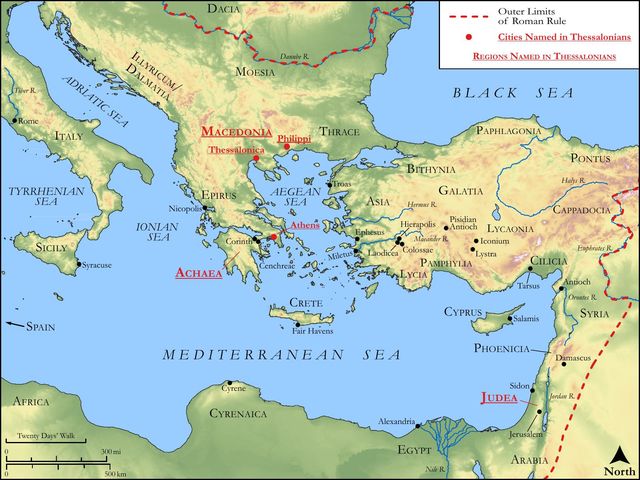
See on the biblical-era map

Study this verse
Public-domain commentary
Matthew Henry
From his Commentary on the Whole Bible. Henry comments on passages, not single verses — this entry covers 1 Thessalonians 5:1–5. His two-level outline is real structure in the source text, so it is rendered as structure.
In these words observe,
I.The apostle tells the Thessalonians it was needless or useless to enquire about the particular time of Christ's coming:
Of the times and seasons you need not that I write unto you, Th1 5:1. The thing is certain that Christ will come, and there is a certain time appointed for his coming; but there was no need that the apostle should write about this, and therefore he had no revelation given him; nor should they or we enquire into this secret, which the Father has reserved in his own power. Of that day and hour knoweth no man. Christ himself did not reveal this while upon earth; it was not in his commission as the great prophet of the church: nor did he reveal this to his apostles; there was no need of this. There are times and seasons for us to do our work in: these it is our duty and interest to know and observe; but the time and season when we must give up our account we know not, nor is it needful that we should know them. Note, There are many things which our vain curiosity desires to know which there is no necessity at all of our knowing, nor would our knowledge of them do us good.
II.He tells them that the coming of Christ would be sudden, and a great surprise to most men, Th1 5:2.
And this is what they knew perfectly, or might know, because our Lord himself had so said: In such an hour as you think not, the Son of man cometh, Mat 24:44. So Mar 13:35, Mar 13:36, Watch you therefore, for you know not when the master of the house cometh; lest, coming suddenly, he find you sleeping. And no doubt the apostle had told them, as of the coming of Christ, so also of his coming suddenly, which is the meaning of his coming as a thief in the night, Rev 16:15. As the thief usually cometh in the dead time of the night, when he is least expected, such a surprise will the day of the Lord be; so sudden and surprising will be his appearance. The knowledge of this will be more useful than to know the exact time, because this should awaken us to stand upon our watch, that we may be ready whenever he cometh.
III.He tells them how terrible Christ's coming would be to the ungodly, Th1 5:3.
It will be to their destruction in that day of the Lord. The righteous God will bring ruin upon his and his people's enemies; and this their destruction, as it will be total and final, so,
1.It will be sudden. It will overtake them, and fall upon them, in the midst of their carnal security and jollity, when they say in their hearts, Peace and safety, when they dream of felicity and please themselves with vain amusements of their fancies or their senses, and think not of it, - as travail cometh upon a woman with child, at the set time indeed, but not perhaps just then expected, nor greatly feared.
2.It will be unavoidable destruction too: They shall not escape; they shall in no wise escape. There will be no means possible for them to avoid the terror nor the punishment of that day. There will be no place where the workers of iniquity shall be able to hide themselves, no shelter from the storm, nor shadow from the burning heat that shall consume the wicked.
IV.He tells them how comfortable this day will be to the righteous, Th1 5:4, Th1 5:5. Here observe,
1.Their character and privilege. They are not in darkness; they are the children of the light, etc. This was the happy condition of the Thessalonians as it is of all true Christians. They were not in a state of sin and ignorance as the heathen world. They were some time darkness, but were made light in the Lord. They were favoured with the divine revelation of things that are unseen and eternal, particularly concerning the coming of Christ, and the consequences thereof. They were the children of the day, for the day-star had risen upon them; yea, the Sun of righteousness had arisen on them with healing under his wings. They were no longer under the darkness of heathenism, nor under the shadows of the law, but under the gospel, which brings life and immortality to light. Ti2 1:10.
2.Their great advantage on this account: that that day should not overtake them as a thief, Th1 5:4. It was at least their own fault if they were surprised by that day. They had fair warning, and sufficient helps to provide against that day, and might hope to stand with comfort and confidence before the Son of man. This would be a time of refreshing to them from the presence of the Lord, who to those that look for him will appear without sin unto their salvation, and will come to them as a friend in the day, not as a thief in the night.
Historical interpretation
Three Centuries of Reception
4 surviving comments on this verse. Each one is dated, so this reads as a timeline rather than a list.
Select a marker to jump to its quote. Markers stagger vertically where authors wrote within a few decades of each other.
This, too, the apostle affirms: "When they shall say, Peace and safety, then sudden destruction shall come upon them."
"When they are saying peace and safety, then sudden destruction cometh upon them, as travail upon a woman with child; and they shall in nowise escape."
Here he has glanced at something which he has also said in his second Epistle. For since they indeed were in affliction, but they that warred on them at ease and in luxury, and then while he comforted them in their present sufferings by this mention of the Resurrection, the others insulted them with arguments taken from their forefathers, and said, When will it happen?
But it may be worth while to ask, If Antichrist comes, and Elias comes, how is it "when they say Peace and safety," that then a sudden destruction comes upon them? For these things do not permit the day to come upon them unawares, being signs of its coming. But he does not mean this to be the time of Antichrist, and the whole day, because that will be a sign of the coming of Christ, but Himself will not have a sign, but will come suddenly and unexpectedly. For travail, indeed, you say, does not come upon the pregnant woman unexpectedly: for she knows that after nine months the birth will take place. And yet it is very uncertain. For some bring forth at the seventh month, and others at the ninth. And at any rate the day and the hour is uncertain. With respect to this therefore, Paul speaks thus. And the image is exact. For there are not many sure signs of travail; many indeed have brought forth in the high roads, or when out of their houses and abroad, not foreseeing it. And he has not only glanced here at the uncertainty, but also at the bitterness of the pain.
And so that you may learn by another thing that the Lord’s silence on this matter is not a sign of ignorance on his part, take note of something else in addition to what we have mentioned. “But as in the days of Noah they were eating and drinking, marrying and giving in marriage, until the day that the flood came and took everything away, so also shall the coming of the Son of Man be.” He said these things in order to show that he would come suddenly and unexpectedly, and precisely when a majority of people would be living luxuriously. Paul also said this when he wrote, “When they shall speak of peace and safety, then sudden destruction will come upon them,” and to show how unexpectedly, he said, “as travail upon a woman with child.”
The woman who is pregnant knows that she has a fetus in the womb but does not know when birth will occur. So it is with us as we know that the Lord will come, but we do not teach the time itself with certainty.
Continue studying 1 Thessalonians 5:3 across the web’s major study libraries — every link below opens this exact verse, chapter, or book on the destination site.
Read & Compare
 BibleGatewayThis verse in more than 200 translations and 70 languages.
 Bible.comThe YouVersion reader — hundreds of translations, reading plans, and highlights.
 ESV.orgCrossway's official English Standard Version reader.
 NET BibleThe NET translation with 60,000+ translators' notes on every rendering decision.
 STEP BibleTyndale House's free study tool — original text, vocabulary, and scholarly resources.
 BibliaLogos Bible Software's free web reader.
 USCCBThe New American Bible (Revised Edition) with the U.S. bishops' study notes.
Commentaries
 BibleHub CommentariesDozens of classic commentaries on this verse, gathered on one page.
 StudyLightMore than 100 commentary sets — the largest collection on the web.
 BibleRefPlain-English commentary on what this verse means, verse by verse.
 Enduring WordDavid Guzik's free commentary on this chapter, widely used by Bible teachers.
 Bible Study ToolsVerse commentary alongside Greek and Hebrew study aids.
Original Language & Research
- BibleHub InterlinearThe verse word by word — original language, transliteration, and English.
- BibleHub LexiconEvery word's original-language definition and Strong's entry.
 Blue Letter BibleDeep-study tools — Strong's numbers, concordance, and word studies.
 CNTR CollationThe earliest Greek manuscripts of this verse, collated letter by letter.
Sermons, Hymns & Audio


TrulyRandomVerse is not affiliated with these sites and doesn’t control their content. They’re linked because they’re genuinely useful.
Summary
First Thessalonians 5:3 issues a solemn warning regarding the unexpected arrival of divine judgment. It describes a time when the world, lulled into a false sense of security, will declare "Peace and safety," only to be met with swift and unavoidable destruction. This sudden calamity is likened to the inescapable pains of childbirth, emphasizing its inevitability and the complete lack of escape for those caught unprepared. The verse starkly contrasts the world's complacency with the vigilance expected of believers, highlighting the critical importance of spiritual readiness in light of the Day of the Lord.
Context
ShowHideLiterary Context
This verse is deeply embedded within Paul's eschatological teaching to the Thessalonian believers, specifically concerning the "Day of the Lord." In 1 Thessalonians 4:13-18, Paul addressed their concerns about those who had died before Christ's return, reassuring them of the resurrection and reunion with the Lord. He then transitions in 1 Thessalonians 5:1-2 to discuss the timing of this event, emphasizing its unexpected nature, "as a thief in the night." Verse 3 serves as a direct continuation, elaborating on the state of the unbelieving world at this precise moment, contrasting their false sense of security with the spiritual alertness Paul calls believers to in the subsequent verses (1 Thessalonians 5:4-8). The entire chapter reinforces the theme of readiness and discernment in anticipation of Christ's return.
Historical & Cultural Context
The city of Thessalonica was a significant Roman colony and a bustling port city, known for its strategic location and economic importance. As a Roman city, it would have been deeply familiar with the concept of the Pax Romana, the "Roman Peace," which was a period of relative peace and stability enforced by the Roman Empire. This "peace and safety" was often a propaganda slogan, promoting the idea that Rome provided ultimate security and prosperity. Paul's use of "Peace and safety" in 1 Thessalonians 5:3 could be a pointed critique of this human-engineered and ultimately fragile peace, contrasting it with the true, divine peace that only God can provide. The early Christians in Thessalonica, living under Roman rule and facing potential persecution, would have understood the irony and spiritual implications of relying on worldly promises of security over divine truth.
Key Themes
ShowHideFirst Thessalonians 5:3 contributes significantly to several major themes woven throughout the epistle. Foremost is the theme of the Day of the Lord, portraying it as a definitive moment of divine intervention and judgment for the unprepared, contrasting with the salvation and hope for believers (1 Thessalonians 5:9-10). The verse powerfully highlights the theme of False Security versus Spiritual Vigilance, demonstrating that human declarations of peace are ultimately futile against God's sovereign plan. It underscores the Inevitable and Sudden Nature of Divine Judgment, using the metaphor of childbirth to convey its unstoppable progression. Furthermore, it reinforces the Distinction Between Believers and Unbelievers, with the former being "children of light" who are not "in darkness" for the Day to overtake them (1 Thessalonians 5:4-5), while the latter are caught unaware. These themes collectively call the Thessalonians, and indeed all believers, to live lives of constant readiness and discernment.
Exposition and Analysis
ShowHideKey Word Analysis
ShowHideThis term refers to a state of tranquility, harmony, and well-being. In the context of 1 Thessalonians 5:3, it describes a false sense of security or a declared absence of conflict, often associated with human efforts or political stability. It is the opposite of the true, spiritual peace that comes from God.
Meaning security or certainty. This word complements "peace," emphasizing a feeling of being free from danger or harm. When paired with "peace," it paints a picture of a world confident in its own defenses and arrangements, believing itself impervious to threat.
This term signifies ruin, death, or perdition. It denotes a devastating and complete undoing, far beyond mere damage. In this verse, it speaks to the ultimate and irreversible judgment that will befall those who are not spiritually prepared.
Verse Breakdown
ShowHide"For when they shall say, Peace and safety;"
This clause sets the scene, indicating a specific point in time when a declaration of security will be made. The "they" refers to the unbelieving world, those who are spiritually unaware or indifferent to God's warnings. Their pronouncement of "peace and safety" suggests a period of perceived stability or perhaps a deliberate attempt to dismiss any notion of impending doom, possibly echoing political slogans or a general societal complacency.
"then sudden destruction cometh upon them,"
This is the stark consequence immediately following the declaration of false security. The word "then" (G5119, tóte') emphasizes the immediate and direct correlation. "Sudden" (G160, aiphnídios') highlights the unexpected and abrupt nature of this judgment, giving no time for preparation or repentance for those who are not ready. "Destruction" (G3639, ólethros') signifies utter ruin and perdition, indicating a severe and final judgment.
"as travail upon a woman with child;"
This powerful simile illustrates the manner of the destruction. "Travail" (G5604, ōdín') refers to the intense, unavoidable, and progressive pains of childbirth. The analogy conveys that the coming judgment is not only sudden but also inevitable and irresistible once it begins, much like labor pains that cannot be stopped or avoided once they commence. It implies a process that, though painful, leads to a definitive outcome.
"and they shall not escape."
This emphatic declaration underscores the finality and inescapability of the judgment for those targeted. The Greek uses a double negative (G3364, ou mḗ') for absolute negation, reinforcing that there will be absolutely no means of evasion or deliverance for those caught in this state of unpreparedness.
Literary Devices
ShowHideThe verse employs several potent literary devices to convey its urgent message. The most prominent is the Simile comparing the sudden destruction to "travail upon a woman with child." This vivid imagery effectively communicates the inevitability, intensity, and sudden onset of the judgment, likening it to a natural process that, once begun, cannot be halted. There is also a strong sense of Irony in the juxtaposition of "Peace and safety" with "sudden destruction." The very words meant to convey security become a prelude to ruin, highlighting the futility of human declarations in the face of divine decree. Furthermore, the verse uses Contrast implicitly, setting the complacent "they" (the world) against the watchful "you" (the believers) of the surrounding context, thereby emphasizing the distinct fates awaiting each group. Finally, the emphatic Negation "they shall not escape" uses a strong Greek double negative to underscore the absolute certainty and finality of the judgment, leaving no room for doubt about its inescapable nature.
Theological and Thematic Connections
ShowHideThis verse profoundly speaks to the nature of God's justice and sovereignty, particularly in the context of eschatology. It reveals that while God is patient and desires all to come to repentance, there is a fixed time for judgment for those who persistently reject His warnings and live in spiritual complacency. The world's declaration of "Peace and safety" is a stark reminder of humanity's tendency to create false securities, whether through political systems, economic stability, or intellectual hubris, rather than seeking true peace with God. This passage underscores that true security is not found in human arrangements but in a right relationship with the Creator, who alone holds the keys to life and destiny. The suddenness and inescapability of the destruction serve as a divine warning, emphasizing that God's judgments are not to be trifled with and will come to pass exactly as foretold, regardless of human perception or preparation.
Reflection and Application
ShowHideFirst Thessalonians 5:3 serves as a profound call to spiritual vigilance and discernment for believers in every generation. It warns against being lulled into a false sense of security by the world's promises, its apparent stability, or its distractions. Instead, it urges us to live with an active awareness of the Lord's imminent return and the certainty of His judgment upon those who are unprepared. This means cultivating a lifestyle of spiritual readiness: being awake, sober, and dressed in the armor of God, as Paul describes in the subsequent verses. It compels us to examine our own lives – are we truly living in peace with God, or are we clinging to a superficial, worldly peace? The inescapable nature of the judgment for the unprepared should ignite within us a greater urgency for evangelism, compelling us to share the true source of peace and safety—Jesus Christ—with a world that desperately needs it before it is too late. Our hope is not in human systems, but in the steadfast promise of our Lord.
Questions for Reflection
ShowHideFAQ
ShowHideWho are "they" who say "Peace and safety"?
ShowHideThe "they" in 1 Thessalonians 5:3 refers to the unbelieving world, those who are not spiritually alert or discerning regarding the signs of the times and the reality of God's impending judgment. This group is contrasted with believers, whom Paul describes as "children of light and children of the day" in 1 Thessalonians 5:5. It represents humanity apart from Christ, living in a state of spiritual darkness and complacency, often trusting in human achievements, political stability, or material prosperity for their security.
What is the "sudden destruction" mentioned here?
ShowHideThe "sudden destruction" (Greek: aiphnídios ólethros) refers to the swift, unexpected, and utterly devastating judgment that will come upon the unprepared world at the Day of the Lord. It is a divine judgment, not merely a natural disaster or human conflict, that will mark the end of the current age and the commencement of God's full wrath against unrighteousness. While its precise nature is not fully detailed here, it signifies a comprehensive and inescapable ruin for those who have rejected God's offer of salvation and lived in spiritual indifference. This destruction is distinct from the tribulation that believers may experience, as Paul assures the Thessalonians that God "has not destined us for wrath, but to obtain salvation through our Lord Jesus Christ" in 1 Thessalonians 5:9.
How does the analogy of "travail upon a woman with child" illuminate this judgment?
ShowHideThe analogy of "travail upon a woman with child" (birth pains) is a powerful biblical metaphor used to describe an event that is inevitable, comes with increasing intensity, and cannot be avoided once it begins. Just as a pregnant woman cannot stop the onset of labor, so too the "sudden destruction" cannot be averted once its time arrives. This comparison emphasizes several key aspects: its inevitability (it will happen), its suddenness (though anticipated, the exact moment of onset is unpredictable), its intensity (it will be severe and painful), and its unstoppable nature (once it starts, there is no escape). Jesus Himself used this analogy to describe the signs preceding the end times in Matthew 24:8. It implies a process that, while painful, leads to a definitive, transformative outcome.
Christ-Centered Fulfillment
ShowHideFirst Thessalonians 5:3, with its stark warning of sudden destruction for those relying on a false "Peace and safety," finds its ultimate Christ-centered fulfillment in the person and work of Jesus Christ. While the verse highlights the inescapable wrath awaiting the unprepared, Christ Himself is the divine provision for true peace and the only means of escape from this impending judgment. He is the one who declares, "My peace I give to you; not as the world gives do I give to you" (John 14:27). Through His atoning sacrifice on the cross, Jesus secured genuine peace with God for all who believe, as Paul declares in Romans 5:1, "Therefore, since we have been justified by faith, we have peace with God through our Lord Jesus Christ." For those "in Christ," there is no condemnation (Romans 8:1), and they are delivered from the domain of darkness into the kingdom of His beloved Son (Colossians 1:13-14). Thus, the "sudden destruction" that befalls the world is precisely the wrath from which Christ has delivered His followers, fulfilling the promise that God "has not destined us for wrath, but to obtain salvation through our Lord Jesus Christ" (1 Thessalonians 5:9). He is the true "safety" and the only "escape" for humanity.