


1 Thessalonians 5:5
Bible text: King James Version (1769 Blayney text) · Public domain
Bible text: Berean Standard Bible · Public domain
Bible text: American Standard Version (1901) · Public domain
Bible text: World English Bible, Messianic edition · Public domain
Bible text: Geneva Bible (1599) · Public domain
Bible text: Young's Literal Translation · Public domain
- πάντεςpantesAllG3956A-NPMAdjective Nominative Plural Masculine
- ὑμεῖςhumeisyou yourselvesG4771P-2NPPersonal pronoun Nominative 2nd Plural
- υἱοὶhuioisonsG5207N-NPMNoun Nominative Plural Masculine
- φωτόςphōtosof lightG5457N-GSNNoun Genitive Singular Neuter
- ἐστεesteareG1510V-PAI-2PVerb Present Active Indicative 2nd Plural
- καὶkaiandG2532CONJConjunction
- υἱοὶhuioisonsG5207N-NPMNoun Nominative Plural Masculine
- ἡμέρας·hēmerasof dayG2250N-GSFNoun Genitive Singular Feminine
- οὐκoukNotG3756PRT-NNegative Particle Negative
- ἐσμὲνesmenwe areG1510V-PAI-1PVerb Present Active Indicative 1st Plural
- νυκτὸςnuktosof nightG3571N-GSFNoun Genitive Singular Feminine
- οὐδὲoudenorG3761CONJ-NConjunction Negative
- σκότουςskotousof darknessG4655N-GSNNoun Genitive Singular Neuter
English is a literal word-by-word gloss of the Greek, not the KJV's wording. Why?
This is the original text the KJV's translators worked from — each Greek word with its own literal English meaning in this verse, prepared by scholars at Tyndale House, Cambridge. The KJV translates whole sentences, not word by word, so its wording differs: one Greek word can become several English words, and the KJV may choose “charity” where the gloss reads “love”. Both are faithful — they answer different questions. For the KJV's own rendering, switch to the KJV text.
Details
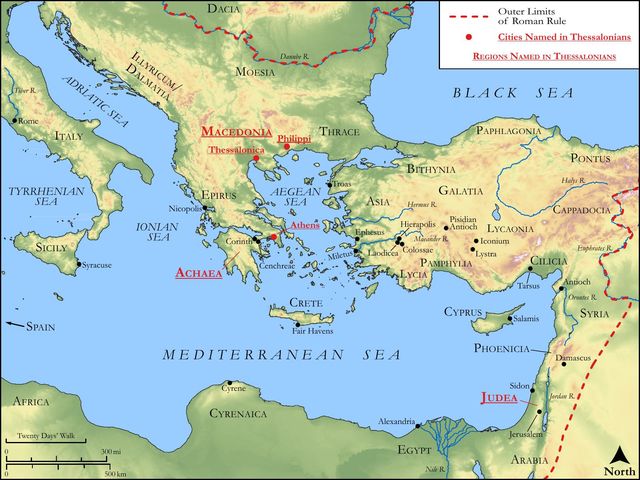
See on the biblical-era maps

Study this verse
Public-domain commentary
Matthew Henry
From his Commentary on the Whole Bible. Henry comments on passages, not single verses — this entry covers 1 Thessalonians 5:1–5. His two-level outline is real structure in the source text, so it is rendered as structure.
In these words observe,
I.The apostle tells the Thessalonians it was needless or useless to enquire about the particular time of Christ's coming:
Of the times and seasons you need not that I write unto you, Th1 5:1. The thing is certain that Christ will come, and there is a certain time appointed for his coming; but there was no need that the apostle should write about this, and therefore he had no revelation given him; nor should they or we enquire into this secret, which the Father has reserved in his own power. Of that day and hour knoweth no man. Christ himself did not reveal this while upon earth; it was not in his commission as the great prophet of the church: nor did he reveal this to his apostles; there was no need of this. There are times and seasons for us to do our work in: these it is our duty and interest to know and observe; but the time and season when we must give up our account we know not, nor is it needful that we should know them. Note, There are many things which our vain curiosity desires to know which there is no necessity at all of our knowing, nor would our knowledge of them do us good.
II.He tells them that the coming of Christ would be sudden, and a great surprise to most men, Th1 5:2.
And this is what they knew perfectly, or might know, because our Lord himself had so said: In such an hour as you think not, the Son of man cometh, Mat 24:44. So Mar 13:35, Mar 13:36, Watch you therefore, for you know not when the master of the house cometh; lest, coming suddenly, he find you sleeping. And no doubt the apostle had told them, as of the coming of Christ, so also of his coming suddenly, which is the meaning of his coming as a thief in the night, Rev 16:15. As the thief usually cometh in the dead time of the night, when he is least expected, such a surprise will the day of the Lord be; so sudden and surprising will be his appearance. The knowledge of this will be more useful than to know the exact time, because this should awaken us to stand upon our watch, that we may be ready whenever he cometh.
III.He tells them how terrible Christ's coming would be to the ungodly, Th1 5:3.
It will be to their destruction in that day of the Lord. The righteous God will bring ruin upon his and his people's enemies; and this their destruction, as it will be total and final, so,
1.It will be sudden. It will overtake them, and fall upon them, in the midst of their carnal security and jollity, when they say in their hearts, Peace and safety, when they dream of felicity and please themselves with vain amusements of their fancies or their senses, and think not of it, - as travail cometh upon a woman with child, at the set time indeed, but not perhaps just then expected, nor greatly feared.
2.It will be unavoidable destruction too: They shall not escape; they shall in no wise escape. There will be no means possible for them to avoid the terror nor the punishment of that day. There will be no place where the workers of iniquity shall be able to hide themselves, no shelter from the storm, nor shadow from the burning heat that shall consume the wicked.
IV.He tells them how comfortable this day will be to the righteous, Th1 5:4, Th1 5:5. Here observe,
1.Their character and privilege. They are not in darkness; they are the children of the light, etc. This was the happy condition of the Thessalonians as it is of all true Christians. They were not in a state of sin and ignorance as the heathen world. They were some time darkness, but were made light in the Lord. They were favoured with the divine revelation of things that are unseen and eternal, particularly concerning the coming of Christ, and the consequences thereof. They were the children of the day, for the day-star had risen upon them; yea, the Sun of righteousness had arisen on them with healing under his wings. They were no longer under the darkness of heathenism, nor under the shadows of the law, but under the gospel, which brings life and immortality to light. Ti2 1:10.
2.Their great advantage on this account: that that day should not overtake them as a thief, Th1 5:4. It was at least their own fault if they were surprised by that day. They had fair warning, and sufficient helps to provide against that day, and might hope to stand with comfort and confidence before the Son of man. This would be a time of refreshing to them from the presence of the Lord, who to those that look for him will appear without sin unto their salvation, and will come to them as a friend in the day, not as a thief in the night.
Historical interpretation
Two Centuries of Reception
4 surviving comments on this verse. Each one is dated, so this reads as a timeline rather than a list.
Select a marker to jump to its quote. Markers stagger vertically where authors wrote within a few decades of each other.
"Let us not then sleep, as do others, but let us watch," says the Scripture, "and be sober. For they that sleep, sleep in the night; and they that be drunken, are drunken in the night," that is, in the darkness of ignorance. "But let us who are of the day be sober. For ye are all children of the light, and children of the day; we are not of the night, nor of the darkness." But whoever of us is most solicitous for living the true life, and for entertaining noble sentiments, will keep awake for as long time as possible, reserving to himself only what in this respect is conducive to his own health.
But when he urges us not to give place to evil, he does not offer the suggestion that we should take to our heels, he only teaches that passion should be kept under restraint; and if he says that the time must be redeemed, because the days are evil, he wishes us to gain a lengthening of life, not by flight, but by wisdom. Besides, he who bids us shine as sons of light, does not bid us hide away out of sight as sons of darkness.
If you wish to see Jesus transfigured before those who went up on the mountain with him, behold with me the Jesus in the Gospels as more simply understood. This is Jesus, as one might say, known “according to the flesh” by those who do not go up through uplifting words and works to the holy mountain of wisdom. Behold him with me as known in his divinity by means of all of the Gospels, beheld in the form of God according to the knowledge that his companions had. For before them Jesus is transfigured, but not to any of those who are below. But when he is transfigured, his face also shines as the sun, so that he may be manifested to the children of light. These have put off the works of darkness and have put on the armor of light and are no longer the children of darkness or night, but have become sons of the day and walk honestly as in the day. Being manifested, he will shine for them not only as the sun, but as the son of righteousness.
"For ye are all sons of light, and sons of the day."
And how is it possible to be "sons of the day"? Just as it is said, "sons of destruction" and "sons of hell." Wherefore Christ also said to the Pharisees, "Woe unto you-for ye compass sea and land to make one proselyte, and when he is become so, ye make him a son of hell." (Matt. xxiii. 15.) And again Paul said, "For which things' sake cometh the wrath of God upon the sons of disobedience." (Col. iii. 6.) That is, those who do the works of hell and the works of disobedience. So also sons of God are those who do things pleasing to God; so also sons of day and sons of light, those who do the works of light. "And we are not of the night nor of darkness."
Continue studying 1 Thessalonians 5:5 across the web’s major study libraries — every link below opens this exact verse, chapter, or book on the destination site.
Read & Compare
 BibleGatewayThis verse in more than 200 translations and 70 languages.
 Bible.comThe YouVersion reader — hundreds of translations, reading plans, and highlights.
 ESV.orgCrossway's official English Standard Version reader.
 NET BibleThe NET translation with 60,000+ translators' notes on every rendering decision.
 STEP BibleTyndale House's free study tool — original text, vocabulary, and scholarly resources.
 BibliaLogos Bible Software's free web reader.
 USCCBThe New American Bible (Revised Edition) with the U.S. bishops' study notes.
Commentaries
 BibleHub CommentariesDozens of classic commentaries on this verse, gathered on one page.
 StudyLightMore than 100 commentary sets — the largest collection on the web.
 BibleRefPlain-English commentary on what this verse means, verse by verse.
 Enduring WordDavid Guzik's free commentary on this chapter, widely used by Bible teachers.
 Bible Study ToolsVerse commentary alongside Greek and Hebrew study aids.
Original Language & Research
- BibleHub InterlinearThe verse word by word — original language, transliteration, and English.
- BibleHub LexiconEvery word's original-language definition and Strong's entry.
 Blue Letter BibleDeep-study tools — Strong's numbers, concordance, and word studies.
 CNTR CollationThe earliest Greek manuscripts of this verse, collated letter by letter.
Sermons, Hymns & Audio


TrulyRandomVerse is not affiliated with these sites and doesn’t control their content. They’re linked because they’re genuinely useful.
Summary
1 Thessalonians 5:5 serves as a foundational declaration of the believer's transformed identity and spiritual reality in Christ. Following Paul's teaching on the unexpected return of the Lord, this verse unequivocally states that Christians are inherently aligned with light and day, not with the darkness or night that characterizes the unregenerate world. This profound spiritual status demands a corresponding lifestyle of vigilance, sobriety, and holiness, distinguishing believers as those who are prepared for the Lord's coming.
Context
ShowHideLiterary Context
This verse is situated within Paul's concluding exhortations in his first epistle to the Thessalonians, specifically within a section (1 Thessalonians 5:1-11) addressing the "times and seasons" of the Lord's return. Paul has just clarified that the "day of the Lord" will come "like a thief in the night" for those who are unprepared and living in spiritual darkness (1 Thessalonians 5:2). Verse 5:5 directly contrasts this with the status of believers, establishing the theological basis for the subsequent commands to "be awake and sober" (1 Thessalonians 5:6) and to "put on the breastplate of faith and love, and for a helmet the hope of salvation" (1 Thessalonians 5:8). The identity declared in 1 Thessalonians 5:5 is the bedrock for the ethical imperatives that follow, emphasizing that their spiritual nature enables and compels them to live differently.
Historical & Cultural Context
The city of Thessalonica was a bustling Roman port city, characterized by its diverse population, pagan worship, and a strong imperial cult. Paul's converts, many of whom were Gentiles, would have been deeply immersed in a culture that often celebrated darkness (e.g., nocturnal revelry, secret cults, immoral practices hidden from public view). The Roman world also had a clear distinction between day (work, public life, order) and night (sleep, hidden activities, danger). Paul's imagery of "light" and "day" versus "night" and "darkness" would have resonated powerfully, drawing a sharp contrast between the values and practices of the pagan world and the new life in Christ. This distinction was not merely metaphorical but had practical implications for how Christians were to conduct themselves publicly and privately in a society that might view their newfound faith with suspicion or hostility.
Key Themes
ShowHide1 Thessalonians 5:5 contributes significantly to several major themes within the epistle and Pauline theology. Firstly, it underscores the theme of Identity in Christ, asserting that believers have undergone a radical transformation, moving from a state of spiritual darkness to one of light. This new identity is not merely a label but defines their very nature and allegiance, akin to the themes found in Ephesians 5:8. Secondly, it highlights the Distinction between Believers and Unbelievers, drawing a clear line between those who are "of the day" and those who remain "of the night." This theological separation provides the impetus for ethical living and spiritual vigilance, as seen in the call to "walk properly as in the daytime" in Romans 13:13. Finally, the verse reinforces the theme of Spiritual Awareness and Readiness for the Lord's return. Being "children of the day" implies a state of wakefulness, discernment, and preparedness, contrasting sharply with the spiritual slumber and unpreparedness of those who live in darkness, a concept Paul reiterates in 1 Thessalonians 5:6.
Exposition and Analysis
ShowHideKey Word Analysis
ShowHideThis word, meaning "son" or "child," is used here in a Semitic idiom (common in the New Testament) to denote a close association, inherent characteristic, or belonging. To be "children of light" or "children of the day" signifies that light and day are the defining qualities, origin, and sphere of existence for believers, rather than merely an external affiliation. It implies a deep, intrinsic connection to the nature of light and day.
This term refers to luminousness in its widest application—natural or artificial, abstract or concrete, literal or figurative. In this context, "light" is a profound theological metaphor for God's nature, truth, holiness, and revelation. It stands in sharp contrast to spiritual ignorance, moral corruption, and the realm of evil. To be "of light" means to partake in God's character and to live in His truth.
Literally meaning the time space between dawn and dark, or the whole 24 hours, "day" is used figuratively here to represent a period defined by clarity, revelation, and the absence of spiritual darkness. It is often associated with the era of salvation, the presence of Christ, and the time of God's judgment and ultimate revelation, in contrast to the "night" of ignorance and sin.
Verse Breakdown
ShowHide"Ye are all the children of light,"
This clause makes a universal declaration to all believers in Thessalonica (and by extension, all Christians). It asserts their new spiritual identity, emphasizing that they are inherently connected to and defined by divine light. This "light" signifies truth, holiness, purity, and God's very nature, implying a transformation from their former state of spiritual darkness.
"and the children of the day:"
This phrase reiterates and reinforces the previous declaration, using a parallel idiom. "Day" symbolizes clarity, revelation, and the time of God's active presence and ultimate judgment. To be "children of the day" means believers live in the full light of God's truth, are spiritually awake, and are prepared for the Lord's return, in contrast to those who slumber in ignorance.
"we are not of the night, nor of darkness."
This is a direct antithetical statement, explicitly contrasting the believer's identity with that of the unbelieving world. "Night" and "darkness" represent spiritual ignorance, moral corruption, sin, and the realm alienated from God. The emphatic "not" and "nor" underscore that believers have been completely severed from this former state and its associated behaviors, highlighting their distinct spiritual allegiance and way of life.
Literary Devices
ShowHide1 Thessalonians 5:5 is rich in literary devices that amplify its theological message. Primarily, it employs Metaphor and Symbolism, where "light" and "day" symbolize truth, holiness, God's presence, and spiritual awareness, while "night" and "darkness" symbolize spiritual ignorance, sin, and separation from God. This creates a powerful Antithesis, sharply contrasting the spiritual state and destiny of believers with that of unbelievers. The repetitive structure of "children of light... children of the day" and "not of the night, nor of darkness" utilizes Parallelism to reinforce the central message of distinct identity. Furthermore, the phrases "children of light" and "children of the day" are examples of a Semitic Idiom, a common Hebrew expression that denotes a characteristic, affiliation, or inherent nature (e.g., "children of wrath" or "children of disobedience"). This idiom emphasizes that light and day are not merely external attributes but define the very essence and being of the believer.
Theological and Thematic Connections
ShowHideThe profound declaration in 1 Thessalonians 5:5 that believers are "children of light" and "children of the day" is a cornerstone of New Testament theology concerning salvation and sanctification. It signifies a radical spiritual re-parenting, where God, who is light, becomes the source and defining reality of the believer's new life. This transformation moves individuals from a realm of spiritual blindness and moral corruption into a sphere of divine truth, holiness, and vigilance. It's a declaration of who believers are in Christ, which then serves as the basis for how they ought to live. This identity demands a conscious separation from the ways of the world, characterized by the "deeds of darkness," and an active pursuit of righteousness and spiritual wakefulness, in anticipation of Christ's return.
Reflection and Application
ShowHide1 Thessalonians 5:5 is far more than a theological statement; it is a powerful call to live in alignment with our true identity in Christ. If we are truly "children of light" and "children of the day," then our lives should reflect the characteristics of light: transparency, purity, truth, and exposure of evil. We are called to shed the hidden deeds of darkness—deception, immorality, and spiritual slumber—and instead walk in integrity, righteousness, and spiritual vigilance. This means cultivating a sober mind, being alert to the spiritual realities around us, and living with an eternal perspective that anticipates the Lord's return. Our identity as children of the day empowers us to live boldly and distinctly in a world still shrouded in darkness, serving as beacons of hope and truth. It is a reminder that our transformed nature compels us to live out our faith actively, demonstrating the light of Christ in every sphere of our lives.
Questions for Reflection
ShowHideFAQ
ShowHideWhat does it mean to be "children of light" and "children of the day"?
ShowHideTo be "children of light" and "children of the day" is a profound declaration of a believer's new spiritual identity in Christ. This is a Semitic idiom, meaning that light and day are the defining characteristics, nature, and sphere of existence for believers. "Light" symbolizes God's truth, holiness, and moral purity, while "day" signifies clarity, spiritual wakefulness, and the era of salvation. In essence, it means believers have been delivered from spiritual darkness (ignorance, sin, separation from God) and now belong to God's realm of truth and righteousness, living in His illuminating presence and anticipating the full revelation of His kingdom. This identity demands a lifestyle that reflects these qualities, contrasting sharply with the "night" and "darkness" of the world.
How does this verse relate to the "day of the Lord"?
ShowHideThis verse is intrinsically linked to Paul's discussion of the "day of the Lord" in 1 Thessalonians 5:1-11. Paul explains that the "day of the Lord" will come unexpectedly, "like a thief in the night," for those who are unprepared and living in spiritual darkness (1 Thessalonians 5:2). However, because believers "are all the children of light, and the children of the day," they are not "of the night, nor of darkness," meaning they should not be caught off guard. Their identity in light implies spiritual awareness and readiness, enabling them to live soberly and vigilantly, prepared for Christ's return, unlike those who remain in spiritual slumber.
Christ-Centered Fulfillment
ShowHide1 Thessalonians 5:5 finds its ultimate fulfillment and meaning in Jesus Christ, who is the very embodiment of light and the dawn of a new spiritual "day." Jesus Himself declared, "I am the light of the world. Whoever follows me will not walk in darkness, but will have the light of life" (John 8:12). Through His incarnation, death, and resurrection, Christ shattered the power of darkness and ushered in the "day" of salvation, delivering humanity from the domain of spiritual night. Believers become "children of light" and "children of the day" precisely because they are united with Christ, the true Light. As Colossians 1:13 states, God "has delivered us from the domain of darkness and transferred us to the kingdom of his beloved Son." Our identity as children of light is not self-generated but is a gracious gift, a new creation in Christ, empowering us to "walk as children of light" (Ephesians 5:8) and reflect His glory until He returns to bring the full and eternal "day" of His kingdom.