


1 Thessalonians 5:4
Bible text: King James Version (1769 Blayney text) · Public domain
Bible text: Berean Standard Bible · Public domain
Bible text: American Standard Version (1901) · Public domain
Bible text: World English Bible, Messianic edition · Public domain
Bible text: Geneva Bible (1599) · Public domain
Bible text: Young's Literal Translation · Public domain
- ὑμεῖςhumeisYou yourselvesG4771P-2NPPersonal pronoun Nominative 2nd Plural
- δέdehoweverG1161CONJConjunction
- ἀδελφοίadelphoibrothersG80N-VPMNoun Vocative Plural Masculine
- οὐκouknotG3756PRT-NNegative Particle Negative
- ἐστὲesteareG1510V-PAI-2PVerb Present Active Indicative 2nd Plural
- ἐνeninG1722PREPPreposition
- σκότειskoteidarknessG4655N-DSNNoun Dative Singular Neuter
- ἵναinathatG2443CONJConjunction
- ἡhētheG3588T-NSFDefinite article Nominative Singular Feminine
- ἡμέραhēmeradayG2250N-NSFNoun Nominative Singular Feminine
- ὑμᾶςhumasyouG4771P-2APPersonal pronoun Accusative 2nd Plural
- ὡςhōslikeG5613PRTParticle or Disjunctive
- κλέπτηςkleptēsa thiefG2812N-NSMNoun Nominative Singular Masculine
- καταλάβῃ·katalabēmay graspG2638V-2AAS-3SVerb 2nd Aorist Active Subjunctive 3rd Singular
English is a literal word-by-word gloss of the Greek, not the KJV's wording. Why?
This is the original text the KJV's translators worked from — each Greek word with its own literal English meaning in this verse, prepared by scholars at Tyndale House, Cambridge. The KJV translates whole sentences, not word by word, so its wording differs: one Greek word can become several English words, and the KJV may choose “charity” where the gloss reads “love”. Both are faithful — they answer different questions. For the KJV's own rendering, switch to the KJV text.
Details
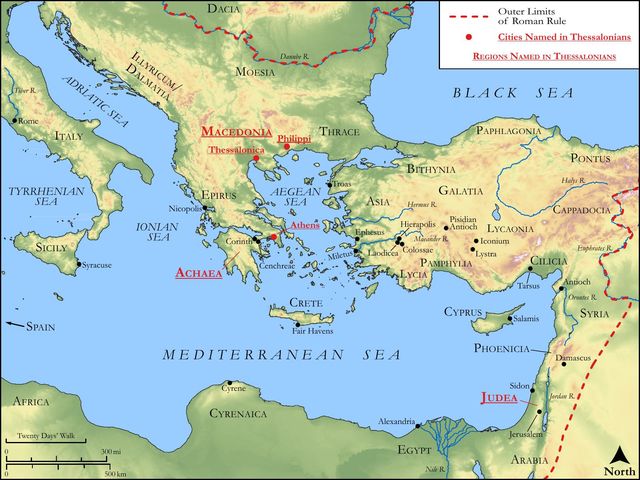
See on the biblical-era maps

Study this verse
Public-domain commentary
Matthew Henry
From his Commentary on the Whole Bible. Henry comments on passages, not single verses — this entry covers 1 Thessalonians 5:1–5. His two-level outline is real structure in the source text, so it is rendered as structure.
In these words observe,
I.The apostle tells the Thessalonians it was needless or useless to enquire about the particular time of Christ's coming:
Of the times and seasons you need not that I write unto you, Th1 5:1. The thing is certain that Christ will come, and there is a certain time appointed for his coming; but there was no need that the apostle should write about this, and therefore he had no revelation given him; nor should they or we enquire into this secret, which the Father has reserved in his own power. Of that day and hour knoweth no man. Christ himself did not reveal this while upon earth; it was not in his commission as the great prophet of the church: nor did he reveal this to his apostles; there was no need of this. There are times and seasons for us to do our work in: these it is our duty and interest to know and observe; but the time and season when we must give up our account we know not, nor is it needful that we should know them. Note, There are many things which our vain curiosity desires to know which there is no necessity at all of our knowing, nor would our knowledge of them do us good.
II.He tells them that the coming of Christ would be sudden, and a great surprise to most men, Th1 5:2.
And this is what they knew perfectly, or might know, because our Lord himself had so said: In such an hour as you think not, the Son of man cometh, Mat 24:44. So Mar 13:35, Mar 13:36, Watch you therefore, for you know not when the master of the house cometh; lest, coming suddenly, he find you sleeping. And no doubt the apostle had told them, as of the coming of Christ, so also of his coming suddenly, which is the meaning of his coming as a thief in the night, Rev 16:15. As the thief usually cometh in the dead time of the night, when he is least expected, such a surprise will the day of the Lord be; so sudden and surprising will be his appearance. The knowledge of this will be more useful than to know the exact time, because this should awaken us to stand upon our watch, that we may be ready whenever he cometh.
III.He tells them how terrible Christ's coming would be to the ungodly, Th1 5:3.
It will be to their destruction in that day of the Lord. The righteous God will bring ruin upon his and his people's enemies; and this their destruction, as it will be total and final, so,
1.It will be sudden. It will overtake them, and fall upon them, in the midst of their carnal security and jollity, when they say in their hearts, Peace and safety, when they dream of felicity and please themselves with vain amusements of their fancies or their senses, and think not of it, - as travail cometh upon a woman with child, at the set time indeed, but not perhaps just then expected, nor greatly feared.
2.It will be unavoidable destruction too: They shall not escape; they shall in no wise escape. There will be no means possible for them to avoid the terror nor the punishment of that day. There will be no place where the workers of iniquity shall be able to hide themselves, no shelter from the storm, nor shadow from the burning heat that shall consume the wicked.
IV.He tells them how comfortable this day will be to the righteous, Th1 5:4, Th1 5:5. Here observe,
1.Their character and privilege. They are not in darkness; they are the children of the light, etc. This was the happy condition of the Thessalonians as it is of all true Christians. They were not in a state of sin and ignorance as the heathen world. They were some time darkness, but were made light in the Lord. They were favoured with the divine revelation of things that are unseen and eternal, particularly concerning the coming of Christ, and the consequences thereof. They were the children of the day, for the day-star had risen upon them; yea, the Sun of righteousness had arisen on them with healing under his wings. They were no longer under the darkness of heathenism, nor under the shadows of the law, but under the gospel, which brings life and immortality to light. Ti2 1:10.
2.Their great advantage on this account: that that day should not overtake them as a thief, Th1 5:4. It was at least their own fault if they were surprised by that day. They had fair warning, and sufficient helps to provide against that day, and might hope to stand with comfort and confidence before the Son of man. This would be a time of refreshing to them from the presence of the Lord, who to those that look for him will appear without sin unto their salvation, and will come to them as a friend in the day, not as a thief in the night.
Historical interpretation
Five Centuries of Reception
5 surviving comments on this verse. Each one is dated, so this reads as a timeline rather than a list.
Select a marker to jump to its quote. Markers stagger vertically where authors wrote within a few decades of each other.
Nay, but this whole world is the one house of all; in which world it is more the heathen, who is found in darkness, whom the grace of God enlightens, than the Christian, who is already in God's light. Finally, it is one "straying" which is ascribed to the ewe and the drachma: (and this is an evidence in my favour); for if the parables had been composed with a view to a Christian sinner, after the loss of his faith, a second loss and restoration of them would have been noted.
"But ye, brethren, are not in darkness, that that day should overtake you as a thief."
Here he speaks of a life that is dark and impure. For it is just as corrupt and wicked men do all things as in the night, escaping the notice of all, and inclosing themselves in darkness. For tell me, does not the adulterer watch for the evening, and the thief for the night? Does not the violator of the tombs carry on all his trade in the night? What then? Does it not overtake them as a thief? Does it not come upon them also uncertainly, but do they know it beforehand? How then does he say, "Ye have no need that aught be written unto you"? He speaks here not with respect to the uncertainty, but with respect to the calamity, that is, it will not come as an evil to them. For it will come uncertainly indeed even to them, but it will involve them in no trouble. "That that Day," he says, "may not overtake you as a thief." For in the case of those who are watching and who are in the light, if there should be any entry of a robber, it can do them no harm: so also it is with those who live well. But those who are sleeping he will strip of everything, and go off; that is, those who are trusting in the things of this life.
Therefore, not to know the times is something different from decay of morals and love of vice. For, when the apostle Paul said, “Don’t allow your thinking to be shaken nor be frightened, neither by word nor by epistle as sent from us, as if the day of the Lord were at hand,” he obviously did not want them to believe those who thought the coming of the Lord was already at hand, but neither did he want them to be like the wicked servant and say, “My Lord is long in coming,” and deliver themselves over to destruction by pride and riotous behavior. Thus, his desire that they should not listen to false rumors about the imminent approach of the last day was consistent with his wish that they should await the coming of their Lord fully prepared, packed for travel and with lamps burning. He said to them, “But you, brothers, are not in darkness that that day should overtake you as a thief, for all you are the children of light and children of the day; we are not of the night nor of darkness.”
On the verse: “This is the day which the Lord has made.” What we have sung to our Lord let us put into practice with his help. To be sure, every day has been made by the Lord, but with good reason has it been said of a particular day, “This is the day which the Lord has made.” We read that when he created heaven and earth, “God said, ‘Let there be light,’ and there was light, and God called the light Day, and the darkness Night.” But there is another day, well established and definitely to be commended by us, concerning which the apostle says, “Let us walk becomingly as in the day.” That day, commonly called “today,” is caused by the rising and setting of the sun. There is still another day by which the word of God shines on the hearts of the faithful and dispels the darkness, not of the eyes, but of evil habits. Let us, therefore, recognize this light; let us rejoice in it; let us pay attention to the apostle when he says, “For we are children of the light and children of the day. We are not of night nor of darkness.”
Now if the good God sees that a man’s heart has not inclined to any of these things as David said, indicating the same, “You have tested my heart, You have visited it in the night, You have tried me by fire, and unrighteousness was not found in me,” then God will help him and deliver him. Why does he say “in the night” and not “in the day”? Because the enemy’s deceptions are a night, as Paul also said, “We are not children of the night but children of the day,” since the Son of God is the Day, but Satan is night.
Continue studying 1 Thessalonians 5:4 across the web’s major study libraries — every link below opens this exact verse, chapter, or book on the destination site.
Read & Compare
 BibleGatewayThis verse in more than 200 translations and 70 languages.
 Bible.comThe YouVersion reader — hundreds of translations, reading plans, and highlights.
 ESV.orgCrossway's official English Standard Version reader.
 NET BibleThe NET translation with 60,000+ translators' notes on every rendering decision.
 STEP BibleTyndale House's free study tool — original text, vocabulary, and scholarly resources.
 BibliaLogos Bible Software's free web reader.
 USCCBThe New American Bible (Revised Edition) with the U.S. bishops' study notes.
Commentaries
 BibleHub CommentariesDozens of classic commentaries on this verse, gathered on one page.
 StudyLightMore than 100 commentary sets — the largest collection on the web.
 BibleRefPlain-English commentary on what this verse means, verse by verse.
 Enduring WordDavid Guzik's free commentary on this chapter, widely used by Bible teachers.
 Bible Study ToolsVerse commentary alongside Greek and Hebrew study aids.
Original Language & Research
- BibleHub InterlinearThe verse word by word — original language, transliteration, and English.
- BibleHub LexiconEvery word's original-language definition and Strong's entry.
 Blue Letter BibleDeep-study tools — Strong's numbers, concordance, and word studies.
 CNTR CollationThe earliest Greek manuscripts of this verse, collated letter by letter.
Sermons, Hymns & Audio


TrulyRandomVerse is not affiliated with these sites and doesn’t control their content. They’re linked because they’re genuinely useful.
Summary
First Thessalonians 5:4 offers a profound contrast to the preceding verses, assuring believers that they are not subject to the same spiritual blindness and impending judgment as the world. Paul declares that, unlike those who dwell in spiritual darkness, the Thessalonian believers, as children of light, will not be caught off guard or overwhelmed by the sudden arrival of the Day of the Lord, which will surprise the unprepared like a thief. This verse serves as both an affirmation of their spiritual identity in Christ and an encouragement regarding their eschatological hope.
Context
ShowHideLiterary Context
This verse is an integral part of Paul's extended teaching on the Day of the Lord, which begins in 1 Thessalonians 4:13. Having addressed the believers' concerns about those who had died before Christ's return (the rapture of the church in 1 Thessalonians 4:13-18), Paul shifts his focus in 1 Thessalonians 5:1-11 to the timing and nature of "the times and the seasons" regarding the Lord's coming. He explicitly states in 1 Thessalonians 5:2-3 that the Day of the Lord will "come as a thief in the night" for the world, bringing "sudden destruction" upon those who say "Peace and safety!" In stark contrast to this grim prognosis for the ungodly, 1 Thessalonians 5:4 provides a powerful reassurance to the believers, highlighting their distinct spiritual status and destiny.
Historical & Cultural Context
The city of Thessalonica was a bustling Roman port city, a hub of commerce and diverse religious practices. The early Christian community there, comprised of both Jews and Gentiles, faced persecution and societal pressures. A significant aspect of early Christian belief was the expectation of Christ's imminent return, often referred to as the "Parousia" (coming) or the "Day of the Lord). This expectation, while a source of hope, also brought questions and anxieties, particularly regarding those who died before the Lord's return. Paul's letters to the Thessalonians are among his earliest, indicating the foundational importance of eschatological teaching in the nascent church. The imagery of a "thief" was a common metaphor for unexpected, unwelcome intrusion in that day, easily understood by the Thessalonians, who would have been familiar with the need for vigilance against actual thieves.
Key Themes
ShowHideThis verse powerfully contributes to several key themes within 1 Thessalonians and broader Pauline theology. The primary theme is the distinction between believers and unbelievers regarding their spiritual state and their experience of the Day of the Lord. Believers are characterized by spiritual enlightenment ("not in darkness"), implying a new identity in Christ that brings understanding, moral purity, and a relationship with God, contrasting sharply with the world's spiritual ignorance and moral depravity. This enlightenment leads directly to the theme of preparedness and vigilance for Christ's return; because believers are "children of light and children of the day" (1 Thessalonians 5:5), they are called to live soberly and be ready, not caught unaware. Finally, the verse offers profound assurance and comfort to the Thessalonian believers, affirming their secure standing in Christ and their exemption from the sudden, destructive judgment that awaits the ungodly, reinforcing the hope found in 1 Thessalonians 4:18.
Exposition and Analysis
ShowHideKey Word Analysis
ShowHideThis term denotes more than just the absence of physical light; it signifies obscurity, both literally and figuratively. In a theological sense, it represents spiritual blindness, ignorance, moral depravity, and separation from God. Paul uses it to describe the spiritual condition of those outside of Christ, who are unable to perceive divine truth or live righteously.
This verb means "to take eagerly," "to seize," "to grasp," or "to come suddenly upon." It conveys the idea of being surprised, caught unaware, or overwhelmed. When applied to the Day of the Lord, it describes an unwelcome, sudden, and inescapable event that seizes those who are unprepared, like a predator seizing its prey.
Derived from the verb "to steal," this noun refers to one who takes secretly and unlawfully. As a metaphor for the Day of the Lord, it emphasizes the unexpected and sudden nature of its arrival for those who are not vigilant. A thief comes at an hour when least expected, usually to inflict loss or harm, and without warning.
Verse Breakdown
ShowHide"But ye, brethren,"
The conjunction "But" (G1161, dé) introduces a strong contrast, pivoting from the description of the world's unpreparedness in 1 Thessalonians 5:3 to the distinct spiritual state of the believers. The address "brethren" (G80, adelphós) is a term of endearment and solidarity, reinforcing the familial bond within the Christian community and highlighting their shared identity in Christ.
"are not in darkness,"
This is the core declaration of the believers' spiritual status. To be "in darkness" (G1722, en G4655, skótos) signifies a state of spiritual ignorance, moral corruption, and alienation from God. Paul asserts that the Thessalonian believers, by virtue of their conversion and new life in Christ, have been delivered from this spiritual condition. They possess spiritual light, understanding, and a relationship with God that fundamentally distinguishes them from the unbelieving world.
"that that day should overtake you as a thief."
This clause explains the consequence of not being "in darkness." The purpose clause introduced by "that" (G2443, hína) indicates that their spiritual illumination prevents the Day of the Lord (G2250, hēméra) from surprising or overwhelming them in the same way it will the ungodly. The simile "as a thief" (G5613, hōs G2812, kléptēs) reiterates the sudden and unexpected nature of the Day, but for believers, this unexpectedness will not result in being caught unprepared for judgment, but rather in a joyful reception of their Lord.
Literary Devices
ShowHidePaul masterfully employs several literary devices in 1 Thessalonians 5:4 to convey his message with clarity and impact. The most prominent is Contrast, which forms the structural backbone of this passage. Paul sets up a sharp dichotomy between "the world" (implied from 1 Thessalonians 5:3) and "ye, brethren," highlighting their differing spiritual states ("in darkness" vs. "not in darkness") and their respective experiences of the Day of the Lord. This contrast underscores the transformative power of faith in Christ. Directly related to this is the Metaphor of "darkness" and "light." "Darkness" is used metaphorically to represent spiritual ignorance, moral depravity, and separation from God, while "light" (implied by "not in darkness" and explicitly stated in 1 Thessalonians 5:5) symbolizes spiritual understanding, righteousness, and fellowship with God. Finally, Paul uses a Simile when he states that the Day will "overtake you as a thief." This comparison vividly illustrates the sudden, unexpected, and potentially devastating nature of the Day of the Lord for those who are unprepared, drawing on a common, relatable experience of vulnerability. For believers, however, this simile is inverted; while the timing may be unexpected, the outcome is not one of surprise and destruction, but rather of anticipated salvation.
Theological and Thematic Connections
ShowHideThe theological significance of 1 Thessalonians 5:4 is immense, articulating a core aspect of Christian eschatology and identity. It underscores the profound spiritual transformation that occurs in salvation, where believers are transferred from a realm of spiritual darkness and ignorance into the light of God's truth. This new spiritual reality means that while the exact timing of Christ's return remains unknown, its arrival will not be a source of terror or judgment for the redeemed, but rather the culmination of their hope. The verse affirms the security of believers in Christ, highlighting that their union with Him grants them a different standing before God, exempting them from the wrath that will be poured out on the ungodly. It implies a call to live consistently with this enlightened status, demonstrating spiritual vigilance and moral integrity as those who genuinely belong to the day.
Reflection and Application
ShowHideFirst Thessalonians 5:4 is a powerful reminder of our spiritual identity and the implications for our daily lives. As believers, we are fundamentally different from the world around us; we have been brought out of darkness into God's marvelous light. This truth should instill a deep sense of security and peace, knowing that the Day of the Lord, while sudden for the world, will not catch us unaware in a state of spiritual unpreparedness or judgment. It calls us to live consistently with our identity as "children of light," meaning we should actively walk in truth, righteousness, and holiness. This involves cultivating spiritual discernment, rejecting the works of darkness, and living with an ongoing awareness of Christ's imminent return. Our hope in His coming should not lead to complacency or fear, but rather to a vibrant, watchful, and purposeful life that reflects the light of Christ to a world still shrouded in darkness.
Questions for Reflection
ShowHideFAQ
ShowHideWhat does it mean for believers to be "not in darkness" in the context of the Day of the Lord?
ShowHideTo be "not in darkness" means that believers have experienced a spiritual transformation, being delivered from the spiritual ignorance, moral depravity, and alienation from God that characterize the unbelieving world. This is a state of spiritual enlightenment and understanding, brought about by their faith in Jesus Christ. Because they are "in the light," they are aware of God's truth, understand His purposes, and are living in a right relationship with Him. Therefore, while the exact timing of the Day of the Lord is unknown to everyone, its arrival will not catch believers in a state of spiritual unpreparedness that leads to judgment or destruction, as it will those who remain in darkness. Instead, for believers, it signifies the culmination of their hope and salvation, as described in 1 Thessalonians 5:9-10.
Christ-Centered Fulfillment
ShowHideFirst Thessalonians 5:4, while speaking of the believer's present spiritual state, finds its ultimate fulfillment and meaning in Christ. It is precisely because believers are "in Christ" that they are "not in darkness." Jesus Himself declared, "I am the light of the world. Whoever follows me will not walk in darkness, but will have the light of life." Our deliverance from darkness is not a self-achieved state but a gracious act of God, who "has delivered us from the domain of darkness and transferred us to the kingdom of his beloved Son." The "Day" that will not overtake believers as a thief is the Day of the Lord, which is fundamentally the day of Christ's glorious appearing. He is the one who will return, and our readiness is rooted in our union with Him. The assurance that we will not be caught unaware is because Christ has already conquered sin and death, and "He died for us so that whether we are awake or asleep we might live with him." Thus, this verse points to Christ as the source of our spiritual illumination, the guarantor of our security, and the object of our blessed hope, ensuring that His coming will be our glorious salvation, not our sudden destruction.