


1 Thessalonians 5:8
Bible text: King James Version (1769 Blayney text) · Public domain
Bible text: King James Version with Strong's numbers · Public domain
Bible text: Berean Standard Bible · Public domain
Bible text: American Standard Version (1901) · Public domain
Bible text: World English Bible, Messianic edition · Public domain
Bible text: Geneva Bible (1599) · Public domain
Bible text: Young's Literal Translation · Public domain
- ἡμεῖςhēmeisWe ourselvesG3165P-1NPPersonal pronoun Nominative 1st Plural
- δὲdehoweverG1161CONJConjunction
- ἡμέραςhēmerasof [the] dayG2250N-GSFNoun Genitive Singular Feminine
- ὄντεςontesbeingG1510V-PAP-NPMVerb Present Active Participle Nominative Plural Masculine
- νήφωμενnēphōmenmay be soberG3525V-PAS-1PVerb Present Active Subjunctive 1st Plural
- ἐνδυσάμενοιendusamenoihaving put onG1746V-AMP-NPMVerb Aorist Middle Participle Nominative Plural Masculine
- θώρακαthōraka[the] breastplateG2382N-ASMNoun Accusative Singular Masculine
- πίστεωςpisteōsof faithG4102N-GSFNoun Genitive Singular Feminine
- καὶkaiandG2532CONJConjunction
- ἀγάπηςagapēsloveG26N-GSFNoun Genitive Singular Feminine
- καὶkaiandG2532CONJConjunction
- περικεφαλαίανperikephalaian[the] helmetG4030N-ASFNoun Accusative Singular Feminine
- ἐλπίδαelpida[the] hopeG1680N-ASFNoun Accusative Singular Feminine
- σωτηρίας·sōtēriasof salvationG4991N-GSFNoun Genitive Singular Feminine
English is a literal word-by-word gloss of the Greek, not the KJV's wording. Why?
This is the original text the KJV's translators worked from — each Greek word with its own literal English meaning in this verse, prepared by scholars at Tyndale House, Cambridge. The KJV translates whole sentences, not word by word, so its wording differs: one Greek word can become several English words, and the KJV may choose “charity” where the gloss reads “love”. Both are faithful — they answer different questions. For the KJV's own rendering, switch to the KJV text.
Details
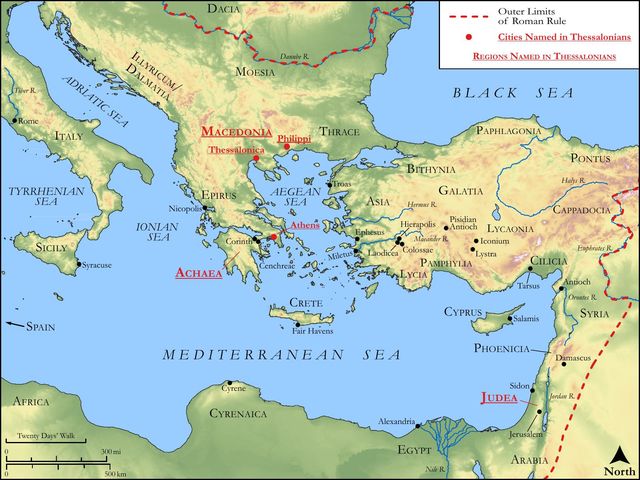
See on the biblical-era maps

Study this verse
Public-domain commentary
Matthew Henry
From his Commentary on the Whole Bible. Henry comments on passages, not single verses — this entry covers 1 Thessalonians 5:6–10. His three-level outline is real structure in the source text, so it is rendered as structure.
On what had been said, the apostle grounds seasonable exhortations to several needful duties.
I.To watchfulness and sobriety, Th1 5:6.
These duties are distinct, yet they mutually befriend one another. For, while we are compassed about with so many temptations to intemperance and excess, we shall not keep sober, unless we be upon our guard, and, unless we keep sober, we shall not long watch.
1.Then let us not sleep as do others, but let us watch; we must not be secure and careless, nor indulge spiritual sloth and idleness. We must not be off our watch, but continually upon our guard against sin, and temptation to it. The generality of men are too careless of their duty and regardless of their spiritual enemies. They say, Peace and safety, when they are in the greatest danger, doze away their precious moments on which eternity depends, indulging idle dreams, and have no more thoughts nor cares about another world than men that are asleep have about this. Either they do not consider the things of another world at all, because they are asleep; or they do not consider them aright, because they dream. But let us watch, and act like men that are awake, and that stand upon their guard.
2.Let us also be sober, or temperate and moderate. Let us keep our natural desires and appetites after the things of this world within due bounds. Sobriety is usually opposed to excess in meats and drinks, and here particularly it is opposed to drunkenness; but it also extends to all other temporal things. Thus our Saviour warned his disciples to take heed lest their hearts should be overcharged with surfeiting and drunkenness, and cares of this life, and so that day come on them unawares, Luk 21:34. Our moderation then, as to all temporal things, should be known to all men, because the Lord is at hand. Besides this, watchfulness and sobriety are most suitable to the Christian's character and privilege, as being children of the day; because those that sleep sleep in the night, and those that are drunken are drunken in the night, Th1 5:7. It is a most reproachful thing for men to sleep away the day-time, which is for work and not for sleep, to be drunken in the day, when so many eyes are upon them, to behold their shame. It was not so strange if those who had not the benefit of divine revelation suffered themselves to be lulled asleep by the devil in carnal security, and if they laid the reins upon the neck of their appetites, and indulged themselves in all manner of riot and excess; for it was night-time with them. They were not sensible of their danger, therefore they slept; they were not sensible of their duty, therefore they were drunk: but it ill becomes Christians to do thus. What! shall Christians, who have the light of the blessed gospel shining in their faces, be careless about their souls, and unmindful of another world? Those who have so many eyes upon them should conduct themselves with peculiar propriety.
II.To be well armed as well as watchful:
to put on the whole armour of God. This is necessary in order to such sobriety as becomes us and will be a preparation for the day of the Lord, because our spiritual enemies are many, and mighty, and malicious. They draw many to their interest, and keep them in it, by making them careless, secure, and presumptuous, by making them drunk - drunk with pride, drunk with passion, drunk and giddy with self-conceit, drunk with the gratifications of sense: so that we have need to arm ourselves against their attempts, by putting on the spiritual breast-plate to keep the heart, and the spiritual helmet to secure the head; and this spiritual armour consists of three great graces of Christians, faith, love, and hope, Th1 5:8.
1.We must live by faith, and this will keep us watchful and sober. If we believe that the eye of God (who is a spirit) is always upon us, that we have spiritual enemies to grapple with, that there is a world of spirits to prepare for, we shall see reason to watch and be sober. Faith will be our best defence against the assaults of our enemies.
2.We must get a heart inflamed with love; and this also will be our defence. True and fervent love to God, and the things of God, will keep us watchful and sober, and hinder our apostasy in times of trouble and temptation.
3.We must make salvation our hope, and should have a lively hope of it. This good hope, through grace, of eternal life, will be as a helmet to defend the head, and hinder our being intoxicated with the pleasures of sin, which are but for a season. If we have hope of salvation, let us take heed of doing any thing that shall shake our hopes, or render us unworthy of or unfit for the great salvation we hope for. Having mentioned salvation and the hope of it, the apostle shows what grounds and reasons Christians have to hope for this salvation, as to which observe, He says nothing of their meriting it. No, the doctrine of our merits is altogether unscriptural and antiscriptural; there is no foundation of any good hope upon that account. But our hopes are to be grounded,
(1.)Upon God's appointment: because God hath not appointed us to wrath, but to obtain salvation, Th1 5:9. If we would trace our salvation to the first cause, that is God's appointment. Those who live and die in darkness and ignorance, who sleep and are drunken as in the night, are, it is but too plain, appointed to wrath; but as for those who are of the day, if they watch and be sober, it is evident that they are appointed to obtain salvation. And the sureness and firmness of the divine appointment are the great support and encouragement of our hope. Were we to obtain salvation by our own merit or power, we could have but little or no hope of it; but seeing we are to obtain it by virtue of God's appointment, which we are sure cannot be shaken (for his purpose, according to election, shall stand), on this we build unshaken hope, especially when we consider,
(2.)Christ's merit and grace, and that salvation is by our Lord Jesus Christ, who died for us. Our salvation therefore is owing to, and our hopes of it are grounded on, Christ's atonement as well as God's appointment: and, as we should think on God's gracious design and purpose, so also on Christ's death and sufferings, for this end, that whether we wake or sleep (whether we live or die, for death is but a sleep to believers, as the apostles had before intimated) we should live together with Christ live in union and in glory with him for ever. And, as it is the salvation that Christians hope for to be for ever with the Lord, so one foundation of their hope is their union with him. And if they are united with Christ, and live in him, and live to him, here, the sleep of death will be no prejudice to the spiritual life, much less to the life of glory hereafter. On the contrary, Christ died for us, that, living and dying, we might be his; that we might live to him while we are here, and live with him when we go hence.
Historical interpretation
Two Centuries of Reception
2 surviving comments on this verse. Each one is dated, so this reads as a timeline rather than a list.
Select a marker to jump to its quote. Markers stagger vertically where authors wrote within a few decades of each other.
But if we must also examine the statement, “And it was night,” so that it has not been interjected to no purpose by the Evangelist, we must say that the perceptible night at that time was symbolic, an image of the night that was in Judas’s soul when Satan, the darkness that lies over the abyss, entered him. “For God called the darkness night,” of which night, indeed, Paul says we are not children, nor of darkness, when he says, “Therefore, brothers, we are not of the night, nor of darkness,” and, “But let us who are of the day be sober.”
"So then let us not sleep, as do also the rest, but let us watch and be sober. For they that sleep sleep in the night; and they that be drunken are drunken in the night. But let us, since we are of the day, be sober, putting on the breastplate of faith and love; and for a helmet the hope of salvation."
Here he shows, that to be in the day depends on ourselves. For here indeed, in the case of the present day and night, it does not depend on ourselves. But night comes even against our will, and sleep overtakes us when we do not wish it. But with respect to that night and that sleep, it is not so, but it is in our power always to have it day, it is in our power always to watch. For to shut the eyes of the soul, and to bring on the sleep of wickedness, is not of nature, but of our own choice.
"But let us watch," he says, "and be sober." For it is possible to sleep while awake, by doing nothing good. Wherefore he has added, "and be sober." For even by day, if any one watches, but is not sober, he will fall into numberless dangers, so that sobriety is the intensity of watchfulness. The drunkenness he here speaks of is not that from wine only, but that also which comes of all vices. For riches and the desire of wealth is a drunkenness of the soul, and so carnal lust; and every sin you can name is a drunkenness of the soul.
But it is not sufficient to watch and be sober, we must also be armed. For if a man watch and is sober, but has not arms, the robbers soon dispatch him. "Putting on the breastplate of faith and love," he says. He has shown what it is to watch and be sober, to have "the breastplate of faith and love." Not a common faith, he says, but as nothing can soon pierce through a breastplate, but it is a safe wall to the breast; so do thou also, he says, surround thy soul with faith and love, and none of the fiery darts of the devil can ever be fixed in it. For where the power of the soul is preoccupied with the armor of love, all the devices of those who plot against it are vain and ineffectual.
"And for a helmet the hope of salvation." For as the helmet guards the vital part in us, surrounding the head and covering it on every side, so also this hope does not suffer the reason to falter, but sets it upright as the head, not permitting anything from without to fall upon it. And whilst nothing falls on it, neither does it slip of itself. For it is not possible that one who is fortified with such arms as these, should ever fall. For "now abideth faith, hope, love." (1 Cor. xiii. 13)
Continue studying 1 Thessalonians 5:8 across the web’s major study libraries — every link below opens this exact verse, chapter, or book on the destination site.
Read & Compare
 BibleGatewayThis verse in more than 200 translations and 70 languages.
 Bible.comThe YouVersion reader — hundreds of translations, reading plans, and highlights.
 ESV.orgCrossway's official English Standard Version reader.
 NET BibleThe NET translation with 60,000+ translators' notes on every rendering decision.
 STEP BibleTyndale House's free study tool — original text, vocabulary, and scholarly resources.
 BibliaLogos Bible Software's free web reader.
 USCCBThe New American Bible (Revised Edition) with the U.S. bishops' study notes.
Commentaries
 BibleHub CommentariesDozens of classic commentaries on this verse, gathered on one page.
 StudyLightMore than 100 commentary sets — the largest collection on the web.
 BibleRefPlain-English commentary on what this verse means, verse by verse.
 Enduring WordDavid Guzik's free commentary on this chapter, widely used by Bible teachers.
 Bible Study ToolsVerse commentary alongside Greek and Hebrew study aids.
Original Language & Research
- BibleHub InterlinearThe verse word by word — original language, transliteration, and English.
- BibleHub LexiconEvery word's original-language definition and Strong's entry.
 Blue Letter BibleDeep-study tools — Strong's numbers, concordance, and word studies.
 CNTR CollationThe earliest Greek manuscripts of this verse, collated letter by letter.
Sermons, Hymns & Audio


TrulyRandomVerse is not affiliated with these sites and doesn’t control their content. They’re linked because they’re genuinely useful.
Summary
First Thessalonians 5:8 is a powerful exhortation from the Apostle Paul, urging believers to live in constant spiritual vigilance and preparedness, contrasting their identity as "children of the day" with those who belong to the night. Paul employs vivid military imagery, calling believers to be spiritually sober and to actively "put on" the essential virtues of faith, love, and the hope of salvation as their spiritual armor, thereby safeguarding their minds and hearts in anticipation of the Lord's return.
Context
ShowHideLiterary Context
This verse is situated within a broader theological and practical section of Paul's first letter to the Thessalonians, specifically 1 Thessalonians 5:1-11. Having addressed the timing and nature of the "Day of the Lord" in the preceding verses, Paul shifts from theological exposition to practical exhortation. He assures the Thessalonian believers that, unlike the unbelieving world, they will not be caught by surprise by Christ's return because they are "children of light and children of the day" (1 Thessalonians 5:5). Verse 8, therefore, serves as a direct command for how those who belong to the light should live, emphasizing spiritual sobriety and preparedness as a natural outflow of their identity in Christ. It builds upon the contrast established between those who sleep and are drunk (representing spiritual apathy and darkness) and those who are awake and sober (representing spiritual alertness and light).
Historical & Cultural Context
The Thessalonians were a relatively young church, facing persecution and grappling with questions about the Lord's return and the fate of deceased believers. Paul's letter aims to encourage, correct, and instruct them. The military imagery used in 1 Thessalonians 5:8 would have resonated deeply with Paul's audience, living in a Roman province. Roman soldiers were a common sight, and their armor—breastplates and helmets—were symbols of protection and readiness. This imagery was not merely illustrative but drew upon a tangible reality familiar to the Thessalonians, making the spiritual analogy of "putting on" faith, love, and hope immediately understandable and impactful. Paul's use of military metaphors for spiritual warfare is consistent throughout his epistles, notably in Ephesians 6:10-17, where he expands on the concept of spiritual armor in greater detail.
Key Themes
ShowHideThe verse contributes significantly to several key themes within 1 Thessalonians and Paul's broader theology. A primary theme is Spiritual Vigilance and Readiness, underscored by the command to "be sober" and the imagery of putting on armor, which directly relates to the anticipation of Christ's return (the "Day of the Lord"). Another crucial theme is The Believer's Distinct Identity, highlighted by the phrase "who are of the day," emphasizing that Christians are set apart from the world's spiritual darkness and ignorance. This identity demands a particular way of living. Furthermore, the verse introduces the theme of Spiritual Armor, using the breastplate and helmet to symbolize essential virtues for spiritual protection. This metaphorical armor—comprising Faith, Love, and Hope—is presented not as a means to earn salvation, but as the necessary spiritual equipment for believers to stand firm against the challenges of a fallen world and to live consistently with their calling as children of light. These virtues are foundational to Christian living and are repeatedly emphasized by Paul as core components of a mature faith, as seen in his discussion of enduring love in 1 Corinthians 13 and the triadic virtues in Colossians 1:4-5.
Exposition and Analysis
ShowHideKey Word Analysis
ShowHideThis word means to abstain from wine (keep sober), but figuratively, it implies being discreet, calm, collected, and spiritually alert. It denotes a state of mental clarity, self-control, and watchfulness, particularly in the context of spiritual realities and the Lord's return. It is a call to clear-headedness, free from the intoxicating influences of worldly distractions or spiritual apathy.
This term directly refers to the chest armor worn by soldiers, designed to protect vital organs. In this spiritual metaphor, it signifies the protection of the heart and core being of the believer. Paul identifies this protection as stemming from "faith and love," indicating that these virtues are essential for safeguarding one's spiritual vitality and integrity against the assaults of sin and the enemy.
This word denotes expectation, usually with pleasure, or confidence. It refers to the confident expectation of future salvation, not merely wishful thinking. As a "helmet," this hope protects the mind, guarding it against despair, doubt, and false teachings by anchoring it in the assured promise of final deliverance, eternal life, and glorified existence with Christ.
Verse Breakdown
ShowHide"But let us, who are of the day,"
This clause establishes a clear contrast with those "of the night" mentioned in the preceding verses. "Of the day" signifies a spiritual identity: believers are illuminated by Christ, living in truth and light, distinct from the spiritual darkness and ignorance of the world. The "but" (G1161, dé) serves as an adversative particle, emphasizing the distinction and the resulting imperative for believers.
"be sober,"
This is a direct command (G3525, nḗphō) for believers to maintain spiritual alertness and self-control. It implies a clear, discerning mind, free from spiritual intoxication or drowsiness, ready to perceive and respond to God's will and the signs of the times. It is a call to live with intentionality and spiritual clarity.
"putting on the breastplate of faith and love;"
Here, Paul introduces military imagery. "Putting on" (G1746, endýō) indicates an active, intentional act. The "breastplate" (G2382, thṓrax), which protects the vital organs, is metaphorically identified as "faith" (G4102, pístis) and "love" (G26, agápē). This signifies that unwavering trust in God and selfless affection for God and others are the primary defenses for the heart and the core of one's spiritual life against spiritual attacks and temptations.
"and for an helmet, the hope of salvation."
Continuing the military metaphor, the "helmet" (G4030, perikephalaía), which protects the head (the mind), is identified as "the hope of salvation" (G1680, elpís of G4991, sōtēría). This means that the confident expectation of ultimate deliverance, eternal life, and glorification in Christ is what guards the believer's thoughts, mindset, and understanding from doubt, despair, and the deceptive philosophies of the world. It provides mental security and purpose.
Literary Devices
ShowHidePaul masterfully employs several literary devices in this verse to convey his urgent message. The most prominent is Metaphor, specifically the military metaphor of spiritual armor. The "breastplate" and "helmet" are direct comparisons to Roman soldier's gear, illustrating the protective qualities of "faith and love" and "the hope of salvation." This imagery transforms abstract virtues into tangible, defensive equipment. There is also a strong element of Contrast implied from the preceding verses, where "those of the night" are contrasted with "us, who are of the day." This highlights the distinct identity and calling of believers. Furthermore, the verse uses Imperative Mood ("be sober," "putting on") to convey a direct command and a sense of urgency, emphasizing the active role believers must take in their spiritual preparedness. The pairing of "faith and love" and "hope of salvation" also demonstrates Paul's frequent use of Triadic Structures to emphasize foundational Christian virtues, often seen alongside faith, hope, and love.
Theological and Thematic Connections
ShowHideThis verse profoundly connects to the broader biblical teaching on spiritual warfare and the active role of believers in their sanctification. It underscores that Christian living is not passive but requires intentional spiritual equipping and vigilance. The "armor" is not for offensive combat as much as it is for defensive steadfastness against the schemes of the enemy and the temptations of the world. The virtues of faith, love, and hope are consistently presented in Paul's writings as foundational to Christian identity and practice, forming the bedrock of a life lived in anticipation of Christ's return. This passage, therefore, serves as a concise summary of the essential spiritual posture for all who claim to be "of the day," emphasizing that our identity in Christ necessitates a corresponding lifestyle of spiritual readiness and moral integrity.
Reflection and Application
ShowHideFirst Thessalonians 5:8 is a timeless call to active spiritual preparedness and intentional living for every believer. It reminds us that our identity as "children of the day" is not merely a status but a summons to a distinct way of life. To "be sober" means to cultivate a clear, discerning mind, free from the spiritual dullness that can arise from worldly distractions, anxieties, or even complacency regarding Christ's return. It's about living with spiritual alertness, always aware of God's presence and purposes. Actively "putting on the breastplate of faith and love" means intentionally nurturing our trust in God's promises and His character, allowing that faith to protect our hearts from doubt and fear. Simultaneously, it means practicing selfless, agape love towards God and others, as love is the greatest commandment and a powerful defense against division, bitterness, and sin. Finally, wearing "the helmet, the hope of salvation," compels us to anchor our minds firmly in the certain promise of our future glorification and eternal life with Christ. This hope is not wishful thinking but a confident expectation that guards our thoughts against despair, false teachings, and the overwhelming pressures of a fallen world, enabling us to endure trials with steadfastness and joy.
Questions for Reflection
ShowHideFAQ
ShowHideWhat does it mean for believers to be "of the day"?
ShowHideTo be "of the day" signifies a believer's spiritual identity and alignment with God's truth and light. In contrast to those "of the night" who live in spiritual darkness, ignorance, and moral decay, believers are illuminated by Christ. As 1 Thessalonians 5:5 states, "Ye are all the children of light, and the children of the day: we are not of the night, nor of darkness." This means Christians are characterized by spiritual awareness, moral uprightness, and an understanding of God's purposes, especially concerning the return of Christ. It implies living in a manner that reflects the light of God in a dark world, marked by vigilance, sobriety, and active righteousness.
How does the "breastplate of faith and love" protect us?
ShowHideThe breastplate in ancient warfare protected the soldier's vital organs, particularly the heart. Spiritually, the "breastplate of faith and love" protects the believer's core being—their inner life, motives, and convictions—from spiritual attacks. Faith (trust in God and His promises) safeguards against doubt, fear, and unbelief, which can cripple a believer's walk. It ensures that our foundation is in God's truth, not shifting circumstances. Love (agape, selfless love for God and others) protects against bitterness, resentment, selfishness, and division. As the greatest commandment (Matthew 22:37-39), love is a powerful defense that binds believers together and fulfills the law, preventing spiritual vulnerabilities that arise from discord or unrighteousness. Together, faith and love safeguard the heart from the enemy's schemes and the world's corrupting influences.
Why is the "hope of salvation" called a helmet?
ShowHideThe helmet in ancient warfare protected the soldier's head, the most vulnerable and critical part of the body, symbolizing the mind and thoughts. The "hope of salvation" as a helmet means that the confident expectation of our ultimate deliverance, eternal life, and glorification with Christ protects our minds. This hope is not a mere wish but a certain assurance based on God's promises. It guards our thoughts against despair, anxiety, doubt, and the deceptive philosophies or false teachings of the world (Colossians 2:8). When our minds are firmly fixed on the future reality of our complete salvation in Christ, we are equipped to withstand mental assaults, maintain spiritual clarity, and persevere through trials, knowing our ultimate destiny is secure in Him.
Christ-Centered Fulfillment
ShowHideFirst Thessalonians 5:8 finds its ultimate fulfillment and deepest meaning in Jesus Christ. He is the very embodiment of the "Day" to which believers belong, for He is the "light of the world" (John 8:12), dispelling the darkness of sin and ignorance. Our call to "be sober" is rooted in Christ's own example of vigilance and His repeated exhortations to "watch" for His return (Matthew 24:42). Furthermore, the spiritual armor—faith, love, and hope—are not merely abstract virtues but are intrinsically tied to Christ Himself. Our "faith" is in Him as the "author and finisher of our faith" (Hebrews 12:2). The "love" we are to put on is a reflection of His sacrificial, agape love demonstrated on the cross (John 15:13). And the "hope of salvation" is entirely centered on His finished work, His resurrection, and His promised return, for He is "our hope" (1 Timothy 1:1). Thus, to put on this spiritual armor is, in essence, to "put on the Lord Jesus Christ" Himself (Romans 13:14), for He is our ultimate protection, our source of strength, and the very ground of our confident expectation of eternal life.