


Romans 13:12
Bible text: King James Version (1769 Blayney text) · Public domain
Bible text: King James Version with Strong's numbers · Public domain
Bible text: Berean Standard Bible · Public domain
Bible text: American Standard Version (1901) · Public domain
Bible text: World English Bible, Messianic edition · Public domain
Bible text: Geneva Bible (1599) · Public domain
Bible text: Young's Literal Translation · Public domain
- ἡhēTheG3588T-NSFDefinite article Nominative Singular Feminine
- νὺξnuxnightG3571N-NSFNoun Nominative Singular Feminine
- προέκοψενproekopsenis nearly overG4298V-AAI-3SVerb Aorist Active Indicative 3rd Singular
- ἡhē<the>G3588T-NSFDefinite article Nominative Singular Feminine
- δὲdeandG1161CONJConjunction
- ἡμέραhēmerathe dayG2250N-NSFNoun Nominative Singular Feminine
- ἤγγικενēngikenhas drawn nearG1448V-RAI-3SVerb Perfect Active Indicative 3rd Singular
- ἀποθώμεθαapothōmethaWe may cast offG659V-2AMS-1PVerb 2nd Aorist Middle Subjunctive 1st Plural
- οὖνounthereforeG3767CONJConjunction
- τὰtatheG3588T-APNDefinite article Accusative Plural Neuter
- ἔργαergaworksG2041N-APNNoun Accusative Plural Neuter
- τοῦtou<the>G3588T-GSNDefinite article Genitive Singular Neuter
- σκότουςskotousof darknessG4655N-GSNNoun Genitive Singular Neuter
- καὶkaiandG2532CONJConjunction
- ἐνδυσώμεθαendusōmethawe may put onG1746V-AMS-1PVerb Aorist Middle Subjunctive 1st Plural
- τὰtatheG3588T-APNDefinite article Accusative Plural Neuter
- ὅπλαhoplaarmorG3696N-APNNoun Accusative Plural Neuter
- τοῦtou<the>G3588T-GSNDefinite article Genitive Singular Neuter
- φωτόςphōtosof lightG5457N-GSNNoun Genitive Singular Neuter
English is a literal word-by-word gloss of the Greek, not the KJV's wording. Why?
This is the original text the KJV's translators worked from — each Greek word with its own literal English meaning in this verse, prepared by scholars at Tyndale House, Cambridge. The KJV translates whole sentences, not word by word, so its wording differs: one Greek word can become several English words, and the KJV may choose “charity” where the gloss reads “love”. Both are faithful — they answer different questions. For the KJV's own rendering, switch to the KJV text.
Details
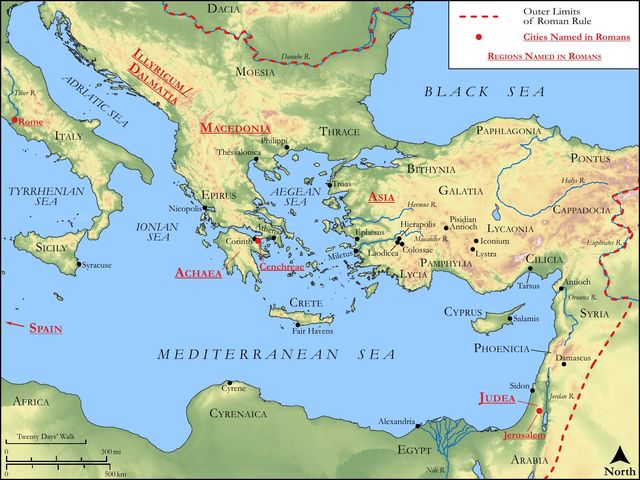
See on the biblical-era maps

Study this verse
Public-domain commentary
Matthew Henry
From his Commentary on the Whole Bible. Henry comments on passages, not single verses — this entry covers Romans 13:11–14. His three-level outline is real structure in the source text, so it is rendered as structure.
We are here taught a lesson of sobriety and godliness in ourselves. Our main care must be to look to ourselves. Four things we are here taught, as a Christian's directory for his day's work: when to awake, how to dress ourselves, how to walk, and what provision to make.
I.When to awake:
Now it is high time to awake (Rom 13:11), to awake out of the sleep of sin (for a sinful condition is a sleeping condition), out of the sleep of carnal security, sloth and negligence, out of the sleep of spiritual death, and out of the sleep of spiritual deadness; both the wise and foolish virgins slumbered and slept, Mat 25:5. We have need to be often excited and stirred up to awake. The word of command to all Christ's disciples is, Watch. "Awake - be concerned about your souls and your eternal interest; take heed of sin, be ready to, and serious in, that which is good, and live in a constant expectation of the coming of our Lord. Considering," 1. "The time we are cast into: Knowing the time. Consider what time of day it is with us, and you will see it is high time to awake. It is gospel time, it is the accepted time, it is working time; it is a time when more is expected than was in the times of that ignorance which God winked at, when people sat in darkness. It is high time to awake; for the sun has been up a great while, and shines in our faces. Have we this light to sleep in? See Th1 5:5, Th1 5:6. It is high time to awake; for others are awake and up about us. Know the time to be a busy time; we have a great deal of work to do, and our Master is calling us to it again and again. Know the time to be a perilous time. We are in the midst of enemies and snares. It is high time to awake, for the Philistines are upon us; our neighbour's house is on fire, and our own in danger. It is time to awake, for we have slept enough (Pe1 4:3), high time indeed, for behold the bridegroom cometh." 2. "The salvation we are upon the brink of: Now is our salvation nearer than when we believed - than when we first believed, and so took upon us the profession of Christianity. The eternal happiness we chose for our portion is now nearer to us than it was when we became Christians. Let us mind our way and mend our pace, for we are now nearer our journey's end than we were when we had our first love. The nearer we are to our centre the quicker should our motion be. Is there but a step between us and heaven, and shall we be so very slow and dull in our Christian course, and move so heavily? The more the days are shortened, and the more grace is increased, the nearer is our salvation, and the more quick and vigorous we should be in our spiritual motions."
II.How to dress ourselves.
This is the next care, when we are awake and up: "The night is far spent, the day is at hand; therefore it is time to dress ourselves. Clearer discoveries will be quickly made of gospel grace than have been yet made, as light gets ground. The night of Jewish rage and cruelty is just at an end; their persecuting power is near a period; the day of our deliverance from them is at hand, that day of redemption which Christ promised, Luk 21:28. And the day of our complete salvation, in the heavenly glory, is at hand. Observe then,"
1."What we must put off; put off our night-clothes, which it is a shame to appear abroad in: Cast off the works of darkness." Sinful works are works of darkness; they come from the darkness of ignorance and mistake, they covet the darkness of privacy and concealment, and they end in the darkness of hell and destruction. "Let us therefore, who are of the day, cast them off; not only cease from the practice of them, but detest and abhor them, and have no more to do with them. Because eternity is just at the door, let us take heed lest we be found doing that which will then make against us," Pe2 3:11, Pe2 3:14.
2."What we must put on." Our care must be wherewithal we shall be clothed, how shall we dress our souls?
(1.)Put on the armour of light. Christians are soldiers in the midst of enemies, and their life a warfare, therefore their array must be armour, that they may stand upon their defence - the armour of God, to which we are directed, Eph 6:13, etc. A Christian may reckon himself undressed if he be unarmed. The graces of the Spirit are this armour, to secure the soul from Satan's temptations and the assaults of this present evil world. This is called the armour of light, some think alluding to the bright glittering armour which the Roman soldiers used to wear; or such armour as it becomes us to wear in the day-light. The graces of the Spirit are suitable splendid ornaments, are in the sight of God of great price.
(2.)Put on the Lord Jesus Christ, Rom 13:14. This stands in opposition to a great many base lusts, mentioned Rom 13:13. Rioting and drunkenness must be cast off: one would think it should follows, but, "Put on sobriety, temperance, chastity," the opposite virtues: no, "Put on Christ, this includes all. Put on the righteousness of Christ for justification; be found in him (Phi 3:9) as a man is found in his clothes; put on the priestly garments of the elder brother, that in them you may obtain the blessing. Put on the spirit and grace of Christ for sanctification; put on the new man (Eph 4:24); get the habit of grace confirmed, the acts of it quickened." Jesus Christ is the best clothing for Christians to adorn themselves with, to arm themselves with; it is decent, distinguishing, dignifying, and defending. Without Christ, we are naked, deformed; all other things are filthy rages, fig-leaves, a sorry shelter. God has provided us coats of skins - large, strong, warm, and durable. By baptism we have in profession put on Christ, Gal 3:27. Let us do it in truth and sincerity. The Lord Jesus Christ. "Put him on as Lord to rule you, as Jesus to save you, and in both as Christ, anointed and appointed by the Father to this ruling saving work."
III.How to walk.
When we are up and dressed, we are not to sit still in an affected closeness and privacy, as monks and hermits. What have we good clothes for, but to appear abroad in them? - Let us walk. Christianity teaches us how to walk so as to please God, whose eye is upon us: Th1 4:1, Walk honestly as in the day. Compare Eph 5:8, Walk as children of light. Our conversation must be as becomes the gospel. Walk honestly; euschēmonōs - decently and becomingly, so as to credit your profession, and to adorn the doctrine of God our Saviour, and recommend religion in its beauty to others. Christians should be in a special manner careful to conduct themselves well in those things wherein men have an eye upon them, and to study that which is lovely and of good report. Particularly, here are three pairs of sins we are cautioned against: - 1. We must not walk in rioting and drunkenness; we must abstain from all excess in eating and drinking. We must not give the least countenance to revelling, nor indulge our sensual appetite in any private excesses. Christians must not overcharge their hearts with surfeiting and drunkenness, Luk 21:34. This is not walking as in the day; for those that are drunk are drunk in the night, Th1 5:7. 2. Not in chambering and wantonness; not in any of those lusts of the flesh, those works of darkness, which are forbidden in the seventh commandment. Downright adultery and fornication are the chambering forbidden. Lascivious thoughts and affections, lascivious looks, words, books, sons, gestures, dances, dalliances, which lead to, and are degrees of, that uncleanness, are the wantonness here forbidden - whatsoever transgresseth the pure and sacred law of chastity and modesty. 3. Not in strife and envying. These are also works of darkness; for, though the acts and instances of strife and envy are very common, yet none are willing to own the principles, or to acknowledge themselves envious and contentious. it may be the lot of the best saints to be envied and striven with; but to strive and to envy ill becomes the disciples and followers of the peaceable and humble Jesus. Where there are riot and drunkenness, there usually are chambering and wantonness, and strife and envy. Solomon puts them all together, Pro 23:29, etc. Those that tarry long at the wine (Pro 23:30) have contentions and wounds without cause (Pro 23:29) and their eyes behold strange women, Pro 23:33.
IV.What provision to make (Pro 23:14):
"Make not provision for the flesh. Be not careful about the body." Our great care must be to provide for our souls; but must we take no care about our bodies? Must we not provide for them, when they need it? Yes, but two things are here forbidden: - 1. Perplexing ourselves with an inordinate care, intimated in these words, pronoian mē poieisthe. "Be not solicitous in forecasting for the body; do not stretch your wits, nor set your thoughts upon the tenter-hooks, in making this provision; be not careful and cumbered about it; do not take thought," Mat 6:31. It forbids an anxious encumbering care. 2. Indulging ourselves in an irregular desire. We are not forbidden barely to provide for the body (it is a lamp that must be supplied with oil), but we are forbidden to fulfil the lusts thereof. The necessities of the body must be considered, but the lusts of it must not be gratified. Natural desires must be answered, but wanton appetites must be checked and denied. To ask meat for our necessities is duty: we are taught to pray for daily bread; but to ask meat for our lusts is provoking, Psa 78:18. Those who profess to walk in the spirit must not fulfil the lusts of the flesh, Gal 5:16.
Historical interpretation
Two Centuries of Reception
12 surviving comments on this verse. Each one is dated, so this reads as a timeline rather than a list.
Select a marker to jump to its quote. Markers stagger vertically where authors wrote within a few decades of each other.
For the apostle decrees that, "putting off the works of darkness, we should put on the armour of light, walking honestly as in the day, not spending our time in rioting and drunkenness, in chambering and wantonness."
By “day” and “light” he designates figuratively the Son, and by “the armor of light” he means the promises.
Nay, but this whole world is the one house of all; in which world it is more the heathen, who is found in darkness, whom the grace of God enlightens, than the Christian, who is already in God's light. Finally, it is one "straying" which is ascribed to the ewe and the drachma: (and this is an evidence in my favour); for if the parables had been composed with a view to a Christian sinner, after the loss of his faith, a second loss and restoration of them would have been noted.
This may be understood in both a universal and in a particular sense. In the first instance, the light is dawning everywhere, and the reign of darkness over the world is rapidly coming to an end.… In the second instance, if we have Christ in our hearts he gives us light. Therefore if the reason of knowledge drives away our ignorance and if we turn away from unworthy deeds and do what is right, we are in the light and are walking honestly as if in the day.
And therefore, beloved brethren, the Lord, taking thought for this risk, that none should fall into the snare of death through jealousy of his brother, when His disciples asked Him which among them should be the greatest, said, "Who soever shall be least among you all, the same shall be great." He cut off all envy by His reply. He plucked out and tore away every cause anti matter of gnawing envy. A disciple of Christ must not be jealous, must not be envious. With us there can be no contest for exaltation; from humility we grow to the highest attainments; we have learnt in what way we may be pleasing. And finally, the Apostle Paul, instructing and warning, that we who, illuminated by the light of Christ, have escaped from the darkness of the conversation of night, should walk in the deeds and works of light, writes and says, "The night has passed over, and the day is approaching: let us therefore cast away the works of darkness, and let us put upon us the armour of light. Let us walk honestly, as in the day; not in rioting and drunkenness, not in lusts and wantonness, not in strifes and jealousy." If the darkness has departed from your breast, if the night is scattered therefrom, if the gloom is chased away, if the brightness of day has illuminated your senses, if you have begun to be a man of light, do those things which are Christ's, because Christ is the Light and the Day.
“Night” means the old man, who is renewed through baptism. Paul says that he has passed away like the night and that the day is near, i.e., the sun of righteousness, by whose light the truth appears to us so that we may know what to do. For before we were in the dark, being ignorant of Christ. But when we learned of him the light rose on us and we passed from the false to the true.The “darkness” refers to carnal sins, which are done by worldly enticements.… But to “put on the armor of light” is to do good deeds.
The “day” is the time of this life which remains to us, in which we can do good works. The “night” is the future, in which it will no longer be possible to work. Then we shall lie in the darkness, having lost the chance to do good works.
"The night is far spent, the day is at hand."
If then this is upon ending, and the latter is drawing near, let us henceforth do what belongs to the latter, not to the former. For this is what is done in the things of this life. And when we see the night pressing on towards the morning, and hear the swallow twittering, we each of us awake our neighbor, although it be night still. But so soon as it is actually departing, we hasten one another, and say It is day now! and we all set about the works of the day, dressing, and leaving our dreams, and shaking our sleep thoroughly off, that the day may find us ready, and we may not have to begin getting up, and stretching ourselves, when the sunlight is up. What then we do in that case, that let us do here also. Let us put off imaginings, let us get clear of the dreams of this life present, let us lay aside its deep slumber, and be clad in virtue for garments. For it is to point out all this that he says,
"Let us therefore cast off the works of darkness, and let us put on the armor of light."
Yes, for the day is calling us to battle-array, and to the fight. Yet fear not at hearing of array and arms. For in the case of the visible suit of armor, to put it on is a heavy and abhorred task. But here it is desirable, and worth being prayed for. For it is of Light the arms are! Hence they will set thee forth brighter than the sunbeam, and giving out a great glistening, and they place thee in security: for they are arms, and glittering do they make thee: for arms of light are they! What then, is there no necessity for thee to fight? yea, needful is it to fight, yet not to be distressed and toil. For it is not in fact war, but a solemn dance and feast-day, such is the nature of the arms, such the power of the Commander. And as the bridegroom goes forth with joyous looks from his chamber, so doth he too who is defended with these arms. For he is at once soldier and bridegroom. But when he says, "the day is at hand," he does not even allow it to be but near, but puts it even now beside us. For he says,
"Let us walk becomingly, as in the day." For day it already is. And what most people insist upon very much in their exhortations, that he also uses to draw them on, the sense of the becoming. For they had a great regard to the esteem of the multitude. And he does not say, walk ye, but let us walk, so making the exhortation free from anything grating, and the reproof gentle.
Paul likens knowledge to the day and ignorance to the night, in accordance with what Hosea says: “I have likened your mother to the night; my people have become as those who have no knowledge.” Let us therefore cast off the works of ignorance and put on the armor of light, that is, works of light.
By “day” Paul means the time since the coming of Christ, for his appearing has made it much easier to tell the difference between good and evil. “Night” refers to the time before his coming.
Paul said this, yet look at how many years have passed since then! Yet what he said was not untrue. How much more probable it is that the coming of the Lord is near now, when there has been such an increase of time toward the end!
“Night” refers to the time of ignorance, whereas “day” refers to the time after the Lord’s coming.
Continue studying Romans 13:12 across the web’s major study libraries — every link below opens this exact verse, chapter, or book on the destination site.
Read & Compare
 BibleGatewayThis verse in more than 200 translations and 70 languages.
 Bible.comThe YouVersion reader — hundreds of translations, reading plans, and highlights.
 ESV.orgCrossway's official English Standard Version reader.
 NET BibleThe NET translation with 60,000+ translators' notes on every rendering decision.
 STEP BibleTyndale House's free study tool — original text, vocabulary, and scholarly resources.
 BibliaLogos Bible Software's free web reader.
 USCCBThe New American Bible (Revised Edition) with the U.S. bishops' study notes.
Commentaries
 BibleHub CommentariesDozens of classic commentaries on this verse, gathered on one page.
 StudyLightMore than 100 commentary sets — the largest collection on the web.
 BibleRefPlain-English commentary on what this verse means, verse by verse.
 Enduring WordDavid Guzik's free commentary on this chapter, widely used by Bible teachers.
 Bible Study ToolsVerse commentary alongside Greek and Hebrew study aids.
Original Language & Research
- BibleHub InterlinearThe verse word by word — original language, transliteration, and English.
- BibleHub LexiconEvery word's original-language definition and Strong's entry.
 Blue Letter BibleDeep-study tools — Strong's numbers, concordance, and word studies.
 CNTR CollationThe earliest Greek manuscripts of this verse, collated letter by letter.
Sermons, Hymns & Audio


TrulyRandomVerse is not affiliated with these sites and doesn’t control their content. They’re linked because they’re genuinely useful.
Summary
Romans 13:12 issues an urgent and transformative call to believers, emphasizing the eschatological reality that the present age of darkness is drawing to a close, and the glorious "day" of Christ's full revelation and reign is imminent. In light of this approaching dawn, Paul exhorts Christians to actively renounce the sinful behaviors characteristic of spiritual ignorance and to consciously embrace a life of righteousness, equipped with the virtues and practices that reflect God's holy character, thereby living in vigilant anticipation of the Lord's return.
Context
ShowHideLiterary Context
Romans 13:12 is situated within the latter half of Paul's Epistle to the Romans, specifically in a section (chapters 12-15) that transitions from profound theological exposition to practical Christian living. This verse forms a pivotal part of a climactic exhortation in Romans 13:11-14 that urges believers to awaken from spiritual slumber. Paul has just discussed the Christian's duty to submit to governing authorities and the overarching principle that love fulfills the law (Romans 13:1-10). The immediate preceding verse, Romans 13:11, sets the stage by reminding them that "now is our salvation nearer than when we believed," establishing the urgent eschatological backdrop for the ethical commands that follow. Thus, the call to "cast off the works of darkness" and "put on the armour of light" is a direct, logical consequence of their new identity in Christ and the nearness of His return.
Historical & Cultural Context
Paul wrote to Christians in Rome, a diverse community comprising both Jewish and Gentile believers, living in the heart of the Roman Empire. The city of Rome itself was characterized by a pervasive pagan culture, where practices such as revelry, drunkenness, sexual immorality, strife, and envy (explicitly mentioned in Romans 13:13) were common. For new converts, particularly Gentiles, shedding these ingrained societal norms and personal habits was a significant challenge. Paul's exhortation provides a clear contrast between the prevailing "night" of pagan society and the "day" of Christian living. The metaphors of "night" and "day" were also deeply rooted in Jewish apocalyptic thought, symbolizing the present evil age and the coming messianic age, respectively. This imagery would have resonated powerfully with both Jewish and Gentile Christians, emphasizing the radical break from their former way of life and the urgent need for distinct, counter-cultural living in anticipation of Christ's return.
Key Themes
ShowHideThe verse powerfully encapsulates several key themes central to Paul's theology and the broader New Testament. The primary theme is the Urgency of the Hour, underscored by the vivid metaphor of "the night is far spent, the day is at hand." This conveys a profound eschatological awareness, emphasizing that the present age of sin and spiritual ignorance is temporary and fading, while the glorious "day" of Christ's full reign and ultimate salvation is drawing near. This immediacy compels spiritual vigilance and readiness. Another crucial theme is Sanctification and Moral Transformation, expressed through the dual commands to "cast off the works of darkness" and "put on the armour of light." "Works of darkness" refer to sinful behaviors and attitudes associated with ungodliness and rebellion against God, as further detailed in Romans 13:13. Conversely, "putting on the armour of light" signifies living righteously, openly, and in alignment with God's character, indicating that Christian living is a spiritual battle requiring divine protection and active engagement with truth and righteousness, a concept further elaborated in Ephesians 6:11-17. This highlights the ongoing process of spiritual growth and the active pursuit of holiness.
Exposition and Analysis
ShowHideKey Word Analysis
ShowHideThis word, translated "is far spent," literally means "to drive forward (as if by beating)," and figuratively, "to advance" or "to be well along." In the context of "the night is far spent," it vividly conveys the idea that the present age of darkness is not merely passing, but actively progressing towards its end, indicating a significant and irreversible advancement towards its conclusion. It implies that the "night" has already made considerable progress and is nearing its culmination, thereby reinforcing the urgency of the subsequent exhortations.
Translated "cast off," this verb means "to put away," "lay aside," or "strip off." It implies a deliberate, decisive action of divesting oneself of something. In the context of "casting off the works of darkness," it signifies a conscious and intentional renunciation of sinful practices and attitudes, much like shedding old, soiled garments. This is not a passive waiting, but an active, volitional act of separation from ungodly behaviors.
This term, rendered "armour," refers to an "implement or utensil or tool," especially "offensive for war," such as a weapon. When Paul commands believers to "put on the armour of light," he is not merely suggesting defensive gear, but instruments or weapons that are characterized by light itself. This implies that the Christian's righteous conduct is not only protective but also an active force that combats darkness, reflecting the very nature of God and enabling believers to live effectively in the spiritual battle.
Verse Breakdown
ShowHide"The night is far spent"
This clause uses a powerful metaphor where "night" represents the present age, characterized by sin, spiritual ignorance, moral decay, and the dominion of darkness. The phrase "is far spent" (from prokóptō) signifies that this era is not merely passing, but has significantly advanced towards its end, indicating its temporary and fading nature. It evokes a sense of urgency, as if the long, dark period is nearing its dawn.
"the day is at hand"
This is the contrasting part of the metaphor. "Day" symbolizes the coming age of Christ's full revelation, His glorious return, and the ultimate establishment of His kingdom, characterized by truth, righteousness, and the full presence of God. "At hand" (from engízō) emphasizes the imminence and closeness of this "day," reinforcing the call to vigilance and readiness. The juxtaposition of "night" and "day" highlights the dramatic shift in spiritual epochs.
"let us therefore cast off the works of darkness"
The "therefore" links the preceding eschatological reality to a practical ethical imperative. "Works of darkness" refers to sinful deeds, attitudes, and lifestyles that belong to the "night"—actions done in spiritual ignorance, hidden from God's light, and characteristic of unregenerate humanity (e.g., revelry, drunkenness, sexual immorality, strife, envy, as listed in Romans 13:13). The command "let us cast off" (from apotíthēmi) is an active, decisive call for believers to strip away, discard, and renounce these practices, much like shedding old, dirty clothes.
"and let us put on the armour of light"
In stark contrast to casting off darkness, believers are commanded to "put on" (from endýō, meaning to invest with clothing) the "armour of light." This is a powerful metaphor for actively embracing and manifesting righteousness, purity, and godly character. The "armour" (from hóplon, meaning weapon or instrument) suggests that Christian living is a spiritual battle, and the virtues of light (truth, righteousness, peace, faith, salvation, the Word of God, as seen in Ephesians 6:14-17) serve as both defensive protection and offensive weapons against spiritual adversaries. This "armour" is characterized by "light," signifying that it is inherently pure, visible, and reflective of God's holy nature.
Literary Devices
ShowHidePaul employs several potent literary devices in Romans 13:12 to convey his urgent message. The most prominent is Metaphor, where "night" and "day" are used to represent distinct spiritual epochs or moral states. "Night" symbolizes the present age of sin, spiritual ignorance, and ungodliness, while "day" signifies the coming age of Christ's glorious return and the full manifestation of God's righteousness. This metaphorical framework creates a vivid sense of temporal urgency and spiritual transition. Directly related is Antithesis, the stark contrast between "night" and "day," and subsequently between "works of darkness" and "armour of light." This opposition highlights the radical difference between the old, sinful way of life and the new, righteous life in Christ, compelling a decisive choice. Furthermore, the phrase "armour of light" is a powerful Image that combines the defensive and offensive aspects of spiritual warfare with the inherent purity and visibility of God's character. Finally, the use of the Imperative Mood ("let us therefore cast off," "and let us put on") underscores the direct, authoritative, and urgent nature of Paul's exhortation, calling for immediate and intentional action from believers.
Theological and Thematic Connections
ShowHideRomans 13:12 stands as a powerful theological statement on Christian eschatology and ethics. It articulates the "already-not yet" tension of the Christian life: the "day" has dawned with Christ's first coming, inaugurating the age of salvation, yet its full consummation awaits His glorious return. This eschatological reality is not merely a doctrinal point but the profound motivation for radical sanctification. The call to "cast off the works of darkness" and "put on the armour of light" is a vivid depiction of the ongoing process of putting off the old self and putting on the new self in Christ, a fundamental aspect of Christian discipleship. It underscores the active, volitional participation required from believers in their pursuit of holiness, distinguishing themselves from the world and living as children of light in anticipation of the Lord's imminent return.
Reflection and Application
ShowHideRomans 13:12 serves as a timeless summons to spiritual vigilance and intentional living for every believer. The profound awareness that "the night is far spent, the day is at hand" should not induce fear or complacency, but rather a powerful sense of purpose and urgency. It calls us to critically examine our lives, identifying any "works of darkness"—hidden sins, ungodly attitudes, or worldly attachments—that we may still harbor, and to decisively "cast them off" through repentance and reliance on God's grace. This involves a conscious, daily commitment to moral purity and separation from the values and practices of a fallen world. Simultaneously, we are exhorted to "put on the armour of light," which means actively cultivating virtues, disciplines, and actions that reflect God's character. This "armour" is not merely defensive; it empowers us to live openly, righteously, and with integrity, shining as beacons of truth and love in a world shrouded in darkness. Our anticipation of Christ's return should fuel a passionate pursuit of holiness, transforming our daily choices and motivating us to live lives that honor Him and draw others to His glorious light.
Questions for Reflection
ShowHideFAQ
ShowHideWhat does "the night is far spent, the day is at hand" mean metaphorically?
ShowHideThis phrase is a powerful metaphor for the progression of salvation history and the urgency of the Christian life. "The night" represents the present age, characterized by sin, spiritual ignorance, and the dominion of darkness, which began after the Fall. "Is far spent" indicates that this period is not merely passing, but has significantly advanced towards its end. "The day" symbolizes the coming age of Christ's full revelation, His glorious return, and the ultimate establishment of His righteous kingdom. "Is at hand" emphasizes its imminence and closeness. Thus, the verse signifies that the era of darkness is giving way to the dawn of Christ's full reign, urging believers to live in light of this approaching glorious reality.
What are "the works of darkness" that believers are called to cast off?
ShowHide"The works of darkness" refer to sinful behaviors, attitudes, and practices that are characteristic of a life alienated from God and lived under the influence of spiritual ignorance and rebellion. While not exhaustive, Romans 13:13 provides specific examples: "rioting and drunkenness, chambering and wantonness, strife and envying." These encompass various forms of debauchery, sexual immorality, contention, and covetousness. More broadly, they include any action or disposition that belongs to the "night" of sin, is hidden from God's light, and is contrary to His holy character. Believers are called to decisively renounce and discard these practices as part of their new identity in Christ.
What is the "armour of light" and how do believers "put it on"?
ShowHideThe "armour of light" is a vivid metaphor for the righteous character and godly conduct that believers are to embrace and manifest. It represents the virtues, disciplines, and actions that reflect God's holy nature and are empowered by His Spirit. While not explicitly detailed here, Paul expands on this concept in Ephesians 6:11-17, describing the "full armour of God" as truth, righteousness, the gospel of peace, faith, salvation, and the Word of God. To "put on" this armour means to actively and intentionally live in accordance with these godly principles, allowing them to shape one's thoughts, words, and deeds. It signifies living openly, purely, and courageously in the spiritual battle against darkness, reflecting the very light of Christ to the world.
Christ-Centered Fulfillment
ShowHideRomans 13:12, while an ethical exhortation, finds its ultimate power and possibility in Christ. He is the very essence of the "Day" that is "at hand," for He is the "Sun of Righteousness" (Malachi 4:2) who has dawned upon a world shrouded in "night." Jesus Himself declared, "I am the light of the world: he that followeth me shall not walk in darkness, but shall have the light of life" (John 8:12). His first advent inaugurated the "day of salvation" (2 Corinthians 6:2), breaking the power of darkness and offering new life. The command to "cast off the works of darkness" is made possible through Christ's atoning work, which frees us from sin's dominion (Romans 6:6-7). Moreover, "putting on the armour of light" is ultimately realized by "putting on the Lord Jesus Christ" Himself (Romans 13:14), for He embodies all righteousness and truth. As believers are united with Him, they are empowered by His Spirit to walk in newness of life, reflecting His light and preparing for the glorious "day" of His second coming, when He will fully banish all darkness and reign as the eternal light of the new heavens and new earth (Revelation 21:23-25).