


2 Corinthians 6:7
Bible text: King James Version (1769 Blayney text) · Public domain
Bible text: Berean Standard Bible · Public domain
Bible text: American Standard Version (1901) · Public domain
Bible text: World English Bible, Messianic edition · Public domain
Bible text: Geneva Bible (1599) · Public domain
Bible text: Young's Literal Translation · Public domain
- ἐνenin [the]G1722PREPPreposition
- λόγῳlogōwordG3056N-DSMNoun Dative Singular Masculine
- ἀληθείαςalētheiasof truthG225N-GSFNoun Genitive Singular Feminine
- ἐνenin [the]G1722PREPPreposition
- δυνάμειdunameipowerG1411N-DSFNoun Dative Singular Feminine
- θεοῦtheouof GodG2316N-GSM-TNoun Genitive Singular Masculine Title
- διὰdiawithG1223PREPPreposition
- τῶνtōntheG3588T-GPNDefinite article Genitive Plural Neuter
- ὅπλωνhoplōnweaponsG3696N-GPNNoun Genitive Plural Neuter
- τῆςtēs<the>G3588T-GSFDefinite article Genitive Singular Feminine
- δικαιοσύνηςdikaiosunēsof righteousnessG1343N-GSFNoun Genitive Singular Feminine
- τῶνtōnfor theG3588T-GPNDefinite article Genitive Plural Neuter
- δεξιῶνdexiōnright handG1188A-GPNAdjective Genitive Plural Neuter
- καὶkaiandG2532CONJConjunction
- ἀριστερῶνaristerōnfor [the] leftG710A-GPNAdjective Genitive Plural Neuter
English is a literal word-by-word gloss of the Greek, not the KJV's wording. Why?
This is the original text the KJV's translators worked from — each Greek word with its own literal English meaning in this verse, prepared by scholars at Tyndale House, Cambridge. The KJV translates whole sentences, not word by word, so its wording differs: one Greek word can become several English words, and the KJV may choose “charity” where the gloss reads “love”. Both are faithful — they answer different questions. For the KJV's own rendering, switch to the KJV text.
Details
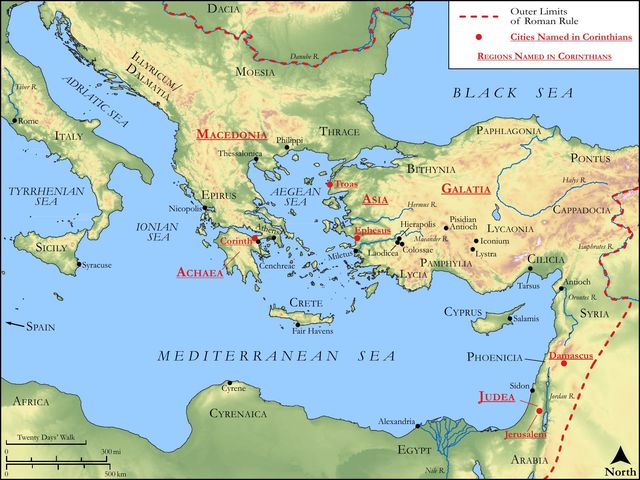
See on the biblical-era maps

Study this verse
Public-domain commentary
Matthew Henry
From his Commentary on the Whole Bible. Henry comments on passages, not single verses — this entry covers 2 Corinthians 6:1–10. His four-level outline is real structure in the source text, so it is rendered as structure.
In these verses we have an account of the apostle's general errand and exhortation to all to whom he preached in every place where he came, with the several arguments and methods he used. Observe,
I.The errand or exhortation itself, namely, to comply with the gospel offers of reconciliation - that, being favoured with the gospel, they would not receive this grace of God in vain, Co2 6:1. The gospel is a word of grace sounding in our ears; but it will be in vain for us to hear it, unless we believe it, and comply with the end and design of it. And as it is the duty of the ministers of the gospel to exhort and persuade their hearers to accept of grace and mercy which are offered to them, so they are honoured with this high title of co-workers with God. Note,
1.They must work; and must work for God and his glory, for souls and their good: and they are workers with God, yet under him, as instruments only; however, if they be faithful, they may hope to find God working with them, and their labour will be effectual.
2.Observe the language and way of the spirit of the gospel: it is not with roughness and severity, but with all mildness and gentleness, to beseech and entreat, to use exhortations and arguments, in order to prevail with sinners and overcome their natural unwillingness to be reconciled to God and to be happy for ever.
II.The arguments and method which the apostle used. And here he tells them,
1.The present time is the only proper season to accept of the grace that is offered, and improve that grace which is afforded: NOW is the accepted time, NOW is the day of salvation, Co2 6:2. The gospel day is a day of salvation, the means of grace the means of salvation, the offers of the gospel the offers of salvation, and the present time the only proper time to accept of these offers: Today, while it is called today. The morrow is none of ours: we know not what will be on the morrow, nor where we shall be; and we should remember that present seasons of grace are short and uncertain, and cannot be recalled when they are past. It is therefore our duty and interest to improve them while we have them, and no less than our salvation depends upon our so doing.
2.What caution they used not to give offence that might hinder the success of their preaching: Giving no offence in any thing, Co2 6:3. The apostle had great difficulty to behave prudently and inoffensively towards the Jews and Gentiles, for many of both sorts watched for his halting, and sought occasion to blame him and his ministry, or his conversation; therefore he was very cautious not to give offence to those who were so apt to take offence, that he might not offend the Jews by unnecessary zeal against the law, nor the Gentiles by unnecessary compliances with such as were zealous for the law. He was careful, in all his words and actions, not to give offence, or occasion of guilt or grief. Note, When others are too apt to take offence, we should be cautious lest we give offence; and ministers especially should be careful lest they do any thing that may bring blame on their ministry or render that unsuccessful.
3.Their constant aim and endeavor in all things to approve themselves faithful, as became the ministers of God, Co2 6:4. We see how much stress the apostle upon all occasions lays on fidelity in our work, because much of our success depends upon that. His eye was single, and his heart upright, in all his ministrations; and his great desire was to be the servant of God, and to approve himself so. Note, Ministers of the gospel should look upon themselves as God's servants or ministers, and act in every thing suitably to that character. So did the apostle,
(1.)By much patience in afflictions. He was a great sufferer, and met with many afflictions, was often in necessities, and wanted the conveniences, if not the necessaries, of life; in distresses, being straitened on every side, hardly knowing what to do; in stripes often (Co2 11:24); in imprisonments; in tumults raised by the Jews and Gentiles against him; in labours, not only in preaching the gospel, but in travelling from place to place for that end, and working with his hands to supply his necessities; in watchings and in fastings, either voluntary or upon a religious account, or involuntary for the sake of religion: but he exercised much patience in all, Co2 6:4, Co2 6:5. Note,
[1.]It is the lot of faithful ministers often to be reduced to great difficulties, and to stand in need of much patience.
[2.]Those who would approve themselves to God must approve themselves faithful in trouble as well as in peace, not only in doing the work of God diligently, but also in bearing the will of God patiently.
(2.)By acting from good principles. The apostle went by a good principle in all he did, and tells them what his principles were (Co2 6:6, Co2 6:7); namely, pureness; and there is no piety without purity. A care to keep ourselves unspotted from the world is necessary in order to our acceptance with God. Knowledge was another principle; and zeal without this is but madness. He also acted with long-suffering and kindness, being not easily provoked, but bearing with the hardness of men's hearts, and hard treatment from their hands, to whom he kindly endeavoured to do good. He acted under the influence of the Holy Ghost, from the noble principle of unfeigned love, according to the rule of the word of truth, under the supports and assistances of the power of God, having on the armour of righteousness (a consciousness of universal righteousness and holiness), which is the best defence against the temptations of prosperity on the right hand, and of adversity on the left.
(3.)By a due temper and behaviour under all the variety of conditions in this world, Co2 6:8-10. We must expect to meet with many alterations of our circumstances and conditions in this world; and it will be a great evidence of our integrity if we preserve a right temper of mind, and duly behave ourselves, under them all. The apostles met with honour and dishonour, good report and evil report: good men in this world must expect to meet with some dishonour and reproaches, to balance their honour and esteem; and we stand in need of the grace of God to arm us against the temptations of honour on the one hand, so as to bear good report without pride, and of dishonour on the other hand, so as to bear reproaches without impatience or recrimination. It should seem that persons differently represented the apostles in their reports; that some represented them as the best, and others as the worst, of men: by some they were counted deceivers, and run down as such; by others as true, preaching the gospel of truth, and men who were true to the trust reposed in them. They were slighted by the men of the world as unknown, men of no figure or account, not worth taking notice of; yet in all the churches of Christ they were well known, and of great account: they were looked upon as dying, being killed all the day long, and their interest was thought to be a dying interest; "and yet behold," says the apostle, "we live, and live comfortably, and bear up cheerfully under all our hardships, and go on conquering and to conquer." They were chastened, and often fell under the lash of the law, yet not killed: and though it was thought that they were sorrowful, a company of mopish and melancholy men, always sighing and mourning, yet they were always rejoicing in God, and had the greatest reason to rejoice always. They were despised as poor, upon the account of their poverty in this world; and yet they made many rich, by preaching the unsearchable riches of Christ. They were thought to have nothing, and silver and gold they had none, houses and lands they had none; yet they possessed all things: they had nothing in this world, but they had a treasure in heaven. Their effects lay in another country, in another world. They had nothing in themselves, but possessed all things in Christ. Such a paradox is a Christian's life, and through such a variety of conditions and reports lies our way to heaven; and we should be careful in all these things to approve ourselves to God.
Historical interpretation
Two Centuries of Reception
7 surviving comments on this verse. Each one is dated, so this reads as a timeline rather than a list.
Select a marker to jump to its quote. Markers stagger vertically where authors wrote within a few decades of each other.
For he who merely abstains from evil conduct is not just, unless he also attain besides beneficence and knowledge; and for this reason some things are to be abstained from, others are to be done. "By the armour of righteousness on the right hand and on the left"
For although the Scripture says, "Shall the clay say to the potter? " that is, Shall man contend with God? although the apostle speaks of "earthen vessels" he refers to man, who was originally clay.
The word of truth was in Paul’s teaching, because he conveyed no message other than the one which he had received from the Lord.
But to one who is elevated in thought, all things appear to be of equal honor, and none is preferred to another, because the course of life is run equally by opposites, and there is present in the destiny of each person the power to live well or badly, “with the armor on the right hand and on the left,” as the apostle says, “in honor and dishonor.” Accordingly, the one who has purified his mind and rightly examined the truth of reality will go on his way in the time assigned to him from birth to death, not spoiled by pleasures or cast down by austerity, but, in accordance with the custom of travelers, he will be little affected by what he encounters. For it is customary for travelers to hasten on to the end of their journey whether they go through meadows and fertile fields or through deserts and rough terrain; pleasure does not delay them, nor does the unpleasant impede them. So he himself will also hurry on without distraction to the goal before him, turning off into none of the byways. He will pass through life looking only to heaven, just like some good captain who guides his ship to its lofty destination.
The man who rightly seeks righteousness according to human understandings is equipped with the arms of righteousness for the left hand. The man who does the same according to the teachings of the truth and who has been sought out for this task by the Son of righteousness bears the weapons of the right hand.
"In the word of truth." A thing he says in many places, that 'we continued neither to handle the word of God deceitfully nor to adulterate it.' "In the power of God." That which he always does ascribing nothing to himself but the whole to God, and imputing whatsoever he hath done aright to Him, this he hath done here also. For since he uttered great things, and affirmed that he had manifested in all things an irreproachable life and exalted wisdom, he ascribes this to the Spirit and to God. For neither were those commonplace things which he had said. For if it be a difficult thing even for one who lives in quiet to do aright and be irreproachable, consider him who was harassed by so great temptations, and yet shone forth through all, what a spirit he was of! "By the armor of righteousness on the right and the left." Seest thou his self-possession of soul and well-strung spirit? For he shows that afflictions are arms not only which strike not down, but do even fortify and make stronger. And he calls those things 'left,' which seem to be painful; for such those are which bring with them the reward. Wherefore then doth he call them thus? Either in conformity with the conception of the generality, or because God commanded us to pray that we enter not into temptation.
The weapons of righteousness on the right hand are those which are pleasing to the mind; those on the left hand are those which are not.
Continue studying 2 Corinthians 6:7 across the web’s major study libraries — every link below opens this exact verse, chapter, or book on the destination site.
Read & Compare
 BibleGatewayThis verse in more than 200 translations and 70 languages.
 Bible.comThe YouVersion reader — hundreds of translations, reading plans, and highlights.
 ESV.orgCrossway's official English Standard Version reader.
 NET BibleThe NET translation with 60,000+ translators' notes on every rendering decision.
 STEP BibleTyndale House's free study tool — original text, vocabulary, and scholarly resources.
 BibliaLogos Bible Software's free web reader.
 USCCBThe New American Bible (Revised Edition) with the U.S. bishops' study notes.
Commentaries
 BibleHub CommentariesDozens of classic commentaries on this verse, gathered on one page.
 StudyLightMore than 100 commentary sets — the largest collection on the web.
 BibleRefPlain-English commentary on what this verse means, verse by verse.
 Enduring WordDavid Guzik's free commentary on this chapter, widely used by Bible teachers.
 Bible Study ToolsVerse commentary alongside Greek and Hebrew study aids.
Original Language & Research
- BibleHub InterlinearThe verse word by word — original language, transliteration, and English.
- BibleHub LexiconEvery word's original-language definition and Strong's entry.
 Blue Letter BibleDeep-study tools — Strong's numbers, concordance, and word studies.
 CNTR CollationThe earliest Greek manuscripts of this verse, collated letter by letter.
Sermons, Hymns & Audio


TrulyRandomVerse is not affiliated with these sites and doesn’t control their content. They’re linked because they’re genuinely useful.
Summary
In 2 Corinthians 6:7, the Apostle Paul continues his defense of apostolic ministry, delineating the essential characteristics and divine resources that authenticate true servants of God. This verse highlights three foundational elements: the inherent power of the gospel ("the word of truth"), the supernatural enablement from God ("the power of God"), and the comprehensive moral and spiritual integrity ("the armour of righteousness on the right hand and on the left") that equip ministers to endure suffering, maintain purity, and effectively commend themselves to all. It underscores that authentic ministry is not based on human eloquence or worldly credentials, but on divine truth, divine power, and a life lived in practical righteousness, providing both offensive capability and defensive protection in spiritual warfare.
Context
ShowHideLiterary Context
This verse is an integral part of Paul's broader apologetic for his ministry, found in 2 Corinthians 6:3-10. Following an urgent plea to the Corinthians not to receive God's grace in vain (2 Corinthians 6:1-2), Paul immediately begins to describe the manner in which he and his co-workers commend themselves as ministers of God. He lists a series of contrasting pairs and characteristics, moving from the afflictions they endure (2 Corinthians 6:4-5) to the virtues they embody (2 Corinthians 6:6-7a), and finally to the spiritual resources and paradoxes of their ministry (2 Corinthians 6:7b-10). Verse 7 specifically transitions from internal virtues like "purity" and "knowledge" to the external and spiritual instruments of their ministry, setting the stage for the paradoxical nature of their service described in the subsequent verses.
Historical & Cultural Context
Paul's ministry in Corinth was fraught with challenges, including opposition from false apostles who sought to undermine his authority and discredit his message (2 Corinthians 10-13). These opponents likely boasted of worldly credentials, rhetorical skill, or personal charisma. In response, Paul deliberately eschews such worldly metrics, instead appealing to the divine nature and spiritual efficacy of his ministry. The imagery of "armour" (Gk. hóplon) would resonate deeply with a Greek and Roman audience familiar with military campaigns and the equipment of soldiers. Corinth itself was a strategic Roman colony, and its citizens would understand the practical necessity of comprehensive defensive and offensive weaponry. Paul's use of military metaphors is common in his epistles, reflecting the spiritual warfare believers are engaged in, as seen in his more extensive treatment in Ephesians 6.
Key Themes
ShowHide2 Corinthians 6:7 contributes significantly to several overarching themes in the epistle. Firstly, it reinforces the theme of Authentic Ministry, contrasting Paul's Spirit-empowered, suffering-marked service with the superficiality of his detractors. Secondly, it highlights Divine Empowerment, emphasizing that the effectiveness of ministry stems not from human ability but from God's supernatural power, a recurring motif throughout Paul's writings, such as his declaration in 1 Corinthians 2:4. Thirdly, the verse underscores the importance of Righteousness and Integrity as both a defensive shield and an offensive weapon in spiritual warfare, connecting to the broader call for believers to live lives consistent with their new identity in Christ, which is foundational to the practical exhortations found in passages like Romans 6.
Exposition and Analysis
ShowHideKey Word Analysis
ShowHideThis term refers to something said, a word, speech, or message. In a theological context, especially when paired with "truth," it denotes the divine message, the gospel itself. It represents the content and foundation of Paul's preaching, emphasizing its divine origin and authoritative nature, rather than human rhetoric or philosophy.
This word signifies inherent force, ability, or miraculous power. It is the root of the English word "dynamite," conveying explosive, transformative energy. In this context, it speaks to the supernatural enablement provided by God for ministry, manifesting in spiritual transformation, endurance, and the demonstration of God's presence, rather than mere human strength or persuasion.
This term denotes an implement, tool, or weapon, specifically military equipment. It points to the instruments used in spiritual combat. When combined with "righteousness," it vividly portrays righteousness not just as a passive virtue, but as active, protective, and offensive equipment essential for navigating the spiritual battles inherent in Christian life and ministry.
Verse Breakdown
ShowHide"By the word of truth"
This clause identifies the foundational content and instrument of Paul's ministry. It refers to the Gospel message, which is inherently true because it originates from God. This "word of truth" is the divine revelation that transforms lives, providing the substance and authority for their apostolic work. It implies that their ministry is not based on human wisdom or persuasive speech, but on the authoritative and reliable message of God.
"by the power of God"
This phrase points to the divine enablement and supernatural energy that accompanies and empowers their ministry. It signifies that their effectiveness, endurance through suffering, and capacity to bring about spiritual change are not due to their own human strength or abilities, but are a direct result of God's miraculous and sustaining power at work within them. This power validates their message and authenticates their calling.
"by the armour of righteousness on the right hand and on the left"
This vivid military metaphor describes righteousness as both a defensive shield and an offensive weapon. "Righteousness" encompasses both the imputed righteousness received through faith in Christ and the practical, ethical righteousness of living a holy life. The phrase "on the right hand and on the left" signifies comprehensive protection and readiness for spiritual battle from all directions, indicating that their integrity and upright conduct serve as an all-encompassing defense against accusations and spiritual attacks, while also enabling them to advance God's kingdom.
Literary Devices
ShowHidePaul masterfully employs several literary devices in this concise verse. The most prominent is Metaphor, particularly in "the armour of righteousness," which vividly portrays abstract righteousness as tangible military equipment. This military imagery is further extended by the phrase "on the right hand and on the left," creating a sense of comprehensive readiness and protection, reminiscent of a soldier fully equipped for battle. The repeated use of the preposition "by" (Greek: en and dia) at the beginning of each clause creates a powerful sense of Parallelism and Anaphora, emphasizing the instrumental nature of each element—truth, power, and righteousness—as the means by which Paul and his co-workers commend themselves. This rhythmic repetition builds a cumulative argument for the divine and spiritual quality of their ministry, contrasting it sharply with any worldly criteria.
Theological and Thematic Connections
ShowHideThis verse profoundly articulates the divine nature of authentic Christian ministry and discipleship. It reveals that effective service is fundamentally grounded in God's revelation (the word of truth), empowered by His supernatural might (the power of God), and protected by a life of integrity (the armour of righteousness). This holistic reliance on God's provisions ensures that all glory redounds to Him, while also equipping believers to stand firm and advance the Kingdom amidst opposition. It speaks to the necessity of both theological accuracy and practical holiness, demonstrating that true spiritual impact flows from a deep engagement with God's truth and power, manifested through a righteous life.
Reflection and Application
ShowHide2 Corinthians 6:7 offers profound insights for every believer, not just those in vocational ministry. It calls us to examine the foundations of our faith and service. Are we truly grounding our lives in the unchanging "word of truth," allowing it to shape our worldview and decisions? Do we recognize our dependence on "the power of God," understanding that genuine spiritual transformation and impact come not from our own strength or cleverness, but from His divine enablement? Furthermore, are we diligently putting on "the armour of righteousness," both the imputed righteousness of Christ and the practical righteousness of a holy life, as our primary defense and means of engagement in the spiritual battles we face daily? This verse challenges us to live with integrity, knowing that our character is a powerful witness and a vital protection. It reminds us that our effectiveness for God is directly tied to our reliance on His truth, His power, and our commitment to living righteously in His sight.
Questions for Reflection
ShowHideFAQ
ShowHideWhat does Paul mean by "the word of truth" in this context?
ShowHide"The word of truth" (Greek: logos aletheias) refers to the Gospel message itself—the divine revelation of God's plan of salvation through Jesus Christ. It is the authoritative, unchanging, and inherently reliable message that Paul preached. It signifies that the foundation and content of his ministry were not human philosophies or persuasive rhetoric, but God's own revealed truth, which possesses inherent power to transform lives and authenticate the messenger.
How does "the power of God" relate to "the word of truth"?
ShowHide"The power of God" (Greek: dynamis theou) is intrinsically linked to "the word of truth" because it is God's power that makes the word effective. The Gospel is not merely information; it is the "power of God unto salvation" (Romans 1:16). This divine power manifests in various ways: enabling the apostles to endure immense suffering, bringing about spiritual transformation in those who believe, and demonstrating God's presence through signs and wonders. It ensures that the impact of the ministry is not due to human ability but to God's supernatural work.
What is the significance of "on the right hand and on the left" regarding the "armour of righteousness"?
ShowHideThe phrase "on the right hand and on the left" (Greek: en dexiā kai aristerā) emphasizes the comprehensive and all-encompassing nature of the "armour of righteousness." In military terms, it suggests that righteousness serves as both offensive and defensive equipment, protecting the minister from all sides. It implies readiness for any challenge, whether direct assault or subtle temptation. It signifies that integrity and holy living provide complete protection and equip believers to engage effectively in spiritual warfare, ensuring they are not vulnerable from any quarter. This imagery is consistent with the broader concept of the full armor of God described in Ephesians 6.
Christ-Centered Fulfillment
ShowHide2 Corinthians 6:7, while describing the resources of apostolic ministry, finds its ultimate fulfillment and deepest meaning in Christ. He is the very embodiment of "the word of truth," as John declares Him to be the Logos, the Word made flesh, full of grace and truth. The Gospel message that Paul preached is fundamentally about Christ—His life, death, resurrection, and reign. Furthermore, Jesus is the ultimate manifestation of "the power of God," through whom God's miraculous works were performed and by whom sin and death were conquered. His resurrection is the supreme demonstration of this divine power (Ephesians 1:19-20). Finally, Christ Himself is our "armour of righteousness." Believers are clothed in His perfect righteousness, which is imputed to them by faith (Philippians 3:9). Moreover, His life serves as the perfect example of practical righteousness, enabling us through the Spirit to pursue holiness. Thus, the truth we proclaim, the power we rely upon, and the righteousness that protects and equips us are all ultimately found in and flow from Jesus Christ, the one through whom God reconciles the world to Himself (2 Corinthians 5:18-19).