


1 Thessalonians 5:9
- ὅτιhotibecauseG3754CONJConjunction
- οὐκouknotG3756PRT-NNegative Particle Negative
- ἔθετοethetohas destinedG5087V-2AMI-3SVerb 2nd Aorist Middle Indicative 3rd Singular
- ἡμᾶςhēmasusG3165P-1APPersonal pronoun Accusative 1st Plural
- ὁho<the>G3588T-NSMDefinite article Nominative Singular Masculine
- θεὸςtheosGodG2316N-NSM-TNoun Nominative Singular Masculine Title
- εἰςeisforG1519PREPPreposition
- ὀργὴνorgēnwrathG3709N-ASFNoun Accusative Singular Feminine
- ἀλλ᾽all᾽butG235CONJConjunction
- εἰςeisforG1519PREPPreposition
- περιποίησινperipoiēsinobtainingG4047N-ASFNoun Accusative Singular Feminine
- σωτηρίαςsōtēriassalvationG4991N-GSFNoun Genitive Singular Feminine
- διὰdiathroughG1223PREPPreposition
- τοῦtoutheG3588T-GSMDefinite article Genitive Singular Masculine
- κυρίουkuriouLordG2962N-GSM-TNoun Genitive Singular Masculine Title
- ἡμῶνhēmōnof usG3165P-1GPPersonal pronoun Genitive 1st Plural
- ἸησοῦIēsouJesusG2424N-GSM-PNoun Genitive Singular Masculine Individual
- ΧριστοῦChristouChristG5547N-GSM-TNoun Genitive Singular Masculine Title
English is a literal word-by-word gloss of the Greek, not the KJV's wording. Why?
This is the original text the KJV's translators worked from — each Greek word with its own literal English meaning in this verse, prepared by scholars at Tyndale House, Cambridge. The KJV translates whole sentences, not word by word, so its wording differs: one Greek word can become several English words, and the KJV may choose “charity” where the gloss reads “love”. Both are faithful — they answer different questions. For the KJV's own rendering, switch to the KJV text.
Details
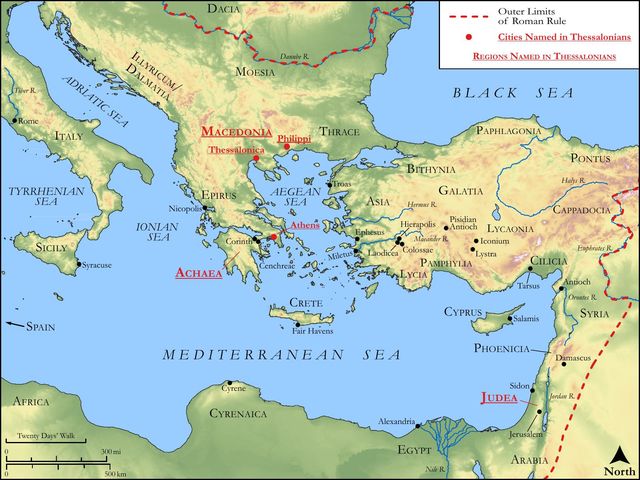
See on the biblical-era map

Study this verse
Public-domain commentary
Matthew Henry
From his Commentary on the Whole Bible. Henry comments on passages, not single verses — this entry covers 1 Thessalonians 5:6–10. His three-level outline is real structure in the source text, so it is rendered as structure.
On what had been said, the apostle grounds seasonable exhortations to several needful duties.
I.To watchfulness and sobriety, Th1 5:6.
These duties are distinct, yet they mutually befriend one another. For, while we are compassed about with so many temptations to intemperance and excess, we shall not keep sober, unless we be upon our guard, and, unless we keep sober, we shall not long watch.
1.Then let us not sleep as do others, but let us watch; we must not be secure and careless, nor indulge spiritual sloth and idleness. We must not be off our watch, but continually upon our guard against sin, and temptation to it. The generality of men are too careless of their duty and regardless of their spiritual enemies. They say, Peace and safety, when they are in the greatest danger, doze away their precious moments on which eternity depends, indulging idle dreams, and have no more thoughts nor cares about another world than men that are asleep have about this. Either they do not consider the things of another world at all, because they are asleep; or they do not consider them aright, because they dream. But let us watch, and act like men that are awake, and that stand upon their guard.
2.Let us also be sober, or temperate and moderate. Let us keep our natural desires and appetites after the things of this world within due bounds. Sobriety is usually opposed to excess in meats and drinks, and here particularly it is opposed to drunkenness; but it also extends to all other temporal things. Thus our Saviour warned his disciples to take heed lest their hearts should be overcharged with surfeiting and drunkenness, and cares of this life, and so that day come on them unawares, Luk 21:34. Our moderation then, as to all temporal things, should be known to all men, because the Lord is at hand. Besides this, watchfulness and sobriety are most suitable to the Christian's character and privilege, as being children of the day; because those that sleep sleep in the night, and those that are drunken are drunken in the night, Th1 5:7. It is a most reproachful thing for men to sleep away the day-time, which is for work and not for sleep, to be drunken in the day, when so many eyes are upon them, to behold their shame. It was not so strange if those who had not the benefit of divine revelation suffered themselves to be lulled asleep by the devil in carnal security, and if they laid the reins upon the neck of their appetites, and indulged themselves in all manner of riot and excess; for it was night-time with them. They were not sensible of their danger, therefore they slept; they were not sensible of their duty, therefore they were drunk: but it ill becomes Christians to do thus. What! shall Christians, who have the light of the blessed gospel shining in their faces, be careless about their souls, and unmindful of another world? Those who have so many eyes upon them should conduct themselves with peculiar propriety.
II.To be well armed as well as watchful:
to put on the whole armour of God. This is necessary in order to such sobriety as becomes us and will be a preparation for the day of the Lord, because our spiritual enemies are many, and mighty, and malicious. They draw many to their interest, and keep them in it, by making them careless, secure, and presumptuous, by making them drunk - drunk with pride, drunk with passion, drunk and giddy with self-conceit, drunk with the gratifications of sense: so that we have need to arm ourselves against their attempts, by putting on the spiritual breast-plate to keep the heart, and the spiritual helmet to secure the head; and this spiritual armour consists of three great graces of Christians, faith, love, and hope, Th1 5:8.
1.We must live by faith, and this will keep us watchful and sober. If we believe that the eye of God (who is a spirit) is always upon us, that we have spiritual enemies to grapple with, that there is a world of spirits to prepare for, we shall see reason to watch and be sober. Faith will be our best defence against the assaults of our enemies.
2.We must get a heart inflamed with love; and this also will be our defence. True and fervent love to God, and the things of God, will keep us watchful and sober, and hinder our apostasy in times of trouble and temptation.
3.We must make salvation our hope, and should have a lively hope of it. This good hope, through grace, of eternal life, will be as a helmet to defend the head, and hinder our being intoxicated with the pleasures of sin, which are but for a season. If we have hope of salvation, let us take heed of doing any thing that shall shake our hopes, or render us unworthy of or unfit for the great salvation we hope for. Having mentioned salvation and the hope of it, the apostle shows what grounds and reasons Christians have to hope for this salvation, as to which observe, He says nothing of their meriting it. No, the doctrine of our merits is altogether unscriptural and antiscriptural; there is no foundation of any good hope upon that account. But our hopes are to be grounded,
(1.)Upon God's appointment: because God hath not appointed us to wrath, but to obtain salvation, Th1 5:9. If we would trace our salvation to the first cause, that is God's appointment. Those who live and die in darkness and ignorance, who sleep and are drunken as in the night, are, it is but too plain, appointed to wrath; but as for those who are of the day, if they watch and be sober, it is evident that they are appointed to obtain salvation. And the sureness and firmness of the divine appointment are the great support and encouragement of our hope. Were we to obtain salvation by our own merit or power, we could have but little or no hope of it; but seeing we are to obtain it by virtue of God's appointment, which we are sure cannot be shaken (for his purpose, according to election, shall stand), on this we build unshaken hope, especially when we consider,
(2.)Christ's merit and grace, and that salvation is by our Lord Jesus Christ, who died for us. Our salvation therefore is owing to, and our hopes of it are grounded on, Christ's atonement as well as God's appointment: and, as we should think on God's gracious design and purpose, so also on Christ's death and sufferings, for this end, that whether we wake or sleep (whether we live or die, for death is but a sleep to believers, as the apostles had before intimated) we should live together with Christ live in union and in glory with him for ever. And, as it is the salvation that Christians hope for to be for ever with the Lord, so one foundation of their hope is their union with him. And if they are united with Christ, and live in him, and live to him, here, the sleep of death will be no prejudice to the spiritual life, much less to the life of glory hereafter. On the contrary, Christ died for us, that, living and dying, we might be his; that we might live to him while we are here, and live with him when we go hence.
Historical interpretation
Historical reception
1 surviving comment on this verse from the historical church.
"For God appointed us not unto wrath, but unto the obtaining of salvation through our Lord Jesus Christ, who died for us."
Thus God has not inclined to this, that He might destroy us, but that He might save us. And whence is it manifest that this is His will? He has given His own Son for us. So does He desire that we should be saved, that He has given His Son, and not merely given, but given Him to death. From these considerations hope is produced. For do not despair of thyself, O man, in going to God, who has not spared even His Son for thee. Faint not at present evils. He who gave His Only-Begotten, that He might save thee and deliver thee from hell, what will He spare henceforth for thy salvation? So that thou oughtest to hope for all things kind. For neither should we fear, if we were going to a judge who was about to judge us, and who had shown so much love for us, as to have sacrificed his son. Let us hope therefore for kind and great things, for we have received the principal thing; let us believe, for we have seen an example; let us love, for it is the extreme of madness for one not to love who has been so treated.
Continue studying 1 Thessalonians 5:9 across the web’s major study libraries — every link below opens this exact verse, chapter, or book on the destination site.
Read & Compare
 BibleGatewayThis verse in more than 200 translations and 70 languages.
 Bible.comThe YouVersion reader — hundreds of translations, reading plans, and highlights.
 ESV.orgCrossway's official English Standard Version reader.
 NET BibleThe NET translation with 60,000+ translators' notes on every rendering decision.
 STEP BibleTyndale House's free study tool — original text, vocabulary, and scholarly resources.
 BibliaLogos Bible Software's free web reader.
 USCCBThe New American Bible (Revised Edition) with the U.S. bishops' study notes.
Commentaries
 BibleHub CommentariesDozens of classic commentaries on this verse, gathered on one page.
 StudyLightMore than 100 commentary sets — the largest collection on the web.
 BibleRefPlain-English commentary on what this verse means, verse by verse.
 Enduring WordDavid Guzik's free commentary on this chapter, widely used by Bible teachers.
 Bible Study ToolsVerse commentary alongside Greek and Hebrew study aids.
Original Language & Research
- BibleHub InterlinearThe verse word by word — original language, transliteration, and English.
- BibleHub LexiconEvery word's original-language definition and Strong's entry.
 Blue Letter BibleDeep-study tools — Strong's numbers, concordance, and word studies.
 CNTR CollationThe earliest Greek manuscripts of this verse, collated letter by letter.
Sermons, Hymns & Audio


TrulyRandomVerse is not affiliated with these sites and doesn’t control their content. They’re linked because they’re genuinely useful.
Summary
1 Thessalonians 5:9 provides profound assurance to believers, declaring God's gracious and sovereign purpose for them. It starkly contrasts the divine appointment of believers to salvation through Jesus Christ with the wrath destined for unbelievers, emphasizing that God's people are not objects of His eschatological judgment but recipients of His redemptive grace. This verse serves as a foundational theological statement, underpinning the hope and vigilance encouraged throughout the epistle.
Context
ShowHideLiterary Context
This verse is strategically positioned within Paul's eschatological discourse in 1 Thessalonians 5. Following his detailed teaching on the "Day of the Lord" in 1 Thessalonians 5:1-3, Paul distinguishes between those who will be caught unaware by this sudden judgment (unbelievers, described as "children of darkness") and believers, whom he identifies as "children of light and children of the day" (1 Thessalonians 5:4-5). Verse 9 serves as the theological bedrock for this distinction, explaining why believers are not destined for wrath but for salvation, thereby reinforcing the call to vigilance and sober living in 1 Thessalonians 5:6-8. It transitions from the imperative of living in light of the Day of the Lord to the indicative truth of God's saving purpose.
Historical & Cultural Context
The Thessalonian church was a relatively young congregation, founded during Paul's second missionary journey. They were facing significant persecution from both Jewish and Gentile opposition (1 Thessalonians 2:14-16). Furthermore, they had concerns and misunderstandings regarding the return of Christ and the fate of deceased believers (1 Thessalonians 4:13-18). In this context of external pressure and internal anxieties about eschatology, Paul's assurance in 1 Thessalonians 5:9 would have been immensely comforting. It addressed their fears about divine judgment, affirming their secure standing in Christ despite their present sufferings and uncertainties about the future.
Key Themes
ShowHideThe verse significantly contributes to several key themes prevalent in 1 Thessalonians and Pauline theology. It powerfully articulates the theme of Divine Sovereignty and Purpose, highlighting God's deliberate and unchangeable plan for His elect. Central to this is the theme of Deliverance from Wrath, which refers not to temporal difficulties but to the ultimate eschatological judgment that will be poured out on ungodliness, as described in Romans 1:18. In stark contrast, the theme of Obtaining Salvation is presented, encompassing not just an escape from judgment but a comprehensive, holistic deliverance that culminates in eternal life and fellowship with God. Crucially, the verse underscores the Centrality of Jesus Christ as the sole means by which this salvation and deliverance are achieved, echoing the truth found in Romans 5:9. This truth provides the basis for the Assurance and Hope that permeates Paul's pastoral counsel to the Thessalonians.
Exposition and Analysis
ShowHideKey Word Analysis
ShowHideMeaning "to place (in the widest application, literally and figuratively; properly, in a passive or horizontal posture, and thus different from ἵστημι, which properly denotes an upright and active position, while κεῖμαι is properly reflexive and utterly prostrate):--+ advise, appoint, bow, commit, conceive, give, X kneel down, lay (aside, down, up), make, ordain, purpose, put, set (forth), settle, sink down." In this context, it signifies a divine decree, a sovereign act of God to establish or destine someone for a particular outcome. It speaks to God's deliberate and unalterable purpose.
Meaning "properly, desire (as a reaching forth or excitement of the mind), i.e. (by analogy), violent passion (ire, or (justifiable) abhorrence); by implication punishment:--anger, indignation, vengeance, wrath." Here, it refers to God's righteous indignation and punitive judgment against sin and ungodliness, particularly in an eschatological sense. It is a just and holy response to rebellion against His nature and law.
Meaning "rescue or safety (physically or morally):--deliver, health, salvation, save, saving." In this theological context, it refers to the comprehensive deliverance from sin, its penalty, and its power, leading to eternal life and reconciliation with God. It encompasses past justification, present sanctification, and future glorification.
Verse Breakdown
ShowHide"For God hath not appointed us to wrath,"
This opening clause establishes a profound negative truth. The conjunction "For" (G3754, hóti') indicates that this statement provides the reason or basis for the preceding exhortations to live as "children of light." God's divine purpose (expressed by "appointed," títhēmi') for "us" (G2248, hēmâs'), referring to believers, is emphatically not "wrath" (G3709, orgḗ'). This "wrath" is God's just and final judgment against sin, a destiny reserved for those who reject Him. This declaration offers immense comfort, assuring believers that they are eternally exempt from divine condemnation.
"but to obtain salvation"
Following the strong contrast introduced by "but" (G235, allá'), this clause presents God's positive and gracious purpose for believers. Instead of wrath, God has appointed them "to obtain" (G4047, peripoíēsis'), meaning to acquire or possess, "salvation" (G4991, sōtēría'). This salvation is not merely an escape from judgment but a positive, comprehensive deliverance that includes reconciliation with God, adoption into His family, and the promise of eternal life. It is a secure and certain future.
"by our Lord Jesus Christ,"
This final phrase is crucial, identifying the sole means and agent through whom this glorious salvation is obtained and this exemption from wrath is secured. The preposition "by" (G1223, diá') indicates the channel or instrument. It is entirely "by our Lord Jesus Christ" (G2962, kýrios' G2424, Iēsoûs' G5547, Christós'), emphasizing that this divine appointment is not based on human merit or effort but solely on the finished redemptive work of Jesus Christ—His atoning death, resurrection, and ascension. He is the mediator and the ground of all Christian hope and security.
Literary Devices
ShowHideThe verse employs several powerful literary devices. The most prominent is Antithesis, a stark contrast between "wrath" and "salvation," highlighting the two distinct destinies God has appointed for humanity based on their relationship with Christ. This contrast is amplified by the use of the conjunction "but" (G235, allá'), which forcefully shifts the reader's focus from condemnation to deliverance. The phrase "God hath not appointed us" followed by "but to obtain salvation" also functions as a form of Parallelism, specifically Antithetical Parallelism, where two opposing ideas are presented in a balanced structure to emphasize the profound difference. The use of "appointed" (G5087, títhēmi') conveys Divine Sovereignty through a single verb, suggesting a pre-determined, unchangeable decree. Finally, the concluding phrase "by our Lord Jesus Christ" serves as a powerful Climax and Emphasis, underscoring the absolute centrality of Christ as the exclusive means of salvation, without whom neither the escape from wrath nor the obtaining of salvation would be possible.
Theological and Thematic Connections
ShowHide1 Thessalonians 5:9 is a cornerstone of Christian assurance, deeply rooted in the broader biblical narrative of God's redemptive plan. It articulates the core truth that while humanity stands condemned under divine wrath due to sin, God, in His sovereign love, has provided a way of escape and a path to eternal life through His Son. This verse highlights the profound distinction between the righteous judgment of God against sin and His merciful provision for those who are "in Christ." It underscores the unmerited favor of God (grace) and the pivotal role of Christ's atoning work as the sole basis for reconciliation and salvation, moving believers from a state of condemnation to one of secure adoption and inheritance.
Reflection and Application
ShowHide1 Thessalonians 5:9 offers a bedrock of comfort and a powerful call to live in light of our secure hope. For believers, this verse eradicates the fear of future divine judgment, replacing it with the peace that comes from knowing God's gracious appointment. It reminds us that our salvation is not precarious or dependent on our fluctuating performance, but is a settled, sovereign act of God through Christ. This profound assurance should motivate us not to complacency, but to a deeper love for God and a more earnest pursuit of holiness. If God has delivered us from wrath and appointed us to salvation, how then shall we live? We are called to live as "children of light," reflecting the character of the One who saved us, marked by watchfulness, soberness, and a steadfast hope that fuels our daily walk. This truth empowers us to face present trials and future uncertainties with courage, knowing our ultimate destiny is secure in Christ.
Questions for Reflection
ShowHideFAQ
ShowHideWhat does "wrath" specifically refer to in this verse?
ShowHideIn 1 Thessalonians 5:9, "wrath" (Greek, orgḗ') refers to God's righteous and just indignation against sin and ungodliness, specifically His eschatological judgment. It is the final, decisive outpouring of divine judgment on those who have rejected His Son and remained in rebellion against Him. It is distinct from temporal consequences or human anger. Paul often uses this term to describe the ultimate divine condemnation that awaits unbelievers at the Day of the Lord, as seen in passages like Romans 1:18 and Ephesians 5:6. Believers, through Christ, are divinely exempted from this ultimate judgment.
How does "appointed" relate to human free will or responsibility?
ShowHideThe term "appointed" (Greek, títhēmi') signifies a divine decree or sovereign purpose. While this verse highlights God's sovereign initiative in salvation, it does not negate human responsibility. Paul consistently teaches that salvation is a gift of God's grace, received through faith (Ephesians 2:8-9). God's appointment is His gracious decision to save those who believe in His Son. The New Testament presents a tension, or rather a divine harmony, between God's sovereign election and humanity's genuine response of faith. This verse assures believers of the certainty of their salvation because it rests on God's unchangeable purpose, not on their own fluctuating efforts.
Christ-Centered Fulfillment
ShowHide1 Thessalonians 5:9 finds its ultimate Christ-centered fulfillment in the person and work of Jesus Christ, who is simultaneously the object of God's wrath as the sin-bearer and the source of our salvation. The "wrath" from which believers are exempted was fully poured out upon Christ on the cross. As Isaiah 53:5 prophesied, "he was wounded for our transgressions, he was bruised for our iniquities: the chastisement of our peace was upon him." Jesus became our substitute, experiencing the divine wrath that was due to us, so that we might be reconciled to God. His atoning sacrifice is the singular basis for God's "appointment" of believers to salvation. Through His death and resurrection, Christ secured our deliverance from the penalty of sin and opened the way to eternal life. He is the "Lamb of God, which taketh away the sin of the world" (John 1:29), and it is "by our Lord Jesus Christ" that we are not only spared from wrath but actively "obtain salvation," a comprehensive deliverance that culminates in eternal communion with God. This truth resonates deeply with 2 Corinthians 5:21, which states that "For he hath made him to be sin for us, who knew no sin; that we might be made the righteousness of God in him." Our secure standing, our hope, and our very destiny are entirely bound up in His finished work.