


Romans 9:23
Bible text: King James Version (1769 Blayney text) · Public domain
Bible text: Berean Standard Bible · Public domain
Bible text: American Standard Version (1901) · Public domain
Bible text: World English Bible, Messianic edition · Public domain
Bible text: Geneva Bible (1599) · Public domain
Bible text: Young's Literal Translation · Public domain
- καὶkaialsoG2532CONJConjunction
- ἵναinathatG2443CONJConjunction
- γνωρίσῃgnōrisēHe may make knownG1107V-AAS-3SVerb Aorist Active Subjunctive 3rd Singular
- τὸνtontheG3588T-ASMDefinite article Accusative Singular Masculine
- πλοῦτονploutonrichesG4149N-ASMNoun Accusative Singular Masculine
- τῆςtēsof theG3588T-GSFDefinite article Genitive Singular Feminine
- δόξηςdoxēsgloryG1391N-GSFNoun Genitive Singular Feminine
- αὐτοῦautouof HimG846P-GSMPersonal pronoun Genitive Singular Masculine
- ἐπὶepiuponG1909PREPPreposition
- σκεύηskeuē[the] vesselsG4632N-APNNoun Accusative Plural Neuter
- ἐλέουςeleousof mercyG1656N-GSNNoun Genitive Singular Neuter
- ἃhawhichG3739R-APNRelative pronoun Accusative Plural Neuter
- προητοίμασενproētoimasenHe prepared beforehandG4282V-AAI-3SVerb Aorist Active Indicative 3rd Singular
- εἰςeisforG1519PREPPreposition
- δόξαν;doxanglory?G1391N-ASFNoun Accusative Singular Feminine
English is a literal word-by-word gloss of the Greek, not the KJV's wording. Why?
This is the original text the KJV's translators worked from — each Greek word with its own literal English meaning in this verse, prepared by scholars at Tyndale House, Cambridge. The KJV translates whole sentences, not word by word, so its wording differs: one Greek word can become several English words, and the KJV may choose “charity” where the gloss reads “love”. Both are faithful — they answer different questions. For the KJV's own rendering, switch to the KJV text.
Details
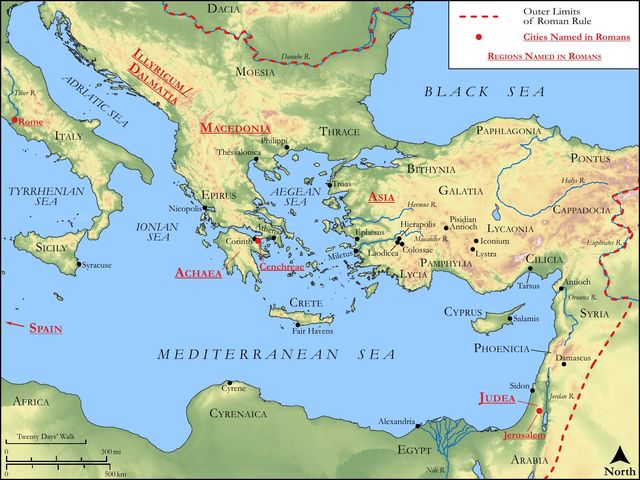
See on the biblical-era maps

Study this verse
Public-domain commentary
Matthew Henry
From his Commentary on the Whole Bible. Henry comments on passages, not single verses — this entry covers Romans 9:14–24. His three-level outline is real structure in the source text, so it is rendered as structure.
The apostle, having asserted the true meaning of the promise, comes here to maintain and prove the absolute sovereignty of God, in disposing of the children of men, with reference to their eternal state. And herein God is to be considered, not as a rector and governor, distributing rewards and punishments according to his revealed laws and covenants, but as an owner and benefactor, giving to the children of men such grace and favour as he has determined in and by his secret and eternal will and counsel: both the favour of visible church-membership and privileges, which is given to some people and denied to others, and the favour of effectual grace, which is given to some particular persons and denied to others.
Now this part of his discourse is in answer to two objections.
I.It might be objected, Is there unrighteousness with God? If God, in dealing with the children of men, do thus, in an arbitrary manner, choose some and refuse others, may it not be suspected that there is unrighteousness with him? This the apostle startles at the thought of: God forbid! Far be it from us to think such a thing; shall not the judge of all the earth do right? Gen 18:25; Rom 3:5, Rom 3:6. He denies the consequences, and proves the denial.
1.In respect of those to whom he shows mercy, Rom 9:15, Rom 9:16. He quotes that scripture to show God's sovereignty in dispensing his favours (Exo 33:19): I will be gracious to whom I will be gracious. All God's reasons of mercy are taken from within himself. All the children of men being plunged alike into a state of sin and misery, equally under guilt and wrath, God, in a way of sovereignty, picks out some from this fallen apostatized race, to be vessels of grace and glory. He dispenses his gifts to whom he will, without giving us any reason: according to his own good pleasure he pitches upon some to be monuments of mercy and grace, preventing grace, effectual grace, while he passes by others. The expression is very emphatic, and the repetition makes it more so: I will have mercy on whom I will have mercy. It imports a perfect absoluteness in God's will; he will do what he will, and giveth not account of any of his matters, nor is it fit he should. As these great words, I am that I am (Exo 3:14) do abundantly express the absolute independency of his being, so these words, I will have mercy on whom I will have mercy, do as fully express the absolute prerogative and sovereignty of his will. To vindicate the righteousness of God, in showing mercy to whom he will, the apostle appeals to that which God himself had spoken, wherein he claims this sovereign power and liberty. God is a competent judge, even in his own case. Whatsoever God does, or is resolved to do, is both by the one and the other proved to be just. Eleēsō on han heleō - I will have mercy on whom I will have mercy. When I begin, I will make an end. Therefore God's mercy endures for ever, because the reason of it is fetched from within himself; therefore his gifts and callings are without repentance. Hence he infers (Rom 9:16), It is not of him that willeth. Whatever good comes from God to man, the glory of it is not to be ascribed to the most generous desire, nor to the most industrious endeavour, of man, but only and purely to the free grace and mercy of God. In Jacob's case it was not of him that willeth, nor of him that runneth; it was not the earnest will and desire of Rebecca that Jacob might have the blessing; it was not Jacob's haste to get it (for he was compelled to run for it) that procured him the blessing, but only the mercy and grace of God. Wherein the holy happy people of God differ from other people, it is God and his grace that make them differ. Applying this general rule to the particular case that Paul has before him, the reason why the unworthy, undeserving, ill-deserving Gentiles are called, and grafted into the church, while the greatest part of the Jews are left to perish in unbelief, is not because those Gentiles were better deserving or better disposed for such a favour, but because of God's free grace that made that difference. The Gentiles did neither will it, nor run for it, for they sat in darkness, Mat 4:16. In darkness, therefore not willing what they knew not; sitting in darkness, a contented posture, therefore not running to meet it, but anticipated with these invaluable blessings of goodness. Such is the method of God's grace towards all that partake of it, for he is found of those that sought him not (Isa 65:1); in this preventing, effectual, distinguishing grace, he acts as a benefactor, whose grace is his own. Our eye therefore must not be evil because his is good; but, of all the grace that we or others have, he must have the glory: Not unto us, Psa 115:1.
2.In respect of those who perish, Rom 9:17. God's sovereignty, manifested in the ruin of sinners, is here discovered in the instance of Pharaoh; it is quoted from Exo 9:16. Observe,
(1.)What God did with Pharaoh. He raised him up, brought him into the world, made him famous, gave him the kingdom and power, - set him up as a beacon upon a hill, as the mark of all his plagues (compare Exo 9:14) - hardened his heart, as he had said he would (Exo 4:21): I will harden his heart, that is, withdraw softening grace, leave him to himself, let Satan loose against him, and lay hardening providences before him. Or, by raising him up may be meant the intermission of the plagues which gave Pharaoh respite, and the reprieve of Pharaoh in those plagues. In the Hebrew, I have made thee stand, continued thee yet in the land of the living. Thus doth God raise up sinners, make them for himself, even for the day of evil (Pro 16:4), raise them up in outward prosperity, external privileges (Mat 11:23), sparing mercies.
(2.)What he designed in it: That I might show my power in thee. God would, by all this, serve the honour of his name, and manifest his power in baffling the pride and insolence of that great and daring tyrant, who bade defiance to Heaven itself, and trampled upon all that was just and sacred. If Pharaoh had not been so high and might, so bold and hardy, the power of God had not been so illustrious in the ruining of him; but the taking off of the spirit of such a prince, who hectored at that rate, did indeed proclaim God glorious in holiness, fearful in praises, doing wonders, Exo 15:11. This is Pharaoh, and all his multitude.
(3.)His conclusion concerning both these we have, Rom 9:18. He hath mercy on whom he will have mercy, and whom he will he hardeneth. The various dealings of God, by which he makes some to differ from others, must be resolved into his absolute sovereignty. He is debtor to no man, his grace is his own, and he may give it or withhold it as it pleaseth him; we have none of us deserved it, nay, we have all justly forfeited it a thousand times, so that herein the work of our salvation is admirably well ordered that those who are saved must thank God only, and those who perish must thank themselves only, Hos 13:9. We are bound, as God hath bound us, to do our utmost for the salvation of all we have to do with; but God is bound no further than he has been pleased to bind himself by his own covenant and promise, which is his revealed will; and that is that he will receive, and not cast out, those that come to Christ; but the drawing of souls in order to that coming is a preventing distinguishing favour to whom he will. Had he mercy on the Gentiles? It was because he would have mercy on them. Were the Jews hardened? It was because it was his own pleasure to deny them softening grace, and to give them up to their chosen affected unbelief. Even so, Father, because it seemed good unto thee. That scripture excellently explains this, Luk 10:21, and, as this, shows the sovereign will of God in giving or withholding both the means of grace and the effectual blessing upon those means.
II.It might be objected, Why doth he yet find fault? For who hath resisted his will? Rom 9:19.
Had the apostle been arguing only for God's sovereignty in appointing and ordering the terms and conditions of acceptance and salvation, there had not been the least colour for this objection; for he might well find fault if people refused to come up to the terms on which such a salvation is offered; the salvation being so great, the terms could not be hard. But there might be colour for the objection against his arguing for the sovereignty of God in giving and withholding differencing and preventing grace; and the objection is commonly and readily advanced against the doctrine of distinguishing grace. If God, while he gives effectual grace to some, denies it to others, why doth he find fault with those to whom he denies it? If he hath rejected the Jews, and hid from their eyes the things that belong to their peace, why doth he find fault with them for their blindness? If it be his pleasure to discard them as not a people, and not obtaining mercy, their knocking off themselves was no resistance of his will. This objection he answers at large,
1.By reproving the objector (Rom 9:20): Nay but, O man. This is not an objection fit to be made by the creature against his Creator, by man against God. The truth, as it is in Jesus, is that which abases man as nothing, less than nothing, and advances God as sovereign Lord of all. Observe how contemptibly he speaks of man, when he comes to argue with God his Maker: "Who art thou, thou that art so foolish, so feeble, so short-sighted, so incompetent a judge of the divine counsels? Art thou able to fathom such a depth, dispute such a case, to trace that way of God which is in the sea, his path in the great waters?" That repliest against God. It becomes us to submit to him, not to reply against him; to lie down under his hand, not to fly in his face, nor to charge him with folly. Ho antapokrinomenos - That answerest again. God is our master, and we are his servants; and it does not become servants to answer again, Tit 2:9.
2.By resolving all into the divine sovereignty. We are the thing formed, and he is the former; and it does not become us to challenge or arraign his wisdom in ordering and disposing of us into this or that shape of figure. The rude and unformed mass of matter hath no right to this or that form, but is shaped at the pleasure of him that formeth it. God's sovereignty over us is fitly illustrated by the power that the potter hath over the clay; compare Jer 18:6, where, by a like comparison, God asserts his dominion over the nation of the Jews, when he was about to magnify his justice in their destruction by Nebuchadnezzar.
(1.)He gives us the comparison, Rom 9:21. The potter, out of the same lump, may make either a fashionable vessel, and a vessel fit for creditable and honourable uses, or a contemptible vessel, and a vessel in which is no pleasure; and herein he acts arbitrarily, as he might have chosen whether he would make any vessel of it at all, or whether he would leave it in the hole of the pit, out of which it was dug.
(2.)The application of the comparison, Rom 9:22-24. Two sorts of vessels God forms out of the great lump of fallen mankind: - [1.] Vessels of wrath - vessels filled with wrath, as a vessel of wine is a vessel filled with wine; full of the fury of the Lord, Isa 51:20. In these God is willing to show his wrath, that is, his punishing justice, and his enmity to sin. This must be shown to all the world, God will make it appear that he hates sin. He will likewise make his power known, to dumaton autou. It is a power of strength and energy, an inflicting power, which works and effects the destruction of those that perish; it is a destruction that proceeds from the glory of his power, Th2 1:9. The eternal damnation of sinners will be an abundant demonstration of the power of God; for he will act in it himself immediately, his wrath preying as it were upon guilty consciences, and his arm stretched out totally to destroy their well-being, and yet at the same instant wonderfully to preserve the being of the creature. In order to this, God endured them with much long-suffering - exercised a great deal of patience towards them, let them alone to fill up the measure of sin, to grow till they were ripe for ruin, and so they became fitted for destruction, fitted by their own sin and self-hardening. The reigning corruptions and wickedness of the soul are its preparedness and disposedness for hell: a soul is hereby made combustible matter, fit for the flames of hell. When Christ said to the Jews (Mat 23:32), Fill you up then the measure of your father, that upon you may come all the righteous blood (Mat 23:35), he did, as it were, endure them with much long-suffering, that they might, by their own obstinacy and wilfulness in sin, fit themselves for destruction. [2.] Vessels of mercy - filled with mercy. The happiness bestowed upon the saved remnant is the fruit, not of their merit, but of God's mercy. The spring of all the joy and glory of heaven is that mercy of God which endures for ever. Vessels of honour must to eternity own themselves vessels of mercy. Observe, First, What he designs in them: To make known the riches of his glory, that is, of his goodness; for God's goodness is his greatest glory, especially when it is communicated with the greatest sovereignty. I beseech thee show me thy glory, says Moses, Exo 33:18. I will make all my goodness to pass before thee, says God (Exo 33:19), and that given out freely: I will be gracious to whom I will be gracious. God makes known his glory, this goodness of his, in the preservation and supply of all the creatures: the earth is full of his goodness, and the year crowned with it; but when he would demonstrate the riches of his goodness, unsearchable riches, he does it in the salvation of the saints, that will be to eternity glorious monuments of divine grace. Secondly, What he does for them he does before prepare them to glory. Sanctification is the preparation of the soul for glory, making it meet to partake of the inheritance of the saints in light. This is God's work. We can destroy ourselves fast enough, but we cannot save ourselves. Sinners fit themselves for hell, but it is God that prepares saints for heaven; and all those that God designs for heaven hereafter he prepares and fits for heaven now: he works them to the self-same thing, Co2 5:5. And would you know who these vessels of mercy are? Those whom he hath called (Rom 9:24); for whom he did predestinate those he also called with an effectual call: and these not of the Jews only, but of the Gentiles; for, the partition-wall being taken down, the world was laid in common, and not (as it had been) God's favour appropriated to the Jews, and they put a degree nearer his acceptance than the rest of the world. They now stood upon the same level with the Gentiles; and the question is not now whether of the seed of Abraham or no, that is neither here nor there, but whether or no called according to his purpose.
Historical interpretation
Three Centuries of Reception
5 surviving comments on this verse. Each one is dated, so this reads as a timeline rather than a list.
Select a marker to jump to its quote. Markers stagger vertically where authors wrote within a few decades of each other.
The riches of God are made known when his mercy is shown toward those who are rejected by men and who are downtrodden, who put their hope not in their own riches or in their own strength but in the Lord.
It is God’s patience and long-suffering that, just as he prepares the wicked for destruction, so also he prepares the good for their reward. For the good are those who have the hope of faith. God preserves everyone knowing what the destiny of each will be. Therefore, it is a sign of his patience that those who have been rescued from evil or who persevere in good works he prepares for glory.
"What if God, willing to show His wrath, and to make His power known, endured with much long-suffering the vessels of wrath fitted to destruction: and that He might make known the riches of His glory on the vessels of mercy, which He had afore prepared unto glory, even us, whom He hath chosen, not of the Jews only, but also of the Gentiles."
What he means is somewhat as follows. Pharaoh was a vessel of wrath, that is, a man who by his own hard-heartedness had kindled the wrath of God. For after enjoying much long-suffering, he became no better, but remained unimproved. Wherefore he calleth him not only "a vessel of wrath," but also one "fitted for destruction." That is, fully fitted indeed, but by his own proper self. For neither had God left out aught of the things likely to recover him, nor did he leave out aught of those that would ruin him, and put him beyond any forgiveness. Yet still, though God knew this, "He endured him with much long-suffering," being willing to bring him to repentance. For had He not willed this, then He would not have been thus long-suffering. But as he would not use the long-suffering in order to repentance, but fully fitted himself for wrath, He used him for the correction of others, through the punishment inflicted upon him making them better, and in this way setting forth His power.
For that it is not God's wish that His power be so made known, but in another way, by His benefits, namely, and kindnesses, he had shown above in all possible ways. For if Paul does not wish to appear powerful in this way ("not that we should appear approved," he says, "but that ye should do that which is honest"), much less doth God. But after that he had shown long-suffering, that He might lead to repentance, but he did not repent, He suffered him a long time, that He might display at once His goodness and His power, even if that man were not minded to gain anything from this great long-suffering. As then by punishing this man, who continued incorrigible, He showed His power, so by having pitied those who had done many sins but repented, He manifested His love toward man.
In giving to some what they did not deserve God obviously wanted his grace to be gratuitous and therefore genuinely grace, and in not giving it to all he showed what all deserved. He is good in the benefit given to certain people and just in the punishment of others but good in all things, for it is good when that which is deserved is given, and just in all things, as it is just when that which is not merited is given without injury to anyone.
We who were vessels of wrath through our first birth have deserved to become vessels of mercy through the second one. The first birth brought us forth unto death, but the second one recalled us to life. All of us were temples of the devil before baptism, but after baptism we were made ready to become temples of Christ.
Continue studying Romans 9:23 across the web’s major study libraries — every link below opens this exact verse, chapter, or book on the destination site.
Read & Compare
 BibleGatewayThis verse in more than 200 translations and 70 languages.
 Bible.comThe YouVersion reader — hundreds of translations, reading plans, and highlights.
 ESV.orgCrossway's official English Standard Version reader.
 NET BibleThe NET translation with 60,000+ translators' notes on every rendering decision.
 STEP BibleTyndale House's free study tool — original text, vocabulary, and scholarly resources.
 BibliaLogos Bible Software's free web reader.
 USCCBThe New American Bible (Revised Edition) with the U.S. bishops' study notes.
Commentaries
 BibleHub CommentariesDozens of classic commentaries on this verse, gathered on one page.
 StudyLightMore than 100 commentary sets — the largest collection on the web.
 BibleRefPlain-English commentary on what this verse means, verse by verse.
 Enduring WordDavid Guzik's free commentary on this chapter, widely used by Bible teachers.
 Bible Study ToolsVerse commentary alongside Greek and Hebrew study aids.
Original Language & Research
- BibleHub InterlinearThe verse word by word — original language, transliteration, and English.
- BibleHub LexiconEvery word's original-language definition and Strong's entry.
 Blue Letter BibleDeep-study tools — Strong's numbers, concordance, and word studies.
 CNTR CollationThe earliest Greek manuscripts of this verse, collated letter by letter.
Sermons, Hymns & Audio


TrulyRandomVerse is not affiliated with these sites and doesn’t control their content. They’re linked because they’re genuinely useful.
Summary
Romans 9:23 unveils God's profound purpose in salvation: to magnificently display the boundless "riches of His glory" upon those whom He has sovereignly chosen and graciously prepared for eternal glory, referred to as "vessels of mercy." This verse stands in stark contrast to the "vessels of wrath" mentioned previously, highlighting God's dual revelation of His character through both righteous judgment and abundant, unmerited compassion, all for the ultimate manifestation of His own inherent splendor and majesty.
Context
ShowHideLiterary Context
Romans 9:23 is positioned within a dense theological argument (Romans 9-11) where Paul addresses the perplexing question of Israel's rejection of Christ and God's continuing faithfulness to His covenant promises. Following a lament over Israel's unbelief (Romans 9:1-5), Paul delves into God's sovereign election, illustrating it with Old Testament examples like Jacob and Esau (Romans 9:10-13) and Pharaoh (Romans 9:17). Verse 23 directly follows the statement in Romans 9:22 about God's patience with "vessels of wrath fitted to destruction." This immediate juxtaposition highlights the contrasting purposes of God's actions: demonstrating His power and wrath on some, and making known the riches of His glory and mercy on others. It serves as a pivotal point, transitioning from the discussion of judgment to the glorious purpose of salvation.
Historical & Cultural Context
Paul's letter to the Romans was written to a diverse church in Rome, comprising both Jewish and Gentile believers. A significant tension existed regarding the status of Israel and the inclusion of Gentiles into God's plan of salvation. The concept of "vessels" (Greek: skeuos) was common in ancient thought, referring to instruments or containers shaped by a potter for a specific purpose. This imagery, drawn from Old Testament prophets like Jeremiah (Jeremiah 18:1-6), would have been familiar to Paul's audience, emphasizing the Creator-creature distinction and God's absolute sovereignty over His creation. The debate over divine election and human responsibility was not new, but Paul's robust articulation of God's unconditioned choice was particularly challenging for those accustomed to a covenant based on lineage or law-keeping.
Key Themes
ShowHideThis verse powerfully contributes to several major theological themes in Romans and the broader biblical narrative. Firstly, it underscores God's absolute sovereignty and unconditioned election, demonstrating that His choice of individuals for salvation is not based on human merit or works, but solely on His divine will and purpose, as seen in the examples of Jacob and Esau. Secondly, it highlights the boundless nature of God's mercy and grace, emphasizing that those who receive salvation are "vessels of mercy," recipients of His undeserved favor. Thirdly, the verse articulates God's ultimate purpose in all His dealings: the manifestation of His own glory. Whether in judgment or mercy, God's actions are directed toward making known the infinite splendor of His character. This theme resonates throughout the book, culminating in the doxology of Romans 11:36. Finally, the concept of divine preparation ("afore prepared unto glory") points to God's eternal plan and foreknowledge, securing the destiny of His chosen ones in glory, a theme also found in Ephesians 1:4-5.
Exposition and Analysis
ShowHideKey Word Analysis
ShowHideFrom the base of πλήθω; wealth (as fulness), i.e. (literally) money, possessions, or (figuratively) abundance, richness, (specially), valuable bestowment. This term emphasizes the immeasurable, overflowing, and superabundant nature of God's glory, indicating that it is not merely sufficient but infinitely vast and inexhaustible.
From the base of δοκέω; glory (as very apparent), in a wide application (literal or figurative, objective or subjective):--dignity, glory(-ious), honour, praise, worship. Here, "glory" refers to God's inherent majesty, splendor, perfect character, and manifest presence. It is the sum of all His perfections, fully revealed.
From πρό and ἑτοιμάζω; to fit up in advance (literally or figuratively):--ordain before, prepare afore. This compound verb strongly conveys the idea of God's pre-ordained, sovereign initiative. It signifies that the preparation of the "vessels of mercy" for glory was not an afterthought or a response to human action, but a deliberate, eternal purpose set in motion by God Himself before time.
Verse Breakdown
ShowHide"And that he might make known the riches of his glory"
This clause reveals God's ultimate purpose in His dealings with humanity. The phrase "make known" (Greek: gnōrízō) implies a full and public revelation. God's aim is not merely to save, but to display the immense, overflowing, and inherent splendor of His character and attributes. His glory is the end goal, the magnificent backdrop against which His plan unfolds.
"on the vessels of mercy"
This identifies the recipients of God's glorious display. "Vessels" (Greek: skeûos) are instruments or containers, emphasizing that humans are not self-made but are shaped by God. They are "of mercy" (Greek: éleos), signifying that their status as recipients of God's glory is entirely due to His compassionate kindness and unmerited favor, not their own worthiness or works. They are objects upon whom God's mercy is poured out.
"which he had afore prepared unto glory"
This final clause underscores the sovereign and eternal nature of God's plan for these "vessels of mercy." The phrase "afore prepared" (Greek: proetoimázō) indicates a divine pre-arrangement or foreordination. Their ultimate destiny, "unto glory," means they are prepared to partake in, reflect, and eternally enjoy God's own glory. This preparation is not a human effort but a divine act, securing their participation in His glorious purpose from eternity past.
Literary Devices
ShowHideRomans 9:23 employs several potent literary devices. Metaphor is central, with humanity depicted as "vessels" (Greek: skeûos). This imagery, drawn from the potter and clay motif (as seen in Romans 9:20-21), powerfully conveys the Creator's absolute sovereignty and prerogative over His creation. Just as a potter shapes clay for different purposes, God shapes humanity. The phrase "riches of his glory" utilizes hyperbole to emphasize the immeasurable and overflowing nature of God's majesty, suggesting a splendor so vast it cannot be fully comprehended. The verse also functions as a contrast to the preceding verse (Romans 9:22), juxtaposing "vessels of wrath fitted to destruction" with "vessels of mercy... prepared unto glory." This stark antithesis highlights the two distinct outcomes of God's sovereign dealings and the diverse ways in which His character (both justice and mercy) is revealed.
Theological and Thematic Connections
ShowHideRomans 9:23 profoundly articulates God's sovereign initiative in salvation, revealing that His ultimate purpose is the display of His own glorious character. The "vessels of mercy" are not merely saved from wrath, but are actively prepared by God to participate in and reflect His glory. This highlights that salvation is entirely a work of divine grace, from its eternal conception to its glorious consummation. It underscores that humanity's role is one of reception, not initiation or merit, fostering deep humility and worship. God's glory is not merely the backdrop but the very essence and goal of His redemptive plan, ensuring that all praise redounds to Him alone.
Reflection and Application
ShowHideRomans 9:23 offers profound comfort and calls for deep humility and gratitude in the life of a believer. To know that one is a "vessel of mercy," not by personal merit but by God's eternal, sovereign preparation, provides an unshakable foundation for assurance. Our salvation is not a precarious endeavor dependent on our fluctuating performance, but a secure reality rooted in God's unchanging purpose and power. This truth should lead us to profound worship, recognizing that our very existence and our hope of glory are entirely His gracious work. As recipients of such immense mercy and destined for such a glorious end, our lives ought to become living demonstrations of the "riches of His glory" to a world desperately in need of seeing God's character. This calls us to live in a manner that reflects His holiness, compassion, and truth, becoming instruments through whom His glory is made known.
Questions for Reflection
ShowHideFAQ
ShowHideWhat does "vessels of mercy" mean in this context?
ShowHideThe term "vessels of mercy" refers to individuals who are recipients of God's unmerited favor and compassionate kindness. The imagery of "vessels" (Greek: skeûos) implies that humans are like containers or instruments, shaped and purposed by a divine "potter." In this context, these vessels are specifically chosen and prepared by God to receive and display His abundant mercy, contrasting them with "vessels of wrath" mentioned in Romans 9:22. It emphasizes that their salvation and destiny are entirely due to God's sovereign grace, not any inherent worthiness or action on their part.
Christ-Centered Fulfillment
ShowHideRomans 9:23 finds its ultimate and most profound fulfillment in Jesus Christ. He is the preeminent "vessel" through whom the "riches of God's glory" are not merely made known, but fully embodied and perfectly revealed. The eternal purpose of God to prepare "vessels unto glory" is supremely realized in Christ, who is the "radiance of God's glory and the exact representation of his being" (Hebrews 1:3). In Jesus, God's mercy is not just demonstrated but actively poured out, as He is the Lamb of God who takes away the sin of the world (John 1:29). Through His incarnation, life, atoning death, and resurrection, the Father's glory, full of grace and truth, was made visible to humanity (John 1:14). Furthermore, believers are made "vessels of mercy" and prepared for glory in Christ. It is through union with Him that we receive God's mercy and are conformed to His image, destined to share in His glory (Romans 8:29-30). Christ is not only the means by which God's glory is revealed, but also the ultimate destination of the "vessels of mercy," for our hope of glory is "Christ in you" (Colossians 1:27).