


1 Thessalonians 1:10
Bible text: King James Version (1769 Blayney text) · Public domain
Bible text: King James Version with Strong's numbers · Public domain
Bible text: Berean Standard Bible · Public domain
Bible text: American Standard Version (1901) · Public domain
Bible text: World English Bible, Messianic edition · Public domain
Bible text: Geneva Bible (1599) · Public domain
Bible text: Young's Literal Translation · Public domain
- καὶkaiandG2532CONJConjunction
- ἀναμένεινanameneinto awaitG362V-PANVerb Present Active Infinitive
- τὸνtontheG3588T-ASMDefinite article Accusative Singular Masculine
- υἱὸνhuionSonG5207N-ASMNoun Accusative Singular Masculine
- αὐτοῦautouof HimG846P-GSMPersonal pronoun Genitive Singular Masculine
- ἐκekfromG1537PREPPreposition
- τῶνtōntheG3588T-GPMDefinite article Genitive Plural Masculine
- οὐρανῶνouranōnheavensG3772N-GPMNoun Genitive Plural Masculine
- ὃνhonwhomG3739R-ASMRelative pronoun Accusative Singular Masculine
- ἤγειρενēgeirenHe raisedG1453V-AAI-3SVerb Aorist Active Indicative 3rd Singular
- ἐκekout fromG1537PREPPreposition
- τῶνtōntheG3588T-GPMDefinite article Genitive Plural Masculine
- νεκρῶνnekrōndeadG3498A-GPMAdjective Genitive Plural Masculine
- ἸησοῦνIēsounJesusG2424N-ASM-PNoun Accusative Singular Masculine Individual
- τὸνtonwhoG3588T-ASMDefinite article Accusative Singular Masculine
- ῥυόμενονrhuomenonis deliveringG4506V-PNP-ASMVerb Present Middle Or Passive Deponent Participle Accusative Singular Masculine
- ἡμᾶςhēmasusG3165P-1APPersonal pronoun Accusative 1st Plural
- ἐκekfromG1537PREPPreposition
- τῆςtēstheG3588T-GSFDefinite article Genitive Singular Feminine
- ὀργῆςorgēswrathG3709N-GSFNoun Genitive Singular Feminine
- τῆςtēswhichG3588T-GSFDefinite article Genitive Singular Feminine
- ἐρχομένηςerchomenēsis comingG2064V-PNP-GSFVerb Present Middle Or Passive Deponent Participle Genitive Singular Feminine
English is a literal word-by-word gloss of the Greek, not the KJV's wording. Why?
This is the original text the KJV's translators worked from — each Greek word with its own literal English meaning in this verse, prepared by scholars at Tyndale House, Cambridge. The KJV translates whole sentences, not word by word, so its wording differs: one Greek word can become several English words, and the KJV may choose “charity” where the gloss reads “love”. Both are faithful — they answer different questions. For the KJV's own rendering, switch to the KJV text.
Details
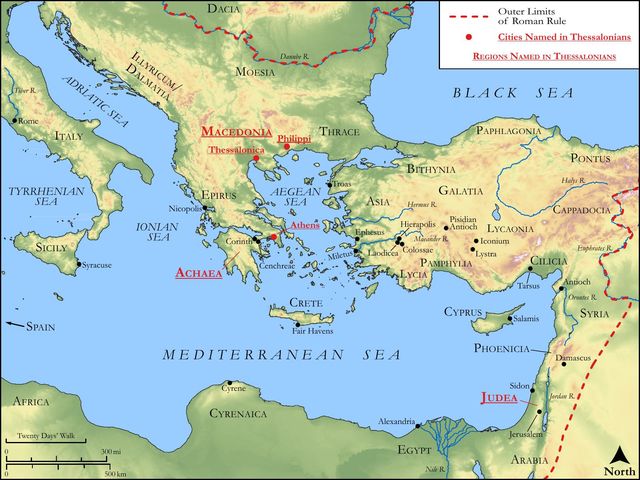
See on the biblical-era maps

Study this verse
Public-domain commentary
Matthew Henry
From his Commentary on the Whole Bible. Henry comments on passages, not single verses — this entry covers 1 Thessalonians 1:6–10. His four-level outline is real structure in the source text, so it is rendered as structure.
In these words we have the evidence of the apostle's success among the Thessalonians, which was notorious and famous in several places. For,
I.They were careful in their holy conversation to imitate the good examples of the apostles and ministers of Christ, Th1 1:6.
As the apostle took care to demean himself well, not only for his own credit's sake, but for the benefit of others, by a conversation suitable to his doctrine, that he might not pull down with one hand what he built up with the other, so the Thessalonians, who observed what manner of men they were among them, how their preaching and living were all of a piece, showed a conscientious care to be followers of them, or to imitate their good example. Herein they became also followers of the Lord, who is the perfect example we must strive to imitate; and we should be followers of others no further than they are followers of Christ, Co1 11:1. The Thessalonians acted thus, notwithstanding their affliction, that much affliction which the apostles and themselves also were exposed to. They were willing to share in the sufferings that attended the embracing and professing of Christianity. They entertained the gospel, notwithstanding the troubles and hardships which attended the preachers and professors of it too. Perhaps this made the word more precious, being dear - bought; and the examples of the apostles shone very bright under their afflictions; so that the Thessalonians embraced the word cheerfully, and followed the example of the suffering apostles joyfully, with joy in the Holy Ghost - such solid and spiritual and lasting joy as the Holy Ghost is the author of, who, when our afflictions abound, makes our consolations much more to abound.
II.Their zeal prevailed to such a degree that they were themselves examples to all about them, Th1 1:7, Th1 1:8. Observe here,
1.Their example was very effectual to make good impressions upon many others. They were tupoi - stamps, or instruments to make impression with. They had themselves received good impressions from the preaching and conversation of the apostles, and they made good impressions, and their conversation had an influence upon others. Note, Christians should be so good as by their example to influence others.
2.It was very extensive, and reached beyond the confines of Thessalonica, even to the believers of all Macedonia, and further, in Achaia; the Philippians, and others who received the gospel before the Thessalonians, were edified by their example. Note, Some who were last hired into the vineyard may sometimes outstrip those who come in before them, and become examples to them.
3.It was very famous. The word of the Lord, or its wonderful effects upon the Thessalonians, sounded, or was famous and well known, in the regions round about that city, and in every place; not strictly every where, but here and there, up and down in the world: so that, from the good success of the gospel among them, many others were encouraged to entertain it, and to be willing, when called, to suffer for it. Their faith was spread abroad.
(1.)The readiness of their faith was famed abroad. These Thessalonians embraced the gospel as soon as it was preached to them; so that every body took notice what manner of entering in among them the apostles had, that there were no such delays as at Philippi, where it was a great while before much good was done.
(2.)The effects of their faith were famous.
[1.]They quitted their idolatry; they turned from their idols, and abandoned all the false worship they had been educated in.
[2.]They gave themselves up to God, to the living and true God, and devoted themselves to his service.
[3.]They set themselves to wait for the Son of God from heaven, Th1 1:10. And this is one of the peculiarities of our holy religion, to wait for Christ's second coming, as those who believe he will come and hope he will come to our joy. The believers under the Old Testament waited for the coming of the Messiah, and believers now wait for his second coming; he is yet to come. And there is good reason to believe he will come, because God has raised him from the dead, which is full assurance unto all men that he will come to judgment, Act 17:31. And there is good reason to hope and wait for his coming, because he has delivered us from the wrath to come. He came to purchase salvation, and will, when he comes again, bring salvation with him, full and final deliverance from sin, and death, and hell, from that wrath which is yet to come upon unbelievers, and which, when it has once come, will be yet to come, because it is everlasting fire prepared for the devil and his angels, Mat 25:41.
Historical interpretation
Nine Centuries of Reception
3 surviving comments on this verse. Each one is dated, so this reads as a timeline rather than a list.
Select a marker to jump to its quote. Markers stagger vertically where authors wrote within a few decades of each other.
"And to wait," he says, "for His Son from heaven, whom He raised from the dead, even Jesus, which delivereth us from the wrath to come." "And to wait," he says, "for His Son from heaven"; Him that was crucified, Him that was buried; to wait for Him from heaven. And how "from heaven"? "Whom He raised from the dead." You see all things at the same time; both the Resurrection, and the Ascension, and the second Coming, the Judgment, the retribution of the just, the punishment of the wicked. "Jesus," he says, "which delivereth us from the wrath to come." This is at once comfort, and exhortation, and encouragement. For if He raised Him from the dead, and He is in heaven, and thence will come, (and ye believed in Him; for if ye had not believed in Him, ye would not have suffered so much), this of itself is sufficient comfort. These shall suffer punishment, which he says in his second epistle, and you will have no small consolation.
And to "wait," he says, "for His Son from heaven." The terrible things are in hand, but the good things are in the future, when Christ shall come from heaven. See how much hope is required, in that He who was crucified has been raised, that He has been taken up into heaven, that He will come to judge the quick and the dead.
whom he raised up from the dead
The Divine power is the same thing as the operation of the Father and the Son; accordingly these two things are mutually consequent, that Christ was raised up by the Divine power of the Father, and by His own power.
Jesus, who has rescued us from the approaching wrath
that is the punishment of Gehenna.
Continue studying 1 Thessalonians 1:10 across the web’s major study libraries — every link below opens this exact verse, chapter, or book on the destination site.
Read & Compare
 BibleGatewayThis verse in more than 200 translations and 70 languages.
 Bible.comThe YouVersion reader — hundreds of translations, reading plans, and highlights.
 ESV.orgCrossway's official English Standard Version reader.
 NET BibleThe NET translation with 60,000+ translators' notes on every rendering decision.
 STEP BibleTyndale House's free study tool — original text, vocabulary, and scholarly resources.
 BibliaLogos Bible Software's free web reader.
 USCCBThe New American Bible (Revised Edition) with the U.S. bishops' study notes.
Commentaries
 BibleHub CommentariesDozens of classic commentaries on this verse, gathered on one page.
 StudyLightMore than 100 commentary sets — the largest collection on the web.
 BibleRefPlain-English commentary on what this verse means, verse by verse.
 Enduring WordDavid Guzik's free commentary on this chapter, widely used by Bible teachers.
 Bible Study ToolsVerse commentary alongside Greek and Hebrew study aids.
Original Language & Research
- BibleHub InterlinearThe verse word by word — original language, transliteration, and English.
- BibleHub LexiconEvery word's original-language definition and Strong's entry.
 Blue Letter BibleDeep-study tools — Strong's numbers, concordance, and word studies.
 CNTR CollationThe earliest Greek manuscripts of this verse, collated letter by letter.
Sermons, Hymns & Audio


TrulyRandomVerse is not affiliated with these sites and doesn’t control their content. They’re linked because they’re genuinely useful.
Summary
First Thessalonians 1:10 powerfully encapsulates the core tenets of the early Christian faith, highlighting the Thessalonians' transformative conversion and their profound, forward-looking hope. It presents Jesus Christ as the eagerly awaited Son from heaven, divinely raised from the dead, and the ultimate deliverer of believers from the certainty of God's coming wrath. This verse serves as a concise theological statement, summarizing the past work of Christ, the present orientation of the believer, and the future expectation of His return and ultimate salvation.
Context
ShowHideLiterary Context
This verse concludes Paul's opening thanksgiving for the Thessalonian believers, a section that runs from 1 Thessalonians 1:2-10. Having praised their "work of faith, and labour of love, and patience of hope" (1 Thessalonians 1:3), Paul then describes their radical conversion from idolatry to serving the living God (1 Thessalonians 1:9). Verse 10 naturally flows from this description of their conversion, linking their turning to God with their new, defining characteristic: an active, expectant waiting for Christ's return. It transitions smoothly into the subsequent chapters which further develop the theme of the Lord's return and its implications for Christian living and suffering.
Historical & Cultural Context
The city of Thessalonica was a major Roman port city and the capital of the province of Macedonia. As a bustling commercial center, it was a melting pot of cultures and religions, including various mystery cults and the pervasive worship of Roman emperors and Greek deities. For the Thessalonian converts, many of whom were Gentiles (1 Thessalonians 1:9), turning "from idols" meant a complete break from their previous societal and religious norms, often leading to social ostracism and persecution. Paul's emphasis on "waiting for his Son from heaven" would have provided immense comfort and a distinct hope in a world dominated by pagan fatalism and the immediate pressures of Roman imperial cults. The concept of divine "wrath to come" would have resonated with both Jewish apocalyptic expectations and the common understanding of divine judgment among the nations of that day, but Paul redefines it through the lens of Christ's deliverance.
Key Themes
ShowHideThis concise verse is rich with several foundational themes central to 1 Thessalonians and Pauline theology. The most prominent is the eschatological hope of Christ's Second Coming, often referred to as the Parousia. This expectation is not a passive waiting but an active, shaping force for their lives, providing motivation for perseverance in faith and love. Another critical theme is the resurrection of Jesus, which is presented as the historical bedrock of Christian faith and the guarantee of future hope for believers, as seen throughout Paul's writings (e.g., 1 Corinthians 15:20). Furthermore, the theme of salvation from divine wrath is crucial, underscoring the salvific work of Christ. This wrath is not an arbitrary outburst but God's righteous judgment against sin, from which believers are delivered through Jesus' atoning work, a concept elaborated in passages like Romans 5:9. Finally, the verse implicitly highlights Jesus' divine Sonship and authority, as He is presented as "his Son from heaven," affirming His unique relationship with God the Father and His supreme role in salvation history.
Exposition and Analysis
ShowHideKey Word Analysis
ShowHideThis word means "to await." It implies an eager, patient, and expectant waiting. It is not a passive idleness but an active anticipation rooted in conviction and hope. The Thessalonians' conversion led them to orient their lives around this future event, demonstrating a living faith that looks forward to the Lord's return.
Meaning "to waken, rouse, lift up, raise." This word specifically refers to God the Father raising Jesus from the dead. It emphasizes the divine power at work in the resurrection, which is the foundational event validating Jesus' claims and securing the hope of believers. The resurrection is presented as a completed, decisive act.
Meaning "violent passion (ire, or (justifiable) abhorrence); by implication punishment." In this context, "wrath" refers to God's settled, righteous indignation and judgment against sin and ungodliness. It is not a sudden, capricious outburst but a holy, determined opposition to evil that culminates in a future, certain judgment.
Meaning "to rush or draw (for oneself), i.e. rescue." This term conveys the idea of a powerful rescue or deliverance from danger. It highlights Jesus' active and decisive role in saving believers from the impending divine judgment, emphasizing the completeness and efficacy of His salvific work.
Verse Breakdown
ShowHide"And to wait for his Son from heaven"
This clause describes the new orientation of the Thessalonians' lives post-conversion. Their turning from idols (mentioned in 1 Thessalonians 1:9) is immediately followed by an active, expectant waiting for Jesus. The phrase "his Son from heaven" underscores Jesus' divine origin and unique relationship with God the Father, establishing His authority and pre-eminence. This waiting is a hallmark of genuine Christian faith, characterized by hope in the future return of Christ.
"whom he raised from the dead, [even] Jesus"
This central clause highlights the foundational event of Christianity: the resurrection of Jesus. The "he" refers to God the Father, emphasizing the divine power and validation behind Jesus' life and ministry. The resurrection is not merely a historical event but the guarantee of Jesus' victory over death and the promise of future resurrection for believers. It solidifies Jesus' identity as the promised Messiah and Lord, making Him worthy of their eager expectation.
"which delivered us from the wrath to come."
This final clause articulates the profound salvific benefit of Jesus' work. The "wrath to come" refers to God's righteous judgment against sin, a future and certain reality for those outside of Christ. The verb "delivered" (past tense) signifies a completed act, meaning that through Jesus' atoning sacrifice, believers have already been rescued and secured from this impending judgment. This deliverance is a present reality based on a past event, providing immense assurance and peace.
Literary Devices
ShowHideThe verse employs several significant literary devices. Conciseness is evident, as Paul packs profound theological truths into a single, compact sentence. The use of Antithesis is subtle but powerful, contrasting the Thessalonians' former life of serving idols with their new life of waiting for God's Son. The phrase "wrath to come" functions as a Metonymy, where "wrath" stands in for the entire concept of divine judgment and its consequences. Furthermore, the verse is structured as a Creedal Statement, summarizing essential Christian beliefs about Christ's identity, His resurrection, and His salvific work, making it easily memorable and teachable. The Anaphora of "from" (from heaven, from the dead, from the wrath) subtly emphasizes origins and deliverance.
Theological and Thematic Connections
ShowHideFirst Thessalonians 1:10 stands as a foundational statement of Christian eschatology and soteriology, deeply connecting the past work of Christ with the future hope of believers. It articulates that genuine conversion (turning from idols to God) intrinsically involves an active, hopeful anticipation of Christ's return, which is predicated on the historical reality of His resurrection. This future expectation is not one of fear, but of assurance, as believers have already been definitively delivered from the impending divine judgment through Jesus' completed work on the cross. The "wrath to come" is a certain future reality for the ungodly, but for those in Christ, it has been definitively averted by His atoning sacrifice. This verse thus provides a comprehensive framework for understanding the Christian's position in time: saved from past sin, living in present hope, and secured for a future glory.
Reflection and Application
ShowHideFirst Thessalonians 1:10 offers profound insights for contemporary believers, serving as a powerful anchor for our faith and a catalyst for our daily living. Our conversion, like that of the Thessalonians, means a radical reorientation of life—from serving anything other than God to actively serving the living and true God. This service is not merely about past repentance but is deeply intertwined with a future-oriented hope: the eager expectation of Jesus' return. This hope should not lead to passive waiting but to active, purposeful living, knowing that our Savior, who conquered death, has already secured our deliverance from ultimate judgment. The assurance of Christ's resurrection validates every promise of God and empowers us to live with courage and conviction, knowing that our future is secure in Him. This verse calls us to live with a dual focus: faithfully serving God in the present while eagerly anticipating the glorious appearing of our Lord, allowing this hope to purify our lives and fuel our witness.
Questions for Reflection
ShowHideFAQ
ShowHideWhat is the "wrath to come" that believers are delivered from?
ShowHideThe "wrath to come" (Greek: tēs orgēs tēs erchomenēs) refers to God's righteous, settled indignation and judgment against sin and ungodliness, which will be fully manifested in the future. It is not a capricious outburst of temper but a just and holy response to human rebellion and rejection of His authority. For those who do not believe in Jesus, this wrath culminates in eternal separation from God. However, 1 Thessalonians 1:10 assures believers that through Jesus' atoning sacrifice, they have been definitively rescued from this impending divine judgment. This deliverance is a core aspect of Christian salvation, as also articulated in Romans 5:9.
Why is Jesus' resurrection so central to this verse's message?
ShowHideJesus' resurrection is absolutely central because it is the divine validation of His identity, His claims, and His power to save. The phrase "whom he raised from the dead" (1 Thessalonians 1:10) underscores that God the Father Himself affirmed Jesus' messianic status and His victory over sin and death. Without the resurrection, the hope of Christ's return would be baseless, and the deliverance from wrath would be impossible. The resurrection serves as the guarantee of future resurrection for believers (1 Corinthians 15:20-22) and the foundation for our faith and hope in His ultimate return and our eternal salvation.
Christ-Centered Fulfillment
ShowHideFirst Thessalonians 1:10 beautifully encapsulates the Christ-centered nature of salvation and eschatological hope. The "Son from heaven" is none other than Jesus Christ, the eternal Word who became flesh (John 1:14), whose very identity is intrinsically linked to His divine origin and unique relationship with the Father. His resurrection, explicitly stated as God's act of raising Him "from the dead," is the pivotal event that validates His messianic claims and secures the believer's hope. This act of God foreshadows and guarantees the future resurrection of all who are in Christ (1 Corinthians 15:20-23). Most profoundly, Jesus is the one "which delivered us from the wrath to come." This deliverance points directly to His atoning work on the cross, where He bore the full weight of God's righteous wrath against sin, becoming a propitiation for our transgressions (Romans 3:25). Therefore, our eager waiting for His glorious return (Titus 2:13) is rooted in the certainty of His past victory and the present reality of our deliverance, ensuring that when He appears, it will be for our complete salvation, not our condemnation (Hebrews 9:28).