


1 Thessalonians 1:9
Bible text: King James Version (1769 Blayney text) · Public domain
Bible text: King James Version with Strong's numbers · Public domain
Bible text: Berean Standard Bible · Public domain
Bible text: American Standard Version (1901) · Public domain
Bible text: World English Bible, Messianic edition · Public domain
Bible text: Geneva Bible (1599) · Public domain
Bible text: Young's Literal Translation · Public domain
- αὐτοὶautoiThey themselvesG846P-NPMPersonal pronoun Nominative Plural Masculine
- γὰρgarforG1063CONJConjunction
- περὶpericoncerningG4012PREPPreposition
- ἡμῶνhēmōnusG3165P-1GPPersonal pronoun Genitive 1st Plural
- ἀπαγγέλλουσινapangellousinreportG518V-PAI-3PVerb Present Active Indicative 3rd Plural
- ὁποίανhopoianwhatG3697I-ASFInterrogative pronoun Accusative Singular Feminine
- εἴσοδονeisodonreceptionG1529N-ASFNoun Accusative Singular Feminine
- ἔσχομενeschomenwe hadG2192V-2AAI-1PVerb 2nd Aorist Active Indicative 1st Plural
- πρὸςprosfromG4314PREPPreposition
- ὑμᾶςhumasyouG4771P-2APPersonal pronoun Accusative 2nd Plural
- καὶkaiandG2532CONJConjunction
- πῶςpōshowG4459PRT-IInterrogative Particle Interrogative
- ἐπεστρέψατεepestrepsateyou turnedG1994V-2AAI-2PVerb 2nd Aorist Active Indicative 2nd Plural
- πρὸςprostoG4314PREPPreposition
- τὸνton<the>G3588T-ASMDefinite article Accusative Singular Masculine
- θεὸνtheonGodG2316N-ASM-TNoun Accusative Singular Masculine Title
- ἀπὸapofromG575PREPPreposition
- τῶνtōn<the>G3588T-GPNDefinite article Genitive Plural Neuter
- εἰδώλωνeidōlōnidolsG1497N-GPNNoun Genitive Plural Neuter
- δουλεύεινdouleueinto serveG1398V-PANVerb Present Active Infinitive
- θεῷtheō[the] GodG2316N-DSM-TNoun Dative Singular Masculine Title
- ζῶντιzōntilivingG2198V-PAP-DSMVerb Present Active Participle Dative Singular Masculine
- καὶkaiandG2532CONJConjunction
- ἀληθινῷalēthinōtrueG228A-DSMAdjective Dative Singular Masculine
English is a literal word-by-word gloss of the Greek, not the KJV's wording. Why?
This is the original text the KJV's translators worked from — each Greek word with its own literal English meaning in this verse, prepared by scholars at Tyndale House, Cambridge. The KJV translates whole sentences, not word by word, so its wording differs: one Greek word can become several English words, and the KJV may choose “charity” where the gloss reads “love”. Both are faithful — they answer different questions. For the KJV's own rendering, switch to the KJV text.
Details
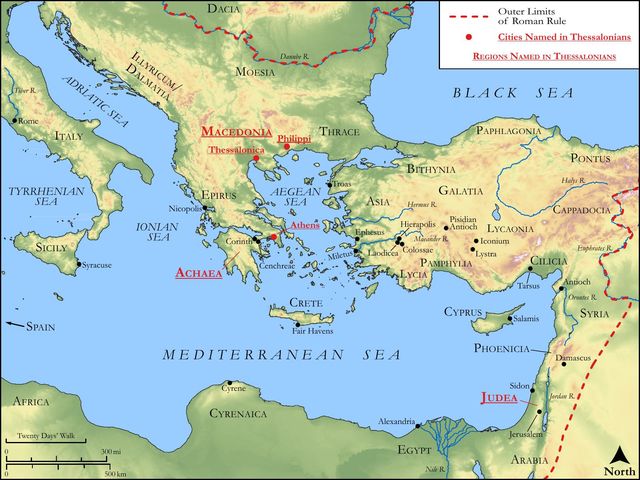
See on the biblical-era maps

Study this verse
Public-domain commentary
Matthew Henry
From his Commentary on the Whole Bible. Henry comments on passages, not single verses — this entry covers 1 Thessalonians 1:6–10. His four-level outline is real structure in the source text, so it is rendered as structure.
In these words we have the evidence of the apostle's success among the Thessalonians, which was notorious and famous in several places. For,
I.They were careful in their holy conversation to imitate the good examples of the apostles and ministers of Christ, Th1 1:6.
As the apostle took care to demean himself well, not only for his own credit's sake, but for the benefit of others, by a conversation suitable to his doctrine, that he might not pull down with one hand what he built up with the other, so the Thessalonians, who observed what manner of men they were among them, how their preaching and living were all of a piece, showed a conscientious care to be followers of them, or to imitate their good example. Herein they became also followers of the Lord, who is the perfect example we must strive to imitate; and we should be followers of others no further than they are followers of Christ, Co1 11:1. The Thessalonians acted thus, notwithstanding their affliction, that much affliction which the apostles and themselves also were exposed to. They were willing to share in the sufferings that attended the embracing and professing of Christianity. They entertained the gospel, notwithstanding the troubles and hardships which attended the preachers and professors of it too. Perhaps this made the word more precious, being dear - bought; and the examples of the apostles shone very bright under their afflictions; so that the Thessalonians embraced the word cheerfully, and followed the example of the suffering apostles joyfully, with joy in the Holy Ghost - such solid and spiritual and lasting joy as the Holy Ghost is the author of, who, when our afflictions abound, makes our consolations much more to abound.
II.Their zeal prevailed to such a degree that they were themselves examples to all about them, Th1 1:7, Th1 1:8. Observe here,
1.Their example was very effectual to make good impressions upon many others. They were tupoi - stamps, or instruments to make impression with. They had themselves received good impressions from the preaching and conversation of the apostles, and they made good impressions, and their conversation had an influence upon others. Note, Christians should be so good as by their example to influence others.
2.It was very extensive, and reached beyond the confines of Thessalonica, even to the believers of all Macedonia, and further, in Achaia; the Philippians, and others who received the gospel before the Thessalonians, were edified by their example. Note, Some who were last hired into the vineyard may sometimes outstrip those who come in before them, and become examples to them.
3.It was very famous. The word of the Lord, or its wonderful effects upon the Thessalonians, sounded, or was famous and well known, in the regions round about that city, and in every place; not strictly every where, but here and there, up and down in the world: so that, from the good success of the gospel among them, many others were encouraged to entertain it, and to be willing, when called, to suffer for it. Their faith was spread abroad.
(1.)The readiness of their faith was famed abroad. These Thessalonians embraced the gospel as soon as it was preached to them; so that every body took notice what manner of entering in among them the apostles had, that there were no such delays as at Philippi, where it was a great while before much good was done.
(2.)The effects of their faith were famous.
[1.]They quitted their idolatry; they turned from their idols, and abandoned all the false worship they had been educated in.
[2.]They gave themselves up to God, to the living and true God, and devoted themselves to his service.
[3.]They set themselves to wait for the Son of God from heaven, Th1 1:10. And this is one of the peculiarities of our holy religion, to wait for Christ's second coming, as those who believe he will come and hope he will come to our joy. The believers under the Old Testament waited for the coming of the Messiah, and believers now wait for his second coming; he is yet to come. And there is good reason to believe he will come, because God has raised him from the dead, which is full assurance unto all men that he will come to judgment, Act 17:31. And there is good reason to hope and wait for his coming, because he has delivered us from the wrath to come. He came to purchase salvation, and will, when he comes again, bring salvation with him, full and final deliverance from sin, and death, and hell, from that wrath which is yet to come upon unbelievers, and which, when it has once come, will be yet to come, because it is everlasting fire prepared for the devil and his angels, Mat 25:41.
Historical interpretation
Eleven Centuries of Reception
6 surviving comments on this verse. Each one is dated, so this reads as a timeline rather than a list.
Select a marker to jump to its quote. Markers stagger vertically where authors wrote within a few decades of each other.
Whence is proved that they have ever been depicted, out of the volume of the divine Scriptures, as guilty of the crime of idolatry; whereas our "less"-that is, posterior-people, quitting the idols which formerly it used slavishly to serve, has been converted to the same God from whom Israel, as we have above related, had departed. For thus has the "less"-that is, posterior-people overcome the"greater people," while it attains the grace of divine favour, from which Israel has been divorced.
For we read: "How ye turned from idols to serve the living and true God, and to wait for His Son from heaven, whom He raised from the dead, even Jesus." And again: "For what is our hope, or joy, or crown of rejoicing? Are not even ye in the presence of our Lord God, Jesus Christ, at His coming? " Likewise: "Before God, even our Father, at the coming of the Lord Jesus Christ, with the whole company of His saints.
By what means do we become Christians? Through our faith would be the universal answer. And in what way are we saved? Plainly because we were regenerated through the grace given to us in our baptism. How else could we be? And after recognizing that this salvation is established through the Father and the Son and the Holy Spirit, shall we fling away “that form of doctrine” which we received? Would it not rather be grounds for great groaning if we are found now further off from our salvation “than when we first believed,” and deny now what we then received?… What if one does not always and everywhere keep to his initial confession and cling to it as a sure protection?… What if one, having been delivered “from the idols,” to the “living God,” now constitutes himself a “stranger” from the “promises” of God? He fights against his own handwriting, which he put on record when he professed the faith. To me my baptism was the beginning of life and that day of regeneration the first of days. It is plain that the utterance confessed in the grace of adoption is the most honorable of all.
What means, "What manner of entering in we had unto you"? That it was full of dangers, and numberless deaths, but that none of these things troubled you. But as if nothing had happened, so you adhered to us; as if ye had suffered no evil, but had enjoyed infinite good, so you received us after these things. For this was the second entering. They went to Beroea, they were persecuted, and when they came after this they so received them, as though they had been honored by these also, so that they even laid down their lives for them. The expression, "What manner of entering in we had," is complicated, and contains an encomium both of them and of themselves. But he himself has turned this to their advantage. "And how," he says, "ye turned to God from idols, to serve a living and true God"; that is, that ye did it readily, that ye did it with much eagerness, that it did not require much labor to make you. "In order to serve," says he, "a living and true God."
Here also he introduced an exhortation, which is the part of one who would make his discourse less offensive.
of the kind of acceptance we had among you
A similar point is made in Prov. (31:31): “Give her of the fruit of her hands, and let her works praise her in the gates.” Those who commend you praise my preaching and your conversion.
For others are reporting
that is, they applaud you.
Continue studying 1 Thessalonians 1:9 across the web’s major study libraries — every link below opens this exact verse, chapter, or book on the destination site.
Read & Compare
 BibleGatewayThis verse in more than 200 translations and 70 languages.
 Bible.comThe YouVersion reader — hundreds of translations, reading plans, and highlights.
 ESV.orgCrossway's official English Standard Version reader.
 NET BibleThe NET translation with 60,000+ translators' notes on every rendering decision.
 STEP BibleTyndale House's free study tool — original text, vocabulary, and scholarly resources.
 BibliaLogos Bible Software's free web reader.
 USCCBThe New American Bible (Revised Edition) with the U.S. bishops' study notes.
Commentaries
 BibleHub CommentariesDozens of classic commentaries on this verse, gathered on one page.
 StudyLightMore than 100 commentary sets — the largest collection on the web.
 BibleRefPlain-English commentary on what this verse means, verse by verse.
 Enduring WordDavid Guzik's free commentary on this chapter, widely used by Bible teachers.
 Bible Study ToolsVerse commentary alongside Greek and Hebrew study aids.
Original Language & Research
- BibleHub InterlinearThe verse word by word — original language, transliteration, and English.
- BibleHub LexiconEvery word's original-language definition and Strong's entry.
 Blue Letter BibleDeep-study tools — Strong's numbers, concordance, and word studies.
 CNTR CollationThe earliest Greek manuscripts of this verse, collated letter by letter.
Sermons, Hymns & Audio


TrulyRandomVerse is not affiliated with these sites and doesn’t control their content. They’re linked because they’re genuinely useful.
Summary
First Thessalonians 1:9 powerfully encapsulates the profound impact of the Gospel on the early Thessalonian believers, serving as a testament to their radical conversion. Paul highlights how their transformation from pagan idolatry to the worship and service of the living and true God was so evident and widely known that it became a compelling witness to the effectiveness of his ministry and the authentic power of the Christian message.
Context
ShowHideLiterary Context
This verse is part of Paul's opening thanksgiving in his first letter to the Thessalonians, immediately following his commendation of their "work of faith, and labour of love, and patience of hope" (1 Thessalonians 1:3). It serves as the concrete evidence and primary example of the spiritual virtues he has just praised. The preceding verses establish Paul's deep affection and gratitude for the Thessalonian church, noting how the Gospel came to them "not in word only, but also in power, and in the Holy Ghost, and in much assurance" (1 Thessalonians 1:5). Verse 9, therefore, explains how this power manifested, namely, in their decisive turning from idols, which then became a widely reported testimony, setting the stage for the subsequent discussion of their exemplary conduct and the spread of the Gospel from them (1 Thessalonians 1:8).
Historical & Cultural Context
Thessalonica was a bustling Roman provincial capital in Macedonia, a major port city situated on the Egnatian Way, a vital trade route. Its diverse population included Greeks, Romans, and Jews. Like most Hellenistic cities, Thessalonica was steeped in polytheism, with numerous temples dedicated to Greek and Roman gods, as well as the pervasive imperial cult, which demanded worship of the Roman emperor. For inhabitants to abandon these deeply ingrained religious and civic practices—which were interwoven with daily life, social standing, and economic activity—and embrace monotheism was a radical, counter-cultural act, often inviting social ostracism, economic hardship, and even persecution. The conversion described in 1 Thessalonians 1:9 was not merely a theological shift but a profound reorientation of their entire worldview and way of life, demonstrating the Gospel's transformative power in a pagan environment.
Key Themes
ShowHideThis verse contributes significantly to several key themes within 1 Thessalonians and Pauline theology. Foremost is the theme of Authentic Conversion, emphasizing a decisive and visible change from idolatry to true worship. This is not merely an intellectual assent but a radical reorientation of life and allegiance, marking a complete break from their former pagan practices. It also highlights the Power of the Gospel, demonstrating that the message preached by Paul was not just persuasive words but a divine force capable of transforming lives and societies, even in the face of entrenched paganism. Furthermore, the verse underscores the theme of Evangelistic Testimony, as the Thessalonians themselves became a living testament to the effectiveness of Paul's ministry and the transforming power of the Gospel. Their transformed lives validated the message, causing their faith to be reported "in every place" (1 Thessalonians 1:8). Finally, it emphasizes the Nature of God as "the living and true God," distinguishing Him sharply from the inert, false deities of pagan worship, a contrast vital for early Christian apologetics and missionary endeavors.
Exposition and Analysis
ShowHideKey Word Analysis
ShowHideFrom ἐπί and στρέφω; to revert (literally, figuratively or morally):--come (go) again, convert, (re-)turn (about, again). This word signifies a complete change of direction, a decisive turning away from one path and towards another. In this context, it denotes a radical spiritual conversion, implying a reorientation of one's entire life and allegiance from false worship to the true God.
From εἶδος; an image (i.e. for worship); by implication, a heathen god, or (plural) the worship of such:--idol. This term refers to the images or representations of pagan deities that the Thessalonians formerly worshipped. The use of the plural emphasizes the multitude of false gods and practices they abandoned, highlighting the comprehensive nature of their conversion.
A primary verb; to live (literally or figuratively):--life(-time), (a-)live(-ly), quick. This adjective, applied to God, contrasts sharply with the lifeless and inert nature of the idols they previously served. It emphasizes God's active existence, vitality, and ongoing power, distinguishing Him as a God who acts, hears, and responds, unlike the dead gods of paganism.
Verse Breakdown
ShowHide"For they themselves shew of us what manner of entering in we had unto you,"
This clause explains why Paul is giving thanks and how the Thessalonians became an example. The "they themselves" refers to people in other regions who had heard about the Thessalonians' conversion. They were reporting to Paul and his team about the nature of their initial reception and the powerful impact of Paul's ministry in Thessalonica. The "manner of entering in" speaks not just of Paul's arrival, but the quality and effectiveness of his initial evangelistic work, which was clearly marked by divine power and conviction.
"and how ye turned to God from idols"
This is the core of the Thessalonians' transformation. It describes a decisive, radical break from their previous religious practices. "Turned to God" signifies a reorientation of their entire lives, allegiance, and worship towards the one true God. This turning from "idols" emphasizes the abandonment of the polytheistic and pagan worship that characterized their former lives, a foundational aspect of genuine conversion in a Gentile context.
"to serve the living and true God;"
This final clause defines the purpose and outcome of their conversion. Their turning was not merely from something but to something and for a specific purpose: to "serve" (Greek: douleúō, G1398, to be a slave to, implying devoted service) the only God who possesses life and reality. The description of God as "living" highlights His active presence, power, and responsiveness, in stark contrast to lifeless idols. As "true," He is the singular, authentic deity, against all false pretenders, solidifying the monotheistic nature of their new faith.
Literary Devices
ShowHideThe verse employs Contrast as a primary literary device, sharply juxtaposing the lifeless "idols" with the "living and true God." This antithesis underscores the radical nature of the Thessalonians' conversion and the qualitative difference between their former paganism and their new Christian faith. The phrase "what manner of entering in we had unto you" also functions as a form of Metonymy, where "entering in" stands for the entire evangelistic mission and its powerful, Spirit-filled impact. Furthermore, the verse uses Testimony as a narrative device, highlighting how the Thessalonians' transformed lives became a powerful, self-evident witness ("they themselves shew of us") that validated Paul's ministry and the Gospel message itself, amplifying its reach and credibility.
Theological and Thematic Connections
ShowHideThis verse profoundly illustrates the nature of genuine conversion as a radical reorientation of one's life, involving a decisive turning from false objects of worship and a wholehearted commitment to the one true God. It underscores that salvation is not merely an intellectual assent but a transformative act that redefines allegiance, purpose, and worship. The Thessalonians' story serves as a model for all believers, demonstrating that true faith results in a visible change that bears witness to God's power. This turning from idols to serve the living God is a universal pattern of spiritual transformation, applicable whether the "idols" are literal statues or modern-day pursuits that usurp God's rightful place in our hearts.
Reflection and Application
ShowHideFirst Thessalonians 1:9 calls us to examine the authenticity of our own conversion and the objects of our devotion. For many, the "idols" are not carved images but rather more subtle, yet equally demanding, allegiances: careers, possessions, relationships, self-image, or even personal comfort and security. True conversion, as exemplified by the Thessalonians, involves a decisive turning away from anything that competes with God for ultimate loyalty and affection. It's a reorientation of our entire being—mind, will, and emotions—to serve the living and true God. This service is not burdensome but liberating, flowing from a heart transformed by His grace. Our lives, like theirs, should naturally bear witness to the power of Christ, becoming a compelling testimony to those around us, demonstrating that the Gospel is not just a message, but a life-altering reality.
Questions for Reflection
ShowHideFAQ
ShowHideWhat does it mean to "turn to God from idols"?
ShowHideTo "turn to God from idols" signifies a profound and complete spiritual conversion. In the context of 1 Thessalonians 1:9, it literally meant abandoning the worship of pagan deities and their associated rituals, which were prevalent in Thessalonica, and embracing the exclusive worship of the one true God revealed in Jesus Christ. Metaphorically, for believers today, it means decisively rejecting anything that takes God's rightful place in our lives—be it materialism, self-reliance, success, relationships, or any other pursuit that becomes an ultimate source of meaning or security—and reorienting our entire life, allegiance, and devotion to God alone. It's a radical shift in loyalty and purpose, moving from serving self or false gods to serving the "living and true God." This turning is often described as repentance, a change of mind leading to a change of direction, as seen in Acts 3:19.
Christ-Centered Fulfillment
ShowHideThe conversion of the Thessalonians, marked by their turning "to God from idols to serve the living and true God," finds its ultimate fulfillment and deepest meaning in Jesus Christ. Christ is the very means by which this turning is made possible, for He is the "way, the truth, and the life" (John 14:6), through whom alone we can approach the living God. Their turning from idols foreshadows the universal call to acknowledge Jesus as Lord, for "there is one God, and one mediator between God and men, the man Christ Jesus" (1 Timothy 2:5). The "living and true God" whom they came to serve is fully revealed in the person of Jesus, who is "the image of the invisible God" (Colossians 1:15) and "the true God, and eternal life" (1 John 5:20). Their eager expectation of Christ's return, mentioned in the very next verse (1 Thessalonians 1:10), further solidifies the Christ-centered nature of their conversion, as they turned to God through His Son, who delivers us from the wrath to come. Thus, the Thessalonians' transformation is a powerful early testament to the saving and reorienting work of Christ in human hearts.