


1 Timothy 1:1
- ΠαῦλοςPaulosPaulG3972N-NSM-PNoun Nominative Singular Masculine Individual
- ἀπόστολοςapostolosan apostleG652N-NSMNoun Nominative Singular Masculine
- ΧριστοῦChristouChristG5547N-GSM-TNoun Genitive Singular Masculine Title
- ἸησοῦIēsouJesusG2424N-GSM-PNoun Genitive Singular Masculine Individual
- κατ᾽kat᾽according toG2596PREPPreposition
- ἐπιταγὴνepitagēn[the] commandG2003N-ASFNoun Accusative Singular Feminine
- θεοῦtheouof GodG2316N-GSM-TNoun Genitive Singular Masculine Title
- σωτῆροςsōtēros[the] SaviorG4990N-GSMNoun Genitive Singular Masculine
- ἡμῶνhēmōnof usG3165P-1GPPersonal pronoun Genitive 1st Plural
- καὶkaiandG2532CONJConjunction
- κυριόυkuriouLordG2962N-GSM-TNoun Genitive Singular Masculine Title
- ΧριστοῦChristouChristG5547N-GSM-TNoun Genitive Singular Masculine Title
- ἸησοῦIēsouJesusG2424N-GSM-PNoun Genitive Singular Masculine Individual
- τῆςtēstheG3588T-GSFDefinite article Genitive Singular Feminine
- ἐλπίδοςelpidoshopeG1680N-GSFNoun Genitive Singular Feminine
- ἡμῶνhēmōnof usG3165P-1GPPersonal pronoun Genitive 1st Plural
English is a literal word-by-word gloss of the Greek, not the KJV's wording. Why?
This is the original text the KJV's translators worked from — each Greek word with its own literal English meaning in this verse, prepared by scholars at Tyndale House, Cambridge. The KJV translates whole sentences, not word by word, so its wording differs: one Greek word can become several English words, and the KJV may choose “charity” where the gloss reads “love”. Both are faithful — they answer different questions. For the KJV's own rendering, switch to the KJV text.
Details
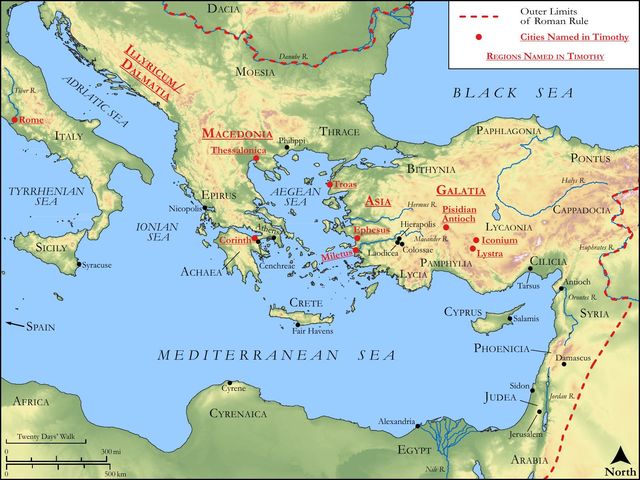
See on the biblical-era map

Study this verse
Public-domain commentary
Matthew Henry
From his Commentary on the Whole Bible. Henry comments on passages, not single verses — this entry covers 1 Timothy 1:1–4. His two-level outline is real structure in the source text, so it is rendered as structure.
Here is, I. The inscription of the epistle, from whom it is sent: Paul an apostle of Jesus Christ, constituted an apostle by the commandment of God our Saviour, and Lord Jesus Christ. His credentials were unquestionable. He had not only a commission, but a commandment, not only from God our Saviour, but from Jesus Christ: he was a preacher of the gospel of Christ, and a minister of the kingdom of Christ. Observe, God is our Saviour. - Jesus Christ, who is our hope. Observe, Jesus Christ is a Christian's hope; our hope is in him, all our hope of eternal life is built upon him; Christ is in us the hope of glory, Col 1:27. He calls Timothy his own son, because he had been an instrument of his conversion, and because he had been a son that served him, served with him in the gospel, Phi 2:22. Timothy had not been wanting in the duty of a son to Paul, and Paul was not wanting in the care and tenderness of a father to him.
II.The benediction is, grace, mercy, and peace, from God our Father.
Some have observed that whereas in all the epistles to the churches the apostolical benediction is grace and peace, in these two epistles to Timothy and that to Titus it is grace, mercy, and peace: as if ministers had more need of God's mercy than other men. Ministers need more grace than others, to discharge their duty faithfully; and they need more mercy than others, to pardon what is amiss in them: and if Timothy, so eminent a minister, must be indebted to the mercy of God, and needed the increase and continuance of it, how much more do we ministers, in these times, who have so little of his excellent spirit!
III.Paul tells Timothy what was the end of his appointing him to this office:
I besought thee to abide at Ephesus. Timothy had a mind to go with Paul, was loth to go from under his wing, but Paul would have it so; it was necessary for the public service: I besought thee, says he. Though he might assume an authority to command him, yet for love's sake he chose rather to beseech him. Now his business was to take care to fix both the ministers and the people of that church: Charge them that they teach no other doctrine than what they have received, that they do not add to the Christian doctrine, under pretence of improving it or making up the defects of it, that they do no alter it, but cleave to it as it was delivered to them. Observe,
1.Ministers must not only be charged to preach the true doctrine of the gospel, but charged to preach no other doctrine. If an angel from heaven preach any other doctrine, let him be anathema, Gal 1:8.
2.In the times of the apostles there were attempts made to corrupt Christianity (we are not as many, who corrupt the word, Co2 2:17), otherwise this charge to Timothy might have been spared.
3.He must not only see to it that he did not preach any other doctrine, but he must charge others that they might not add any thing of their own to the gospel, or take any thing from it, but that they preach it pure and uncorrupt. He must also take care to prevent their regarding fables, and endless genealogies, and strifes of words. This is often repeated in these two epistles (as Ti1 4:7; Ti1 6:4; Ti2 2:23), as well as in the epistle to Titus. As among the Jews there were some who brought Judaism into Christianity; so among the Gentiles there were some who brought paganism into Christianity. "Take heed of these," says he, "watch against them, or they will be the corrupting and ruining of religion among you, for they minister questions rather than edifying." That which ministers questions is not for edifying; that which gives occasion for doubtful disputes pulls down the church rather than builds it up. And I think, by a parity of reason, every thing else that ministers questions rather than godly edifying should be disclaimed and disregarded by us, such as an uninterrupted succession in the ministry from the apostles down to these times, the absolute necessity of episcopal ordination, and of the intention of the minister to the efficacy and validity of the sacraments he ministers. These are as bad as Jewish fables and endless genealogies, for they involve us in inextricable difficulties, and tend only to shake the foundations of a Christian's hope and to fill his mind with perplexing doubts and fears. Godly edifying is the end ministers should aim at in all their discourses, that Christians may be improving in godliness and growing up to a greater likeness to the blessed God. Observe, further, Godly edifying must be in faith: the gospel is the foundation on which we build; it is by faith that we come to God at first (Heb 11:6), and it must be in the same way, and by the same principle of faith, that we must be edified. Again, Ministers should avoid, as much as may be, what will occasion disputes; and would do well to insist on the great and practical points of religion, about which there can be no disputes; for even disputes about great and necessary truths draw off the mind from the main design of Christianity, and eat out the vitals of religion, which consist in practice and obedience as well as in faith, that we may not hold the truth in unrighteousness, but may keep the mystery of the faith in a pure conscience.
Historical interpretation
Nine Centuries of Reception
8 surviving comments on this verse. Each one is dated, so this reads as a timeline rather than a list.
Select a marker to jump to its quote. Markers stagger vertically where authors wrote within a few decades of each other.
These things [I address to you], my beloved, not that I know any of you to be in such a state; but, as less than any of you, I desire to guard you beforehand, that ye fall not upon the hooks of vain doctrine, but that ye attain to full assurance in regard to the birth, and passion, and resurrection which took place in the time of the government of Pontius Pilate, being truly and certainly accomplished by Jesus Christ, who is our hope, from which may no one of you ever be turned aside.
None of these things is hid from you, if ye perfectly possess that faith and love towards Christ Jesus which are the beginning and the end of life. For the beginning is faith, and the end is love. Now these two, being inseparably connected together, are of God, while all other things which are requisite for a holy life follow after them. No man [truly] making a profession of faith sinneth; nor does he that possesses love hate any one. The tree is made manifest by its fruit; so those that profess themselves to be Christians shall be recognised by their conduct. For there is not now a demand for mere profession, but that a man be found continuing in the power of faith to the end.
Wherefore none of the devices of the devil shall be hidden from you, if, like Paul, ye perfectly possess that faith and love towards Christ which are the beginning and the end of life. The beginning of life is faith, and the end is love. And these two being inseparably connected together, do perfect the man of God; while all other things which are requisite to a holy life follow after them. No man making a profession of faith ought to sin, nor one possessed of love to hate his brother. For He that said, "Thou shalt love the Lord thy God," said also, "and thy neighbour as thyself." Those that profess themselves to be Christ's are known not only by what they say, but by what they practise. "For the tree is known by its fruit."
Timothy is a true son in faith, for his generation is one that will not know death or sickness or pestilence or hunger or thirst, because it is based on God and the future is glorious immortality in the gift of God in the kingdom of God and Christ.
Great and admirable is the dignity of an Apostle, and we find Paul constantly setting forth the causes of it, not as if he took the honor to himself, but as intrusted with it, and being under the necessity of so doing. For when he speaks of himself as "called," and that "by the will of God," and again elsewhere, "a necessity is laid upon me" (1 Cor. ix. 16.), and when he says, "for this I was separated," by these expressions all idea of arrogance and ambition is removed. For as he deserves the severest blame, who intrudes into an office which is not given him of God, so he who refuses, and shrinks from it when offered to him, incurs blame of another kind, that of rebellion and disobedience. Therefore Paul, in the beginning of this Epistle, thus expresses himself, "Paul, an Apostle of Jesus Christ by the commandment of God." He does not say here, "Paul called," but "by commandment." He begins in this manner, that Timothy may not feel any human infirmity from supposing that Paul addresses him on the same terms as his disciples. But where is this commandment given? We read in the Acts of the Apostles: "The Spirit said, Separate me Paul and Barnabas." (Acts xiii. 2.) And everywhere in his writings Paul adds the name of Apostle, to instruct his hearers not to consider the doctrines he delivered as proceeding from man. For an Apostle can say nothing of his own, and by calling himself an Apostle, he at once refers his hearers to Him that sent him.
Now it does not appear that the Father anywhere commanded him. It is everywhere Christ who addresses him. Thus, "He said unto me, Depart, for I will send thee far hence unto the Gentiles" (Acts xxii. 21); and again, "Thou must be brought before Caesar." (Acts xxvii. 24.) But whatever the Son commands, this he considers to be the commandment of the Father, as those of the Spirit are the commandments of the Son. For he was sent by the Spirit, he was separated by the Spirit, and this he says was the commandment of God. What then? does it derogate from the power of the Son, that His Apostle was sent forth by the commandment of the Father? By no means. For observe, how he represents the power as common to both. For having said, "according to the commandment of God our Saviour"; he adds, "and Lord Jesus Christ, our hope." And observe, with what propriety he applies the titles. And indeed, the Psalmist applies this to the Father, saying, "The hope of all the ends of the earth." (Ps. lxiv. 5.) And again, the blessed Paul in another place writes, "For therefore we both labor, and suffer reproach, because we have hope in the living God."
The teacher must suffer dangers even more than the disciple. "For I will smite the shepherd, (he says,) "and the sheep shall be scattered abroad." (Zech. xiii. 7.) Therefore the devil rages with greater violence against teachers, because by their destruction the flock also is scattered. For by slaying the sheep, he has lessened the flock, but when he has made away with the shepherd, he has ruined the whole flock, so that he the rather assaults him, as working greater mischief by a less effort; and in one soul effecting the ruin of all. For this reason Paul, at the beginning, elevates and encourages the soul of Timothy, by saying, We have God for our Saviour and Christ for our hope. We suffer much, but our hopes are great; we are exposed to snares and perils, but to save us we have not man but God. Our Saviour is not weak, for He is God, and whatever be our dangers they will not overcome us; nor is our hope made ashamed, for it is Christ. For in two ways we are enabled to bear up against dangers, when we are either speedily delivered from them, or supported by good hopes under them.
But Paul never calls himself the Apostle of the Father, but always of Christ. Because he makes everything common to both. The Gospel itself he calls "the Gospel of God."
Timothy is a son in faith, not in flesh.
It is not nature but faith that has made Timothy a son.
HYPOTHESIS ON THE FIRST EPISTLE TO TIMOTHY
Paul sends this letter from Laodicea; the motive of the letter is this: in Ephesus, some who were Judaizing attempted to teach different doctrines and deceive the more sincere ones under the pretext of the law. Having learned this, the apostle urges Timothy to remain there to correct them, and he writes the letter. First of all, he reminds Timothy, knowing the faith in Christ, teaching him about the law, to prevent those who speak contrary to the correct doctrine and to rebuke them. For he himself also handed over Hymenaeus and Alexander to Satan so that they might be disciplined and not blaspheme, who had shipwrecked concerning the faith, to Satan so that they might be disciplined and not blaspheme. Having reminded Timothy of these things, Paul then ordains apostolic rules for him. First, concerning prayer, how, where, and for whom one ought to pray. Second, concerning the silence of women in the church, and that they should rather learn, and not teach. Third, concerning bishops, elders, and deacons, how and what kind those appointed ought to be. Fourth, concerning the widows in the church, from what age they should be counted, what kind they ought to be, and how they ought to be cared for. Fifth, concerning the moderation of the younger ones, and to marry rather, and not to live shamefully. Sixth, concerning commanding the rich not to be arrogant, nor to put their hope in wealth. Having arranged these matters, Paul is encouraged to teach them; and to not drink water, but to pay attention to himself and to the teaching, knowing that there will be times when some will depart from the faith. Having taught that foods are clean, and having commanded him to avoid quarrelsome disputes, as they are profane, on account of which some, boasting, have broken the faith; and finally, the manner in which one must rule and order, he completes the letter.
Although Paul had other disciples as well, such as Silas, Luke, and others, why does he write only to Timothy and Titus by name? And we might say that he had already entrusted these churches to their leadership but still kept the others with him. Paul writes to Timothy about what is proper for a teacher.
Paul, an apostle of Jesus Christ by the command of God our Savior, and of the Lord Jesus Christ, our hope.
Paul still shows modesty now at the beginning when he says, I did not come on my own initiative, but was commissioned by God. But where was he commissioned? In the Acts of the Apostles, where the Spirit says, "Set apart for me Saul and Barnabas," (Acts 13:2) and there the Lord says to him, "I am sending you far to the Gentiles." (Acts 22:21) But whatever the Son or the Spirit commanded, he says the Father commanded these things. For it is the will of the Holy Trinity.
and of the Lord Jesus Christ, our hope. The apostles say that we suffer much, but we have God as our Savior, and Christ as the Savior of our hope. For the term "Savior" is to be understood commonly. For He Himself provides, they say, the hope that we will be saved.
Continue studying 1 Timothy 1:1 across the web’s major study libraries — every link below opens this exact verse, chapter, or book on the destination site.
Read & Compare
 BibleGatewayThis verse in more than 200 translations and 70 languages.
 Bible.comThe YouVersion reader — hundreds of translations, reading plans, and highlights.
 ESV.orgCrossway's official English Standard Version reader.
 NET BibleThe NET translation with 60,000+ translators' notes on every rendering decision.
 STEP BibleTyndale House's free study tool — original text, vocabulary, and scholarly resources.
 BibliaLogos Bible Software's free web reader.
 USCCBThe New American Bible (Revised Edition) with the U.S. bishops' study notes.
Commentaries
 BibleHub CommentariesDozens of classic commentaries on this verse, gathered on one page.
 StudyLightMore than 100 commentary sets — the largest collection on the web.
 BibleRefPlain-English commentary on what this verse means, verse by verse.
 Enduring WordDavid Guzik's free commentary on this chapter, widely used by Bible teachers.
 Bible Study ToolsVerse commentary alongside Greek and Hebrew study aids.
Original Language & Research
- BibleHub InterlinearThe verse word by word — original language, transliteration, and English.
- BibleHub LexiconEvery word's original-language definition and Strong's entry.
 Blue Letter BibleDeep-study tools — Strong's numbers, concordance, and word studies.
 CNTR CollationThe earliest Greek manuscripts of this verse, collated letter by letter.
Sermons, Hymns & Audio


TrulyRandomVerse is not affiliated with these sites and doesn’t control their content. They’re linked because they’re genuinely useful.
Summary
1 Timothy 1:1 serves as the authoritative opening to Paul's first letter to Timothy, immediately establishing the apostle's divine commission and identifying God as the ultimate source of salvation and Jesus Christ as the singular object of Christian hope. This salutation not only authenticates Paul's message but also grounds the subsequent instructions for church order and doctrine in the sovereign will of God and the saving work of Christ.
Context
ShowHideLiterary Context
This verse initiates the first of Paul's "Pastoral Epistles," a collection including 1 and 2 Timothy and Titus. These letters are distinct in their focus, primarily addressing matters of church leadership, sound doctrine, and practical Christian living within local congregations. Unlike earlier epistles that often address specific theological disputes or moral failings within churches, the Pastoral Epistles are directed to Paul's trusted associates, Timothy and Titus, providing guidance for their pastoral responsibilities. The salutation here sets the tone for the entire letter, emphasizing Paul's apostolic authority as the foundation for the weighty instructions and warnings against false teaching that follow. It immediately frames the ensuing counsel as divinely mandated, not merely human advice.
Historical & Cultural Context
At the time of this letter's writing, likely in the mid-60s AD, Timothy was serving in Ephesus, a prominent Roman provincial capital known for its temple to Artemis (Diana) and a diverse, often syncretistic, religious environment. This setting presented unique challenges for the nascent Christian community, including the infiltration of false teachers propagating asceticism, mythical genealogies, and legalistic practices (1 Timothy 1:3-7). Paul's emphasis on his divine "commandment" and the identity of "God our Saviour" and "Lord Jesus Christ" directly counters any human-derived authority or alternative salvific claims prevalent in Ephesus, including the burgeoning imperial cult that elevated emperors to divine status. The letter aims to solidify orthodox teaching and establish proper church governance in a challenging cultural milieu.
Key Themes
ShowHideThe opening verse immediately introduces several pivotal themes that permeate 1 Timothy. First, Apostolic Authority is paramount, with Paul asserting his commission "by the commandment of God our Saviour, and Lord Jesus Christ." This divine mandate undergirds all his instructions regarding church order, doctrine, and conduct, reinforcing that his words carry the weight of God's will (1 Corinthians 14:37). Second, the theme of God as Saviour is introduced, highlighting God's active role in initiating and accomplishing salvation, a concept further developed in passages like Titus 2:11. This title emphasizes God's redemptive purpose for humanity. Finally, Jesus Christ as Hope is powerfully declared, positioning Christ not merely as a historical figure or a teacher, but as the living, ultimate source of all Christian expectation, assurance, and future (Colossians 1:27). This hope is certain and foundational, providing stability amidst the theological challenges Timothy faced.
Exposition and Analysis
ShowHideKey Word Analysis
ShowHideFrom apostéllō (to send forth), this term signifies a delegate, specifically an ambassador of the Gospel, or officially a commissioner of Christ with miraculous powers. Paul consistently uses this title to assert the divine origin and authority of his mission, emphasizing that he was "sent" by God and Christ, not by human appointment or will. This underscores the authoritative nature of his message and the instructions that follow.
Derived from epitássō (to enjoin), this word denotes an injunction or decree, implying authoritativeness. Paul's apostleship is not a self-appointed role or a human enterprise, but a direct, authoritative mandate from God and Christ. This term highlights the divine imperative behind his ministry and the gospel he proclaims, lending absolute weight to his teachings.
From a primary root meaning "to anticipate, usually with pleasure," elpís refers to expectation (abstractly or concretely) or confidence. In the New Testament, "hope" is not a mere wish or uncertain desire, but a confident and certain expectation rooted in God's faithfulness and promises, particularly concerning the resurrection, eternal life, and Christ's return. Here, Jesus Christ Himself is the embodiment and object of this assured hope.
Verse Breakdown
ShowHide"Paul, an apostle of Jesus Christ"
This opening identifies the author, Paul, and immediately establishes his foundational identity and authority. His designation as "an apostle of Jesus Christ" signifies that his commission and message originate directly from Christ, not from human institutions or personal ambition. This claim to apostleship is crucial for the letter's authority, especially given its focus on church order and doctrine.
"by the commandment of God our Saviour"
Paul clarifies the source of his apostolic authority. It is not by human will or ecclesiastical appointment, but "by the commandment" (a direct, authoritative decree) of God. The title "God our Saviour" emphasizes God's initiative, purpose, and active role in providing salvation for humanity, setting the theological stage for the letter's emphasis on grace and redemption.
"and Lord Jesus Christ, which is our hope;"
This clause further specifies the dual source of Paul's commission—God and "Lord Jesus Christ." The inclusion of "Lord" (Kyrios) asserts Christ's divine sovereignty and authority. The concluding phrase, "which is our hope," powerfully declares Jesus Christ as the central object and embodiment of the believer's confident expectation and assurance. He is the living source of all Christian confidence for both the present and the future, the anchor of faith in a turbulent world.
Literary Devices
ShowHideThe opening verse of 1 Timothy employs several significant literary devices. The most prominent is the Epistolary Salutation, a conventional opening in ancient letters that identifies the sender and recipient, but here it is infused with profound theological meaning. Paul's self-identification as "an apostle of Jesus Christ" immediately establishes his Apostolic Authority, a recurring theme in his epistles, serving as a foundational claim for the divine origin of his message. The phrase "by the commandment of God our Saviour, and Lord Jesus Christ" utilizes Parallelism to link God the Father and God the Son as co-equal sources of Paul's divine commission, underscoring their unified will in salvation. Finally, the declaration "[which is] our hope" functions as a powerful Theological Declaration and a succinct Confession of Faith, succinctly stating the core of Christian eschatological expectation and placing Jesus Christ at its very center.
Theological and Thematic Connections
ShowHide1 Timothy 1:1 lays the theological groundwork for the entire letter, asserting the divine origin of the Christian faith and the supreme authority of God and Christ. By identifying God as "our Saviour" and Jesus Christ as "our hope," Paul establishes a robust framework for understanding salvation as a work initiated and completed by the Triune God. This foundational truth counters any human-centered or legalistic attempts at righteousness, emphasizing that salvation is a gift received through faith in Christ. The verse also underscores the certainty of Christian hope, which is not a mere wish but a confident expectation rooted in the person and work of Jesus, providing an unshakeable anchor for believers in all circumstances. This theological bedrock empowers Timothy to confront false teachings and faithfully shepherd the church, knowing that his ministry is aligned with God's eternal purposes.
Reflection and Application
ShowHide1 Timothy 1:1 offers profound truths for contemporary believers, reminding us of the divine foundation of our faith and the ultimate source of our hope. In a world constantly shifting and offering fleeting promises, this verse calls us to anchor our lives in the unchanging character and sovereign will of God our Saviour and the steadfast person of Jesus Christ, who is our hope. It challenges us to examine the source of our own convictions: are they rooted in human wisdom or divine revelation? Furthermore, recognizing Paul's divinely given authority should prompt us to receive the apostolic teachings, including those found in this letter concerning church order and sound doctrine, with humility and obedience. Our salvation is not a self-achieved feat but a gracious act of God, and our future is securely held in Christ, providing unshakeable confidence for living faithfully today.
Questions for Reflection
ShowHideFAQ
ShowHideWhy does Paul emphasize his apostleship in the opening verse?
ShowHidePaul's emphasis on his apostleship in 1 Timothy 1:1 is crucial for establishing the divine authority of his message. As an apostle, Paul was a direct emissary of Jesus Christ, commissioned by God Himself. This was particularly important for Timothy's ministry in Ephesus, where false teachers were challenging orthodox doctrine and undermining the church's stability. By asserting his divine mandate, Paul ensures that the instructions and warnings he provides throughout the letter are received not as mere human advice, but as authoritative revelations from God, essential for the health and order of the church. This divine commission is also highlighted in other Pauline epistles, such as Romans 1:1.
What does it mean for Jesus Christ to be "our hope"?
ShowHideFor Jesus Christ to be "our hope" (as stated in 1 Timothy 1:1) signifies that He is the ultimate, certain, and living object of the Christian's confident expectation. In the New Testament, "hope" is not a wishful desire but a firm assurance based on God's faithfulness and promises. Jesus Christ embodies this hope because through His death and resurrection, He secured eternal life and reconciliation with God for believers. He is the guarantee of future glory, the promise of His return, and the source of steadfast confidence in the present. This hope provides an anchor for the soul, as described in Hebrews 6:19, enabling believers to persevere through trials with an assured future.
Christ-Centered Fulfillment
ShowHide1 Timothy 1:1, though a salutation, is profoundly Christ-centered, immediately identifying Jesus Christ as both the source of Paul's apostolic authority and the very embodiment of the believer's hope. Paul's commission comes "by the commandment of God our Saviour, and Lord Jesus Christ," underscoring the unified divine will in sending Christ and in establishing His messengers. This highlights Christ's preeminence and active role in salvation history, not merely as a historical figure but as the sovereign "Lord" who commands and empowers His servants. Furthermore, the declaration that Jesus Christ "is our hope" points directly to His person and work as the ultimate fulfillment of all God's promises. He is the one in whom all eschatological expectations converge, the "hope of glory" revealed to the Gentiles (Colossians 1:27). Through His atoning sacrifice and victorious resurrection, Christ has secured the believer's future, making Him the living, certain, and unshakeable foundation of all Christian assurance, both for this life and the life to come (Titus 2:13).