


1 Corinthians 4:17
Bible text: King James Version (1769 Blayney text) · Public domain
Bible text: King James Version with Strong's numbers · Public domain
Bible text: Berean Standard Bible · Public domain
Bible text: American Standard Version (1901) · Public domain
Bible text: World English Bible, Messianic edition · Public domain
Bible text: Geneva Bible (1599) · Public domain
Bible text: Young's Literal Translation · Public domain
- διὰdiaOn account ofG1223PREPPreposition
- τοῦτοtoutothisG3778D-ASNDemonstrative pronoun Accusative Singular Neuter
- ἔπεμψαepempsaI sentG3992V-AAI-1SVerb Aorist Active Indicative 1st Singular
- ὑμῖνhuminto youG4771P-2DPPersonal pronoun Dative 2nd Plural
- ΤιμόθεονTimotheonTimothyG5095N-ASM-PNoun Accusative Singular Masculine Individual
- ὅςhoswhoG3739R-NSMRelative pronoun Nominative Singular Masculine
- ἐστίνestinisG1510V-PAI-3SVerb Present Active Indicative 3rd Singular
- μουmoumyG3165P-1GSPersonal pronoun Genitive 1st Singular
- τέκνονteknonchildG5043N-NSNNoun Nominative Singular Neuter
- ἀγαπητὸνagapētonbelovedG27A-NSNAdjective Nominative Singular Neuter
- καὶkaiandG2532CONJConjunction
- πιστὸνpistonfaithfulG4103A-NSNAdjective Nominative Singular Neuter
- ἐνenin [the]G1722PREPPreposition
- κυρίῳkuriōLordG2962N-DSM-TNoun Dative Singular Masculine Title
- ὃςhoswhoG3739R-NSMRelative pronoun Nominative Singular Masculine
- ὑμᾶςhumasyouG4771P-2APPersonal pronoun Accusative 2nd Plural
- ἀναμνήσειanamnēseiwill remind ofG363V-FAI-3SVerb Future Active Indicative 3rd Singular
- τὰςtastheG3588T-APFDefinite article Accusative Plural Feminine
- ὁδούςhodouswaysG3598N-APFNoun Accusative Plural Feminine
- μουmouof mineG3165P-1GSPersonal pronoun Genitive 1st Singular
- τὰςtasthat [are]G3588T-APFDefinite article Accusative Plural Feminine
- ἐνeninG1722PREPPreposition
- ΧριστῷChristōChristG5547N-DSM-TNoun Dative Singular Masculine Title
- καθὼςkathōseven asG2531CONJConjunction
- πανταχοῦpantachoueverywhereG3837ADVAdverb
- ἐνeninG1722PREPPreposition
- πάσῃpasēeveryG3956A-DSFAdjective Dative Singular Feminine
- ἐκκλησίᾳekklēsiachurchG1577N-DSFNoun Dative Singular Feminine
- διδάσκωdidaskōI teachG1321V-PAI-1SVerb Present Active Indicative 1st Singular
English is a literal word-by-word gloss of the Greek, not the KJV's wording. Why?
This is the original text the KJV's translators worked from — each Greek word with its own literal English meaning in this verse, prepared by scholars at Tyndale House, Cambridge. The KJV translates whole sentences, not word by word, so its wording differs: one Greek word can become several English words, and the KJV may choose “charity” where the gloss reads “love”. Both are faithful — they answer different questions. For the KJV's own rendering, switch to the KJV text.
Details
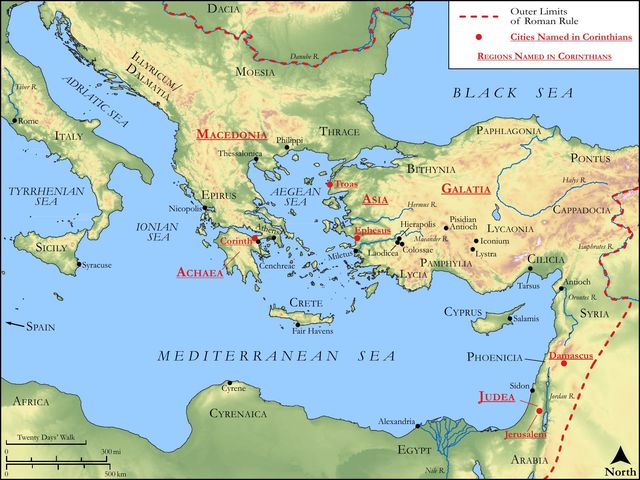
See on the biblical-era maps

Study this verse
Public-domain commentary
Matthew Henry
From his Commentary on the Whole Bible. Henry comments on passages, not single verses — this entry covers 1 Corinthians 4:17–21.
Here, I. He tells them of his having sent Timothy to them, to bring them into remembrance of his ways in Christ, as he taught every where in every church (Co1 4:17) - to remind them of his ways in Christ, to refresh their memory as to his preaching and practice, what he taught, and how he lived among them. Note, Those who have had ever so good teaching are apt to forget, and need to have their memories refreshed. The same truth, taught over again, if it give no new light, may make new and quicker impression. He also lets them know that his teaching was the same every where, and in every church. He had not one doctrine for one place and people, and another for another. He kept close to his instructions. What he received of the Lord, that he delivered, Co1 11:23. This was the gospel revelation, which was the equal concern of all men, and did not very from itself. He therefore taught the same things in every church, and lived after the same manner in all times and places. Note, The truth of Christ is one and invariable. What one apostle taught every one taught. What one apostle taught at one time and in one place, he taught at all times and in all places. Christians may mistake and differ in their apprehensions, but Christ and Christian truth are the same yesterday, today, and for ever, Heb 13:8. To render their regard to Timothy the greater, he gives them his character. He was his beloved son, a spiritual child of his, as well as themselves. Note, Spiritual brotherhood should engage affection as well as what is common and natural. The children of one father should have one heart. But he adds, "He is faithful in the Lord - trustworthy, as one that feared the Lord. He will be faithful in the particular office he has now received of the Lord, the particular errand on which he comes; not only from me, but from Christ. He knows what I have taught, and what my conversation has been in all places, and, you may depend upon it, he will make a faithful report." Note, It is a great commendation of any minister that he is faithful in the Lord, faithful to his soul, to his light, to his trust from God; this must go a great way in procuring regard to his message with those that fear God.
II.He rebukes the vanity of those who imagined he would not come to them, by letting them know this was his purpose, though he had sent Timothy: "I will come to you shortly, though some of you are so vain as to think I will not." But he adds, if the Lord will. It seems, as to the common events of life, apostles knew no more than other men, nor were they in these points under inspiration. For, had the apostle certainly known the mind of God in this matter, he would not have expressed himself with this certainty. But he sets a good example to us in it. Note, All our purposes must be formed with a dependence on Providence, and a reserve for the overruling purposes of God. If the Lord will, we shall live, and do this and that, Jam 4:15.
III.He lets them know what would follow upon his coming to them:
I will know, not the speech of those that are puffed up, but the power, Co1 4:19. He would bring the great pretenders among them to a trial, would know what they were, not by their rhetoric or philosophy, but by the authority and efficacy of what they taught, whether they could confirm it by miraculous operations, and whether it was accompanied with divine influences and saving effects on the minds of men. For, adds he, the kingdom of God is not in word, but in power. It is not set up, nor propagated, nor established, in the hearts of men, by plausible reasonings nor florid discourses, but by the external power of the Holy Spirit in miraculous operations at first, and the powerful influence of divine truth on the minds and manners of men. Note, It is a good way in the general to judge of a preacher's doctrine, to see whether the effects of it upon men's hearts to be truly divine. That is most likely to come from God which in its own nature is most fit, and in event is found to produce most likeness to God, to spread piety and virtue, to change men's hearts and mend their manners.
IV.He puts it to their choice how he should come among them, whether with a rod or in love and the spirit of meekness (Co1 4:21); that is, according as they were they would find him. If they continued perverse among themselves and with him, it would be necessary to come with a rod; that is, to exert his apostolical power in chastising them, by making some examples, and inflicting some diseases and corporal punishments, or by other censures for their faults. Note, Stubborn offenders must be used with severity. In families, in Christian communities, paternal pity and tenderness, Christian love and compassion, will sometimes force the use of the rod. But this is far from being desirable, if it may be prevented. And therefore the apostle adds that it was in their own option whether he should come with a rod or in a quite different disposition and manner: Or in love and the spirit of meekness. As much as if he had said, "Take warning, cease your unchristian feuds, rectify the abuses among you, and return to your duty, and you shall find me as gentle and benign as you can with. It will be a force upon my inclination to proceed with severity. I had rather come and display the tenderness of a father among you than assert his authority. Do but your duty, and you have no reason to avoid my presence." Note, It is a happy temper in a minister to have the spirit of love and meekness predominant, and yet to maintain his just authority.
Historical interpretation
Two Centuries of Reception
3 surviving comments on this verse. Each one is dated, so this reads as a timeline rather than a list.
Select a marker to jump to its quote. Markers stagger vertically where authors wrote within a few decades of each other.
By “ways in Christ” Paul means his embodied good deeds. He tells the Corinthians to remember them, because they are self-evident and do not need to be taught.
Consider here also, I entreat, the noble soul, the soul more glowing and keener than fire: how he was indeed especially desirous to be present himself with the Corinthians, thus distempered and broken into parties. For he knew well what a help to the disciples his presence was and what a mischief his absence. And the former he declared in the Epistle to the Philippians, saying, "Not as in my presence only, but also now much more in my absence, work out your own salvation with fear and trembling." The latter he signifies in this Epistle, saying, "Now some are puffed up, as though I were not coming to you; but I will come." He was urgent, it seems, and desirous to be present himself. But as this was not possible for a time, he corrects them by the promise of his appearance; and not this only, but also by the sending of his disciple. "For this," he saith, "I have sent unto you Timothy." "For this cause:" how is that? "Because I care for you as for children, and as having begotten you." And the message is accompanied with a recommendation of his person: "Who is my beloved and faithful child in the Lord." Now this he said, both to shew his love of him, and to prepare them to look on him with respect. And not simply "faithful," but, "in the Lord;" that is, in the things pertaining to the Lord. Now if in worldly things it is high praise for a man to be faithful, much more in things spiritual.
If then he was his "beloved child," consider how great was Paul's love, in choosing to be separated from him for the Corinthian's sake, And if "faithful" also, he will be unexceptionable in his ministering to their affairs.
"Who shall put you in remembrance." He said not, "shall teach," lest they should take it ill, as being used to learn from himself. Wherefore also towards the end he saith, "For he worketh the work of the Lord, as I, also do. Let no man therefore despise him." For there was no envy among the Apostles, but they had an eye unto one thing, the edification of the Church. And if he that was employed was their inferior, they did as it were support him with all earnestness. Wherefore neither was he contented with saying, "He shall put you in remembrance;" but purposing to cut out their envy more completely,-for Timothy was young,-with this view, I say, he adds, "my ways;" not "his," but "mine;" that is, his methods, his dangers, his customs, his laws, his ordinances, his Apostolical Canons, and all the rest. For since he had said, "We are naked, and are buffered, and have no certain dwelling place: all these things," saith he, "he will remind you of;" and also of the laws of Christ; for destroying all heresies. Then, carrying his argument higher, he adds, "which be in Christ;" ascribing all, as was his wont, unto the Lord, and on that ground establishing the credibility of what is to follow. Wherefore he subjoins, "Even as I teach every where in every church." "Nothing new have I spoken unto you: of these my proceedings all the other Churches are cognizant as well as you." Further: he calls them "ways in Christ," to shew that they have in them nothing human, and that with the aid from that source he doth all things well.
Paul’s behavior was completely consistent with his teaching.
Continue studying 1 Corinthians 4:17 across the web’s major study libraries — every link below opens this exact verse, chapter, or book on the destination site.
Read & Compare
 BibleGatewayThis verse in more than 200 translations and 70 languages.
 Bible.comThe YouVersion reader — hundreds of translations, reading plans, and highlights.
 ESV.orgCrossway's official English Standard Version reader.
 NET BibleThe NET translation with 60,000+ translators' notes on every rendering decision.
 STEP BibleTyndale House's free study tool — original text, vocabulary, and scholarly resources.
 BibliaLogos Bible Software's free web reader.
 USCCBThe New American Bible (Revised Edition) with the U.S. bishops' study notes.
Commentaries
 BibleHub CommentariesDozens of classic commentaries on this verse, gathered on one page.
 StudyLightMore than 100 commentary sets — the largest collection on the web.
 BibleRefPlain-English commentary on what this verse means, verse by verse.
 Enduring WordDavid Guzik's free commentary on this chapter, widely used by Bible teachers.
 Bible Study ToolsVerse commentary alongside Greek and Hebrew study aids.
Original Language & Research
- BibleHub InterlinearThe verse word by word — original language, transliteration, and English.
- BibleHub LexiconEvery word's original-language definition and Strong's entry.
 Blue Letter BibleDeep-study tools — Strong's numbers, concordance, and word studies.
 CNTR CollationThe earliest Greek manuscripts of this verse, collated letter by letter.
Sermons, Hymns & Audio


TrulyRandomVerse is not affiliated with these sites and doesn’t control their content. They’re linked because they’re genuinely useful.
Summary
In 1 Corinthians 4:17, the Apostle Paul articulates his strategic decision to dispatch Timothy, his "beloved son" and faithful co-worker, to the Corinthian church. This action serves as a crucial pastoral intervention, designed to remind the Corinthians of Paul's consistent, Christ-centered "ways" of life and teaching, which he universally imparts across all Christian communities. The verse underscores Paul's apostolic care, the importance of faithful discipleship, and the unified nature of foundational Christian doctrine.
Context
ShowHideLiterary Context
This verse is situated within a significant section of Paul's letter where he addresses the severe divisions, arrogance, and spiritual immaturity prevalent in the Corinthian church. Having just contrasted his own humble, suffering apostolic ministry with their self-exalted state (1 Corinthians 4:8-13), Paul shifts to a tone of paternal correction and guidance. He reminds them of his spiritual fatherhood, having "begotten" them in Christ through the Gospel (1 Corinthians 4:15). Sending Timothy, whom he calls his "beloved son," is presented as a direct, loving response to their chaotic state, a means to reinforce the very teachings and conduct that Paul himself embodies and desires for them. It is a precursor to his own intended, though delayed, visit (1 Corinthians 4:19).
Historical & Cultural Context
The Corinthian church was a vibrant but deeply problematic community, situated in a wealthy, cosmopolitan Roman city known for its diverse religious practices, philosophical schools, and moral laxity. This environment contributed to the internal strife Paul addresses, as believers struggled to shed their pagan influences and embrace a unified, Christ-like identity. Paul, as an itinerant apostle, often relied on trusted co-workers like Timothy to extend his pastoral reach, deliver his letters, and ensure the consistent application of his teachings in churches he had founded. This practice was essential for maintaining doctrinal purity and communal order across the geographically dispersed early Christian movement, especially in a culture where personal emissaries held significant authority and conveyed the sender's will.
Key Themes
ShowHide1 Corinthians 4:17 contributes significantly to several overarching themes in the epistle. It highlights Apostolic Authority and Pastoral Care, demonstrating Paul's commitment to the Corinthians' spiritual well-being despite their failings, and his exercise of authority through trusted representatives. The description of Timothy as "beloved son" and "faithful in the Lord" emphasizes the theme of Discipleship and Mentorship, showcasing the vital role of raising up and entrusting ministry to reliable individuals. Most critically, the verse underscores the Consistency and Universality of Christian Doctrine, as Paul insists that Timothy will remind them of "my ways which be in Christ, as I teach every where in every church." This theme is crucial for combating the factionalism and varied interpretations that plagued Corinth, reinforcing that the Gospel and Christian conduct are not subject to local preferences but are unified truths, as Paul further emphasizes in passages like 1 Corinthians 7:17.
Exposition and Analysis
ShowHideKey Word Analysis
ShowHideDerived from the word for "love" (agapao), this term signifies deep affection, esteem, and endearment. When Paul calls Timothy his "beloved son," it's not merely a familial term but indicates a profound spiritual bond and high regard for Timothy's character and faithfulness. It underscores the intimate and trustworthy nature of their relationship.
This word denotes trustworthiness, reliability, and loyalty. In the context of Timothy, it means he is dependable in his service to the Lord and in carrying out Paul's instructions. His faithfulness is a key qualification for the significant mission he is being sent on, ensuring he will accurately represent Paul's teachings and conduct.
Literally meaning "road" or "path," in this context, "ways" refers to Paul's manner of life, his conduct, his methods of ministry, and especially his consistent teaching of the Gospel. It encompasses his practical application of Christian principles and the pattern of discipleship he exemplified, all of which were "in Christ."
Verse Breakdown
ShowHide"For this cause have I sent unto you Timotheus"
Paul initiates the action, indicating a deliberate and purposeful decision to dispatch Timothy. The phrase "for this cause" links back to the preceding discussion about the Corinthians' spiritual state and Paul's paternal concern, signifying that Timothy's mission is a direct response to their needs.
"who is my beloved son, and faithful in the Lord"
This clause provides Timothy's credentials and character. He is not merely a messenger but a trusted, spiritually intimate disciple ("beloved son") who has proven himself reliable and consistent in his commitment to Christ ("faithful in the Lord"). These qualities make him an ideal representative of Paul's authority and teaching.
"who shall bring you into remembrance of my ways which be in Christ"
This specifies Timothy's primary mission: to remind the Corinthians of Paul's established patterns of conduct and teaching. The phrase "my ways which be in Christ" emphasizes that Paul's life and doctrine are not arbitrary but are fundamentally rooted in and consistent with the person and work of Jesus Christ. The need for "remembrance" implies that the Corinthians had either forgotten or deviated from these foundational truths.
"as I teach every where in every church"
This final clause underscores the universality and consistency of Paul's apostolic teaching. It highlights that the "ways in Christ" he practiced and taught were not unique to Corinth or adapted to local preferences, but were the standard, unified doctrine and practice for all Christian churches he established, serving as a powerful rebuke to the Corinthians' internal divisions and unique interpretations.
Literary Devices
ShowHidePaul employs several literary devices in this verse to convey his message effectively. The most prominent is Metaphor, specifically when he refers to Timothy as "my beloved son." This isn't a literal biological relationship but a powerful spiritual metaphor, emphasizing Paul's paternal affection, his role as Timothy's spiritual mentor, and the deep trust and shared purpose between them. This metaphor also implicitly contrasts with the Corinthians' spiritual immaturity, highlighting what a mature "son" in the faith looks like. Paul also uses Emphasis through repetition and universality: "every where in every church" underscores the consistent, non-negotiable nature of his teachings, serving as a subtle but firm rebuke to the Corinthians' deviation from these universal standards. Finally, there is an element of Apostolic Authority conveyed through the act of sending a trusted representative, which was a common practice for leaders to extend their influence and ensure adherence to their directives.
Theological and Thematic Connections
ShowHide1 Corinthians 4:17 profoundly illustrates the apostolic model of church planting and pastoral oversight, emphasizing the necessity of consistent, Christ-centered teaching across all Christian communities. Paul's delegation to Timothy underscores the principle that the truth of the Gospel and the pattern of Christian living are universal, not culturally relative or subject to local whims. This verse connects theologically to the concept of the unity of the body of Christ, where diverse local expressions are bound together by a shared foundation of doctrine and practice, ensuring that the church remains faithful to its head, Jesus Christ. It also highlights the vital role of spiritual mentorship and the passing down of sound doctrine through faithful individuals, ensuring the continuity and integrity of the Christian faith from one generation to the next.
Reflection and Application
ShowHide1 Corinthians 4:17 offers timeless principles for believers and the church today. It reminds us that spiritual leadership involves not only direct teaching but also strategically empowering and sending faithful individuals to reinforce truth and bring order. For individual believers, the verse challenges us to be "faithful in the Lord," reliable and trustworthy in our walk and service, much like Timothy. It also calls us to a humble posture of "remembrance," acknowledging that we often need to be reminded of foundational truths and "ways which be in Christ" that we may have forgotten or neglected. Furthermore, the emphasis on Paul's universal teaching across "every church" serves as a crucial reminder for contemporary churches to prioritize consistent, biblical doctrine over fleeting trends or cultural accommodations, ensuring that the core message of the Gospel and the pattern of Christ-like living remain paramount and unified across the global body of Christ.
Questions for Reflection
ShowHideFAQ
ShowHideWhy did Paul send Timothy instead of going himself?
ShowHidePaul's immediate travel plans were often subject to change due to various circumstances, including his apostolic duties, imprisonment, or strategic considerations. In 1 Corinthians 4:19, Paul indicates his intention to visit Corinth himself "shortly," if the Lord permits. Sending Timothy ahead served as a preliminary, urgent intervention to address the pressing issues of division and immaturity. Timothy, as Paul's trusted "son" and faithful representative, could convey Paul's mind and teachings accurately, preparing the church for Paul's eventual arrival and reinforcing the consistent message Paul taught everywhere.
What does "my ways which be in Christ" mean?
ShowHideThis phrase refers to Paul's entire pattern of life, conduct, and teaching, all of which were rooted in and consistent with the person, work, and principles of Jesus Christ. It encompasses his apostolic methodology, his ethical standards, his approach to ministry, and the specific doctrines he taught concerning the Gospel, Christian living, and church order. It was not merely Paul's personal preferences, but a Christ-centered way of living and ministering that he exemplified and expected from all believers, as he encouraged the Corinthians to imitate him, "just as I imitate Christ" (1 Corinthians 11:1).
Christ-Centered Fulfillment
ShowHide1 Corinthians 4:17, though focused on Paul's apostolic strategy, finds its ultimate fulfillment and significance in Christ. Paul's "ways which be in Christ" are not merely his personal habits but a pattern of life, teaching, and ministry that perfectly reflects Christ's own humility, servanthood, and truth. Just as Paul sent Timothy as a faithful representative to remind the Corinthians of his Christ-centered ways, so too has God the Father sent His Son, Jesus Christ, as the ultimate and perfect embodiment of His own "ways" and truth. Jesus is the faithful witness, the "beloved Son" (Matthew 3:17), who came to reveal the Father's character and will (John 1:18). Furthermore, Christ's consistent teaching, "as I teach every where in every church," foreshadows the universal, unchanging nature of the Gospel message that transcends all cultures and generations, binding believers together into one body, the Church, of which Christ Himself is the head (Ephesians 1:22-23). Thus, Timothy's mission serves as a micro-example of God's macro-plan of redemption and revelation through His Son, Jesus Christ, and the ongoing work of the Holy Spirit in reminding believers of Christ's truth (John 14:26).