


1 Corinthians 16:1
- ΠερὶPeriConcerningG4012PREPPreposition
- δὲdenowG1161CONJConjunction
- τῆςtēstheG3588T-GSFDefinite article Genitive Singular Feminine
- λογείαςlogeiascollectionG3048N-GSFNoun Genitive Singular Feminine
- τῆςtēswhich [is]G3588T-GSFDefinite article Genitive Singular Feminine
- εἰςeisforG1519PREPPreposition
- τοὺςtoustheG3588T-APMDefinite article Accusative Plural Masculine
- ἁγίουςhagioussaintsG40A-APMAdjective Accusative Plural Masculine
- ὥσπερhōsperasG5618CONJConjunction
- διέταξαdietaxaI have directedG1299V-AAI-1SVerb Aorist Active Indicative 1st Singular
- ταῖςtaistheG3588T-DPFDefinite article Dative Plural Feminine
- ἐκκλησίαιςekklēsiaischurchesG1577N-DPFNoun Dative Plural Feminine
- τῆςtēs<the>G3588T-GSFDefinite article Genitive Singular Feminine
- ΓαλατίαςGalatiasof GalatiaG1053N-GSF-LNoun Genitive Singular Feminine Location
- οὕτωςhoutōssoG3779ADVAdverb
- καὶkaialsoG2532CONJConjunction
- ὑμεῖςhumeisyou yourselvesG4771P-2NPPersonal pronoun Nominative 2nd Plural
- ποιήσατεpoiēsatedo performG4160V-AAM-2PVerb Aorist Active Imperative 2nd Plural
English is a literal word-by-word gloss of the Greek, not the KJV's wording. Why?
This is the original text the KJV's translators worked from — each Greek word with its own literal English meaning in this verse, prepared by scholars at Tyndale House, Cambridge. The KJV translates whole sentences, not word by word, so its wording differs: one Greek word can become several English words, and the KJV may choose “charity” where the gloss reads “love”. Both are faithful — they answer different questions. For the KJV's own rendering, switch to the KJV text.
Details
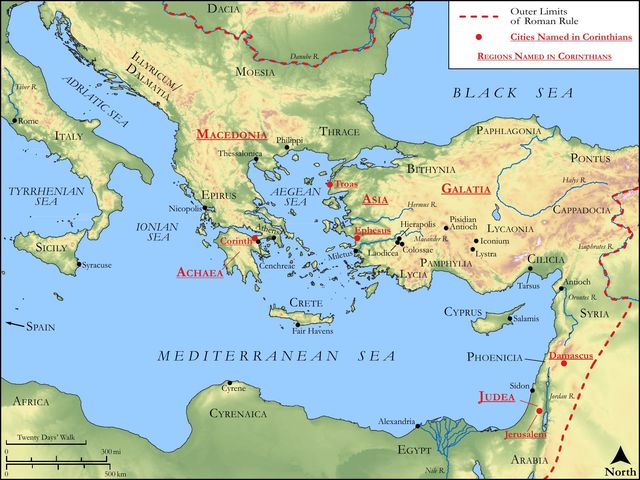
See on the biblical-era map

Study this verse
Public-domain commentary
Matthew Henry
From his Commentary on the Whole Bible. Henry comments on passages, not single verses — this entry covers 1 Corinthians 16:1–4. His three-level outline is real structure in the source text, so it is rendered as structure.
In this chapter Paul closes this long epistle with some particular matters of less moment; but, as all was written by divine inspiration, it is all profitable for our instruction. He begins with directing them about a charitable collection on a particular occasion, the distresses and poverty of Christians in Judea, which at this time were extraordinary, partly through the general calamities of that nation and partly through the particular sufferings to which they were exposed. Now concerning this observe,
I.How he introduces his direction.
It was not a peculiar service which he required of them; he had given similar orders to the churches of Galatia, Co1 16:1. He desired them only to conform to the same rules which he had given to other churches on a similar occasion. He did not desire that others should be eased and they burdened, Co2 8:13. He also prudently mentions these orders of his to the churches of Galatia, to excite emulation, and stir them up to be liberal, according to their circumstances, and the occasion. Those who exceeded most churches in spiritual gifts, and, as it is probable, in worldly wealth (see the argument), surely would not suffer themselves to come behind any in their bounty to their afflicted brethren. Note, The good examples of other Christians and churches should excite in us a holy emulation. It is becoming a Christian not to bear to be outdone by a fellow-christian in any thing virtuous and praise-worthy, provided this consideration only makes him exert himself, not envy others; and the more advantages we have above others the more should we endeavour to exceed them. The church of Corinth should not be outdone in this service of love by the churches of Galatia, which do not appear to have been enriched with equal spiritual gifts nor outward ability.
II.The direction itself, concerning which observe,
1.The manner in which the collection was to be made: Every one was to lay by in store (Co1 16:2), have a treasury, or fund, with himself, for this purpose. The meaning is that he should lay by as he could spare from time to time, and by this means make up a sum for this charitable purpose. Note, It is a good thing to lay up in store for good uses. Those who are rich in this world should be rich in good works, Ti1 6:17, Ti1 6:18. The best way to be so is to appropriate of their income, and have a treasury for this purpose, a stock for the poor as well as for themselves. By this means they will be ready to every good work as the opportunity offers; and many who labour with their own hands for a livelihood should so work that they may have to give to him that needeth, Eph 4:28. Indeed their treasury for good works can never be very large (though, according to circumstances, it may considerably vary); but the best way in the world for them to get a treasury for this purpose is to lay by from time to time, as they can afford. Some of the Greek fathers rightly observe here that this advice was given for the sake of the poorer among them. They were to lay by from week to week, and not bring in to the common treasury, that by this means their contributions might be easy to themselves, and yet grow into a fund for the relief of their brethren. "Every little," as the proverb says, "would make a mickle." Indeed all our charity and benevolence should be free and cheerful, and for that reason should be made as easy to ourselves as may be. And what more likely way to make us easy in this matter than thus to lay by? We may cheerfully give when we know that we can spare, and that we have been laying by in store that we may.
2.Here is the measure in which they are to lay by: As God hath prospered them; ti an euodōtai, as he has been prospered, namely, by divine Providence, as God has been pleased to bless and succeed his labours and business. Note, All our business and labour are that to us which God is pleased to make them. It is not the diligent hand that will make rich by itself, without the divine blessing, Pro 10:4, Pro 10:22. Our prosperity and success are from God and not from ourselves; and he is to be owned in all and honoured with all. It is his bounty and blessing to which we owe all we have; and whatever we have is to be used, and employed, and improved, for him. His right to ourselves and all that is ours is to be owned and yielded to him. And what argument more proper to excite us to charity to the people and children of God than to consider all we have as his gift, as coming from him? Note, When God blesses and prospers us, we should be ready to relieve and comfort his needy servants; when his bounty flows forth upon us, we should not confine it to ourselves, but let it stream out to others. The good we receive from him should stir us up to do good to others, to resemble him in our beneficence; and therefore the more good we receive from God the more we should do good to others. They were to lay by as God had blessed them, in that proportion. The more they had, through God's blessing, gained by their business or labour, their traffic or work, the more they were to lay by. Note, God expects that our beneficence to others should hold some proportion to his bounty to us. All we have is from God; the more he gives (circumstances being considered), the more he enables us to give, and the more he expects we should give, that we should give more than others who are less able, that we should give more than ourselves when we were less able. And, on the other hand, from him to whom God gives less he expects less. He is no tyrant nor cruel taskmaster, to exact brick without straw, or expect men shall do more good than he gives ability. Note, Where there is a willing mind he accepts according to what a man hath, and not according to what he hath not (Co2 8:12); but as he prospers and blesses us, and puts us in a capacity to do good, he expects we should. The greater ability he gives, the more enlarged should our hearts be, and the more open our hands; but, where the ability is less, the hands cannot be as open, however willing the mind and however large the heart; nor does God expect it.
3.Here is the time when this is to be done: The first day of the week, kata mian sabbatōn (Luk 24:1), the Lord's day, the Christian holiday, when public assemblies were held and public worship was celebrated, and the Christian institutions and mysteries (as the ancients called them) were attended upon; then let every one lay by him. It is a day of holy rest; and the more vacation the mind has from worldly cares and toils the more disposition has it to show mercy: and the other duties of the day should stir us up to the performance of this; works of charity should always accompany works of piety. True piety towards God will beget kind and friendly dispositions towards men. This commandment have we from him that he who loveth God love his brother also, Jo1 4:21. Works of mercy are the genuine fruits of true love to God, and therefore are a proper service on his own day. Note, God's day is a proper season on which to lay up for charitable uses, or lay out in them, according as he has prospered us; it is paying tribute for the blessings of the past week, and it is a proper way to procure his blessing on the work of our hands for the next.
4.We have here the disposal of the collections thus made: the apostle would have every thing ready against he came, and therefore gave direction as before: That there be no gatherings when I come, Co1 16:2. But, when he came, as to the disposal of it, he would leave it much to themselves. The charity was theirs, and it was fit they should dispose of it in their own way, so it answered its end, and was applied to the right use. Paul no more pretended to lord it over the purses of his hearers than over their faith; he would not meddle with their contributions without their consent.
(1.)He tells them that they should give letters of credence, and send messengers of their own with their liberality, Co1 16:3. This would be a proper testimony of their respect and brotherly love to their distressed brethren, to send their gift by members of their own body, trusty and tenderhearted, who would have compassion on their suffering brethren, and a Christian concern for them, and not defraud them. It would argue that they were very hearty in this service, when they should send some of their own body on so long and hazardous a journey or voyage, to convey their liberality. Note, We should not only charitably relieve our poor fellow-christians but do it in such a way as will best signify our compassion to them and care of them.
(2.)He offers to go with their messengers, if they think proper, Co1 16:4. His business, as an apostle, was not to serve tables, but to give himself to the word and prayer; yet he was never wanting to set on foot, or help forward, a work of charity, when an opportunity offered. He would go to Jerusalem, to carry the contributions of the church at Corinth to their suffering brethren, rather than they should go without them, or the charity of the Corinthians fail of a due effect. It was no hindrance to his preaching work, but a great furtherance to the success of it, to show such a tender and benign disposition of mind. Note, Ministers are doing their proper business when they are promoting or helping in works of charity. Paul stirs up the Corinthians to gather for the relief of the churches in Judea, and he is ready to go with their messengers, to convey what is gathered; and he is still in the way of his duty, in the business of his office.
Historical interpretation
Three Centuries of Reception
2 surviving comments on this verse. Each one is dated, so this reads as a timeline rather than a list.
Select a marker to jump to its quote. Markers stagger vertically where authors wrote within a few decades of each other.
These things therefore being manifest to us, and since we look into the depths of the divine knowledge, it behooves us to do all things in [their proper] order, which the Lord has commanded us to perform at stated times. He has enjoined offerings [to be presented] and service to be performed [to Him], and that not thoughtlessly or irregularly, but at the appointed times and hours. Where and by whom He desires these things to be done, He Himself has fixed by His own supreme will, in order that all things, being piously done according to His good pleasure, may be acceptable unto Him. Those, therefore, who present their offerings at the appointed times, are accepted and blessed; for inasmuch as they follow the laws of the Lord, they sin not. For his own peculiar services are assigned to the high priest, and their own proper place is prescribed to the priests, and their own special ministrations devolve on the Levites. The layman is bound by the laws that pertain to laymen.
Having completed his discourse concerning doctrines, and being about to enter upon that which belongs rather to morals, he dismisses every thing else and proceeds to the chief of good things, discoursing about alms. Nor does he discuss morals in general, but when he hath treated of this matter alone, he leaves off. A thing however obviously unlike what he did every where else; for of alms and of temperance and of meekness and of long-suffering and of all the rest, he treats in the other Epistles in the conclusion. For what reason then doth he handle here this part only of practical morality? Because the greater part also of what had been spoken before was of an ethical nature: I mean, where he chastised the fornicator; where he was correcting those who go to law among Gentiles; where he terrified the drunkards and the gluttons; where he condemned the seditious, the contentious, and those who loved to have the preeminence; where those who unworthily approach the Mysteries were delivered over by him unto that intolerable sentence; where he discoursed concerning love. For this cause, I say, the subject which most pressed on him, viz. the aid required for the saints, this alone he mentions.
And observe his consideration. When he had persuaded them concerning the resurrection, and made them more earnest, then and not till then he discusses this point also.
And he calls the collection logian (a "contribution,") immediately from the very first making out the things to be easy. For when contribution is made by all together, that becomes light which is charged upon each.
But having spoken about the collection, he did not say immediately, "Let every one of you lay up in store with himself;" although this of course was the natural consequence; but having first said, "As I gave order to the Churches of Galatia," he added this, kindling their emulation by the account of the well-doings of others, and putting it in the form of a narration. And this also he did when writing to the Romans; for to them also while appearing to narrate the reason why he was going away to Jerusalem, he introduces thereupon his discourse about alms; "But now I go unto Jerusalem, ministering unto the saints: for it hath been the good pleasure of Macedonia and Achaia to make a certain contribution for the poor among the saints." Only those he stimulates by mention of Macedonians and Corinthians; these of Galatians. For he saith, "As I gave order to the Churches of Galatia, so also do ye:" for they would surely feel ashamed ever afterwards to be found inferior to Galatians. And he saith not, "I advised," and, "I counselled;" but, "I gave order," which is more authoritative. And he doth not bring forward a single city, or two, or three, but an entire nation: which also he doth in his doctrinal instructions, saying, "Even as also in all the Churches of the saints." For if this be potent for conviction of doctrines, much more for imitation of actions.
Continue studying 1 Corinthians 16:1 across the web’s major study libraries — every link below opens this exact verse, chapter, or book on the destination site.
Read & Compare
 BibleGatewayThis verse in more than 200 translations and 70 languages.
 Bible.comThe YouVersion reader — hundreds of translations, reading plans, and highlights.
 ESV.orgCrossway's official English Standard Version reader.
 NET BibleThe NET translation with 60,000+ translators' notes on every rendering decision.
 STEP BibleTyndale House's free study tool — original text, vocabulary, and scholarly resources.
 BibliaLogos Bible Software's free web reader.
 USCCBThe New American Bible (Revised Edition) with the U.S. bishops' study notes.
Commentaries
 BibleHub CommentariesDozens of classic commentaries on this verse, gathered on one page.
 StudyLightMore than 100 commentary sets — the largest collection on the web.
 BibleRefPlain-English commentary on what this verse means, verse by verse.
 Enduring WordDavid Guzik's free commentary on this chapter, widely used by Bible teachers.
 Bible Study ToolsVerse commentary alongside Greek and Hebrew study aids.
Original Language & Research
- BibleHub InterlinearThe verse word by word — original language, transliteration, and English.
- BibleHub LexiconEvery word's original-language definition and Strong's entry.
 Blue Letter BibleDeep-study tools — Strong's numbers, concordance, and word studies.
 CNTR CollationThe earliest Greek manuscripts of this verse, collated letter by letter.
Sermons, Hymns & Audio


TrulyRandomVerse is not affiliated with these sites and doesn’t control their content. They’re linked because they’re genuinely useful.
Summary
Paul transitions from profound theological discourse on the resurrection to practical matters concerning financial support for fellow believers. This verse introduces the collection for the saints in Jerusalem, a significant organized effort to alleviate poverty among the Judean Christians. Paul instructs the Corinthian church to follow the same systematic approach to giving that he had already established in the churches of Galatia, emphasizing consistency and apostolic authority in matters of Christian generosity and mutual aid.
Context
ShowHideLiterary Context
1 Corinthians 16:1 marks a distinct shift in Paul's letter. Chapters 1-15 have addressed a wide array of theological and ethical issues within the Corinthian church, including divisions (1 Corinthians 1), immorality (1 Corinthians 5), lawsuits (1 Corinthians 6), marriage (1 Corinthians 7), food sacrificed to idols (1 Corinthians 8-10), spiritual gifts (1 Corinthians 12-14), and the foundational doctrine of the resurrection (1 Corinthians 15). Having laid a robust theological and ethical framework, Paul now moves to practical, administrative instructions regarding a specific financial collection, personal travel plans, and final greetings, signaling the conclusion of his epistle. This transition underscores that Christian faith is not merely intellectual assent but also involves tangible acts of love and support within the community.
Historical & Cultural Context
The collection mentioned here was a major undertaking initiated by Paul to gather financial aid from Gentile churches for the impoverished Jewish Christians in Jerusalem. This was not a unique or spontaneous offering but a well-organized, pan-church effort that Paul discusses in other epistles, notably Romans 15:25-27 and 2 Corinthians 8-9. Jerusalem had faced severe economic hardships, possibly due to famine (Acts 11:27-30), persecution, or the communal living practices of the early church. This collection served a dual purpose: to provide material relief and to foster unity between Jewish and Gentile believers, demonstrating the practical outworking of their shared faith in Christ. The instruction to the churches of Galatia indicates that this was a standardized practice Paul was implementing across various regions, reflecting his apostolic authority and the emerging organizational structure of the early church.
Key Themes
ShowHideThis verse introduces and contributes to several significant themes within 1 Corinthians and Paul's broader theology. Firstly, it highlights Christian Generosity and Stewardship, emphasizing that material resources are to be used for the good of the community, especially those in need. Secondly, it underscores Unity and Mutual Support within the Body of Christ, demonstrating a tangible expression of solidarity between geographically separated and culturally diverse congregations. The collection served as a powerful symbol of the unity of the church, bridging the divide between Jewish and Gentile believers. Thirdly, it reinforces Apostolic Authority and Order, as Paul's instruction ("as I have given order") indicates a clear, authoritative directive that should be followed consistently across different churches, establishing a pattern for practical Christian living and church administration. This echoes Paul's earlier calls for order and unity within the Corinthian church itself, now extended to inter-church relations.
Exposition and Analysis
ShowHideKey Word Analysis
ShowHideThis term refers to a "gathering" or "levy," specifically a "contribution." It implies a systematic, organized effort to collect funds rather than a spontaneous, one-time offering. The word suggests a pre-arranged, perhaps even regular, gathering of resources for a specific purpose, underscoring the planned nature of this charitable endeavor.
Derived from a root meaning "sacred" or "set apart," this term refers to those who are consecrated or dedicated to God. In Paul's usage, "saints" is a common designation for all believers in Christ, regardless of their moral perfection. It emphasizes their new status and identity as belonging to God, called out from the world for His purposes. Here, it specifically refers to the Christian community in Jerusalem who were in need.
This verb means "to arrange thoroughly," "institute," or "prescribe." It conveys the idea of a formal, authoritative directive or command. Paul is not merely suggesting or requesting; he is issuing a clear, definite instruction, indicating that this collection is an established practice he has already put into effect in other churches, specifically those in Galatia. This highlights the apostolic authority behind the instruction and the desire for consistent practice across the early Christian communities.
Verse Breakdown
ShowHide"Now concerning the collection for the saints,"
Paul introduces the new topic with "Now concerning," a common Pauline transition phrase (1 Corinthians 7:1). The "collection" (logía) is not a random act but an organized gathering of resources. The recipients are "the saints," specifically the impoverished believers in Jerusalem, demonstrating the early church's commitment to mutual support within the wider body of Christ.
"as I have given order to the churches of Galatia,"
This clause establishes a precedent and a standard. Paul is not asking the Corinthians to do something novel or unique; rather, he is instructing them to follow a pattern he has already implemented and commanded in other Gentile churches, specifically those in the Roman province of Galatia. This emphasizes the consistency of Paul's apostolic directives and the unity of practice across diverse regions.
"even so do ye."
This is a direct command, urging the Corinthian believers to emulate the practice of the Galatian churches. The phrase "even so" (hoútō) means "in this way" or "thus," reinforcing that the Corinthians are to adopt the exact method and systematic approach that Paul prescribed elsewhere. It underscores the practical, obedient response expected from the Corinthian church to Paul's authoritative instruction.
Literary Devices
ShowHideThe primary literary device at play in this verse is Apostolic Instruction, which is conveyed through Paul's direct and authoritative language. The phrase "as I have given order... even so do ye" functions as a Command or Directive, leaving no ambiguity about the expectation for the Corinthian church to follow established practices. There is also an element of Parallelism or Analogy in the comparison between the instructions given to Galatia and those now given to Corinth, which serves to legitimize and standardize the practice across different churches. This not only reinforces Paul's authority but also highlights the unity of the early Christian movement in its practical expressions of faith.
Theological and Thematic Connections
ShowHideThis verse underscores the profound theological truth that Christian faith is not merely individualistic but inherently communal, calling believers to tangible expressions of love and solidarity. The collection for the saints in Jerusalem exemplifies the early church's commitment to practical mutual aid, demonstrating that the spiritual unity forged by Christ transcends geographical and cultural boundaries. It reveals a robust theology of stewardship, where material blessings are to be shared for the common good, particularly to alleviate suffering among fellow believers. This act of giving also served as a powerful symbol of Gentile believers' gratitude to Jewish Christians, from whom they had received the spiritual blessings of the gospel, echoing the principle of reciprocal giving.
Reflection and Application
ShowHide1 Corinthians 16:1 serves as a timeless reminder that genuine faith is expressed through concrete acts of generosity and care for others, especially those within the family of God. Paul's instruction for an organized collection highlights that Christian giving is not merely an impulsive act but can be a thoughtful, systematic, and disciplined practice. It challenges us to consider how we, individually and corporately, are participating in the support of God's people and His work globally. The unity demonstrated by distant churches supporting one another should inspire us to look beyond our immediate communities and embrace a broader vision of the Body of Christ, recognizing our shared responsibility to alleviate suffering and advance the gospel. This verse encourages us to be proactive and intentional in our stewardship, reflecting the character of a God who generously provides for all His children.
Questions for Reflection
ShowHideFAQ
ShowHideWhy was this collection for the "saints" so important, and who were these "saints"?
ShowHideThe "saints" in this context primarily refer to the impoverished Jewish Christians in Jerusalem. This collection was profoundly important for several reasons. Materially, it provided much-needed financial relief to a community facing significant hardship, possibly due to famine, persecution, or the economic strain of early communal living. Theologically, it was a tangible expression of unity between Gentile and Jewish believers, demonstrating that the gospel had broken down the dividing wall (Ephesians 2:14). Paul saw it as a spiritual obligation for the Gentile churches to share their material blessings with those from whom they had received the spiritual blessings of the gospel (Romans 15:27). It was a practical outworking of Christian love and a powerful witness to the world of the church's unique fellowship.
Did Paul give specific instructions on how to collect the money?
ShowHideWhile 1 Corinthians 16:1 states that Paul "given order" to the churches of Galatia and expects the Corinthians to follow suit, the specific details of how to collect are elaborated further in 1 Corinthians 16:2 and more extensively in 2 Corinthians 8-9. In 1 Corinthians 16:2, he instructs them to set aside money "upon the first day of the week," suggesting a regular, systematic saving. In 2 Corinthians, he emphasizes principles like cheerful giving (2 Corinthians 9:7), proportionate giving, and the spiritual blessings that flow from generosity.
Christ-Centered Fulfillment
ShowHideWhile 1 Corinthians 16:1 deals with practical matters of church administration and financial generosity, it finds its ultimate fulfillment and deepest meaning in the person and work of Christ. The very concept of a "collection for the saints" embodies the self-sacrificial love and radical generosity that Christ exemplified. Jesus, "though he was rich, yet for your sakes he became poor, that ye through his poverty might be rich" (2 Corinthians 8:9). His entire life was a collection for the "saints"—those set apart by God—culminating in His ultimate offering on the cross, where He gave Himself entirely for the spiritual and eternal well-being of humanity. The unity fostered by this collection, bridging the divide between Jewish and Gentile believers, foreshadows the new humanity created in Christ, where "there is neither Jew nor Greek, there is neither bond nor free, there is neither male nor female: for ye are all one in Christ Jesus" (Galatians 3:28). Thus, Christian giving, as commanded by Paul, is not merely philanthropy but an act of worship that mirrors the divine generosity of our Savior, who came not to be served but to serve and to give His life as a ransom for many (Mark 10:45). Our acts of compassion and material support for one another are a direct reflection of the love of Christ poured out for us, demonstrating that "by this shall all men know that ye are my disciples, if ye have love one to another" (John 13:35).