


1 Corinthians 16:3
- ὅτανhotanWhenG3752CONJConjunction
- δὲdethenG1161CONJConjunction
- παραγένωμαιparagenōmaiI may have arrivedG3854V-2ADS-1SVerb 2nd Aorist Middle Deponent Subjunctive 1st Singular
- οὓςhouswhomeverG3739R-APMRelative pronoun Accusative Plural Masculine
- ἐὰνeanmaybeG1437CONDConjunction
- δοκιμάσητεdokimasēteyou shall approveG1381V-AAS-2PVerb Aorist Active Subjunctive 2nd Plural
- δι᾽di᾽withG1223PREPPreposition
- ἐπιστολῶνepistolōnlettersG1992N-GPFNoun Genitive Plural Feminine
- τούτουςtoutoustheseG3778D-APMDemonstrative pronoun Accusative Plural Masculine
- πέμψωpempsōI will sendG3992V-FAI-1SVerb Future Active Indicative 1st Singular
- ἀπενεγκεῖνapenegkeinto carryG667V-2AANVerb 2nd Aorist Active Infinitive
- τὴνtēntheG3588T-ASFDefinite article Accusative Singular Feminine
- χάρινcharinbountyG5485N-ASFNoun Accusative Singular Feminine
- ὑμῶνhumōnof youG4771P-2GPPersonal pronoun Genitive 2nd Plural
- εἰςeistoG1519PREPPreposition
- Ἰερουσαλήμ·IerousalēmJerusalemG2419N-ASF-LNoun Accusative Singular Feminine Location
English is a literal word-by-word gloss of the Greek, not the KJV's wording. Why?
This is the original text the KJV's translators worked from — each Greek word with its own literal English meaning in this verse, prepared by scholars at Tyndale House, Cambridge. The KJV translates whole sentences, not word by word, so its wording differs: one Greek word can become several English words, and the KJV may choose “charity” where the gloss reads “love”. Both are faithful — they answer different questions. For the KJV's own rendering, switch to the KJV text.
Details
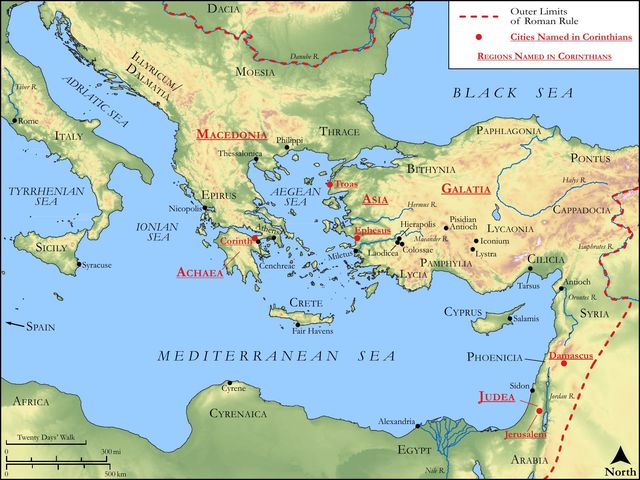
See on the biblical-era map

Study this verse
Public-domain commentary
Matthew Henry
From his Commentary on the Whole Bible. Henry comments on passages, not single verses — this entry covers 1 Corinthians 16:1–4. His three-level outline is real structure in the source text, so it is rendered as structure.
In this chapter Paul closes this long epistle with some particular matters of less moment; but, as all was written by divine inspiration, it is all profitable for our instruction. He begins with directing them about a charitable collection on a particular occasion, the distresses and poverty of Christians in Judea, which at this time were extraordinary, partly through the general calamities of that nation and partly through the particular sufferings to which they were exposed. Now concerning this observe,
I.How he introduces his direction.
It was not a peculiar service which he required of them; he had given similar orders to the churches of Galatia, Co1 16:1. He desired them only to conform to the same rules which he had given to other churches on a similar occasion. He did not desire that others should be eased and they burdened, Co2 8:13. He also prudently mentions these orders of his to the churches of Galatia, to excite emulation, and stir them up to be liberal, according to their circumstances, and the occasion. Those who exceeded most churches in spiritual gifts, and, as it is probable, in worldly wealth (see the argument), surely would not suffer themselves to come behind any in their bounty to their afflicted brethren. Note, The good examples of other Christians and churches should excite in us a holy emulation. It is becoming a Christian not to bear to be outdone by a fellow-christian in any thing virtuous and praise-worthy, provided this consideration only makes him exert himself, not envy others; and the more advantages we have above others the more should we endeavour to exceed them. The church of Corinth should not be outdone in this service of love by the churches of Galatia, which do not appear to have been enriched with equal spiritual gifts nor outward ability.
II.The direction itself, concerning which observe,
1.The manner in which the collection was to be made: Every one was to lay by in store (Co1 16:2), have a treasury, or fund, with himself, for this purpose. The meaning is that he should lay by as he could spare from time to time, and by this means make up a sum for this charitable purpose. Note, It is a good thing to lay up in store for good uses. Those who are rich in this world should be rich in good works, Ti1 6:17, Ti1 6:18. The best way to be so is to appropriate of their income, and have a treasury for this purpose, a stock for the poor as well as for themselves. By this means they will be ready to every good work as the opportunity offers; and many who labour with their own hands for a livelihood should so work that they may have to give to him that needeth, Eph 4:28. Indeed their treasury for good works can never be very large (though, according to circumstances, it may considerably vary); but the best way in the world for them to get a treasury for this purpose is to lay by from time to time, as they can afford. Some of the Greek fathers rightly observe here that this advice was given for the sake of the poorer among them. They were to lay by from week to week, and not bring in to the common treasury, that by this means their contributions might be easy to themselves, and yet grow into a fund for the relief of their brethren. "Every little," as the proverb says, "would make a mickle." Indeed all our charity and benevolence should be free and cheerful, and for that reason should be made as easy to ourselves as may be. And what more likely way to make us easy in this matter than thus to lay by? We may cheerfully give when we know that we can spare, and that we have been laying by in store that we may.
2.Here is the measure in which they are to lay by: As God hath prospered them; ti an euodōtai, as he has been prospered, namely, by divine Providence, as God has been pleased to bless and succeed his labours and business. Note, All our business and labour are that to us which God is pleased to make them. It is not the diligent hand that will make rich by itself, without the divine blessing, Pro 10:4, Pro 10:22. Our prosperity and success are from God and not from ourselves; and he is to be owned in all and honoured with all. It is his bounty and blessing to which we owe all we have; and whatever we have is to be used, and employed, and improved, for him. His right to ourselves and all that is ours is to be owned and yielded to him. And what argument more proper to excite us to charity to the people and children of God than to consider all we have as his gift, as coming from him? Note, When God blesses and prospers us, we should be ready to relieve and comfort his needy servants; when his bounty flows forth upon us, we should not confine it to ourselves, but let it stream out to others. The good we receive from him should stir us up to do good to others, to resemble him in our beneficence; and therefore the more good we receive from God the more we should do good to others. They were to lay by as God had blessed them, in that proportion. The more they had, through God's blessing, gained by their business or labour, their traffic or work, the more they were to lay by. Note, God expects that our beneficence to others should hold some proportion to his bounty to us. All we have is from God; the more he gives (circumstances being considered), the more he enables us to give, and the more he expects we should give, that we should give more than others who are less able, that we should give more than ourselves when we were less able. And, on the other hand, from him to whom God gives less he expects less. He is no tyrant nor cruel taskmaster, to exact brick without straw, or expect men shall do more good than he gives ability. Note, Where there is a willing mind he accepts according to what a man hath, and not according to what he hath not (Co2 8:12); but as he prospers and blesses us, and puts us in a capacity to do good, he expects we should. The greater ability he gives, the more enlarged should our hearts be, and the more open our hands; but, where the ability is less, the hands cannot be as open, however willing the mind and however large the heart; nor does God expect it.
3.Here is the time when this is to be done: The first day of the week, kata mian sabbatōn (Luk 24:1), the Lord's day, the Christian holiday, when public assemblies were held and public worship was celebrated, and the Christian institutions and mysteries (as the ancients called them) were attended upon; then let every one lay by him. It is a day of holy rest; and the more vacation the mind has from worldly cares and toils the more disposition has it to show mercy: and the other duties of the day should stir us up to the performance of this; works of charity should always accompany works of piety. True piety towards God will beget kind and friendly dispositions towards men. This commandment have we from him that he who loveth God love his brother also, Jo1 4:21. Works of mercy are the genuine fruits of true love to God, and therefore are a proper service on his own day. Note, God's day is a proper season on which to lay up for charitable uses, or lay out in them, according as he has prospered us; it is paying tribute for the blessings of the past week, and it is a proper way to procure his blessing on the work of our hands for the next.
4.We have here the disposal of the collections thus made: the apostle would have every thing ready against he came, and therefore gave direction as before: That there be no gatherings when I come, Co1 16:2. But, when he came, as to the disposal of it, he would leave it much to themselves. The charity was theirs, and it was fit they should dispose of it in their own way, so it answered its end, and was applied to the right use. Paul no more pretended to lord it over the purses of his hearers than over their faith; he would not meddle with their contributions without their consent.
(1.)He tells them that they should give letters of credence, and send messengers of their own with their liberality, Co1 16:3. This would be a proper testimony of their respect and brotherly love to their distressed brethren, to send their gift by members of their own body, trusty and tenderhearted, who would have compassion on their suffering brethren, and a Christian concern for them, and not defraud them. It would argue that they were very hearty in this service, when they should send some of their own body on so long and hazardous a journey or voyage, to convey their liberality. Note, We should not only charitably relieve our poor fellow-christians but do it in such a way as will best signify our compassion to them and care of them.
(2.)He offers to go with their messengers, if they think proper, Co1 16:4. His business, as an apostle, was not to serve tables, but to give himself to the word and prayer; yet he was never wanting to set on foot, or help forward, a work of charity, when an opportunity offered. He would go to Jerusalem, to carry the contributions of the church at Corinth to their suffering brethren, rather than they should go without them, or the charity of the Corinthians fail of a due effect. It was no hindrance to his preaching work, but a great furtherance to the success of it, to show such a tender and benign disposition of mind. Note, Ministers are doing their proper business when they are promoting or helping in works of charity. Paul stirs up the Corinthians to gather for the relief of the churches in Judea, and he is ready to go with their messengers, to convey what is gathered; and he is still in the way of his duty, in the business of his office.
Historical interpretation
Historical reception
2 surviving comments on this verse. Each one is dated, so this reads as a timeline rather than a list.
Select a marker to jump to its quote. Markers stagger vertically where authors wrote within a few decades of each other.
This collection was doubly beneficial, because it helped the saints mentioned above and also the poor people who were in the church.
"And when I arrive, whomsoever ye shall approve, them will I send with letters to carry your bounty to Jerusalem."
He said not, "this person," and "that," but, "whomsoever ye shall approve," whomsoever you shall choose, thus freeing his ministration from suspicion. Wherefore to them he leaves the right of voting in the choice of those who are to convey it. He is far enough from saying, "The payment is yours, but the privilege of selecting those who are to carry it is not yours." Next, that they might not think him quite absent, he adds his letters, saying, "Whomsoever you approve, I will send with letters." As if he had said, I also will be with them and share in the ministration, by my letters. And he said not, "These will I send to bear your alms," but, "your bounty;" to signify that they were doing great deeds; to mark that they were gainers themselves. And elsewhere he calls it both "a blessing" and "a distribution." The one that he might not make them less active, the other that he might not elate them. But in no case whatever hath he called it "alms."
Continue studying 1 Corinthians 16:3 across the web’s major study libraries — every link below opens this exact verse, chapter, or book on the destination site.
Read & Compare
 BibleGatewayThis verse in more than 200 translations and 70 languages.
 Bible.comThe YouVersion reader — hundreds of translations, reading plans, and highlights.
 ESV.orgCrossway's official English Standard Version reader.
 NET BibleThe NET translation with 60,000+ translators' notes on every rendering decision.
 STEP BibleTyndale House's free study tool — original text, vocabulary, and scholarly resources.
 BibliaLogos Bible Software's free web reader.
 USCCBThe New American Bible (Revised Edition) with the U.S. bishops' study notes.
Commentaries
 BibleHub CommentariesDozens of classic commentaries on this verse, gathered on one page.
 StudyLightMore than 100 commentary sets — the largest collection on the web.
 BibleRefPlain-English commentary on what this verse means, verse by verse.
 Enduring WordDavid Guzik's free commentary on this chapter, widely used by Bible teachers.
 Bible Study ToolsVerse commentary alongside Greek and Hebrew study aids.
Original Language & Research
- BibleHub InterlinearThe verse word by word — original language, transliteration, and English.
- BibleHub LexiconEvery word's original-language definition and Strong's entry.
 Blue Letter BibleDeep-study tools — Strong's numbers, concordance, and word studies.
 CNTR CollationThe earliest Greek manuscripts of this verse, collated letter by letter.
Sermons, Hymns & Audio


TrulyRandomVerse is not affiliated with these sites and doesn’t control their content. They’re linked because they’re genuinely useful.
Summary
In 1 Corinthians 16:3, Paul outlines the practical arrangements for transporting the collection gathered from the Corinthian church for the needy saints in Jerusalem. He instructs that upon his arrival, the Corinthians are to select and formally endorse messengers through written letters, whom Paul will then dispatch to deliver their generous financial contribution, ensuring transparency, accountability, and integrity in this significant act of inter-church solidarity.
Context
ShowHideLiterary Context
This verse is situated within the concluding practical instructions of Paul's First Letter to the Corinthians. Following his comprehensive theological and ethical teachings, Paul shifts to specific directives concerning the collection for Jerusalem, which he first introduces in 1 Corinthians 16:1-2. Here, he moves from the "how" (systematic saving) to the "who" and "what" of the transport, demonstrating his meticulous planning for the practical outworking of Christian charity. This passage precedes his discussion of travel plans and final greetings, underscoring the importance of this collection as a tangible expression of unity and love within the broader body of Christ.
Historical & Cultural Context
The collection for Jerusalem was a significant undertaking for Paul, mentioned across several of his epistles (e.g., Romans 15:25-27, 2 Corinthians 8-9). Jerusalem, the birthplace of the church, faced economic hardship, possibly due to famine or persecution, leading to poverty among its Christian community. In the ancient world, transporting large sums of money was fraught with risk, both from robbers and from accusations of embezzlement. Paul's insistence on the Corinthians' approval "by your letters" (a formal, written endorsement) was a crucial measure to ensure complete transparency and prevent any suspicion or slander against himself or the church regarding the handling of these funds, thereby safeguarding the integrity of the ministry.
Key Themes
ShowHideThis verse contributes to several key themes prevalent in Paul's letters and the broader New Testament. Firstly, it highlights Accountable Stewardship, emphasizing the necessity of integrity and transparency in managing communal resources, particularly financial gifts. Paul's method ensures that the church itself has oversight and approves the process. Secondly, it underscores Communal Participation and Autonomy, as the responsibility for selecting and endorsing the messengers rests squarely with the Corinthian congregation, fostering a sense of shared ownership and responsibility in the broader mission. Thirdly, it exemplifies Practical Ministry and Inter-Church Solidarity, demonstrating that Christian love extends beyond spiritual encouragement to tangible acts of material support, bridging geographical and cultural divides within the early church, as also seen in Paul's exhortations in 2 Corinthians 8:1-5.
Exposition and Analysis
ShowHideKey Word Analysis
ShowHideMeaning "to test (literally or figuratively); by implication, to approve." Paul's use of this word indicates that the Corinthians were not to randomly select individuals but were to carefully examine and discern the trustworthiness and suitability of the messengers. This implies a process of vetting to ensure the integrity of those entrusted with such a significant financial responsibility, reflecting a commitment to due diligence in ministry.
Meaning "a written message; 'epistle,' letter." The requirement of "letters" signifies a formal, verifiable, and official endorsement from the Corinthian church. These letters would serve as credentials for the messengers, confirming their identity and the legitimacy of their mission to deliver the collection. This written documentation was a critical safeguard against fraud and ensured accountability to both the sending and receiving parties.
Meaning "graciousness (as gratifying), of manner or act (abstract or concrete; literal, figurative or spiritual; especially the divine influence upon the heart, and its reflection in the life; including gratitude):--acceptable, benefit, favour, gift, grace(-ious), joy, liberality, pleasure, thank(-s, -worthy)." The KJV translation "liberality" captures one facet of cháris, but the underlying Greek word emphasizes that this collection was not a tax or obligation, but a "grace" or "gift" – a voluntary, joyful, and Spirit-inspired act of generosity. This highlights the theological nature of their giving, stemming from God's grace and reflecting His character.
Verse Breakdown
ShowHide"And when I come"
This phrase sets the timing for the practical arrangements, indicating that the selection and sending of messengers would occur upon Paul's personal arrival in Corinth. This suggests Paul's desire for direct oversight and participation in the final stages of the collection's preparation, ensuring everything was handled properly and transparently.
"whomsoever ye shall approve by your letters"
This clause places the crucial responsibility of selecting and formally endorsing the messengers squarely on the Corinthian church. The "approval" (dokimázō) implies careful discernment and testing of character, while "by your letters" (epistolē) signifies a written, official, and public validation of their chosen representatives, ensuring accountability and preventing any suspicion of mishandling funds.
"them will I send to bring your liberality"
Paul states his intention to dispatch these church-approved individuals. The term "liberality" (cháris) emphasizes that the collection was a generous, voluntary gift, an act of grace from the Corinthians, rather than a compulsory levy. Paul's role is to facilitate the safe and proper delivery of this gracious offering.
"unto Jerusalem"
This specifies the destination of the collection, identifying the recipients as the impoverished saints in the mother church in Jerusalem. This act of material support underscored the unity and mutual care between the predominantly Gentile church in Corinth and the Jewish Christian community in Jerusalem, demonstrating the practical outworking of the gospel's power to create a unified body.
Literary Devices
ShowHidePaul employs Pragmatism in this verse, providing highly practical and logistical instructions for a significant church undertaking. His detailed plan for the collection's transport, including the specific role of the Corinthian church in approving messengers, demonstrates his concern for order and efficiency in ministry. There is also an element of Emphasis on transparency and accountability, as seen in the repeated stress on the Corinthians' approval and the use of "letters." This meticulous approach is a rhetorical strategy to preempt any potential accusations of financial impropriety, thereby protecting the integrity of the gospel ministry. The term "liberality" (cháris) also functions as a form of Euphemism or Metonymy, where a positive quality (grace/generosity) stands for the tangible gift itself, elevating the act of giving beyond mere financial transaction to a spiritual expression of love and divine influence.
Theological and Thematic Connections
ShowHideThis verse, while seemingly mundane in its practical instructions, is deeply rooted in profound theological principles. It exemplifies the New Testament's emphasis on integrity in ministry, particularly concerning financial matters, reflecting a divine standard for handling God's resources and the generosity of His people. The collection itself symbolizes the unity of the body of Christ, demonstrating that believers, regardless of their geographical location or ethnic background, are interconnected and called to bear one another's burdens. This act of giving is presented not as a duty but as an expression of grace (cháris), flowing from the overflow of God's own generosity towards His people. Paul consistently links such practical acts of charity to the very nature of the gospel, where love is expressed tangibly, fostering fellowship and glorifying God.
Reflection and Application
ShowHidePaul's meticulous instructions in 1 Corinthians 16:3 offer timeless principles for Christian communities today regarding financial stewardship and inter-church relations. The emphasis on the local church's role in approving messengers by "letters" underscores the paramount importance of transparency, accountability, and integrity in handling communal funds. This model calls contemporary churches to establish clear, verifiable processes for managing finances, selecting trustworthy individuals for financial roles, and ensuring congregational oversight to prevent suspicion and maintain the credibility of the ministry. Furthermore, this verse reminds us that Christian charity is not merely a local endeavor but extends to the wider body of Christ, calling believers to support those in need beyond their immediate community, fostering global unity and demonstrating the tangible love of Christ across geographical and cultural divides. It challenges us to consider how our giving reflects not just our resources, but our heart of grace and our commitment to the well-being of the whole church.
Questions for Reflection
ShowHideFAQ
ShowHideWhy was Paul so concerned about the Corinthians approving the messengers by letters?
ShowHidePaul's concern stemmed from a deep commitment to integrity and transparency in ministry. In the ancient world, transporting large sums of money was risky, not only due to potential theft but also due to the ever-present danger of accusations of embezzlement or misuse of funds. By having the Corinthian church formally "approve" (dokimázō – to test and discern) the messengers through official "letters" (epistolḗ – written credentials), Paul ensured that the process was entirely above board. This protected his own reputation, the reputation of the Corinthian church, and the integrity of the gospel message itself, preventing any cause for slander or suspicion regarding the handling of the generous collection. This meticulous approach is also evident in 2 Corinthians 8:20-21, where Paul explicitly states his desire to "avoid any criticism of our handling of this generous gift."
What does "liberality" mean in this context, and why is it significant?
ShowHideThe KJV term "liberality" translates the Greek word cháris (G5485), which is more commonly translated as "grace." In this context, it signifies that the collection was not a compulsory tax or a grudging obligation, but a voluntary, joyful, and generous "gift" or "favor" given out of a spirit of grace. This is highly significant because it elevates the act of giving from a mere financial transaction to a spiritual expression of God's divine influence upon the hearts of believers, reflecting His own gracious character. Paul consistently frames Christian giving as an overflow of grace, as seen extensively in 2 Corinthians chapters 8 and 9, where he encourages the Corinthians to excel in "this grace of giving." It underscores that true Christian generosity flows from a heart transformed by God's grace.
Christ-Centered Fulfillment
ShowHideThe practical arrangements for the collection in 1 Corinthians 16:3, though seemingly mundane, find their ultimate fulfillment and deepest meaning in Christ. The entire act of giving for the needy saints in Jerusalem, facilitated by approved messengers and formal letters, mirrors the self-giving nature of Jesus Christ. He is the ultimate "messenger" approved by the Father, sent to bring the greatest "liberality"—the grace of salvation—to a world in need. Just as the Corinthians were to give generously, Christ, "though he was rich, yet for your sakes he became poor, so that you through his poverty might become rich" (2 Corinthians 8:9). The unity fostered by this collection between Gentile and Jewish believers foreshadows the new humanity created in Christ, where dividing walls are broken down (Ephesians 2:14). Furthermore, the emphasis on transparency and integrity in handling funds reflects Christ's own spotless character and the purity of His mission, calling His followers to conduct all ministry with blamelessness, thereby glorifying the One who gave Himself fully for us (Philippians 2:5-8). Thus, every act of Christian generosity and integrity in ministry is a reflection of the saving grace and sacrificial love embodied in Jesus Christ, the ultimate gift of God to humanity.