


1 Timothy 6:18
Bible text: King James Version (1769 Blayney text) · Public domain
Bible text: King James Version with Strong's numbers · Public domain
Bible text: Berean Standard Bible · Public domain
Bible text: American Standard Version (1901) · Public domain
Bible text: World English Bible, Messianic edition · Public domain
Bible text: Geneva Bible (1599) · Public domain
Bible text: Young's Literal Translation · Public domain
- ἀγαθοεργεῖνagathoergeinto do goodG14V-PANVerb Present Active Infinitive
- πλουτεῖνplouteinto be richG4147V-PANVerb Present Active Infinitive
- ἐνeninG1722PREPPreposition
- ἔργοιςergoisworksG2041N-DPNNoun Dative Plural Neuter
- καλοῖςkaloisgoodG2570A-DPNAdjective Dative Plural Neuter
- εὐμεταδότουςeumetadotousgenerous in distributingG2130A-APMAdjective Accusative Plural Masculine
- εἶναιeinaito beG1511V-PANVerb Present Active Infinitive
- κοινωνικούςkoinōnikousready to shareG2843A-APMAdjective Accusative Plural Masculine
English is a literal word-by-word gloss of the Greek, not the KJV's wording. Why?
This is the original text the KJV's translators worked from — each Greek word with its own literal English meaning in this verse, prepared by scholars at Tyndale House, Cambridge. The KJV translates whole sentences, not word by word, so its wording differs: one Greek word can become several English words, and the KJV may choose “charity” where the gloss reads “love”. Both are faithful — they answer different questions. For the KJV's own rendering, switch to the KJV text.
Details
See on the biblical-era maps

Study this verse
Public-domain commentary
Matthew Henry
From his Commentary on the Whole Bible. Henry comments on passages, not single verses — this entry covers 1 Timothy 6:13–21. His three-level outline is real structure in the source text, so it is rendered as structure.
The apostle here charges Timothy to keep this commandment (that is, the whole work of his ministry, all the trust reposed in him, all the service expected from him) without spot, unrebukable; he must conduct himself so in his ministry that he might not lay himself open to any blame nor incur any blemish. What are the motives to move him to this?
I.He gives him a solemn charge:
I give thee charge in the sight of God that thou do this. He charges him as he will answer it at the great day to that God whose eyes are upon us all, who sees what we are and what we do: - God, who quickens all things, who has life in himself and is the fountain of life. This should quicken us to the service of God that we serve a God who quickens all things. He charges him before Christ Jesus, to whom in a peculiar manner he stood related as a minister of his gospel: Who before Pontius Pilate witnessed a good confession. Observe, Christ died not only as a sacrifice, but as a martyr; and he witnessed a good confession when he was arraigned before Pilate, saying (Joh 18:36, Joh 18:37), My kingdom is not of this world: I am come to bear witness unto the truth. That good confession of his before Pilate, My kingdom is not of this world, should be effectual to draw off all his followers, both ministers and people, from the love of this world.
II.He reminds him of the confession that he himself had made:
Thou hast professed a good profession before many witnesses (Ti1 6:12), namely, when he was ordained by the laying on of the hands of the presbytery. The obligation of that was still upon him, and he must live up to that, and be quickened by that, to do the work of his ministry.
III.He reminds him of Christ's second coming:
"Keep this commandment - until the appearing of our Lord Jesus Christ; keep it as long as thou live, till Christ come at death to give thee a discharge. Keep it with an eye to his second coming, when we must all give an account of the talents we have been entrusted with," Luk 16:2. Observe, The Lord Jesus Christ will appear, and it will be a glorious appearing, not like his first appearing in the days of his humiliation. Ministers should have an eye to this appearing of the Lord Jesus Christ in all their ministrations, and, till his appearing, they are to keep this commandment without spot, unrebukable. Mentioning the appearing of Christ, as one that loved it, Paul loves to speak of it, and loves to speak of him who shall then appear. The appearing of Christ is certain (he shall show it), but it is not for us to know the time and season of it, which the Father has kept in his own power: let this suffice us, that in time he will show it, in the time that he thinks fit for it. Observe,
1.Concerning Christ and God the Father the apostle here speaks great things.
(1.)That God is the only Potentate; the powers of earthly princes are all derived from him, and depend upon him. The powers that exist are ordained of God, Rom 13:1. He is the only Potentate that is absolute and sovereign, and perfectly independent.
(2.)He is the blessed and the only Potentate, infinitely happy, and nothing can in the least impair his happiness.
(3.)He is King of kings, and Lord of lords. All the kings of the earth derive their power from him; he gave them their crowns, they hold them under him, and he has a sovereign dominion over them. This is Christ's title (Rev 19:16), upon his vesture and his thigh; for he has a name higher than the kings of the earth.
(4.)He only has immortality. He only is immortal in himself, and has immortality as he is the fountain of it, for the immortality of angels and spirits derived from him.
(5.)He dwells in inaccessible light, light which no man can approach unto: no man can get to heaven but those whom he is pleased to bring thither, and admit into his kingdom.
(6.)He is invisible: Whom no man hath seen, nor can see. It is impossible that mortal eyes should bear the brightness of the divine glory. No man can see God and live.
2.Having mentioned these glorious attributes, he concludes with a doxology: To him be honour and power everlasting. Amen. God having all power and honour to himself, it is our duty to ascribe all power and honour to him.
(1.)What an evil is sin, when committed against such a God, the blessed and only Potentate! The evil of it rises in proportion to the dignity of him against whom it is committed.
(2.)Great is his condescension, to take notice of such mean and vile creatures as we are. What are we then, that the blessed God, the King of kings and Lord of lords, should seek after us?
(3.)Blessed are those who are admitted to dwell with this great and blessed Potentate. Happy are thy men (says the queen of Sheba to king Solomon), happy are these thy servants, who stand continually before thee, Kg1 10:8. Much more happy are those who are allowed to stand before the King of kings.
(4.)Let us love, adore, and praise, the great God; for who shall not fear thee, O Lord, and glorify thy name? For thou only art holy, Rev 15:4.
IV.The apostle adds, by way of postscript, a lesson for rich people, Ti1 6:17-19.
1.Timothy must charge those that are rich to beware of the temptations, and improve the opportunities, of their prosperous estate.
(1.)He must caution them to take heed of pride. This is a sin that easily besets rich people, upon whom the world smiles. Charge them that they be not high-minded, or think of themselves above what is meet, or be puffed up with their wealth.
(2.)He must caution them against vain confidence in their wealth. Charge them that they trust not in uncertain riches. Nothing is more uncertain than the wealth of this world; many have had much of it one day and been stripped of all the next. Riches make themselves wings, and fly away as an eagle, etc., Pro 23:5.
(3.)He must charge them to trust in God, the living God, to make him their hope, who giveth us richly all things to enjoy. Those who are rich must see God giving them their riches, and giving them to enjoy them richly; for many have riches, but enjoy them poorly, not having a heart to use them.
(4.)He must charge them to do good with what they have (for what is the best estate worth, any more than as it gives a man an opportunity of doing so much the more good?): That they be rich in good works. Those are truly rich who are rich in good works. That they be ready to distribute, willing to communicate: not only to do it, but to do it willingly, for God loves a cheerful giver.
(5.)He must charge them to think of another world, and prepare for that which is to come by works of charity: Laying up in store a good foundation against the time to come, that they may take hold on eternal life.
2.Hence we may observe,
(1.)Ministers must not be afraid of the rich; be they ever so rich, they must speak to them, and charge them.
(2.)They must caution them against pride, and vain confidence in their riches: That they be not high-minded, nor trust in uncertain riches. Stir them up to works of piety and charity: That they do good, etc.
(3.)This is the way for the rich to lay up in store for themselves for the time to come, that they may lay hold on eternal life; in the way of well-doing we are to seek for glory, honour, and immortality, and eternal life will be the end of all, Rom 2:7.
(4.)Here is a lesson for ministers in the charge given to Timothy: Keep that which is committed to thy trust. Every minister is a trustee, and it is a treasure committed to his trust, which he has to keep. The truths of God, the ordinances of God, keep these, avoiding profane and vain babblings; not affecting human eloquence, which the apostle calls vain babbling, or human learning, which often opposes the truths of God, but keep close to the written word, for that is committed to our trust. Some who have been very proud of their learning, their science, which is falsely so called, have by that been debauched in their principles and been drawn away from the faith of Christ, which is a good reason why we should keep to the plain word of the gospel, and resolve to live and die by that. Observe, [1.] Ministers cannot be too earnestly exhorted to keep what is committed to their trust, because it is a great trust lodged with them: O Timothy, keep that which is committed to thy trust! as if he had said, "I cannot conclude without charging thee again; whatever thou doest, be sure to keep this trust, for it is too great a trust to be betrayed." [2.] Ministers are to avoid babblings, if they would keep what is committed to them, because they are vain and profane. [3.] That science that opposes the truth of the gospel is falsely so called; it is not true science, for if it were it would approve of the gospel and consent to it. [4.] Those who are so fond of such science are in great danger of erring concerning the faith; those who are for advancing reason above faith are in danger of leaving faith.
V.Our apostle concludes with a solemn prayer and benediction:
Grace be with thee. Amen. Observe, this is a short, yet comprehensive prayer for our friends, for grace comprehends in it all that is good, and grace is an earnest, yea, a beginning, of glory; for, wherever God gives grace, he will give glory, and will not withhold any good thing from him who walketh uprightly. Grace be with you all. Amen.
Historical interpretation
Six Centuries of Reception
5 surviving comments on this verse. Each one is dated, so this reads as a timeline rather than a list.
Select a marker to jump to its quote. Markers stagger vertically where authors wrote within a few decades of each other.
"That they do good," he says, "that they be rich in good works, ready to distribute willing to communicate."
The first phrase refers to wealth, the second to charity. For to be willing to communicate, implies that they are sociable and kind.
Those who have given liberally of their riches have had great gains to compensate them for light losses. Their joy at what they assured for themselves more securely by readiness to give outweighed their sadness at the surrender of possessions they more easily lost because they clung to them fearfully. Reluctance to remove their goods from this world exposed them to the risk of loss. There were those who accepted the Lord’s advice: “Do not store your treasures on earth, where moth and rust destroy, and where thieves break in and steal. Pile up treasure in heaven, where no thief comes near and no moth destroys. For where your treasure is, there your heart will be also.” Such people proved in the time of tribulation how wise they were in not despising the finest of advisers and the most faithful and unconquerable guardian of treasure.
Let those who want Christ to spare them have compassion for the poor. Let those who desire a bond with the fellowship of the blessed be “readily disposed” toward nourishing the wretched. No human being should be considered worthless by another. The nature which the Creator of the universe made his own should not be looked down upon in anyone.
Whenever we talk about contempt for riches, some rich man replies to me: I have learned not to hope in the uncertainty of riches; I do not want to be rich, lest I fall into temptation; but since I am rich already, what am I to do with the possessions which I now happen to have? The apostle continues, “Let them give readily, sharing with others.” What does it mean to share with others? To share your possessions with the man who does not have any. Therefore, if you begin to share with others, you will not be that plunderer and robber who broods over the wants of the poor as over the property of another.
to do good, to be rich in good works, to be generous and ready to share, storing up for themselves a good foundation for the future, so that they may obtain eternal life.
to do good, to be rich in good works. If you seek wealth, seek true wealth, not uncertain. What are these? Goods, Paul says, are easy to distribute; for this is the nature of money.
to be generous. That is, gentle, friendly, modest, and humble.
storing up for themselves. That is, laying down, Paul says, a good foundation. Where the foundation is good, all is safe and secure.
so that they may obtain eternal life. Therefore, for this life, one must lay up the foundation. But how could this be? If by doing good here, we lay up for ourselves the foundation and security of this life. For the practice of good works, which Paul also called a foundation, is able to grant the enjoyment of that life.
Continue studying 1 Timothy 6:18 across the web’s major study libraries — every link below opens this exact verse, chapter, or book on the destination site.
Read & Compare
 BibleGatewayThis verse in more than 200 translations and 70 languages.
 Bible.comThe YouVersion reader — hundreds of translations, reading plans, and highlights.
 ESV.orgCrossway's official English Standard Version reader.
 NET BibleThe NET translation with 60,000+ translators' notes on every rendering decision.
 STEP BibleTyndale House's free study tool — original text, vocabulary, and scholarly resources.
 BibliaLogos Bible Software's free web reader.
 USCCBThe New American Bible (Revised Edition) with the U.S. bishops' study notes.
Commentaries
 BibleHub CommentariesDozens of classic commentaries on this verse, gathered on one page.
 StudyLightMore than 100 commentary sets — the largest collection on the web.
 BibleRefPlain-English commentary on what this verse means, verse by verse.
 Enduring WordDavid Guzik's free commentary on this chapter, widely used by Bible teachers.
 Bible Study ToolsVerse commentary alongside Greek and Hebrew study aids.
Original Language & Research
- BibleHub InterlinearThe verse word by word — original language, transliteration, and English.
- BibleHub LexiconEvery word's original-language definition and Strong's entry.
 Blue Letter BibleDeep-study tools — Strong's numbers, concordance, and word studies.
 CNTR CollationThe earliest Greek manuscripts of this verse, collated letter by letter.
Sermons, Hymns & Audio


TrulyRandomVerse is not affiliated with these sites and doesn’t control their content. They’re linked because they’re genuinely useful.
Summary
First Timothy 6:18 serves as a direct and positive command from Paul to those who are wealthy within the Ephesian church, urging them to actively counter the dangers of materialism by embracing a life of radical generosity and practical benevolence. It calls believers not merely to avoid the pitfalls of riches, but to leverage their resources as instruments for God's glory and the tangible benefit of others, demonstrating their faith through deeds of love, sharing, and active participation in the needs of the community.
Context
ShowHideLiterary Context
This verse is strategically placed within Paul's comprehensive instructions to Timothy regarding the proper conduct and teaching within the church at Ephesus. It immediately follows Paul's severe warnings against the love of money, which he identifies as a root of all kinds of evil, leading to apostasy and sorrow (1 Timothy 6:9-10). Paul then directly addresses those who are rich, exhorting them not to be arrogant or to place their hope in the uncertainty of wealth, but rather in God, who richly provides all things for our enjoyment (1 Timothy 6:17). Verse 18, therefore, provides the positive counterpoint and practical application to these warnings and exhortations, outlining the righteous use of material abundance as a means of worship and service.
Historical & Cultural Context
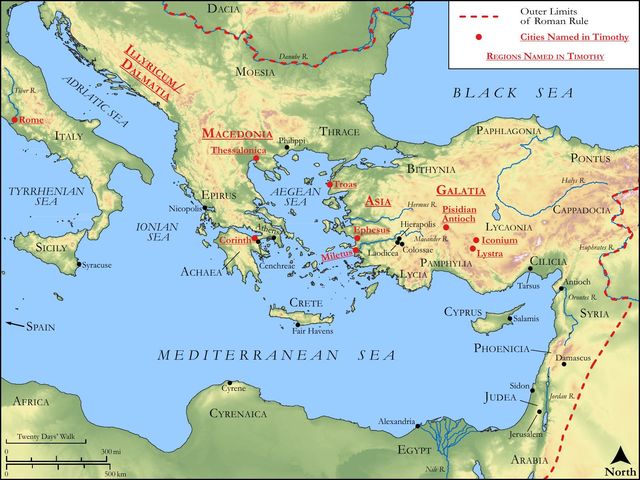
Ephesus was a major metropolitan center in the Roman province of Asia, renowned for its wealth, commerce, and the magnificent Temple of Artemis. Within such a bustling and affluent society, significant disparities in wealth were common. The early Christian community in Ephesus, like many urban churches, would have comprised individuals from various social strata, including both the poor and the materially prosperous. The Greeks and Romans often practiced patronage, where the wealthy would support clients in exchange for social status or political influence. However, Paul's instruction here transcends this secular model, calling for a distinctively Christian generosity rooted in divine love and stewardship, not in seeking human acclaim or reciprocal benefit. This teaching challenged the prevailing cultural norms by redirecting the purpose of wealth from self-aggrandizement to God-centered benevolence and communal solidarity.
Key Themes
ShowHideFirst Timothy 6:18 powerfully reinforces several major theological and narrative themes present throughout Paul's letters and the broader biblical narrative. Central among these is the theme of Stewardship, emphasizing that all possessions are ultimately God's, and believers are entrusted with them to manage for His purposes. This verse specifically applies stewardship to material wealth, calling for its active deployment in "good works." It also highlights Generosity as a core Christian virtue, moving beyond mere avoidance of greed to proactive, open-handed giving. This aligns with the teaching to lay up treasures in heaven rather than on earth. Furthermore, the verse underscores the importance of Good Works as an Expression of Faith, demonstrating that true faith is not passive but is evidenced by tangible acts of love and service. Believers are, in fact, created in Christ Jesus for good works, which God prepared beforehand. Finally, it promotes Communal Solidarity and Fellowship through sharing, resisting the isolating tendencies of wealth and fostering genuine Christian community where needs are met.
Exposition and Analysis
ShowHideKey Word Analysis
ShowHideThis verb (G14) is a compound of agathos (good) and ergon (work), literally meaning "to work good" or "to do good deeds." It signifies active, intentional benevolence, not merely avoiding evil but proactively engaging in acts that benefit others and align with God's will. It implies a practical, outward expression of one's faith.
Derived from ploutos (wealth), this verb (G4147) means "to be or become wealthy," whether literally in material possessions or figuratively. In this context, it refers to those who possess abundant material resources. Paul's command is for them to redirect their "richness" from mere accumulation to an abundance of righteous deeds.
This adjective (G2843) is derived from koinōnia, a rich theological term meaning "fellowship," "partnership," or "sharing." To be koinōnikós means to be communicative, liberal, or ready to share, particularly in a pecuniary sense. It implies a disposition to share one's possessions in a way that fosters genuine fellowship and partnership, participating in the lives and needs of others.
Verse Breakdown
ShowHide"That they do good"
This phrase sets the primary directive for the wealthy. It's an active command, urging them to engage in practical, beneficial actions. It's not enough to simply possess wealth; it must be channeled into doing what is morally and spiritually right, contributing positively to the world and the church.
"that they be rich in good works"
This expands on the previous clause, specifying the nature of the "good" they are to do. It's a call to an abundance of righteous deeds. The "riches" of their material possessions are to be paralleled, and perhaps even eclipsed, by their "riches" in virtuous actions. This suggests a life overflowing with acts of charity, service, and justice, demonstrating that their true wealth lies in their character and contributions, not just their bank accounts.
"ready to distribute"
This emphasizes a proactive and eager disposition towards sharing their material resources. The Greek term eumetádotos (G2130) implies being "easy to impart" or "liberal in giving." It's about a cheerful, ungrudging willingness to share what they have, not waiting to be asked or giving reluctantly, but seeking opportunities to give freely and generously.
"willing to communicate"
This final phrase deepens the meaning of sharing. As discussed in the key word analysis, koinōnikós (G2843) points to a sharing that fosters fellowship and partnership. It's not just a transactional act of giving, but a relational one—sharing one's resources in a way that builds community, expresses solidarity, and participates in the lives of others, especially those in need. It's about mutual participation and support within the body of Christ.
Literary Devices
ShowHidePaul employs several literary devices to convey his urgent message. The verse functions as an imperative, a direct command, underscoring the non-negotiable nature of this instruction for the wealthy. The phrase "rich in good works" utilizes metaphor, contrasting the uncertainty and often corrupting influence of material wealth with the enduring and spiritually enriching nature of virtuous deeds. This creates a powerful image of a different kind of "riches" that believers should aspire to accumulate. Furthermore, the pairing of "ready to distribute" and "willing to communicate" exhibits parallelism, where two phrases express similar ideas using different but complementary words, reinforcing the multifaceted nature of Christian generosity—both in the act of giving and in the spirit of communal sharing.
Theological and Thematic Connections
ShowHideThis verse profoundly connects to the broader biblical theology of stewardship, generosity, and the practical outworking of faith. It challenges the common human tendency to hoard or find security in material possessions, redirecting the believer's focus to God as the ultimate provider and the eternal value of investing in His kingdom through acts of love and service. True wealth, from a divine perspective, is measured not by what one accumulates, but by what one generously gives and how one contributes to the well-being of others and the advancement of God's purposes. This active benevolence demonstrates a transformed heart, where the love of God has replaced the love of money, and where faith is made visible through tangible deeds of compassion and justice.
Reflection and Application
ShowHideFirst Timothy 6:18 provides timeless and challenging guidance for every believer, regardless of their financial standing, though it specifically addresses those with material abundance. It compels us to examine our hearts regarding our possessions and priorities. We are called to cultivate a generous disposition, recognizing that everything we have is a gift from God, to be stewarded for His glory and the good of others. This means actively seeking opportunities to "do good" and to be "rich in good works," moving beyond passive goodwill to intentional acts of kindness, service, and financial support for those in need and for the advancement of the Gospel. For those with significant financial means, this verse serves as a powerful reminder that wealth is a tool for ministry and blessing, not merely for personal comfort or status. It is a profound responsibility to be managed wisely for eternal impact. Ultimately, embracing the spirit of this verse leads to a life of open-handed living, fostering genuine Christian community and reflecting the very nature of God, who is the ultimate giver.
Questions for Reflection
ShowHideFAQ
ShowHideWhat does "communicate" mean in this verse, and how is it different from "distribute"?
ShowHideIn 1 Timothy 6:18, "communicate" (Greek: koinōnikós) does not refer to verbal communication. Instead, it carries the sense of sharing, participating, or having fellowship, particularly in a material sense. While "distribute" (Greek: eumetádotos) emphasizes the act of giving or imparting resources, "communicate" highlights the relational aspect of sharing. It implies a willingness to enter into a partnership or fellowship with others by sharing one's possessions, fostering mutual support and communal solidarity. This is akin to the early church's practice of having all things in common where they shared their resources to meet each other's needs. So, "distribute" is about the act of giving, while "communicate" is about the spirit of sharing and the fellowship it creates.
Is this instruction only for the materially wealthy, or does it apply to all believers?
ShowHideWhile the immediate context of 1 Timothy 6:17-18 specifically addresses "those who are rich in this present age," the underlying principles of generosity, good works, and stewardship are universal for all believers. Every Christian, regardless of their financial status, is called to be a good steward of whatever resources God has entrusted to them—whether it be time, talents, or treasure. The specific application for the wealthy is to use their abundance for God's glory and the benefit of others, but the heart of generosity and a willingness to share is expected of all who follow Christ. Even those with limited means can be "rich in good works" and "willing to communicate" what they have, as seen in the example of the widow's mite.
Christ-Centered Fulfillment
ShowHideFirst Timothy 6:18 finds its ultimate fulfillment and perfect example in the person and work of Jesus Christ. He is the epitome of one who was "rich in good works, ready to distribute, willing to communicate." Though He was eternally rich in glory and divine prerogatives, He "became poor, so that you through His poverty might become rich" (2 Corinthians 8:9). His entire earthly ministry was characterized by actively "doing good" and healing all who were oppressed (Acts 10:38). He freely distributed healing, hope, and truth, never hoarding His power or love. His willingness to "communicate" was supremely demonstrated in His ultimate act of sharing Himself entirely on the cross, entering into the deepest fellowship and solidarity with humanity's sin and suffering to redeem us. Our call to generosity and good works is not merely an ethical mandate but a Spirit-empowered response to Christ's own boundless generosity. As we are transformed into His likeness, we are enabled to reflect His self-giving nature, becoming channels of His grace and instruments of His good works in the world, all for the glory of Him who first gave Himself for us.