


Luke 12:21
Bible text: King James Version (1769 Blayney text) · Public domain
Bible text: Berean Standard Bible · Public domain
Bible text: American Standard Version (1901) · Public domain
Bible text: World English Bible, Messianic edition · Public domain
Bible text: Geneva Bible (1599) · Public domain
Bible text: Young's Literal Translation · Public domain
- οὕτωςhoutōsSo [is]G3779ADVAdverb
- ὁhothe [one]G3588T-NSMDefinite article Nominative Singular Masculine
- θησαυρίζωνthēsaurizōntreasuring upG2343V-PAP-NSMVerb Present Active Participle Nominative Singular Masculine
- ἑαυτῷhe'autōfor himselfG1438F-3DSMReflexive pronoun Dative 3rd Singular Masculine
- καὶkaiandG2532CONJConjunction
- μὴmēnotG3361PRT-NNegative Particle Negative
- εἰςeistowardG1519PREPPreposition
- θεὸνtheonGodG2316N-ASM-TNoun Accusative Singular Masculine Title
- πλουτῶνploutōnbeing richG4147V-PAP-NSMVerb Present Active Participle Nominative Singular Masculine
English is a literal word-by-word gloss of the Greek, not the KJV's wording. Why?
This is the original text the KJV's translators worked from — each Greek word with its own literal English meaning in this verse, prepared by scholars at Tyndale House, Cambridge. The KJV translates whole sentences, not word by word, so its wording differs: one Greek word can become several English words, and the KJV may choose “charity” where the gloss reads “love”. Both are faithful — they answer different questions. For the KJV's own rendering, switch to the KJV text.
Details
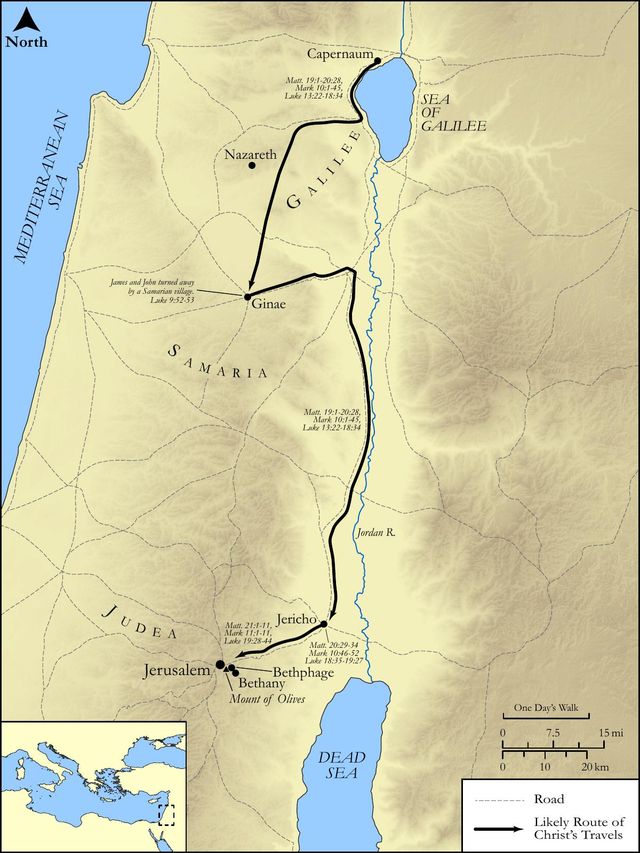
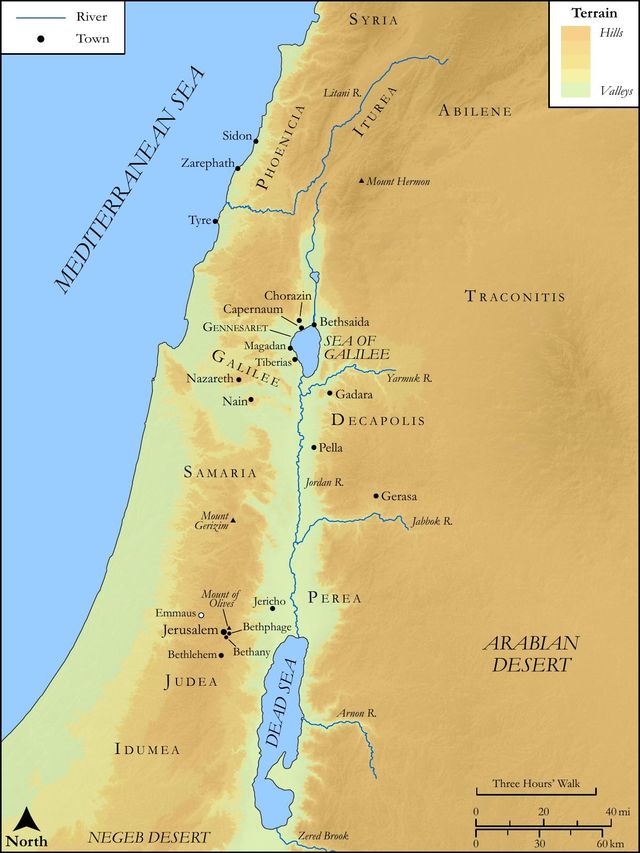
See on the biblical-era maps

Study this verse
Public-domain commentary
Matthew Henry
From his Commentary on the Whole Bible. Henry comments on passages, not single verses — this entry covers Luke 12:13–21. His four-level outline is real structure in the source text, so it is rendered as structure.
We have in these verses,
I.The application that was made to Christ, very unseasonably, by one of his hearers, desiring him to interpose between him and his brother in a matter that concerned the estate of the family (Luk 12:13): "Master, speak to my brother; speak as a prophet, speak as a king, speak with authority; he is one that will have regard to what thou sayest; speak to him, that he divide the inheritance with me." Now,
1.Some think that his brother did him wrong, and that he appealed to Christ to right him, because he knew the law was costly. His brother was such a one as the Jews called Ben-hamesen - a son of violence, that took not only his own part of the estate, but his brother's too, and forcibly detained it from him. Such brethren there are in the world, who have no sense at all either of natural equity or natural affection, who make a prey of those whom they ought to patronize and protect. They who are so wronged have God to go to, who will execute judgment and justice for those that are oppressed.
2.Others think that he had a mind to do his brother wrong, and would have Christ to assist him; that, whereas the law gave the elder brother a double portion of the estate, and the father himself could not dispose of what he had but by that rule (Deu 21:16, Deu 21:17), he would have Christ to alter that law, and oblige his brother, who perhaps was a follower of Christ at large, to divide the inheritance equally with him, in gavel-kind, share and share alike, and to allot him as much as his elder brother. I suspect that this was the case, because Christ takes occasion from it to warn against covetousness, pleonexia - a desire of having more, more than God in his providence has allotted us. It was not a lawful desire of getting his own, but a sinful desire of getting more than his own.
II.Christ's refusal to interpose in this matter (Luk 12:14):
Man, who made me a judge or divider over you? In matters of this nature, Christ will not assume either a legislative power to alter the settled rule of inheritances, or a judicial power to determine controversies concerning them. He could have done the judge's part, and the lawyer's, as well as he did the physician's, and have ended suits at law as happily as he did diseases; but he would not, for it was not in his commission: Who made me a judge? Probably he refers to the indignity done to Moses by his brethren in Egypt, with which Stephen upbraided the Jews, Act 7:27, Act 7:35. "If I should offer to do this, you would taunt me as you did Moses, Who made thee a judge or a divider?" He corrects the man's mistake, will not admit his appeal (it was coram non judice - not before the proper judge), and so dismisses his bill. If he had come to him to desire him to assist his pursuit of the heavenly inheritance, Christ would have given him his best help; but as to this matter he has nothing to do: Who made me a judge? Note, Jesus Christ was no usurper; he took no honour, no power, to himself, but what was given him, Heb 5:5. Whatever he did, he could tell by what authority he did it, and who gave him that authority. Now this shows us what is the nature and constitution of Christ's kingdom. It is a spiritual kingdom, and not of this world.
1.It does not interfere with civil powers, nor take the authority of princes out of their hands. Christianity leaves the matter as it found it, as to civil power.
2.It does not intermeddle with civil rights; it obliges all to do justly, according to the settled rules of equity, but dominion is not founded in grace.
3.It does not encourage our expectations of worldly advantages by our religion. If this man will be a disciple of Christ, and expects that in consideration of this Christ should give him his brother's estate, he is mistaken; the rewards of Christ's disciples are of another nature.
4.It does not encourage our contests with our brethren, and our being rigorous and high in our demands, but rather, for peace' sake, to recede from our right.
5.It does not allow ministers to entangle themselves in the affairs of this life (Ti2 2:4), to leave the word of God to serve tables. There are those whose business it is, let it be left to them, Tractent fabrilia fabri - Each workman to his proper craft.
III.The necessary caution which Christ took occasion from this to give to his hearers.
Though he came not to be a divider of men's estates, he came to be a director of their consciences about them, and would have all take heed of harbouring that corrupt principle which they saw to be in others the root of so much evil. Here is,
1.The caution itself (Luk 12:15): Take heed and beware of covetousness; horate - "Observe yourselves, keep a jealous eye upon your own hearts, lest covetous principles steal into them; and phulassesthe - preserve yourselves, keep a strict band upon your own hearts, lest covetous principles rule and give law in them." Covetousness is a sin which we have need constantly to watch against, and therefore frequently to be warned against.
2.The reason of it, or an argument to enforce this caution: For a man's life consisteth not in the abundance of the things which he possesseth; that is, "our happiness and comfort do not depend upon our having a great deal of the wealth of this world." (1.) The life of the soul, undoubtedly, does not depend upon it, and the soul is the man. The things of the world will not suit the nature of a soul, nor supply its needs, nor satisfy its desires, nor last so long as it will last. Nay, (2.) Even the life of the body and the happiness of that do not consist in an abundance of these things; for many live very contentedly and easily, and get through the world very comfortably, who have but a little of the wealth of it (a dinner of herbs with holy love is better than a feast of fat things); and, on the other hand, many live very miserably who have a great deal of the things of this world; they possess abundance, and yet have no comfort of it; they bereave their souls of good, Ecc 4:8. Many who have abundance are discontented and fretful, as Ahab and Haman; and then what good does their abundance do them?
3.The illustration of this by a parable, the sum of which is to show the folly of carnal worldlings while they live, and their misery when they die, which is intended not only for a check to that man who came to Christ with an address about his estate, while he was in no care about his soul and another world, but for the enforcing of that necessary caution to us all, to take heed of covetousness. The parable gives us the life and death of a rich man, and leaves us to judge whether he was a happy man.
(1.)Here is an account of his worldly wealth and abundance (Luk 12:16): The ground of a certain rich man brought forth plentifully, chōra - regio - the country. He had a whole country to himself, a lordship of his own; he was a little prince. Observe, His wealth lay much in the fruits of the earth, for the king himself is served by the field, Ecc 5:9. He had a great deal of ground, and his ground was fruitful; much would have more, and he had more. Note, The fruitfulness of the earth is a great blessing, but it is a blessing which God often gives plentifully to wicked men, to whom it is a snare, that we may not think to judge of his love or hatred by what is before us.
(2.)Here are the workings of his heart, in the midst of this abundance. We are here told what he thought within himself, Luk 12:17. Note, The God of heaven knows and observes whatever we think within ourselves, and we are accountable to him for it. He is both a discerner and judge of the thoughts and intents of the heart. We mistake if we imagine that thoughts are hid and thoughts are free. Let us here observe,
[1.]What his cares and concerns were. When he saw an extraordinary crop upon his ground, instead of thanking God for it, or rejoicing in the opportunity it would give him of doing the more good, he afflicts himself with this thought, What shall I do, because I have no room where to bestow my fruits? He speaks as one at a loss, and full of perplexity. What shall I do now? The poorest beggar in the country, that did not know where to get a meal's meat, could not have said a more anxious word. Disquieting care is the common fruit of an abundance of this world, and the common fault of those that have abundance. The more men have, the more perplexity they have with it, and the more solicitous they are to keep what they have and to add to it, how to spare and how to spend; so that even the abundance of the rich will not suffer them to sleep, for thinking what they shall do with what they have and how they shall dispose of it. The rich man seems to speak it with a sigh, What shall I do? And if you ask, Why, what is the matter? Truly he had abundance of wealth, and wants a place to put it in, that is all.
[2.]What his projects and purposes were, which were the result of his cares, and were indeed absurd and foolish like them (Luk 12:18): "This will I do, and it is the wisest course I can take, I will pull down my barns, for they are too little, and I will build greater, and there will I bestow all my fruits and my goods, and then I shall be at ease." Now here, First, It was folly for him to call the fruits of the ground his fruits and his goods. He seems to lay a pleasing emphasis upon that, my fruits and my goods; whereas what we have is but lent us for our use, the property is still in God; we are but stewards of our Lord's goods, tenants at will of our Lord's land. It is my corn (saith God) and my wine, Hos 2:8, Hos 2:9. Secondly, It was folly for him to hoard up what he had, and then to think it well bestowed. There will I bestow it all; as if none must be bestowed upon the poor, none upon his family, none upon the Levite and the stranger, the fatherless and the widow, but all in the great barn. Thirdly, It was folly for him to let his mind rise with his condition; when his ground brought forth more plentifully than usual, then to talk of bigger barns, as if the next year must needs be as fruitful as this, and much more abundant, whereas the barn might be as much too big the next year as it was too little this. Years of famine commonly follow years of plenty, as they did in Egypt; and therefore it were better to stack some of his corn for this once. Fourthly, It was folly for him to think to ease his care by building new barns, for the building of them would but increase his care; those know this who know any thing of the spirit of building. The way that God prescribes for the cure of inordinate care is certainly successful, but the way of the world does but increase it. Besides, when he had done this, there were other cares that would still attend him; the greater the barns, still the greater the cares, Ecc 5:10. Fifthly, It was folly for him to contrive and resolve all this absolutely and without reserve. This I will do: I will pull down my barns and will build greater, yea, that I will; without so much as that necessary proviso, If the Lord will, I shall live, Jam 4:13-15. Peremptory projects are foolish projects; for our times are in God's hand, and not in our own, and we do not so much as know what shall be on the morrow.
[3.]What his pleasing hopes and expectations were, when he should have made good these projects. "Then I will say to my soul, upon the credit of this security, whether God say it or no, Soul, mark what I say, thou hast much goods laid up for many years in these barns; now take thine ease, enjoy thyself, eat, drink, and be merry," Luk 12:19. Here also appears his folly, as much in the enjoyment of his wealth as in the pursuit of it. First, It was folly for him to put off his comfort in his abundance till he had compassed his projects concerning it. When he has built bigger barns, and filled them (which will be a work of time), then he will take his ease; and might he not as well have done that now? Grotius here quotes the story of Pyrrhus, who was projecting to make himself master of Sicily, Africa, and other places, in the prosecution of his victories. Well, says his friend Cyneas, and what must we do then? Postea vivemus, says he, Then we will live; At hoc jam licet, says Cyneas, We may live now if we please. Secondly, It was folly for him to be confident that his goods were laid up for many years, as if his bigger barns would be safer than those he had; whereas in an hour's time they might be burnt to the ground and all that was laid up in them, perhaps by lightning, against which there is no defence. A few years may make a great change; moth and rust may corrupt, or thieves break through and steal. Thirdly, It was folly for him to count upon certain ease, when he had laid up abundance of the wealth of this world, whereas there are many things that may make people uneasy in the midst of their greatest abundance. One dead fly may spoil a whole pot of precious ointment; and one thorn a whole bed of down. Pain and sickness of body, disagreeableness of relations, and especially a guilty conscience, may rob a man of his ease, who has ever so much of the wealth of this world. Fourthly, It was folly for him to think of making no other use of his plenty than to eat and drink, and to be merry; to indulge the flesh, and gratify the sensual appetite, without any thought of doing good to others, and being put thereby into a better capacity of serving God and his generation: as if we lived to eat, and did not eat to live, and the happiness of man consisted in nothing else but in having all the gratifications of sense wound up to the height of pleasurableness. Fifthly, It was the greatest folly of all to say all this to his soul. if he had said, Body, take thine ease, for thou hast goods laid up for many years, there had been sense in it; but the soul, considered as an immortal spirit, separable from the body, was no way interested in a barn full of corn or a bag full of gold. If he had had the soul of a swine, he might have blessed it with the satisfaction of eating and drinking; but what is this to the soul of a man, that has exigencies and desires which these things will be no ways suited to? It is the great absurdity which the children of this world are guilty of that they portion their souls in the wealth of the world and the pleasures of sense.
(3.)Here is God's sentence upon all this; and we are sure that his judgment is according to truth. He said to himself, said to his soul, Take thine ease. If God had said so too, the man had been happy, as his Spirit witnesses with the spirit of believers to make them easy. But God said quite otherwise; and by his judgment of us we must stand or fall, not by ours of ourselves, Co1 4:3, Co1 4:4. His neighbours blessed him (Psa 10:3), praised him as doing well for himself (Psa 49:18); but God said he did ill for himself: Thou fool, this night thy soul shall be required of thee, Luk 12:20. God said to him, that is, decreed this concerning him, and let him know it, either by his conscience or by some awakening providence, or rather by both together. This was said when he was in the fulness of his sufficiency (Job 20:22), when his eyes were held waking upon his bed with his cares and contrivances about enlarging his barns, not by adding a bay or two more of building to them, which might serve to answer the end, but by pulling them down and building greater, which was requisite to please his fancy. When he was forecasting this, and had brought it to an issue, and then lulled himself asleep again with a pleasing dream of many years' enjoyment of his present improvements, then God said this to him. Thus Belshazzar was struck with terror by the hand-writing on the wall, in the midst of his jollity. Now observe what God said,
[1.]The character he gave him: Thou fool, thou Nabal, alluding to the story of Nabal, that fool (Nabal is his name, and folly is with him) whose heart was struck dead as a stone while he was regaling himself in the abundance of his provision for his sheep-shearers. Note, Carnal worldlings are fools, and the day is coming when God will call them by their own name, Thou fool, and they will call themselves so.
[2.]The sentence he passed upon him, a sentence of death: This night thy soul shall be required of thee; they shall require thy soul (so the words are), and then whose shall those things be which thou hast provided? He thought he had goods that should be his for many years, but he must part from them this night; he thought he should enjoy them himself, but he must leave them to he knows not who. Note, The death of carnal worldlings is miserable in itself and terrible to them.
First, It is a force, an arrest; it is the requiring of the soul, that soul that thou art making such a fool of; what hast thou to do with a soul, who canst use it no better? Thy soul shall be required; this intimates that he is loth to part with it. A good man, who has taken his heart off from this world, cheerfully resigns his soul at death, and gives it up; but a worldly man has it torn from him with violence; it is a terror to him to think of leaving this world. They shall require thy soul. God shall require it; he shall require an account of it. "Man, woman, what hast thou done with thy soul. Give an account of that stewardship." They shall; that is, evil angels as the messengers of God's justice. As good angels receive gracious souls to carry them to their joy, so evil angels receive wicked souls to carry them to the place of torment; they shall require it as a guilty soul to be punished. The devil requires thy soul as his own, for it did, in effect, give itself to him.
Secondly, It is a surprise, an unexpected force. It is in the night, and terrors in the night are most terrible. The time of death is day-time to a good man; it is his morning. But it is night to a worldling, a dark night; he lies down in sorrow. It is this night, this present night, without delay; there is no giving bail, or begging a day. This pleasant night, when thou art promising thyself many years to come, now thou must die, and go to judgment. Thou art entertaining thyself with the fancy of many a merry day, and merry night, and merry feast; but, in the midst of all, here is an end of all, Isa 21:4.
Thirdly, It is the leaving of all those things behind which they have provided, which they have laboured for, and prepared for hereafter, with abundance of toil and care. All that which they have placed their happiness in, and built their hope upon, and raised their expectations fRom. they must leave behind. Their pomp shall not descend after them (Psa 49:17), but they shall go as naked out of the world as they came into it, and they shall have no benefit at all by what they have hoarded up either in death, in judgment, or in their everlasting state.
Fourthly, It is leaving them to they know not who: "Then whose shall those things be? Not thine to be sure, and thou knowest not what they will prove for whom thou didst design them, thy children and relations, whether they will be wise or fools (Ecc 2:18, Ecc 2:19), whether such as will bless thy memory or curse it, be a credit to thy family or a blemish, do good or hurt with what thou leavest them, keep it or spend it; nay, thou knowest not but those for whom thou dost design it may be prevented from the enjoyment of it, and it may be turned to somebody else thou little thinkest of; nay, though thou knowest to whom thou leavest it, thou knowest not to whom they will leave it, or into whose hand it will come at last." If many a man could have foreseen to whom his house would have come after his death, he would rather have burned it than beautified it.
Fifthly, It is a demonstration of his folly. Carnal worldlings are fools while they live: this their way is their folly (Psa 49:13); but their folly is made most evident when they die: at his end he shall be a fool (Jer 17:11); for then it will appear that he took pains to lay up treasure in a world he was hastening fRom. but took no care to lay it up in the world he was hastening to.
Lastly, Here is the application of this parable (Luk 12:21): So is he, such a fool, a fool in God's judgment, a fool upon record, that layeth up treasure for himself, and is not rich towards God. This is the way and this is the end of such a man. Observe here,
1.The description of a worldly man: He lays up treasure for himself, for the body, for the world, for himself in opposition to God, for that self that is to be denied.
(1.)It is his error that he counts his flesh himself, as if the body were the man. If self be rightly stated and understood, it is only the true Christian that lays up treasure for himself, and is wise for himself, Pro 9:12.
(2.)It is his error that he makes it his business to lay up for the flesh, which he calls laying up for himself. All his labour is for his mouth (Ecc 6:7), making provision for the flesh.
(3.)It is his error that he counts those things his treasure which are thus laid up for the world, and the body, and the life that now is; they are the wealth he trusts to, and spends upon, and lets out his affections toward.
(4.)The greatest error of all is that he is in no care to be rich towards God, rich in the account of God, whose accounting us rich makes us so (Rev 2:9), rich in the things of God, rich in faith (Jam 2:5), rich in good works, in the fruits of righteousness (Ti1 6:18), rich in graces, and comforts, and spiritual gifts. Many who have abundance of this world are wholly destitute of that which will enrich their souls, which will make them rich towards God, rich for eternity.
2.The folly and misery of a worldly man: So is he. Our Lord Jesus Christ, who knows what the end of things will be, has here told us what his end will be. Note, It is the unspeakable folly of the most of men to mind and pursue the wealth of this world more than the wealth of the other world, that which is merely for the body and for time, more than that which is for the soul and eternity.
Historical interpretation
Seven Centuries of Reception
9 surviving comments on this verse. Each one is dated, so this reads as a timeline rather than a list.
Select a marker to jump to its quote. Markers stagger vertically where authors wrote within a few decades of each other.
(non occ.) Now if any one lives so as to die daily, seeing that our life is naturally uncertain, he will not sin, for the greater fear destroys very much pleasure, but the rich man on the contrary, promising to himself length of life, secks after pleasures, for he says, Rest, that is, from toil, eat, drink, and be merry, that is, with great luxury.
(in Hom. de Avar.) Not indeed about to reap any good from his plenty of fruits, but that the mercy of God might the more appear, which extends its goodness even to the bad; sending down His rain upon the just and the unjust. But what are the things wherewith this man repays his Benefactor? He remembered not his fellow-creatures, nor deemed that he ought to give of his superfluities to the needy. His barns indeed bursting from the abundance of his stores, yet was his greedy mind by no means satisfied. He was unwilling to put up with his old ones because of his covetousness, and not able to undertake new ones because of the number, for his counsels were imperfect, and his care barren. Hence it follows, And he thought. His complaint is like that of the poor. Does not the man oppressed with want say, What shall I do, whence can I get food, whence clothing? Such things also the rich man utters. For his mind is distressed on account of his fruits pouring out from his storehouse, lest perchance when they have come forth they should profit the poor; like the glutton who had rather burst from eating, than give any thing of what remains to the starving.
(ubi sup.) It was easy for him to say, I will open my barn, I will call together the needy, but he has no thought of want, only of amassing; for it follows, And he said, This will I do, I will pull down my barns. Thou doest well, for the storehouses of iniquity are worthy of destruction. Pull down thy barns, from which no one receives comfort. He adds, I will build greater. But thou shalt complete these, wilt thou again destroy them? What more foolish than labouring on for ever. Thy barns, if thou wilt, are the home of the poor. But thou wilt say, Whom do I wrong by keeping what is my own? For it follows also, And there will I bestow all my fruits and my goods. Tell me what is thine, from whence didst thou get it and bring it into life? As he who anticipates the public games, injures those who are coming by appropriating to himself what is appointed for the common use, so likewise the rich who regard as their own the common things which they have forestalled. For if every one receiving what is sufficient for his own necessity would leave what remains to the needy, there would be no rich or poor.
(ubi sup.) But if thou confessest that those things have come to thee from God, is God then unjust in distributing to us unequally. Why dost thou abound while another begs? unless that thou shouldest gain the rewards of a good stewardship, and be honoured with the meed of patience. Art not thou then a robber, for counting as thine own what thou hast received to distribute? It is the bread of the famished which thou receivest, the garment of the naked which rots in thy possession, the money of the pennyless which thou hast buried in the earth. Wherefore then dost thou injure so many to whom thou mightest be a benefactor.
(ubi sup.) Thou art so careless with respect to the goods of the soul, that thou ascribest the meats of the body to the soul. If indeed it has virtue, if it is fruitful in good works, if it clings to God, it possesses many goods, and rejoices with a worthy joy. But because thou art altogether carnal and subject to the passions, thou speakest from thy belly, not from thy soul.
(Hom. in loc.) But he was permitted to deliberate in every thing, and to manifest his purpose, that he might receive a sentence such as his inclinations deserved. But while he speaks in secret, his words are weighed in heaven, from whence the answers come to him. For it follows, But God said unto him, Thou fool, this night thy soul shall they require of thee. Hear the name of folly, which most properly belongs to thee which not man has imposed, but God Himself.
For in vain he amasses wealth who knows not how to use it. Neither are these things ours which we cannot take away with us. Virtue alone is the companion of the dead, mercy alone follows us, which gains for the dead an everlasting habitation.
(Hom. 8. in 2 ad Tim.) But in this he errs, that he thinks those things good which are indifferent. For there are some things good, some evil, some between the two. The good are chastity, and humility, and the like, which when a man chooses he becomes good. But opposed to these are the evil, which when a man chooses he becomes bad; and there are the neutral, as riches, which at one time indeed are directed to good, as to almsgiving, at other times to evil, as to covetousness. And in like manner poverty at one time leads to blasphemy, at another to wisdom, according to the disposition of the user.
(Hom. 39, 8. in 1 ad Cor.) Now it behoves us not to indulge in delights which fattening the body make lean the soul, and bring a heavy burden upon it, and spread darkness over it, and a thick covering, because in pleasure our governing part which is the soul becomes the slave, but the subject part, namely the body, rules. But the body is in need not of luxuries but of food, that it may be nourished, not that it may be racked and melt away. For not to the soul alone are pleasures hurtful, but to the body itself, because from being a strong body it becomes weak, from being healthy diseased, from being active slothful, from being beautiful unshapely, and from youthful old.
(Concio. 2. de Lazar.) They shall require of thee, for perhaps certain dread powers were sent to require it, since if when going from city to city we want a guide, much more will the soul when released from the body, and passing to a future life, need direction. On this account many times the soul rises and sinks into the deep again, when it ought to depart from the body. For the consciousness of our sins is ever pricking us, but most of all when we are going to be dragged before the awful tribunal. For when the whole accumulation of crimes is brought up again, and placed before the eyes, it astounds the mind. And as prisoners are always indeed sorrowful, but particularly at the time when they are going to be brought before the judge; so also the soul at this time is greatly tormented by sin and afflicted, but much more after it has been removed.
(Hom. 23. in Gen.) For here shalt thou leave those things, and not only reap no advantage from them, but carry a load of sins upon thy own shoulders. And these things which thou hast laid up will for the most part come into the hands of enemies, but of thee shall an account of them be required. It follows, So is he that layeth up treasure for himself, and is not rich toward God.
It is true that a person’s life is not from one’s possessions or because of having an overabundance. He who is rich toward God is very blessed and has glorious hope. Who is he? Evidently, one who does not love wealth but rather loves virtue, and to whom few things are sufficient. It is one whose hand is open to the needs of the poor, comforting the sorrows of those in poverty according to his means and the utmost of his power. He gathers in the storehouses that are above and lays up treasures in heaven. Such a one shall find the interest of his virtue and the reward of his right and blameless life.
(Mor. 15. c. 13.) O adversity, the child of plenty. For saying, What shall I do, he surely betokens, that, oppressed by the success of his wishes, he labours as it were under a load of goods.
(22. Mor. c. 2.) The same night he was taken away, who had expected many years, that he indeed who had in gathering stores for himself looked a long time forward, should not see even the next day.
(ubi sup.) But in the night the soul was taken away which had gone forth in the darkness of its heart, being unwilling to have the light of consideration, so as to foresee what it might suffer. But He adds, Then whose shall those things be which thou hast provided?
Then he spoke a parable to them, saying: "The land of a certain rich man yielded an abundant harvest, and he thought to himself, saying, 'What shall I do, for I have no place to store my crops?' And he said, 'This will I do: I will pull down my barns and build larger ones, and there I will store all my grain and my goods.' This rich man is not condemned for having cultivated the land or for having stored the fruits that came from it in barns, but for placing his entire life's trust in the very abundance of things, considering the surplus fruits that the land yielded as belonging to him and his goods, without distributing to the poor, according to the Lord's command saying, 'What is left over give as alms,' but rather making larger storehouses to reserve for his future luxury.
For such a one is a fool, and will be taken off in the night. He then who wishes to be rich toward God, will not lay up treasures for himself, but distribute his possessions to the poor.
This our Lord says to rebuke the motives of the covetous, who seem to heap up riches as if they were going to live for a long time. But will wealth ever make thee long lived? Why then dost thou manifestly undergo evils for the sake of an uncertain rest? For it is doubtful whether thou oughtest to attain to an old age, for the sake of which thou art collecting treasures.
Having said that the life of man is not extended by abundance of wealth, he adds a parable to induce belief in this, as it follows, And he spake a parable unto them, saying, The ground of a certain rich man brought forth plentifully.
Continue studying Luke 12:21 across the web’s major study libraries — every link below opens this exact verse, chapter, or book on the destination site.
Read & Compare
 BibleGatewayThis verse in more than 200 translations and 70 languages.
 Bible.comThe YouVersion reader — hundreds of translations, reading plans, and highlights.
 ESV.orgCrossway's official English Standard Version reader.
 NET BibleThe NET translation with 60,000+ translators' notes on every rendering decision.
 STEP BibleTyndale House's free study tool — original text, vocabulary, and scholarly resources.
 BibliaLogos Bible Software's free web reader.
 USCCBThe New American Bible (Revised Edition) with the U.S. bishops' study notes.
Commentaries
 BibleHub CommentariesDozens of classic commentaries on this verse, gathered on one page.
 StudyLightMore than 100 commentary sets — the largest collection on the web.
 BibleRefPlain-English commentary on what this verse means, verse by verse.
 Enduring WordDavid Guzik's free commentary on this chapter, widely used by Bible teachers.
 Bible Study ToolsVerse commentary alongside Greek and Hebrew study aids.
Original Language & Research
- BibleHub InterlinearThe verse word by word — original language, transliteration, and English.
- BibleHub LexiconEvery word's original-language definition and Strong's entry.
 Blue Letter BibleDeep-study tools — Strong's numbers, concordance, and word studies.
 CNTR CollationThe earliest Greek manuscripts of this verse, collated letter by letter.
Sermons, Hymns & Audio


TrulyRandomVerse is not affiliated with these sites and doesn’t control their content. They’re linked because they’re genuinely useful.
Summary
Luke 12:21 serves as a stark concluding indictment to Jesus' Parable of the Rich Fool, encapsulating the profound spiritual folly of a life devoted solely to earthly accumulation. It warns against the deceptive nature of material wealth when pursued for selfish gain, contrasting such a path with the eternal and true riches found in a relationship with God. The verse underscores that while one may amass great treasure on earth, if that pursuit neglects spiritual investment and a God-centered life, the individual remains utterly impoverished in the eyes of eternity.
Context
ShowHideLiterary Context
This verse provides the climactic punchline to the Parable of the Rich Fool, which Jesus tells in response to a man's request for Him to intervene in an inheritance dispute (Luke 12:13-15). The parable itself depicts a wealthy farmer whose abundant harvest leads him to build larger barns, planning a life of self-indulgent ease, only to die unexpectedly that very night. Jesus' concluding statement in Luke 12:21 directly interprets the parable's meaning, linking the "rich fool" to anyone who prioritizes self-serving material gain over a relationship with God. It functions as a universal warning against covetousness and a call to re-evaluate one's ultimate priorities, setting the stage for Jesus' subsequent teaching on anxiety and seeking God's kingdom in Luke 12:22-34.
Historical & Cultural Context
In first-century Jewish society, wealth was often perceived as a sign of God's blessing and favor, a common theme in the Old Testament (e.g., Deuteronomy 28:1-14). This cultural assumption made Jesus' teaching on wealth particularly counter-cultural and challenging. The parable's setting, with a farmer and barns, reflects the agrarian economy of the time, where surplus harvest was indeed a source of security and status. However, Jesus critiques the attitude toward wealth—the self-centered accumulation and reliance on it for ultimate security, rather than the wealth itself. His words challenge the prevailing wisdom, asserting that true security and richness are not found in material possessions, which are fleeting, but in one's standing and relationship with God, who holds the ultimate power over life and death.
Key Themes
ShowHideLuke 12:21 powerfully encapsulates several major themes prevalent in Jesus' teaching and throughout the broader book of Luke. Primarily, it highlights the vanity and futility of earthly accumulation when pursued as an end in itself, echoing the wisdom literature's warnings about the ephemeral nature of material possessions (e.g., Ecclesiastes 2:18-23). Secondly, it defines true riches as spiritual, emphasizing that genuine wealth is measured by one's relationship and investment "toward God," rather than by worldly possessions (Matthew 6:19-21). This theme underscores the importance of an eternal perspective, reminding listeners that life is brief and death is certain, rendering earthly treasures ultimately useless beyond the grave. Finally, the verse reveals God's judgment on self-centered materialism, portraying a life rich only in earthly goods as foolish and spiritually impoverished from a divine viewpoint. This aligns with Luke's broader emphasis on justice, care for the poor, and the dangers of wealth, as seen in passages like the Parable of Lazarus and the Rich Man.
Exposition and Analysis
ShowHideKey Word Analysis
ShowHideThis verb, translated "layeth up treasure," means "to amass or reserve," "to store up," or "to hoard." It describes the act of gathering and keeping wealth, often with an implication of accumulation for one's own benefit and security. In the context of the parable, it refers to the rich man's excessive and self-focused hoarding of his harvest, beyond what was necessary, for a life of ease.
This reflexive pronoun, translated "for himself," emphasizes the self-centered nature of the rich man's actions. His entire plan for his surplus wealth was directed inward—his soul, his ease, his enjoyment. This highlights the contrast with being "rich toward God," which implies an outward, God-directed orientation of one's resources and life.
This verb means "to be (or become) wealthy" or "to be rich." In the context of the verse, it is contrasted with earthly wealth. To be "rich toward God" (using the preposition eis) means to possess spiritual wealth, to be abundant in things that matter to God, such as faith, good works, generosity, and a righteous character.
This preposition, translated "toward" in "rich toward God," indicates direction, purpose, or result. It suggests a dynamic relationship or orientation. Being "rich eis God" implies not merely possessing spiritual knowledge, but actively investing one's life, resources, and priorities into God's kingdom, for God's purposes, and resulting in spiritual capital with eternal value.
Verse Breakdown
ShowHide"So is he that layeth up treasure for himself"
This clause directly connects the rich fool's fate to a universal principle. The phrase "layeth up treasure for himself" describes the act of accumulating material possessions and resources with a primary, self-serving focus. It implies a life strategy centered on personal comfort, security, and pleasure, where wealth is seen as an end in itself, rather than a means for God's purposes or a tool for generosity. The "so is he" indicates that the rich fool's tragic end is the inevitable outcome for anyone who adopts this self-centered approach to wealth.
"and is not rich toward God"
This is the critical contrasting clause that defines the spiritual deficiency. It reveals the true measure of wealth from God's perspective. To be "not rich toward God" means to lack spiritual capital, to have failed to invest one's life, time, talents, and material resources in ways that honor God, serve His kingdom, and build up eternal value. Despite any earthly abundance, such a person is spiritually bankrupt, having neglected the one relationship and the one set of values that truly endure beyond death.
Literary Devices
ShowHideLuke 12:21 is rich in literary devices that amplify its message. The most prominent is Irony, as the rich fool, who believes he has secured his future, is ironically revealed to be utterly foolish and unprepared for the true reality of death and judgment. His plans for many years are thwarted by a single night. This verse also employs powerful Contrast, juxtaposing "treasure for himself" with being "rich toward God." This highlights the fundamental difference between a worldly, self-centered worldview and a spiritual, God-centered one. The concept of "treasure" itself functions as a Metaphor for what one values and invests in. Earthly treasure is fleeting, while spiritual treasure, accumulated "toward God," is eternal. The entire parable, culminating in this verse, serves as an Allegory, where the characters and events represent deeper spiritual truths about life, death, and divine judgment concerning stewardship and priorities.
Theological and Thematic Connections
ShowHideLuke 12:21 distills a core biblical truth: true security and lasting value are found not in material possessions, but in one's relationship with God and the eternal kingdom. This verse challenges the human tendency to find ultimate meaning and security in what can be accumulated and controlled, redirecting focus to the ephemeral nature of earthly life and the certainty of divine judgment. It underscores the theological principle of stewardship, reminding believers that all resources are ultimately God's, entrusted to us for His purposes. To be "rich toward God" implies a life of faith, obedience, generosity, and love, where one's priorities are aligned with God's heart for justice, righteousness, and the spread of His kingdom. This spiritual richness is the only true wealth that ensures beyond the grave, securing an eternal inheritance rather than a fleeting earthly one.
Reflection and Application
ShowHideLuke 12:21 stands as a timeless challenge to every generation, particularly relevant in our consumer-driven, achievement-oriented world. It compels us to critically examine the deepest desires of our hearts and the ultimate destination of our life's energy and resources. Are we, like the rich fool, primarily laying up treasure for ourselves—pursuing comfort, security, status, or pleasure as our highest good? Or are our lives characterized by a conscious effort to be "rich toward God," investing in eternal values, serving others, and advancing His kingdom? This verse calls for a radical re-evaluation of our priorities, urging us to recognize that our true worth and lasting legacy are defined not by our material net worth or worldly achievements, but by our relationship with God and the spiritual fruit we bear. It's a call to generosity, to stewardship, and to living with an acute awareness of life's brevity and eternity's certainty, ensuring that our ultimate treasure is secured in heaven, not on earth.
Questions for Reflection
ShowHideFAQ
ShowHideDoes Luke 12:21 mean that all wealth is inherently bad or that Christians should not save money?
ShowHideNo, Luke 12:21 does not condemn wealth itself or responsible saving. The issue is not the possession of wealth, but the attitude toward it and the purpose for which it is accumulated. The rich fool's error was his self-centeredness ("for himself"), his reliance on wealth for ultimate security, and his neglect of God. The Bible teaches responsible stewardship and even saving (e.g., Proverbs 6:6-8). However, it consistently warns against covetousness (Luke 12:15), the love of money (1 Timothy 6:10), and trusting in riches (Proverbs 11:28). The verse calls us to hold earthly possessions lightly and to prioritize being "rich toward God" through generosity, faith, and seeking His kingdom first (Matthew 6:33).
Christ-Centered Fulfillment
ShowHideLuke 12:21 finds its ultimate fulfillment and radical redefinition in the person and work of Jesus Christ. He is the quintessential example of one who was "rich toward God," not by accumulating earthly possessions, but by perfectly aligning His life with the Father's will and investing entirely in the kingdom of God. Though "being in the form of God, [He] did not consider equality with God something to be grasped, but emptied Himself, taking the form of a servant" (Philippians 2:6-7). As 2 Corinthians 8:9 declares, "For you know the grace of our Lord Jesus Christ, that though He was rich, yet for your sakes He became poor, that you through His poverty might become rich." Christ's "poverty" was His willingness to forsake heavenly glory and earthly comfort, culminating in His sacrificial death, all to secure for us true, eternal riches: reconciliation with God, forgiveness of sins, and an inheritance in heaven (Ephesians 1:7). Through His life, death, and resurrection, Jesus demonstrates that true wealth is not found in what one possesses, but in what one gives and in whom one trusts. He enables believers to be "rich toward God" by granting them new life in Him, empowering them by His Spirit to live lives of generosity, faith, and obedience, thereby laying up imperishable treasures in heaven (Matthew 6:20) and participating in His eternal kingdom.