


2 Timothy 2:4
- οὐδεὶςoudeisNo [one]G3762A-NSMAdjective Nominative Singular Masculine
- στρατευόμενοςstrateuomenosserving as a soldierG4754V-PMP-NSMVerb Present Middle Participle Nominative Singular Masculine
- ἐμπλέκεταιempleketaientangles himselfG1707V-PMI-3SVerb Present Middle Indicative 3rd Singular
- ταῖςtaisin theG3588T-DPFDefinite article Dative Plural Feminine
- τοῦtouof thisG3588T-GSMDefinite article Genitive Singular Masculine
- βίουbioulifeG979N-GSMNoun Genitive Singular Masculine
- πραγματείαιςpragmateiaisaffairsG4230N-DPFNoun Dative Plural Feminine
- ἵναinaso thatG2443CONJConjunction
- τῷtōthe [one]G3588T-DSMDefinite article Dative Singular Masculine
- στρατολογήσαντιstratologēsantihaving enlisted himG4758V-AAP-DSMVerb Aorist Active Participle Dative Singular Masculine
- ἀρέσῃaresēhe may pleaseG700V-AAS-3SVerb Aorist Active Subjunctive 3rd Singular
English is a literal word-by-word gloss of the Greek, not the KJV's wording. Why?
This is the original text the KJV's translators worked from — each Greek word with its own literal English meaning in this verse, prepared by scholars at Tyndale House, Cambridge. The KJV translates whole sentences, not word by word, so its wording differs: one Greek word can become several English words, and the KJV may choose “charity” where the gloss reads “love”. Both are faithful — they answer different questions. For the KJV's own rendering, switch to the KJV text.
Details
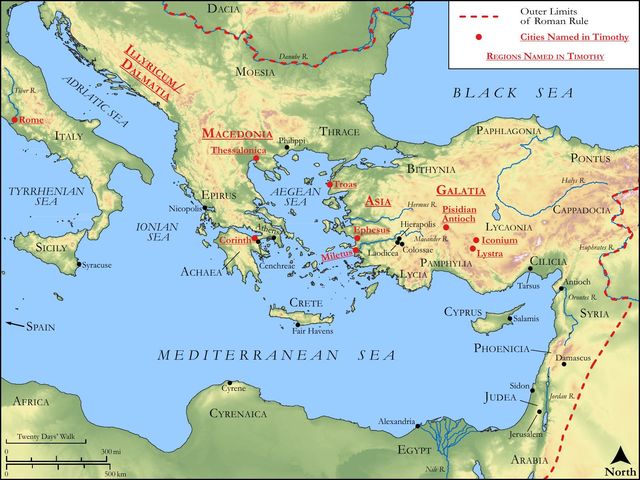
See on the biblical-era map

Study this verse
Public-domain commentary
Matthew Henry
From his Commentary on the Whole Bible. Henry comments on passages, not single verses — this entry covers 2 Timothy 2:1–7. His two-level outline is real structure in the source text, so it is rendered as structure.
Here Paul encourages Timothy to constancy and perseverance in his work: Be strong in the grace that is in Christ Jesus, Ti2 2:1. Observe, Those who have work to do for God must stir up themselves to do it, and strengthen themselves for it. Being strong in the grace that is in Christ Jesus may be understood in opposition to the weakness of grace. Where there is the truth of grace there must be a labouring after the strength of grace. As our trials increase, we have need to grow stronger and stronger in that which is good; our faith stronger, our resolution stronger, our love to God and Christ stronger. Or it may be understood in opposition to our being strong in our own strength: "Be strong, not confiding in thy own sufficiency, but in the grace that is in Jesus Christ." Compare Eph 6:10, Be strong in the Lord, and in the power of his might. When Peter promised rather to die for Christ than to deny him he was strong in his own strength; had he been strong in the grace that is in Christ Jesus, he would have kept his standing better. Observe, 1. There is grace in Christ Jesus; for the law was given by Moses, but grace and truth came by Jesus Christ, Joh 1:17. There is grace enough in him for all of us. 2. We must be strong in this grace; not in ourselves, in our own strength, or in the grace we have already received, but in the grace that is in him, and that is the way to be strong in grace. 3. As a father exhorts his son, so does Paul exhort Timothy, with great tenderness and affection: Thou, therefore, my son, be strong, etc. Observe,
I.Timothy must count upon sufferings, even unto blood, and therefore he must train up others to succeed him in the ministry of the gospel, Ti2 2:2. He must instruct others, and train them up for the ministry, and so commit to them the things which he had heard; and he must also ordain them to the ministry, lodge the gospel as a trust in their hands, and so commit to them the things which he had heard. Two things he must have an eye to in ordaining ministers: - Their fidelity or integrity ("Commit them to faithful men, who will sincerely aim at the glory of God, the honour of Christ, the welfare of souls, and the advancement of the kingdom of the Redeemer among men"), and also their ministerial ability. They must not only be knowing themselves, but be able to teach others also, and be apt to teach. Here we have,
1.The things Timothy was to commit to others - what he had heard of the apostle among many witnesses; he must not deliver any thing besides, and what Paul delivered to him and others he had received of the Lord Jesus Christ.
2.He was to commit them as a trust, as a sacred deposit, which they were to keep, and to transmit pure and uncorrupt unto others.
3.Those to whom he was to commit these things must be faithful, that is, trusty men, and who were skilful to teach others.
4.Though men were both faithful and able to teach others, yet these things must be committed to them by Timothy, a minister, a man in office; for none must intrude themselves into the ministry, but must have these things committed to them by those already in that office.
II.He must endure hardness (Ti2 2:3): Thou therefore, etc.
1.All Christians, but especially ministers, are soldiers of Jesus Christ; they fight under his banner, in his cause, and against his enemies, for he is the captain of our salvation, Heb 2:10.
2.The soldiers of Jesus Christ must approve themselves good soldiers, faithful to their captain, resolute in his cause, and must not give over fighting till they are made more than conquerors, through him that loved them, Rom 8:37.
3.Those who would approve themselves good soldiers of Jesus Christ must endure hardness; that is, we must expect it and count upon it in this world, must endure and accustom ourselves to it, and bear it patiently when it comes, and not be moved by it from our integrity.
III.He must not entangle himself in the affairs of this world, Ti2 2:4.
A soldier, when he has enlisted, leaves his calling, and all the business of it, that he may attend his captain's orders. If we have given up ourselves to be Christ's soldiers, we must sit loose to this world; and though there is no remedy, but we must employ ourselves in the affairs of this life while we are here (we have something to do here), we must not entangle ourselves with those affairs, so as by them to be diverted and drawn aside from our duty to God and the great concerns of our Christianity. Those who will war the good warfare must sit loose to this world. That we may please him who hath chosen us to be soldiers. Observe, 1. The great care of a soldier should be to please his general; so the great care of a Christian should be to please Christ, to approve ourselves to him. The way to please him who hath chosen us to be soldiers is not to entangle ourselves with the affairs of this life, but to be free from such entanglements as would hinder us in our holy warfare.
IV.He must see to it that in carrying on the spiritual warfare he went by rule, that he observed the laws of war (Ti2 2:5):
If a man strive for masteries, yet is he not crowned, except he strive lawfully. We are striving for mastery, to get the mastery of our lusts and corruptions, to excel in that which is good, but we cannot expect the prize unless we observe the laws. In doing that which is good we must take care that we do it in a right manner, that our good may not be evil spoken of. Observe here,
1.A Christian is to strive for masteries; he must aim at mastering his own lusts and corruptions.
2.Yet he must strive according to the laws given to him; he must strive lawfully.
3.Those who do so shall be crowned at last, after a complete victory is obtained.
V.He must be willing to wait for a recompence (Ti2 2:6):
The husbandman that laboureth must be first partaker of the fruits. Or, as it should be read, The husbandman labouring first must partake of the fruits, as appears by comparing it with Jam 5:7. If we would be partakers of the fruits, we must labour; if we would gain the prize, we must run the race. And, further, we must first labour as the husbandman does, with diligence and patience, before we are partakers of the fruit; we must do the will of God, before we receive the promises, for which reason we have need of patience, Heb 10:36.
The apostle further commends what he had said to the attention of Timothy, and expresses his desire and hope respecting him: Consider what I say, and the Lord give thee understanding in all things, Ti2 2:7. Here, 1. Paul exhorts Timothy to consider those thing about which he admonished him. Timothy must be reminded to use his considering faculties about the things of God. Consideration is as necessary to a good conversation as to a sound conversion. 2. He prays for him: The Lord give thee understanding in all things. Observe, It is God who gives understanding. The most intelligent man needs more and more of this gift. If he who gave the revelation in the word does not give the understanding in the heart, we are nothing. Together with our prayers for others, that the Lord would give them understanding in all things, we must exhort and stir them up to consider what we say, for consideration is the way to understand, remember, and practise, what we hear or read.
Historical interpretation
Nine Centuries of Reception
13 surviving comments on this verse. Each one is dated, so this reads as a timeline rather than a list.
Select a marker to jump to its quote. Markers stagger vertically where authors wrote within a few decades of each other.
Give attention to reading, that thou mayest not only thyself know the laws, but mayest also explain them to others, as the earnest servant of God. "No man that warreth entangleth himself with the affairs of this life, that he may please him who hath chosen him to be a soldier; and if a man also strive for masteries, yet is he not crowned except he strive lawfully." I that am in bonds pray that my soul may be in place of yours.
Pay attention to the bishop so that God will pay attention to you. I give my life as a sacrifice (poor as it is) for those who are obedient to the bishop, the presbyters and the deacons. Along with them may I get my share of God’s reward! Share your hard training together—wrestle together, run together, suffer together, retire together, get up together, as God’s stewards, assessors and assistants. Give satisfaction to him in whose ranks you serve and from whom you get your pay. Let none of you be a deserter. Let your baptism be your arms; your faith, your helmet; your love, your spear; your endurance, your armor.
If you have understood how either an animal or a vessel or a garment is called holy, understand too that a person is also called holy by these observances and laws. For if anyone should devote himself to God, if anyone should not entangle himself in secular affairs, “in order to please him who appointed him,” if anyone was separated and set apart from the rest of men who live carnally and are bound with mundane affairs and does not seek things which are upon the earth but which are in heaven, that person is deservedly called holy.
For it is written: "No man that warreth for God entangleth himself with the affairs of this life, that he may please Him to whom he has pledged himself.".
And again: "No man that warreth for God binds himself to anxieties of this world, that he may be able to please Him to whom he hath approved himself. Moreover, also, if a man should contend, he will not be crowned unless he have fought lawfully.".
Concerning this same thing to Timothy: "No man that warreth for God bindeth himself with worldly annoyances, that he may please Him to whom he hath approved himself. But and if a man should contend, he will not be crowned unless he fight lawfully."
Where is Christ, the King? In heaven, to be sure. In this direction it behooves you, soldier of Christ, to direct your course. Forget all earthly delights. A soldier does not build a house. He does not aspire to the possession of lands. He does not concern himself with devious, coin-purveying trade.… The soldier enjoys a sustenance provided by the king. He need not furnish his own nor vex himself in this regard.
No one can serve two masters. Since business affairs often involve the exercise of greed, the faithful churchman must be separate from these.
You are a spiritual soldier. This kind of soldier does not sleep on an ivory bed but on the ground. He is not anointed with perfumed oils. These are the concern of those corrupt men who dally with courtesans, of those who act on the stage, of those who live carelessly. You must not smell of perfumes but of virtue.
"No man that warreth entangleth himself with the affairs of this life, that he may please him who hath chosen him to be a soldier. And if a man also strive for masteries, yet is he not crowned except he strive lawfully." These things are said indeed to Timothy, but through him they are addressed to every teacher and disciple. Let no one therefore of those who hold the office of a Bishop disdain to hear these things, but let him be ashamed not to do them. "If any one strive for masteries," he says, "he is not crowned, except he strive lawfully." What is meant by "lawfully"? It is not enough that he enters into the lists, that he is anointed, and even engages, unless he comply with all the laws of the exercise, with respect to diet, to temperance and sobriety, and all the rules of the wrestling school, unless, in short, he go through all that is befitting for a wrestler, he is not crowned. And observe the wisdom of Paul. He mentions wrestlers and soldiers, the one to prepare him for slaughter and blood, the other with reference to endurance, that he might bear everything with fortitude, and be ever in exercise.
How can the clergy be managers and stewards of other men’s households and estates when they are bidden to disregard even their own interests?
We are not anxious about the necessities of life, because, when we can perform these labors, he feeds and clothes us as men in general are fed and clothed. When, however, we are not able to work, then he feeds and clothes us just as the birds are fed and the lilies clothed, since we are of more value than they. Therefore, in this warfare of ours, we give no thought to the morrow, because it is not by temporal concerns pertaining to the morrow but by eternal matters, the concern of the everlasting today, that we have proved ourselves to him whom we cannot please if we are entangled in worldly affairs.
He who is enrolled in God’s army must not be bound to others, lest any obligatory ties call him away from the Lord’s camp, where his name is inscribed.
Clerics do not seem to be on military service in the world, yet they are nonetheless soldiers for God and the Lord. As the apostle says, No one soldiering for God involves himself in secular affairs. We seem, I say, not to be soldiers in our loose and flowing tunics, but we have our military belt, by which we are bound to an interior purity.
Therefore, endure hardship as a good soldier of Jesus Christ. No one engaged in warfare gets entangled in the affairs of life, so that he may please the one who joined him. And if anyone competes as an athlete, he is not crowned unless he competes according to the rules. The hardworking farmer must be the first to receive a share of the crops.
Woe to me if I do not preach the gospel! Is it so great a thing to be a soldier of Christ? But the mark of a soldier is to endure hardship.
No one engaged in warfare. Paul remembered the soldier, showing that the servant of Christ must be eager and bold; and as an athlete, showing that he needs continuous training. If, therefore, he says, the one serving the earthly king is not entangled in matters that distract him from his weapons, how much more the one who has committed himself to the heavenly king and recruited.
unless he competes according to the rules. For it is not enough merely to be anointed, or to enter the place of combat, or to engage in hand-to-hand fighting with the enemy, but it is also necessary to endure and to win: for this is the law of combat.
The hardworking farmer. Not careless: but one who works. For indeed, the teacher who also works with the students will receive rewards from God for the benefit and advantage of the students.
— [GREGORY OF NYSSA]1 As teachers must first be perfected in themselves in what they teach. For this is necessary, to partake first of the fruits, which they cultivate in themselves through virtues before others. [end of the excerpt by Gregory of Nyssa] —
The example of the soldier and the wanderer suits the students, but that of the farmer suits only the teachers. For just as, it is said, the farmer takes care of the land and the fruits, so must you take care of the students and your preaching. And see to the return. The benefit, it is said, of the students is first enjoyed by the teacher from God, just as the farmer enjoys the fruits.
Continue studying 2 Timothy 2:4 across the web’s major study libraries — every link below opens this exact verse, chapter, or book on the destination site.
Read & Compare
 BibleGatewayThis verse in more than 200 translations and 70 languages.
 Bible.comThe YouVersion reader — hundreds of translations, reading plans, and highlights.
 ESV.orgCrossway's official English Standard Version reader.
 NET BibleThe NET translation with 60,000+ translators' notes on every rendering decision.
 STEP BibleTyndale House's free study tool — original text, vocabulary, and scholarly resources.
 BibliaLogos Bible Software's free web reader.
 USCCBThe New American Bible (Revised Edition) with the U.S. bishops' study notes.
Commentaries
 BibleHub CommentariesDozens of classic commentaries on this verse, gathered on one page.
 StudyLightMore than 100 commentary sets — the largest collection on the web.
 BibleRefPlain-English commentary on what this verse means, verse by verse.
 Enduring WordDavid Guzik's free commentary on this chapter, widely used by Bible teachers.
 Bible Study ToolsVerse commentary alongside Greek and Hebrew study aids.
Original Language & Research
- BibleHub InterlinearThe verse word by word — original language, transliteration, and English.
- BibleHub LexiconEvery word's original-language definition and Strong's entry.
 Blue Letter BibleDeep-study tools — Strong's numbers, concordance, and word studies.
 CNTR CollationThe earliest Greek manuscripts of this verse, collated letter by letter.
Sermons, Hymns & Audio


TrulyRandomVerse is not affiliated with these sites and doesn’t control their content. They’re linked because they’re genuinely useful.
Summary
The Apostle Paul, in his second letter to Timothy, employs the vivid analogy of a soldier to impress upon his young protégé, and by extension all believers, the imperative of undivided devotion in Christian service. This verse emphasizes that just as a soldier must remain unencumbered by civilian concerns to effectively fulfill their military duties, so too must the follower of Christ avoid entanglement with worldly distractions, ensuring their singular focus remains on pleasing the divine Commander who has enlisted them.
Context
ShowHideLiterary Context
This verse is situated within the second chapter of 2 Timothy, where Paul provides robust encouragement and instruction to Timothy regarding his ministry. Following a call to "be strong in the grace that is in Christ Jesus" 2 Timothy 2:1, Paul urges Timothy to faithfully transmit the gospel message to others 2 Timothy 2:2. The immediate preceding verse, 2 Timothy 2:3, directly introduces the soldier analogy, calling Timothy to "endure hardness, as a good soldier of Jesus Christ." Verse 4 then elaborates on the characteristics of such a soldier, forming part of a triad of illustrations (soldier, athlete, farmer) that highlight the discipline, focus, and perseverance required for effective Christian life and ministry. These analogies serve to reinforce Paul's overarching theme of steadfastness in the face of suffering and opposition for the sake of the gospel.
Historical & Cultural Context
The Roman Empire, under which both Paul and Timothy lived, was a highly militarized society. Roman soldiers were a common sight, and their discipline, loyalty, and single-minded dedication to their duties were well-known. A Roman soldier was expected to be entirely committed to their military service, often for many years, and was legally prohibited from engaging in civilian occupations, marriage, or other activities that might distract from their primary duty. This cultural understanding of military life would have been immediately comprehensible to Timothy and the original recipients of the letter. Paul leverages this familiar image to convey profound spiritual truths about the nature of Christian commitment, drawing a parallel between the soldier's earthly commander and the believer's heavenly enroller. The "affairs of this life" would encompass any civilian business, family responsibilities, or personal pursuits that could divert a soldier's attention or allegiance from their military oath.
Key Themes
ShowHideThe soldier analogy in 2 Timothy 2:4 contributes significantly to several key themes prevalent in 2 Timothy and Paul's broader theology. Undivided Devotion is paramount, emphasizing that true service to Christ demands a singular focus, uncompromised by worldly entanglements. This aligns with Paul's consistent call for believers to live lives set apart for God's purposes, as seen in his exhortation to "present your bodies a living sacrifice" in Romans 12:1. The theme of Spiritual Warfare is also central; the Christian life is depicted as a battle, requiring discipline, readiness, and a clear understanding of the enemy and the objective. This echoes Paul's extensive teaching on the "whole armour of God" in Ephesians 6:10-18. Furthermore, the verse underscores the theme of Pleasing God as the ultimate motivation for Christian living. The soldier's aim is to please his enlisting officer, just as the believer's supreme goal is to live in a manner that honors and brings joy to God, who has called them into His service. This motivation transcends earthly rewards, focusing on eternal approval, as highlighted in 1 Corinthians 10:31.
Exposition and Analysis
ShowHideKey Word Analysis
ShowHideThis word, derived from the base of stratiá (army), means to serve in a military campaign, to be a soldier, or to go to war. In a figurative sense, as used here, it implies executing the arduous duties and functions of the apostolate or contending with carnal inclinations. It denotes active, ongoing military service, highlighting the continuous and demanding nature of the Christian's spiritual engagement.
From en (in) and plékō (to entwine), this verb means to entwine, ensnare, or involve oneself with. It vividly portrays being caught up or intertwined in something that hinders or impedes. The reflexive form ("entangleth himself") suggests a self-imposed hindrance, indicating that the soldier (or believer) is responsible for avoiding such entanglements.
Likely from aírō (to excite emotion), this word means to be agreeable or to seek to be agreeable. It signifies the soldier's ultimate objective: to satisfy the will and expectations of the one who enlisted him. For the Christian, it points to the desire to live a life that is pleasing and acceptable to God, their divine Commander.
Verse Breakdown
ShowHide"No man that warreth"
This opening clause establishes the subject of the analogy: anyone engaged in military service. In the spiritual application, it refers to any believer who has enlisted in Christ's army, particularly those in ministry or actively contending for the faith. The "no man" emphasizes the universal principle for all who take up this calling.
"entangleth himself with the affairs of [this] life;"
This is the core prohibition and warning. A soldier, by definition and necessity, does not allow himself to become intertwined or preoccupied with the ordinary civilian pursuits, businesses, or concerns of daily life. These "affairs" (Greek: pragmateía) are not inherently evil, but they represent distractions that would compromise the soldier's focus, readiness, and loyalty. For the Christian, this means avoiding an excessive preoccupation with worldly matters that would divert attention or energy from their spiritual mission and commitment to Christ.
"that he may please him who hath chosen him to be a soldier."
This clause reveals the profound motivation behind the soldier's discipline and detachment. The ultimate purpose of avoiding entanglement is to fulfill the will and bring satisfaction to the one who recruited and commissioned him. For the believer, this "him" is God, who has sovereignly called and enlisted them into His service. The desire to please God becomes the driving force for single-minded devotion and freedom from worldly distractions.
Literary Devices
ShowHideThe primary literary device employed in 2 Timothy 2:4 is an extended Analogy or Metaphor. Paul uses the familiar and culturally resonant image of a Roman soldier to illustrate profound spiritual truths about Christian discipleship and ministry. The characteristics of a good earthly soldier—discipline, focus, loyalty, and freedom from civilian entanglements—are directly mapped onto the ideal Christian. This analogy creates a vivid and memorable picture for Timothy. Furthermore, there is a clear Contrast established between the "affairs of this life" and the soldier's singular purpose. This juxtaposition highlights the incompatibility of divided loyalties with effective spiritual service. Finally, the phrase "that he may please him" functions as a Purpose Clause, explicitly stating the ultimate goal and motivation for the soldier's (and believer's) disciplined conduct.
Theological and Thematic Connections
ShowHideThe theological implications of 2 Timothy 2:4 are profound, extending beyond mere discipline to touch upon the very nature of discipleship and divine calling. It underscores the concept of a "set-apart" life for those who serve Christ, a life characterized by intentional detachment from anything that would compromise their allegiance or effectiveness. This does not imply an ascetic withdrawal from the world, but rather a reordering of priorities where God's will and kingdom purposes take precedence over personal comfort, worldly success, or mundane preoccupations. The verse highlights the active, engaged nature of Christian faith, portraying believers not as passive recipients but as enlisted participants in a spiritual campaign, driven by the desire to honor their divine Enroller. This commitment is not born of legalism, but from a grateful response to the one who has called them into such a high and noble service.
Reflection and Application
ShowHide2 Timothy 2:4 stands as a timeless challenge to every believer, urging a profound re-evaluation of priorities and commitments in light of our divine calling. In a world saturated with distractions, demands, and endless opportunities for entanglement, Paul's words serve as a piercing reminder that our ultimate allegiance belongs to Christ, our Commander. This verse calls us to cultivate a single-minded devotion that is not easily swayed by the "affairs of this life"—whether they be career ambitions, social pressures, material pursuits, or even legitimate family concerns that become disproportionately consuming. It compels us to ask if our daily choices, our use of time, and the focus of our hearts are truly aligned with the mission to which we have been called. The goal is not to abandon our responsibilities, but to approach them with a spiritual perspective, ensuring that nothing hinders our ability to effectively serve and, most importantly, to please the One who enlisted us. This requires intentional discipline, a clear vision of our spiritual purpose, and a willingness to say "no" to good things that might prevent us from pursuing the best things, all for the glory of God.
Questions for Reflection
ShowHideFAQ
ShowHideWhat does "affairs of this life" mean in this context?
ShowHideThe "affairs of this life" (Greek: pragmateíais tou bíou) refers to the ordinary business, occupations, concerns, or pursuits of civilian life. It's not necessarily about sinful activities, but rather anything that, while perhaps legitimate in itself, would distract a soldier from their primary duty. For a Christian, it means worldly concerns, ambitions, or even daily responsibilities that, if given undue prominence, can divert one's focus and energy from their spiritual calling and commitment to Christ. The point is not to withdraw from life, but to ensure that life's concerns do not become an entanglement that compromises one's service to God.
Is Paul suggesting that Christians should not work or have families?
ShowHideNo, Paul is not advocating for an abandonment of work or family responsibilities. The Bible clearly affirms the importance of both work Colossians 3:23 and family Ephesians 5:22-33 and Ephesians 6:1-4. The analogy of the soldier is about priorities and focus. Just as a soldier's primary allegiance is to their commander and mission, a Christian's ultimate allegiance is to Christ. The "entanglement" refers to allowing these earthly affairs to become so consuming or prioritized that they hinder one's ability to serve God effectively or compromise one's spiritual devotion. It's a call to ensure that our earthly responsibilities are managed in a way that supports, rather than detracts from, our heavenly calling.
Christ-Centered Fulfillment
ShowHideWhile 2 Timothy 2:4 is a direct exhortation to Timothy, its principles find their ultimate and perfect fulfillment in Jesus Christ. He is the quintessential "soldier" who perfectly embodied undivided devotion, never entangling Himself with the "affairs of this life" in a way that would compromise His divine mission. From His early declaration, "I must be about my Father's business" Luke 2:49, to His resolute journey to Jerusalem, knowing the suffering that awaited Him Luke 9:51, Jesus consistently demonstrated a singular focus on pleasing the Father who had "chosen Him to be a soldier" for the redemption of humanity. He resisted every temptation to deviate from His path, whether it was the devil's offers of worldly kingdoms Matthew 4:8-10 or the disciples' attempts to deter Him from the cross Matthew 16:21-23. His life was a flawless testament to living solely "that He may please Him who hath chosen Him," culminating in His ultimate act of obedience on the cross Philippians 2:8. As believers, we are called to be "good soldiers of Jesus Christ" 2 Timothy 2:3, enlisted by Him, empowered by His Spirit, and motivated by His example to live lives of similar, though imperfect, devotion, aiming always to please our divine Commander.