


1 Corinthians 7:22
- ὁhoThe [one]G3588T-NSMDefinite article Nominative Singular Masculine
- γὰρgarforG1063CONJConjunction
- ἐνeninG1722PREPPreposition
- κυρίῳkuriō[the] LordG2962N-DSM-TNoun Dative Singular Masculine Title
- κληθεὶςklētheishaving been calledG2564V-APP-NSMVerb Aorist Passive Participle Nominative Singular Masculine
- δοῦλοςdoulos[being] a slaveG1401N-NSMNoun Nominative Singular Masculine
- ἀπελεύθεροςapeleutherosa freedmanG558A-NSMAdjective Nominative Singular Masculine
- κυρίουkuriouof [the] LordG2962N-GSM-TNoun Genitive Singular Masculine Title
- ἐστίν·estinisG1510V-PAI-3SVerb Present Active Indicative 3rd Singular
- ὁμοίωςhomoiōslikewiseG3668ADVAdverb
- καὶkaiandG2532CONJConjunction
- ὁhothe [one]G3588T-NSMDefinite article Nominative Singular Masculine
- ἐλεύθεροςeleutherosfreeG1658A-NSMAdjective Nominative Singular Masculine
- κληθεὶςklētheishaving been calledG2564V-APP-NSMVerb Aorist Passive Participle Nominative Singular Masculine
- δοῦλόςdoulosa slaveG1401N-NSMNoun Nominative Singular Masculine
- ἐστινestinisG1510V-PAI-3SVerb Present Active Indicative 3rd Singular
- ΧριστοῦChristouof ChristG5547N-GSM-TNoun Genitive Singular Masculine Title
English is a literal word-by-word gloss of the Greek, not the KJV's wording. Why?
This is the original text the KJV's translators worked from — each Greek word with its own literal English meaning in this verse, prepared by scholars at Tyndale House, Cambridge. The KJV translates whole sentences, not word by word, so its wording differs: one Greek word can become several English words, and the KJV may choose “charity” where the gloss reads “love”. Both are faithful — they answer different questions. For the KJV's own rendering, switch to the KJV text.
Details
See on the biblical-era map
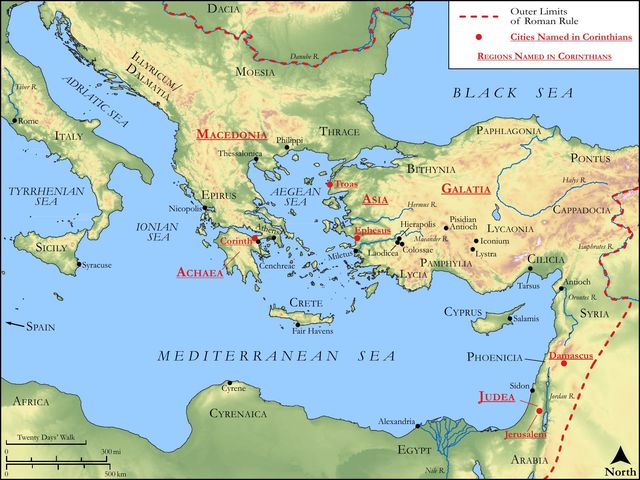

Study this verse
Public-domain commentary
Matthew Henry
From his Commentary on the Whole Bible. Henry comments on passages, not single verses — this entry covers 1 Corinthians 7:17–24. His two-level outline is real structure in the source text, so it is rendered as structure.
Here the apostle takes occasion to advise them to continue in the state and condition in which Christianity found them, and in which they became converts to it. And here,
I.He lays down this rule in general - as God hath distributed to every one.
Note, Our states and circumstances in this world are distributions of divine Providence. This fixes the bounds of men's habitations, and orders their steps. God setteth up and pulleth down. And again, As the Lord hath called every one, so let him walk. Whatever his circumstances or condition was when he was converted to Christianity, let him abide therein, and suit his conversation to it. The rules of Christianity reach every condition. And in every state a man may live so as to be a credit to it. Note, It is the duty of every Christian to suit his behaviour to his condition and the rules of religion, to be content with his lot, and conduct himself in his rank and place as becomes a Christian. The apostle adds that this was a general rule, to be observed at all times and in all places; So ordain I in all churches.
II.He specifies particular cases; as,
1.That of circumcision. Is any man called being circumcised? Let him not be uncircumcised. Is any man called being uncircumcised? Let him not be circumcised. It matters not whether a man be a Jew or Gentile, within the covenant of peculiarity made with Abraham or without it. He who is converted, being a Jew, has no need to give himself uneasiness upon that head, and wish himself uncircumcised. Nor, is he who is converted from Gentilism under an obligation to be circumcised: nor should he be concerned because he wants that mark of distinction which did heretofore belong to the people of God. For, as the apostle goes on, circumcision is nothing, and uncircumcision is nothing, but keeping the commandments of God, Co1 7:19. In point of acceptance with God, it is neither here nor there whether men be circumcised or not. Note, It is practical religion, sincere obedience to the commands of God, on which the gospel lays stress. External observances without internal piety are as nothing. Therefore let every man abide in the calling (the state) wherein he was called, Co1 7:20.
2.That of servitude and freedom. It was common in that age of the world for many to be in a state of slavery, bought and sold for money, and so the property of those who purchased them. "Now," says the apostle, "art thou called being a servant? Care not for it. Be not over-solicitous about it. It is not inconsistent with thy duty, profession, or hopes, as a Christian. Yet, if thou mayest be made free, use it rather," Co1 7:21. There are many conveniences in a state of freedom above that of servitude: a man has more power over himself, and more command of his time, and is not under the control of another lord; and therefore liberty is the more eligible state. But men's outward condition does neither hinder nor promote their acceptance with God. For he that is called being a servant is the Lord's freed-man - apeleutheros, as he that is called being free is the Lord's servant. Though he be not discharged from his master's service, he is freed from the dominion and vassalage of sin. Though he be not enslaved to Christ, yet he is bound to yield himself up wholly to his pleasure and service; and yet that service is perfect freedom. Note, Our comfort and happiness depend on what we are to Christ, not what we are in the world. The goodness of our outward condition does not discharge us from the duties of Christianity, nor the badness of it debar us from Christian privileges. He who is a slave may yet be a Christian freeman; he who is a freeman may yet be Christ's servant. He is bought with a price, and should not therefore be the servant of man. Not that he must quit the service of his master, or not take all proper measures to please him (this were to contradict the whole scope of the apostle's discourse); but he must not be so the servant of men but that Christ's will must be obeyed, and regarded, more than his master's. He has paid a much dearer price for him, and has a much fuller property in him. He is to be served and obeyed without limitation or reserve. Note, The servants of Christ should be at the absolute command of no other master besides himself, should serve no man, any further than is consistent with their duty to him. No man can serve two masters. Though some understand this passage of persons being bought out of slavery by the bounty and charity of fellow-Christians; and read the passage thus, Have you been redeemed out of slavery with a price? Do not again become enslaved; just as before he had advised that, if in slavery they had any prospect of being made free, they should choose it rather. This meaning the words will bear, but the other seems the more natural. See Co1 6:20.
III.He sums up his advice:
Let every man wherein he is called abide therein with God, Co1 7:24. This is to be understood of the state wherein a man is converted to Christianity. No man should make his faith or religion an argument to break through any natural or civil obligations. He should quietly and comfortably abide in the condition in which he is; and this he may well do, when he may abide therein with God. Note, The special presence and favour of God are not limited to any outward condition or performance. He may enjoy it who is circumcised; and so may he who is uncircumcised. He who is bound may have it as well as he who is free. In this respect there is neither Greek nor Jew, circumcision nor uncircumcision, barbarian nor Scythian, bond nor free, Col 3:11. The favour of God is not bound.
Historical interpretation
Six Centuries of Reception
3 surviving comments on this verse. Each one is dated, so this reads as a timeline rather than a list.
Select a marker to jump to its quote. Markers stagger vertically where authors wrote within a few decades of each other.
Whoever has been delivered from sin is truly free. The ancients used to say that anyone who acts unwisely is a slave. They called all wise men free, and all the unwise were slaves as far as they were concerned. In any case, even a free believer is a slave of Christ, for to be free from God is the greatest sin of all.
Next he adds also the cause; "For he that was called in the Lord being a bondservant, is the Lord's free man: likewise he that was called, being free, is Christ's bondservant." "For," saith he, "in the things that relate to Christ, both are equal: and like as thou art the slave of Christ, so also is thy master. How then is the slave a free man? Because He has freed thee not only from sin, but also from outward slavery while continuing a slave. For he suffers not the slave to be a slave, not even though he be a man abiding in slavery: and this is the great wonder.
But how is the slave a free man while continuing a slave? When he is freed from passions and the diseases of the mind: when he looks down upon riches and wrath and all other the like passions.
Paul wants to show that slave and master are equal. We are all freedmen of Christ because he has set us free from the tyranny of Satan, and we are voluntary slaves of Christ because, having set us free, he led us into his own kingdom.
Continue studying 1 Corinthians 7:22 across the web’s major study libraries — every link below opens this exact verse, chapter, or book on the destination site.
Read & Compare
 BibleGatewayThis verse in more than 200 translations and 70 languages.
 Bible.comThe YouVersion reader — hundreds of translations, reading plans, and highlights.
 ESV.orgCrossway's official English Standard Version reader.
 NET BibleThe NET translation with 60,000+ translators' notes on every rendering decision.
 STEP BibleTyndale House's free study tool — original text, vocabulary, and scholarly resources.
 BibliaLogos Bible Software's free web reader.
 USCCBThe New American Bible (Revised Edition) with the U.S. bishops' study notes.
Commentaries
 BibleHub CommentariesDozens of classic commentaries on this verse, gathered on one page.
 StudyLightMore than 100 commentary sets — the largest collection on the web.
 BibleRefPlain-English commentary on what this verse means, verse by verse.
 Enduring WordDavid Guzik's free commentary on this chapter, widely used by Bible teachers.
 Bible Study ToolsVerse commentary alongside Greek and Hebrew study aids.
Original Language & Research
- BibleHub InterlinearThe verse word by word — original language, transliteration, and English.
- BibleHub LexiconEvery word's original-language definition and Strong's entry.
 Blue Letter BibleDeep-study tools — Strong's numbers, concordance, and word studies.
 CNTR CollationThe earliest Greek manuscripts of this verse, collated letter by letter.
Sermons, Hymns & Audio


TrulyRandomVerse is not affiliated with these sites and doesn’t control their content. They’re linked because they’re genuinely useful.
Summary
In 1 Corinthians 7:22, the Apostle Paul articulates a profound spiritual paradox: regardless of one's earthly social standing, a believer's true identity and status are redefined by their relationship with Christ. He reveals that a person who is a slave in the world is spiritually liberated as "the Lord's freeman," while conversely, one who is socially free is spiritually bound as "Christ's servant," thereby emphasizing that ultimate freedom and true servitude are found exclusively in allegiance to Jesus Christ.
Context
ShowHideLiterary Context
This verse is situated within 1 Corinthians chapter 7, where Paul addresses various practical questions posed by the Corinthian church concerning marriage, singleness, and social status. His overarching principle, introduced in 1 Corinthians 7:17, is that believers should generally remain in the social and marital state they were in when they were "called" by God, unless there is a clear spiritual imperative to change. This principle aims to minimize worldly distractions and maximize devotion to the Lord. Verse 22 specifically applies this reorientation of perspective to the social institution of slavery, which was a pervasive reality in the Roman Empire, including the bustling port city of Corinth. Paul is not endorsing slavery as an institution but rather providing a theological framework for believers to understand their true identity and freedom in Christ, irrespective of their external circumstances.
Historical & Cultural Context
First-century Corinth was a major Roman city, a hub of commerce and culture, where slavery was an integral part of the social and economic fabric. Estimates suggest that a significant portion of the population in Roman society, possibly up to a third, were slaves. Slaves performed a wide range of tasks, from manual labor to highly skilled professions, and their legal status varied, though they were generally considered property. Freedmen (former slaves who had gained their freedom) also formed a distinct social class. Within this context, Paul's words would have been revolutionary. They did not abolish earthly station ("Let every man abide in the same calling wherein he was called," 7:20) but set it beneath one's standing before God. For a slave, the message of being "the Lord's freeman" offered immense dignity and hope, while for a free person, the call to be "Christ's servant" underscored humility and ultimate allegiance.
Key Themes
ShowHide1 Corinthians 7:22 powerfully contributes to several major theological and narrative themes found throughout Paul's writings and the broader New Testament. Foremost among these is the theme of Spiritual Identity Transcending Social Status. The verse asserts that a believer's ultimate worth and belonging are defined by their relationship with Christ, not by their societal position, wealth, or freedom. This aligns with Paul's broader teaching on the spiritual equality of all believers in Christ, where distinctions like "Jew or Gentile, slave or free, male or female" are rendered secondary in the new creation (Galatians 3:28). It also highlights the Paradox of Christian Freedom, where true liberation is found not in the absence of external constraints but in willing submission to Christ, turning worldly freedom into spiritual servitude and worldly servitude into spiritual freedom. This concept of ultimate Allegiance to Christ is central, emphasizing that all believers, regardless of their earthly circumstances, are ultimately "bought with a price" (1 Corinthians 6:20) and belong to God, called to serve Him above all else.
Exposition and Analysis
ShowHideKey Word Analysis
ShowHideThis term denotes a slave or bondservant, implying absolute ownership and submission, not merely a hired employee. In the context of the Roman Empire, a doûlos was property, lacking personal rights. Paul uses this term to describe both the earthly status of the slave and the spiritual status of the free person, highlighting the complete devotion expected of Christ's followers.
This word literally means "one freed away," or a freedman. It refers to a person who was formerly a slave but has been legally manumitted. Paul's use here is profoundly significant: a person who is a slave in society is, by virtue of their calling in the Lord, a "freedman" of the Lord, emphasizing that their spiritual freedom is a gift from God, transcending their earthly bondage.
This verb means "to call" (properly, aloud, but used in a variety of applications). In a theological sense, it refers to God's divine invitation, summons, or effectual call to salvation. The fact that both the slave and the free person are "called in the Lord" underscores that their spiritual transformation and new identity in Christ are the foundational truths that redefine their existence, irrespective of their social standing.
Verse Breakdown
ShowHide"For he that is called in the Lord, [being] a servant, is the Lord's freeman"
This clause addresses the believer who is socially a slave. Paul asserts that their "calling in the Lord" (God's divine summons to salvation) fundamentally redefines their status. Despite being a doûlos (slave) in the eyes of the world, they are spiritually an apeleútheros (freedman) of the Lord. Their ultimate allegiance and freedom are found in Christ, who has purchased them from the bondage of sin, granting them a spiritual liberty that no earthly master can revoke. This provides immense dignity and hope to those in the most oppressive social conditions.
"likewise also he that is called, [being] free, is Christ's servant."
This second clause presents the reciprocal truth for the believer who is socially free. Just as the slave's identity is transformed, so too is the free person's. Their "calling" means that their earthly freedom does not equate to spiritual autonomy. Instead, they are spiritually a doûlos (servant/slave) of Christ. This highlights the paradox of Christian freedom: true liberty is found in willing submission and devoted service to Christ. It is a call to humility for the socially privileged, reminding them that their highest identity and purpose are found in serving their true Master, Jesus Christ.
Literary Devices
ShowHidePaul employs several powerful literary devices in 1 Corinthians 7:22 to convey his profound theological message. The most prominent is Paradox, where seemingly contradictory truths are presented to reveal a deeper reality. The idea that a slave is truly free in the Lord, and a free person is truly a servant of Christ, challenges conventional understanding and forces the reader to consider spiritual realities over societal norms. This creates a striking contrast between earthly status and heavenly identity. Furthermore, the verse exhibits a form of Chiasm (an A-B-B'-A' structure), though not perfectly symmetrical, in its presentation of the two contrasting yet parallel statements: "called (A) in the Lord, servant (B), is the Lord's freeman (B')" followed by "likewise... called (A'), free (B''), is Christ's servant (B'')." This mirroring structure emphasizes the reciprocal nature of the spiritual transformation for both social groups. Finally, Contrast is central to the verse, juxtaposing the external, visible social status (slave vs. free) with the internal, spiritual reality (Lord's freeman vs. Christ's servant), thereby underscoring the radical reorientation of values that occurs through conversion to Christ.
Theological and Thematic Connections
ShowHide1 Corinthians 7:22 offers a profound theological statement on the nature of Christian identity and freedom. It asserts that in Christ, all worldly distinctions are relativized; one's ultimate status is defined not by societal labels but by divine calling and spiritual relationship. This verse underscores the equal standing of every believer in the body of Christ, where the servant is "the Lord's freeman" and the free man is "Christ's servant." True freedom is revealed as liberation from sin's dominion, leading to willing servitude to God, while true servitude is elevated to a privileged position of belonging to the Creator and Redeemer. This reorientation of perspective challenges believers to find their dignity and purpose in their spiritual reality, rather than in their external circumstances, fostering humility in the free and hope in the oppressed.
Reflection and Application
ShowHide1 Corinthians 7:22 remains deeply relevant for believers today, offering timeless insights into our identity, purpose, and approach to life's circumstances. It challenges us to look beyond superficial external labels—whether of success, failure, privilege, or disadvantage—and to anchor our self-worth in our divine calling. For those who feel constrained by their circumstances, it offers immense dignity and hope, reminding them that in Christ, they are truly free, possessing a spiritual liberty that transcends any earthly limitation. For those who enjoy worldly freedom or privilege, it serves as a profound call to humility, reminding them that their highest identity is as a bondservant of Christ, called to dedicate their lives to His purposes. This perspective encourages us to live with an eternal mindset, prioritizing spiritual realities and finding our ultimate joy and fulfillment in serving the Lord, knowing that true freedom is found in complete devotion to Him.
Questions for Reflection
ShowHideFAQ
ShowHideDoes this verse endorse slavery or suggest that Christians should not seek freedom from oppressive practices?
ShowHideNo, 1 Corinthians 7:22 does not endorse slavery. Paul is not making a statement on the morality or legality of the institution itself, which was a pervasive reality in the Roman Empire. Instead, he is providing a theological framework for believers to understand their spiritual identity and freedom in Christ, irrespective of their external social or economic conditions. His primary concern is the believer's spiritual state and their devotion to the Lord, encouraging them to find contentment and purpose in their calling, even within difficult circumstances. Elsewhere, Paul even suggests that if a slave has an opportunity to gain freedom, they should take it (1 Corinthians 7:21). The verse reorients the believer's perspective, emphasizing that true freedom is spiritual, found in Christ, and that all believers are ultimately servants of God.
What does it mean to be "called in the Lord"?
ShowHideTo be "called in the Lord" refers to God's divine and effectual summons to salvation. It signifies the moment a person responds to the Gospel message and enters into a saving relationship with Jesus Christ. This "calling" is not merely an invitation but an act of God's grace that fundamentally changes one's spiritual status and identity. As Paul states in Romans 8:30, "And those he predestined, he also called; those he called, he also justified; those he justified, he also glorified." It is this divine calling that transcends all earthly distinctions, making the slave "the Lord's freeman" and the free person "Christ's servant," establishing a new, spiritual reality that takes precedence over any social standing.
Christ-Centered Fulfillment
ShowHide1 Corinthians 7:22 finds its ultimate fulfillment in the person and work of Jesus Christ, who perfectly embodies both the "freeman" and the "servant" in the most profound sense. Though eternally God, Christ willingly "made himself nothing, by taking the very nature of a servant, being made in human likeness" (Philippians 2:7). He, the ultimate "freeman" in His divine sovereignty, chose the path of humble servitude, culminating in His obedient death on the cross to secure our freedom from sin and death (John 8:36). Through His redemptive work, He liberates those enslaved by sin, making them "the Lord's freeman," while simultaneously calling those who are "free" from sin's dominion to become His willing servants, dedicating their lives to Him who bought them with His precious blood (1 Peter 1:18-19). Thus, Christ is the model and the means by which all believers, regardless of their earthly status, find their true identity as both spiritually liberated and joyfully bound to Him in eternal service.