


1 Corinthians 7:21
Bible text: King James Version (1769 Blayney text) · Public domain
Bible text: Berean Standard Bible · Public domain
Bible text: American Standard Version (1901) · Public domain
Bible text: World English Bible, Messianic edition · Public domain
Bible text: Geneva Bible (1599) · Public domain
Bible text: Young's Literal Translation · Public domain
- δοῦλοςdoulosSlave [being]G1401N-NSMNoun Nominative Singular Masculine
- ἐκλήθης;eklēthēswere you called?G2564V-API-2SVerb Aorist Passive Indicative 2nd Singular
- μήmēnotG3361PRT-NNegative Particle Negative
- σοιsoiyouG4771P-2DSPersonal pronoun Dative 2nd Singular
- μελέτω·meletōshould it concernG3199V-PAM-3SVerb Present Active Imperative 3rd Singular
- ἀλλ᾽all᾽butG235CONJConjunction
- εἰeiifG1487CONDConjunction
- καὶkaievenG2532CONJConjunction
- δύνασαιdunasaiyou are ableG1410V-PNI-2SVerb Present Middle Or Passive Deponent Indicative 2nd Singular
- ἐλεύθεροςeleutherosfreeG1658A-NSMAdjective Nominative Singular Masculine
- γενέσθαιgenesthaito becomeG1096V-2ADNVerb 2nd Aorist Middle Deponent Infinitive
- μᾶλλονmallonratherG3123ADVAdverb
- χρῆσαιchrēsaido take advantageG5530V-ADM-2SVerb Aorist Middle Deponent Imperative 2nd Singular
English is a literal word-by-word gloss of the Greek, not the KJV's wording. Why?
This is the original text the KJV's translators worked from — each Greek word with its own literal English meaning in this verse, prepared by scholars at Tyndale House, Cambridge. The KJV translates whole sentences, not word by word, so its wording differs: one Greek word can become several English words, and the KJV may choose “charity” where the gloss reads “love”. Both are faithful — they answer different questions. For the KJV's own rendering, switch to the KJV text.
Details
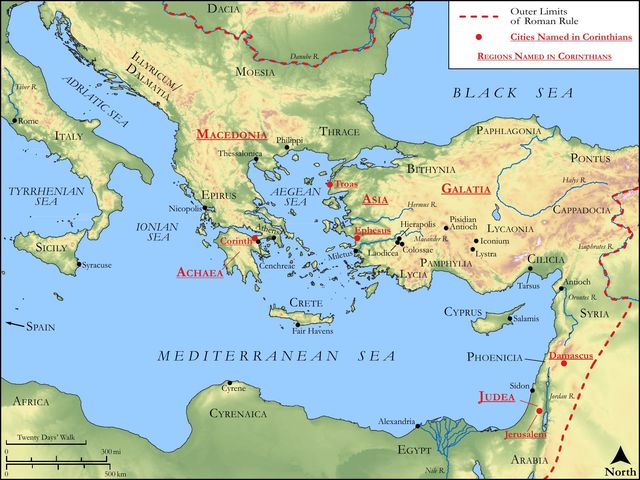
See on the biblical-era maps

Study this verse
Public-domain commentary
Matthew Henry
From his Commentary on the Whole Bible. Henry comments on passages, not single verses — this entry covers 1 Corinthians 7:17–24. His two-level outline is real structure in the source text, so it is rendered as structure.
Here the apostle takes occasion to advise them to continue in the state and condition in which Christianity found them, and in which they became converts to it. And here,
I.He lays down this rule in general - as God hath distributed to every one.
Note, Our states and circumstances in this world are distributions of divine Providence. This fixes the bounds of men's habitations, and orders their steps. God setteth up and pulleth down. And again, As the Lord hath called every one, so let him walk. Whatever his circumstances or condition was when he was converted to Christianity, let him abide therein, and suit his conversation to it. The rules of Christianity reach every condition. And in every state a man may live so as to be a credit to it. Note, It is the duty of every Christian to suit his behaviour to his condition and the rules of religion, to be content with his lot, and conduct himself in his rank and place as becomes a Christian. The apostle adds that this was a general rule, to be observed at all times and in all places; So ordain I in all churches.
II.He specifies particular cases; as,
1.That of circumcision. Is any man called being circumcised? Let him not be uncircumcised. Is any man called being uncircumcised? Let him not be circumcised. It matters not whether a man be a Jew or Gentile, within the covenant of peculiarity made with Abraham or without it. He who is converted, being a Jew, has no need to give himself uneasiness upon that head, and wish himself uncircumcised. Nor, is he who is converted from Gentilism under an obligation to be circumcised: nor should he be concerned because he wants that mark of distinction which did heretofore belong to the people of God. For, as the apostle goes on, circumcision is nothing, and uncircumcision is nothing, but keeping the commandments of God, Co1 7:19. In point of acceptance with God, it is neither here nor there whether men be circumcised or not. Note, It is practical religion, sincere obedience to the commands of God, on which the gospel lays stress. External observances without internal piety are as nothing. Therefore let every man abide in the calling (the state) wherein he was called, Co1 7:20.
2.That of servitude and freedom. It was common in that age of the world for many to be in a state of slavery, bought and sold for money, and so the property of those who purchased them. "Now," says the apostle, "art thou called being a servant? Care not for it. Be not over-solicitous about it. It is not inconsistent with thy duty, profession, or hopes, as a Christian. Yet, if thou mayest be made free, use it rather," Co1 7:21. There are many conveniences in a state of freedom above that of servitude: a man has more power over himself, and more command of his time, and is not under the control of another lord; and therefore liberty is the more eligible state. But men's outward condition does neither hinder nor promote their acceptance with God. For he that is called being a servant is the Lord's freed-man - apeleutheros, as he that is called being free is the Lord's servant. Though he be not discharged from his master's service, he is freed from the dominion and vassalage of sin. Though he be not enslaved to Christ, yet he is bound to yield himself up wholly to his pleasure and service; and yet that service is perfect freedom. Note, Our comfort and happiness depend on what we are to Christ, not what we are in the world. The goodness of our outward condition does not discharge us from the duties of Christianity, nor the badness of it debar us from Christian privileges. He who is a slave may yet be a Christian freeman; he who is a freeman may yet be Christ's servant. He is bought with a price, and should not therefore be the servant of man. Not that he must quit the service of his master, or not take all proper measures to please him (this were to contradict the whole scope of the apostle's discourse); but he must not be so the servant of men but that Christ's will must be obeyed, and regarded, more than his master's. He has paid a much dearer price for him, and has a much fuller property in him. He is to be served and obeyed without limitation or reserve. Note, The servants of Christ should be at the absolute command of no other master besides himself, should serve no man, any further than is consistent with their duty to him. No man can serve two masters. Though some understand this passage of persons being bought out of slavery by the bounty and charity of fellow-Christians; and read the passage thus, Have you been redeemed out of slavery with a price? Do not again become enslaved; just as before he had advised that, if in slavery they had any prospect of being made free, they should choose it rather. This meaning the words will bear, but the other seems the more natural. See Co1 6:20.
III.He sums up his advice:
Let every man wherein he is called abide therein with God, Co1 7:24. This is to be understood of the state wherein a man is converted to Christianity. No man should make his faith or religion an argument to break through any natural or civil obligations. He should quietly and comfortably abide in the condition in which he is; and this he may well do, when he may abide therein with God. Note, The special presence and favour of God are not limited to any outward condition or performance. He may enjoy it who is circumcised; and so may he who is uncircumcised. He who is bound may have it as well as he who is free. In this respect there is neither Greek nor Jew, circumcision nor uncircumcision, barbarian nor Scythian, bond nor free, Col 3:11. The favour of God is not bound.
Historical interpretation
Two Centuries of Reception
5 surviving comments on this verse. Each one is dated, so this reads as a timeline rather than a list.
Select a marker to jump to its quote. Markers stagger vertically where authors wrote within a few decades of each other.
The virgins of men go about, in opposition to the virgins of God, with front quite bare, excited to a rash audacity; and the semblance of virgins is exhibited by women who have the power of asking somewhat from husbands, not to say such a request as that (forsooth) their rivals-all the more "free" in that they are the "hand-maids" of Christ alone -may be surrendered to them.
I am a slave of that affair and care to which I am bound. For I know that it is written that whatever one is conquered by, to that he is delivered as a slave.… Who will free me from this most unseemly slavery except him who said, “If the Son shall make you free, you shall be free indeed”.?
Paul encourages slaves to serve their earthy masters well, so that they may appear to them to deserve their freedom. A slave who did not do his work properly would blaspheme the name of Christ and do nothing to further God’s cause.
Astonishing! where has he put slavery? As circumcision profits not: and uncircumcision does no harm; so neither doth slavery, nor yet liberty. And that he might point out this with surpassing clearness, he says, "But even if thou canst become free, use it rather:" that is, rather continue a slave. Now upon what possible ground does he tell the person who might be set free to remain a slave? He means to point out that slavery is no harm but rather an advantage.
Now we are not ignorant that some say, the words, "use it rather," are spoken with regard to liberty: interpreting it, "if thou canst become free, become free." But the expression would be very contrary to Paul's manner if he intended this. For he would not, when consoling the slave and signifying that he was in no respect injured, have told him to get free. Since perhaps some one might say, "What then, if I am not able? I am an injured and degraded person." This then is not what he says: but as I said, meaning to point out that a man gets nothing by being made free, he says, "Though thou hast it in thy power to be made free, remain rather in slavery."
Paul is saying that no slave should run away, using religion as his excuse.
Continue studying 1 Corinthians 7:21 across the web’s major study libraries — every link below opens this exact verse, chapter, or book on the destination site.
Read & Compare
 BibleGatewayThis verse in more than 200 translations and 70 languages.
 Bible.comThe YouVersion reader — hundreds of translations, reading plans, and highlights.
 ESV.orgCrossway's official English Standard Version reader.
 NET BibleThe NET translation with 60,000+ translators' notes on every rendering decision.
 STEP BibleTyndale House's free study tool — original text, vocabulary, and scholarly resources.
 BibliaLogos Bible Software's free web reader.
 USCCBThe New American Bible (Revised Edition) with the U.S. bishops' study notes.
Commentaries
 BibleHub CommentariesDozens of classic commentaries on this verse, gathered on one page.
 StudyLightMore than 100 commentary sets — the largest collection on the web.
 BibleRefPlain-English commentary on what this verse means, verse by verse.
 Enduring WordDavid Guzik's free commentary on this chapter, widely used by Bible teachers.
 Bible Study ToolsVerse commentary alongside Greek and Hebrew study aids.
Original Language & Research
- BibleHub InterlinearThe verse word by word — original language, transliteration, and English.
- BibleHub LexiconEvery word's original-language definition and Strong's entry.
 Blue Letter BibleDeep-study tools — Strong's numbers, concordance, and word studies.
 CNTR CollationThe earliest Greek manuscripts of this verse, collated letter by letter.
Sermons, Hymns & Audio


TrulyRandomVerse is not affiliated with these sites and doesn’t control their content. They’re linked because they’re genuinely useful.
Summary
1 Corinthians 7:21 offers profound counsel to believers regarding their social status, particularly concerning servitude or freedom, within the broader context of Paul's advice on living a Christian life in various circumstances. The verse encourages those called by God while enslaved not to be overly concerned with their earthly condition, yet simultaneously advises them to embrace opportunities for freedom if they arise, underscoring that spiritual identity in Christ transcends external social standing.
Context
ShowHideLiterary Context
This verse is situated within 1 Corinthians chapter 7, where the Apostle Paul addresses a series of practical questions posed by the Corinthian church concerning marriage, celibacy, and social status. Paul's overarching message throughout the chapter is a call to contentment and stability in one's current state, emphasizing that believers' primary identity and calling are in Christ, rendering external circumstances secondary. He transitions from discussing marital status (remaining single or married) to social status, applying the same principle of "remaining in the state in which one was called" to bondservants and free individuals. This particular verse directly precedes Paul's explicit declaration that "he that is called in the Lord, being a servant, is the Lord's freeman: likewise also he that is called, being free, is Christ's servant" 1 Corinthians 7:22, reinforcing the spiritual over the social.
Historical & Cultural Context
First-century Corinth was a bustling Roman provincial capital, characterized by a diverse population and significant social stratification, including a large number of enslaved people. Slavery was a pervasive institution throughout the Roman Empire, differing from later forms of chattel slavery in some respects (e.g., some enslaved people could earn money, buy their freedom, or be manumitted). Paul's audience included both free persons and bondservants. For a bondservant to become a Christian meant entering a community where, in principle, social distinctions were dissolved in Christ Galatians 3:28. This presented a unique challenge: how should a Christian slave view their earthly bondage in light of their newfound spiritual liberty? Paul's counsel is revolutionary, not advocating for social revolution, but for a radical reorientation of values based on one's relationship with God.
Key Themes
ShowHideThe verse contributes significantly to several key themes within 1 Corinthians and Paul's broader theology. A central theme is Spiritual Freedom and Identity in Christ, asserting that one's true status is defined by their relationship with God, not by societal labels. Paul consistently emphasizes that believers are "bought with a price" 1 Corinthians 6:20, belonging to Christ, which grants them a profound spiritual liberty that transcends any earthly bondage. Another theme is Contentment and Focus on God's Calling, encouraging believers not to be overly distressed by their external circumstances but to focus on serving God within their current situation. This aligns with Paul's teaching on learning to be content in all circumstances Philippians 4:11. Finally, there's a theme of Pragmatism and Wise Stewardship of Opportunity, as Paul, while advocating contentment, also advises utilizing opportunities for legitimate social improvement, demonstrating a balanced approach to Christian living that is both spiritually grounded and practically discerning.
Exposition and Analysis
ShowHideKey Word Analysis
ShowHideMeaning "to call (properly, aloud, but used in a variety of applications, directly or otherwise)." In this context, it refers to God's effectual calling to salvation, the divine invitation that brings one into a relationship with Christ. It signifies the initiation of one's Christian life, irrespective of their social standing at that moment.
Meaning "a slave (literal or figurative, involuntary or voluntary; frequently, therefore in a qualified sense of subjection or subserviency); bond(-man), servant." This term accurately reflects the legal and social reality of slavery in the Roman world. Paul's use here explicitly addresses those who were in literal legal bondage, highlighting the universal reach of the early church where even slaves were considered full members and brothers/sisters in Christ.
Meaning "unrestrained (to go at pleasure), i.e. (as a citizen) not a slave (whether freeborn or manumitted), or (genitive case) exempt (from obligation or liability); free (man, woman), at liberty." This word stands in direct contrast to doûlos, representing the state of not being enslaved, either by birth or through manumission. Paul's instruction here acknowledges the practical difference between these two states while relativizing their ultimate spiritual significance.
Verse Breakdown
ShowHide"Art thou called [being] a servant?"
This rhetorical question addresses the specific situation of a believer who was a doûlos (slave or bondservant) at the time of their conversion. It acknowledges their social reality and sets the stage for Paul's counsel. The implication is that one's social status at the point of calling does not invalidate or diminish their divine calling.
"care not for it:"
This phrase, translating the Greek mélō (G3199) combined with mḗ (G3361), means "do not be concerned about it" or "do not let it trouble you." It is not a command to be indifferent to one's condition, but rather to not be consumed by anxiety or despair over one's social bondage. The emphasis is on prioritizing one's spiritual identity and freedom in Christ over the discomfort or indignity of earthly servitude.
"but if thou mayest be made free, use [it] rather."
This clause provides a crucial qualification and practical instruction. The Greek ei kaí (G1499) "if also" or "though," combined with dýnamai (G1410) "to be able" and gínomai (G1096) "to become," indicates a real possibility. If an opportunity for manumission or legal freedom arises, the bondservant should "use it rather" (chráomai G5530, mâllon G3123). This is not a command to actively seek freedom at all costs, but an encouragement to embrace it if it legitimately becomes available, as freedom generally offers greater opportunities for service and less hindrance.
Literary Devices
ShowHidePaul employs several literary devices in this concise verse to convey his profound theological and practical advice. The initial phrase, "Art thou called [being] a servant?", functions as a Rhetorical Question, immediately engaging the audience and setting up the specific scenario for which counsel is given. This is followed by a clear Antithesis or Contrast between "care not for it" and "use it rather." While the first part encourages spiritual contentment despite social hardship, the second part offers a pragmatic allowance for improving one's external circumstances if the opportunity arises. This creates a balanced perspective, avoiding both fatalistic resignation and restless striving. The underlying message also contains a powerful Paradox: true freedom is found in Christ, regardless of one's social state, yet earthly freedom is still preferable if attainable. This highlights the tension between the spiritual reality of Christian liberty and the practical realities of human existence.
Theological and Thematic Connections
ShowHidePaul's counsel in 1 Corinthians 7:21 profoundly impacts our understanding of Christian identity and liberty. It asserts that one's standing before God is not contingent upon social status, wealth, or earthly power. In Christ, all believers, whether free or enslaved, possess an equal spiritual dignity and freedom. This radical equality undermines the hierarchical structures of the world and redefines true worth. The verse encourages a spiritual resilience that finds contentment in God's calling, while simultaneously acknowledging the practical benefits of earthly freedom. It teaches that while our primary focus should be on our relationship with Christ, we are not to be passive in the face of opportunities for legitimate improvement in our lives, especially if such improvement enables greater service or reduces hindrances.
Reflection and Application
ShowHide1 Corinthians 7:21 offers enduring wisdom for believers navigating the complexities of their social and professional lives today. It challenges us to critically examine where we derive our sense of worth and identity. Are we defined by our job titles, financial standing, social networks, or perceived successes? Or is our fundamental identity rooted in our calling as children of God, redeemed and made new in Christ? The verse encourages a profound spiritual contentment, urging us not to be consumed by anxiety or dissatisfaction over our external circumstances. This does not mean passive resignation to hardship, but rather a deep trust in God's providence and a focus on serving Him faithfully in our current sphere. Simultaneously, it provides a liberating permission to pursue opportunities for growth, advancement, or positive change if they align with God's will and do not compromise our spiritual integrity. This balance calls for discernment: to be content in the Lord, yet wise stewards of the opportunities He presents, always prioritizing our spiritual freedom and calling above all else.
Questions for Reflection
ShowHideFAQ
ShowHideDoes 1 Corinthians 7:21 endorse slavery?
ShowHideNo, 1 Corinthians 7:21 does not endorse slavery. Instead, it provides pastoral counsel to individuals living within a pervasive social system of the time. Paul's primary concern is the spiritual well-being and identity of believers, emphasizing that one's external social status (whether free or enslaved) does not diminish their spiritual standing or worth in Christ. He advises those who are enslaved not to be overly distressed by their condition, as their true freedom is found in the Lord 1 Corinthians 7:22. However, he also pragmatically encourages them to accept freedom if it becomes available. The New Testament, while not explicitly calling for the abolition of slavery, lays theological groundwork that ultimately undermines its moral legitimacy by proclaiming the radical equality and dignity of all people in Christ Galatians 3:28; Colossians 3:11).
Christ-Centered Fulfillment
ShowHide1 Corinthians 7:21 finds its ultimate fulfillment in the person and work of Jesus Christ, who is the embodiment of true freedom and the source of our spiritual identity. While Paul addresses the practicalities of social status, his underlying theological premise is that in Christ, earthly distinctions are relativized. Jesus, though "in the form of God, did not count equality with God a thing to be grasped, but emptied himself, by taking the form of a servant" Philippians 2:6-7, becoming a doûlos to redeem humanity. Through His sacrificial death and resurrection, Christ secured genuine liberty for all who believe, liberating them from the bondage of sin and death Romans 6:18. Therefore, whether one is socially free or enslaved, their ultimate freedom is found in being "the Lord's freeman" 1 Corinthians 7:22—a profound truth made possible by Christ's redemptive work. Our calling in Christ transcends any earthly label, inviting us to live as those truly set free by the Son John 8:36, whose service is perfect freedom.