


Colossians 3:11
Bible text: King James Version (1769 Blayney text) · Public domain
Bible text: King James Version with Strong's numbers · Public domain
Bible text: Berean Standard Bible · Public domain
Bible text: American Standard Version (1901) · Public domain
Bible text: World English Bible, Messianic edition · Public domain
Bible text: Geneva Bible (1599) · Public domain
Bible text: Young's Literal Translation · Public domain
- ὅπουhopouwhereG3699CONJConjunction
- οὐκouknotG3756PRT-NNegative Particle Negative
- ἔνιenithere isG1762V-PAI-3SVerb Present Active Indicative 3rd Singular
- ἝλληνHellēnGreekG1672N-NSM-LGNoun Nominative Singular Masculine Location Gentilic
- καὶkaiandG2532CONJConjunction
- ἸουδαῖοςIoudaiosJewG2453N-NSM-PGNoun Nominative Singular Masculine Person Gentilic
- περιτομὴperitomēcircumcisionG4061N-NSFNoun Nominative Singular Feminine
- καὶkaiandG2532CONJConjunction
- ἀκροβυστίαakrobustiauncircumcisionG203N-NSFNoun Nominative Singular Feminine
- βάρβαροςbarbarosBarbarianG915A-NSMAdjective Nominative Singular Masculine
- ΣκύθηςSkuthēsScythianG4658N-NSM-LGNoun Nominative Singular Masculine Location Gentilic
- δοῦλοςdoulosslaveG1401N-NSMNoun Nominative Singular Masculine
- ἐλεύθεροςeleutherosfreeG1658A-NSMAdjective Nominative Singular Masculine
- ἀλλὰallabutG235CONJConjunction
- τὰta<the>G3588T-NPNDefinite article Nominative Plural Neuter
- πάνταpantaallG3956A-NPNAdjective Nominative Plural Neuter
- καὶkaiandG2532CONJConjunction
- ἐνeninG1722PREPPreposition
- πᾶσινpasinallG3956A-DPNAdjective Dative Plural Neuter
- ΧριστόςChristosChrist [is]G5547N-NSM-TNoun Nominative Singular Masculine Title
English is a literal word-by-word gloss of the Greek, not the KJV's wording. Why?
This is the original text the KJV's translators worked from — each Greek word with its own literal English meaning in this verse, prepared by scholars at Tyndale House, Cambridge. The KJV translates whole sentences, not word by word, so its wording differs: one Greek word can become several English words, and the KJV may choose “charity” where the gloss reads “love”. Both are faithful — they answer different questions. For the KJV's own rendering, switch to the KJV text.
Details
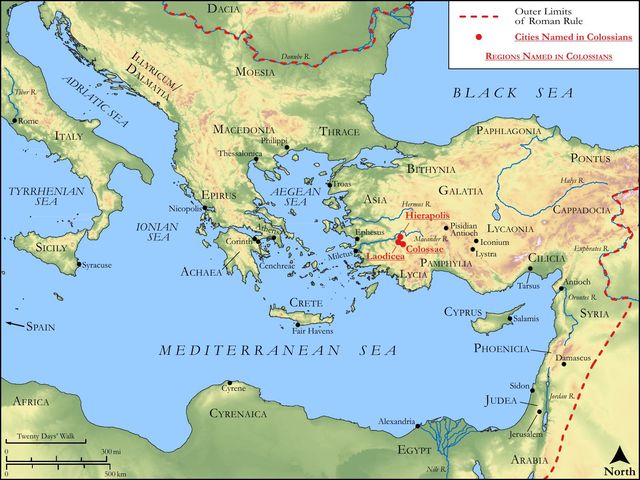
See on the biblical-era maps

Study this verse
Public-domain commentary
Matthew Henry
From his Commentary on the Whole Bible. Henry comments on passages, not single verses — this entry covers Colossians 3:8–11.
As we are to mortify inordinate appetites, so we are to mortify inordinate passions (Col 3:8): But now you also put off all these, anger wrath, malice; for these are contrary to the design of the gospel, as well as grosser impurities; and, though they are more spiritual wickedness, have not less malignity in them. The gospel religion introduces a change of the higher as well as the lower powers of the soul, and supports the dominion of right reason and conscience over appetite and passion. Anger and wrath are bad, but malice is worse, because it is more rooted and deliberate; it is anger heightened and settled. And, as the corrupt principles in the heart must be cut off, so the product of them in the tongue; as blasphemy, which seems there to mean, not so much speaking ill of God as speaking ill of men, giving ill language to them, or raising ill reports of them, and injuring their good name by any evil arts, - filthy communication, that is, all lewd and wanton discourse, which comes from a polluted mind in the speaker and propagates the same defilements in the hearers, - and lying: Lie not one to another (Col 3:9), for it is contrary both to the law of truth and the law of love, it is both unjust and unkind, and naturally tends to destroy all faith and friendship among mankind. Lying makes us like the devil (who is the father of lies), and is a prime part of the devil's image upon our souls; and therefore we are cautioned against this sin by this general reason: Seeing you have put off the old man with his deeds, and have put on the new man, Col 3:10. The consideration that we have by profession put away sin and espoused the cause and interest of Christ, that we have renounced all sin and stand engaged to Christ, should fortify us against this sin of lying. Those who have put off the old man have put it off with its deeds; and those who have put on the new man must put on all its deeds - not only espouse good principles but act them in a good conversation. The new man is said to be renewed in knowledge, because an ignorant soul cannot be a good soul. Without knowledge the heart cannot be good, Pro 19:2. The grace of God works upon the will and affections by renewing the understanding. Light is the first thing in the new creation, as it was in the first: after the image of him who created him. It was the honour of man in innocence that he was made after the image of God; but that image was defaced and lost by sin, and is renewed by sanctifying grace: so that a renewed soul is something like what Adam was in the day he was created. In the privilege and duty of sanctification there is neither Greek nor Jew, circumcision nor uncircumcision, Barbarian, Scythian, bond nor free, Col 3:11. There is now no difference arising from different country or different condition and circumstance of life: it is as much the duty of the one as of the other to be holy, and as much the privilege of the one as of the other to receive from God the grace to be so. Christ came to take down all partition-walls, that all might stand on the same level before God, both in duty and privilege. And for this reason, because Christ is all in all. Christ is a Christian's all, his only Lord and Saviour, and all his hope and happiness. And to those who are sanctified, one as well as another and whatever they are in other respects, he is all in all, the Alpha and Omega, the beginning and the end: he is all in all things to them.
Historical interpretation
Two Centuries of Reception
5 surviving comments on this verse. Each one is dated, so this reads as a timeline rather than a list.
Select a marker to jump to its quote. Markers stagger vertically where authors wrote within a few decades of each other.
And they state that it was clearly on this account that Paul said, "And He Himself is all things; "
Masters, render to your servants justice and equity; knowing that ye also have a Master in heaven, where there is neither Greek nor Jew, circumcision and uncircumcision, barbarian, Scythian, bond, free: but Christ is all, and in all."
Now, if we all have one Master, with whom is no respect of persons, since Christ is all and in all, in barbarian, Scythian, bond or free,
But God will be all in all in the time of restitution; not in the sense that the Father alone will be, and the Son be wholly resolved into him, like a torch into a great pyre, from which it was pulled away for a short time and then put back … when we shall be no longer divided (as we are now by movements and passions) and containing nothing at all of God, or very little, but then we shall be entirely like God, ready to receive into our hearts the whole God and him alone. This is the perfection to which we press on. Paul himself indeed bears witness to this.
"Where there cannot be Greek and Jew, circumcision and uncircumcision, Barbarian, Scythian, bondman, freeman: but Christ is all, and in all."
Lo! here is a third encomium of this "man." With him, there is no difference admitted either of nation, or of rank, or of ancestry, seeing he hath nothing of externals, nor needeth them; for all external things are such as these, "circumcision, and uncircumcision, bondman, freeman, Greek," that is, proselyte, "and Jew," from his ancestors. If thou have only this "man," thou wilt obtain the same things with the others that have him.
"But Christ," he saith, "is all, and in all": Christ will be all things to you, both rank, and descent, "and" Himself "in you all." Or he says another thing, to wit, that ye all are become one Christ, being His body.
Continue studying Colossians 3:11 across the web’s major study libraries — every link below opens this exact verse, chapter, or book on the destination site.
Read & Compare
 BibleGatewayThis verse in more than 200 translations and 70 languages.
 Bible.comThe YouVersion reader — hundreds of translations, reading plans, and highlights.
 ESV.orgCrossway's official English Standard Version reader.
 NET BibleThe NET translation with 60,000+ translators' notes on every rendering decision.
 STEP BibleTyndale House's free study tool — original text, vocabulary, and scholarly resources.
 BibliaLogos Bible Software's free web reader.
 USCCBThe New American Bible (Revised Edition) with the U.S. bishops' study notes.
Commentaries
 BibleHub CommentariesDozens of classic commentaries on this verse, gathered on one page.
 StudyLightMore than 100 commentary sets — the largest collection on the web.
 BibleRefPlain-English commentary on what this verse means, verse by verse.
 Enduring WordDavid Guzik's free commentary on this chapter, widely used by Bible teachers.
 Bible Study ToolsVerse commentary alongside Greek and Hebrew study aids.
Original Language & Research
- BibleHub InterlinearThe verse word by word — original language, transliteration, and English.
- BibleHub LexiconEvery word's original-language definition and Strong's entry.
 Blue Letter BibleDeep-study tools — Strong's numbers, concordance, and word studies.
 CNTR CollationThe earliest Greek manuscripts of this verse, collated letter by letter.
Sermons, Hymns & Audio


TrulyRandomVerse is not affiliated with these sites and doesn’t control their content. They’re linked because they’re genuinely useful.
Summary
Colossians 3:11 powerfully declares that in Christ, all human distinctions—ethnic, religious, cultural, and socio-economic—are transcended and rendered irrelevant for defining one's identity or standing before God. Paul asserts that the new humanity created in Christ is characterized by a profound unity, because Christ Himself is the ultimate reality and unifying principle, indwelling and encompassing all believers.
Context
ShowHideLiterary Context
Colossians 3:11 is a pivotal statement within Paul's larger exhortation to believers regarding their new life in Christ. Following the theological foundation laid in chapters 1 and 2 concerning Christ's supremacy and the believer's completeness in Him, chapter 3 shifts to practical living. Paul first calls believers to "seek those things which are above, where Christ sits on the right hand of God" (Colossians 3:1) and to "mortify therefore your members which are upon the earth" (Colossians 3:5). This involves putting off the "old man" with its sinful practices and putting on the "new man" (Colossians 3:9-10), which is being renewed in knowledge after the image of its Creator. Verse 11 directly follows this instruction, explaining the radical implications of this new identity: in this "new man," traditional human categories no longer hold sway because Christ is the defining reality for all.
Historical & Cultural Context
The Roman Empire, where Colossae was located, was deeply stratified by numerous distinctions. "Greek nor Jew" highlights the foundational ethnic and religious divide between the dominant Hellenistic culture and the Jewish people, a tension that frequently challenged the early church (Acts 6:1). "Circumcision nor uncircumcision" refers to the ritual mark of the Abrahamic covenant, a critical boundary marker for Jewish identity and a major point of contention regarding Gentile inclusion in the early church (Acts 15). "Barbarian, Scythian" represents the spectrum of perceived civilization: "Barbarian" (G915, bárbaros) was a Greek term for anyone who did not speak Greek, often implying uncivilized or uncultured, while "Scythian" (G4658, Skýthēs) referred to nomadic tribes from the Black Sea region, notorious for their perceived savagery and brutality, representing the extreme end of "otherness." Finally, "bond nor free" addresses the pervasive institution of slavery, which determined a person's social status, rights, and economic standing. Paul's enumeration systematically dismantles the very categories that defined and divided people in their society.
Key Themes
ShowHideColossians 3:11 contributes significantly to several overarching themes in the book of Colossians. First and foremost, it underscores the Supremacy of Christ, demonstrating that His person and work transcend all human-made distinctions. Secondly, it elaborates on the theme of New Life in Christ, emphasizing that believers are a "new creation" (2 Corinthians 5:17) where old identities are superseded by a shared identity in Him. This leads directly to the theme of Radical Unity and Equality within the body of Christ, dismantling barriers that historically separated people. The verse also serves as a foundational principle for the Practical Living section of Colossians, arguing that because of this profound spiritual unity, believers are called to live out their new identity by putting on virtues like compassion, kindness, humility, meekness, and patience (Colossians 3:12), and above all, love (Colossians 3:14). This unity in Christ is not merely theoretical but demands a transformed community life.
Exposition and Analysis
ShowHideKey Word Analysis
ShowHideVerse Breakdown
ShowHide"Where there is neither Greek nor Jew, circumcision nor uncircumcision, Barbarian, Scythian, bond [nor] free"
This opening clause systematically dismantles the major categories of human distinction prevalent in that day. "Greek nor Jew" addresses ethnic and religious heritage. "Circumcision nor uncircumcision" speaks to ritual and covenantal identity, a significant point of contention in early Christianity. "Barbarian, Scythian" covers cultural and societal standing, moving from those merely outside Greek culture to those considered utterly savage. "Bond nor free" refers to socio-economic status, specifically the institution of slavery. The repeated "neither... nor" (implied "nor" between Barbarian/Scythian and bond/free due to the structure) emphatically declares that these former defining distinctions are nullified in the new spiritual reality.
"but Christ [is] all, and in all"
This concluding declaration provides the profound theological reason for the nullification of human distinctions. The Greek word "but" (G235, allá) introduces a strong contrast, shifting from what is absent to what is supremely present. "Christ is all" signifies His absolute supremacy and sufficiency; He is the sum total of all that truly matters for the believer's identity, value, and purpose. "and in all" emphasizes His pervasive indwelling presence within every single believer, regardless of their former earthly status. This means that Christ Himself is the unifying principle and the very substance of the new community.
Literary Devices
ShowHidePaul employs several powerful literary devices in Colossians 3:11 to convey his message of radical unity. The most prominent is Antithesis, where he presents a series of contrasting pairs (Greek/Jew, circumcised/uncircumcised, bond/free) and a spectrum of cultural distinctions (Barbarian, Scythian) to highlight their irrelevance in Christ. This creates a Merism, where the extremes are mentioned to imply the whole, signifying that all human categories are dissolved. The structure moves from the culturally refined (Greek) to the religiously distinct (Jew), then to the ritually defined (circumcision/uncircumcision), and finally to the culturally overlooked (Barbarian/Scythian) and socially stratified (bond/free), creating a powerful Climax of dissolving distinctions. The verse culminates in a profound Summary Statement ("but Christ is all, and in all") that acts as the ultimate resolution and unifying principle, asserting Christ's comprehensive supremacy and pervasive presence as the single, overarching reality that defines the new humanity.
Theological and Thematic Connections
ShowHideColossians 3:11 articulates a foundational truth of New Testament theology: the radical equality and unity of believers in Christ. This verse underscores that the new creation inaugurated by Christ's redemptive work transcends and nullifies all human-made distinctions that once served as barriers or sources of pride and prejudice. In the divine economy, one's identity is no longer rooted in ethnicity, religious ritual, cultural background, or socio-economic status, but solely in Christ. He is the new center of gravity for humanity, forming a single, unified body where every member is equally valued and indwelt by the same Spirit. This truth dismantles hierarchical thinking within the church and calls believers to embody a counter-cultural community where Christ's presence is the defining and unifying reality.
Reflection and Application
ShowHideColossians 3:11 serves as a profound challenge and a liberating truth for believers today, calling us to actively live out the implications of our shared identity in Christ. In a world still deeply fractured by racial, ethnic, national, socio-economic, and political divisions, this verse reminds us that our primary allegiance and defining characteristic is our union with Christ. It compels us to examine our own hearts and communities: Do we truly see others through the lens of Christ, or do we allow worldly distinctions to create barriers, foster prejudice, or elevate some above others? Living out this truth means intentionally pursuing reconciliation, celebrating diversity as a manifestation of God's creative genius, and actively dismantling any structures or attitudes within the church that contradict the radical unity Christ has established. It calls us to cultivate a community where love, humility, and mutual respect prevail, demonstrating to the world that Christ truly is "all, and in all."
Questions for Reflection
ShowHideFAQ
ShowHideWhat does "Christ is all, and in all" mean?
ShowHideThis phrase is the theological climax of the verse, meaning that Christ is the supreme and ultimate reality for believers, the sum total of all that truly matters. "Christ is all" signifies His absolute sufficiency and supremacy; He is the source, substance, and goal of our new life. "And in all" means that Christ's presence indwells every single believer, unifying them regardless of their former earthly distinctions. He is the common denominator and the pervasive presence that binds the new community together. It implies that every aspect of our identity, value, and purpose is now found in Him.
Does this verse mean that cultural or ethnic identities are erased in Christianity?
ShowHideNo, Colossians 3:11 does not advocate for the erasure of cultural or ethnic identities, but rather for their reordering and redefinition under the supremacy of Christ. It means that these identities no longer serve as barriers to fellowship or as a basis for superiority or inferiority within the body of Christ. While our cultural heritage remains, our primary and most defining identity becomes our shared identity in Christ. The church is a diverse tapestry, not a monochrome canvas, where people from "every nation, tribe, people and language" (Revelation 7:9) worship together, unified by Christ, not uniformity. Our cultural distinctives can be celebrated within the context of Christian unity, enriching the body rather than dividing it.
Christ-Centered Fulfillment
ShowHideColossians 3:11 finds its ultimate fulfillment in the person and work of Jesus Christ, who is Himself the embodiment of this radical unity and the new humanity. Through His incarnation, Jesus entered into all human experience, breaking down the spiritual and social barriers that separated humanity from God and from each other. His sacrificial death on the cross did not merely reconcile individuals to God, but also "broke down the dividing wall of hostility" between Jew and Gentile, creating "one new man in place of the two" (Ephesians 2:14-16). Jesus is the "firstborn over all creation" (Colossians 1:15), the Head of the Church, and in Him "all things hold together" (Colossians 1:17). He is the "all" in whom every believer finds their true identity, purpose, and belonging, and He indwells "in all" believers through the Holy Spirit, making the church a living testament to His unifying power. Thus, Christ is not just a concept or an ideal; He is the living reality who actively brings about and sustains the profound unity described in this verse, making it possible for diverse individuals to be "one in Christ Jesus" (Galatians 3:28).