


Acts 6:1
Bible text: King James Version (1769 Blayney text) · Public domain
Bible text: King James Version with Strong's numbers · Public domain
Bible text: Berean Standard Bible · Public domain
Bible text: American Standard Version (1901) · Public domain
Bible text: World English Bible, Messianic edition · Public domain
Bible text: Geneva Bible (1599) · Public domain
Bible text: Young's Literal Translation · Public domain
- ἘνEnInG1722PREPPreposition
- δὲdenowG1161CONJConjunction
- ταῖςtais<the>G3588T-DPFDefinite article Dative Plural Feminine
- ἡμέραιςhēmeraisdaysG2250N-DPFNoun Dative Plural Feminine
- ταύταιςtautaistheseG3778D-DPFDemonstrative pronoun Dative Plural Feminine
- πληθυνόντωνplēthunontōnwhen are multiplyingG4129V-PAP-GPMVerb Present Active Participle Genitive Plural Masculine
- τῶνtōntheG3588T-GPMDefinite article Genitive Plural Masculine
- μαθητῶνmathētōndisciplesG3101N-GPMNoun Genitive Plural Masculine
- ἐγένετοegenetothere aroseG1096V-2ADI-3SVerb 2nd Aorist Middle Deponent Indicative 3rd Singular
- γογγυσμὸςgongusmosa grumblingG1112N-NSMNoun Nominative Singular Masculine
- τῶνtōnof theG3588T-GPMDefinite article Genitive Plural Masculine
- ἙλληνιστῶνHellēnistōnHellenistsG1675N-GPM-LGNoun Genitive Plural Masculine Location Gentilic
- πρὸςprosagainstG4314PREPPreposition
- τοὺςtoustheG3588T-APMDefinite article Accusative Plural Masculine
- ἙβραίουςHebraiousHebrewsG1445N-APM-PGNoun Accusative Plural Masculine Person Gentilic
- ὅτιhotibecauseG3754CONJConjunction
- παρεθεωροῦντοparetheōrountowere being overlookedG3865V-IPI-3PVerb Imperfect Passive Indicative 3rd Plural
- ἐνeninG1722PREPPreposition
- τῇtēatheG3588T-DSFDefinite article Dative Singular Feminine
- διακονίᾳdiakoniadistributionG1248N-DSFNoun Dative Singular Feminine
- τῇtēa<the>G3588T-DSFDefinite article Dative Singular Feminine
- καθημερινῇkathēmerinēadailyG2522A-DSFAdjective Dative Singular Feminine
- αἱhaitheG3588T-NPFDefinite article Nominative Plural Feminine
- χῆραιchēraiwidowsG5503N-NPFNoun Nominative Plural Feminine
- αὐτῶνautōnof themG846P-GPMPersonal pronoun Genitive Plural Masculine
English is a literal word-by-word gloss of the Greek, not the KJV's wording. Why?
This is the original text the KJV's translators worked from — each Greek word with its own literal English meaning in this verse, prepared by scholars at Tyndale House, Cambridge. The KJV translates whole sentences, not word by word, so its wording differs: one Greek word can become several English words, and the KJV may choose “charity” where the gloss reads “love”. Both are faithful — they answer different questions. For the KJV's own rendering, switch to the KJV text.
Details
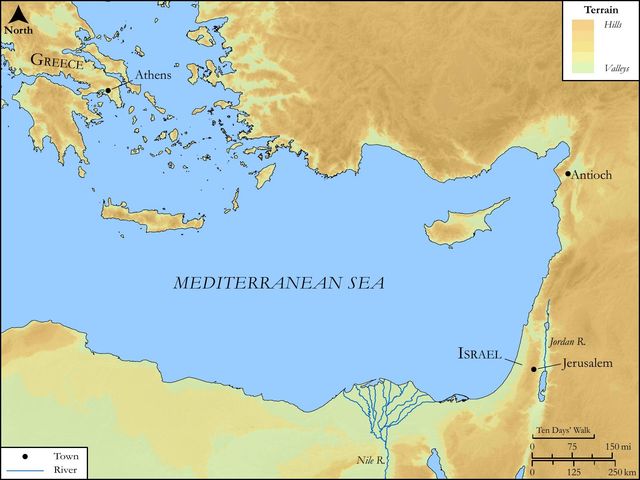
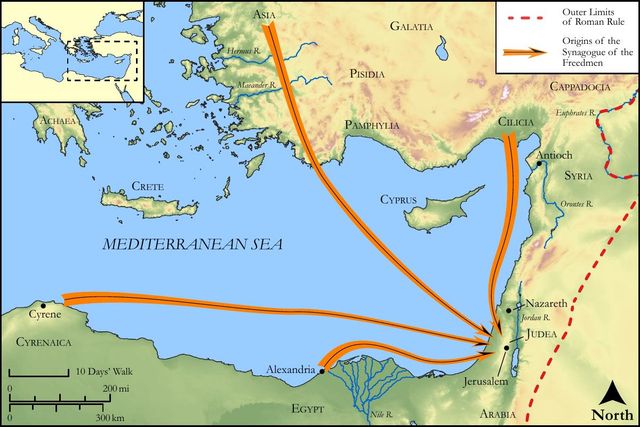
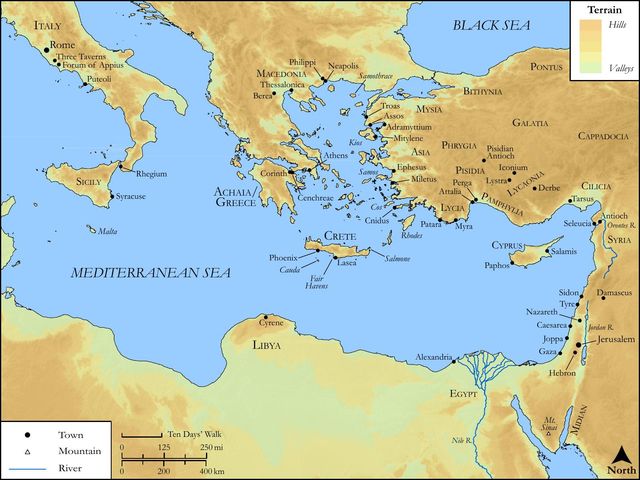
See on the biblical-era maps
Study this verse
Public-domain commentary
Matthew Henry
From his Commentary on the Whole Bible. Henry comments on passages, not single verses — this entry covers Acts 6:1–7. His four-level outline is real structure in the source text, so it is rendered as structure.
Having seen the church's struggles with her enemies, and triumphed with her in her victories, we now come to take a view of the administration of her affairs at home; and here we have,
I.An unhappy disagreement among some of the church-members, which might have been of ill consequence, but was prudently accommodated and taken up in time (Act 6:1): When the number of the disciples (for so Christians were at first called, learners of Christ) was multiplied to many thousands in Jerusalem, there arose a murmuring.
1.It does our hearts good to find that the number of the disciples is multiplied, as, no doubt, it vexed the priests and Sadducees to the heart to see it. The opposition that the preaching of the gospel met with, instead of checking its progress, contributed to the success of it; and this infant Christian church, like the infant Jewish church in Egypt, the more it was afflicted, the more it multiplied. The preachers were beaten, threatened, and abused, and yet the people received their doctrine, invited, no doubt, thereto by their wonderful patience and cheerfulness under their trials, which convinced men that they were borne up and carried on by a better spirit than their own.
2.Yet it casts a damp upon us to find that the multiplying of the disciples proves an occasion of discord. Hitherto they were all with one accord. This had been often taken notice of to their honour; but now that they were multiplied, they began to murmur; as in the old world, when men began to multiply, they corrupted themselves. Thou hast multiplied the nation, and not increased their joy, Isa 9:3. When Abraham and Lot increased their families, there was a strife between their herdsmen; so it was here: There arose a murmuring, not an open falling out, but a secret heart-burning.
(1.)The complainants were the Grecians, or Hellenists, against the Hebrews - the Jews that were scattered in Greece, and other parts, who ordinarily spoke the Greek tongue, and read the Old Testament in the Greek version, and not the original Hebrew, many of whom being at Jerusalem at the feast embraced the faith of Christ, and were added to the church, and so continued there. These complained against the Hebrews, the native Jews, that used the original Hebrew of the Old Testament. Some of each of these became Christians, and, it seems, their joint-embracing of the faith of Christ did not prevail, as it ought to have done, to extinguish the little jealousies they had one of another before their conversion, but they retained somewhat of that old leaven; not understanding, or not remembering, that in Christ Jesus there is neither Greek nor Jew, no distinction of Hebrew and Hellenist, but all are alike welcome to Christ, and should be, for his sake, dear to one another.
(2.)The complaint of these Grecians was that their widows were neglected in the daily administration, that is in the distribution of the public charity, and the Hebrew widows had more care taken of them. Observe, The first contention in the Christian church was about a money-matter; but it is a pity that the little things of this world should be makebates among those that profess to be taken up with the great things of another world. A great deal of money was gathered for the relief of the poor, but, as often happens in such cases, it was impossible to please every body in the laying of it out. The apostles, at whose feet it was laid, did their best to dispose of it so as to answer the intentions of the donors, and no doubt designed to do it with the utmost impartiality, and were far from respecting the Hebrews more than the Grecians; and yet here they are complained to, and tacitly complained of, that the Grecian widows were neglected; though they were as real objects of charity, yet they had not so much allowed them, or not to so many, or not so duly paid them, as the Hebrews. Now,
[1.]Perhaps this complaint was groundless and unjust, and there was no cause for it; but those who, upon any account, lie under disadvantages (as the Grecian Jews did, in comparison with those that were Hebrews of the Hebrews) are apt to be jealous that they are slighted when really they are not so; and it is the common fault of poor people that, instead of being thankful for what is given them, they are querulous and clamorous, and apt to find fault that more is not given them, or that more is given to others than to them; and there are envy and covetousness, those roots of bitterness, to be found among the poor as well as among the rich, notwithstanding the humbling providences they are under, and should accommodate themselves to. But,
[2.]We will suppose there might be some occasion for their complaint. First, Some suggest that though their other poor were well provided for, yet their widows were neglected, because the managers governed themselves by an ancient rule which the Hebrews observed, that a widow was to be maintained by her husband's children. See Ti1 5:4. But, Secondly, I take it that the widows are here put for all the poor, because many of those that were in the church-book, and received alms, were widows, who were well provided for by the industry of their husbands while they lived, but were reduced to straits when they were gone. As those that have the administration of public justice ought in a particular manner to protect widows from injury (Isa 1:17; Luk 18:3); so those that have the administration of public charity ought in a particular manner to provide for widows what is necessary. See Ti1 5:3. And observe, The widows here, and the other poor, had a daily ministration; perhaps they wanted forecast, and could not save for hereafter, and therefore the managers of the fund, in kindness to them, gave them day by day their daily bread; they lived from hand to mouth. Now, it seems, the Grecian widows were, comparatively, neglected. Perhaps those that disposed of the money considered that there was more brought into the fund by the rich Hebrews than by the rich Grecians, who had not estates to sell, as the Hebrews had, and therefore the poor Grecians should have less out of the fund; this, though there was some tolerant reason for it, they thought hard and unfair. Note, In the best-ordered church in the world there will be something amiss, some mal - administration or other, some grievances, or at least some complaints; those are the best that have the least and the fewest.
II.The happy accommodating of this matter, and the expedient pitched upon for the taking away of the cause of this murmuring.
The apostles had hitherto the directing of the matter. Applications were made to them, and appeals in cases of grievances. They were obliged to employ persons under them, who did not take all the care they might have taken, nor were so well fortified as they should have been against temptations to partiality; and therefore some persons must be chosen to manage this matter who have more leisure to attend to it than the apostles had, and were better qualified for the trust than those whom the apostles employed were. Now observe,
1.How the method was proposed by the apostles: They called the multitude of the disciples unto them, the heads of the congregations of Christians in Jerusalem, the principal leading men. The twelve themselves would not determine any thing without them, for in multitude of counsellors there is safety; and in an affair of this nature those might be best able to advise who were more conversant in the affairs of this life than the apostles were.
(1.)The apostles urge that they could by no means admit so great a diversion, as this would be, from their great work (Act 6:2): It is not reasonable that we should leave the word of God and serve tables. The receiving and paying of money was serving tables, too like the tables of the money-changers in the temple. This was foreign to the business which the apostles were called to. They were to preach the word of God; and though they had not such occasion to study for what they preached as we have (it being given in that same hour what they should speak), yet they thought that was work enough for a whole man, and to employ all their thoughts, and cares, and time, though one man of them was more than ten of us, than ten thousand. If they serve tables, they must, in some measure, leave the word of God; they could not attend their preaching work so closely as they ought. Pectora nostra duas non admittentia curas - These minds of ours admit not of two distinct anxious employments. Though this serving of tables was for pious uses, and serving the charity of rich Christians and the necessity of poor Christians, and in both serving Christ, yet the apostles would not take so much time from their preaching as this would require. They will no more be drawn from their preaching by the money laid at their feet than they will be driven from it by the stripes laid on their backs. While the number of the disciples was small, the apostles might manage this matter without making it any considerable interruption to their main business; but, now that their number was increased, they could not do it. It is not reason, ouk areston estin - it is not fit, or commendable, that we should neglect the business of feeding souls with the bread of life, to attend the business of relieving the bodies of the poor. Note, Preaching the gospel is the best work, and the most proper and needful that a minister can be employed in, and that which he must give himself wholly to (Ti1 4:15), which that he may do, he must not entangle himself in the affairs of this life (Ti2 2:4), no, not in the outward business of the house of God, Neh 11:16.
(2.)They therefore desire that seven men might be chosen, well qualified for the purpose, whose business it should be to serve tables, diakonein trapezais - to be deacons to the tables, Act 6:2. The business must be minded, must be better minded than it had been, and than the apostles could mind it; and therefore proper persons must be occasionally employed in the word, and prayer, were not so entirely devoted to it as the apostles were; and these must take care of the church's stock - must review, and pay, and keep accounts - must buy those things which they had need of against the feast (Joh 13:29), and attend to all those things which are necessary in ordine ad spiritualia - in order to spiritual exercises, that every thing might be done decently and in order, and no person nor thing neglected. Now,
[1.]The persons must be duly qualified. The people are to choose, and the apostles to ordain; but the people have no authority to choose, nor the apostles to ordain, men utterly unfit for the office: Look out seven men; so many they thought might suffice for the present, more might be added afterwards if there were occasion. These must be, First, Of honest report, men free from scandal, that were looked upon by their neighbours as men of integrity, and faithful men, well attested, as men that might be trusted, not under a blemish for any vice, but, on the contrary, well spoken of for every thing that is virtuous and praiseworthy; marturoumenous - men that can produce good testimonials concerning their conversation. Note, Those that are employed in any office in the church ought to be men of honest report, of a blameless, nay, of an admirable character, which is requisite not only to the credit of their office, but to the due discharge of it. Secondly, They must be full of the Holy Ghost, must be filled with those gifts and graces of the Holy Ghost which were necessary to the right management of this trust. They must not only be honest men, but they must be men of ability and men of courage; such as were to be made judges in Israel (Exo 18:21), able men, fearing God; men of truth, and hating covetousness; and hereby appearing to be full of the Holy Ghost. Thirdly, They must be full of wisdom. It was not enough that they were honest, good men, but they must be discreet, judicious men, that could not be imposed upon, and would order things for the best, and with consideration: full of the Holy Ghost, and wisdom, that is, of the Holy Ghost as a Spirit of wisdom. We find the word of wisdom given by the Spirit, as distinct form the word of knowledge by the same Spirit, Co1 12:8. Those must be full of wisdom who are entrusted with public money, that it may be disposed of, not only with fidelity, but with frugality.
[2.]The people must nominate the persons: "Look you out among yourselves seven men; consider among yourselves who are the fittest for such a trust, and whom you can with the most satisfaction confide in." They might be presumed to know better, or at least were fitter to enquire, what character men had, than the apostles; and therefore they are entrusted with the choice.
[3.]They apostles will ordain them to the service, will give them their charge, that they may know what they have to do and make conscience of doing it, and give them their authority, that the persons concerned may know whom they are to apply to, and submit to, in affairs of that nature: Men, whom we may appoint. In many editions of our English Bibles there has been an error of the press here; for they have read it, whom ye may appoint, as if the power were in the people; whereas it was certainly in the apostles: whom we may appoint over this business, to take care of it, and to see that there be neither waste nor want.
(3.)The apostles engage to addict themselves wholly to their work as ministers, and the more closely if they can but get fairly quit of this troublesome office (Act 6:4): We will give ourselves continually to prayer, and to the ministry of the word. See here,
[1.]What are the two great gospel ordinances - the word, and prayer; by these two communion between God and his people is kept up and maintained; by the word he speaks to them, and by prayer they speak to him; and these have a mutual reference to each other. By these two the kingdom of Christ must be advanced, and additions made to it; we must prophesy upon the dry bones, and then pray for a spirit of life from God to enter into them. By the word and prayer other ordinances are sanctified to us, and sacraments have their efficacy.
[2.]What is the great business of gospel ministers - to give themselves continually to prayer, and to the ministry of the word; they must still be either fitting and furnishing themselves for those services, or employing themselves in them; either publicly or privately; in the stated times, or out of them. They must be God's mouth to the people in the ministry of the word, and the people's mouth to God in prayer. In order to the conviction and conversion of sinners, and the edification and consolation of saints, we must not only offer up our prayers for them, but we must minister the word to them, seconding our prayers with our endeavours, in the use of appointed means. Nor must we only minister the word to them, but we must pray for them, that it may be effectual; for God's grace can do all without our preaching, but our preaching can do nothing without God's grace. The apostles were endued with extraordinary gifts of the Holy Ghost, tongues and miracles; and yet that to which they gave themselves continually was preaching and praying, by which they might edify the church: and those ministers, without doubt, are the successors of the apostles (not in the plenitude of the apostolical power - those are daring usurpers who pretend to this, but in the best and most excellent of the apostolical works) who give themselves continually to prayer, and to the ministry of the word; and such Christ will always be with, even to the end of the world.
2.How this proposal was agreed to, and presently put in execution, by the disciples. It was not imposed upon them by an absolute power, though they might have been bold in Christ to do this (Plm 1:8), but proposed, as that which was highly convenient, and then the saying pleased the whole multitude, Act 6:5. It pleased them to see the apostles so willing to have themselves discharged from intermeddling in secular affairs, and to transmit them to others; it pleased them to hear that they would give themselves to the word and prayer; and therefore they neither disputed the matter nor deferred the execution of it.
(1.)They pitched upon the persons. It is not probable that they all cast their eye upon the same men. Everyone had his friend, whom he thought well of. But the majority of votes fell upon the persons here named; and the rest both of the candidates and the electors acquiesced, and made no disturbance, as the members of societies in such cases ought to do. An apostle, who was an extraordinary officer, was chosen by lot, which is more immediately the act of God; but the overseers of the poor were chosen by the suffrage of the people, in which yet a regard is to be had to the providence of God, who has all men's hearts and tongues in his hand. We have a list of the persons chosen. Some think they were such as were before of the seventy disciples; but this is not likely, for they were ordained by Christ himself, long since, to preach the gospel; and there was not more reason that they should leave the word of God to serve tables than that the apostles should. It is therefore more probable that they were of those that were converted since the pouring out of the Spirit; for it was promised to all that would be baptized that they should receive the gift of the Holy Ghost; and the gift, according to that promise, is that fulness of the Holy Ghost which was required in those that were to be chosen to this service. We may further conjecture, concerning these seven,
[1.]That they were such as had sold their estates, and brought the money into the common stock; for caeteris paribus - other things being equal, those were fittest to be entrusted with the distribution of it who had been most generous in the contribution to it.
[2.]That these seven were all of the Grecian or Hellenist Jews, for they have all Greek names, and this would be most likely to silence the murmurings of the Grecians (which occasioned this institution), to have the trust lodged in those that were foreigners, like themselves, who would be sure not to neglect them. Nicolas, it is plain, was one of them, for he was a proselyte of Antioch; and some think the manner of expression intimates that they were all proselytes of Jerusalem, as he was of Antioch. The first named is Stephen, the glory of these septemviri, a man full of faith and of the Holy Ghost; he had a strong faith in the doctrine of Christ, and was full of it above most; full of fidelity, full of courage (so some), for he was full of the Holy Ghost, of his gifts and graces. He was an extraordinary man, and excelled in every thing that was good; his name signifies a crown. Phillip is put next, because he, having used this office of a deacon well, thereby obtained a good degree, and was afterwards ordained to the office of an evangelist, a companion and assistant to the apostles, for so he is expressly called, Act 21:8. Compare Eph 4:11. And his preaching and baptizing (which we read of Act 8:12) were certainly not as a deacon (for it is plain that that office was serving tables, in opposition to the ministry of the word), but as an evangelist; and, when he was preferred to that office, we have reason to think he quitted this office, as incompatible with that. As for Stephen, nothing we find done by him proves him to be a preacher of the gospel; for he only disputes in the schools, and pleads for his life at the bar, Act 6:9, and Act 7:2. The last named is Nicolas, who, some say, afterwards degenerated (as the Judas among these seven) and was the founder of the sect of the Nicolaitans which we read of (Rev 2:6, Rev 2:15), and which Christ there says, once and again, was a thing he hated. But some of the ancients clear him from this charge, and tell us that, though that vile impure sect denominated themselves from him, yet it was unjustly, and because he only insisted much upon it that those that had wives should be as though they had none, thence they wickedly inferred that those that had wives should have them in common, which therefore Tertullian, when he speaks of the community of goods, particularly excepts: Omnia indiscreta apud nos, praeter uxores - All things are common among us, except our wives. - Apol. cap, 39.
(2.)The apostles appointed them to this work of serving tables for the present, Act 6:6. The people presented them to the apostles, who approved their choice, and ordained them.
[1.]They prayed with them, and for them, that God would give them more and more of the Holy Ghost and of wisdom - that he would qualify them for the service to which they were called, and own them in it, and make them thereby a blessing to the church, and particularly to the poor of the flock. All that are employed in the service of the church ought to be committed to the conduct of the divine grace by the prayers of the church.
[2.]They laid their hands on them, that is, they blessed them in the name of the Lord, for laying on hands was used in blessing; so Jacob blessed both the sons of Joseph; and, without controversy, the less is blessed of the greater (Heb 7:7); the deacons are blessed by the apostles, and the overseers of the poor by the pastors of the congregation. Having by prayer implored a blessing upon them, they did by the laying on of hands assure them that the blessing was conferred in answer to the prayer; and this was giving them authority to execute that office, and laying an obligation upon the people to be observant of them therein.
III.The advancement of the church hereupon.
When things were thus put into good order in the church (grievances were redressed and discontents silenced) then religion got ground, Act 6:7.
1.The word of God increased. Now that the apostles resolved to stick more closely than ever to their preaching, it spread the gospel further, and brought it home with the more power. Ministers disentangling themselves from secular employments, and addicting themselves entirely and vigorously to their work, will contribute very much, as a means, to the success of the gospel. The word of God is said to increase as the seed sown increases when it comes up again thirty, sixty, a hundred fold.
2.Christians became numerous: The number of the disciples multiplied in Jerusalem greatly. When Christ was upon earth, his ministry had least success in Jerusalem; yet now that city affords most converts. God has his remnant even in the worst of places.
3.A great company of the priests were obedient to the faith. Then is the word and grace of God greatly magnified when those are wrought upon by it that were least likely, as the priests here, who either had opposed it, or at least were linked in with those that had. The priests, whose preferments arose from the law of Moses, were yet willing to let them go for the gospel of Christ; and, it should seem, they came in a body; many of them agreed together, for the keeping up of one another's credit, and the strengthening of one another's hands, to join at once in giving up their names to Christ: polis ochlos - a great crowd of priests were, by the grace of God helped over their prejudices, and were obedient to the faith, so their conversion is described.
(1.)They embraced the doctrine of the gospel; their understandings were captivated to the power of the truths of Christ, and every opposing objecting thought brought into obedience to him, Co2 10:4, Co2 10:5. The gospel is said to be made known for the obedience of faith, Rom 16:26. Faith is an act of obedience, for this is God's commandment, that we believe, Jo1 3:23.
(2.)They envinced the sincerity of their believing the gospel of Christ by a cheerful compliance with all the rules and precepts of the gospel. The design of the gospel is to refine and reform our hearts and lives; faith gives law to us, and we must be obedient to it.
Historical interpretation
Sixteen Centuries of Reception
6 surviving comments on this verse. Each one is dated, so this reads as a timeline rather than a list.
Select a marker to jump to its quote. Markers stagger vertically where authors wrote within a few decades of each other.
And they who believed from the ninth mountain, which was deserted, and had in it creeping things and wild beasts which destroy men, were the following: they who had the stains as servants, who discharged their duty ill, and who plundered widows and orphans of their livelihood.
A brother heretic emerged in Nicolaus. He was one of the seven deacons who were appointed in the Acts of the Apostles. He affirms that Darkness was seized with a concupiscence-and, indeed, a foul and obscene one-after Light: out of this permixture it is a shame to say what fetid and unclean (combinations arose).
"And in those days, when the number of the disciples was multiplied, there arose a murmuring of the Hellenists against the Hebrews, because their widows were neglected in the daily ministration." Not absolutely in those immediate days; for it is the custom of Scripture to speak of things next about to happen, as taking place in immediate succession. But by "Hellenists" I suppose he means those who spoke Greek "against the Hebrews": for they did not use the Greek language. Behold another trial! observe how from within and from without there are warrings, from the very first! And this comes of the multitude: for it is impossible to have strict order in a multitude.
"There arose a murmuring against the Hebrews" for that description of people seemed to be more honorable, "because their widows were neglected in the daily ministration." So then there was a daily ministration for the widows. And observe how he calls it a "ministration," and not directly alms: extolling by this at once the doers, and those to whom it was done. "Were neglected." This did not arise from malice, but perhaps from the carelessness of the multitude. And therefore he brought it forward openly, for this was no small evil. Observe, how even in the beginning the evils came not only from without, but also from within. For you must not look to this only, that it was set to rights, but observe that it was a great evil that it existed.
There was a complaint of the Greeks against the Hebrews. The cause of the complaint was that the Hebrews preferred their widows, as supposedly more learned, in the ministry over the widows of the Greeks.
Greeks: So they called the Jews that were born and brought up in Greece.
Continue studying Acts 6:1 across the web’s major study libraries — every link below opens this exact verse, chapter, or book on the destination site.
Read & Compare
 BibleGatewayThis verse in more than 200 translations and 70 languages.
 Bible.comThe YouVersion reader — hundreds of translations, reading plans, and highlights.
 ESV.orgCrossway's official English Standard Version reader.
 NET BibleThe NET translation with 60,000+ translators' notes on every rendering decision.
 STEP BibleTyndale House's free study tool — original text, vocabulary, and scholarly resources.
 BibliaLogos Bible Software's free web reader.
 USCCBThe New American Bible (Revised Edition) with the U.S. bishops' study notes.
Commentaries
 BibleHub CommentariesDozens of classic commentaries on this verse, gathered on one page.
 StudyLightMore than 100 commentary sets — the largest collection on the web.
 BibleRefPlain-English commentary on what this verse means, verse by verse.
 Enduring WordDavid Guzik's free commentary on this chapter, widely used by Bible teachers.
 Bible Study ToolsVerse commentary alongside Greek and Hebrew study aids.
Original Language & Research
- BibleHub InterlinearThe verse word by word — original language, transliteration, and English.
- BibleHub LexiconEvery word's original-language definition and Strong's entry.
 Blue Letter BibleDeep-study tools — Strong's numbers, concordance, and word studies.
 CNTR CollationThe earliest Greek manuscripts of this verse, collated letter by letter.
Sermons, Hymns & Audio


TrulyRandomVerse is not affiliated with these sites and doesn’t control their content. They’re linked because they’re genuinely useful.
Summary
Acts 6:1 unveils a critical internal challenge faced by the rapidly expanding early Christian community in Jerusalem. As the number of disciples grew significantly, a serious complaint arose from the Greek-speaking Jewish believers ("Grecians") against the Aramaic-speaking Jewish believers ("Hebrews"). This discontent stemmed from the perception that the widows among the Grecians were being overlooked or neglected in the daily distribution of food and resources, highlighting the practical complexities of managing a burgeoning and diverse spiritual movement.
Context
ShowHideLiterary Context
This verse marks a pivotal shift in the narrative of the Book of Acts. Following the powerful outpouring of the Holy Spirit at Pentecost in Acts 2, the apostles' bold preaching led to an explosive growth in the number of believers. The early church was characterized by profound unity, devotion to apostolic teaching, fellowship, breaking of bread, and prayer, as described in Acts 2:42-47. They also practiced a radical form of communal sharing, selling possessions and distributing to all as any had need (Acts 4:32-37). Acts 6:1 introduces the first significant internal conflict within this otherwise harmonious community, demonstrating that even Spirit-filled growth brings administrative and social challenges. This problem directly leads to the apostles' decision to delegate responsibilities, setting the stage for the appointment of the first deacons in the subsequent verses (Acts 6:2-4).
Historical & Cultural Context
The distinction between "Grecians" (Hellenists) and "Hebrews" was a significant cultural and linguistic divide within first-century Judaism, which naturally extended into the early church. "Hebrews" were Aramaic-speaking Jews, typically native to Judea, who maintained traditional Jewish customs and language. "Grecians" or "Hellenistic Jews" were Greek-speaking Jews, often from the Diaspora (those who lived outside Judea), who were more assimilated into Hellenistic culture and spoke Koine Greek as their primary language. While both groups were Jewish, their differing cultural backgrounds and linguistic preferences could lead to misunderstandings or perceived biases, especially in a practical matter like daily food distribution. Widows, in that society, were particularly vulnerable, often lacking male family members for support and relying on community or charitable aid. Both Jewish tradition (Deuteronomy 14:29, Isaiah 1:17) and Jesus's teachings emphasized the importance of caring for widows, making their neglect a serious breach of societal and spiritual responsibility.
Key Themes
ShowHideActs 6:1 introduces several crucial themes that resonate throughout the New Testament. Firstly, it highlights the Challenges of Growth, demonstrating that while numerical expansion is a blessing, it inevitably introduces administrative complexities and potential for internal friction. The church, despite being divinely empowered, was still composed of imperfect human beings navigating practical issues. Secondly, the verse underscores the importance of Unity Amidst Diversity. The early church was a melting pot of various Jewish backgrounds, and the conflict between Grecians and Hebrews illustrates the ongoing need to bridge cultural and linguistic divides to maintain the "unity of the Spirit in the bond of peace" (Ephesians 4:3). Thirdly, it emphasizes the church's enduring responsibility for Care for the Vulnerable. The neglect of widows was a serious issue, reflecting a failure in practical compassion and justice, a principle foundational to "pure and undefiled religion" (James 1:27). Finally, the "murmuring" itself sets the stage for the theme of Proactive Problem Solving and Delegation, as the apostles wisely address the issue by establishing new roles within the church (Acts 6:2-4), ensuring that practical needs are met without compromising their primary spiritual duties.
Exposition and Analysis
ShowHideKey Word Analysis
ShowHideThis verb means "to increase" or "to abound," used transitively or intransitively. In this context, it describes the rapid and significant growth in the number of disciples, indicating a flourishing movement but also the logistical strain that such expansion inevitably brings. The multiplication of believers is a recurring theme in Acts, signifying God's blessing and the power of the gospel.
This noun denotes a "grumbling" or "complaint," often expressed in low tones or privately. The term carries a negative connotation, reminiscent of the Israelites' complaints against Moses and God in the wilderness (e.g., Exodus 16:7-9 in the Septuagint). Its presence here indicates a deep-seated dissatisfaction and potential for division within the early church, requiring immediate and careful attention.
This word refers to "attendance," "service," or "ministry." Here, it specifically denotes the practical service of distributing food or aid to those in need, particularly the widows. This term is significant as it is the root from which the word "deacon" (Greek, diakonos, meaning "servant") is derived, foreshadowing the establishment of new roles dedicated to this very type of practical service. It highlights the early church's commitment to tangible care for its members.
Verse Breakdown
ShowHide"¶ And in those days, when the number of the disciples was multiplied,"
This opening clause establishes the temporal setting ("in those days," referring to the period immediately following Pentecost and the initial growth of the church) and the foundational condition for the ensuing problem. The "multiplication" of disciples signifies God's blessing and the effectiveness of the apostles' ministry, but also implies increased logistical and administrative challenges for the burgeoning community.
"there arose a murmuring of the Grecians against the Hebrews,"
This identifies the core conflict and the parties involved. A "murmuring" (a grumbling complaint) emerged, indicating internal discontent rather than external persecution. The division was along cultural and linguistic lines: "Grecians" (Hellenistic, Greek-speaking Jews) felt aggrieved by "Hebrews" (Aramaic-speaking, more traditional Jews), suggesting a perceived favoritism or oversight in the church's operations.
"because their widows were neglected in the daily ministration."
This clause specifies the precise reason for the complaint. The "daily ministration" refers to the regular distribution of food or resources to the needy, a vital aspect of the early church's communal life. The "neglect" of the Grecians' widows implies an unintentional oversight, a pervasive flaw, or perhaps an unconscious bias in the distribution process, which was a serious matter given the vulnerability of widows and the church's commitment to their care.
Literary Devices
ShowHideLuke, as a meticulous historian and skilled writer, employs several literary devices in Acts 6:1. The most prominent is Contrast, specifically between the "Grecians" and the "Hebrews." This highlights the internal diversity within the early Jewish Christian community and sets the stage for the resolution that promotes unity. There is also an element of Understatement or Euphemism in the word "neglected," which, while accurate, might subtly downplay the severity of the oversight from the perspective of the aggrieved widows. The "murmuring" itself serves as a Motif, echoing the complaints of the Israelites in the wilderness narratives, thereby subtly linking the early church's struggles to the broader history of God's people. Furthermore, this verse functions as a Foreshadowing device, signaling the administrative crisis that will necessitate the appointment of the Seven, thereby introducing a new dimension of leadership and service within the burgeoning Christian movement. The entire passage is presented as a Historical Narrative, characteristic of Luke's writing, providing an objective account of a real challenge and its resolution within the nascent church.
Theological and Thematic Connections
ShowHideActs 6:1 reveals that even a Spirit-filled community, operating under divine guidance, is not immune to practical challenges and human imperfections. The "murmuring" underscores the reality that rapid growth, while a sign of God's blessing, necessitates wise and equitable administration to prevent internal division. The theological imperative to care for the vulnerable, particularly widows, is paramount, reflecting God's own character and the ethical demands of the gospel. This incident serves as a crucial reminder that genuine faith must manifest in tangible acts of justice and compassion, ensuring that no one within the community is overlooked. The church's response, detailed in subsequent verses, demonstrates the importance of addressing grievances promptly and strategically, prioritizing both spiritual ministry and practical service to maintain unity and fulfill its mission.
Reflection and Application
ShowHideActs 6:1 provides invaluable lessons for the church today, regardless of its size or context. It reminds us that growth, while a blessing, often brings with it the need for intentional organization and sensitive leadership. Are we, as a community, attentive to the needs and potential grievances of all our members, especially those who might be overlooked or less vocal? The "murmuring" of the Grecians serves as a powerful reminder that unspoken discontent, if left unaddressed, can fester and lead to significant division. True spiritual health requires not only fervent worship and sound teaching but also compassionate and equitable practical service. Leaders must be willing to listen, find the causes of neglect, and delegate responsibilities wisely, empowering others to serve where needs arise. This ensures that the church remains a place where all are valued, cared for, and able to participate fully in the life and mission of the body of Christ, reflecting God's heart for justice and mercy.
Questions for Reflection
ShowHideFAQ
ShowHideWho were the "Grecians" and "Hebrews" mentioned in this verse?
ShowHideThe "Grecians" (Greek, Hellēnistai) were Greek-speaking Jews, typically from the Diaspora (Jewish communities outside Judea) who had settled in Jerusalem or were visiting. They often had a more Hellenized (Greek) cultural outlook, even while adhering to Judaism. The "Hebrews" (Greek, Hebraioi) were Aramaic-speaking Jews, usually native to Judea, who maintained more traditional Jewish customs and spoke Aramaic (a language closely related to Hebrew) as their primary tongue. This distinction was primarily linguistic and cultural, not ethnic, as both groups were ethnically Jewish. The early church, being predominantly Jewish at this stage, naturally inherited these pre-existing cultural fault lines, as seen in the diverse origins of the Jews present at Pentecost in Acts 2:5-11.
Why were "widows" specifically mentioned as being neglected?
ShowHideIn ancient Near Eastern societies, including Jewish culture, widows were a particularly vulnerable demographic. Without a husband, they often lacked a male provider or protector and could easily fall into poverty or exploitation. Both Old Testament law and Jewish tradition placed a strong emphasis on caring for widows, along with orphans and foreigners, as a mark of righteousness and piety (e.g., Deuteronomy 14:29). The early Christian church, following Jesus's teachings, continued this commitment to care for the needy. Therefore, the neglect of widows was not merely a logistical oversight but a serious failure in compassion and adherence to a core tenet of their faith. Later, the Apostle Paul would also give instructions regarding the care of widows in 1 Timothy 5:3-16.
What was the "daily ministration"?
ShowHideThe "daily ministration" (Greek, diakonía) refers to the regular, systematic distribution of food, money, or other necessities to the needy members of the early Christian community, particularly the poor and vulnerable like widows. This practice was an outgrowth of the early church's communal sharing and radical generosity, where believers sold possessions and distributed the proceeds "as any had need" (Acts 4:35). It was a practical expression of their love and solidarity, ensuring that no one among them suffered want. The term diakonía itself is significant, as it is the root of the word "deacon," highlighting that this practical service was a foundational aspect of ministry in the nascent church.
Christ-Centered Fulfillment
ShowHideActs 6:1, while detailing an internal church conflict, ultimately points to the very heart of Christ's mission and character. The "daily ministration" to widows mirrors Jesus's own profound compassion for the lowly and vulnerable, consistently demonstrating His care for the poor, the sick, and those overlooked by society. His parables, such as the sheep and the goats, explicitly state that true service to Him is manifest in tangible acts of kindness to "the least of these" (Matthew 25:35-40). Furthermore, the "murmuring" between Grecians and Hebrews highlights the human tendency towards division, a stark contrast to Christ's fervent prayer for unity among His followers (John 17:20-23). The solution to this conflict, the appointment of the Seven, exemplifies the Christ-like principle of humble service, as Jesus Himself declared that He "did not come to be served, but to serve, and to give his life as a ransom for many" (Mark 10:45). Thus, this passage underscores that the church, as the body of Christ, is called to embody His self-giving love, His unifying spirit, and His unwavering commitment to justice and care for all, especially those in greatest need, thereby reflecting the very nature of God's kingdom.