


Acts 8:12
Bible text: King James Version (1769 Blayney text) · Public domain
Bible text: King James Version with Strong's numbers · Public domain
Bible text: Berean Standard Bible · Public domain
Bible text: American Standard Version (1901) · Public domain
Bible text: World English Bible, Messianic edition · Public domain
Bible text: Geneva Bible (1599) · Public domain
Bible text: Young's Literal Translation · Public domain
- ὅτεhoteWhenG3753CONJConjunction
- δὲdehoweverG1161CONJConjunction
- ἐπίστευσανepisteusanthey believedG4100V-AAI-3PVerb Aorist Active Indicative 3rd Plural
- τῷtō<the>G3588T-DSMDefinite article Dative Singular Masculine
- ΦιλίππῳPhilippōPhilipG5376N-DSM-PNoun Dative Singular Masculine Individual
- εὐαγγελιζομένῳeuangelizomenōevangelisingG2097V-PMP-DSMVerb Present Middle Participle Dative Singular Masculine
- τὰta<the>G3588T-APNDefinite article Accusative Plural Neuter
- περὶpericoncerningG4012PREPPreposition
- τῆςtēstheG3588T-GSFDefinite article Genitive Singular Feminine
- βασιλείαςbasileiaskingdomG932N-GSFNoun Genitive Singular Feminine
- τοῦtou<the>G3588T-GSMDefinite article Genitive Singular Masculine
- θεοῦtheouof GodG2316N-GSM-TNoun Genitive Singular Masculine Title
- καὶkaiandG2532CONJConjunction
- τοῦtoutheG3588T-GSNDefinite article Genitive Singular Neuter
- ὀνόματοςonomatosnameG3686N-GSNNoun Genitive Singular Neuter
- τοῦtou<the>G3588T-GSMDefinite article Genitive Singular Masculine
- ἸησοῦIēsouof JesusG2424N-GSM-PNoun Genitive Singular Masculine Individual
- ΧριστοῦChristouChristG5547N-GSM-TNoun Genitive Singular Masculine Title
- ἐβαπτίζοντοebaptizontothey were baptizedG907V-IPI-3PVerb Imperfect Passive Indicative 3rd Plural
- ἄνδρεςandresmenG435N-NPMNoun Nominative Plural Masculine
- τεtebothG5037CONJConjunction
- καὶkaiandG2532CONJConjunction
- γυναῖκεςgunaikeswomenG1135N-NPFNoun Nominative Plural Feminine
English is a literal word-by-word gloss of the Greek, not the KJV's wording. Why?
This is the original text the KJV's translators worked from — each Greek word with its own literal English meaning in this verse, prepared by scholars at Tyndale House, Cambridge. The KJV translates whole sentences, not word by word, so its wording differs: one Greek word can become several English words, and the KJV may choose “charity” where the gloss reads “love”. Both are faithful — they answer different questions. For the KJV's own rendering, switch to the KJV text.
Details
See on the biblical-era maps
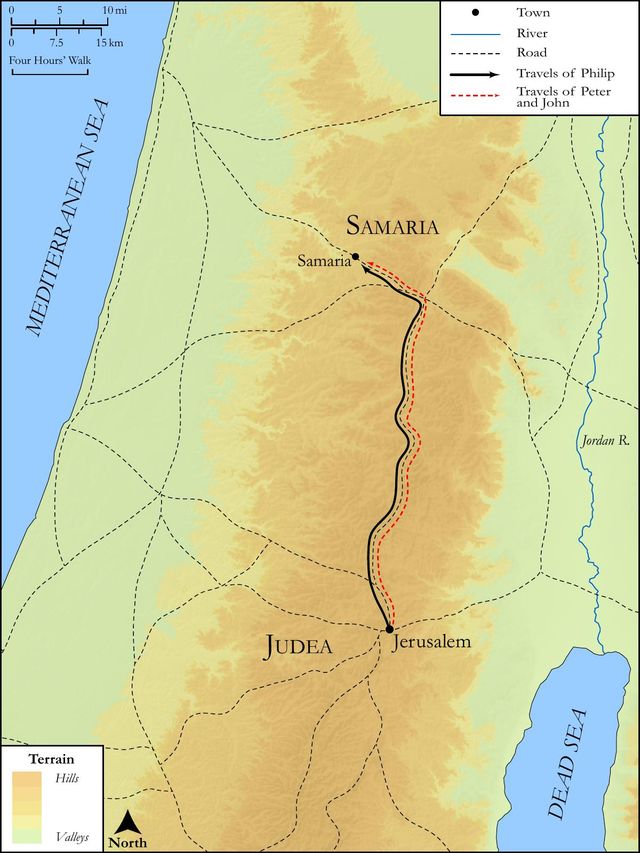
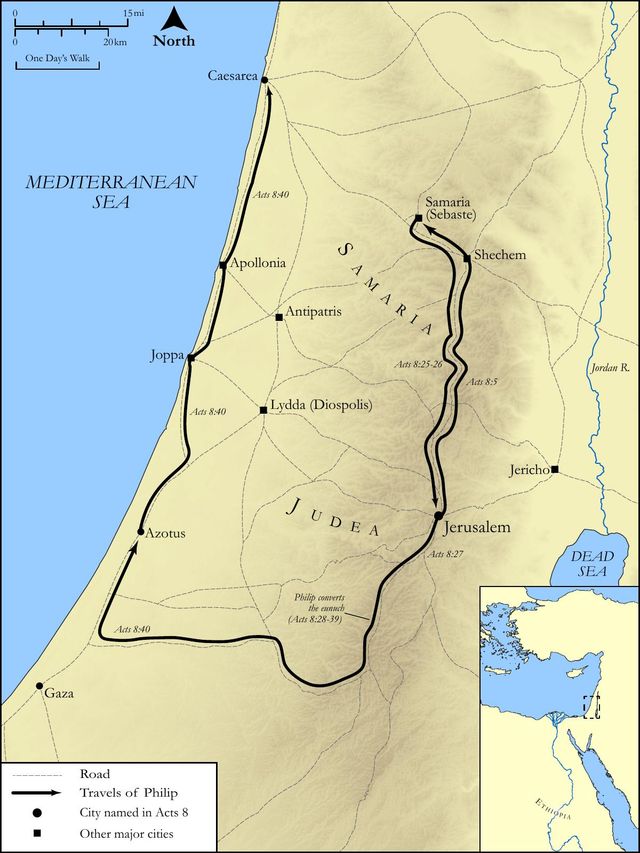
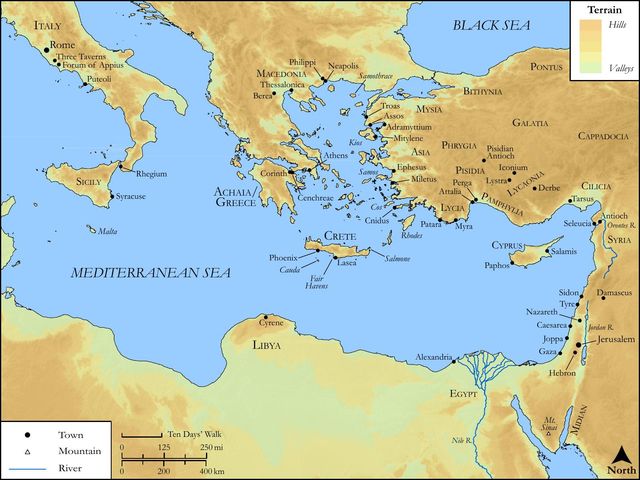
Study this verse
Public-domain commentary
Matthew Henry
From his Commentary on the Whole Bible. Henry comments on passages, not single verses — this entry covers Acts 8:4–13. His four-level outline is real structure in the source text, so it is rendered as structure.
Samson's riddle is here again unriddled: Out of the eater comes forth meat, and out of the strong sweetness. The persecution that was designed to extirpate the church was by the overruling providence of God made an occasion of the enlargement of it. Christ had said, I am come to send fire on the earth; and they thought, by scattering those who were kindled with that fire, to have put it out, but instead of this they did but help to spread it.
I.Here is a general account of what was done by them all (Act 8:4):
They went every where, preaching the word. They did not go to hide themselves for fear of suffering, no, nor to show themselves as proud of their sufferings; but they went up and down to scatter the knowledge of Christ in every place where they were scattered. They went every where, into the way of the Gentiles, and the cities of the Samaritans, which before they were forbidden to go into, Mat 10:5. They did not keep together in a body, though this might have been a strength to them; but they scattered into all parts, not to take their ease, but to find out work. They went evangelizing the world, preaching the word of the gospel; it was this which filled them, and which they endeavoured to fill the country with, those of them that were preachers in their preaching, and others in their common converse. They were now in a country where they were no strangers, for Christ and his disciples had conversed much in the regions of Judea; so that they had a foundation laid there for them to build upon; and it would be requisite to let the people there know what that doctrine which Jesus had preached there some time ago was come to, and that it was not lost and forgotten, as perhaps they were made to believe.
II.A particular account of what was done by Philip.
We shall hear of the progress and success of others of them afterwards (Act 11:19), but here must attend the motions of Philip, not Philip the apostle, but Philip the deacon, who was chosen and ordained to serve tables, but having used the office of a deacon well he purchased to himself a good degree, and great boldness in the faith, Ti1 3:13. Stephen was advanced to the degree of a martyr, Philip to the degree of an evangelist, which when he entered upon, being obliged by it to give himself to the word and prayer, he was, no doubt, discharged from the office of a deacon; for how could he serve tables at Jerusalem, which by that office he was obliged to do, when he was preaching in Samaria? And it is probable that two others were chosen in the room of Stephen and Philip. Now observe,
1.What wonderful success Philip had in his preaching, and what reception he met with.
(1.)The place he chose was the city of Samaria, the head city of Samaria, the metropolis of that country, which stood where the city of Samaria had formerly stood, of the building of which we read, Kg1 16:24, now called Sebaste. Some think it was the same with Sychem or Sychar, that city of Samaria where Christ was, Joh 4:5. Many of that city then believed in Christ, though he did no miracle among them (Act 8:39, 41), and now Philip, three years after, carries on the work then begun. The Jews would have no dealings with the Samaritans; but Christ sent his gospel to slay all enmities, and particularly that between the Jews and the Samaritans, by making them one in his church.
(2.)The doctrine he preached was Christ; for he determined to know nothing else. He preached Christ to them; he proclaimed Christ to them (so the word signifies), as a king, when he comes to the crown, is proclaimed throughout his dominions. The Samaritans had an expectation of the Messiah's coming, as appears by Joh 4:25. Now Philip tells them that he is come, and that the Samaritans are welcome to him. Ministers' business is to preach Christ - Christ, and him crucified - Christ, and him glorified.
(3.)The proofs he produced for the confirmation of his doctrine were miracles, Act 8:6. To convince them that he had his commission from heaven (and therefore not only they might venture upon what he said, but they were bound to yield to it), he shows them this broad seal of heaven annexed to it, which the God of truth would never put to a lie. The miracles were undeniable; they heard and saw the miracles which he did. They heard the commanding words he spoke, and saw the amazing effects of them immediately; that he spoke, and it was done. And the nature of the miracles was such as suited the intention of his commission, and gave light and lustre to it.
[1.]He was sent to break the power of Satan; and, in token of this, unclean spirits, being charged in the name of the Lord Jesus to remove, came out of many that were possessed with them, Act 8:7. As far as the gospel prevails, Satan is forced to quit his hold of men and his interest in them, and then those are restored to themselves, and to their right mind again, who, while he kept possession, were distracted. Wherever the gospel gains the admission and submission it ought to have, evil spirits are dislodged, and particularly unclean spirits, all inclinations to the lusts of the flesh, which war against the soul; for God has called us from uncleanness to holiness, Th1 4:7. This was signified by the casting of these unclean spirits out of the bodies of people, who, it is here said, came out crying with a loud voice, which signifies that they came out with great reluctancy, and sorely against their wills, but were forced to acknowledge themselves overcome by a superior power, Mar 1:26; Mar 3:11; Mar 9:26.
[2.]He was sent to heal the minds of men, to cure a distempered world, and to put it into a good state of health; and, in token of this, many that were taken with palsies, and that were lame, were healed. Those distempers are specified that were most difficult to be cured by the course of nature (that the miraculous cure might be the more illustrious), and those that were most expressive of the disease of sin and that moral impotency which the souls of men labour under as to the service of God. The grace of God in the gospel is designed for the healing of those that are spiritually lame and paralytic, and cannot help themselves, Rom 5:6.
(4.)The acceptance which Philip's doctrine, thus proved, met with in Samaria (Act 8:6): The people with one accord gave heed to those things which Philip spoke, induced thereto by the miracles which served at first to gain attention, and so by degrees to gain assent. There then begin to be some hopes of people when they begin to take notice of what is said to them concerning the things of their souls and eternity - when they begin to give heed to the word of God, as those that are well pleased to hear it, desirous to understand and remember it, and that look upon themselves as concerned in it. The common people gave heed to Philip, oi ochloi - a multitude of them, not here and there one, but with one accord; they were all of a mind, that it was fit the doctrine of the gospel should be enquired into, and an impartial hearing given to it.
(5.)The satisfaction they had in attending on, and attending to, Philip's preaching, and the success it had with many of them (Act 8:8): There was great joy in that city; for (Act 8:12) they believed Philip, and were baptized into the faith of Christ, the generality of them, both men and women. Observe,
[1.]Philip preached the things concerning the kingdom of God, the constitution of that kingdom, the laws and ordinances of it, the liberties and privileges of it, and the obligations we are all under to be the loyal subjects of that kingdom; and he preached the name of Jesus Christ, as king of that kingdom - his name, which is above every name. He preached it up in its commanding power and influence - all that by which he has made himself known.
[2.]The people not only gave heed to what he said, but at length believed it, were fully convinced that it was of God and not of men, and gave up themselves to the direction and government of it. As to this mountain, on which they had hitherto worshipped God, and placed a great deal of religion in it, they were now as much weaned from it as every they had been wedded to it, and become the true worshippers, who worship the Father in spirit and in truth, and in the name of Christ, the true temple, Joh 4:20-23.
[3.]When they believed, without scruple (though they were Samaritans) and without delay they were baptized, openly professed the Christian faith, promised to adhere to it, and then, by washing them with water, were solemnly admitted into the communion of the Christian church, and owned as brethren by the disciples. Men only were capable of being admitted into the Jewish church by circumcision; but, to show that in Jesus Christ there is neither male nor female (Gal 3:28), but both are alike welcome to him, the initiating ordinance is such as women are capable of, for they are numbered with God's spiritual Israel, though not with Israel according to the flesh, Num 1:2. And hence it is easily gathered that women are to be admitted to the Lord's supper, though it does not appear that there were any among those to whom it was first administered.
[4.]This occasioned great joy; each one rejoiced for himself, as he in the parable who found the treasure hid in the field; and they all rejoiced for the benefit hereby brought to their city, and that it came without opposition, which it would scarcely have done if Samaria had been within the jurisdiction of the chief priests. Note, The bringing of the gospel to any place is just matter of joy, of great joy, to that place. Hence the spreading of the gospel in the world is often prophesied of in the Old Testament as the diffusing of joy among the nations: Let the nations be glad and sing for joy, Psa 67:4; Th1 1:6. The gospel of Christ does not make men melancholy, but fills them with joy, if it be received as it should be; for it is glad tidings of great joy to all people, Luk 2:10.
2.What there was in particular at this city of Samaria that made the success of the gospel there more than ordinarily wonderful.
(1.)That Simon Magus had been busy there, and had gained a great interest among the people, and yet they believed the things that Philip spoke. To unlearn that which is bad proves many times a harder task than to learn that which is good. These Samaritans, though they were not idolaters as the Gentiles, nor prejudiced against the gospel by traditions received from their fathers, yet had of late been drawn to follow Simon, a conjurer (For so Magus signifies) who made a mighty noise among them, and had strangely bewitched them. We are told,
[1.]How strong the delusion of Satan was by which they were brought into the interests of this great deceiver. He had been for some time, nay, for a long time, in this city, using sorceries; perhaps he came there by the instigation of the devil, soon after our Saviour had been there, to undo what he had been doing there; for it was always Satan's way to crush a good work in its bud and infancy, Co2 11:3; Th1 3:5. Now,
First, Simon assumed to himself that which was considerable: He gave out that he himself was some great one, and would have all people to believe so and to pay him respect accordingly; and then, as to every thing else, they might do as they pleased. He had no design to reform their lives, nor improve their worship and devotion, only to make them believe that he was, tis megas - some divine person. Justin Martyr says that he would be worshipped as prōton theon - the chief god. He gave out himself to be the Son of God, the Messiah, so some think; or to be an angel, or a prophet. Perhaps he was uncertain within himself what title of honour to pretend to; but he would be thought some great one. Pride, ambition, and an affectation of grandeur, have always been the cause of abundance of mischief both to the world and to the church.
Secondly, The people ascribed to him what he pleased. 1. They all gave heed to him, from the least to the greatest, both young and old, both poor and rich, both governors and governed. To him they had regard (Act 8:10, Act 8:11), and perhaps the more because the time fixed for the coming of the Messiah had now expired, which had raised a general expectation of the appearing of some great one about this time. Probably he was a native of their country, and therefore they embraced him the more cheerfully, that by giving honour to him they might reflect it upon themselves. 2. They said of him, This man is the great power of God - the power of God, that great power (so it might be read), that power which made the world. See how ignorant inconsiderate people mistake that which is done by the power of Satan, as if it were done by the power of God. Thus, in the Gentile world, devils pass for deities; and in the antichristian kingdom all the world wonders after a beast, to whom the dragon gives his power, and who opens his mouth in blasphemy against God, Rev 13:2-5. 3. They were brought to it by his sorceries: He bewitched the people of Samaria (Act 8:9), bewitched them with sorceries (Act 8:11), that is, either, (1.) By his magic arts he bewitched the minds of the people, at least some of them, who drew in others. Satan, by God's permission, filled their hearts to follow Simon. O foolish Galatians, saith Paul, who hath bewitched you? Gal 3:1. These people are said to be bewitched by Simon, because they were so strangely infatuated to believe a lie. Or, (2.) By his magic arts he did many signs and lying wonders, which seemed to be miracles, but really were not so: like those of the magicians of Egypt, and those of the man of sin, Th2 2:9. When they knew no better, they were influenced by his sorceries; but, when they were acquainted with Philip's real miracles, they saw plainly that the one was real and the other a sham, and that there was as much difference as between Aaron's rod and those of the magicians. What is the chaff to the wheat? Jer 23:28.
Thus, notwithstanding the influence Simon Magus had had upon them, and the unwillingness there generally is in people to own themselves in an error, and to retract it, yet, when they saw the difference between Simon and Philip, they quitted Simon, gave heed no longer to him, but to Philip: and thus you see,
[2.]How strong the power of Divine grace is, by which they were brought to Christ, who is truth itself, and was, as I may say, the great undeceiver. By that grace working with the word those that had been led captive by Satan were brought into obedience to Christ. Where Satan, as a strong man armed, kept possession of the palace, and thought himself safe, Christ, as a stronger than he, dispossessed him, and divided the spoil; led captivity captive, and made those the trophies of his victory whom the devil had triumphed over. Let us not despair of the worst, when even those whom Simon Magus had bewitched were brought to believe.
(2.)Here is another thing yet more wonderful, that Simon Magus himself became a convert to the faith of Christ, in show and profession, for a time. Is Saul also among the prophets? Yes (Act 8:13), Simon himself believed also. He was convinced that Philip preached a true doctrine, because he saw it confirmed by real miracles, of which he was the better able to judge because he was conscious to himself of the trick of his own pretended ones.
[1.]The present conviction went so far that he was baptized, was admitted, as other believers were, into the church by baptism; and we have no reason to think that Philip did amiss in baptizing him, no, nor in baptizing him quickly. Though he had been a very wicked man, a sorcerer, a pretender to divine honours, yet, upon his solemn profession of repentance for his sin and faith in Jesus Christ, he was baptized. For, as great wickedness before conversion keeps not true penitents from the benefits of God's grace, so neither should it keep professing ones from church-fellowship. Prodigals, when they return, must be joyfully welcomed home, though we cannot be sure but that they will play the prodigal again. Nay, though he was now but a hypocrite, and really in the gall of bitterness and bond of iniquity all this while, and would soon have been found to be so if he had been tried awhile, yet Philip baptized him; for it is God's prerogative to know the heart. The church and its ministers must go by a judgment of charity, as far as there is room for it. It is a maxim in the law, Donec contrarium patet, semper praesumitur meliori parti - We must hope the best as long as we can. And it is a maxim in the discipline of the church, De secretis non judicat ecclesia - The secrets of the heart God only judges.
[2.]The present conviction lasted so long that he continued with Philip. Though afterwards he apostatized from Christianity, yet not quickly. He courted Philip's acquaintance, and now he that had given out himself to be some great one is content to sit at the feet of a preacher of the gospel. Even bad men, very bad, may sometimes be in a good frame, very good; and those whose hearts still go after their covetousness may possibly not only come before God as his people come, but continue with them.
[3.]The present conviction was wrought and kept up by the miracles; he wondered to see himself so far outdone in signs and miracles. Many wonder at the proofs of divine truths who never experience the power of them.
Historical interpretation
Two Centuries of Reception
8 surviving comments on this verse. Each one is dated, so this reads as a timeline rather than a list.
Select a marker to jump to its quote. Markers stagger vertically where authors wrote within a few decades of each other.
But the evil spirits were not satisfied with saying, before Christ's appearance, that those who were said to be sons of Jupiter were born of him; but after He had appeared, and been born among men, and when they learned how He had been foretold by the prophets, and knew that He should be believed on and looked for by every nation, they again, as was said above, put forward other men, the Samaritans Simon and Menander, who did many mighty works by magic, and deceived many, and still keep them deceived. For even among yourselves, as we said before, Simon was in the royal city Rome in the reign of Claudius Caesar, and so greatly astonished the sacred senate and people of the Romans, that he was considered a god, and honoured, like the others whom you honour as gods, with a statue. Wherefore we pray that the sacred senate and your people may, along with yourselves, be arbiters of this our memorial, in order that if any one be entangled by that man's doctrines, he may learn the truth, and so be able to escape error; and as for the statue, if you please, destroy it.
For I gave no thought to any of my people, that is, the Samaritans, when I had a communication in writing with Caesar, but stated that they were wrong in trusting to the magician Simon of their own nation, who, they say, is God above all power, and authority, and might.
And, thirdly, because after Christ's ascension into heaven the devils put forward certain men who said that they themselves were gods; and they were not only not persecuted by you, but even deemed worthy of honours. There was a Samaritan, Simon, a native of the village called Gitto, who in the reign of Claudius Caesar, and in your royal city of Rome, did mighty acts of magic, by virtue of the art of the devils operating in him. He was considered a god, and as a god was honoured by you with a statue, which statue was erected on the river Tiber, between the two bridges, and bore this inscription, in the language of Rome:-"Simoni Deo Sancto," "To Simon the holy God."And almost all the Samaritans, and a few even of other nations, worship him, and acknowledge him as the first god; and a woman, Helena, who went about with him at that time, and had formerly been a prostitute, they say is the first idea generated by him. And a man, Meander, also a Samaritan, of the town Capparetaea, a disciple of Simon, and inspired by devils, we know to have deceived many while he was in Antioch by his magical art. He persuaded those who adhered to him that they should never die, and even now there are some living who hold this opinion of his. And there is Marcion, a man of Pontus, who is even at this day alive, and teaching his disciples to believe in some other god greater than the Creator. And he, by the aid of the devils, has caused many of every nation to speak blasphemies, and to deny that God is the maker of this universe, and to assert that some other being, greater than He, has done greater works. All who take their opinions from these men, are, as we before said, called Christians; just as also those who do not agree with the philosophers in their doctrines, have yet in common with them the name of philosophers given to them. And whether they perpetrate those fabulous and shameful deeds-the upsetting of the lamp, and promiscuous intercourse, and eating human flesh-we know not; but we do know that they are neither persecuted nor put to death by you, at least on account of their opinions. But I have a treatise against all the heresies that have existed already composed, which, if you wish to read it, I will give you.
Now after a few days there was a great commotion in the midst of the church, for some said that they had seen wonderful works done by a certain man whose name was Simon, and that he was at Aricia, and they added further that he said he was a great power of God and without God he did nothing. Is not this the Christ? but we believe in him whom Paul preached unto us; for by him have we seen the dead raised, and men Delivered from divers infirmities: but this man seeketh contention, we know it (or, but what this contention is, we know not) for there is no small stir made among us. Perchance also he will now enter into Rome; for yesterday they besought him with great acclamations, saying unto him: Thou art God in Italy, thou art the saviour of the Romans: haste quickly unto Rome. But he spake to the people with a shrill voice, saying: Tomorrow about the seventh hour ye shall see me fly over the gate of the city in the form (habit) wherein ye now see me speaking unto you. Therefore, brethren, if it seem good unto you, let us go and await carefully the issue of the matter. They all therefore ran together and came unto the gate. And when it was the seventh hour, behold suddenly a dust was seen in the sky afar off, like a smoke shining with rays stretching far from it. And when he drew near to the gate, suddenly he was not seen: and thereafter he appeared, standing in the midst of the people; whom they all worshipped, and took knowledge that he was the same that was seen of them the day before.
And the brethren were not a little offended among themselves, seeing, moreover, that Paul was not at Rome, neither Timotheus nor Barnabas, for they had been sent into Macedonia by Paul, and that there was no man to comfort us, to speak nothing of them that had but just become catechumens. And as Simon exalted himself yet more by the works which he did, and many of them daily called Paul a sorcerer, and others a deceiver, of so great a multitude that had been stablished in the faith all fell away save Narcissus the presbyter and two women in the lodging of the Bithynians, and four that could no longer go out of their house, but were shut up (day and night): these gave themselves unto prayer (by day and night), beseeching the Lord that Paul might return quickly, or some other that should visit his servants, because the devil had made them fall by his wickedness.
And as they prayed and fasted, God was already teaching Peter at Jerusalem of that which should come to pass. For whereas the twelve years which the Lord Christ had enjoined upon him were fulfilled, he showed him a vision after this manner, saying unto him: Peter, that Simon the sorcerer whom thou didst cast out of Judaea, convicting him, hath again come before thee (prevented thee) at Rome. And that shalt thou know shortly (or, and that thou mayest know in few words): for all that did believe in me hath Satan made to fall by his craft and working: whose Power Simon approveth himself to be. But delay thee not: set forth on the morrow, and there shalt thou find a ship ready, setting sail for Italy, and within few days I will show thee my grace which hath in it no grudging. Peter then, admonished by the vision, related it unto the brethren without delay, saying: It is necessary for me to go up unto Rome to fight with the enemy and adversary of the Lord and of our brethren...
And the brethren repented and entreated Peter to fight against Simon: (who said that he was the power of God, and lodged in the house of Marcellus a senator, whom he had convinced by his charms)...
But the brethren besought Peter to join battle with Simon and not suffer him any longer to vex the people... And Peter turned unto the people that followed him and said: Ye shall now see a great and marvellous wonder. And Peter seeing a great dog bound with a strong chain, went to him and loosed him, and when he was loosed the dog received a man's voice and said unto Peter: What dost thou bid me to do, thou servant of the unspeakable and living God? Peter said unto him: Go in and say unto Simon in the midst of his company: Peter saith unto thee, Come forth abroad, for thy sake am I come to Rome, thou wicked one and deceiver of simple souls. And immediately the dog ran and entered in, and rushed into the midst of them that were with Simon, and lifted up his forefeet and in a loud voice said: Thou Simon, Peter the servant of Christ who standeth at the door saith unto thee: Come forth abroad, for thy sake am I come to Rome, thou most wicked one and deceiver of simple souls. And when Simon heard it, and beheld the incredible sight, he lost the words wherewith he was deceiving them that stood by, and all of them were amazed...
And Simon, shrewdly beaten and cast out of the house, ran unto the house where Peter lodged, even the house of Narcissus, and standing at the gate cried out: Lo, here am I, Simon: come thou down, Peter, and I will convict thee that thou hast believed on a man which is a Jew and a carpenter's son...
Now the brethren were gathered together, and all that were in Rome, and took places every one for a piece of gold: there came together also the senators and the prefects and those in authority. And Peter came and stood in the midst, and all cried out: Show us, O Peter, who is thy God and what is his greatness which hath given thee confidence. Begrudge not the Romans; they are lovers of the gods. We have had proof of Simon, let us have it of thee; convince us, both of you, whom we ought truly to believe. And as they said these things, Simon also came in, and standing in trouble of mind at Peter's side, at first he looked at him.
And after long silence Peter said: Ye men of Rome, be ye true judges unto us, for I say that I have believed on the living and true God; and I promise to give you proofs of him, which are known unto me, as many among you also can bear witness. For ye see that this man is now rebuked and silent, knowing that I drove him out of Judaea because of the deceits which he practised upon Eubula, an honourable and simple woman, by his art magic; and being driven out from thence, he is come hither, thinking to escape notice among you; and lo, he standeth face to face with me. Say now, Simon, didst thou not at Jerusalem fall at my feet and Paul's, when thou sawest the healings that were wrought by our hands, and say: I pray you take of me a payment as much as ye will, that I may be able to lay hands on men and do such mighty works? And we when we heard it cursed thee, saying: Dost thou think to tempt us as if we desired to possess money? And now, fearest thou not at all? My name is Peter, because the Lord Christ vouchsafed to call me 'prepared for all things': for I trust in the living God by whom I shall put down thy sorceries. Now let him do in your presence the wonders which he did aforetime: and what I have now said of him, will ye not believe it?
But Simon said: Thou presumest to speak of Jesus of Nazareth, the son of a carpenter, and a carpenter himself, whose birth is recorded (or whose race dwelleth) in Judaea. Hear thou, Peter: the Romans have understanding: they are no fools. And he turned to the people and said: Ye men of Rome, is God born? is he crucified? he that hath a master is no God. And when he so spake, many said: Thou sayest well, Simon...
But the prefect desired to show patience unto both, that he might not appear to do aught unjustly. And the prefect put forward one of his servants and said thus unto Simon: Take this man and deliver him to death. And to Peter he said: And do thou revive him. And unto the people the prefect said: It is now for you to judge whether of these two is acceptable unto God, he that killeth or he that maketh alive. And straightway Simon spake in the ear of the lad and made him speechless, and he died...
And Peter said: God is not tempted nor proved, O Agrippa, but if he be loved and entreated he heareth them that are worthy. But since now my God and Lord Jesus Christ is tempted among you, who hath done so great signs and wonders by my hands to turn you from your sins -now also in the sight of all do thou, Lord, at my word, by thy power raise up him whom Simon hath slain by touching him. And Peter said unto the master of the lad: Go, take hold on his right hand, and thou shalt have him alive and walking with thee. And Agrippa the prefect ran and went to the lad and took his hand and raised him up. And all the multitude seeing it cried: One is the God, one is the God of Peter...
Then every man cast stones at him [Simon] and went away home, and thenceforth believed Peter...
But Simon in his affliction found some to carry him by night on a bed from Rome unto Aricia; and he abode there a space, and was brought thence unto Terracina to one Castor that was banished from Rome upon an accusation of sorcery. And there he was sorely cut (Lat. by two physicians), and so Simon the angel of Satan came to his end.
It seems, then, expedient likewise to explain now the opinions of Simon, a native of Gitta, a village of Samaria; and we shall also prove that his successors, taking a starting-point from him, have endeavoured (to establish) similar opinions under a change of name. This Simon being an adept in sorceries, both making a mockery of many, partly according to the art of Thrasymedes, in the manner in which we have explained above, and partly also by the assistance of demons perpetrating his villany, attempted to deify himself. (But) the man was a (mere) cheat, and full of folly, and the Apostles reproved him in the Acts. [Acts 8:9-24] With much greater wisdom and moderation than Simon, did Apsethus the Libyan, inflamed with a similar wish, endeavour to have himself considered a god in Libya, And inasmuch as his legendary system does not present any wide divergence from the inordinate desire of that silly Simon, it seems expedient to furnish an explanation of it, as one worthy of the attempt made by this man.
But that very sapient fellow Simon makes his statement thus, that there is an indefinite power, and that this is the root of the universe. And this indefinite power, he says, which is fire, is in itself not anything which is simple, as the gross bulk of speculators maintain, when they assert that there are four incomposite elements, and have supposed fire, as one of these, to be uncompounded. Simon, on the other hand, alleges that the nature of fire is twofold; and one portion of this twofold (nature) he calls a something secret, and another (a something) manifest. And he asserts that the secret is concealed in the manifest parts of the fire, and that the manifest parts of the fire have been produced from the secret. And he says that all the parts of the fire, visible and invisible, have been supposed to be in possession of a capacity of perception. The world, therefore, he says, that is begotten, has been produced from the unbegotten fire. And it commenced, he says, to exist thus: The Unbegotten One took six primal roots of the principle of generation from the principle of that fire. For he maintains that these roots have been generated in pairs from the fire; and these he denominates Mind and Intelligence, Voice and Name, Ratiocination and Reflection. And he asserts that in the six roots, at the same time, resides the indefinite power, which he affirms to be Him that stood, stands, and will stand. And when this one has been formed into a figure, He will, according to this heretic, exist in the six powers substantially and potentially. And He will be in magnitude and perfection one and the same with that unbegotten and indefinite power, possessing no attribute in any respect more deficient than that unbegotten, and unalterable, and indefinite power. If, however, He who stood, stands, and will stand, continues to exist only potentially in the six powers, and has not assumed any definite figure, He becomes, says Simon, utterly evanescent, and perishes. And this takes place in the same manner as the grammatical or geometrical capacity, which, though it has been implanted in man's soul, suffers extinction when it does not obtain (the assistance of) a master of either of these arts, who would indoctrinate that soul into its principles. Now Simon affirms that he himself is He who stood, stands, and will stand, and that He is a power that is above all things. So far, then, for the opinions of Simon likewise.
But Philip here by his word also won them over, discoursing concerning the kingdom of Christ. "And Simon," it says, "being baptized, continued with Philip": not for faith's sake, but in order that he might become such as he. And how came he to baptize Simon also? Just as Christ chose Judas. And "beholding the signs" which he did, forasmuch as the others did not receive the power of working signs he durst not ask for it.
But why did they not correct him instantly? They were content with his condemning himself. For this too belonged to their work of teaching. But when he had not power to resist, he plays the hypocrite, just as did the magicians, who said, "This is the finger of God." And indeed that he might not be driven away again, therefore he "continued with Philip," and did not part from him.
Continue studying Acts 8:12 across the web’s major study libraries — every link below opens this exact verse, chapter, or book on the destination site.
Read & Compare
 BibleGatewayThis verse in more than 200 translations and 70 languages.
 Bible.comThe YouVersion reader — hundreds of translations, reading plans, and highlights.
 ESV.orgCrossway's official English Standard Version reader.
 NET BibleThe NET translation with 60,000+ translators' notes on every rendering decision.
 STEP BibleTyndale House's free study tool — original text, vocabulary, and scholarly resources.
 BibliaLogos Bible Software's free web reader.
 USCCBThe New American Bible (Revised Edition) with the U.S. bishops' study notes.
Commentaries
 BibleHub CommentariesDozens of classic commentaries on this verse, gathered on one page.
 StudyLightMore than 100 commentary sets — the largest collection on the web.
 BibleRefPlain-English commentary on what this verse means, verse by verse.
 Enduring WordDavid Guzik's free commentary on this chapter, widely used by Bible teachers.
 Bible Study ToolsVerse commentary alongside Greek and Hebrew study aids.
Original Language & Research
- BibleHub InterlinearThe verse word by word — original language, transliteration, and English.
- BibleHub LexiconEvery word's original-language definition and Strong's entry.
 Blue Letter BibleDeep-study tools — Strong's numbers, concordance, and word studies.
 CNTR CollationThe earliest Greek manuscripts of this verse, collated letter by letter.
Sermons, Hymns & Audio


TrulyRandomVerse is not affiliated with these sites and doesn’t control their content. They’re linked because they’re genuinely useful.
Summary
Acts 8:12 marks a pivotal moment in the early church's expansion, illustrating the transformative power of the Gospel as preached by Philip in Samaria. This verse succinctly captures the essential elements of early Christian conversion: the proclamation of God's sovereign reign and the saving authority of Jesus Christ, the genuine response of faith, and the public declaration of that faith through baptism, notably embracing both men and women, underscoring the universal reach of the Good News.
Context
ShowHideLiterary Context
Acts 8:12 is situated immediately after the intense persecution that scattered believers from Jerusalem following Stephen's martyrdom (Acts 8:1). Philip, one of the seven deacons appointed in Acts 6:5, emerges as a key evangelist. The preceding verses (Acts 8:4-8) describe Philip's arrival in Samaria, his powerful preaching, and the miraculous signs he performed, which garnered significant attention and led to widespread joy. Verse 12 thus details the spiritual fruit of this initial outreach, specifically the Samaritans' acceptance of the message and their subsequent baptism, setting the stage for Peter and John's later visit to impart the Holy Spirit (Acts 8:14-17).
Historical & Cultural Context
Samaria, located between Judea and Galilee, had a long-standing history of animosity with the Jews, stemming from ethnic and religious differences (e.g., the Samaritan worship at Mount Gerizim versus Jewish worship in Jerusalem). Jews typically avoided Samaria, making Philip's ministry there, and the Samaritans' positive response, a significant breakthrough. This outreach defied deeply ingrained cultural prejudices and marked a crucial step in the Gospel's expansion beyond its Jewish origins, foreshadowing its global reach. The inclusion of "both men and women" in baptism was also culturally significant, as women in ancient societies often held a secondary status. Their explicit mention highlights the universal reach of the early Christian community, where social distinctions were transcended by faith in Christ.
Key Themes
ShowHideThis verse powerfully contributes to several overarching themes within the book of Acts and the broader New Testament. It exemplifies the theme of Gospel Expansion, demonstrating how the message of Christ transcends geographical and ethnic barriers, moving from Jerusalem to "Judea and Samaria and to the ends of the earth" (Acts 1:8). It underscores the Centrality of the Gospel Message, emphasizing the dual focus on "the kingdom of God" and "the name of Jesus Christ," which were foundational to Jesus' own ministry (Mark 1:15). The immediate response of Faith and Obedience through baptism highlights the early church's understanding of conversion as a public declaration of commitment, in line with the command given in the Great Commission). Finally, the mention of "both men and women" powerfully illustrates the Universal reach of the Church, demonstrating that the new community in Christ breaks down social and gender distinctions, offering salvation and belonging to all who believe.
Exposition and Analysis
ShowHideKey Word Analysis
ShowHideThis word signifies more than mere intellectual assent; it means "to have faith (in, upon, or with respect to, a person or thing), i.e. credit; by implication, to entrust (especially one's spiritual well-being to Christ)." The Samaritans' belief was a transformative trust, leading to action and commitment.
This term denotes "royalty, i.e. (abstractly) rule, or (concretely) a realm (literally or figuratively)." When Philip preached "the kingdom of God," he was proclaiming God's sovereign reign, which had decisively broken into human history through the person and work of Jesus Christ, establishing a new spiritual reality and community.
This word refers to a "name" literally or figuratively, encompassing "authority, character." "The name of Jesus Christ" is far more than a label; it embodies His entire person, authority, power, and saving efficacy. To believe in His name is to trust in who He is and what He has accomplished.
Meaning "to immerse, submerge; to make whelmed (i.e. fully wet); used only (in the New Testament) of ceremonial ablution, especially (technically) of the ordinance of Christian baptism." This act was a public, outward symbol of an inward spiritual reality—repentance, identification with Christ's death and resurrection, and new life in Him.
Verse Breakdown
ShowHide"But when they believed Philip preaching"
This clause highlights the immediate and direct response of the Samaritans to Philip's evangelistic message. Their belief was not a casual acceptance but a genuine, active faith that arose from hearing the proclamation of the Gospel. The "but" (G1161, dé) indicates a contrast or continuation from previous events, specifically the widespread joy and miracles in Samaria, leading to this deeper spiritual commitment.
"the things concerning the kingdom of God, and the name of Jesus Christ"
This specifies the dual content of Philip's preaching, which was central to the early apostolic message. "The kingdom of God" refers to God's active reign and sovereign rule, inaugurated by Christ. "The name of Jesus Christ" encapsulates His person, authority, and saving work, emphasizing that salvation is uniquely found in Him. These two elements together form the core of the Gospel message.
"they were baptized"
This describes the immediate and public act that followed their belief. Baptism was the outward sign of their inward conversion, symbolizing their repentance, identification with Christ, and initiation into the Christian community. It was not merely a ritual but a profound declaration of their new allegiance.
"both men and women"
This crucial phrase emphasizes the universal reach of the Gospel. In a society often marked by gender hierarchies, the fact that both genders were equally welcomed into the community through baptism underscores that salvation and membership in the body of Christ transcend social and gender distinctions, affirming the universal accessibility of the Good News.
Literary Devices
ShowHideThe passage employs Narrative Progression, moving from Philip's initial preaching and miracles to the Samaritans' belief and baptism, illustrating the logical sequence of conversion in the early church. The phrase "both men and women" serves as a powerful instance of Universal Reach, highlighting the universal scope of the Gospel and challenging prevailing social norms. There is also a strong element of Thematic Emphasis on the core content of the Gospel: "the kingdom of God" and "the name of Jesus Christ," which are presented as the essential truths that compel belief and lead to baptism. This concise summary of the preached message underscores its foundational importance.
Theological and Thematic Connections
ShowHideActs 8:12 provides a foundational example of conversion in the early church, demonstrating that genuine faith in the Gospel message—comprising God's kingdom and the person of Jesus Christ—leads to immediate and public identification with Him through baptism. This pattern underscores the inseparable link between belief and obedience, where the internal transformation of faith is outwardly expressed. The inclusion of both men and women highlights the radical equality and universal accessibility of salvation offered through Christ, breaking down social and cultural barriers that might otherwise impede the spread of the Gospel. This verse serves as a template for understanding the essential components of Christian initiation: hearing the Word, believing in Christ, and being baptized into His community.
Reflection and Application
ShowHideActs 8:12 offers profound insights for contemporary believers and the church. It reminds us that the core of our message must remain centered on "the kingdom of God and the name of Jesus Christ"—God's sovereign rule and the saving power found in His Son. Our evangelism should be clear, compelling, and accompanied by a call to genuine belief, which is not merely intellectual assent but a life-transforming trust. The immediate and public nature of baptism in this account challenges us to consider whether we are adequately emphasizing this crucial step of obedience and identification with Christ in our discipleship processes. Furthermore, the explicit mention of "both men and women" serves as a timeless reminder of the Gospel's universal reach, urging us to actively dismantle any barriers—social, cultural, or personal—that might hinder anyone from hearing, believing, and responding to Christ. Our churches should be places where all are welcomed into the family of God, reflecting the boundless love and grace of our Savior.
Questions for Reflection
ShowHideFAQ
ShowHideWhy is "the kingdom of God" mentioned alongside "the name of Jesus Christ" as the content of Philip's preaching?
ShowHidePhilip's preaching of "the kingdom of God" and "the name of Jesus Christ" represents the two inseparable pillars of the early Christian message. "The kingdom of God" refers to God's active, sovereign rule, which Jesus inaugurated through His life, death, and resurrection. It signifies the new spiritual reality and reign of God breaking into human history. "The name of Jesus Christ" embodies His person, authority, and saving work. To preach both means to declare that God's promised reign has arrived in and through Jesus, and that salvation, entrance into this kingdom, and new life are found uniquely in His identity and sacrifice. This dual focus was consistent with Jesus' own ministry, as seen in Mark 1:15, where He proclaimed, "The time is fulfilled, and the kingdom of God is at hand. Repent, and believe in the gospel." The kingdom is realized through faith in the King, Jesus Christ.
What is the significance of "both men and women" being baptized in this verse?
ShowHideThe explicit mention of "both men and women" being baptized is highly significant, particularly in the cultural context of the ancient world where women often held a subordinate status and were not always counted or given equal standing in public religious rites. This phrase underscores the universal reach of the Gospel and the early Christian community. It demonstrates that in Christ, traditional social, ethnic, and gender distinctions are transcended, and all who believe are equally welcomed into the body of Christ through baptism. This aligns with the New Testament's broader teaching on unity in Christ, as articulated in Galatians 3:28, which declares, "There is neither Jew nor Greek, there is neither slave nor free, there is neither male nor female; for you are all one in Christ Jesus." It signifies that salvation and church membership are open to all, regardless of their societal standing.
Christ-Centered Fulfillment
ShowHideActs 8:12, though describing an early apostolic outreach, profoundly points to Christ as the ultimate fulfillment of God's redemptive plan. Philip's preaching of "the kingdom of God" finds its complete realization in Jesus, who is not merely the herald of the kingdom but its very embodiment and King. He inaugurated God's reign through His life, miracles, teachings, and ultimately, His atoning death and victorious resurrection, establishing a spiritual kingdom that transcends earthly boundaries (Colossians 1:13). Furthermore, believing in "the name of Jesus Christ" is the essential response to this kingdom message. The "name" of Jesus encompasses His divine authority, His saving power, and His unique identity as the Messiah, the Anointed One. It is through His name that salvation is found (Acts 4:12), sins are forgiven (Acts 10:43), and all authority in heaven and on earth has been given to Him (Matthew 28:18). The baptism of both men and women into this name signifies their new identity in Christ, becoming part of His body, the church, where all are one in Him (Galatians 3:27-28). Thus, Acts 8:12 beautifully illustrates the Christ-centered nature of the Gospel: Jesus is the content of the message, the means of salvation, and the head of the new, inclusive community.