


Acts 8:6
Bible text: King James Version (1769 Blayney text) · Public domain
Bible text: King James Version with Strong's numbers · Public domain
Bible text: Berean Standard Bible · Public domain
Bible text: American Standard Version (1901) · Public domain
Bible text: World English Bible, Messianic edition · Public domain
Bible text: Geneva Bible (1599) · Public domain
Bible text: Young's Literal Translation · Public domain
- προσεῖχονproseichonWere giving heedG4337V-IAI-3PVerb Imperfect Active Indicative 3rd Plural
- δὲdenowG1161CONJConjunction
- οἱhoitheG3588T-NPMDefinite article Nominative Plural Masculine
- ὄχλοιochloicrowdsG3793N-NPMNoun Nominative Plural Masculine
- τοῖςtoisto the [things]G3588T-DPNDefinite article Dative Plural Neuter
- λεγομένοιςlegomenoisbeing spokenG3004V-PPP-DPNVerb Present Passive Participle Dative Plural Neuter
- ὑπὸhupobyG5259PREPPreposition
- τοῦtou<the>G3588T-GSMDefinite article Genitive Singular Masculine
- ΦιλίππουPhilippouPhilipG5376N-GSM-PNoun Genitive Singular Masculine Individual
- ὁμοθυμαδὸνhomothumadonwith one accordG3661ADVAdverb
- ἐνeninG1722PREPPreposition
- τῷtōthe [time]G3588T-DSNDefinite article Dative Singular Neuter
- ἀκούεινakoueinto hearG191V-PANVerb Present Active Infinitive
- αὐτοὺςautousthemG846P-APMPersonal pronoun Accusative Plural Masculine
- καὶkaiandG2532CONJConjunction
- βλέπεινblepeinto seeG991V-PANVerb Present Active Infinitive
- τὰtatheG3588T-APNDefinite article Accusative Plural Neuter
- σημεῖαsēmeiasignsG4592N-APNNoun Accusative Plural Neuter
- ἃhathatG3739R-APNRelative pronoun Accusative Plural Neuter
- ἐποίει·epoieihe was performingG4160V-IAI-3SVerb Imperfect Active Indicative 3rd Singular
English is a literal word-by-word gloss of the Greek, not the KJV's wording. Why?
This is the original text the KJV's translators worked from — each Greek word with its own literal English meaning in this verse, prepared by scholars at Tyndale House, Cambridge. The KJV translates whole sentences, not word by word, so its wording differs: one Greek word can become several English words, and the KJV may choose “charity” where the gloss reads “love”. Both are faithful — they answer different questions. For the KJV's own rendering, switch to the KJV text.
Details
See on the biblical-era maps

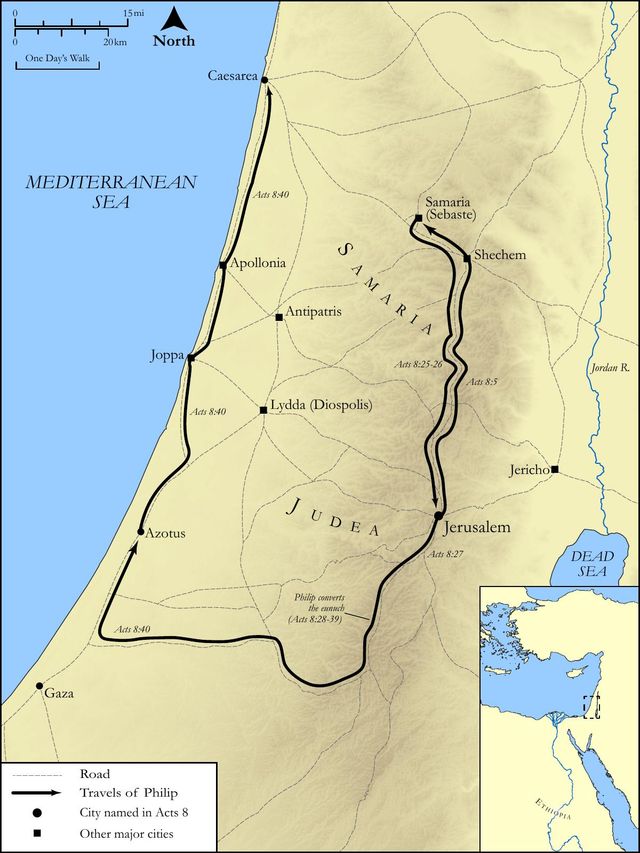
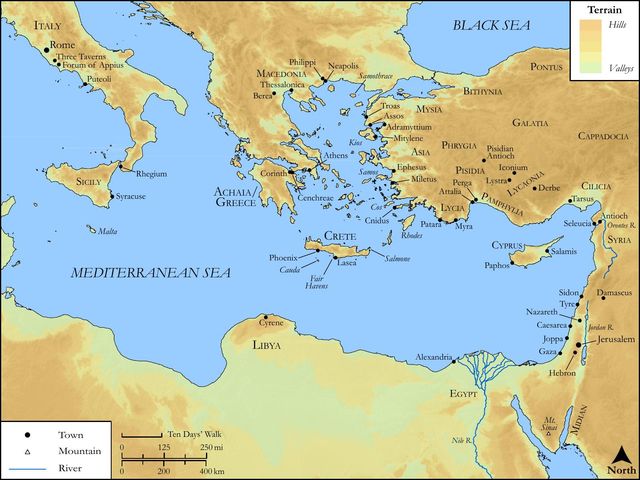
Study this verse
Public-domain commentary
Matthew Henry
From his Commentary on the Whole Bible. Henry comments on passages, not single verses — this entry covers Acts 8:4–13. His four-level outline is real structure in the source text, so it is rendered as structure.
Samson's riddle is here again unriddled: Out of the eater comes forth meat, and out of the strong sweetness. The persecution that was designed to extirpate the church was by the overruling providence of God made an occasion of the enlargement of it. Christ had said, I am come to send fire on the earth; and they thought, by scattering those who were kindled with that fire, to have put it out, but instead of this they did but help to spread it.
I.Here is a general account of what was done by them all (Act 8:4):
They went every where, preaching the word. They did not go to hide themselves for fear of suffering, no, nor to show themselves as proud of their sufferings; but they went up and down to scatter the knowledge of Christ in every place where they were scattered. They went every where, into the way of the Gentiles, and the cities of the Samaritans, which before they were forbidden to go into, Mat 10:5. They did not keep together in a body, though this might have been a strength to them; but they scattered into all parts, not to take their ease, but to find out work. They went evangelizing the world, preaching the word of the gospel; it was this which filled them, and which they endeavoured to fill the country with, those of them that were preachers in their preaching, and others in their common converse. They were now in a country where they were no strangers, for Christ and his disciples had conversed much in the regions of Judea; so that they had a foundation laid there for them to build upon; and it would be requisite to let the people there know what that doctrine which Jesus had preached there some time ago was come to, and that it was not lost and forgotten, as perhaps they were made to believe.
II.A particular account of what was done by Philip.
We shall hear of the progress and success of others of them afterwards (Act 11:19), but here must attend the motions of Philip, not Philip the apostle, but Philip the deacon, who was chosen and ordained to serve tables, but having used the office of a deacon well he purchased to himself a good degree, and great boldness in the faith, Ti1 3:13. Stephen was advanced to the degree of a martyr, Philip to the degree of an evangelist, which when he entered upon, being obliged by it to give himself to the word and prayer, he was, no doubt, discharged from the office of a deacon; for how could he serve tables at Jerusalem, which by that office he was obliged to do, when he was preaching in Samaria? And it is probable that two others were chosen in the room of Stephen and Philip. Now observe,
1.What wonderful success Philip had in his preaching, and what reception he met with.
(1.)The place he chose was the city of Samaria, the head city of Samaria, the metropolis of that country, which stood where the city of Samaria had formerly stood, of the building of which we read, Kg1 16:24, now called Sebaste. Some think it was the same with Sychem or Sychar, that city of Samaria where Christ was, Joh 4:5. Many of that city then believed in Christ, though he did no miracle among them (Act 8:39, 41), and now Philip, three years after, carries on the work then begun. The Jews would have no dealings with the Samaritans; but Christ sent his gospel to slay all enmities, and particularly that between the Jews and the Samaritans, by making them one in his church.
(2.)The doctrine he preached was Christ; for he determined to know nothing else. He preached Christ to them; he proclaimed Christ to them (so the word signifies), as a king, when he comes to the crown, is proclaimed throughout his dominions. The Samaritans had an expectation of the Messiah's coming, as appears by Joh 4:25. Now Philip tells them that he is come, and that the Samaritans are welcome to him. Ministers' business is to preach Christ - Christ, and him crucified - Christ, and him glorified.
(3.)The proofs he produced for the confirmation of his doctrine were miracles, Act 8:6. To convince them that he had his commission from heaven (and therefore not only they might venture upon what he said, but they were bound to yield to it), he shows them this broad seal of heaven annexed to it, which the God of truth would never put to a lie. The miracles were undeniable; they heard and saw the miracles which he did. They heard the commanding words he spoke, and saw the amazing effects of them immediately; that he spoke, and it was done. And the nature of the miracles was such as suited the intention of his commission, and gave light and lustre to it.
[1.]He was sent to break the power of Satan; and, in token of this, unclean spirits, being charged in the name of the Lord Jesus to remove, came out of many that were possessed with them, Act 8:7. As far as the gospel prevails, Satan is forced to quit his hold of men and his interest in them, and then those are restored to themselves, and to their right mind again, who, while he kept possession, were distracted. Wherever the gospel gains the admission and submission it ought to have, evil spirits are dislodged, and particularly unclean spirits, all inclinations to the lusts of the flesh, which war against the soul; for God has called us from uncleanness to holiness, Th1 4:7. This was signified by the casting of these unclean spirits out of the bodies of people, who, it is here said, came out crying with a loud voice, which signifies that they came out with great reluctancy, and sorely against their wills, but were forced to acknowledge themselves overcome by a superior power, Mar 1:26; Mar 3:11; Mar 9:26.
[2.]He was sent to heal the minds of men, to cure a distempered world, and to put it into a good state of health; and, in token of this, many that were taken with palsies, and that were lame, were healed. Those distempers are specified that were most difficult to be cured by the course of nature (that the miraculous cure might be the more illustrious), and those that were most expressive of the disease of sin and that moral impotency which the souls of men labour under as to the service of God. The grace of God in the gospel is designed for the healing of those that are spiritually lame and paralytic, and cannot help themselves, Rom 5:6.
(4.)The acceptance which Philip's doctrine, thus proved, met with in Samaria (Act 8:6): The people with one accord gave heed to those things which Philip spoke, induced thereto by the miracles which served at first to gain attention, and so by degrees to gain assent. There then begin to be some hopes of people when they begin to take notice of what is said to them concerning the things of their souls and eternity - when they begin to give heed to the word of God, as those that are well pleased to hear it, desirous to understand and remember it, and that look upon themselves as concerned in it. The common people gave heed to Philip, oi ochloi - a multitude of them, not here and there one, but with one accord; they were all of a mind, that it was fit the doctrine of the gospel should be enquired into, and an impartial hearing given to it.
(5.)The satisfaction they had in attending on, and attending to, Philip's preaching, and the success it had with many of them (Act 8:8): There was great joy in that city; for (Act 8:12) they believed Philip, and were baptized into the faith of Christ, the generality of them, both men and women. Observe,
[1.]Philip preached the things concerning the kingdom of God, the constitution of that kingdom, the laws and ordinances of it, the liberties and privileges of it, and the obligations we are all under to be the loyal subjects of that kingdom; and he preached the name of Jesus Christ, as king of that kingdom - his name, which is above every name. He preached it up in its commanding power and influence - all that by which he has made himself known.
[2.]The people not only gave heed to what he said, but at length believed it, were fully convinced that it was of God and not of men, and gave up themselves to the direction and government of it. As to this mountain, on which they had hitherto worshipped God, and placed a great deal of religion in it, they were now as much weaned from it as every they had been wedded to it, and become the true worshippers, who worship the Father in spirit and in truth, and in the name of Christ, the true temple, Joh 4:20-23.
[3.]When they believed, without scruple (though they were Samaritans) and without delay they were baptized, openly professed the Christian faith, promised to adhere to it, and then, by washing them with water, were solemnly admitted into the communion of the Christian church, and owned as brethren by the disciples. Men only were capable of being admitted into the Jewish church by circumcision; but, to show that in Jesus Christ there is neither male nor female (Gal 3:28), but both are alike welcome to him, the initiating ordinance is such as women are capable of, for they are numbered with God's spiritual Israel, though not with Israel according to the flesh, Num 1:2. And hence it is easily gathered that women are to be admitted to the Lord's supper, though it does not appear that there were any among those to whom it was first administered.
[4.]This occasioned great joy; each one rejoiced for himself, as he in the parable who found the treasure hid in the field; and they all rejoiced for the benefit hereby brought to their city, and that it came without opposition, which it would scarcely have done if Samaria had been within the jurisdiction of the chief priests. Note, The bringing of the gospel to any place is just matter of joy, of great joy, to that place. Hence the spreading of the gospel in the world is often prophesied of in the Old Testament as the diffusing of joy among the nations: Let the nations be glad and sing for joy, Psa 67:4; Th1 1:6. The gospel of Christ does not make men melancholy, but fills them with joy, if it be received as it should be; for it is glad tidings of great joy to all people, Luk 2:10.
2.What there was in particular at this city of Samaria that made the success of the gospel there more than ordinarily wonderful.
(1.)That Simon Magus had been busy there, and had gained a great interest among the people, and yet they believed the things that Philip spoke. To unlearn that which is bad proves many times a harder task than to learn that which is good. These Samaritans, though they were not idolaters as the Gentiles, nor prejudiced against the gospel by traditions received from their fathers, yet had of late been drawn to follow Simon, a conjurer (For so Magus signifies) who made a mighty noise among them, and had strangely bewitched them. We are told,
[1.]How strong the delusion of Satan was by which they were brought into the interests of this great deceiver. He had been for some time, nay, for a long time, in this city, using sorceries; perhaps he came there by the instigation of the devil, soon after our Saviour had been there, to undo what he had been doing there; for it was always Satan's way to crush a good work in its bud and infancy, Co2 11:3; Th1 3:5. Now,
First, Simon assumed to himself that which was considerable: He gave out that he himself was some great one, and would have all people to believe so and to pay him respect accordingly; and then, as to every thing else, they might do as they pleased. He had no design to reform their lives, nor improve their worship and devotion, only to make them believe that he was, tis megas - some divine person. Justin Martyr says that he would be worshipped as prōton theon - the chief god. He gave out himself to be the Son of God, the Messiah, so some think; or to be an angel, or a prophet. Perhaps he was uncertain within himself what title of honour to pretend to; but he would be thought some great one. Pride, ambition, and an affectation of grandeur, have always been the cause of abundance of mischief both to the world and to the church.
Secondly, The people ascribed to him what he pleased. 1. They all gave heed to him, from the least to the greatest, both young and old, both poor and rich, both governors and governed. To him they had regard (Act 8:10, Act 8:11), and perhaps the more because the time fixed for the coming of the Messiah had now expired, which had raised a general expectation of the appearing of some great one about this time. Probably he was a native of their country, and therefore they embraced him the more cheerfully, that by giving honour to him they might reflect it upon themselves. 2. They said of him, This man is the great power of God - the power of God, that great power (so it might be read), that power which made the world. See how ignorant inconsiderate people mistake that which is done by the power of Satan, as if it were done by the power of God. Thus, in the Gentile world, devils pass for deities; and in the antichristian kingdom all the world wonders after a beast, to whom the dragon gives his power, and who opens his mouth in blasphemy against God, Rev 13:2-5. 3. They were brought to it by his sorceries: He bewitched the people of Samaria (Act 8:9), bewitched them with sorceries (Act 8:11), that is, either, (1.) By his magic arts he bewitched the minds of the people, at least some of them, who drew in others. Satan, by God's permission, filled their hearts to follow Simon. O foolish Galatians, saith Paul, who hath bewitched you? Gal 3:1. These people are said to be bewitched by Simon, because they were so strangely infatuated to believe a lie. Or, (2.) By his magic arts he did many signs and lying wonders, which seemed to be miracles, but really were not so: like those of the magicians of Egypt, and those of the man of sin, Th2 2:9. When they knew no better, they were influenced by his sorceries; but, when they were acquainted with Philip's real miracles, they saw plainly that the one was real and the other a sham, and that there was as much difference as between Aaron's rod and those of the magicians. What is the chaff to the wheat? Jer 23:28.
Thus, notwithstanding the influence Simon Magus had had upon them, and the unwillingness there generally is in people to own themselves in an error, and to retract it, yet, when they saw the difference between Simon and Philip, they quitted Simon, gave heed no longer to him, but to Philip: and thus you see,
[2.]How strong the power of Divine grace is, by which they were brought to Christ, who is truth itself, and was, as I may say, the great undeceiver. By that grace working with the word those that had been led captive by Satan were brought into obedience to Christ. Where Satan, as a strong man armed, kept possession of the palace, and thought himself safe, Christ, as a stronger than he, dispossessed him, and divided the spoil; led captivity captive, and made those the trophies of his victory whom the devil had triumphed over. Let us not despair of the worst, when even those whom Simon Magus had bewitched were brought to believe.
(2.)Here is another thing yet more wonderful, that Simon Magus himself became a convert to the faith of Christ, in show and profession, for a time. Is Saul also among the prophets? Yes (Act 8:13), Simon himself believed also. He was convinced that Philip preached a true doctrine, because he saw it confirmed by real miracles, of which he was the better able to judge because he was conscious to himself of the trick of his own pretended ones.
[1.]The present conviction went so far that he was baptized, was admitted, as other believers were, into the church by baptism; and we have no reason to think that Philip did amiss in baptizing him, no, nor in baptizing him quickly. Though he had been a very wicked man, a sorcerer, a pretender to divine honours, yet, upon his solemn profession of repentance for his sin and faith in Jesus Christ, he was baptized. For, as great wickedness before conversion keeps not true penitents from the benefits of God's grace, so neither should it keep professing ones from church-fellowship. Prodigals, when they return, must be joyfully welcomed home, though we cannot be sure but that they will play the prodigal again. Nay, though he was now but a hypocrite, and really in the gall of bitterness and bond of iniquity all this while, and would soon have been found to be so if he had been tried awhile, yet Philip baptized him; for it is God's prerogative to know the heart. The church and its ministers must go by a judgment of charity, as far as there is room for it. It is a maxim in the law, Donec contrarium patet, semper praesumitur meliori parti - We must hope the best as long as we can. And it is a maxim in the discipline of the church, De secretis non judicat ecclesia - The secrets of the heart God only judges.
[2.]The present conviction lasted so long that he continued with Philip. Though afterwards he apostatized from Christianity, yet not quickly. He courted Philip's acquaintance, and now he that had given out himself to be some great one is content to sit at the feet of a preacher of the gospel. Even bad men, very bad, may sometimes be in a good frame, very good; and those whose hearts still go after their covetousness may possibly not only come before God as his people come, but continue with them.
[3.]The present conviction was wrought and kept up by the miracles; he wondered to see himself so far outdone in signs and miracles. Many wonder at the proofs of divine truths who never experience the power of them.
Historical interpretation
Three Centuries of Reception
3 surviving comments on this verse. Each one is dated, so this reads as a timeline rather than a list.
Select a marker to jump to its quote. Markers stagger vertically where authors wrote within a few decades of each other.
"And there was joy." And yet there had been "great lamentation": true; but mark again the good.
"Then Philip went down to the city of Samaria, and preached Christ unto them. And the people with one accord gave heed unto those things which Philip spake, hearing and seeing the miracles which he did. For unclean spirits, crying with loud voice, came out of many that were possessed with them: and many taken with palsies, and that were lame, were healed. And there was great joy in that city." "Hearing and seeing the miracles which he did." Just as in the case of Moses by contrast with the magicians the miracles were evident miracles, so here also. There was magic, and so these signs were manifest. "For unclean spirits came out of many that were possessed with them"; for this was a manifest miracle - not as the magicians did: for the other (Simon), it is likely, bound men with spells - "and many," it says, "that were palsied and lame were healed." There was no deceit here: for it needed but that they should walk and work.
But the crowds paid attention to what was being said by Philip. From this chapter and from the story of the Samaritan woman, it is proven that this nation was prompt in spirit to believe.
Continue studying Acts 8:6 across the web’s major study libraries — every link below opens this exact verse, chapter, or book on the destination site.
Read & Compare
 BibleGatewayThis verse in more than 200 translations and 70 languages.
 Bible.comThe YouVersion reader — hundreds of translations, reading plans, and highlights.
 ESV.orgCrossway's official English Standard Version reader.
 NET BibleThe NET translation with 60,000+ translators' notes on every rendering decision.
 STEP BibleTyndale House's free study tool — original text, vocabulary, and scholarly resources.
 BibliaLogos Bible Software's free web reader.
 USCCBThe New American Bible (Revised Edition) with the U.S. bishops' study notes.
Commentaries
 BibleHub CommentariesDozens of classic commentaries on this verse, gathered on one page.
 StudyLightMore than 100 commentary sets — the largest collection on the web.
 BibleRefPlain-English commentary on what this verse means, verse by verse.
 Enduring WordDavid Guzik's free commentary on this chapter, widely used by Bible teachers.
 Bible Study ToolsVerse commentary alongside Greek and Hebrew study aids.
Original Language & Research
- BibleHub InterlinearThe verse word by word — original language, transliteration, and English.
- BibleHub LexiconEvery word's original-language definition and Strong's entry.
 Blue Letter BibleDeep-study tools — Strong's numbers, concordance, and word studies.
 CNTR CollationThe earliest Greek manuscripts of this verse, collated letter by letter.
Sermons, Hymns & Audio


TrulyRandomVerse is not affiliated with these sites and doesn’t control their content. They’re linked because they’re genuinely useful.
Summary
Acts 8:6 vividly portrays the profound impact of Philip's ministry in Samaria, where the populace, united in purpose, eagerly received his message. Their receptivity was significantly bolstered by the undeniable evidence of the miracles Philip performed, which served as powerful divine authentication for the gospel he proclaimed, leading to widespread attention and belief among a people historically at odds with the Jews.
Context
ShowHideLiterary Context
This verse is situated immediately after a pivotal moment in the early church's history: the severe persecution that erupted in Jerusalem following the martyrdom of Stephen. Acts 8:1-4 describes how this persecution caused believers, with the notable exception of the apostles, to scatter throughout Judea and Samaria, inadvertently fulfilling the Great Commission's geographical expansion outlined in Acts 1:8. Philip, one of the seven men chosen to serve the church (as detailed in Acts 6:5), emerges as a key evangelist in this new phase. Verse 5 explicitly states his arrival in "the city of Samaria" to preach Christ, setting the stage for the collective, unified response described in verse 6, which then leads into the specific examples of miracles and the widespread joy in Acts 8:7-8.
Historical & Cultural Context
The historical animosity between Jews and Samaritans is crucial for understanding the significance of Philip's ministry. Originating from the Assyrian conquest of the Northern Kingdom of Israel in 722 BC, the Samaritans were a mixed race, combining Israelite remnants with foreign settlers, and their religion blended elements of Judaism with pagan practices. They built their own temple on Mount Gerizim, rejecting the Jerusalem temple, leading to centuries of mutual disdain and avoidance (John 4:9). For Philip, a Jew, to be welcomed and for his message to be embraced by Samaritans "with one accord" represents a radical breaking down of ethnic and religious barriers, a testament to the universal power of the gospel to reconcile diverse peoples. This event directly challenges the deeply ingrained prejudices of the time.
Key Themes
ShowHideActs 8:6 contributes to several overarching themes within the Book of Acts. Firstly, it highlights the expansion of the gospel beyond Jerusalem, demonstrating the Spirit-empowered movement into new territories and among new peoples, fulfilling the mandate of Acts 1:8. Secondly, it underscores the divine authentication of the message through signs and wonders. Philip's miracles were not mere displays of power but served as undeniable proof that his message was from God, validating his divine commission and the truth of the gospel, much like Jesus' own ministry was attested by miracles (Acts 2:22). Thirdly, the phrase "with one accord" emphasizes the unity and receptivity of the audience, showcasing how the Holy Spirit can prepare hearts and bring about a collective openness to the divine message, even in unexpected places. This collective response foreshadows the broader Gentile inclusion that will become a major theme later in Acts.
Exposition and Analysis
ShowHideKey Word Analysis
ShowHideThis term, often translated as "multitude" or "crowd," refers to a large, often unorganized assembly of people. In this context, it emphasizes the widespread nature of the Samaritans' response to Philip, indicating that it was not just a few individuals but a significant portion of the populace that gathered and paid attention. It conveys the idea of a general populace rather than a select group.
This powerful adverb signifies a remarkable unity of mind, purpose, or passion. It indicates that the people's attention was not fragmented or hesitant but a collective, harmonious, and eager response. This term is notably used multiple times in Acts to describe the unity of the early Christian community (e.g., Acts 1:14, Acts 2:46), suggesting a divine work in bringing about such a unified and positive reception among the Samaritans.
This verb means "to hold the mind towards," implying to pay attention to, apply oneself to, or adhere to. It denotes an intentional and focused act of listening and considering. The Samaritans were not merely hearing sounds; they were actively engaging their minds with Philip's message, indicating a deep level of engagement and seriousness in their receptivity.
This noun refers to an indication, a sign, or a token, especially one that is ceremonially or supernaturally significant. In the New Testament, sēmeîon often denotes a miracle that points beyond itself to a divine truth or the power of God. Here, Philip's miracles were not ends in themselves but served as divine "signs" validating his message and demonstrating the presence and power of God confirming the gospel.
Verse Breakdown
ShowHide"And the people with one accord gave heed unto those things which Philip spake"
This clause highlights the extraordinary collective unity and focus of the Samaritan populace. The phrase "with one accord" (Greek: homothymadón) underscores that their attention was not fragmented but a unified, harmonious, and eager response to Philip's preaching. They were not merely hearing, but actively "giving heed" (Greek: proséchō), indicating an intentional and focused engagement with the content of his message, demonstrating a remarkable openness to the gospel despite historical prejudices.
"hearing and seeing the miracles which he did."
This second clause provides the crucial reason for the Samaritans' unified attention and receptivity. Their engagement was not based solely on Philip's words but was profoundly influenced by the tangible, observable evidence of divine power. The "miracles" (Greek: sēmeîon) served as powerful, undeniable signs that authenticated Philip's divine commission and confirmed the truth of the message he proclaimed. The combination of "hearing" the message and "seeing" the accompanying supernatural works created a compelling and convincing witness, leading to their collective conviction.
Literary Devices
ShowHideActs 8:6 effectively employs Synecdoche by using "hearing and seeing" to represent the full sensory and intellectual engagement of the people. While only two senses are explicitly named, they stand for the complete experience of witnessing and processing Philip's ministry. The phrase "with one accord" functions as Hyperbole to emphasize the extraordinary unity and unanimity of the crowd's response, suggesting a near-perfect collective receptivity that transcends typical crowd dynamics. This also serves as a form of Emphasis, drawing the reader's attention to the unusual and powerful nature of the Samaritans' unified attention. The miracles themselves serve as powerful Symbols of God's active presence and validation of Philip's message, pointing to a reality beyond the physical acts themselves.
Theological and Thematic Connections
ShowHideActs 8:6 profoundly illustrates the principle that God often confirms His spoken word with accompanying signs and wonders, thereby validating His messengers and drawing people to Himself. This divine authentication is not merely for spectacle but serves a theological purpose: to underscore the truth and power of the gospel message, especially when it is being proclaimed in new and challenging contexts. The collective, unified response of the Samaritans, a people historically estranged from the Jews, demonstrates the Holy Spirit's power to transcend deep-seated divisions and prepare hearts for the universal message of salvation. This verse serves as a powerful reminder that the effectiveness of evangelism often lies not just in human eloquence but in the Spirit's accompanying power.
Reflection and Application
ShowHideActs 8:6 offers profound insights for contemporary believers regarding the nature of God's work and our role in it. It reminds us that while the specific manifestations of miracles may vary across different eras and cultures, the principle remains: God's truth, empowered by His Spirit, possesses an inherent, compelling power to capture hearts and minds. This verse encourages us to proclaim the gospel boldly, trusting that God will work to authenticate His message, whether through overt supernatural signs or through the subtle, yet powerful, transformation of lives. We are called to be faithful in sowing the seed of the Word, knowing that the harvest is ultimately God's work. Furthermore, the "one accord" of the Samaritans challenges us to pray for and cultivate a spirit of receptivity in those we seek to reach, recognizing that true spiritual awakening often involves a collective turning of hearts towards the Lord, breaking down barriers of prejudice and indifference.
Questions for Reflection
ShowHideFAQ
ShowHideWhy was it significant that the Samaritans responded "with one accord" to Philip?
ShowHideThe phrase "with one accord" (Greek: homothymadón) is highly significant because it emphasizes an extraordinary unity and collective enthusiasm among the Samaritan people. Historically, Samaritans and Jews had deep-seated animosity and religious division, making a unified, positive response to a Jewish evangelist like Philip highly unusual. This unanimity highlights the powerful, unifying effect of the Holy Spirit working through the gospel, breaking down centuries of prejudice and demonstrating the universal appeal and power of Christ's message to reconcile diverse groups. It shows that their attention was not fragmented but a shared, intentional focus on Philip's words and works.
Did miracles always accompany the preaching of the gospel in the early church?
ShowHideWhile miracles, signs, and wonders were a prominent feature of the early apostolic ministry, as seen with Philip in Acts 8:6-7, and with Peter and John in Acts 3:1-10, they were not the only means by which the gospel spread. The Book of Acts also records instances where the Word spread solely through powerful preaching and teaching (e.g., Acts 17:2-4). Miracles served as divine authentication, particularly in establishing the credibility of the message and messengers in new territories or among skeptical audiences. They were a powerful, but not exclusive, tool used by God to confirm His word and draw people to faith, as mentioned in Hebrews 2:4.
Christ-Centered Fulfillment
ShowHideActs 8:6, though focusing on Philip's ministry, profoundly points to Christ as the ultimate source and fulfillment of the power and message proclaimed. Philip preached "Christ" in Samaria (Acts 8:5), and the miracles he performed were not for his own glory but were a continuation of the signs that authenticated Jesus' own ministry (Acts 2:22). The "miracles which he did" were a demonstration of the power of the resurrected Christ, who promised His followers that they would do "greater works" because He was going to the Father (John 14:12). The "one accord" response of the Samaritans, a people previously estranged from God's covenant people, foreshadows the universal reconciliation accomplished through Christ's atoning work on the cross, breaking down "the dividing wall of hostility" between Jew and Gentile (Ephesians 2:14). Ultimately, the scene in Samaria is a powerful illustration of the living Christ, through His Spirit, actively drawing all people to Himself, fulfilling His commission to be witnesses "to the end of the earth" (Acts 1:8).