


John 14:12
- ἈμὴνAmēnAmenG281INJ-HEBInterjection
- ἀμὴνamēnAmenG281INJ-HEBInterjection
- λέγωlegōI sayG3004V-PAI-1SVerb Present Active Indicative 1st Singular
- ὑμῖν·huminto youG4771P-2DPPersonal pronoun Dative 2nd Plural
- ὁhothe [one]G3588T-NSMDefinite article Nominative Singular Masculine
- πιστεύωνpisteuōnbelievingG4100V-PAP-NSMVerb Present Active Participle Nominative Singular Masculine
- εἰςeisinG1519PREPPreposition
- ἐμέemeMe myselfG1473P-1ASPersonal pronoun Accusative 1st Singular
- τὰtatheG3588T-APNDefinite article Accusative Plural Neuter
- ἔργαergaworksG2041N-APNNoun Accusative Plural Neuter
- ἃhathatG3739R-APNRelative pronoun Accusative Plural Neuter
- ἐγὼegōI myselfG1473P-1NSPersonal pronoun Nominative 1st Singular
- ποιῶpoiōdoG4160V-PAI-1SVerb Present Active Indicative 1st Singular
- κἀκεῖνοςkakeinosalso heG1565CONJ + G1565=D-NSM
- ποιήσειpoiēseiwill doG4160V-FAI-3SVerb Future Active Indicative 3rd Singular
- καὶkaiandG2532CONJConjunction
- μείζοναmeizonagreaterG3173A-APN-CAdjective Accusative Plural Neuter Comparative
- τούτωνtoutōnthan theseG3778D-GPNDemonstrative pronoun Genitive Plural Neuter
- ποιήσειpoiēseihe will doG4160V-FAI-3SVerb Future Active Indicative 3rd Singular
- ὅτιhotibecauseG3754CONJConjunction
- ἐγὼegōI myselfG1473P-1NSPersonal pronoun Nominative 1st Singular
- πρὸςprostoG4314PREPPreposition
- τὸνtontheG3588T-ASMDefinite article Accusative Singular Masculine
- πατέραpateraFatherG3962N-ASM-TNoun Accusative Singular Masculine Title
- μουmouof mineG3165P-1GSPersonal pronoun Genitive 1st Singular
- πορεύομαιporeuomaiam goingG4198V-PNI-1SVerb Present Middle Or Passive Deponent Indicative 1st Singular
English is a literal word-by-word gloss of the Greek, not the KJV's wording. Why?
This is the original text the KJV's translators worked from — each Greek word with its own literal English meaning in this verse, prepared by scholars at Tyndale House, Cambridge. The KJV translates whole sentences, not word by word, so its wording differs: one Greek word can become several English words, and the KJV may choose “charity” where the gloss reads “love”. Both are faithful — they answer different questions. For the KJV's own rendering, switch to the KJV text.
Details
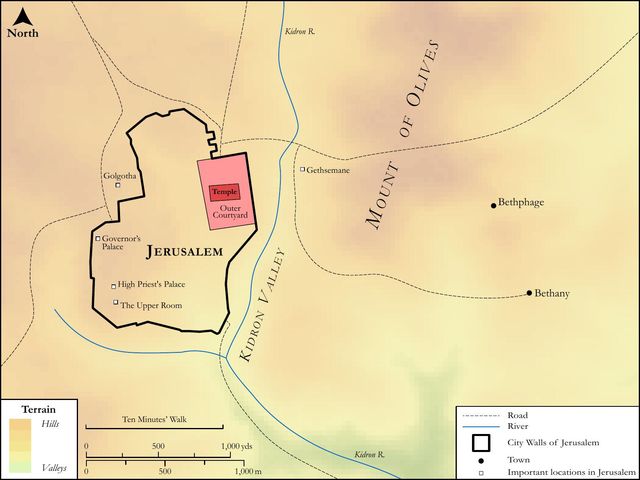
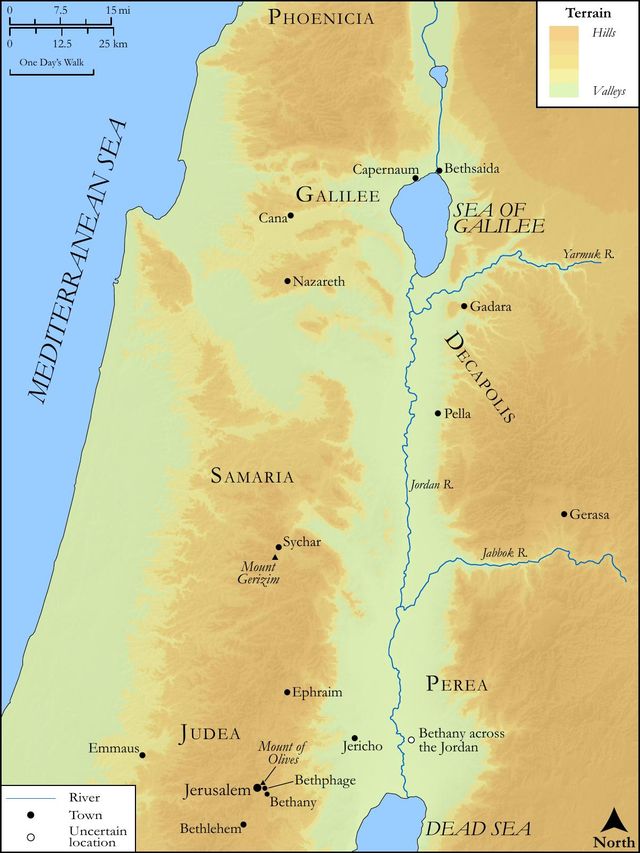
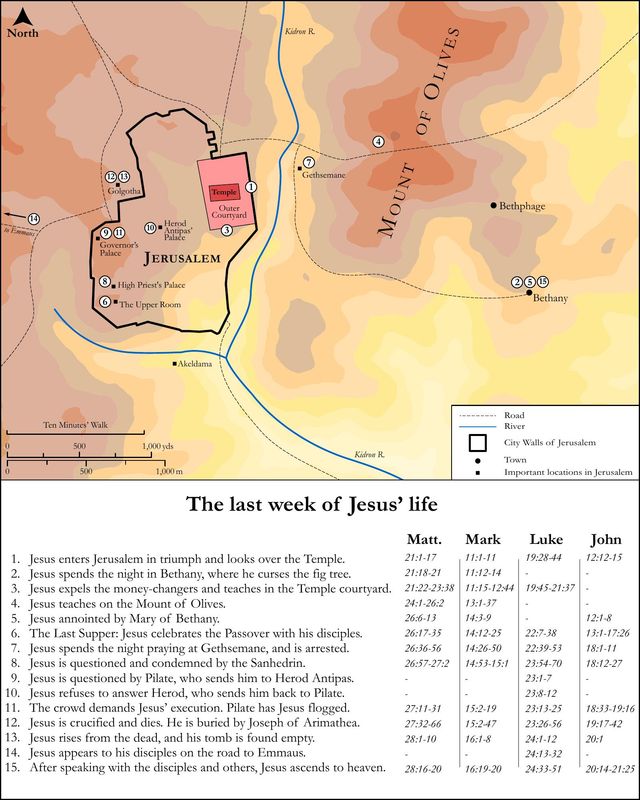
See on the biblical-era map
Study this verse
Public-domain commentary
Matthew Henry
From his Commentary on the Whole Bible. Henry comments on passages, not single verses — this entry covers John 14:12–14. His four-level outline is real structure in the source text, so it is rendered as structure.
The disciples, as they were full of grief to think of parting with their Master, so they were full of care what would become of themselves when he was gone; while he was with them, he was a support to them, kept them in countenance, kept them in heart; but, if he leave them, they will be as sheep having no shepherd, an easy prey to those who seek to run them down. Now, to silence these fears, Christ here assures them that they should be clothed with powers sufficient to bear them out. As Christ has all power, they, in his name, should have great power, both in heaven and in earth.
I.Great power on earth (Joh 14:12):
He that believeth on me (as I know you do), the works that I do shall he do also. This does not weaken the argument Christ had taken from his works, to prove himself one with the Father (that others should do as great works), but rather strengthens it; for the miracles which the apostles wrought were wrought in his name, and by faith in him; and this magnifies his power more than any thing, that he not only wrought miracles himself, but gave power to others to do so too.
1.Two things he assures them of: -
(1.)That they should be enabled to do such works as he had done, and that they should have a more ample power for the doing of them than they had had when he first sent them forth, Mat 10:8. Did Christ heal the sick, cleanse the leper, raise the dead? So should they. Did he convince and convert sinners, and draw multitudes to him? So should they. Though he should depart, the work should not cease, nor fall to the ground, but should be carried on as vigorously and successfully as ever; and it is still in the doing.
(2.)That they should do greater works than these.
[1.]In the kingdom of nature they should work greater miracles. No miracle is little, but some to our apprehension seem greater than others. Christ had healed with the hem of his garment, but Peter with his shadow (Act 5:15), Paul by the handkerchief that had touched him, Act 19:12. Christ wrought miracles for two or three years in one country, but his followers wrought miracles in his name for many ages in divers countries. You shall do greater works, if there be occasion, for the glory of God. The prayer of faith, if at any time it had been necessary, would have removed mountains.
[2.]In the kingdom of grace. They should obtain greater victories by the gospel than had been obtained while Christ was upon earth. The truth is, the captivating of so great a part of the world to Christ, under such outward disadvantages, was the miracle of all. I think this refers especially to the gift of tongues; this was the immediate effect of the pouring out of the Spirit, which was a constant miracle upon the mind, in which words are framed, and which was made to serve so glorious an intention as that of spreading the gospel to all nations in their own language. This was a greater sign to them that believed not (Co1 14:22), and more powerful for their conviction, than any other miracle whatever.
2.The reason Christ gives for this is, Because I go unto my Father, (1.) "Because I go, it will be requisite that you should have such a power, lest the work suffer damage by my absence." (2.) "Because I go to the Father, I shall be in a capacity to furnish you with such a power, for I go to the Father, to send the Comforter, from whom you shall receive power," Act 1:8. The wonderful works which they did in Christ's name were part of the glories of his exalted state, when he ascended on high, Eph 4:8.
II.Great power in heaven:
"Whatsoever you shall ask, that will I do (Joh 14:13, Joh 14:14), as Israel, who was a prince with God. Therefore you shall do such mighty works, because you have such an interest in me, and I in my Father." Observe,
1.In what way they were to keep up communion with him, and derive power from him, when he was gone to the Father - by prayer. When dear friends are to be removed to a distance from each other, they provide for the settling of a correspondence; thus, when Christ was going to his Father, he tells his disciples how they might write to him upon every occasion, and send their epistles by a safe and ready way of conveyance, without danger of miscarrying, or lying by the way: "Let me hear from you by prayer, the prayer of faith, and you shall hear from me by the Spirit." This was the old way of intercourse with Heaven, ever since men began to call upon the name of the Lord; but Christ by his death has laid it more open, and it is still open to us. Here is,
(1.)Humility prescribed: You shall ask. Though they had quitted all for Christ, they could demand nothing of him as a debt, but must be humble supplicants, beg or starve, beg or perish.
(2.)Liberty allowed: "Ask any thing, any thing that is good and proper for you; any thing, provided you know what you ask, you may ask; you may ask for assistance in your work, for a mouth and wisdom, for preservation out of the hands of your enemies, for power to work miracles when there is occasion, for the success of the ministry in the conversion of souls; ask to be informed, directed, vindicated." Occasions vary, but they shall be welcome to the throne of grace upon every occasion.
2.In what name they were to present their petitions: Ask in my name. To ask in Christ's name is,
(1.)To plead his merit and intercession, and to depend upon that plea. The Old Testament saints had an eye to this when they prayed for the Lord's sake (Dan 9:17), and for the sake of the anointed (Psa 84:9), but Christ's mediation is brought to a clearer light by the gospel, and so we are enabled more expressly to ask in his name. When Christ dictated the Lord's prayer, this was not inserted, because they did not then so fully understand this matter as they did afterwards, when the Spirit was poured out. If we ask in our own name, we cannot expect to speed, for, being strangers, we have no name in heaven; being sinners, we have an ill name there; but Christ's is a good name, well known in heaven, and very precious.
(2.)It is to aim at his glory and to seek this as our highest end in all our prayers.
3.What success they should have in their prayers: "What you ask, that will I do," Joh 14:13. And again (Joh 14:14), "I will do it. You may be sure I will: not only it shall be done, I will see it done, or give orders for the doing of it, but I will do it;" for he has not only the interest of an intercessor, but the power of a sovereign prince, who sits at the right hand of God, the hand of action, and has the doing of all in the kingdom of God. By faith in his name we may have what we will for the asking.
4.For what reason their prayers should speed so well: That the Father may be glorified in the Son. That is,
(1.)This they ought to aim at, and have their eye upon, in asking. In this all our desires and prayers should meet as in their centre; to this they must all be directed, that God in Christ may be honoured by our services, and in our salvation. Hallowed be thy name is an answered prayer, and is put first, because, if the heart be sincere in this, it does in a manner consecrate all the other petitions.
(2.)This Christ will aim at in granting, and for the sake of this will do what they ask, that hereby the glory of the Father in the Son may be manifested. The wisdom, power, and goodness of God were magnified in the Redeemer when by a power derived from him, and exerted in his name and for his service, his apostles and ministers were enabled to do such great things, both in the proofs of their doctrine and in the successes of it.
Historical interpretation
Historical reception
11 surviving comments on this verse. Each one is dated, so this reads as a timeline rather than a list.
Select a marker to jump to its quote. Markers stagger vertically where authors wrote within a few decades of each other.
This refers to the other miracles that the apostles did, such as healing a man through their shadow falling on him. But this incident did not reveal the fullness of this saying, but rather it was fulfilled in the fact that, when he used the power of the Godhead for an act of kindness, the disciples on the one hand worked through the power given to them for the service of those who believe and the punishment of the extremely wicked, and on the other hand they exceeded the power of their teacher, even though he was mightier in his ability to punish the godless, since he chose to restrain and control his power to punish in the meantime until the right moment of judgment.
Skillfully inserting here the word also, he has allowed us similarity and yet has not ascribed natural unity. The work of the Father and the work of the Son, therefore, are one.
"That at the least the shadow of Peter passing by," etc. This had not occurred in the history of Christ; but see here what He had told them actually coming to pass, that "they which believe on Me, the works that I do shall they do also; and greater works than these shall they do."
Great faith, surpassing what had been shown in the case of Christ. How comes this? Because Christ declared: "And greater works than these shall he do, because I go unto My Father." And these things the people do, while the Apostles remain there, and are not moving about from place to place: also from other places they were all bringing their sick on beds and couches: and from all quarters accrued to them fresh tribute of wonder; from them that believed, from them that were healed, from him that was punished; from their boldness of speech towards those their adversaries, from the virtuous behavior of the believers: for certainly the effect produced was not owing to the miracles only.
(Hom. lxxiv. 2) Having said, Believe for the works' sake, our Lord goes on to declare that He can do much greater than these, and what is more wonderful, give others the power of working them. Verily, verily, I say unto you, He that believeth on Me, the works that I do, shall he do also; and greater works than these shall he do.
(Hom. lxxiv. 2) i. e. I shall not perish, but shall remain in My proper dignity, in heaven. Or He means: It is your part henceforth to work miracles, since I am going.
(Hom. lxxiv. 2) In My name, He says. Thus the Apostles; In the name of Jesus of Nazareth, arise and walk. (Acts 3:6) All the miracles that they did, He did: the hand of the Lord was with them.
(Hom. lxxiv. 2) For when the great power of the Son is manifested, He that begat Him is glorified. He introduces this last, to confirm the truth of what He has said.
We said above that the words “I am going to the Father” refer to [his union with the Father after his passion]. After … this union, he will have the power to give everything to those who ask him, because by asking they ask for the greatness dwelling in him. He can give because of his [union with the Father], and the Father then is completely recognized in the Son to be excellent and admirable.
It is no easy matter to comprehend what is meant by, or in what sense we are to receive, these words of the Lord, "He that believeth on me, the works that I do shall he do also:" and then, to this great difficulty in the way of our understanding, He has added another still more difficult, "And greater things than these shall he do." What are we to make of it? We have not found one who did such works as Christ did; and are we likely to find one who will do even greater? But we remarked in our last discourse, that it was a greater deed to heal the sick by the passing of their shadow, as was done by the disciples, than as the Lord Himself did by the touch of the hem of His garment; and that more believed on the apostles than on the Lord Himself, when preaching with His own lips; so that we might suppose works like these to be understood as greater: not that the disciple was to be greater than his Master, or the servant than his Lord, or the adopted son than the Only-begotten, or man than God, but that by them He Himself would condescend to do these greater works, while telling them in another passage, "Without me ye can do nothing." While He Himself, on the other hand, to say nothing of His other works, which are numberless, made them without any aid from themselves, and without them made this world; and because He Himself thought meet to become man, without them He made also Himself. But what have they made or done without Him, save sin? And last of all, He straightway also withdrew from the subject all that could cause us agitation; for after saying, "He that believeth on me, the works that I do shall he do also; and greater works than these shall he do;" He immediately went on to add, "Because I go unto the Father; and whatsoever ye shall ask in my name, that will I do." He who had said, "He will do," afterwards said, "I will do;" as if He had said, Let not this appear to you impossible; for he that believeth on me can never become greater than I am, but it is I who shall then be doing greater things than now; greater things by him that believeth on me, than by myself apart from him; yet it is I myself apart from him, and I myself by him that will do the works: and as it is apart from him, it is not he that will do them; and as, on the other hand, it is by him, although not by his own self, it is he also that will do them. And besides, to do greater things by one than apart from one, is not a sign of deficiency, but of condescension. For what can servants render unto the Lord for all His benefits towards them? And sometimes He hath condescended to number this also amongst His other benefits towards them, namely, to do greater works by them than apart from them. Did not that rich man go away sad from His presence, when seeking counsel about eternal life? He heard, and cast it away: and yet in after days the counsel that fell on his ears was followed, not by one, but by many, when the good Master was speaking by the disciples; He was an object of contempt to the rich man, when warned by Himself directly, and of love to those whom by means of poor men He transformed from rich into poor. Here, then, you see, He did greater works when preached by believers, than when speaking Himself to hearers.
"And greater works than these shall he do." Than what, pray? Shall we say that one is doing greater works than all that Christ did who is working out his own salvation with fear and trembling? A work which Christ is certainly working in him, but not without him; and one which I might, without hesitation, call greater than the heavens and the earth, and all in both within the compass of our vision. For both heaven and earth shall pass away, but the salvation and justification of those predestinated thereto, that is, of those whom He foreknoweth, shall continue forever. In the former there is only the working of God, but in the latter there is also His image. But there are also in the heavens, thrones, governments, principalities, powers, archangels, and angels, which are all of them the work of Christ; and is it, then, greater works also than these that he doeth, who, with Christ working in him, is a co-worker in his own eternal salvation and justification? I dare not call for any hurried decision on such a point: let him who can, understand, and let him who can, judge whether it is a greater work to create righteous beings than to make righteous the ungodly. For at least, if there is equal power employed in both, there is greater mercy in the latter. For "this is the great mystery of godliness which was manifested in the flesh, justified in the Spirit, seen of angels, preached unto the Gentiles, believed on in the world, received up into glory." But when He said, "Greater works than these shall he do," there is no necessity requiring us to suppose that all of Christ's works are to be understood. For He spake, perhaps, only of these He was now doing; and the work He was doing at that time was uttering the words of faith, and of such works specially had He spoken just before when He said, "The words that I speak unto you, I speak not of myself: but the Father, that dwelleth in me, He doeth the works." His words, accordingly, were His works. And it is assuredly something less to preach the words of righteousness, which He did apart from us, than to justify the ungodly, which He does in such a way in us that we also are doing it ourselves. It remains for us to inquire how the words are to be understood, "Whatsoever ye shall ask in my name, I will do it." Because of the many things His believing ones ask, and receive not, there is no small question claiming our attention.
(Tr. lxxi. 3) But what are these greater works? Is it that the shadow of the Apostles, as they passed, by, healed the sick? It is indeed a greater thing that a shadow should heal, than that the border of a garment should. Nevertheless, by works here our Lord refers to His words. For when He says, My Father that dwelleth in Me, He doeth the works, what are these works but the words which He spoke? And the fruit of those words was their faith. But these were but few converts in comparison with what those disciples made afterwards by their preaching: they converted the Gentiles to the faith. Did not the rich man go away sorrowful from His words? And yet that which one did not do at His own exhortation, many did afterwards when He preached through the disciples. He did greater works when preached by the believing, than when speaking to men's ears. (lxxii. 2). Still these greater works He did by His Apostles, whereas He includes others besides them, when He says, He that believeth on Me. Are we not to compute any one among the believers in Christ, who does not do greater works than Christ? This sounds harsh if not explained. The Apostle says, To him that believeth on Him that justifieth the ungodly, his faith is counted for righteousness. (Rom. 4:5) By this work then we shall do the works of Christ, the very believing in Christ being the work of Christ, for He worketh this in us, though not without us. Attend then'; He that believeth on Me, the works that I do, shall he do also. First I do them, then he will do them: I do them, that he may do them. Do what works but this, viz. that a man, from being a sinner, become just? which thing Christ worketh in us, though not without us. This in truth I call a greater work to do, than to create the heaven and the earth; for heaven and earth shall pass away, but the salvation and justification of the predestinated shall remain. (c. 3.). However, the Angels in heaven are the work of Christ; shall he who worketh with Christ for his own justification, do greater even than these? Judge any one which be the greater work, to create the just, or to justify the ungodly? At least, if both be of equal power, the latter hath more of mercy. But it is not necessary to understand all the works of Christ, when He says, greater works than these shall he do. These perhaps refers to the works He had done that hour. He had then been instructing them in the faith. And surely it is a less work to preach righteousness, which He did without us, than to justify the ungodly, which He so does in us, as that we do it ourselves. Great things truly did our Lord promise His people, when He went to His Father: Because I go unto My Father.
(Tract. lxxiii. 2) And that no one might attribute the merit to himself, He shows, that even those greater works were His own doing: And whatsoever ye shall ask in My name, that will I do. Before it was, He shall do, now, I will do: as if He said, Let not this appear impossible to you. He that believeth in Me, will not be greater than I; but I shall do greater works then than now; greater by him that believeth on Me, than now by Myself; which will not be a failing, but a condescension.
But there is still something to excite thought in His doing such greater works by the apostles; for He said not, as if merely with reference to them, The works that I do shall ye do also; and greater works than these shall ye do: but wishing to be understood as speaking of all that belonged to His family, said, "He that believeth on me, the works that I do shall he do also; and greater works than these shall he do." If, then, he that believeth shall do such works, he that shall do them not is certainly no believer: just as "He that loveth me, keepeth my commandments," implies, of course, that he who keepeth them not, loveth not. In another place, also, He says, "He that heareth these sayings of mine and doeth them, I will liken him unto a wise man, who buildeth his house upon a rock;" and he, therefore, who is unlike this wise man, without doubt either heareth these sayings and doeth them not, or faileth even to hear them. "He that believeth in me," He says, "though he die, yet shall he live;" and he, therefore, that shall not live, is certainly no believer now. In a similar way, also, it is said here, "He that believeth in me shall do such works:" he is, therefore, no believer who shall not do so. What have we here, then, brethren? Is it that one is not to be reckoned among believers in Christ, who shall not do greater works than Christ? It were hard, unreasonable, intolerable, to suppose so; that is, unless it be rightly understood. Let us listen, then, to the apostle, when he says, "To him that believeth on Him that justifieth the ungodly, his faith is counted for righteousness." This is the work in which we may be doing the works of Christ, for even our very believing in Christ is the work of Christ. It is this He worketh in us, not certainly without us. Hear now, then, and understand, "He that believeth on me, the works that I do shall he do also:" I do them first, and he shall do them afterwards; for I do such works that he may do them also. And what are the works, but the making of a righteous man out of an ungodly one?
"Verily, verily, I say unto you, He that believeth on me, the works that I do shall he do also; and greater works than these shall he do; because I go unto my Father. And whatsoever ye shall ask in my name, that will I do, that the Father may be glorified in the Son. If ye shall ask anything in my name, I will do it." And so He promised that He Himself would also do those greater works. Let not the servant exalt himself above his Lord, or the disciple above his Master. He says that they will do greater works than He doeth Himself; but it is all by His doing such in or by them, and not as if they did them of themselves. Hence the song that is addressed to Him, "I will love Thee, O Lord, my strength." But what, then, are those greater works? Was it that their very shadow, as they themselves passed by, healed the sick? For it is a mightier thing for a shadow, than for the hem of a garment, to possess the power of healing. The one work was done by Christ Himself, the other by them; and yet it was He that did both. Nevertheless, when He so spake, He was commending the efficacious power of His own words: for it was in this sense He had said, "The words that I speak unto you, I speak not of myself; but the Father that dwelleth in me, He doeth the works." What works was He then referring to, but the words He was speaking? They were hearing and believing, and their faith was the fruit of those very words: howbeit, when the disciples preached the gospel, it was not small numbers like themselves, but nations also that believed; and such, doubtless, are greater works. And yet He said not, Greater works than these shall ye do, to lead us to suppose that it was only the apostles who would do so; for He added, "He that believeth on me, the works that I do shall he do also; and greater works than these shall he do." Is the case then so, that he that believeth on Christ doeth the same works as Christ, or even greater than He did?
If anyone should think to discourse hereon commensurately with the extent of the meaning of what is here submitted to us. the task would be broad and deep. But if we consider what is rather profitable for the hearers, we shall think it beseems us to grasp in general wise the things signified, and to curtail the length of our discourse. For so would the meaning be most easy to be received by most men. So then, wishing to show forth that He was Consubstantial with His own Father, and that He is a Very Image of Him; carried in the Father as in an Archetype, albeit having the Archetype in Himself, as being a Very Image both naturally and essentially, and not in virtue of any shaping which implies a process of moulding and fashioning; for the Divinity transcends shape, inasmuch as. it is incorporeal withal: I, He says, am in the Father and the Father is in Me. But to the end that we may not look for the identity of the resemblance and the exact conformity thereof in any other sort than as a conclusion from those prerogatives alone that attach to His nature; for it was possible therefrom to see that the similarity is essential and natural; He says: Or else, believe by reason of the works. For indeed He very rightly thought that of a surety if any man beheld Him radiant with the like mighty works to those of God the Father, He would accept Him for a really natural Image and Likeness of His essence; for nought save what is naturally of God would ever do equivalent deeds to those of God; nay, neither could the power to work wonders on any wise in equal measure with the Divine nature come to belong to any created thing. For utterly unapproachable and beyond reach to them that have been called into being out of nothing are the proper excellences of the Eternal. And in no wise was it likely that any would doubt that the Saviour's saying would be utterly irreproachable, at least in the eyes of the right-minded; yet, as God, He was not ignorant that even what was well said would be, to them that held opposite opinions, an occasion and a pretext for strange teaching. With intent then that no place for loquacity might be left herein for them that pervert such things as are right, and lest they should say it was not of His immanent might nor of His own power that the Son became a worker of wonders, but only inasmuch as He had within Him the Father doing the works: on this account, as He Himself said and insisted, the Lord (when need arose) courted them with words that might allure their minds: for He promises herein that He will be to them that believe on Him a Supplier of what things soever they will ask, and promises that He will supply to them not merely an equal power and authority but the same with increase: for greater things, He says, than I have done, shall he do. Seest thou then how He cuts short, and profitably so, the boldness of our opponents, and by His refutations of error reins in men (as it were) when they are rushing over precipices? For anyone will say to them: "O fools and blind, whereas ye suppose the Son to have been able to effect nothing of Himself, but rather to have been supplied by the Father with the power and authority for all those things that have been wondrously accomplished; how does He promise that He will grant to them that believe on Him to effect even greater things? How shall another, by borrowing the power from Him, effect what He has not done Himself? For notice that He has not said herein that the Father will supply power to them that believe; but, Whatsoever ye shall ask in My Name, I will do it. But He Who as God imparts to others the power to effect even those greater things, how could He have been Himself supplied with the power by another?" So that what they say is utter nonsense, and thoughtless trash, and inventions of a devilish perversity. But no man would contemplate the power of the Son as in any wise limited, nor as extending to one thing but insufficient to reach things still greater; nay, but as doing easily whatsoever it will, and bestowing on the worthy the power to glory in thrones, it may be of equal honour, or it may be even more highly exalted. And let none suppose us to say that any of those who have set store by their faith in Him will ever have such excess of power as to be able to fashion a heaven, or to make a sun and a moon, or the brilliant choir of the stars, or peradventure to create angels, or an earth, or such things as are therein. For the aim of His words is not directed towards these things, but is bent upon the things whereon it was reasonable that so it should be; and He overpasses not the measure of the splendour that beseems mankind, in glory to wit, and holiness. For surely it is for this cause, by way of restraining His words from ranging as it were whithersoever a man might desire, and of confining Himself to those wondrous works which He did while on earth after He became man, when He draws the contrast with the greatness of the still greater deeds, that He says: "He shall do the things which I have done, and greater things than these." For it was not because He was too weak to accomplish the greater things, that He held back His own power within the bounds of the things which He accomplished; but when He has done what was needful, and all perchance for which opportunity offered, He kindly gives us to understand by these words, that the reach of the incomprehensible greatness of His immanent power is not limited to those things. But to the end that, preserving the order of the thoughts presented to us, we may set the minds of our hearers on the contemplation of His utterance, [we will repeat that] He says: Verily, I say unto you, he that believeth on Me, the works that I do shall he do also; and greater works than these shall he do; because I go unto the Father.
Then, "What is this?" one of the hearers might say with some reason, "I mean the Son's going to the Father in order that they who believe on Him may be able to effect things even still greater than the deeds exhibited by Himself? Surely the saying introduces some hidden subject for contemplation." To learn what it is that He says, consider Him as perhaps meaning: ----"O ministers and genuine pupils of My words, so long as I abode with you on the earth, and had My conversation as a man, I did not exhibit the power of the Godhead undimmed before you: I both spake and acted as befitted the measure of My humiliation and the condition of a slave. But thereafter, when those things shall have been be-seemingly accomplished, then also will the mystery of the dispensation in the flesh be completed for Me. For almost immediately I shall suffer death and shall rise to life again. And I promise to then bestow on you the power to accomplish works still greater than My own miracles. And the time for this is even now at hand, and so is the glory of their accomplishment. For I am going to the Father, that is, to sit down with Him and to reign with Him as God of God in unveiled power and authority, [and in the fulness] of My own nature to give good things unto My friends. Whatsoever ye shall ask," He says, "in My Name, I will do it, when the time has been completed wherein it was necessary," He says, "that I should show Myself in the garb of humiliation. I have observed all that was requisite to the proper carrying out of the scheme of the Incarnation; and now henceforth I promise that unveiledly as God I will work the works of God, not thrusting out the Father from the glory so God-befitting, but with intent that He may be glorified in the Son." For if the Offspring is glorified, the Parent also shall assuredly be glorified in Him. For the Son, being ever in His nature God, would have been declared by many other signs; yet no less also is He disclosed by receiving the prayers of the saints, and granting them whatsoever they might ask and wish. How then should not the Father be glorified in Him? For like as He would have been grievously blamed, and naturally so, if the Offspring that came forth from Him had not been in His nature God; in like manner He will be exceeding glorious in that He has for the Fruit that came forth from His essence One Who is God and can skill so well to do all things and to enable others to do them.
But if it tends to the glory of the Father that the Son should be seen possessed of God-befitting prerogatives, what manner of punishment shall fasten upon the heretic, forasmuch as he dreads not to disparage Him with shameless blasphemies in divers manners? And I will further say another thing, in no small measure (as I deem) at issue with their crude ignorances. For if we pray to the Son and seek our petitions from Him, and He pledges His promise to grant them; how could it be that He is not by nature God, and begotten of One Who is in His nature God? For if they conceive Him not so to be, and say that He was created, how shall we any longer be distinguished from those who invoke the sun, or the heaven, or any other of the creatures? For if, exceeding mischievously, ashamed of the ungainliness of their own folly, they say that albeit a creature equally with the rest of the creatures yet He hath a certain incomparable supereminence over all; notwithstanding let them be assured that none the less will they outrage the glory of the Father, that is, the Son, so long as ever they say that He is one in the number of the things that have been made. For the issue is, not whether He is haply a great or a small creature, but whether He is a creature at all, and is not rather in His nature God; which indeed is the truth.
Continue studying John 14:12 across the web’s major study libraries — every link below opens this exact verse, chapter, or book on the destination site.
Read & Compare
 BibleGatewayThis verse in more than 200 translations and 70 languages.
 Bible.comThe YouVersion reader — hundreds of translations, reading plans, and highlights.
 ESV.orgCrossway's official English Standard Version reader.
 NET BibleThe NET translation with 60,000+ translators' notes on every rendering decision.
 STEP BibleTyndale House's free study tool — original text, vocabulary, and scholarly resources.
 BibliaLogos Bible Software's free web reader.
 USCCBThe New American Bible (Revised Edition) with the U.S. bishops' study notes.
Commentaries
 BibleHub CommentariesDozens of classic commentaries on this verse, gathered on one page.
 StudyLightMore than 100 commentary sets — the largest collection on the web.
 BibleRefPlain-English commentary on what this verse means, verse by verse.
 Enduring WordDavid Guzik's free commentary on this chapter, widely used by Bible teachers.
 Bible Study ToolsVerse commentary alongside Greek and Hebrew study aids.
Original Language & Research
- BibleHub InterlinearThe verse word by word — original language, transliteration, and English.
- BibleHub LexiconEvery word's original-language definition and Strong's entry.
 Blue Letter BibleDeep-study tools — Strong's numbers, concordance, and word studies.
 CNTR CollationThe earliest Greek manuscripts of this verse, collated letter by letter.
Sermons, Hymns & Audio


TrulyRandomVerse is not affiliated with these sites and doesn’t control their content. They’re linked because they’re genuinely useful.
Summary
In Jesus delivers a profound and pivotal promise to His disciples, asserting that those who believe in Him will not only perform the same types of works He did but will accomplish "greater works" than these, all made possible by His impending return to the Father. This declaration, part of His Farewell Discourse, underscores the continuity of God's redemptive mission through Spirit-empowered believers and anticipates the expansive global reach of the Gospel after His ascension.
Context
ShowHideLiterary Context
This powerful declaration is situated within Jesus' Farewell Discourse, spanning John 13-17 in the Upper Room, just hours before His crucifixion. The disciples are deeply troubled by Jesus' announcement of His departure (John 13:33), and He dedicates this discourse to comforting, instructing, and preparing them for life after His physical presence. Immediately preceding John 14:12, Jesus has assured them of His unity with the Father, stating that "He that hath seen me hath seen the Father" (John 14:9), and that the works He performs are evidence of the Father dwelling in Him (John 14:10-11). Thus, the promise of "greater works" in verse 12 builds directly upon the understanding that Jesus' works are divine in origin and purpose, and that His followers will continue this divine activity.
Historical & Cultural Context
The setting is the Passover meal, a deeply significant event for Jewish people, commemorating their liberation from slavery in Egypt. Jesus, as the ultimate Passover Lamb, is preparing His disciples for a new covenant reality. The disciples, like many Jews of their time, likely held expectations of a Messiah who would establish an earthly kingdom and lead a political revolution. Jesus' repeated statements about His departure and death would have been profoundly disorienting and disheartening. In this context, the promise of "works" would have resonated with their understanding of prophetic signs and divine power, but the idea of them doing "greater works" would have been startling. Jesus' reference to "going to my Father" would have evoked the concept of divine authority and heavenly enthronement, signifying not an end, but a transition to a new phase of redemptive activity.
Key Themes
ShowHideJohn 14:12 contributes to several overarching themes within the Gospel of John and broader biblical theology. One key theme is the empowerment of believers through faith and the Holy Spirit. While the Spirit is not explicitly named in this verse, Jesus immediately elaborates on the sending of the "Comforter" or "Advocate" in John 14:16-17 and John 14:26. This Spirit is the divine agent enabling the promised "works." Another central theme is the continuity and expansion of Christ's mission. Jesus' earthly ministry was geographically and temporally limited, but through His followers, empowered by His Spirit, His redemptive work would extend globally, reaching "all nations" (Matthew 28:19). This verse also highlights the supremacy of Christ's ascension as the necessary condition for this new era of ministry, emphasizing that His departure is not an abandonment but a strategic move for the greater good of His Kingdom.
Exposition and Analysis
ShowHideKey Word Analysis
ShowHideFrom Hebrew origin, this word means "firm" or "trustworthy," and adverbially, "surely" or "so be it." Jesus' double use of "Amen, Amen" (translated "Verily, verily") is a characteristic Johannine emphatic declaration, signaling that what follows is a solemn, weighty, and absolutely certain truth that demands the listener's utmost attention and belief. It underscores the divine authority and certainty of the promise.
This verb signifies "to have faith (in, upon, or with respect to, a person or thing)," implying credit or entrusting. In this context, it refers to a deep, abiding trust in Jesus Christ, not merely intellectual assent but a commitment of one's spiritual well-being to Him. This active, living faith is presented as the foundational condition for receiving the empowerment to perform the promised works.
Derived from a root meaning "to work," this term broadly refers to toil, effort, deeds, or accomplishments. In the context of Jesus' ministry, it encompasses His miracles (healing, casting out demons, raising the dead), His authoritative teachings, and His overall demonstration of God's character and power. When applied to believers, it extends to both supernatural manifestations and the spiritual work of evangelism, discipleship, and the transformation of lives through the Gospel.
This irregular comparative adjective of "megas" (great) means "larger," "more extensive," or "more significant." In the context of "greater works," it primarily refers to the scope and impact of the ministry, rather than implying a superior quality or inherent power over Jesus' own divine acts (e.g., creation or resurrection by His own power). It points to the vast numerical and geographical expansion of the Kingdom through the Church.
Verse Breakdown
ShowHide"Verily, verily, I say unto you,"
This solemn double affirmation by Jesus serves as a divine seal of truth, emphasizing the absolute certainty and profound importance of the declaration that follows. It demands the disciples' full attention and belief.
"He that believeth on me,"
This clause establishes the foundational condition for participating in the promised works. It is not a universal promise but is contingent upon genuine faith in Jesus Christ—a faith that involves trust, commitment, and spiritual reliance upon Him as Lord and Savior.
"the works that I do shall he do also;"
This part of the promise indicates a continuity of ministry. Believers, through their faith in Christ, will be enabled to perform the same types of works that Jesus performed during His earthly ministry—works of healing, deliverance, teaching, and demonstrating God's love and power. This highlights that the mission of Christ continues through His followers.
"and greater [works] than these shall he do;"
This is the most striking and debated part of the verse. The "greater works" do not imply that believers will perform miracles of a higher quality or inherent divine power than Jesus' own unique acts (e.g., His personal resurrection or creation). Instead, "greater" refers to the vastly expanded scope, reach, and numerical impact of the Gospel message after Jesus' ascension. During His earthly ministry, Jesus' physical presence limited His reach. However, after His departure and the outpouring of the Holy Spirit, His disciples would spread the Gospel globally, leading to the conversion of multitudes and the establishment of the Church across nations, a spiritual harvest far surpassing the numerical scale of Jesus' direct ministry.
"because I go unto my Father."
This crucial phrase provides the theological explanation and enablement for the "greater works." Jesus' ascension to the Father is not an abandonment but a necessary step for the sending of the Holy Spirit (John 16:7). It is the Spirit who empowers believers, equips them with spiritual gifts, and enables them to fulfill the Great Commission, thereby extending Christ's redemptive work to the ends of the earth. His going to the Father signifies His glorification, enthronement, and the commencement of His intercessory ministry, all of which facilitate the Spirit's work in and through believers.
Literary Devices
ShowHideJesus employs several Literary Devices to convey the weight and significance of this promise. The Repetition of "Verily, verily" (Greek: Amēn, amēn) serves as an emphatic introduction, demanding absolute attention and signifying the profound truthfulness of the statement. This device is characteristic of John's Gospel, underscoring the divine authority behind Jesus' words. The concept of "greater works" can be seen as a form of Paradox, as it seems counterintuitive that finite humans could perform works "greater" than the Son of God. This paradox is resolved by understanding "greater" in terms of scope and by recognizing the divine enablement of the Holy Spirit. Furthermore, the verse clearly establishes a Cause and Effect relationship: "greater works... because I go unto my Father." Jesus' ascension is presented as the direct cause that enables the future, expansive ministry of His followers, highlighting the strategic necessity of His departure.
Theological and Thematic Connections
ShowHideJohn 14:12 stands as a cornerstone for understanding the Church's mission and the nature of God's work through humanity. It fundamentally asserts that Christ's redemptive activity did not cease with His ascension but rather expanded exponentially through His Spirit-empowered followers. This promise elevates the role of every believer, demonstrating that their faith in Jesus is not merely for personal salvation but for active participation in the ongoing demonstration of God's power and love in the world. The "greater works" are a testament to the Holy Spirit's global reach, enabling the Gospel to penetrate every nation and transform countless lives, a scale impossible during Jesus' earthly ministry. This verse connects the individual believer's faith directly to the cosmic purposes of God, revealing that the Church's ministry is a direct continuation and amplification of Christ's own work, culminating in the establishment of His Kingdom.
Reflection and Application
ShowHideJohn 14:12 offers immense encouragement and a profound challenge to believers today. It reminds us that our faith in Jesus is not passive but active, empowering us to participate in God's redemptive work. The "works" we are called to do encompass not only supernatural manifestations of God's power but, more broadly, the spiritual work of evangelism, discipleship, acts of mercy, and the demonstration of God's love and truth in a broken world. This promise compels us to move beyond self-reliance and to depend entirely on the Holy Spirit, who indwells every believer since Christ's ascension. It calls us to embrace our unique roles within the body of Christ, recognizing that our collective efforts, empowered by the Spirit, contribute to the global expansion of God's Kingdom, reaching far beyond what any single individual, even Jesus in His earthly ministry, could accomplish alone. We are invited to live with boldness, knowing that the same power that raised Christ from the dead is at work within us, enabling us to bear fruit that brings glory to God and draws others into His marvelous light.
Questions for Reflection
ShowHideFAQ
ShowHideWhat exactly are the "greater works" Jesus refers to in John 14:12?
ShowHideThe "greater works" (Greek: meizona erga) primarily refer to the vastly expanded scope and impact of the Gospel message and the Kingdom of God after Jesus' ascension and the outpouring of the Holy Spirit. While believers may perform similar miracles to those Jesus did (healing, casting out demons, etc.), the "greater" aspect is not about doing miracles of a higher quality or inherent power than Jesus' divine acts (e.g., creating the world or raising Himself from the dead). Instead, it signifies the global, numerical, and spiritual reach of the Church. During His earthly ministry, Jesus' physical presence limited His direct impact to a specific geographical region and a finite number of people. However, after His departure, His Spirit-empowered disciples would spread the Gospel to "all nations" (Matthew 28:19), leading to the conversion of millions and the establishment of the Church worldwide. This spiritual harvest, encompassing multitudes brought into the Kingdom, far surpasses the numerical scale of Jesus' direct ministry during His three years on earth.
Does this verse mean believers can do more powerful miracles than Jesus did?
ShowHideNo, the verse does not imply that believers can perform miracles of greater inherent power or quality than Jesus. Jesus, as God incarnate, performed unique, sovereign acts that demonstrated His divine nature and authority (e.g., calming storms with a word, raising Himself from the dead). The "greater works" in John 14:12 are "greater" in terms of their extent and reach, not their inherent power or divine quality. The power behind the works of believers is still Christ's power, working through His Spirit. The emphasis is on the multiplication and global dissemination of the Gospel and its transformative effects, which was made possible by Jesus' ascension and the subsequent sending of the Holy Spirit to indwell and empower countless believers across generations and continents.
Christ-Centered Fulfillment
ShowHideJohn 14:12, though a promise to believers, finds its ultimate fulfillment and meaning in Christ Himself. The "works" believers perform are not independent acts but are a continuation of His works, flowing from His authority and empowered by His Spirit. Jesus' ascension, the very condition for these "greater works," is the pivotal moment of His glorification and enthronement at the right hand of the Father (Acts 2:33). It is from this position of supreme authority that He sends the Holy Spirit, the "Comforter" (John 14:26), who then indwells and empowers His disciples. Thus, the "greater works" are a direct manifestation of Christ's ongoing reign and intercession (Hebrews 7:25), demonstrating His victorious triumph over sin and death and His continued active involvement in the world through His body, the Church. Every soul saved, every life transformed, and every act of Christ-like service performed by believers is ultimately a testament to the living, reigning Christ, who continues to build His Kingdom through those who believe in Him.