


Mark 16:17
Bible text: King James Version (1769 Blayney text) · Public domain
Bible text: Berean Standard Bible · Public domain
Bible text: American Standard Version (1901) · Public domain
Bible text: World English Bible, Messianic edition · Public domain
Bible text: Geneva Bible (1599) · Public domain
Bible text: Young's Literal Translation · Public domain
- ΣημεῖαSēmeiaSignsG4592N-NPNNoun Nominative Plural Neuter
- δὲdenowG1161CONJConjunction
- τοῖςtoiswith thoseG3588T-DPMDefinite article Dative Plural Masculine
- πιστεύσασινpisteusasinhaving believedG4100V-AAP-DPMVerb Aorist Active Participle Dative Plural Masculine
- ταῦταtautatheseG3778D-NPNDemonstrative pronoun Nominative Plural Neuter
- παρακολουθήσει·parakolouthēseiwill accompanyG3877V-FAI-3SVerb Future Active Indicative 3rd Singular
- ἐνenInG1722PREPPreposition
- τῷtōtheG3588T-DSNDefinite article Dative Singular Neuter
- ὀνόματίonomatinameG3686N-DSNNoun Dative Singular Neuter
- μουmouof MeG3165P-1GSPersonal pronoun Genitive 1st Singular
- δαιμόνιαdaimoniademonsG1140N-APNNoun Accusative Plural Neuter
- ἐκβαλοῦσινekbalousinthey will cast outG1544V-FAI-3PVerb Future Active Indicative 3rd Plural
- γλώσσαιςglōssaiswith tonguesG1100N-DPFNoun Dative Plural Feminine
- λαλήσουσινlalēsousinthey will speakG2980V-FAI-3PVerb Future Active Indicative 3rd Plural
- καιναῖςkainaisnewG2537A-DPFAdjective Dative Plural Feminine
English is a literal word-by-word gloss of the Greek, not the KJV's wording. Why?
This is the original text the KJV's translators worked from — each Greek word with its own literal English meaning in this verse, prepared by scholars at Tyndale House, Cambridge. The KJV translates whole sentences, not word by word, so its wording differs: one Greek word can become several English words, and the KJV may choose “charity” where the gloss reads “love”. Both are faithful — they answer different questions. For the KJV's own rendering, switch to the KJV text.
Details
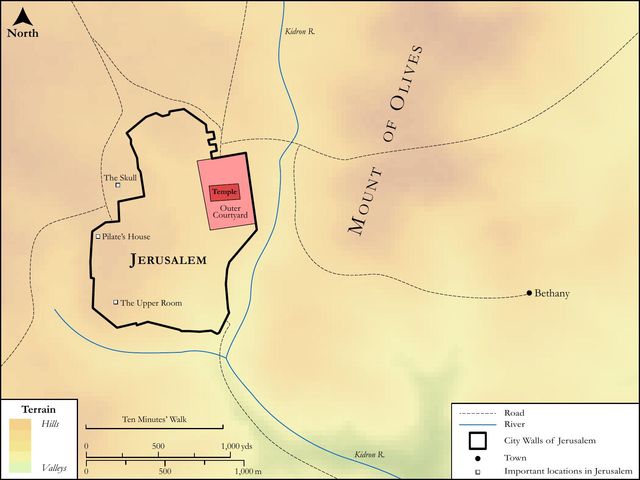
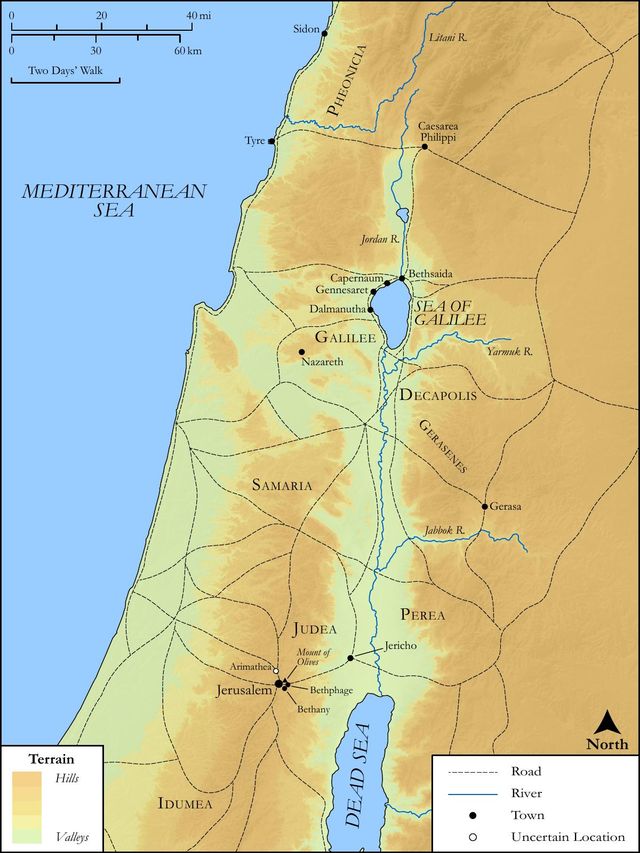
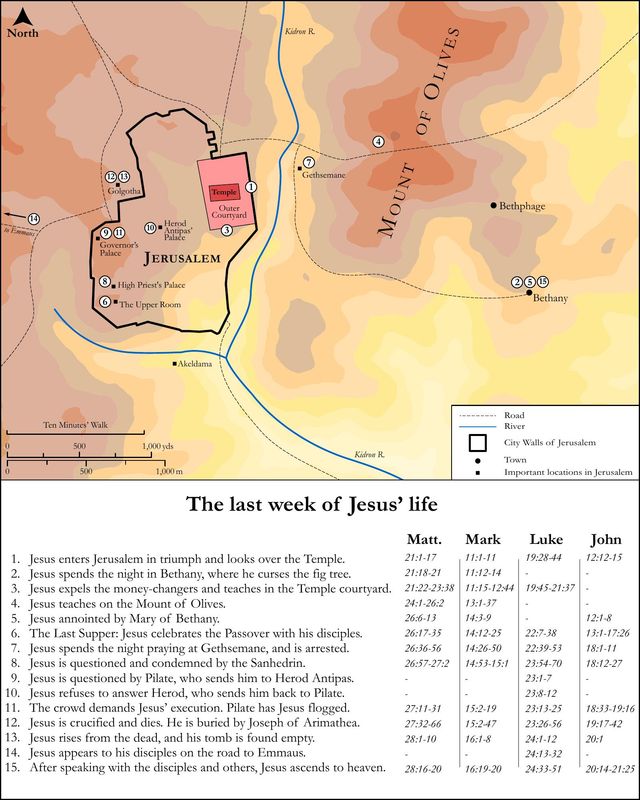
See on the biblical-era maps
Study this verse
Public-domain commentary
Matthew Henry
From his Commentary on the Whole Bible. Henry comments on passages, not single verses — this entry covers Mark 16:14–18. His three-level outline is real structure in the source text, so it is rendered as structure.
Here is, I. The conviction which Christ gave his apostles of the truth of his resurrection (Mar 16:14); He appeared to them himself, when they were all together, as they sat at meat, which gave him an opportunity to eat and drink with them, for their full satisfaction; see Act 10:41. And still, when he appeared to them, he upbraided them with their unbelief and hardness of heart, for even at the general meeting in Galilee, some doubted, as we find Mat 28:17. Note, The evidences of the truth of the gospel are so full, that those who receive it not, may justly be upbraided with their unbelief; and it is owing not to any weakness or deficiency in the proofs, but to the hardness of their heart, its senselessness and stupidity. Though they had not till now seen him themselves, they are justly blamed because they believed not them who had seen him after he was risen; and perhaps it was owing in part to the pride of their hearts, that they did not; for they thought, "If indeed he be risen, to whom should he delight to do the honour of showing himself but to us?" And if he pass them by, and show himself to others first, they cannot believe it is he. Thus many disbelieve the doctrine of Christ, because they think it below them to give credit to such as he had chosen to be the witnesses and publishers of it. Observe, It will not suffice for an excuse of our infidelity in the great day, to say, "We did not see him after he was risen," for we ought to have believed the testimony of those who did see him.
II.The commission which he gave them to set up his kingdom among men by the preaching of his gospel, the glad tidings of reconciliation to God through a Mediator. Now observe,
1.To whom they were to preach the gospel. Hitherto they had been sent only to the lost sheep of the house of Israel, and were forbidden to go into the way of the Gentiles, or into any city of the Samaritans; but now their commission is enlarged, and they are authorized to go into all the world, into all parts of the world, the habitable world, and to preach the gospel of Christ to every creature, to the Gentiles as well as to the Jews; to every human creature that is capable of receiving it. "Inform them concerning Christ, the history of his life, and death, and resurrection; instruct them in the meaning and intention of these, and of the advantages which the children of men have, or may have, hereby; and invite them, without exception, to come and share in them. This is gospel. Let this be preached in all places, to all persons." These eleven men could not themselves preach it to all the world, much less to every creature in it; but they and the other disciples, seventy in number, with those who should afterward to be added to them, must disperse themselves several ways, and, wherever they went, carry the gospel along with them. They must send others to those places whither they could not go themselves, and, in short, make it the business of their lives to send those glad tidings up and down the world with all possible fidelity and care, not as an amusement or entertainment, but as a solemn message from God to men, and an appointed means of making men happy. "Tell as many as you can, and bid them tell others; it is a message of universal concern, and therefore, ought to have a universal welcome, because it gives a universal welcome."
2.What is the summary of the gospel they are to preach (Mar 16:16); "Set before the world life and death, good and evil. Tell the children of men that they are all in a state of misery and danger, condemned by their prince, and conquered and enslaved by their enemies." This is supposed in their being saved, which they would not need to be if they were not lost. "Now go and tell them," (1.) "That if they believe the gospel, and give up themselves to be Christ's disciples; if they renounce the devil, the world, and the flesh, and be devoted to Christ as their prophet, priest, and king, and to God in Christ a their God in covenant, and evidence by their constant adherence to this covenant their sincerity herein, they shall be saved from the guilt and power of sin, it shall not rule them, it shall not ruin them. He that is a true Christian, shall be saved through Christ." Baptism was appointed to be the inaugurating rite, by which those that embraced Christ owned him; but it is here put rather for the thing signified than for the sign, for Simon Magus believed and was baptized, yet was not saved, Act 8:13. Believing with the heart, and confessing with the mouth the Lord Jesus (Rom 10:9), seems to be much the same with this here. Or thus, We must assent to gospel-truths, and consent to gospel-terms. (2.) "If they believe not, if they receive not the record God gives concerning his Son, they cannot expect any other way of salvation, but must inevitably perish; they shall be damned, by the sentence of a despised gospel, added to that of a broken law." And even this is gospel, it is good news, that nothing else but unbelief shall damn men, which is a sin against the remedy. Dr. Whitby here observes, that they who hence infer "that the infant seed of believers are not capable of baptism, because they cannot believe, must hence also infer that they cannot be saved; faith being here more expressly required to salvation than to baptism. And that in the latter clause baptism is omitted, because it is not simply the want of baptism, but the contemptuous neglect of it, which makes men guilty of damnation, otherwise infants might be damned for the mistakes or profaneness of their parents."
3.What power they should be endowed with, for the confirmation of the doctrine they were to preach (Mar 16:17); These signs shall follow them that believe. Not that all who believe, shall be able to produce these signs, but some, even as many as were employed in propagating the faith, and bringing others to it; for signs are intended for them that believe not; see Co1 14:22. It added much to the glory and evidence of the gospel, that the preachers not only wrought miracles themselves, but conferred upon others a power to work miracles, which power followed some of them that believed, wherever they went to preach. They shall do wonders in Christ's name, the same name into which they were baptized, in the virtue of power derived from him, and fetched in by prayer. Some particular signs are mentioned;
(1.)They shall cast out devils; this power was more common among Christians than any other, and lasted longer, as appears by the testimonies of Justin Martyr, Origen, Irenaeus, Tertullian Minutius Felix, and others, cited by Grotius on this place.
(2.)They shall speak with new tongues, which they had never learned, or been acquainted with; and this was both a miracle (a miracle upon the mind), for the confirming of the truth of the gospel, and a means of spreading the gospel among those nations that had not heard it. It saved the preachers a vast labour in learning the languages; and, no doubt, they who by miracle were made masters of languages, were complete masters of them and of all their native elegancies, which were proper both to instruct and affect, which would very much recommend them and their preaching.
(3.)They shall take up serpents. This was fulfilled in Paul, who was not hurt by the viper that fastened on his hand, which was acknowledged a great miracle by the barbarous people, Act 28:5, Act 28:6. They shall be kept unhurt by that generation of vipers among whom they live, and by the malice of the old serpent.
(4.)If they be compelled by their persecutors to drink any deadly poisonous thing, it shall not hurt them: of which very thing some instances are found in ecclesiastical history.
(5.)They shall not only be preserved from hurt themselves, but they shall be enabled to do good to others; They shall lay hands on the sick, and they shall recover, as multitudes had done by their master's healing touch. Many of the elders of the church had this power, as appears by Jam 5:14, where, as an instituted sign of this miraculous healing, they are said to anoint the sick with oil in the name of the Lord. With what assurance of success might they go about executing their commission, when they had such credentials as these to produce!
Historical interpretation
Eleven Centuries of Reception
15 surviving comments on this verse. Each one is dated, so this reads as a timeline rather than a list.
Select a marker to jump to its quote. Markers stagger vertically where authors wrote within a few decades of each other.
But in a mystic sense we may understand that faith here labours, leading the active life, but there it reigns secure in the contemplative vision. Here we see His face through a glass, there we shall see the truth face to face, wherefore He was shown to them as they were walking, that is, labouring, in another form. And when it was told, the disciples did not believe, because they saw, like Moses, that which was not enough for them, for he said, show me thyself; (Exod. 33:18. Sept.) forgetting his flesh, he prays in this life for that which we hope for in the life to come.
But He appeared when all the eleven were together, that all might be witnesses, and relate to all men what they had seen and heard in common. It goes on: And upbraided them with their unbelief and hardness of heart, because they believed not them who had seen him after his resurrection.
But He rebukes their want of faith, that faith might take its place; He rebukes the hardness of their stony heart, that the fleshy heart, full of love, might take its place.
But the Lord, having suffered, and bestowing the knowledge of the Father, conferred on us salvation. For the Lord, through means of suffering, "ascending into the lofty place, led captivity captive, gave gifts to men," and conferred on those that believe in Him the power "to tread upon serpents and scorpions, and on all the power of the enemy," that is, of the leader of apostasy. Our Lord also by His passion destroyed death, and dispersed error, and put an end to corruption, and destroyed ignorance, while He manifested life and revealed truth, and bestowed the gift of incorruption.
Vincentius of Thibaris said: We know that heretics are worse than Gentiles. If, therefore, being converted, they should wish to come to the Lord, we have assuredly the rule of truth which the Lord by His divine precept commanded to His apostles, saying, "Go ye, lay on hands in my name, expel demons." And in another place: "Go ye and teach the nations, baptizing them in the name of the Father, of the Son, and of the Holy Ghost." Therefore first of all by imposition of hands in exorcism, secondly by the regeneration of baptism, they may then come to the promise of Christ. Otherwise I think it ought not to be done.
With good reason did he say to all of us together, when we became fully aware of those gifts that were given from him by the Spirit: “And these signs will accompany those who believe; in my name they will cast out demons; they will speak in new tongues; they will pick up serpents, and if they drink any deadly thing, it will not hurt them; they will lay their hands on the sick, and they will recover.” These gifts were first bestowed on us the apostles when we were about to preach the gospel to every creature. Later they of necessity were afforded to others who had by the apostles come to believe. These gifts were not given for the advantage of those who perform them, but for the conviction of the unbelievers, that those whom the word did not persuade, the power of signs might put to shame.
As the Father gives the gift of healings, so too does the Son give; as the Father gives the gift of tongues, so too has the Son also granted it.
See, God sent apostles, and sent prophets and teachers, gave the gift of healings, which as we have found are given by the Holy Spirit, and God gave many kinds of tongues. But yet all are not apostles, all are not prophets, all are not teachers. Not all, says he, have the gift of healings, nor do all, says he, speak with tongues. For the whole range of divine gifts cannot exist in each particular individual. Each, according to his capacity, receives that which he either desires or deserves.
This same Macarius once went down from Scetis to a place named Terenuthis, and he climbed into an old pagan burial place to sleep. He put one of the bodies under his head as a pillow. The demons hated him when they saw his assurance and tried to frighten him by calling out, ‘Lady, come with us to bathe.’ Another demon answered from underneath Macarius, as though he were the dead woman, ‘I have a pilgrim on top of me, and can’t move.’ Macarius was not frightened, but confidently thumped the body, saying, ‘Get up and go if you can.’ When the demons heard it, they cried out and said, ‘You have defeated us,’ and they fled in confusion.
There is something to be said of these signs and powers of a more veiled nature. The holy church is even now doing spiritually, every day, what she then did through the apostles corporately. For when priests, by the grace of exorcism, lay hands on believers and forbid evil spirits to inhabit their minds, what are they doing but “casting out demons”? And any believers whatever who henceforth abandon the profanity of the old life, and utter holy mysteries, and rehearse, as best they can, the praise and power of their maker, what are they doing but “speaking in new tongues?” Moreover, when by their good exhortations they remove evil from the hearts of others, are they not “taking up serpents”? Aren’t these miracles the greater because they are spiritual, because they are the means not of raising up bodies but souls? These signs then, beloved, you do if you will.
Is it, my brethren, because we do not have these signs that you do not believe? These were needed at the church’s beginning. The new faith needed to be nourished by miracles to grow. When we plant a vineyard, we must water the plants till we see they have begun to grow in the earth, and when they have once taken root we cease to water them constantly.… But true life cannot be obtained by means of these outward signs by those who perform them. For although corporeal works of this kind sometimes do proclaim an inner holiness of life, they do not bring it about.
(ubi sup.) We should observe that Luke says in the Acts, As he was eating with them he commanded that they should not depart from Jerusalem, and shortly afterwards, while they beheld he was taken up. For He ate, and then ascended, that by the act of eating, the truth of the flesh might be declared; wherefore it is also here said, that he appeared to them for the last time as they sat at meat.
(ubi sup.) Another reason also why our Lord rebuked His disciples, when He left them as to His bodily presence, was, that the words which He spoke on leaving them might remain more deeply impressed upon the hearts of His hearers.
(ubi sup.) After rebuking the hardness of their hearts, let us hear the words of advice which He speaks. For it goes on: Go ye into all the world, and preach the Gospel to every creature. Every man must be understood by every creature; for man partakes something of every creature; he has existence as have stones, life as trees, feeling as animals, understanding as have Angels. For the Gospel is preached to every creature, because he is taught by it, for whose sake all are created, whom all things are in some way like, and from whom therefore they are not alien. By the name of every creature also every nation of the Gentiles may be meant. For it had been said before, Go not into the way of the Gentiles. (Matt. 10:5) But now it is said, Preach the Gospel to every creature, so that the preaching of the Apostles which was thrust aside by Judæa, might be an assistance to us, since Judæa had haughtily rejected it, thus witnessing to her own damnation.
(ubi sup.) But perhaps some one may say in himself, I have already believed, I shall be saved. He says what is true, if he keeps his faith by works; for that is a true faith, which does not contradict by its deeds what it says in words. There follows: But he that believeth not shall be damned.
(ubi sup.) Are we then without faith because we cannot do these signs? Nay, but these things were necessary in the beginning of the Church, for the faith of believers was to be nourished by miracles, that it might increase. Thus we also, when we plant groves, pour water upon them, until we see that they have grown strong in the earth; but when once they have firmly fixed their roots, we leave off irrigating them. These signs and miracles have other things which we ought to consider more minutely. For Holy Church does every day in spirit what then the Apostles did in body; for when her Priests by the grace of exorcism lay their hands on believers, and forbid the evil spirits to dwell in their minds, what do they, but cast out devils? And the faithful who have left earthly words, and whose tongues sound forth the Holy Mysteries, speak a new language; they who by their good warnings take away evil from the hearts of others, take up serpents; and when they are hearing words of pestilent persuasion, without being at all drawn aside to evil doing, they drink a deadly thing, but it will never hurt them; whenever they see their neighbours growing weak in good works, and by their good example strengthen their life, they lay their hands on the sick, that they may recover. And all these miracles are greater in proportion as they are spiritual, and by them souls and not bodies are raised.
And these signs shall follow them that believe. In my name they shall cast out devils, they shall speak with new tongues, they shall take up serpents; and if they shall drink any deadly thing, it shall not hurt them; they shall lay hands on the sick, and they shall recover.
What then, my brethren, because you do not these signs, do you not believe? But these things were necessary in the beginning of the Church. For that faith might grow, it needed to be nourished by miracles, because we also, when we plant shrubs, pour water on them only until we see that they have taken root in the ground; and once they have fixed their roots, we cease watering. Hence it is that Paul says: Tongues are for a sign, not to believers, but to unbelievers.
We have concerning these signs and powers things that we ought yet more carefully to consider. For holy Church daily does spiritually what then she did corporally through the apostles. For when her priests lay hands upon believers through the grace of exorcism, and forbid evil spirits to dwell in their minds, what else do they do but cast out devils? And believers who now abandon the worldly words of their former life, and utter forth holy mysteries, and declare the praises and power of their Creator as much as they are able, what else do they do but speak with new tongues?
And these signs will follow those who believe: In my name they will cast out demons; they will speak with new tongues; they will take up serpents; and if they drink anything deadly, it will by no means hurt them; they will lay hands on the sick, and they will recover. Should it be said that because we do not perform these signs we do not believe at all? But these were necessary at the beginning of the Church. For as faith was to grow, it had to be nurtured by miracles. For when we plant young trees, we water them until they seem to have taken root in the ground. But if they have once fixed their roots, the watering will cease. Hence it is that Paul says: Tongues are a sign, not for believers but for unbelievers (1 Cor. XIV). Do we not have of these signs and virtues what we should more subtly consider? The holy Church indeed daily spiritually performs what it did physically through the apostles. For when its priests lay hands on believers through the grace of exorcism, and deny the evil spirit dwelling in their minds, what else do they do but cast out demons? And faithful ones who have already renounced the secular words of the old life, but sound out the holy mysteries, and narrate, as far as they can, the praises and power of their Creator, what else do they do but speak in new tongues? When they remove malice from others' hearts by their good exhortations, they take up serpents. And when they hear pestilent suggestions but are not led into evil action, indeed it is deadly what they drink, but it will not harm them. Whenever they see their neighbors weakened in good work and run to help them with all their strength, and strengthen their life by the example of their actions, who waver in their own deeds, what else do they do but lay hands on the sick, that they may recover? These miracles are indeed all the greater as they are more spiritual. They are all the greater as by these not bodies, but souls are raised.
(ubi sup.) What shall we say here about infants, who by reason of their age cannot yet believe; for as to older persons there is no question. In the Church then of our Saviour children believe by others, as also they drew from others the sins which are remitted to them in baptism. It goes on: And these signs shall follow them that believe; In my name shall they cast out devils; they shall speak with new tongues; they shall take up serpents.
Or else; to every creature, that is, whether believing or unbelieving. It goes on: He that believeth and is baptized shall be saved. For it is not enough to believe, for he who believeth and is not baptized, but is a catechumen, has not yet attained to perfect salvation.
That is, they shall scatter before them serpents, whether intellectual or sensible, as it is said, Ye shall tread upon serpents and scorpions, which is understood spiritually. But it may also mean sensible serpents, as when Paul received no hurt from the viper. There follows: And if they drink any deadly thing, it shall not hurt them. (Luke 10:19) We read of many such cases in history, for many persons have drank poison unhurt, by guarding themselves with the sign of Christ. It goes on: They shall lay hands on the sick, and they shall recorer.
(non occ.) Mark, when about to finish his Gospel, relates the last appearance of our Lord to His disciples after His resurrection, saying,1 For the last time he appeared unto the eleven as they sat at meat. (Acts 1:4, 9)
Continue studying Mark 16:17 across the web’s major study libraries — every link below opens this exact verse, chapter, or book on the destination site.
Read & Compare
 BibleGatewayThis verse in more than 200 translations and 70 languages.
 Bible.comThe YouVersion reader — hundreds of translations, reading plans, and highlights.
 ESV.orgCrossway's official English Standard Version reader.
 NET BibleThe NET translation with 60,000+ translators' notes on every rendering decision.
 STEP BibleTyndale House's free study tool — original text, vocabulary, and scholarly resources.
 BibliaLogos Bible Software's free web reader.
 USCCBThe New American Bible (Revised Edition) with the U.S. bishops' study notes.
Commentaries
 BibleHub CommentariesDozens of classic commentaries on this verse, gathered on one page.
 StudyLightMore than 100 commentary sets — the largest collection on the web.
 BibleRefPlain-English commentary on what this verse means, verse by verse.
 Enduring WordDavid Guzik's free commentary on this chapter, widely used by Bible teachers.
 Bible Study ToolsVerse commentary alongside Greek and Hebrew study aids.
Original Language & Research
- BibleHub InterlinearThe verse word by word — original language, transliteration, and English.
- BibleHub LexiconEvery word's original-language definition and Strong's entry.
 Blue Letter BibleDeep-study tools — Strong's numbers, concordance, and word studies.
 CNTR CollationThe earliest Greek manuscripts of this verse, collated letter by letter.
Sermons, Hymns & Audio


TrulyRandomVerse is not affiliated with these sites and doesn’t control their content. They’re linked because they’re genuinely useful.
Summary
Mark 16:17 presents a profound post-resurrection promise from Jesus to His disciples, outlining specific supernatural "signs" that will accompany those who believe. These miraculous manifestations – including the casting out of demons and speaking in new tongues – are presented not as ends in themselves, but as divine endorsements of the Gospel message and authentications of the authority granted to believers operating in Jesus' name. This verse underscores the ongoing spiritual empowerment available to Christ's followers for the advancement of His kingdom.
Context
ShowHideLiterary Context
Mark 16:17 is part of what is widely known as the "longer ending of Mark" (Mark 16:9-20). While scholarly debate exists regarding its earliest manuscript attestation, this section has been historically accepted and included in the vast majority of biblical traditions for centuries, including the King James Version. It immediately follows Jesus' post-resurrection appearances to His disciples and His pivotal command, often called the Great Commission, to "go into all the world and preach the gospel to every creature." Thus, these promised signs are presented as direct accompaniments and validations of the disciples' obedience to this evangelistic mandate, providing divine attestation to their message as they embark on their global mission.
Historical & Cultural Context
In the 1st-century Greco-Roman world, the concept of divine power manifesting through signs and wonders was not unfamiliar, though often associated with pagan deities or philosophical figures. Within Judaism, miracles were understood as demonstrations of God's presence and power, authenticating His messengers (e.g., Moses, Elijah). Jesus' ministry was replete with such signs, which served to confirm His identity and authority. Therefore, the promise of these signs following believers would have resonated deeply with a culture that expected divine intervention to validate spiritual claims. It positioned the nascent Christian movement not merely as another philosophical school, but as a community empowered by the living God, capable of confronting the spiritual forces and linguistic barriers prevalent in their diverse world.
Key Themes
ShowHideThis verse powerfully contributes to several overarching themes within Mark's Gospel and the broader New Testament. Firstly, it highlights the theme of Divine Empowerment, emphasizing that believers are not left to their own devices but are supernaturally equipped for ministry. Secondly, it underscores the Authority of Jesus' Name, revealing that all power and effectiveness in ministry derive solely from Christ's supreme authority. Thirdly, the mention of "casting out devils" reinforces the theme of Spiritual Warfare, acknowledging the reality of demonic opposition and equipping believers to engage in the ongoing battle against the forces of darkness, just as Jesus did throughout His earthly ministry (e.g., Mark 1:27). Finally, "speaking with new tongues" introduces the theme of Supernatural Communication, anticipating the miraculous linguistic abilities that would later be dramatically displayed at Pentecost, facilitating the global spread of the Gospel across diverse cultures (e.g., Acts 2:4).
Exposition and Analysis
ShowHideKey Word Analysis
ShowHideThis term refers to an indication, especially one that is ceremonially or supernaturally given. In biblical contexts, sēmeîon denotes a miraculous event or phenomenon that serves as a divine attestation or proof, pointing beyond itself to a greater truth or the authority of the one performing it. These are not merely wonders but serve a revelatory purpose, confirming the message of the Gospel.
This word, a neuter form derived from daimōn, refers to a demonic being or evil spirit. It is crucial to note that this term specifically denotes lesser evil spirits or demons, not the Devil himself (Satan). The ability to "cast out daimonia" signifies authority over these malevolent spiritual entities that oppress humanity, a hallmark of Jesus' own ministry and now extended to His followers.
Of uncertain affinity, this word primarily means "the tongue" as an organ of speech. By implication, it refers to a language, specifically one that is naturally unacquired. In the context of miraculous signs, it refers to the supernatural ability to speak in languages previously unknown to the speaker, often for the purpose of communicating the Gospel across linguistic barriers, as seen in the book of Acts.
Verse Breakdown
ShowHide"And these signs shall follow them that believe;"
This opening clause establishes the condition and the promise. The "signs" (miraculous manifestations) are not arbitrary but are specifically linked to "them that believe" – indicating that faith is the prerequisite for experiencing or witnessing these divine accompaniments. The verb "shall follow" (Greek, parakolouthéō) suggests that these signs will naturally attend or be a consequence of genuine belief, serving as corroboration for the message proclaimed by believers.
"In my name shall they cast out devils;"
This phrase specifies the first of two miraculous signs. The power to "cast out devils" (demons) is explicitly stated to operate "In my name" (Greek, en to onomati mou). This is a crucial theological point, signifying that the authority and power do not reside in the believer but are derived entirely from Jesus Christ and His supreme authority. It reflects the continuation of Jesus' own ministry of spiritual liberation and confrontation with the forces of evil.
"they shall speak with new tongues;"
The second specific sign promised is the ability to "speak with new tongues." The adjective "new" (Greek, kainós) implies a fresh, unprecedented quality, distinguishing it from ordinary human language acquisition. This refers to a supernatural utterance of languages previously unknown to the speaker, a gift that would prove instrumental in the early church's mission to communicate the Gospel universally, transcending linguistic barriers and serving as a powerful sign to both believers and unbelievers.
Literary Devices
ShowHideMark 16:17 employs several potent literary devices to convey its message. The most prominent is Promise, as Jesus directly states what "shall follow" those who believe, setting an expectation for supernatural enablement. This promise functions as a form of Divine Assurance, comforting and empowering the disciples for their daunting mission. The phrase "In my name" utilizes Metonymy, where "name" stands for the entire authority, character, and power of Jesus Christ. This emphasizes that the power originates from Him, not the believers themselves. The verse also contains elements of Foreshadowing, particularly regarding "speaking with new tongues," which clearly anticipates the dramatic outpouring of the Holy Spirit and the gift of tongues at Pentecost as recorded in Acts 2. Furthermore, the mention of "casting out devils" evokes Spiritual Warfare imagery, portraying the Christian mission as an active engagement against malevolent spiritual forces, where believers are equipped with divine authority.
Theological and Thematic Connections
ShowHideMark 16:17 stands as a powerful testament to the ongoing, dynamic nature of God's work through His people. Theologically, it affirms that the resurrected Christ continues His ministry through His body, the Church, by empowering believers with supernatural abilities. These signs are not merely spectacular displays but serve as divine validation for the truth of the Gospel message and the authority of those who proclaim it. They underscore the reality of the spiritual realm and the church's mandate to confront the forces of darkness. The promise highlights the active presence of the Holy Spirit, who enables believers to carry out the Great Commission with divine backing, ensuring that the message of salvation is not just spoken, but also powerfully demonstrated. This verse connects the early church's experience to the broader theological understanding of spiritual gifts as instruments for kingdom advancement and the edification of the body of Christ.
Reflection and Application
ShowHideMark 16:17 challenges believers to consider the scope of God's power available to them through faith in Jesus Christ. While the specific manifestations of these signs may be debated in contemporary contexts, the underlying principles of divine empowerment, spiritual authority, and the purpose of God's power for evangelism remain profoundly relevant. This verse calls us to cultivate a robust faith that trusts in God's ability to work supernaturally through ordinary people. It encourages us to recognize that our mission to spread the Gospel is not dependent on human strength or eloquence alone, but on the accompanying power of the Holy Spirit, enabling us to confront spiritual opposition and communicate God's truth effectively. Ultimately, it reminds us that God equips those He calls, and His power is always for His glory and the advancement of His kingdom, confirming the message of salvation to a world in need.
Questions for Reflection
ShowHideFAQ
ShowHideIs the "longer ending of Mark" (Mark 16:9-20) considered authentic scripture by all scholars?
ShowHideThe authenticity of the "longer ending of Mark" (Mark 16:9-20), which includes Mark 16:17, has been a subject of scholarly debate for centuries. Some of the earliest and most significant Greek manuscripts (like Codex Sinaiticus and Codex Vaticanus) omit these verses, ending Mark's Gospel at Mark 16:8. However, other ancient manuscripts and early church fathers do include them. While many modern critical editions of the Bible note the textual variations, the longer ending has been traditionally accepted and included in most Bibles, including the King James Version, for centuries. Theologically, the content of these verses aligns with themes found elsewhere in the New Testament, particularly in Acts. Ultimately, whether one views it as original to Mark or a very early, inspired addition, its theological message is generally considered consistent with biblical teaching on the power and mission of the church.
Are the signs mentioned in Mark 16:17 (casting out devils, speaking with new tongues) still relevant for believers today?
ShowHideThe relevance of these specific signs for contemporary believers is a point of ongoing theological discussion among Christians. Some traditions believe these signs were primarily for the apostolic age, serving to establish the early church and authenticate the Gospel message in its initial spread, and are therefore not normative for all believers in all times. Other traditions believe that these signs, or at least the underlying principles of divine empowerment and spiritual gifts, continue to be available and active for believers today, as the Holy Spirit continues to equip the church for its mission. Regardless of one's specific interpretation of their frequency or manifestation, the core message of God's power at work through believers for the advancement of His kingdom remains a central truth for all Christians. The purpose of these signs, as seen throughout the New Testament, is always to confirm the Word and glorify God, not for personal display.
What is meant by "speaking with new tongues" in this verse, and how does it relate to the gift of tongues in Acts and 1 Corinthians?
ShowHide"Speaking with new tongues" (Greek: glōssais kainais) refers to the miraculous ability to speak in languages previously unknown to the speaker. This promise in Mark 16:17 directly anticipates the dramatic fulfillment seen on the Day of Pentecost in Acts 2:4, where the disciples spoke in various foreign languages, enabling people from diverse nations to understand the Gospel in their native tongues. This is often referred to as xenolalia (speaking in actual foreign languages). In 1 Corinthians 12-14, Paul discusses the gift of tongues further, which can also include speaking in a language unknown to any human (often called glossolalia), primarily for personal or corporate edification when interpreted. While there are nuances between the two, both manifestations are supernatural utterances by the power of the Holy Spirit, serving to glorify God and build up the church, often as a sign to unbelievers.
Christ-Centered Fulfillment
ShowHideMark 16:17 finds its ultimate fulfillment and meaning in the person and ongoing work of Jesus Christ. These promised signs are not merely arbitrary displays of power but are direct extensions of Christ's own earthly ministry, which was characterized by casting out demons, healing the sick, and proclaiming the kingdom of God with authority. The phrase "In my name" is paramount, revealing that the power to perform these signs does not originate from the believers themselves, but from their union with the resurrected Christ and their reliance on His supreme authority. It is His victory over sin, death, and the demonic forces that empowers His followers to continue His work. The signs, therefore, serve as tangible evidence that Christ is indeed alive, ascended, and actively working through His Church by the power of the Holy Spirit, fulfilling His promise that His followers would do even greater works than He did. Thus, Mark 16:17 points not to human ability, but to the indwelling Christ, who empowers His disciples to be His witnesses "to the ends of the earth" (as seen in Acts 1:8), confirming the truth of the Gospel message through accompanying signs and wonders, just as Hebrews 2:3-4 affirms. The signs are ultimately for the glory of Christ, validating His redemptive work and the message of salvation He entrusted to His Church, making Him known as Christ in us, the hope of glory.