


1 Corinthians 12:28
Bible text: King James Version (1769 Blayney text) · Public domain
Bible text: King James Version with Strong's numbers · Public domain
Bible text: Berean Standard Bible · Public domain
Bible text: American Standard Version (1901) · Public domain
Bible text: World English Bible, Messianic edition · Public domain
Bible text: Geneva Bible (1599) · Public domain
Bible text: Young's Literal Translation · Public domain
- καὶkaiAndG2532CONJConjunction
- οὓςhoussomeG3739R-APMRelative pronoun Accusative Plural Masculine
- μὲνmenindeedG3303PRTParticle or Disjunctive
- ἔθετοethetohas appointedG5087V-2AMI-3SVerb 2nd Aorist Middle Indicative 3rd Singular
- ὁho<the>G3588T-NSMDefinite article Nominative Singular Masculine
- θεὸςtheosGodG2316N-NSM-TNoun Nominative Singular Masculine Title
- ἐνeninG1722PREPPreposition
- τῇtēatheG3588T-DSFDefinite article Dative Singular Feminine
- ἐκκλησίᾳekklēsiachurchG1577N-DSFNoun Dative Singular Feminine
- πρῶτονprōtonfirstG4413A-ASNAdjective Accusative Singular Neuter
- ἀποστόλουςapostolousapostlesG652N-APMNoun Accusative Plural Masculine
- δεύτερονdeuteronsecondlyG1208A-ASNAdjective Accusative Singular Neuter
- προφήταςprophētasprophetsG4396N-APMNoun Accusative Plural Masculine
- τρίτονtritonthirdG5154A-ASNAdjective Accusative Singular Neuter
- διδασκάλουςdidaskalousteachersG1320N-APMNoun Accusative Plural Masculine
- ἔπειταepeitathenG1899ADVAdverb
- δυνάμειςdunameismiraclesG1411N-APFNoun Accusative Plural Feminine
- ἔπειταepeitathenG1899ADVAdverb
- χαρίσματαcharismatagiftsG5486N-APNNoun Accusative Plural Neuter
- ἰαμάτωνiamatōnof healingG2386N-GPNNoun Genitive Plural Neuter
- ἀντιλήμψειςantilēmpseishelpingG484N-APFNoun Accusative Plural Feminine
- κυβερνήσειςkubernēseisadministratingG2941N-APFNoun Accusative Plural Feminine
- γένηgenēvarious kindsG1085N-APNNoun Accusative Plural Neuter
- γλωσσῶνglōssōnof tonguesG1100N-GPFNoun Genitive Plural Feminine
English is a literal word-by-word gloss of the Greek, not the KJV's wording. Why?
This is the original text the KJV's translators worked from — each Greek word with its own literal English meaning in this verse, prepared by scholars at Tyndale House, Cambridge. The KJV translates whole sentences, not word by word, so its wording differs: one Greek word can become several English words, and the KJV may choose “charity” where the gloss reads “love”. Both are faithful — they answer different questions. For the KJV's own rendering, switch to the KJV text.
Details
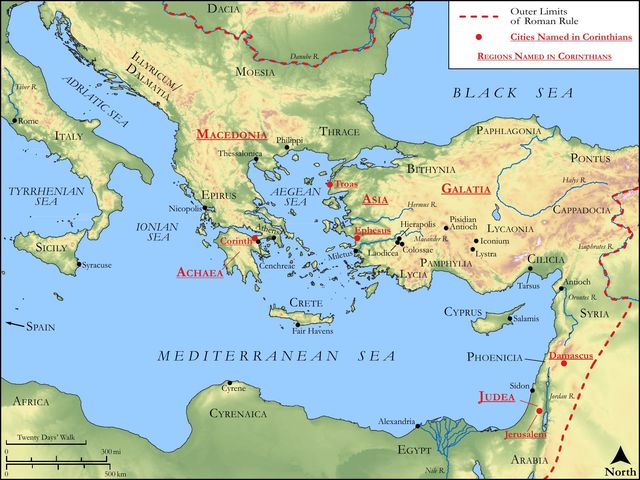
See on the biblical-era maps

Study this verse
Public-domain commentary
Matthew Henry
From his Commentary on the Whole Bible. Henry comments on passages, not single verses — this entry covers 1 Corinthians 12:27–31. His three-level outline is real structure in the source text, so it is rendered as structure.
I.Here the apostle sums up the argument, and applies this similitude to the church of Christ, concerning which observe,
1.The relation wherein Christians stand to Christ and one another. The church, or whole collective body of Christians, in all ages, is his body. Every Christian is a member of his body, and every other Christian stands related to him as a fellow-member (Co1 12:27): Now you are the body of Christ, and members in particular, or particular members. Each is a member of the body, not the whole body; each stands related to the body as a part of it, and all have a common relation to one another, dependence upon one another, and should have a mutual care and concern. Thus are the members of the natural body, thus should the members of the mystical body be, disposed. Note, Mutual indifference, and much more contempt, and hatred, and envy, and strife, are very unnatural in Christians. It is like the members of the same body being destitute of all concern for one another, or quarrelling with each other. This is the apostle's scope in this argument. He endeavours in it to suppress the proud, vaunting, and contentious spirit, that had prevailed among the Corinthians, by reason of their spiritual gifts.
2.The variety of offices instituted by Christ, and gifts or favours dispensed by him (Co1 12:28): God hath set some in the church; first, apostles, the chief ministers entrusted with all the powers necessary to found a church, and make an entire revelation of God's will. Secondarily, prophets, or persons enabled by inspiration, as the evangelists did. Thirdly, teachers, those who labour in word and doctrine, whether with pastoral charge or without it. After that, miracles, or miracle-workers. The gifts of healing, or those who had power to heal diseases; helps, or such as had compassion on the sick and weak, and ministered to them; governments, or such as had the disposal of the charitable contributions of the church, and dealt them out to the poor; diversities of tongues, or such as could speak divers languages. Concerning all these observe,
(1.)The plenteous variety of these gifts and offices. What a multitude are they! A good God was free in his communications to the primitive church; he was no niggard of his benefits and favours. No, he provided richly for them. They had no want, but a store - all that was necessary, and even more; what was convenient for them too.
(2.)Observe the order of these offices and gifts. They are here placed in their proper ranks. Those of most value have the first place. Apostles, prophets, and teachers, were all intended to instruct the people, to inform them well in the things of God, and promote their spiritual edification: without them, neither evangelical knowledge nor holiness could have been promoted. But the rest, however fitted to answer the great intentions of Christianity, had no such immediate regard to religion, strictly so called. Note, God does, and we should, value things according to their real worth: and the use of things is the best criterion of their real worth. Those are most valuable that best answer the highest purposes. Such were apostolical powers, compared with theirs who had only the gift of healing and miracles. What holds the last and lowest rank in this enumeration is diversity of tongues. It is by itself the most useless and insignificant of all these gifts. Healing diseases, relieving the poor, helping the sick, have their use: but how vain a thing is it to speak languages, if a man does it merely to amuse or boast himself! This may indeed raise the admiration, but cannot promote the edification, of the hearers, nor do them any good. And yet it is manifest from ch. 14 that the Corinthians valued themselves exceedingly on this gift. Note, How proper a method it is to beat down pride to let persons know the true value of what they pride themselves in! It is but too common a thing for men to value themselves most on what is least worth: and it is of great use to bring them to a sober mind by letting them know how much they are mistaken.
(3.)The various distribution of these gifts, not all to one, nor to every one alike. All members and officers had not the same rank in the church, nor the same endowments (Co1 12:29, Co1 12:30): Are all apostles? Are all prophets? This were to make the church a monster: all one as if the body were all ear or all eye. Some are fit for one office and employment, and some for another; and the Spirit distributes to every one as he will. We must be content with our own rank and share, if they be lower and less than those of others. We must not be conceited of ourselves, and despise others, if we are in the higher rank and have greater gifts. Every member of the body is to preserve its own rank, and do its own office; and all are to minister to one another, and promote the good of the body in general, without envying, or despising, or neglecting, or ill-using, any one particular member. How blessed a constitution were the Christian church, if all the members did their duty!
II.He closes this chapter with an advice (as the generality read it) and a hint.
1.An advice to covet the best gifts, charismata ta kreittona - dona potiora, praestantiora, either the most valuable in themselves or the most serviceable to others; and these are, in truth, most valuable in themselves, though men may be apt to esteem those most that will raise their fame and esteem highest. Those are truly best by which God will be most honoured and his church edified. Such gifts should be most earnestly coveted. Note, We should desire that most which is best, and most worth. Grace is therefore to be preferred before gifts; and, of gifts, those are to be preferred which are of greatest use. But some read this passage, not as an advice, but a charge: zēloute, You are envious at each other's gifts. In Co1 13:4, the same word is thus translated. You quarrel and contend about them. This they certainly did. And this behaviour the apostle here reprehends, and labours to rectify. Only of pride cometh contention. These contests in the church of Corinth sprang from this original. It was a quarrel about precedency (as most quarrels among Christians are, with whatever pretences they are gilded over); and it is no wonder that a quarrel about precedence should extinguish charity. When all would stand in the first rank, no wonder if they jostle, or throw down, or thrust back, their brethren. Gifts may be valued for their use, but they are mischievous when made the fuel of pride and contention. This therefore the apostle endeavours to prevent.
2.By giving them the hint of a more excellent way, namely, of charity, of mutual love and good-will. This was the only right way to quiet and cement them, and make their gifts turn to the advantage and edification of the church. This would render them kind to each other, and concerned for each other, and therefore calm their spirits, and put an end to their little piques and contests, their disputes about precedency. Those would appear to be in the foremost rank, according to the apostle, who had most of true Christian love. Note, True charity is greatly to be preferred to the most glorious gifts. To have the heart glow with mutual love is vastly better than to glare with the most pompous titles, offices, or powers.
Historical interpretation
Eighteen Centuries of Reception
5 surviving comments on this verse. Each one is dated, so this reads as a timeline rather than a list.
Select a marker to jump to its quote. Markers stagger vertically where authors wrote within a few decades of each other.
For all the other prophets preached the advent of the paternal Light, and desired to be worthy of seeing Him whom they preached; but John did both announce .
for this purpose, that all the members receiving it may be vivified; and the .
Paul then, teaching us where one may find such, says, "God hath placed in the Church, first, apostles; secondly, prophets; thirdly, teachers."
"Seven thunders uttered their voices." The seven thunders uttering their voices signify, the Holy Spirit of sevenfold power, who through the prophets announced all things to come, and by His voice John gave his testimony in the world; but because he says that he was about to write the things which the thunders had uttered, that is, whatever things had been obscure in the announcements of the Old Testament; he is forbidden to write them, but he was charged to leave them sealed, because he is an apostle, nor was it fitting that the grace of the subsequent stage should be given in the first. "The time," says he, "is at hand." For the apostles, by powers, by signs, by portents, and by mighty works, have overcome unbelief. After them there is now given to the same completed Churches the comfort of having the prophetic Scriptures subsequently interpreted, for I said that after the apostles there would be interpreting prophets.
For the apostle says: "And he placed in the Church indeed, first, apostles; secondly, prophets; thirdly, teachers," and the rest. And in another place he says: "Let the prophets speak two or three, and let the others judge." And he says: "Every woman that prayeth or prophesieth with her head uncovered, dishonoureth her head" And when he says, "Let the prophets speak two or three, and let the others judge," he is not speaking in respect of the Catholic prophecy of things unheard and unknown, but of things both announced and known. But let them judge whether or not the interpretation is consistent with the testimonies of the prophetic utterance. It is plain, therefore, that to John, armed as he was with superior virtue, this was not necessary, although the body of Christ, which is the Church, adorned with His members, ought to respond to its position.
Paul has placed the apostles at the head of the church. They may be identified with bishops, as Peter said of Judas: “Let another take his bishopric.” There are two types of prophets, those who predict the future and those who interpret the Scriptures. The apostles are also prophets, because the top rank has all the others subordinated to it. Even a wicked man like Caiaphas uttered prophecies on the strength of his rank, not for any virtue he might have possessed. Teachers are those who instructed boys in the synagogue, a practice which has come down to us as well.
Thus what I spake of before, this also he now doth. Because they thought highly of themselves in respect of the tongues he sets it last every where. For the terms, "first" and "secondly," are not used by him here at random, but in order by enumeration to point out the more honorable and the inferior. Wherefore also he set the apostles first who had all the gifts in themselves. And he said not, "God hath set certain in the Church, apostles" simply, or "prophets," but he employs "first, second," and "third," signifying that same thing which I told you of.
"Secondly, prophets." For they used to whom he saith, "Let the prophets speak, two or three." And writing also to Timothy, he said, "Neglect not the gift that is in thee, which was given thee by prophecy." And they were much more many that prophesied. And if Christ saith, "The Law and the Prophets prophesied until John," He saith it of those prophets who before proclaimed His coming.
"Thirdly, teachers." For he that prophesieth speaks all things from the Spirit; but he that teacheth sometimes discourses also out of his own mind. Wherefore also he said, "Let the elders that rule well be counted worthy of double honor, especially they who labor in the word and in teaching:" whereas he that speaks all things by the Spirit doth not labor. This accordingly is the reason why he set him after the prophet, because the one is wholly a gift but the other is also man's labor. For he speaks many things of his own mind, agreeing however with the sacred Scriptures.
"Then miracles, then gifts of healings." Seest thou how he again divides the healings from the power, which also he did before. For the power is more than the healing: since he that hath power both punishes and heals, but he that hath the gift of healings doeth cures only. And observe how excellent the order he made use of, when he set the prophecy before the miracles and the healings. For above when he said, "To one is given by the Spirit the word of wisdom, and to another the word of knowledge," he spake, not setting them in order, but indifferently. Here, on the other hand, he sets a first and a second rank. Wherefore then doth he set prophecy first? Because even in the old covenant the matter has this order. For example, when Isaiah was discoursing with the Jews, and exhibiting a demonstration of the power of God, and bringing forward the evidence of the worthlessness of the demons, he made this also as the greater evidence of his divinity, his foretelling things to come. And Christ Himself after working so many signs saith that this was no small sign of His divinity: and continually adds, "But these things have I told you, that when it is come to pass, ye may believe that I am He."
"Well then; the gifts of healing are justly inferior to prophecy. But why likewise to teaching?" Because it is not the same thing to declare the word of preaching and sow piety in the hearts of the hearers, as it is to work miracles: since these are done merely for the sake of that. When therefore any one teaches both by word and life, he is greater than all. For those he calls emphatically teachers, who both teach by deeds and instruct in word. For instance: this made the Apostles themselves to become Apostles. And those gifts certain others also, of no great worth, received in the beginning, as they who said, "Lord, did we not prophesy by Thy Name, and do mighty works?" and after this were told, "I never knew you; depart from Me, ye that work iniquity." But this twofold mode of teaching, I mean that by deeds and by words, no bad man would ever undertake. As to his setting the prophets first marvel not at it. For he is not speaking of prophets simply, but of those who by prophecy do also teach and say every thing to the common benefit: which in proceeding he makes more clear to us.
"Helps, governments" What is, "helps?" To support the weak. Is this then a gift, tell me? In the first place, this too is of the Gift of God, aptness for a patron's office; the dispensing spiritual things; besides which he calls many even of our own good deeds, "gifts."
The only rite which we know to have been instituted by Our Lord Himself is the Holy Communion ('Do this in remembrance of me' - 'If you do not eat the flesh of the Son of Man and drink His blood, ye have no life in you'). This is an order and must be obeyed. The other services are, I take it, traditional and might lawfully be altered. But the New Testament does not envisage solitary religion: some kind of regular assembly for worship and instruction is everywhere taken for granted in the Epistles. So we must be regular practising members of the Church.
Of course we differ in temperament. Some (like you - and me) find it more natural to approach God in solitude: but we must go to church as well. Others find it easier to approach Him through the services: but they must practice private prayer and reading as well. For the Church is not a human society of people united by their natural affinities but the Body of Christ in which all members however different (and He rejoices in their differences and by no means wishes to iron them out) must share the common life, complementing and helping and receiving one another precisely by their differences. (Re-read 1st Corinthians cap 12 and meditate on it. The word translated members would perhaps be better translated organs).
Continue studying 1 Corinthians 12:28 across the web’s major study libraries — every link below opens this exact verse, chapter, or book on the destination site.
Read & Compare
 BibleGatewayThis verse in more than 200 translations and 70 languages.
 Bible.comThe YouVersion reader — hundreds of translations, reading plans, and highlights.
 ESV.orgCrossway's official English Standard Version reader.
 NET BibleThe NET translation with 60,000+ translators' notes on every rendering decision.
 STEP BibleTyndale House's free study tool — original text, vocabulary, and scholarly resources.
 BibliaLogos Bible Software's free web reader.
 USCCBThe New American Bible (Revised Edition) with the U.S. bishops' study notes.
Commentaries
 BibleHub CommentariesDozens of classic commentaries on this verse, gathered on one page.
 StudyLightMore than 100 commentary sets — the largest collection on the web.
 BibleRefPlain-English commentary on what this verse means, verse by verse.
 Enduring WordDavid Guzik's free commentary on this chapter, widely used by Bible teachers.
 Bible Study ToolsVerse commentary alongside Greek and Hebrew study aids.
Original Language & Research
- BibleHub InterlinearThe verse word by word — original language, transliteration, and English.
- BibleHub LexiconEvery word's original-language definition and Strong's entry.
 Blue Letter BibleDeep-study tools — Strong's numbers, concordance, and word studies.
 CNTR CollationThe earliest Greek manuscripts of this verse, collated letter by letter.
Sermons, Hymns & Audio


TrulyRandomVerse is not affiliated with these sites and doesn’t control their content. They’re linked because they’re genuinely useful.
Summary
God's sovereign establishment of various spiritual gifts and ministries within the Christian church, detailing a specific enumeration of foundational roles like apostles, prophets, and teachers, followed by miraculous manifestations such as miracles and gifts of healings, and practical ministries including helps, governments, and diversities of tongues. This verse underscores the divine origin and diverse nature of spiritual endowments, all purposed for the edification and effective functioning of the Body of Christ.
Context
ShowHideLiterary Context
This verse is a pivotal statement within Paul's extensive discourse on spiritual gifts in 1 Corinthians 12-14. Preceding 1 Corinthians 12:28, Paul emphasizes the unity of the Spirit despite the diversity of gifts, using the powerful analogy of the human body in 1 Corinthians 12:12-27. He asserts that just as a body has many members, each with a unique function, so too the church, as the Body of Christ, comprises diverse members endowed with different gifts by the same Spirit. Verse 28 then serves as a concrete enumeration, providing examples of the "members" and their "functions" within this divine organism, transitioning from the general principle of diversity to specific roles and manifestations.
Historical & Cultural Context
The Corinthian church was a vibrant but problematic community, marked by spiritual fervor, yet also by divisions, pride, and misuse of spiritual gifts, particularly tongues. Some members elevated certain gifts (like speaking in tongues) above others, leading to disorder and a sense of superiority or inferiority among believers. Paul writes to correct these abuses, restore order, and promote unity and love. Among the Greeks and Romans, various cults and philosophical schools often featured ecstatic experiences, and the Corinthians may have been influenced by these, misinterpreting true spiritual manifestations. Paul's emphasis on "order" and "edification" (1 Corinthians 14:26) directly addresses the chaotic worship services and the competitive spirit prevalent in Corinth.
Key Themes
ShowHide1 Corinthians 12:28 contributes significantly to several key themes within 1 Corinthians. Foremost is the Divine Sovereignty and Appointment of gifts, highlighted by the phrase "God hath set some in the church," emphasizing that these roles are not self-appointed but divinely ordained. Another crucial theme is the Diversity in Unity of the church, where various gifts and ministries, though distinct, are all essential for the health and growth of the single Body of Christ, echoing the principle in 1 Corinthians 12:4-6. The verse also subtly introduces the theme of Order and Edification, as the listing implies a structured, purposeful arrangement of ministries designed to build up the church, rather than cause chaos or division, a concept further developed in 1 Corinthians 14.
Exposition and Analysis
ShowHideKey Word Analysis
ShowHideThis verb signifies a deliberate, purposeful placement or appointment. It conveys God's active and intentional role in establishing the various ministries and gifts within the church. It is not a haphazard distribution but a sovereign, ordered arrangement, emphasizing divine design over human initiative or ambition.
Derived from a compound meaning "a calling out," this term refers to a popular assembly, specifically a religious congregation. In the New Testament, it denotes the community of Christian believers, whether local or universal. Its use here underscores that these gifts are given for the benefit and functioning of this divinely called-out assembly, the Body of Christ.
This unique term, derived from a word relating to "piloting" or "steering a ship," refers to the gift of directorship, administration, or wise guidance. It highlights the necessity of leadership and organizational ability within the church to navigate its affairs, ensure order, and direct its mission effectively, much like a pilot guides a vessel.
Verse Breakdown
ShowHide"And God hath set some in the church"
This opening clause establishes the divine origin and authority behind the distribution of spiritual gifts and ministries. It is God Himself who actively and intentionally places individuals and their corresponding endowments within the community of believers, underscoring His sovereignty over the church's structure and function.
"first apostles, secondarily prophets, thirdly teachers"
Paul begins with what appear to be foundational and authoritative roles, indicating a certain order or priority. Apostles were those specially "sent" by Christ, often eyewitnesses of His resurrection, foundational to the church's establishment. Prophets were inspired speakers who "forth-told" God's message, providing divine insight and instruction. Teachers were gifted in explaining and applying God's Word, ensuring sound doctrine and understanding. This sequence suggests a progression of foundational authority and instruction.
"after that miracles, then gifts of healings"
Following the foundational leadership and teaching roles, Paul lists miraculous manifestations. "Miracles" (dýnamis) refers to mighty works or displays of divine power, while "gifts of healings" (chárisma íama) specifically denotes the supernatural ability to restore health. These demonstrate God's active presence and power within the church, validating the divine message and bringing relief.
"helps, governments, diversities of tongues"
The list concludes with practical and diverse ministries. "Helps" (antílēpsis) refers to acts of practical assistance, support, and aid to others, highlighting the importance of service-oriented ministries. "Governments" (kybérnēsis) signifies the gift of administration, leadership, or wise guidance in managing the church's affairs. "Diversities of tongues" (génos glōssa) refers to various kinds or types of languages, often miraculous speech in unknown human languages or divine utterances, a gift Paul addresses further in 1 Corinthians 14. This final grouping emphasizes the comprehensive nature of God's provision for the church's spiritual, practical, and administrative needs.
Literary Devices
ShowHidePaul employs Enumeration in 1 Corinthians 12:28 to provide a clear, albeit not exhaustive, list of the diverse ministries and spiritual gifts God has established in the church. The use of Ordinal Numbers ("first," "secondarily," "thirdly") suggests a hierarchical or foundational order, implying that certain roles (apostles, prophets, teachers) were primary in the establishment and instruction of the early church, while other gifts followed in sequence of importance or manifestation. This structured listing serves as a practical application of the broader Analogy of the Body of Christ presented earlier in the chapter, demonstrating how different "parts" (gifts/ministries) contribute to the whole. The verse also implicitly uses Metonymy, where the "gifts" stand for the individuals who possess and exercise them, emphasizing that these are not merely abstract abilities but active functions performed by members within the community.
Theological and Thematic Connections
ShowHide1 Corinthians 12:28 profoundly illustrates God's sovereign design for His church, emphasizing that its structure and function are divinely ordained, not humanly contrived. The diversity of gifts listed, from leadership and teaching to miraculous manifestations and practical service, underscores the comprehensive provision God makes for the church's health, growth, and mission. This divine appointment ensures that the church is equipped to fulfill its purpose in the world, reflecting God's wisdom and power through its various members working in unity. The theological implication is that every believer, regardless of their specific gifting, plays a vital role in the Body of Christ, and all gifts, whether seemingly "greater" or "lesser," are essential and interdependent.
Reflection and Application
ShowHide1 Corinthians 12:28 serves as a powerful reminder that the church is not merely a human organization but a divine organism, purposefully designed and empowered by God Himself. For contemporary believers, this means recognizing that God continues to sovereignly place individuals within the church body with diverse gifts and callings for His purposes. We are called to value every role, understanding that each gift, whether prominent or behind-the-scenes, is essential for the holistic functioning and vitality of the church. This understanding should foster humility, discourage comparison or competition, and promote a spirit of mutual dependence and collaboration. It challenges us to prayerfully discern our own spiritual gifting and actively seek opportunities to deploy them for the common good and the edification of the Body of Christ, contributing to the church's mission with diligence and love.
Questions for Reflection
ShowHideFAQ
ShowHideAre the gifts listed in 1 Corinthians 12:28 still active in the church today?
ShowHideWhile there is theological debate on the continuation of all "sign gifts" (like apostleship in its foundational sense, and some aspects of prophecy and tongues), many scholars and denominations believe that the Holy Spirit continues to empower believers with a variety of gifts for the edification of the church. Gifts like teaching, helps, and governments are clearly ongoing. The miraculous gifts (miracles, healings, tongues) are also seen by many as continuing, though their manifestation and interpretation may vary. Paul's emphasis throughout 1 Corinthians 12 is on the Spirit's sovereign distribution of gifts as He wills (1 Corinthians 12:11), suggesting that their presence is tied to His ongoing work in the church.
Does the order "first, secondarily, thirdly" imply a hierarchy of importance for these gifts?
ShowHideWhile the ordinal numbering ("first," "secondarily," "thirdly") suggests a certain order, it's generally understood to indicate a foundational or logical sequence rather than a strict hierarchy of value. Apostles, prophets, and teachers were foundational to the establishment and instruction of the early church. All gifts are essential for the body to function, as Paul emphasizes in the body analogy (1 Corinthians 12:12-27). The "more excellent way" is love (1 Corinthians 12:31), which is superior to any gift. Therefore, while some gifts may have greater public visibility or foundational significance, none are inherently "more important" in terms of their necessity for the church's overall health and mission.
Christ-Centered Fulfillment
ShowHide1 Corinthians 12:28 finds its ultimate Christ-centered fulfillment in the reality that all spiritual gifts and ministries are given by God through the Holy Spirit to build up the Body of Christ, of which Jesus Himself is the Head (Ephesians 1:22-23). The very purpose of these diverse endowments is to equip the saints for the work of ministry, leading to the maturity and unity of faith, "unto the measure of the stature of the fullness of Christ" (Ephesians 4:11-13). Jesus, as the perfect embodiment of all divine wisdom and power, is the supreme Apostle, Prophet, and Teacher, fulfilling these roles perfectly in His earthly ministry (Hebrews 3:1, Luke 24:19, Matthew 7:29). His miracles demonstrated the kingdom of God breaking into the world (Matthew 11:4-5), and His ultimate act of "helps" was laying down His life for humanity (Philippians 2:5-8). The "governments" within the church ultimately reflect the wise and just governance of Christ, the King of kings (Revelation 19:16). Thus, every gift listed serves to manifest Christ's ongoing work in the world, drawing believers into deeper conformity with His character and advancing His kingdom until He returns in glory (Colossians 1:18).