


1 Corinthians 14:26
Bible text: King James Version (1769 Blayney text) · Public domain
Bible text: King James Version with Strong's numbers · Public domain
Bible text: Berean Standard Bible · Public domain
Bible text: American Standard Version (1901) · Public domain
Bible text: World English Bible, Messianic edition · Public domain
Bible text: Geneva Bible (1599) · Public domain
Bible text: Young's Literal Translation · Public domain
- ΤίTiWhatG5101I-NSNInterrogative pronoun Nominative Singular Neuter
- οὖνounthenG3767CONJConjunction
- ἐστινestinis itG1510V-PAI-3SVerb Present Active Indicative 3rd Singular
- ἀδελφοί;adelphoibrothers?G80N-VPMNoun Vocative Plural Masculine
- ὅτανhotanWhenG3752CONJConjunction
- συνέρχησθεsunerchēstheyou may come togetherG4905V-PNS-2PVerb Present Middle Or Passive Deponent Subjunctive 2nd Plural
- ἕκαστοςhekastoseachG1538A-NSMAdjective Nominative Singular Masculine
- ὑμῶνhumōnof youG4771P-2GPPersonal pronoun Genitive 2nd Plural
- ψαλμὸνpsalmona psalmG5568N-ASMNoun Accusative Singular Masculine
- ἔχειecheihasG2192V-PAI-3SVerb Present Active Indicative 3rd Singular
- διδαχὴνdidachēna teachingG1322N-ASFNoun Accusative Singular Feminine
- ἔχειecheihasG2192V-PAI-3SVerb Present Active Indicative 3rd Singular
- ἀποκάλυψινapokalupsina revelationG602N-ASFNoun Accusative Singular Feminine
- ἔχειecheihasG2192V-PAI-3SVerb Present Active Indicative 3rd Singular
- γλῶσσανglōssana tongueG1100N-ASFNoun Accusative Singular Feminine
- ἔχειecheihasG2192V-PAI-3SVerb Present Active Indicative 3rd Singular
- ἑρμηνείανhermēneianan interpretationG2058N-ASFNoun Accusative Singular Feminine
- ἔχει·echeihasG2192V-PAI-3SVerb Present Active Indicative 3rd Singular
- πάνταpantaAll thingsG3956A-NPNAdjective Nominative Plural Neuter
- πρὸςprosforG4314PREPPreposition
- οἰκοδομὴνoikodomēnedificationG3619N-ASFNoun Accusative Singular Feminine
- γινέσθωginesthōshould beG1096V-PNM-3SVerb Present Middle Or Passive Deponent Imperative 3rd Singular
English is a literal word-by-word gloss of the Greek, not the KJV's wording. Why?
This is the original text the KJV's translators worked from — each Greek word with its own literal English meaning in this verse, prepared by scholars at Tyndale House, Cambridge. The KJV translates whole sentences, not word by word, so its wording differs: one Greek word can become several English words, and the KJV may choose “charity” where the gloss reads “love”. Both are faithful — they answer different questions. For the KJV's own rendering, switch to the KJV text.
Details
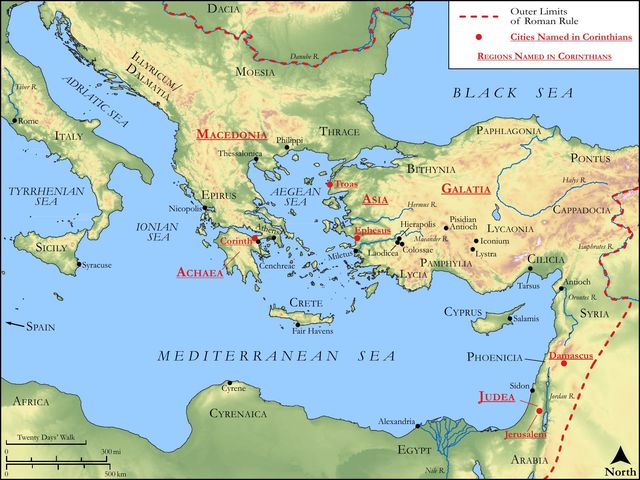
See on the biblical-era maps

Study this verse
Public-domain commentary
Matthew Henry
From his Commentary on the Whole Bible. Henry comments on passages, not single verses — this entry covers 1 Corinthians 14:26–33. His three-level outline is real structure in the source text, so it is rendered as structure.
In this passage the apostle reproves them for their disorder, and endeavours to correct and regulate their conduct for the future.
I.He blames them for the confusion they introduced into the assembly, by ostentation of their gifts (Co1 14:26):
When you come together every one hath a psalm, hath a doctrine, hath a tongue, etc.; that is, "You are apt to confound the several parts of worship; and, while one has a psalm to utter by inspiration, another has a doctrine, or revelation;" or else, "You are apt to be confused in the same branch of worship, many of you having psalms or doctrines to propose at the same time, without staying for one another. Is not this perfect uproar? Can this be edifying? And yet all religious exercises in public assemblies should have this view, Let all things be done to edifying."
II.He corrects their faults, and lays down some regulations for their future conduct.
1.As to speaking in an unknown tongue, he orders that no more than two or three should do it at one meeting, and this not altogether, but successively, one after another. And even this was not to be done unless there were some one to interpret (Co1 14:27, Co1 14:28), some other interpreter besides himself, who spoke; for to speak in an unknown tongue what he himself was afterwards to interpret could only be for ostentation. But, if another were present who could interpret, two miraculous gifts might be exercised at once, and thereby the church edified, and the faith of the hearers confirmed at the same time. But, if there were none to interpret, he was to be silent in the church, and only exercise his gift between God and himself (Co1 14:28), that is (as I think) in private, at home; for all who are present at public worship should join in it, and not be at their private devotions in public assemblies. Solitary devotions are out of time and place when the church has met for social worship.
2.As to prophesying he orders,
(1.)That two or three only should speak at one meeting (Co1 14:20), and this successively, not all at once; and that the other should examine and judge what he delivered, that is, discern and determine concerning it, whether it were of divine inspiration or not. There might be false prophets, mere pretenders to divine inspiration; and the true prophets were to judge of these, and discern and discover who was divinely inspired, and by such inspiration interpreted scripture, and taught the church, and who was not - what was of divine inspiration and what was not. This seems to be the meaning of this rule. For where a prophet was known to be such, and under the divine afflatus, he could not be judged; for this were to subject even the Holy Spirit to the judgment of men. He who was indeed inspired, and known to be so, was above all human judgment.
(2.)He orders that, if any assistant prophet had a revelation, while another was prophesying, the other should hold his peace, be silent (Co1 14:30), before the inspired assistant uttered his revelation. Indeed, it is by many understood that the former speaker should immediately hold his peace. But this seems unnatural, and not so well to agree with the context. For why must one that was speaking by inspiration be immediately silent upon another man's being inspired, and suppress what was dictated to him by the same Spirit? Indeed, he who had the new revelation might claim liberty of speech in his turn, upon producing his vouchers; but why must liberty of speech be taken from him who was speaking before, and his mouth stopped, when he was delivering the dictates of the same Spirit, and could produce the same vouchers? Would the Spirit of God move one to speak, and, before he had delivered what he had to say, move another to interrupt him, and put him to silence? This seems to me an unnatural thought. Nor is it more agreeable to the context, and the reason annexed (Co1 14:31): That all might prophesy, one by one, or one after another, which could not be where any one was interrupted and silenced before he had done prophesying; but might easily be if he who was afterwards inspired forbore to deliver his new revelation till the former prophet had finished what he had to say. And, to confirm this sense, the apostle quickly adds, The spirits of the prophets are subject to the prophets (Co1 14:33); that is, the spiritual gifts they have leave them still possessed of their reason, and capable of using their own judgment in the exercise of them. Divine inspirations are not, like the diabolical possessions of heathen priests, violent and ungovernable, and prompting them to act as if they were beside themselves; but are sober and calm, and capable of regular conduct. The man inspired by the Spirit of God may still act the man, and observe the rules of natural order and decency in delivering his revelations. His spiritual gift is thus far subject to his pleasure, and to be managed by his discretion.
III.The apostle gives the reasons of these regulations. As,
1.That they would be for the church's benefit, their instruction and consolation. It is that all may learn, and all may be comforted or exhorted, that the prophets were to speak in the orderly manner the apostle advises. Note, The instruction, edification, and comfort of the church, is that for which God instituted the ministry. And surely ministers should, as much as possible, fit their ministrations to these purposes.
2.He tells them, God is not the God of confusion, but of peace and good order, Co1 14:33. Therefore divine inspiration should by no means throw Christian assemblies into confusion, and break through all rules of common decency, which yet would be unavoidable if several inspired men should all at once utter what was suggested to them by the Spirit of God, and not wait to take their turns. Note, The honour of God requires that things should be managed in Christian assemblies so as not to transgress the rules of natural decency. If they are managed in a tumultuous and confused manner, what a notion must this give of the God who is worshipped, to considerate observers! Does it look as if he were the God of peace and order, and an enemy to confusion? Things should be managed so in divine worship that no unlovely nor dishonourable notion of God should be formed in the minds of observers.
3.He adds that things were thus orderly managed in all the other churches: As in all the churches of the saints (Co1 14:33); they kept to these rules in the exercise of their spiritual gifts, which was a manifest proof that the church of Corinth might observe the same regulations. And it would be perfectly scandalous for them, who exceeded most churches in spiritual gifts, to be more disorderly than any in the exercise of them. Note, Though other churches are not to be our rule, yet the regard they pay to the rules of natural decency and order should restrain us from breaking these rules. Thus far they may be proposed as examples, and it is a shame not to follow them.
Historical interpretation
Two Centuries of Reception
3 surviving comments on this verse. Each one is dated, so this reads as a timeline rather than a list.
Select a marker to jump to its quote. Markers stagger vertically where authors wrote within a few decades of each other.
Let Marcion then exhibit, as gifts of his god, some prophets, such as have not spoken by human sense, but with the Spirit of God, such as have both predicted things to come, and have made manifest the secrets of the heart; let him produce a psalm, a vision, a prayer -only let it be by the Spirit, in an ecstasy, that is, in a rapture, whenever an interpretation of tongues has occurred to him; let him show to me also, that any woman of boastful tongue in his community has ever prophesied from amongst those specially holy sisters of his.
Particular effort should be made to ensure that unlearned people will benefit. Nothing should be done to hide things from them because of their lack of learning.
"What is it then, brethren? When ye come together, each one hath a psalm, hath a teaching, hath a tongue, hath a revelation, hath an interpretation. Let all things be done unto edifying."
Seest thou the foundation and the rule of Christianity? how, as it is the artificer's work to build, so it is the Christian's to profit his neighbors in all things.
But since he had vehemently run down the gift; lest it might seem to be superfluous, for with a view to pull down their pride and no more, he did this:-again he reckons it with the other gifts, saying, "hath a psalm, hath a teaching, hath a tongue." For of old they used also to make psalms by a gift and to teach by a gift. Nevertheless, "let all these look to one thing," saith he, "the correction of their neighbor: let nothing be done at random. For if thou comest not to edify thy brother, why dost thou come here at all? In fact, I do not make much account of the difference of the gifts. One thing concerns me, one thing is my desire, to do all things "unto edifying." Thus also he that hath the lesser gift will outrun him that hath the greater, if this be not wanting. Yea, therefore are the gifts bestowed, that each might be edified; since unless this take place, the gift will rather turn to the condemnation of the receiver. For what, tell me, is the use of prophesying? What is the use of raising the dead, when there is none who profits by it? But if this be the end of the gifts, and if it be possible to effect it in another way without gifts, boast not thyself on the score of the signs, nor do thou bewail thyself to whom the gifts are denied.
Continue studying 1 Corinthians 14:26 across the web’s major study libraries — every link below opens this exact verse, chapter, or book on the destination site.
Read & Compare
 BibleGatewayThis verse in more than 200 translations and 70 languages.
 Bible.comThe YouVersion reader — hundreds of translations, reading plans, and highlights.
 ESV.orgCrossway's official English Standard Version reader.
 NET BibleThe NET translation with 60,000+ translators' notes on every rendering decision.
 STEP BibleTyndale House's free study tool — original text, vocabulary, and scholarly resources.
 BibliaLogos Bible Software's free web reader.
 USCCBThe New American Bible (Revised Edition) with the U.S. bishops' study notes.
Commentaries
 BibleHub CommentariesDozens of classic commentaries on this verse, gathered on one page.
 StudyLightMore than 100 commentary sets — the largest collection on the web.
 BibleRefPlain-English commentary on what this verse means, verse by verse.
 Enduring WordDavid Guzik's free commentary on this chapter, widely used by Bible teachers.
 Bible Study ToolsVerse commentary alongside Greek and Hebrew study aids.
Original Language & Research
- BibleHub InterlinearThe verse word by word — original language, transliteration, and English.
- BibleHub LexiconEvery word's original-language definition and Strong's entry.
 Blue Letter BibleDeep-study tools — Strong's numbers, concordance, and word studies.
 CNTR CollationThe earliest Greek manuscripts of this verse, collated letter by letter.
Sermons, Hymns & Audio


TrulyRandomVerse is not affiliated with these sites and doesn’t control their content. They’re linked because they’re genuinely useful.
Summary
First Corinthians 14:26 serves as a foundational principle for the orderly and edifying conduct of Christian corporate worship, addressing the chaotic enthusiasm prevalent in the Corinthian church. Paul acknowledges the diverse spiritual contributions individual members bring—including psalms, teachings, tongues, revelations, and interpretations—but immediately establishes the overarching imperative that all such expressions must ultimately serve to build up the entire body of believers, rather than merely showcasing individual gifts.
Context
ShowHideLiterary Context
This verse marks a pivotal shift in Paul's discussion on spiritual gifts within the Corinthian church. Following his profound exposition on the supremacy of love in 1 Corinthians 13 and his detailed comparison of prophecy and tongues in 1 Corinthians 14:1-25, Paul transitions from theoretical principles to practical guidelines for public worship. Verse 26 acts as a summary of the issues he is addressing—the unbridled, simultaneous exercise of gifts—and sets the stage for the specific regulations that follow in 1 Corinthians 14:27-36, which dictate the proper use and sequence of tongues and prophecy. The concluding instruction, "Let all things be done unto edifying," functions as the guiding principle for the entire chapter's directives.
Historical & Cultural Context
The city of Corinth was a bustling, cosmopolitan trade center, known for its diverse population, wealth, and moral laxity. The Corinthian church, a relatively young community, reflected this environment, grappling with internal divisions, ethical issues, and an enthusiastic but often disorderly expression of spiritual gifts. Among the Greeks and Romans, public assemblies often involved boisterous participation and rhetorical display. It appears that some Corinthian believers, perhaps influenced by their cultural context or an overemphasis on ecstatic experiences, were exercising their gifts—particularly speaking in tongues—simultaneously and without interpretation, leading to confusion rather than clarity. Paul's instructions here are a direct response to this specific problem, aiming to bring order and purpose to their gatherings, ensuring they would be understandable and beneficial to all, including unbelievers who might visit, as highlighted in 1 Corinthians 14:23-25.
Key Themes
ShowHideThe verse strongly contributes to several key themes within 1 Corinthians. First, it underscores the diversity of spiritual gifts within the body of Christ, affirming that each member is uniquely gifted by the Spirit for ministry, as Paul elaborates in 1 Corinthians 12. Second, it emphasizes the critical theme of order and decorum in worship. While valuing spontaneous spiritual expression, Paul insists that it must be governed by principles of decency and order, culminating in his famous dictum in 1 Corinthians 14:40. Most importantly, the verse champions the primacy of edification (building up) as the ultimate purpose of all spiritual gifts and corporate worship. Every contribution, whether a psalm, teaching, or spiritual utterance, must aim to strengthen, instruct, and spiritually mature the entire community, aligning with Paul's consistent teaching that gifts are for the common good, not individual display, as seen earlier in 1 Corinthians 14:4.
Exposition and Analysis
ShowHideKey Word Analysis
ShowHideThis verb, appearing five times in the first part of the verse, signifies possession or holding. Its repeated use emphasizes the individual ownership and exercise of diverse spiritual gifts within the Corinthian assembly. It highlights that "every one of you" (G1538, hékastos) possessed a contribution, underscoring the participatory nature of their gatherings and the widespread distribution of gifts among believers.
This verb, meaning "to cause to be," "to become," or "to happen," here functions as an imperative, signifying a command or a necessary outcome. When Paul says, "Let all things be done," he is not merely suggesting but actively directing that the exercise of all gifts and activities in the assembly must conform to the principle of edification. It implies a deliberate, intentional action on the part of the participants.
Derived from words meaning "house" and "to build," this noun literally means "building" or "construction." In a spiritual context, it refers to the spiritual growth, strengthening, and maturation of individuals and the church as a whole. It is the ultimate goal and governing principle for all activities in the assembly, ensuring that every contribution contributes to the collective spiritual architecture of the body of Christ.
Verse Breakdown
ShowHide"How is it then, brethren?"
This rhetorical question signals Paul's concern and sets a tone of gentle but firm correction. He is addressing a problem and inviting the Corinthians to consider the implications of their current practices, implying that their manner of gathering is not ideal.
"when ye come together, every one of you hath a psalm, hath a doctrine, hath a tongue, hath a revelation, hath an interpretation."
This clause vividly describes the chaotic scene in Corinthian worship. Paul lists five distinct spiritual contributions, acknowledging the genuine and diverse spiritual gifts present among the believers. The repetition of "hath" (Greek, échō') for each item underscores the individualistic and perhaps simultaneous expression of these gifts, which, while good in themselves, were being exercised without proper order.
"Let all things be done unto edifying."
This is Paul's concise, overarching directive and the central command of the verse. It establishes the non-negotiable purpose for all activities in the church gathering: everything must contribute to the spiritual building up, strengthening, and instruction of the entire community. This principle serves as the litmus test for the appropriateness and manner of exercising any spiritual gift.
Literary Devices
ShowHidePaul employs several effective literary devices in this verse. The opening phrase, "How is it then, brethren?" functions as a rhetorical question, immediately engaging the audience and prompting them to reflect on their current practices. It implies a problem without directly stating it as an accusation, making the subsequent instruction more palatable. The enumeration of diverse spiritual gifts ("a psalm, a doctrine, a tongue, a revelation, an interpretation") vividly paints a picture of the vibrant, yet potentially disorderly, nature of their gatherings. This list serves as a synecdoche, where a part (these specific gifts) represents the whole (all possible contributions in worship). Finally, the concluding imperative, "Let all things be done unto edifying," acts as a thesis statement or leitmotif for the entire discussion on order in worship, providing a concise, guiding principle that is both memorable and universally applicable.
Theological and Thematic Connections
ShowHideThe theological implications of 1 Corinthians 14:26 are profound, underscoring that the primary purpose of Christian corporate worship and the exercise of spiritual gifts is not individual display or ecstatic experience for its own sake, but the mutual spiritual growth and strengthening of the entire community. This verse establishes edification as the supreme regulative principle for all church activities, emphasizing that God's design for His church is one of order, unity, and maturity, where every part contributes to the health of the whole. It reflects the truth that the Holy Spirit gifts believers not for self-aggrandizement, but for the common good and the building up of the body of Christ.
Reflection and Application
ShowHideFirst Corinthians 14:26 offers timeless wisdom for contemporary church gatherings, challenging us to re-evaluate the purpose and practice of our corporate worship. It encourages a participatory environment where every believer's gift is valued and given space to contribute, recognizing that the Holy Spirit empowers all members for ministry. However, it equally stresses the critical need for order, intentionality, and, above all, the pursuit of mutual edification. This means that every song, sermon, prayer, or shared testimony should be assessed by whether it genuinely builds up, instructs, or strengthens the faith of the community. It calls us to move beyond individual preferences or chaotic expressions towards a unified focus on Christ and the spiritual growth of His body, ensuring that our gatherings are not only vibrant but also deeply purposeful and welcoming to all, including those exploring faith.
Questions for Reflection
ShowHideFAQ
ShowHideWhat does Paul mean by "a psalm, a doctrine, a tongue, a revelation, an interpretation"?
ShowHidePaul is describing the various spiritual contributions that members of the Corinthian church were bringing to their corporate gatherings. "A psalm" likely refers to a spontaneous song of praise or spiritual hymn, possibly inspired by the Spirit. "A doctrine" (Greek, didachḗ') refers to a teaching or instruction, likely a Spirit-inspired word of wisdom or knowledge. "A tongue" (Greek, glōssa') refers to speaking in an unlearned language, an ecstatic utterance. "A revelation" (Greek, apokálypsis') refers to a divine insight or message from God. "An interpretation" (Greek, hermēneía') refers to the Spirit-given ability to translate or explain a message spoken in tongues. Paul acknowledges the legitimacy of these gifts but insists on their proper, orderly, and edifying use within the assembly.
Why is "edifying" so important in this context?
ShowHide"Edifying" (Greek, oikodomḗ') means "building up" or "construction." In the context of the church, it refers to the spiritual growth, strengthening, and maturity of believers. Paul emphasizes edification because the ultimate purpose of all spiritual gifts and corporate worship is to mature the body of Christ and bring glory to God. Without edification, spiritual gifts can become chaotic, self-serving, or even detrimental to the church's witness. Paul consistently teaches that gifts are given for the common good, not individual display (1 Corinthians 12:7), and the principle of edification ensures that this purpose is met, leading to a healthy, unified, and growing church.
Christ-Centered Fulfillment
ShowHideWhile 1 Corinthians 14:26 directly addresses the practicalities of worship in the early church, its underlying principle of edification finds its ultimate fulfillment and purpose in Christ. Jesus Christ is the cornerstone upon whom the entire spiritual house of God is built (Ephesians 2:20-22). All spiritual gifts, including those mentioned by Paul, are given by the Holy Spirit, who was poured out by Christ after His ascension (Acts 2:33). The very purpose of these gifts and the church's gatherings is to build up the body of Christ until we all reach unity in the faith and in the knowledge of the Son of God, becoming mature, attaining to the whole measure of the fullness of Christ (Ephesians 4:11-13). Thus, every psalm, doctrine, revelation, or interpretation that genuinely edifies the church ultimately points to, glorifies, and deepens our understanding of Jesus, who is the head of the church and the source of all spiritual life and growth (Colossians 1:18). The orderly and purposeful exercise of gifts, focused on mutual edification, reflects the very character of God revealed in Christ, who is not a God of disorder but of peace (1 Corinthians 14:33).