


1 Corinthians 12:31
But now I will show you the best way of all.
- ζηλοῦτεzēloutedo be desirous ofG2206V-PAM-2PVerb Present Active Imperative 2nd Plural
- δὲdehoweverG1161CONJConjunction
- τὰtatheG3588T-APNDefinite article Accusative Plural Neuter
- χαρίσματαcharismatagiftsG5486N-APNNoun Accusative Plural Neuter
- τὰta<the>G3588T-APNDefinite article Accusative Plural Neuter
- μείζοναmeizonagreaterG3173A-APN-CAdjective Accusative Plural Neuter Comparative
- ΚαὶKaiAndG2532CONJConjunction
- ἔτιetinowG2089ADVAdverb
- καθ᾽kath᾽according toG2596PREPPreposition
- ὑπερβολὴνhuperbolēna more surpassingG5236N-ASFNoun Accusative Singular Feminine
- ὁδὸνhodonwayG3598N-ASFNoun Accusative Singular Feminine
- ὑμῖνhuminto youG4771P-2DPPersonal pronoun Dative 2nd Plural
- δείκνυμιdeiknumiI showG1166V-PAI-1SVerb Present Active Indicative 1st Singular
English is a literal word-by-word gloss of the Greek, not the KJV's wording. Why?
This is the original text the KJV's translators worked from — each Greek word with its own literal English meaning in this verse, prepared by scholars at Tyndale House, Cambridge. The KJV translates whole sentences, not word by word, so its wording differs: one Greek word can become several English words, and the KJV may choose “charity” where the gloss reads “love”. Both are faithful — they answer different questions. For the KJV's own rendering, switch to the KJV text.
Details
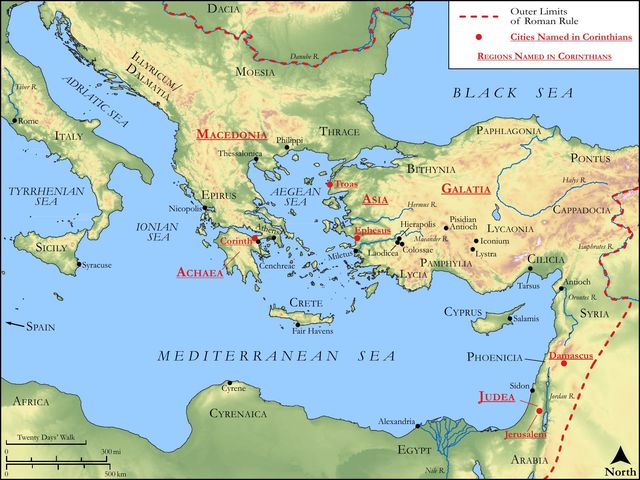
See on the biblical-era map

Study this verse
Public-domain commentary
Matthew Henry
From his Commentary on the Whole Bible. Henry comments on passages, not single verses — this entry covers 1 Corinthians 12:27–31. His three-level outline is real structure in the source text, so it is rendered as structure.
I.Here the apostle sums up the argument, and applies this similitude to the church of Christ, concerning which observe,
1.The relation wherein Christians stand to Christ and one another. The church, or whole collective body of Christians, in all ages, is his body. Every Christian is a member of his body, and every other Christian stands related to him as a fellow-member (Co1 12:27): Now you are the body of Christ, and members in particular, or particular members. Each is a member of the body, not the whole body; each stands related to the body as a part of it, and all have a common relation to one another, dependence upon one another, and should have a mutual care and concern. Thus are the members of the natural body, thus should the members of the mystical body be, disposed. Note, Mutual indifference, and much more contempt, and hatred, and envy, and strife, are very unnatural in Christians. It is like the members of the same body being destitute of all concern for one another, or quarrelling with each other. This is the apostle's scope in this argument. He endeavours in it to suppress the proud, vaunting, and contentious spirit, that had prevailed among the Corinthians, by reason of their spiritual gifts.
2.The variety of offices instituted by Christ, and gifts or favours dispensed by him (Co1 12:28): God hath set some in the church; first, apostles, the chief ministers entrusted with all the powers necessary to found a church, and make an entire revelation of God's will. Secondarily, prophets, or persons enabled by inspiration, as the evangelists did. Thirdly, teachers, those who labour in word and doctrine, whether with pastoral charge or without it. After that, miracles, or miracle-workers. The gifts of healing, or those who had power to heal diseases; helps, or such as had compassion on the sick and weak, and ministered to them; governments, or such as had the disposal of the charitable contributions of the church, and dealt them out to the poor; diversities of tongues, or such as could speak divers languages. Concerning all these observe,
(1.)The plenteous variety of these gifts and offices. What a multitude are they! A good God was free in his communications to the primitive church; he was no niggard of his benefits and favours. No, he provided richly for them. They had no want, but a store - all that was necessary, and even more; what was convenient for them too.
(2.)Observe the order of these offices and gifts. They are here placed in their proper ranks. Those of most value have the first place. Apostles, prophets, and teachers, were all intended to instruct the people, to inform them well in the things of God, and promote their spiritual edification: without them, neither evangelical knowledge nor holiness could have been promoted. But the rest, however fitted to answer the great intentions of Christianity, had no such immediate regard to religion, strictly so called. Note, God does, and we should, value things according to their real worth: and the use of things is the best criterion of their real worth. Those are most valuable that best answer the highest purposes. Such were apostolical powers, compared with theirs who had only the gift of healing and miracles. What holds the last and lowest rank in this enumeration is diversity of tongues. It is by itself the most useless and insignificant of all these gifts. Healing diseases, relieving the poor, helping the sick, have their use: but how vain a thing is it to speak languages, if a man does it merely to amuse or boast himself! This may indeed raise the admiration, but cannot promote the edification, of the hearers, nor do them any good. And yet it is manifest from ch. 14 that the Corinthians valued themselves exceedingly on this gift. Note, How proper a method it is to beat down pride to let persons know the true value of what they pride themselves in! It is but too common a thing for men to value themselves most on what is least worth: and it is of great use to bring them to a sober mind by letting them know how much they are mistaken.
(3.)The various distribution of these gifts, not all to one, nor to every one alike. All members and officers had not the same rank in the church, nor the same endowments (Co1 12:29, Co1 12:30): Are all apostles? Are all prophets? This were to make the church a monster: all one as if the body were all ear or all eye. Some are fit for one office and employment, and some for another; and the Spirit distributes to every one as he will. We must be content with our own rank and share, if they be lower and less than those of others. We must not be conceited of ourselves, and despise others, if we are in the higher rank and have greater gifts. Every member of the body is to preserve its own rank, and do its own office; and all are to minister to one another, and promote the good of the body in general, without envying, or despising, or neglecting, or ill-using, any one particular member. How blessed a constitution were the Christian church, if all the members did their duty!
II.He closes this chapter with an advice (as the generality read it) and a hint.
1.An advice to covet the best gifts, charismata ta kreittona - dona potiora, praestantiora, either the most valuable in themselves or the most serviceable to others; and these are, in truth, most valuable in themselves, though men may be apt to esteem those most that will raise their fame and esteem highest. Those are truly best by which God will be most honoured and his church edified. Such gifts should be most earnestly coveted. Note, We should desire that most which is best, and most worth. Grace is therefore to be preferred before gifts; and, of gifts, those are to be preferred which are of greatest use. But some read this passage, not as an advice, but a charge: zēloute, You are envious at each other's gifts. In Co1 13:4, the same word is thus translated. You quarrel and contend about them. This they certainly did. And this behaviour the apostle here reprehends, and labours to rectify. Only of pride cometh contention. These contests in the church of Corinth sprang from this original. It was a quarrel about precedency (as most quarrels among Christians are, with whatever pretences they are gilded over); and it is no wonder that a quarrel about precedence should extinguish charity. When all would stand in the first rank, no wonder if they jostle, or throw down, or thrust back, their brethren. Gifts may be valued for their use, but they are mischievous when made the fuel of pride and contention. This therefore the apostle endeavours to prevent.
2.By giving them the hint of a more excellent way, namely, of charity, of mutual love and good-will. This was the only right way to quiet and cement them, and make their gifts turn to the advantage and edification of the church. This would render them kind to each other, and concerned for each other, and therefore calm their spirits, and put an end to their little piques and contests, their disputes about precedency. Those would appear to be in the foremost rank, according to the apostle, who had most of true Christian love. Note, True charity is greatly to be preferred to the most glorious gifts. To have the heart glow with mutual love is vastly better than to glare with the most pompous titles, offices, or powers.
Historical interpretation
Seventeen Centuries of Reception
4 surviving comments on this verse. Each one is dated, so this reads as a timeline rather than a list.
Select a marker to jump to its quote. Markers stagger vertically where authors wrote within a few decades of each other.
This Spirit, (according to the apostle's showing, ) meant not that the service of these gifts should be in the body, nor did He place them in the human body); and on the subject of the superiority of love above all these gifts, He even taught the apostle that it was the chief commandment, just as Christ has shown it to be: "Thou shalt love the Lord with all thine heart and soul, with all thy strength, and with all thy mind, and thy neighbour as thine own self.
The graces of the Lord which are seen in persons do not relate to the merit of the individual but to the honoring of God.
Then he subjoins further the most powerful consolation, and sufficient to recover them and quiet their vexed souls. And what is this? "Desire earnestly," saith he, "the better gifts. And a still more excellent way show I unto you."
Now by saying this, he gently hinted that they were the cause of their own receiving the lesser gifts, and had it in their power, if they would, to receive the greater. For when he saith, "desire earnestly," he demands from them all diligence and desire for spiritual things. And he said not, the greater gifts, but "the better," i.e., the more useful, those which would profit. And what he means is this: "continue to desire gifts; and I point out to you a fountain of gifts." For neither did he say, "a gift," but "a way," that he might the more extol that which he intends to mention. As if he said, It is not one, or two, or three gifts that I point out to you, but one way which leadeth to all these: and not merely a way, but both "a more excellent way" and one that is open in common to all. For not as the gifts are vouchsafed, to some these, to others those, but not all to all; so also in this case: but it is an universal gift. Wherefore also he invites all to it. "Desire earnestly," saith he, "the better gifts and yet show I unto you a more excellent way;" meaning love towards our neighbor.
Then intending to proceed to the discourse concerning it and the encomium of this virtue, he first lowereth these by comparison with it, intimating that they are nothing without it; very considerately. For if he had at once discoursed of love, and having said, "I show unto you a way," had added, "but this is love," and had not conducted his discourse by way of comparison; some might possibly have scoffed at what was said, not understanding clearly the force of the thing spoken of but still gaping after these. Wherefore he doth not at once unfold it, but first excites the hearer by the promise, and saith, "I show unto you a more excellent way," and so having led him to desire it, he doth not even thus straightway proceed to it, but augmenting still further and extending their desire, he discourses first of these very things, and shows that without it they are nothing; reducing them to the greatest necessity of loving one another; seeing also that from neglect of it sprang that which caused all their evils. So that in this respect also it might justly appear great, if the gifts not only brought them not together, but divided them even when united: but this, when many were so divided, would reunite them by virtue of its own and make them one body. This however he doth not say at once, but what they chiefly longed for, that he sets down; as that the thing was a gift and a most excellent way to all the gifts. So that, even if thou wilt not love thy brother on the score of friendship, yet for the sake of obtaining a better sign and an abundant gift, cherish love.
The only rite which we know to have been instituted by Our Lord Himself is the Holy Communion ('Do this in remembrance of me' - 'If you do not eat the flesh of the Son of Man and drink His blood, ye have no life in you'). This is an order and must be obeyed. The other services are, I take it, traditional and might lawfully be altered. But the New Testament does not envisage solitary religion: some kind of regular assembly for worship and instruction is everywhere taken for granted in the Epistles. So we must be regular practising members of the Church.
Of course we differ in temperament. Some (like you - and me) find it more natural to approach God in solitude: but we must go to church as well. Others find it easier to approach Him through the services: but they must practice private prayer and reading as well. For the Church is not a human society of people united by their natural affinities but the Body of Christ in which all members however different (and He rejoices in their differences and by no means wishes to iron them out) must share the common life, complementing and helping and receiving one another precisely by their differences. (Re-read 1st Corinthians cap 12 and meditate on it. The word translated members would perhaps be better translated organs).
Continue studying 1 Corinthians 12:31 across the web’s major study libraries — every link below opens this exact verse, chapter, or book on the destination site.
Read & Compare
 BibleGatewayThis verse in more than 200 translations and 70 languages.
 Bible.comThe YouVersion reader — hundreds of translations, reading plans, and highlights.
 ESV.orgCrossway's official English Standard Version reader.
 NET BibleThe NET translation with 60,000+ translators' notes on every rendering decision.
 STEP BibleTyndale House's free study tool — original text, vocabulary, and scholarly resources.
 BibliaLogos Bible Software's free web reader.
 USCCBThe New American Bible (Revised Edition) with the U.S. bishops' study notes.
Commentaries
 BibleHub CommentariesDozens of classic commentaries on this verse, gathered on one page.
 StudyLightMore than 100 commentary sets — the largest collection on the web.
 BibleRefPlain-English commentary on what this verse means, verse by verse.
 Enduring WordDavid Guzik's free commentary on this chapter, widely used by Bible teachers.
 Bible Study ToolsVerse commentary alongside Greek and Hebrew study aids.
Original Language & Research
- BibleHub InterlinearThe verse word by word — original language, transliteration, and English.
- BibleHub LexiconEvery word's original-language definition and Strong's entry.
 Blue Letter BibleDeep-study tools — Strong's numbers, concordance, and word studies.
 CNTR CollationThe earliest Greek manuscripts of this verse, collated letter by letter.
Sermons, Hymns & Audio


TrulyRandomVerse is not affiliated with these sites and doesn’t control their content. They’re linked because they’re genuinely useful.
Summary
First Corinthians 12:31 serves as a pivotal transition in Paul's discourse on spiritual gifts within the Corinthian church. Having meticulously explained the diversity and unity of gifts, and the church as the body of Christ, Paul concludes this section by urging believers to earnestly desire the more edifying spiritual gifts. However, he immediately pivots, announcing that he will show them an even "more excellent way," thereby introducing the profound and indispensable principle of agape love, which is the subject of the subsequent, renowned thirteenth chapter.
Context
ShowHideLiterary Context
This verse concludes Paul's extensive teaching in 1 Corinthians 12, where he addresses the Corinthians' confusion and potential divisions regarding spiritual gifts. Chapters 12 through 14 form a cohesive unit on this topic. In 1 Corinthians 12:1-11, Paul identifies various gifts as manifestations of the same Spirit. In 1 Corinthians 12:12-26, he employs the powerful metaphor of the body to emphasize unity in diversity, arguing that every member and every gift is essential. Verse 31, therefore, acts as a bridge, summarizing the call to pursue beneficial gifts while simultaneously setting the stage for the ultimate principle that governs all gift-use: love, which is then expounded in 1 Corinthians 13.
Historical & Cultural Context
The church in Corinth was characterized by a vibrant but often chaotic expression of spiritual gifts, particularly speaking in tongues, which some members apparently valued above all others, leading to pride, division, and disorder. Corinth itself was a bustling, cosmopolitan port city, known for its wealth, diverse population, and prevalent pagan cults, many of which involved ecstatic experiences. This environment likely influenced the Corinthians' understanding and practice of spiritual phenomena, leading them to prioritize outward, spectacular manifestations over more humble, edifying gifts. Paul's letter seeks to correct these misconceptions, emphasizing order, unity, and the proper purpose of gifts: the edification of the entire community, not individual display or status.
Key Themes
ShowHideThe immediate themes contributing to this verse are the diversity and unity of spiritual gifts (as seen in 1 Corinthians 12:4-11), the church as the body of Christ (developed in 1 Corinthians 12:12-27), and the proper use of gifts for edification. Verse 31 introduces the overarching theme of the supremacy of love (agape), which transcends all gifts and provides the essential context and motivation for their exercise. This theme is fully developed in 1 Corinthians 13, where Paul argues that without love, even the most impressive spiritual manifestations are meaningless. The verse also subtly touches on the theme of discernment, as believers are encouraged to "covet earnestly the best gifts," implying a need to discern which gifts are truly most beneficial for the community.
Exposition and Analysis
ShowHideKey Word Analysis
ShowHideFrom Strong's G2206, this verb means "to have warmth of feeling for or against," "to be zealous for," or "eagerly desire." In this context, it carries a positive connotation, denoting a fervent, commendable zeal or passionate pursuit, distinct from the negative sense of coveting (as in the Ten Commandments). Paul encourages a zealous pursuit of gifts that build up the church, not a selfish craving for personal power or recognition.
From Strong's G2909, this is a comparative adjective meaning "stronger" or, figuratively, "better" and "nobler." It suggests a qualitative distinction among gifts, implying that some gifts are more beneficial or effective for the common good and the edification of the body of Christ. This is not about personal preference but about communal utility and spiritual impact.
From Strong's G5236, this noun means "a throwing beyond others," or "supereminence." Adverbially, as used here (with katá, G2596, meaning "according to" or "beyond"), it signifies something "pre-eminently" or "exceedingly" superior. Paul uses this strong term to emphasize that the "way" he is about to reveal—the way of love—is not merely better, but supremely, overwhelmingly superior to even the "best" spiritual gifts.
Verse Breakdown
ShowHide"But covet earnestly the best gifts"
This clause serves as a concluding exhortation to Paul's discussion on spiritual gifts. The conjunction "But" (G1161, dé) indicates a slight shift or contrast, yet it doesn't negate the preceding discussion. Instead, it directs the Corinthians' zeal. Having established that all gifts are from the Spirit and are for the common good, Paul now encourages them to actively and fervently desire those gifts that are truly "best" – meaning those that are most edifying, beneficial, and effective for building up the entire community, such as prophecy, teaching, and discernment. This is a communal, not individualistic, pursuit.
"and yet shew I unto you a more excellent way"
This second clause introduces a profound shift in emphasis. The phrase "and yet" (G2532, kaí and G2089, éti) signals a further, even more significant revelation. Paul promises to "shew" (G1166, deiknýō) or reveal to them a "more excellent way." This "way" (G3598, hodós) is not another gift among gifts, but the overarching principle, the supreme path, that governs the use and value of all gifts. The term "more excellent" (G2596, katá + G5236, hyperbolḗ) conveys a sense of unparalleled superiority, indicating that this "way" surpasses all spiritual gifts in importance, efficacy, and eternal value. This sets the stage for the unparalleled exposition of love in 1 Corinthians 13.
Literary Devices
ShowHide1 Corinthians 12:31 employs several potent literary devices. Firstly, it functions as a crucial Transition, artfully bridging Paul's extensive discussion on the diversity of spiritual gifts in 1 Corinthians 12 with the preeminent exposition of love in 1 Corinthians 13. This transition is marked by the contrasting conjunction "But" and the anticipatory phrase "yet shew I unto you." Secondly, Paul uses Hyperbole with the phrase "a more excellent way" (Greek: kath' hyperbolen hodon). The word hyperbolḗ itself means "a throwing beyond," emphasizing the extraordinary, surpassing superiority of love over all other spiritual gifts. It's not just a better way, but a supremely, incomparably superior path. Finally, the "way" itself can be seen as a Metaphor for a mode of living, a path of conduct, or a guiding principle. It represents a lifestyle and a spiritual orientation that is fundamentally superior to merely possessing or exercising spiritual gifts, no matter how impressive.
Theological and Thematic Connections
ShowHide1 Corinthians 12:31 is a theological linchpin, connecting the practical outworking of spiritual gifts with the foundational ethic of Christian love. It teaches that while spiritual endowments are valuable and to be desired for the church's health, they are ultimately subservient to the supreme principle of agape love. This love is not merely an emotion, but a divine attribute and a selfless way of living that prioritizes the good of others and the glory of God. Without this love, the exercise of even the most powerful gifts becomes hollow, ineffective, and ultimately counterproductive to the unity and edification of the body of Christ. It underscores that God's power (manifested through gifts) must always be channeled through His character (manifested through love).
Reflection and Application
ShowHideFor believers today, 1 Corinthians 12:31 provides profound guidance for Christian living and ministry, urging a balanced and spiritually mature perspective on spiritual gifts. It encourages a zealous pursuit of gifts that genuinely build up the church, reminding us that our desire for spiritual empowerment should always be oriented towards communal edification rather than personal prominence or spiritual pride. However, this pursuit is immediately contextualized and overshadowed by the revelation of "a more excellent way"—the way of love. This means that our spiritual activities, no matter how impressive or seemingly effective, are ultimately meaningless and even detrimental if not rooted in and propelled by genuine, self-sacrificial love for God and others. It challenges us to examine our motivations, ensuring that love is the primary driver behind all our service, our exercise of gifts, and our interactions within the body of Christ.
Questions for Reflection
ShowHideFAQ
ShowHideWhat does Paul mean by "covet earnestly the best gifts," and how does this relate to the Ten Commandments' prohibition against coveting?
ShowHidePaul's command to "covet earnestly" (Greek: zēlóō) in 1 Corinthians 12:31 carries a positive connotation, meaning to be zealous for, eagerly desire, or strive for. It's distinct from the negative coveting (Greek: epithyméō) prohibited in the Ten Commandments, which refers to a selfish, grasping desire for what belongs to another (e.g., Exodus 20:17). Here, Paul encourages believers to passionately seek spiritual gifts that are "best" (Greek: kreíttōn) – meaning those most beneficial and edifying for the entire body of Christ, such as prophecy and teaching, which build up the community. This is a communal, selfless zeal, aimed at strengthening the church, rather than a self-serving, acquisitive desire for personal gain or status.
Christ-Centered Fulfillment
ShowHide1 Corinthians 12:31, by pointing to "a more excellent way," ultimately directs our gaze to Christ Himself, who perfectly embodies and fulfills this way. Jesus is the supreme example of love in action, demonstrating agape not merely as a feeling but as a sacrificial, self-giving life. His entire earthly ministry, culminating in His atoning death on the cross, was the ultimate expression of this "more excellent way" (Ephesians 5:2). He possessed all spiritual "gifts" in their fullness, yet His exercise of power, healing, and teaching was always motivated by profound compassion and love for humanity (Matthew 9:36). Furthermore, Jesus declared Himself to be "the way, the truth, and the life" (John 14:6), identifying Himself as the very path that leads to God. Therefore, the "more excellent way" is not just a principle or a set of behaviors; it is a Person. To walk in this way is to follow Christ, to imitate His humility (Philippians 2:5-8), and to love as He loved (John 13:34-35). In Him, love is not merely the highest virtue; it is the very essence of God Himself, the ultimate purpose for which all gifts are given and through which they find their true meaning and eternal value.