


1 Corinthians 14:1
Bible text: King James Version (1769 Blayney text) · Public domain
Bible text: Berean Standard Bible · Public domain
Bible text: American Standard Version (1901) · Public domain
Bible text: World English Bible, Messianic edition · Public domain
Bible text: Geneva Bible (1599) · Public domain
Bible text: Young's Literal Translation · Public domain
- ΔιώκετεDiōketedo earnestly pursueG1377V-PAM-2PVerb Present Active Imperative 2nd Plural
- τὴνtēn<the>G3588T-ASFDefinite article Accusative Singular Feminine
- ἀγάπην·agapēnloveG26N-ASFNoun Accusative Singular Feminine
- ζηλοῦτεzēloutedo earnestly desireG2206V-PAM-2PVerb Present Active Imperative 2nd Plural
- δὲdenowG1161CONJConjunction
- τὰta<the>G3588T-APNDefinite article Accusative Plural Neuter
- πνευματικάpneumatikaspiritual giftsG4152A-APNAdjective Accusative Plural Neuter
- μᾶλλονmallonespeciallyG3123ADVAdverb
- δὲdenowG1161CONJConjunction
- ἵναinathatG2443CONJConjunction
- προφητεύητεprophēteuēteyou may prophesyG4395V-PAS-2PVerb Present Active Subjunctive 2nd Plural
English is a literal word-by-word gloss of the Greek, not the KJV's wording. Why?
This is the original text the KJV's translators worked from — each Greek word with its own literal English meaning in this verse, prepared by scholars at Tyndale House, Cambridge. The KJV translates whole sentences, not word by word, so its wording differs: one Greek word can become several English words, and the KJV may choose “charity” where the gloss reads “love”. Both are faithful — they answer different questions. For the KJV's own rendering, switch to the KJV text.
Details
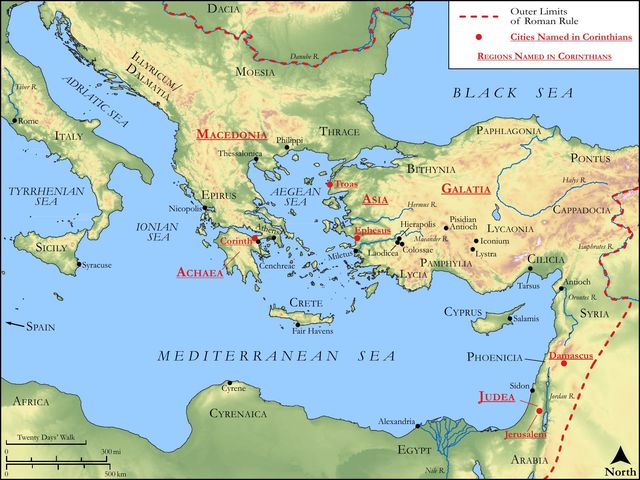
See on the biblical-era maps

Study this verse
Public-domain commentary
Matthew Henry
From his Commentary on the Whole Bible. Henry comments on passages, not single verses — this entry covers 1 Corinthians 14:1–5. His two-level outline is real structure in the source text, so it is rendered as structure.
The apostle, in the foregoing chapter, had himself preferred, and advised the Corinthians to prefer, Christian charity to all spiritual gifts. Here he teaches them, among spiritual gifts, which they should prefer, and by what rules they should make comparison. He begins the chapter,
I.With an exhortation to charity (Co1 14:1):
Follow after charity, pursue it. The original, diōkete, when spoken of a thing, signifies a singular concern to obtain it; and is commonly taken in a good and laudable sense. It is an exhortation to obtain charity, to get this excellent disposition of mind upon any terms, whatever pains or prayers it may cost: as if he had said, "In whatever you fail, see you do not miss of this; the principal of all graces is worth your getting at any rate."
II.He directs them which spiritual gift to prefer, from a principle of charity:
"Desire spiritual gifts, but rather that you may prophesy, or chiefly that you may prophesy." While they were in close pursuit of charity, and made this Christian disposition their chief scope, they might be zealous of spiritual gifts, be ambitious of them in some measure, but especially of prophesying, that is, of interpreting scripture. This preference would most plainly discover that they were indeed upon such pursuit, that they had a due value for Christian charity, and were intent upon it. Note, Gifts are fit objects of our desire and pursuit, in subordination to grace and charity. That should be sought first and with the greatest earnestness which is most worth.
III.He assigns the reasons of this preference.
And it is remarkable here that he only compares prophesying with speaking with tongues. It seems, this was the gift on which the Corinthians principally valued themselves. This was more ostentatious than the plain interpretation of scripture, more fit to gratify pride, but less fit to pursue the purposes of Christian charity; it would not equally edify nor do good to the souls of men. For,
1.He that spoke with tongues must wholly speak between God and himself; for, whatever mysteries might be communicated in his language, none of his own countrymen could understand them, because they did not understand the language, Co1 14:2. Note, What cannot be understood can never edify. No advantage can be reaped from the most excellent discourses, if delivered in unintelligible language, such as the audience can neither speak nor understand: but he that prophesies speaks to the advantage of his hearers; they may profit by his gift. Interpretation of scripture will be for their edification; they may be exhorted and comforted by it, Co1 14:3. And indeed these two must go together. Duty is the proper way to comfort; and those that would be comforted must bear being exhorted.
2.He that speaks with tongues may edify himself, Co1 14:4. He may understand and be affected with what he speaks; and so every minister should; and he that is most edified himself is in the disposition and fitness to do good to others by what he speaks; but he that speaks with tongues, or language unknown, can only edify himself; others can reap no benefit from his speech. Whereas the end of speaking in the church is to edify the church (Co1 14:4), to which prophesying, or interpreting scripture by inspiration or otherwise, is immediately adapted. Note, That is the best and most eligible gift which best answers the purposes of charity and does most good; not that which can edify ourselves only, but that which will edify the church. Such is prophesying, or preaching, and interpreting scripture, compared with speaking in an unknown tongue.
3.Indeed, no gift is to be despised, but the best gifts are to be preferred. I could wish, says the apostle, that you all spoke with tongues, but rather that you prophesied, Co1 14:5. Every gift of God is a favour from God, and may be improved for his glory, and as such is to be valued and thankfully received; but then those are to be most valued that are most useful. Greater is he that prophesieth than he that speaketh with tongues, unless he interpret, that the church may receive edifying, Co1 14:5. Benevolence makes a man truly great. It is more blessed to give than to receive. And it is true magnanimity to study and seek to be useful to others, rather than to raise their admiration and draw their esteem. Such a man has a large soul, copious and diffused in proportion to his benevolence and bent of mind for public good. Greater is he who interprets scripture to edify the church than he who speaks tongues to recommend himself. And what other end he who spoke with tongues could have, unless he interpreted what he spoke, is not easy to say, Note, That makes most for the honour of a minister which is most for the church's edification, not that which shows his gifts to most advantage. He acts in a narrow sphere, while he aims at himself; but his spirit and character increase in proportion to his usefulness, I mean his own intention and endeavours to be useful.
Historical interpretation
Historical reception
3 surviving comments on this verse. Each one is dated, so this reads as a timeline rather than a list.
Select a marker to jump to its quote. Markers stagger vertically where authors wrote within a few decades of each other.
Paul says that prophecy is the highest gift after love because it is to the benefit and advantage of the church, since by it everybody learns the principles of God’s law.
If now so great is the virtue of love, with good reason doth he add and say, "Follow after love." For there is surely need of "following," and a kind of vehement running after her: in such sort doth she fly from us, and so many are the things which trip us up in that direction. Wherefore we have ever need of great earnestness in order to overtake her. And to point out this, Paul said not, "follow love," but, "pursue" her; stirring us up, and inflaming us to lay hold on her.
Thus, inasmuch as he had with exactness rehearsed unto them all the excellence of love, he exhorts them in what follows, with alacrity to lay hold of it. Wherefore also he said, "Follow after:" for he that is in chase beholds that only which is chased, and towards that he strains himself, and leaves not off until he lay hold of it. He that is in chase, when by himself he cannot, by those that are before him he doth overtake the fugitive, beseeching those who are near with much eagerness to seize and keep it so seized for him until he shall come up. This then let us also do. When of ourselves we do not reach unto love, let us bid them that are near her to hold her, till we come up with her, and when we have apprehended, no more let her go, that she may not again escape us. For continually she springs away from us, because we use her not as we ought, but prefer all things unto her. Therefore we ought to make every effort, so as perfectly to retain her. For if this be done, we require not henceforth much labor, nay rather scarce any; but taking our ease, and keeping holidays, we shall march on in the narrow path of virtue. Wherefore he saith, "Follow after her."
Then that they might not suppose that for no other end he brought in the discourse of charity, except that he might extinguish the gifts, he subjoins as follows: "Yet desire earnestly spiritual gifts; but rather that ye may prophesy."
Continue studying 1 Corinthians 14:1 across the web’s major study libraries — every link below opens this exact verse, chapter, or book on the destination site.
Read & Compare
 BibleGatewayThis verse in more than 200 translations and 70 languages.
 Bible.comThe YouVersion reader — hundreds of translations, reading plans, and highlights.
 ESV.orgCrossway's official English Standard Version reader.
 NET BibleThe NET translation with 60,000+ translators' notes on every rendering decision.
 STEP BibleTyndale House's free study tool — original text, vocabulary, and scholarly resources.
 BibliaLogos Bible Software's free web reader.
 USCCBThe New American Bible (Revised Edition) with the U.S. bishops' study notes.
Commentaries
 BibleHub CommentariesDozens of classic commentaries on this verse, gathered on one page.
 StudyLightMore than 100 commentary sets — the largest collection on the web.
 BibleRefPlain-English commentary on what this verse means, verse by verse.
 Enduring WordDavid Guzik's free commentary on this chapter, widely used by Bible teachers.
 Bible Study ToolsVerse commentary alongside Greek and Hebrew study aids.
Original Language & Research
- BibleHub InterlinearThe verse word by word — original language, transliteration, and English.
- BibleHub LexiconEvery word's original-language definition and Strong's entry.
 Blue Letter BibleDeep-study tools — Strong's numbers, concordance, and word studies.
 CNTR CollationThe earliest Greek manuscripts of this verse, collated letter by letter.
Sermons, Hymns & Audio


TrulyRandomVerse is not affiliated with these sites and doesn’t control their content. They’re linked because they’re genuinely useful.
Summary
First Corinthians 14:1 serves as a foundational exhortation from the Apostle Paul, bridging his sublime teaching on the supremacy of love in chapter 13 with practical instructions for the proper exercise of spiritual gifts within the Corinthian church. Paul commands believers to actively pursue divine, selfless love as the ultimate guiding principle for all spiritual endeavors, while simultaneously encouraging a fervent desire for spiritual manifestations. However, he establishes a clear preference for the gift of prophecy due to its superior capacity to edify, exhort, and comfort the entire assembly, thereby promoting order and growth within the community of faith.
Context
ShowHideLiterary Context
This verse acts as a crucial transition from Paul's profound discourse on agape love in 1 Corinthians 13 to his detailed regulations concerning spiritual gifts, particularly tongues and prophecy, in 1 Corinthians 14. Chapter 12 introduces the diversity and unity of spiritual gifts within the body of Christ, emphasizing that all gifts are from the same Spirit and are for the common good. Chapter 13 then interjects a powerful argument that love is the "most excellent way" (as stated in 1 Corinthians 12:31), without which all spiritual gifts are meaningless. Thus, 1 Corinthians 14:1 immediately follows this climax on love, ensuring that the pursuit and exercise of gifts are always governed by love. The subsequent verses in 1 Corinthians 14 then elaborate on why prophecy is superior to uninterpreted tongues for corporate worship, providing practical guidelines for their use.
Historical & Cultural Context
The Corinthian church was a vibrant but problematic community, situated in a bustling, cosmopolitan Roman city known for its wealth, diverse pagan cults, and moral laxity. This environment likely contributed to the Corinthians' enthusiasm for outward, spectacular spiritual manifestations, which they may have equated with spiritual maturity or status, mirroring the ecstatic experiences found in some pagan religions. There was a clear lack of order and understanding regarding the purpose and proper use of spiritual gifts, leading to confusion and disunity. Paul's letters address these issues, seeking to correct their misconceptions and bring divine order to their worship practices. His emphasis on love and the edification of the community directly counters their self-centered and chaotic approach to spiritual expressions, providing a corrective theological framework for a church struggling with internal divisions and external cultural pressures.
Key Themes
ShowHide1 Corinthians 14:1 contributes significantly to several major themes within the Corinthian correspondence. Foremost is the Primacy of Love, which Paul unequivocally establishes as the essential pursuit that must inform all Christian conduct and the exercise of spiritual gifts. This theme is the direct continuation of 1 Corinthians 13, where love is described as the "most excellent way" and the enduring virtue that outlasts all gifts. Another key theme is the Purpose and Proper Use of Spiritual Gifts, particularly the tension between gifts that edify the individual (like uninterpreted tongues, as discussed in 1 Corinthians 14:4) and those that edify the entire church (like prophecy, as highlighted in 1 Corinthians 14:3). Paul guides the Corinthians towards a corporate-minded approach to worship, emphasizing Order and Edification in Worship as paramount principles, ensuring that all activities contribute to the spiritual growth and understanding of the entire assembly, rather than promoting individual display or chaos.
Exposition and Analysis
ShowHideKey Word Analysis
ShowHideThis verb implies an active, zealous pursuit, like chasing after something or someone. It suggests a determined, persistent effort, not a passive waiting. In this context, it means to "pursue with diligence," "strive for," or "press onward towards" charity. It's a strong imperative, demanding intentionality in the pursuit of love.
This is the profound, selfless, unconditional, and divine love described in 1 Corinthians 13. It is distinct from other forms of love (like philia for friendship or eros for romantic love) in that it is volitional, sacrificial, and seeks the highest good of the beloved, even at personal cost. Paul places this love as the supreme virtue that must govern all spiritual expression and Christian living.
In the New Testament, this term primarily means "to speak forth" or "to declare" a message from God under divine inspiration. While it can include foretelling the future, its primary function in the church context is to edify, exhort, and comfort the assembly (1 Corinthians 14:3). It involves communicating God's truth in a way that builds up the faith and understanding of believers.
Verse Breakdown
ShowHide"Follow after charity"
This is an imperative command, urging believers to actively and diligently pursue agape love. It signifies that love is not merely a feeling but a virtue to be cultivated and practiced with intentionality. Paul positions love as the foundational and overarching principle that must govern all spiritual life and ministry, especially the exercise of spiritual gifts.
"and desire spiritual [gifts]"
This clause provides a complementary instruction. While love is paramount, Paul does not negate the value of spiritual gifts. Instead, he encourages believers to earnestly "desire" or "covet" these endowments from the Holy Spirit. The word "gifts" is supplied by translators; the Greek literally refers to "spiritual things" or "manifestations of the Spirit" (pneumatika), indicating their divine origin and purpose for the church.
"but rather that ye may prophesy"
This phrase introduces a crucial qualification and preference. The conjunction "but rather" (mallon) indicates a strong preference or priority. While all spiritual gifts are legitimate, Paul directs their desire specifically towards prophecy. This preference is rooted in the practical benefit of prophecy for the entire congregation, as it directly communicates God's truth in an understandable way, leading to edification, exhortation, and comfort for all present, unlike uninterpreted tongues which primarily edify the speaker.
Literary Devices
ShowHidePaul employs several effective Literary Devices in this concise verse. The primary device is Imperative Mood, as seen in "Follow after charity" and "desire spiritual [gifts]," which conveys a direct command and strong exhortation to the Corinthian believers. This highlights the urgency and importance of his instructions. There is also a clear Contrast established between the general desire for spiritual gifts and the specific preference for prophecy. The phrase "but rather" (mallon) acts as a strong Emphasis marker, redirecting the Corinthians' perhaps indiscriminate zeal for all gifts towards the one that offers the most communal benefit. Furthermore, the verse uses Juxtaposition by placing the pursuit of love immediately before the desire for gifts, subtly reinforcing the idea that love must be the governing principle for all spiritual manifestations.
Theological and Thematic Connections
ShowHideThis verse powerfully articulates the essential relationship between Christian character (love) and Christian service (spiritual gifts). Theologically, it asserts that the Holy Spirit's endowments are not for self-aggrandizement or chaotic display, but for the edification of the body of Christ, always flowing from and constrained by divine love. Love is not just one virtue among many; it is the "more excellent way" that gives meaning and efficacy to all spiritual expressions. Without agape, even the most spectacular gifts are "nothing" (1 Corinthians 13:2). The preference for prophecy underscores the value of intelligible, truth-proclaiming ministry that builds up the faith and understanding of the entire community, aligning with God's desire for order and clarity in worship.
Reflection and Application
ShowHideFirst Corinthians 14:1 offers profound and timeless guidance for believers and the church today. It calls us to a dual pursuit: an unwavering commitment to cultivating agape love and an earnest desire for spiritual gifts that build up the body of Christ. In a world often driven by self-interest and outward display, Paul's instruction reminds us that the true measure of spiritual maturity is not the spectacular nature of our gifts, but the depth of our love for God and others. We are challenged to examine our motivations: do we seek spiritual experiences for personal validation or for the genuine edification of our community? This verse encourages us to prioritize ministries that clearly communicate God's truth, bring comfort, and exhort believers to greater faithfulness, fostering an environment where all can grow in Christ. It's a call to active, loving participation in the life of the church, always seeking the good of the whole.
Questions for Reflection
ShowHideFAQ
ShowHideWhat does "charity" mean in this context, and why is it so important?
ShowHideIn the King James Version, "charity" translates the Greek word agápē (G26), which signifies a selfless, unconditional, divine love. It's not merely an emotion or affection but a volitional act of seeking the highest good of others, even at personal cost. Paul dedicates the entire preceding chapter, 1 Corinthians 13, to describing this love, calling it the "most excellent way." Its importance here is paramount because Paul asserts that without agápē, all spiritual gifts—no matter how impressive—are meaningless, noisy, and ineffective (1 Corinthians 13:1-3). Love provides the proper motivation, context, and purpose for the exercise of any spiritual gift, ensuring that gifts are used to build up, not to tear down or promote self.
Why does Paul prefer "prophesy" over other spiritual gifts like speaking in tongues?
ShowHidePaul's preference for prophecy is rooted in its ability to edify the entire church assembly, whereas uninterpreted speaking in tongues primarily edifies the individual speaker (1 Corinthians 14:4). Prophecy, in the New Testament context, means "to speak forth" a message from God, which includes teaching, exhortation, comfort, and revelation that is understandable and directly beneficial to all who hear (1 Corinthians 14:3). While Paul acknowledges the legitimacy of tongues, he emphasizes that in public worship, intelligibility and communal benefit are crucial for order and spiritual growth (1 Corinthians 14:19). Therefore, he encourages the Corinthians to prioritize the gift that most effectively builds up the body of Christ.
Christ-Centered Fulfillment
ShowHideThe exhortation in 1 Corinthians 14:1 finds its ultimate fulfillment and perfect embodiment in Jesus Christ. He is the quintessential example of one who "followed after charity," perfectly demonstrating agape love in every aspect of His life and ministry. From His incarnation, humbling Himself to take on human form (Philippians 2:5-8), to His sacrificial death on the cross (John 15:13), Christ's entire existence was a manifestation of selfless, divine love for humanity. Furthermore, Jesus is the ultimate Prophet, the one through whom God spoke His final and most complete revelation (Hebrews 1:1-2). He "prophesied" not only by foretelling future events but, more profoundly, by declaring the very words of God, revealing the Father's will, and bringing comfort, exhortation, and salvation to all who would listen (John 7:16). As believers, we are called to imitate Christ's love (Ephesians 5:2) and to participate in His prophetic ministry by speaking forth God's truth, empowered by the same Spirit who dwelt in Him, always with the aim of building up the church, His body (Ephesians 4:11-16).