


1 Corinthians 12:27
Bible text: King James Version (1769 Blayney text) · Public domain
Bible text: Berean Standard Bible · Public domain
Bible text: American Standard Version (1901) · Public domain
Bible text: World English Bible, Messianic edition · Public domain
Bible text: Geneva Bible (1599) · Public domain
Bible text: Young's Literal Translation · Public domain
- ὙμεῖςHumeisYou yourselvesG4771P-2NPPersonal pronoun Nominative 2nd Plural
- δέdenowG1161CONJConjunction
- ἐστεesteareG1510V-PAI-2PVerb Present Active Indicative 2nd Plural
- σῶμαsōma[the] bodyG4983N-NSNNoun Nominative Singular Neuter
- ΧριστοῦChristouof ChristG5547N-GSM-TNoun Genitive Singular Masculine Title
- καὶkaiandG2532CONJConjunction
- μέληmelēmembersG3196N-NPNNoun Nominative Plural Neuter
- ἐκekinG1537PREPPreposition
- μέρουςmerousparticularG3313N-GSNNoun Genitive Singular Neuter
English is a literal word-by-word gloss of the Greek, not the KJV's wording. Why?
This is the original text the KJV's translators worked from — each Greek word with its own literal English meaning in this verse, prepared by scholars at Tyndale House, Cambridge. The KJV translates whole sentences, not word by word, so its wording differs: one Greek word can become several English words, and the KJV may choose “charity” where the gloss reads “love”. Both are faithful — they answer different questions. For the KJV's own rendering, switch to the KJV text.
Details
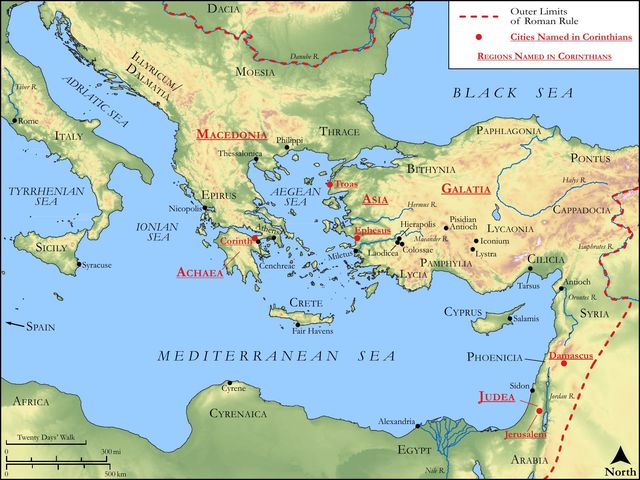
See on the biblical-era maps

Study this verse
Public-domain commentary
Matthew Henry
From his Commentary on the Whole Bible. Henry comments on passages, not single verses — this entry covers 1 Corinthians 12:27–31. His three-level outline is real structure in the source text, so it is rendered as structure.
I.Here the apostle sums up the argument, and applies this similitude to the church of Christ, concerning which observe,
1.The relation wherein Christians stand to Christ and one another. The church, or whole collective body of Christians, in all ages, is his body. Every Christian is a member of his body, and every other Christian stands related to him as a fellow-member (Co1 12:27): Now you are the body of Christ, and members in particular, or particular members. Each is a member of the body, not the whole body; each stands related to the body as a part of it, and all have a common relation to one another, dependence upon one another, and should have a mutual care and concern. Thus are the members of the natural body, thus should the members of the mystical body be, disposed. Note, Mutual indifference, and much more contempt, and hatred, and envy, and strife, are very unnatural in Christians. It is like the members of the same body being destitute of all concern for one another, or quarrelling with each other. This is the apostle's scope in this argument. He endeavours in it to suppress the proud, vaunting, and contentious spirit, that had prevailed among the Corinthians, by reason of their spiritual gifts.
2.The variety of offices instituted by Christ, and gifts or favours dispensed by him (Co1 12:28): God hath set some in the church; first, apostles, the chief ministers entrusted with all the powers necessary to found a church, and make an entire revelation of God's will. Secondarily, prophets, or persons enabled by inspiration, as the evangelists did. Thirdly, teachers, those who labour in word and doctrine, whether with pastoral charge or without it. After that, miracles, or miracle-workers. The gifts of healing, or those who had power to heal diseases; helps, or such as had compassion on the sick and weak, and ministered to them; governments, or such as had the disposal of the charitable contributions of the church, and dealt them out to the poor; diversities of tongues, or such as could speak divers languages. Concerning all these observe,
(1.)The plenteous variety of these gifts and offices. What a multitude are they! A good God was free in his communications to the primitive church; he was no niggard of his benefits and favours. No, he provided richly for them. They had no want, but a store - all that was necessary, and even more; what was convenient for them too.
(2.)Observe the order of these offices and gifts. They are here placed in their proper ranks. Those of most value have the first place. Apostles, prophets, and teachers, were all intended to instruct the people, to inform them well in the things of God, and promote their spiritual edification: without them, neither evangelical knowledge nor holiness could have been promoted. But the rest, however fitted to answer the great intentions of Christianity, had no such immediate regard to religion, strictly so called. Note, God does, and we should, value things according to their real worth: and the use of things is the best criterion of their real worth. Those are most valuable that best answer the highest purposes. Such were apostolical powers, compared with theirs who had only the gift of healing and miracles. What holds the last and lowest rank in this enumeration is diversity of tongues. It is by itself the most useless and insignificant of all these gifts. Healing diseases, relieving the poor, helping the sick, have their use: but how vain a thing is it to speak languages, if a man does it merely to amuse or boast himself! This may indeed raise the admiration, but cannot promote the edification, of the hearers, nor do them any good. And yet it is manifest from ch. 14 that the Corinthians valued themselves exceedingly on this gift. Note, How proper a method it is to beat down pride to let persons know the true value of what they pride themselves in! It is but too common a thing for men to value themselves most on what is least worth: and it is of great use to bring them to a sober mind by letting them know how much they are mistaken.
(3.)The various distribution of these gifts, not all to one, nor to every one alike. All members and officers had not the same rank in the church, nor the same endowments (Co1 12:29, Co1 12:30): Are all apostles? Are all prophets? This were to make the church a monster: all one as if the body were all ear or all eye. Some are fit for one office and employment, and some for another; and the Spirit distributes to every one as he will. We must be content with our own rank and share, if they be lower and less than those of others. We must not be conceited of ourselves, and despise others, if we are in the higher rank and have greater gifts. Every member of the body is to preserve its own rank, and do its own office; and all are to minister to one another, and promote the good of the body in general, without envying, or despising, or neglecting, or ill-using, any one particular member. How blessed a constitution were the Christian church, if all the members did their duty!
II.He closes this chapter with an advice (as the generality read it) and a hint.
1.An advice to covet the best gifts, charismata ta kreittona - dona potiora, praestantiora, either the most valuable in themselves or the most serviceable to others; and these are, in truth, most valuable in themselves, though men may be apt to esteem those most that will raise their fame and esteem highest. Those are truly best by which God will be most honoured and his church edified. Such gifts should be most earnestly coveted. Note, We should desire that most which is best, and most worth. Grace is therefore to be preferred before gifts; and, of gifts, those are to be preferred which are of greatest use. But some read this passage, not as an advice, but a charge: zēloute, You are envious at each other's gifts. In Co1 13:4, the same word is thus translated. You quarrel and contend about them. This they certainly did. And this behaviour the apostle here reprehends, and labours to rectify. Only of pride cometh contention. These contests in the church of Corinth sprang from this original. It was a quarrel about precedency (as most quarrels among Christians are, with whatever pretences they are gilded over); and it is no wonder that a quarrel about precedence should extinguish charity. When all would stand in the first rank, no wonder if they jostle, or throw down, or thrust back, their brethren. Gifts may be valued for their use, but they are mischievous when made the fuel of pride and contention. This therefore the apostle endeavours to prevent.
2.By giving them the hint of a more excellent way, namely, of charity, of mutual love and good-will. This was the only right way to quiet and cement them, and make their gifts turn to the advantage and edification of the church. This would render them kind to each other, and concerned for each other, and therefore calm their spirits, and put an end to their little piques and contests, their disputes about precedency. Those would appear to be in the foremost rank, according to the apostle, who had most of true Christian love. Note, True charity is greatly to be preferred to the most glorious gifts. To have the heart glow with mutual love is vastly better than to glare with the most pompous titles, offices, or powers.
Historical interpretation
Seventeen Centuries of Reception
6 surviving comments on this verse. Each one is dated, so this reads as a timeline rather than a list.
Select a marker to jump to its quote. Markers stagger vertically where authors wrote within a few decades of each other.
And, accordingly, why excuse it on the ground of pristine precedent? It did not bear the names of "body of Christ," of "members of Christ," of "temple of God," at the time When it used to obtain pardon for adultery.
For lest any should say, "What is the example of the body to us? since the body is a slave to nature but our good deeds are of choice;" he applies it to our own concerns; and to signify that we ought to have the same concord of design as they have from nature, he saith, "Now ye are the body of Christ." But if our body ought not to be divided, much less the body of Christ, and so much less as grace is more powerful than nature.
But what is the expression, "severally?" "So far at least as appertaineth to you; and so far as naturally a part should be built up from you." For because he had said, "the body," whereas the whole body was not the Corinthian Church, but the Church in every part of the world, therefore he said, "severally:" i.e., the Church amongst you is a part of the Church existing every where and of the body which is made up of all the Churches: so that not only with yourselves alone, but also with the whole Church throughout the world, ye ought to be at peace, if at least ye be members of the whole body.
We are not individual members who elect to join together to form a whole but rather organic members of a wider whole, which is the whole body.
In Christ’s resurrection, all his members have necessarily risen with him. For while he passes from the depths to the heights, he has made us pass from death to life.
The only rite which we know to have been instituted by Our Lord Himself is the Holy Communion ('Do this in remembrance of me' - 'If you do not eat the flesh of the Son of Man and drink His blood, ye have no life in you'). This is an order and must be obeyed. The other services are, I take it, traditional and might lawfully be altered. But the New Testament does not envisage solitary religion: some kind of regular assembly for worship and instruction is everywhere taken for granted in the Epistles. So we must be regular practising members of the Church.
Of course we differ in temperament. Some (like you - and me) find it more natural to approach God in solitude: but we must go to church as well. Others find it easier to approach Him through the services: but they must practice private prayer and reading as well. For the Church is not a human society of people united by their natural affinities but the Body of Christ in which all members however different (and He rejoices in their differences and by no means wishes to iron them out) must share the common life, complementing and helping and receiving one another precisely by their differences. (Re-read 1st Corinthians cap 12 and meditate on it. The word translated members would perhaps be better translated organs).
The Christian is called not to individualism but to membership in the mystical body... The very word membership is of Christian origin, but it has been taken over by the world and emptied of all meaning. In any book on logic you may see the expression "members of a class." It must be most emphatically stated that the items or particulars included in a homogeneous class are almost the reverse of what St. Paul meant by members. By members he meant what we should call organs, things essentially different from, and complimentary to, one another, things differing not only in structure and function but also in dignity. Thus, in a club, the committee as a whole and the servants as a whole may both properly be regarded as "members"; what we should call the members of the club are merely units. A row of identically dressed and identically trained soldiers set side by side, or a number of citizens listed as voters in a constituency are not members of anything in the Pauline sense. I am afraid that when we describe a man as "a member of the Church" we usually mean nothing Pauline; we mean only that he is a unit - that he is one more specimen of some kind of things as X and Y and Z. How true membership in a body differs from inclusion in a collective may be seen in the structure of a family. The grandfather, the parents, the grown-up son, the child, the dog, and the cat are true members (in the organic sense), precisely because they are not members or units of a homogenous class. They are not interchangeable. Each person is almost a species in himself. The mother is not simply a different person from the daughter; she is a different kind of person. The grown-up brother is not simply one unit in the class children; he is a separate estate of the realm. The father and grandfather are almost as different as the cat and the dog. If you subtract any one member, you have not simply reduced the family in number; you have inflicted an injury on its structure. Its unity is a unity of unliked, almost of incommensurables...
The society into which the Christian is called at baptism is not a collective but a Body. It is in fact that Body of which the family is an image on the natural level. If anyone came to it with the misconception that membership of the Church was membership in a debased modern sense - a massing together of persons as if they were pennies or counters - he would be corrected at the threshold by the discovery that the head of this Body is so unlike the inferior memberships that they share no predicate with Him save by analogy.
Continue studying 1 Corinthians 12:27 across the web’s major study libraries — every link below opens this exact verse, chapter, or book on the destination site.
Read & Compare
 BibleGatewayThis verse in more than 200 translations and 70 languages.
 Bible.comThe YouVersion reader — hundreds of translations, reading plans, and highlights.
 ESV.orgCrossway's official English Standard Version reader.
 NET BibleThe NET translation with 60,000+ translators' notes on every rendering decision.
 STEP BibleTyndale House's free study tool — original text, vocabulary, and scholarly resources.
 BibliaLogos Bible Software's free web reader.
 USCCBThe New American Bible (Revised Edition) with the U.S. bishops' study notes.
Commentaries
 BibleHub CommentariesDozens of classic commentaries on this verse, gathered on one page.
 StudyLightMore than 100 commentary sets — the largest collection on the web.
 BibleRefPlain-English commentary on what this verse means, verse by verse.
 Enduring WordDavid Guzik's free commentary on this chapter, widely used by Bible teachers.
 Bible Study ToolsVerse commentary alongside Greek and Hebrew study aids.
Original Language & Research
- BibleHub InterlinearThe verse word by word — original language, transliteration, and English.
- BibleHub LexiconEvery word's original-language definition and Strong's entry.
 Blue Letter BibleDeep-study tools — Strong's numbers, concordance, and word studies.
 CNTR CollationThe earliest Greek manuscripts of this verse, collated letter by letter.
Sermons, Hymns & Audio


TrulyRandomVerse is not affiliated with these sites and doesn’t control their content. They’re linked because they’re genuinely useful.
Summary
1 Corinthians 12:27 serves as a pivotal summary and direct application of Paul's extended analogy of the church as a physical body, asserting that believers collectively constitute the "body of Christ" while individually functioning as distinct, indispensable "members in particular." This verse encapsulates the profound theological truth of the church's organic unity and Christocentric identity, emphasizing both corporate solidarity and individual significance within the divine design for Christian community.
Context
ShowHideLiterary Context
1 Corinthians 12:27 is the culminating statement in Paul's comprehensive discourse on spiritual gifts and the unity of the church, spanning 1 Corinthians 12:1-31. Paul addresses the Corinthian church's issues of division, spiritual pride, and misunderstanding regarding charismatic manifestations. He begins by establishing the singular source of all gifts in the Holy Spirit (1 Corinthians 12:4-11), then introduces the profound metaphor of the church as a single body with many members, all baptized into one Spirit (1 Corinthians 12:12-13). The preceding verses (1 Corinthians 12:14-26) meticulously elaborate on the interdependence and mutual necessity of each part, countering any sense of inferiority or superiority among members. Verse 27 then directly applies this analogy to the Corinthian believers, affirming their corporate identity as Christ's body and their individual roles within it, setting the stage for the discussion of love as the "most excellent way" in 1 Corinthians 13.
Historical & Cultural Context
The city of Corinth was a bustling, cosmopolitan port city, notorious for its wealth, diverse population, and moral laxity. The Corinthian church, a young community, was grappling with internal divisions, factions, and a strong influence from Greek philosophical thought and pagan religious practices, which often emphasized individual achievement or exclusive spiritual experiences. Within this environment, some believers likely elevated certain spiritual gifts (like speaking in tongues) over others, leading to pride, envy, and disorder in their communal gatherings. Paul's emphasis on unity, mutual dependence, and the corporate identity as the "body of Christ" directly confronts these cultural tendencies and internal conflicts. The concept of a unified body, where each part contributes to the whole, would have been a powerful counter-cultural message in a society that often valued individualistic pursuits or hierarchical social structures.
Key Themes
ShowHideThe central themes woven through 1 Corinthians 12 and affirmed in verse 27 include Unity in Diversity, highlighting that while there are many different gifts and members, they are all united by one Spirit into one body. This counters the Corinthian tendency towards factionalism and elitism based on spiritual endowments. Another key theme is the Organic Nature of the Church, portrayed vividly through the body metaphor, emphasizing that the church is not merely an organization but a living organism, intimately connected to its head, Christ. This leads to the theme of Interdependence and Mutual Edification, stressing that no member is self-sufficient or insignificant; rather, all parts are essential and rely on one another for the healthy functioning of the whole, as articulated in 1 Corinthians 12:21-26. Finally, the verse underscores the Christocentric Identity of the Church, affirming that believers are not just "a body" but "the body of Christ," implying a profound union with Him and His ongoing work in the world, a concept further developed in Ephesians 1:22-23.
Exposition and Analysis
ShowHideKey Word Analysis
ShowHideThis term, derived from sōzō (to save or make whole), signifies a sound, complete whole. In this context, it refers to the collective entity of believers, not just as an organization, but as an organic, living whole that is intimately connected to Christ. It implies a unified, functional organism, where each part contributes to the overall health and purpose.
This word denotes a limb or part of the body. Here, it specifically refers to individual believers, emphasizing their distinctiveness and particular function within the larger "body." It highlights that while they are part of a whole, they retain their individual identity and unique contribution.
Composed of ek (from, out of) and méros (a division, share, or part), this phrase emphasizes that each believer is a distinct, individual part out of the whole. It underscores the specificity and intentionality of each person's placement and gifting within the body, reinforcing that God has sovereignly appointed each member precisely as He desires.
Verse Breakdown
ShowHide"Now ye are the body of Christ,"
This declarative statement directly applies the preceding analogy to the Corinthian believers. "Ye" (Greek, hymeîs) is emphatic, pointing directly to the recipients. The phrase "the body of Christ" is a profound theological assertion, identifying the church not merely as a group of people, but as an organic extension and representation of Christ Himself on earth. It signifies an intimate, spiritual union with Christ, who is the Head of this body.
"and members in particular."
This clause further clarifies the nature of this "body." While collectively the "body of Christ," individually each believer is a "member" (a distinct limb or part). The phrase "in particular" (Greek, ek mérous) accentuates the individuality and specific function of each member. It means that each person is a distinct, unique, and indispensable part of the whole, designed by God with specific gifts and roles, contributing to the overall functioning and health of the corporate body.
Literary Devices
ShowHidePaul's masterful use of Analogy and Metaphor is the most prominent literary device in 1 Corinthians 12, culminating in verse 27. By comparing the church to a human body, he creates a vivid and easily understandable image that conveys complex theological truths about unity, diversity, and interdependence. The human body serves as a perfect illustration of how many diverse parts can function cohesively as a single, unified organism. The phrase "body of Christ" itself is a powerful Metaphor, transforming the abstract concept of the church into a living, tangible entity intimately connected to its divine Head. Furthermore, there is an element of Emphasis through direct address ("Now ye are..."), which personalizes the message and directly applies the teaching to the Corinthian audience, making it clear that they are not merely observing an analogy but are the very embodiment of it.
Theological and Thematic Connections
ShowHide1 Corinthians 12:27 stands as a cornerstone of Pauline ecclesiology, defining the church not merely as a collection of individuals but as a unified, living organism intrinsically linked to Jesus Christ. This verse underscores the profound reality that the church is Christ's ongoing presence and instrument in the world, carrying out His will and manifesting His character. It refutes any notion of individual autonomy or self-sufficiency within the Christian community, emphasizing that each believer's identity and purpose are found within the larger corporate body. The theological implication is that true spiritual maturity and effective ministry are realized not in isolation, but in the harmonious interplay of diverse gifts and functions, all directed by Christ, the Head.
Reflection and Application
ShowHide1 Corinthians 12:27 calls believers to a profound understanding of their identity and purpose within the Christian community. Recognizing ourselves as "the body of Christ" means embracing our collective responsibility to represent Him faithfully in the world, embodying His love, truth, and grace. As "members in particular," we are challenged to discern and humbly deploy our unique spiritual gifts, talents, and resources, understanding that our individual contributions are indispensable for the health and effective functioning of the whole. This verse fosters a spirit of humility, interdependence, and mutual respect, eradicating pride in one's own gifts and envy of others'. It compels us to actively participate in the life of the local church, seeing ourselves not as consumers but as vital, contributing parts of a living organism, working together to fulfill God's mission.
Questions for Reflection
ShowHideFAQ
ShowHideWhat does it mean for the church to be "the body of Christ"?
ShowHideFor the church to be "the body of Christ" means that it is not merely a human organization or a collection of individuals, but a living, organic entity intimately connected to Jesus Christ, its Head. This metaphor, central to Paul's theology, signifies that the church is Christ's physical presence and instrument on earth, through which He continues His work in the world. Just as a physical body carries out the will of its head, the church is called to manifest Christ's character, accomplish His purposes, and be His visible representation to humanity. This profound union implies that believers are spiritually united with Christ and with one another, sharing in His life and mission, as further elaborated in Ephesians 1:22-23.
How does "members in particular" relate to individual believers?
ShowHideThe phrase "members in particular" emphasizes the unique and distinct role of each individual believer within the larger "body of Christ." It highlights that while all believers are part of one unified body, each one possesses specific gifts, talents, and callings appointed by God. No member is redundant or insignificant; rather, every single part is essential for the proper functioning, health, and growth of the whole body. This concept encourages believers to embrace their individuality, discover their God-given purpose, and faithfully use their unique contributions for the common good, fostering interdependence and mutual edification rather than competition or isolation, as seen in Romans 12:5-6.
Christ-Centered Fulfillment
ShowHide1 Corinthians 12:27 finds its ultimate Christ-centered fulfillment in the person and work of Jesus, who is the Head of this very body. The existence of the church as "the body of Christ" is a direct result of Christ's atoning sacrifice and resurrection, through which He established a new covenant community. He is the one who baptizes believers into this one body by His Spirit (1 Corinthians 12:13), and it is through His ongoing headship that the body is nourished, grows, and functions effectively (Ephesians 4:15-16). The "members in particular" are not merely arbitrarily placed, but are sovereignly gifted and positioned by the ascended Christ to continue His mission on earth. Thus, the church's identity, unity, and purpose are entirely derived from and dependent upon Christ, reflecting His glory and extending His redemptive work until His glorious return (Colossians 1:18).