


New Testament · Pauline Epistles · Book 46 of 66
1 Corinthians
Paul’s letter to the church he founded at Corinth, answering its divisions, its disorders and its written questions from the gospel of Christ crucified and risen.
- 16 chapters
- 437 verses
- About 43 minutes to read
- Letters to the Churches, c. AD 48–96
First Corinthians is a letter of answers. Paul had planted the church at Corinth (3:6), and from Ephesus he answers what he has heard from “them which are of the house of Chloe” (1:11) and what the church itself wrote to him (7:1). The matters are practical. Members rank themselves under teachers, a man has his father’s wife, brother goes to law with brother, and the church asks about marriage, things offered to idols, spiritual gifts and a collection. Some among them say “there is no resurrection of the dead” (15:12).
Paul answers each from the gospel. The factions meet the cross, fornication the body that is “the temple of the Holy Ghost” (6:19), and the boast of knowledge the weak brother “for whom Christ died” (8:11). Disorder at the table meets the Lord’s own words, the gifts meet charity, and the doubters the risen Christ. Watch for “Now concerning”, which takes up the church’s own questions (7:1; 7:25; 12:1; 16:1), and for “Know ye not”, asked eight times, calling them back to what they had been taught.
For the preaching of the cross is to them that perish foolishness; but unto us which are saved it is the power of God.
Before you read
- Who wrote it
- Paul, “called to be an apostle of Jesus Christ through the will of God”, writing with “Sosthenes our brother” (1:1). He adds the closing salutation “with mine own hand” (16:21).
- When it was written
- From Ephesus: “I will tarry at Ephesus until Pentecost” (16:8). Acts records Paul’s two years of teaching there (Acts 19:10). Timothy has been sent on ahead (4:17), and Paul plans to come through Macedonia (16:5).
- To whom
- “The church of God which is at Corinth” (1:2), with all who call on the name of Jesus Christ in every place. Paul founded it, teaching there “a year and six months” (Acts 18:11), and calls himself its father: “in Christ Jesus I have begotten you through the gospel” (4:15).
How 1 Corinthians is laid out
8 movements · 72 passages · 437 verses
The cross against the factions
Chapters 1–4 · 91 verses
Paul gives thanks for the church’s gifts, then turns to the report of contentions: “I am of Paul; and I of Apollos; and I of Cephas.” He answers with the preaching of the cross, God’s wisdom revealed by his Spirit. Ministers only plant and water; Christ is the one foundation, and the church is God’s temple. Timothy is sent, and Paul himself will come.
17 passages
- 1:1–3 Salutation and Authorship
- 1:4–9 Thanksgiving for Spiritual Gifts
- 1:10–17 Plea for Unity and Against Divisions
- 1:18–25 The Cross: God's Power, Human Foolishness
- 1:26–31 God Chooses the Weak and Lowly
- 2:1–5 Paul's Method in Corinth: Christ Crucified
- 2:6–9 The Hidden Wisdom of God
- 2:10–16 Revealed by the Holy Spirit
- 3:1–4 Carnality and Immaturity in the Church
- 3:5–9 Ministers are God's Fellow Workers
- 3:10–15 Building on the Foundation of Christ
- 3:16–17 The Community is God's Temple
- 3:18–23 True Wisdom and Divine Ownership
- 4:1–5 Ministers and Stewards of God
- 4:6–13 Pride Rebuked and the Apostles' Suffering
- 4:14–17 Paul's Paternal Warning
- 4:18–21 The Test of Power
Leaven, lawsuits and the body
Chapters 5–6 · 33 verses
A man has his father’s wife, and the church is puffed up instead of mourning. Paul judges him to be delivered unto Satan, and bids them purge out the old leaven, for Christ our passover is sacrificed. Brother goes to law with brother before unbelievers. The unrighteous shall not inherit the kingdom of God, and the body, bought with a price, is the temple of the Holy Ghost.
Marriage and the unmarried
Chapter 7 · 40 verses
Paul takes up the church’s letter. Husband and wife owe each other due benevolence, and the Lord forbids the married to depart; a believer married to an unbeliever should not leave. Each is to abide in his calling. For the present distress Paul counsels virgins to remain as they are, though to marry is no sin, and a widow may remarry “only in the Lord.”
8 passages
- 7:1–7 Marriage, Abstinence, and Mutual Duty
- 7:8–9 Advice for the Unmarried and Widows
- 7:10–11 Commands for Christian Marriage
- 7:12–16 Mixed Marriages and Divorce
- 7:17–24 Remain in Your Calling
- 7:25–35 Counsel Concerning Virgins and the Present Distress
- 7:36–38 Decisions Regarding Engagement and Marriage
- 7:39–40 Remarriage of Widows
Things offered to idols
Chapters 8–10 · 73 verses
An idol is nothing, but knowledge puffeth up, and the liberty of those with knowledge can make the weak brother perish, for whom Christ died. Paul has a right to be supported and does not use it, and is made all things to all men. Israel’s judgments in the wilderness are written for warning; no one can share the Lord’s table and the table of devils.
11 passages
- 8:1–3 Knowledge vs. Love
- 8:4–8 The Truth About Idols and God
- 8:9–13 Liberty Must Not Cause Stumbling
- 9:1–6 Paul's Defense of Apostolic Authority and Rights
- 9:7–14 The Principle of Ministerial Support
- 9:15–18 Paul Waives His Right to Boast of Selflessness
- 9:19–23 Becoming All Things to All People
- 9:24–27 Discipline and the Race for the Prize
- 10:1–13 Warnings from Israel's History
- 10:14–22 Flee from Idolatry and Demonic Tables
- 10:23–11:1 Christian Liberty and Edification
Headship and the Lord’s Supper
Chapter 11 · 34 verses
Paul praises them for keeping the ordinances, and sets out an order of headship: a man prays with his head uncovered, a woman with hers covered. At the Lord’s Supper some go hungry while others are drunken. Paul repeats what he received of the Lord, the bread and the cup, and warns that whoever eats unworthily eats judgment, not discerning the Lord’s body.
Gifts, charity and order
Chapters 12–14 · 84 verses
Concerning spiritual gifts: one Spirit divides them to every man severally as he will, and the many members are one body. Without charity, tongues, prophecy, knowledge and faith profit nothing, and charity never faileth. In the assembly prophecy edifies more than an uninterpreted tongue. Speakers take their turn, women keep silence in the churches, and all things are done decently and in order.
14 passages
- 12:1–3 Introduction to Spiritual Gifts
- 12:4–11 Unity in Diversity: The Source of Gifts
- 12:12–26 The Church as the Body of Christ
- 12:27–31 Structure and Ordering of Gifts in the Church
- 13:1–3 The Necessity of Love for Spiritual Gifts
- 13:4–7 The Defining Characteristics of Love
- 13:8–13 Love Endures; Gifts Are Temporary
- 14:1–5 Prophecy Superior to Tongues for Edification
- 14:6–12 The Need for Intelligibility in Worship
- 14:13–19 Praying with the Spirit and the Mind
- 14:20–25 Tongues as a Sign; Prophecy Brings Conviction
- 14:26–33 Rules for Orderly Public Worship
- 14:34–36 Instructions for Women in the Assembly
- 14:37–40 Final Exhortations: Authority and Order
The resurrection of the dead
Chapter 15 · 58 verses
Paul restates the gospel he received: Christ died for our sins, was buried, rose the third day, and was seen of Cephas, of the twelve, of above five hundred brethren at once, of James, and last of all of Paul. If Christ be not raised, faith is vain. He is the firstfruits; the body sown in corruption is raised in incorruption, and death is swallowed up in victory.
The collection and farewell
Chapter 16 · 24 verses
Concerning the collection for the saints: on the first day of the week each is to lay by him in store, and the gift will be carried to Jerusalem. Paul will tarry at Ephesus until Pentecost, then come through Macedonia. He commends Timothy and the house of Stephanas, sends greetings from Aquila and Priscilla, and adds the salutation with his own hand.
The words 1 Corinthians turns on
Wisdom fills chapters 1–3 and resurrection chapter 15. Between them, “Knowledge puffeth up, but charity edifieth” (8:1), and body runs from chapter 5 to 15.
What 1 Corinthians teaches
sophía · wisdom
The wisdom of the cross
Each faction gloried in its teacher, and Paul answers with the cross. “The Jews require a sign, and the Greeks seek after wisdom: But we preach Christ crucified” (1:22–23), a stumblingblock to the one and foolishness to the other, but to the called “Christ the power of God, and the wisdom of God” (1:24). God chose the foolish, the weak and the base “that no flesh should glory in his presence” (1:29), and made Christ “unto us wisdom, and righteousness, and sanctification, and redemption” (1:30). This wisdom is not reached by the natural man but revealed by God’s Spirit (2:10–14). So the teachers they set against each other are servants: Paul planted, Apollos watered, “but God gave the increase” (3:6). “Therefore let no man glory in men” (3:21).
sōma · body
One body
Four different matters are answered from one word. The believer’s body is “the temple of the Holy Ghost” and is “bought with a price” (6:19–20), so fornication is a sin against it. Of the bread Paul asks, “is it not the communion of the body of Christ?” and adds, “we being many are one bread, and one body” (10:16–17); whoever eats unworthily eats “not discerning the Lord’s body” (11:29). The church is that body: “by one Spirit are we all baptized into one body” (12:13), and the eye cannot say to the hand, “I have no need of thee” (12:21). And the body laid in the grave is raised: “It is sown a natural body; it is raised a spiritual body” (15:44).
agápē · charity
Charity never faileth
The Corinthians came behind in no gift (1:7), yet some were puffed up (4:18; 5:2). Charity “is not puffed up” (13:4), and without it the tongues of men and of angels are “as sounding brass, or a tinkling cymbal” (13:1). Prophecies fail and tongues cease, but “Charity never faileth” (13:8). Methodius took “that which is perfect” (13:10) to be the kingdom of heaven and the resurrection
. Some Christians hold that prophecy and tongues continue until then. Others hold that they ceased with the apostles, whose word such signs confirmed (Hebrews 2:3–4), and Chrysostom wrote of gifts such as then used to occur but now no longer take place
. Charity outlasts the gifts and abides with faith and hope: “the greatest of these is charity” (13:13).
anástasis · resurrection
Christ the firstfruits
Some at Corinth said “there is no resurrection of the dead” (15:12). Paul begins from the gospel he received: “Christ died for our sins according to the scriptures”, was buried, and “rose again the third day according to the scriptures” (15:3–4), and was seen of above five hundred brethren at once, most of them still living (15:6). If the dead rise not, Christ is not raised: “your faith is vain; ye are yet in your sins” (15:17). But Christ is “the firstfruits of them that slept” (15:20), like the first sheaf of the harvest waved before the LORD (Leviticus 23:10–11), and the harvest follows in order: “afterward they that are Christ’s at his coming” (15:23). The body is sown like seed and raised changed, and then “Death is swallowed up in victory” (15:54).
Christ in 1 Corinthians
Paul sums up his preaching at Corinth in one line: “I determined not to know any thing among you, save Jesus Christ, and him crucified” (2:2). Christ is the one foundation (3:11). Confessing that “there is none other God but one” (8:4), Paul names him with the Father: “one Lord Jesus Christ, by whom are all things, and we by him” (8:6).
He reads Israel’s history as pointing to Christ. “Christ our passover is sacrificed for us” (5:7), so the church keeps the feast with “the unleavened bread of sincerity and truth” (5:8). Israel in the wilderness “drank of that spiritual Rock that followed them: and that Rock was Christ” (10:4). At the table the church repeats his words, “This cup is the new testament in my blood” (11:25), and shows “the Lord’s death till he come” (11:26). And against the first man stands the last Adam: “as in Adam all die, even so in Christ shall all be made alive” (15:22; 15:45).
People
By how many verses name them
- Paul7
- Apollos7
- CephasSon of Jona (Matthew 16:17); a brother of Andrew4
- Stephanas3
- AdamHusband of Eve; father of Cain, Abel and Seth2
- MosesSon of Amram and Jochebed; a brother of Aaron and Miriam; husband of Zipporah2
- Satan2
- TimotheusHis mother was Eunice2
10 more are named.
Places
7 named
- EphesusWhere Paul writes, tarrying until Pentecost; a great door is open there2
- AchaiaThe province of Corinth; the house of Stephanas its firstfruits1
- AsiaThe province round Ephesus; its churches send greetings1
- CorinthThe church’s city, where Paul taught a year and six months1
- GalatiaIts churches had the same order for the collection1
- JerusalemWhere the collection for the saints is to be carried1
- MacedoniaPaul’s route: he will come to Corinth through it1
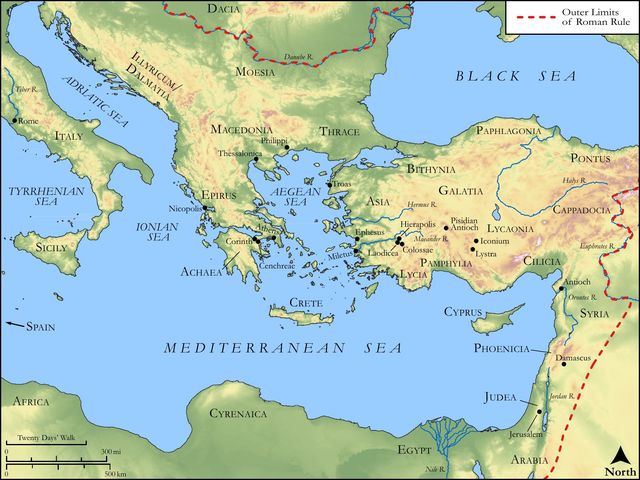
Where 1 Corinthians reaches
The passages it leans on, and the ones that lean on it
1 Corinthians 1:19 Isaiah 29:14
Isaiah’s word that “the wisdom of their wise men shall perish”, set against the wisdom of this world.
1 Corinthians 5:7 Exodus 12:6 Exodus 12:15
The lamb killed in the evening and the leaven put out of the house: Paul reads both in “Christ our passover.”
1 Corinthians 10:4 Exodus 17:6 Numbers 20:11
The rock smitten in Horeb and again at Kadesh, from which Israel drank: “that Rock was Christ.”
1 Corinthians 11:23–25 Luke 22:19–20
What Paul “received of the Lord” agrees with Luke’s account of the bread and the cup.
1 Corinthians 15:54–55 Isaiah 25:8 Hosea 13:14
Isaiah’s “He will swallow up death in victory” and Hosea’s word against the grave, brought to pass at the resurrection.
Books 1 Corinthians links to most
The Church Fathers on 1 Corinthians
2,232 quotations from 68 writers before AD 800 · the ten most quoted, in date order
- Irenaeus202
- Clement215
- Tertullian220
- Origen253
- Cyprian258
- Ambrosiaster384
- Chrysostom407
- Pelagius418
- Augustine430
- Theodoret458
Clement of Rome, writing to Corinth when it had divided again, sent the church back to this letter.
Inspired by God, Paul wrote to you concerning himself and Cephas and Apollos, because even then you were given to faction. But that factiousness involved you in less guilt, because then you were partisans of highly reputed apostles and of those commended by them.
Augustine on the cross as death’s defeat: by killing the last man, the devil lost the first.
But if Christ had not been put to death, death would not have died. The devil was overcome by his own trophy, for the devil rejoiced when, by seducing the first man, he cast him into death. By seducing the first man, he killed him. By killing the last man, he lost the first from his snare.
Tertullian on “bought with a price”, and what the price was.
So far as I know, "we are not our own, but bought with a price; " and what kind of price? The blood of God.
Cyril of Jerusalem on the same body raised and changed.
While the identical body is raised up, it will be transformed by the putting on of incorruption, as iron exposed to fire is made incandescent. This occurs in a manner known only to the Lord who raises the dead.
Keep studying
Articles