


1 Corinthians 11:25
Bible text: King James Version (1769 Blayney text) · Public domain
Bible text: King James Version with Strong's numbers · Public domain
Bible text: Berean Standard Bible · Public domain
Bible text: American Standard Version (1901) · Public domain
Bible text: World English Bible, Messianic edition · Public domain
Bible text: Geneva Bible (1599) · Public domain
Bible text: Young's Literal Translation · Public domain
- ὡσαύτωςhōsautōsLikewiseG5615ADVAdverb
- καὶkaialsoG2532CONJConjunction
- τὸtotheG3588T-ASNDefinite article Accusative Singular Neuter
- ποτήριονpotērioncupG4221N-ASNNoun Accusative Singular Neuter
- μετὰmetaafterG3326PREPPreposition
- τὸto<the>G3588T-ASNDefinite article Accusative Singular Neuter
- δειπνῆσαιdeipnēsaihaving suppedG1172V-AANVerb Aorist Active Infinitive
- λέγων·legōnsayingG3004V-PAP-NSMVerb Present Active Participle Nominative Singular Masculine
- τοῦτοtoutoThisG3778D-NSNDemonstrative pronoun Nominative Singular Neuter
- τὸto<the>G3588T-NSNDefinite article Nominative Singular Neuter
- ποτήριονpotērioncupG4221N-NSNNoun Nominative Singular Neuter
- ἡhētheG3588T-NSFDefinite article Nominative Singular Feminine
- καινὴkainēnewG2537A-NSFAdjective Nominative Singular Feminine
- διαθήκηdiathēkēcovenantG1242N-NSFNoun Nominative Singular Feminine
- ἐστὶνestinisG1510V-PAI-3SVerb Present Active Indicative 3rd Singular
- ἐνeninG1722PREPPreposition
- τῷtō<the>G3588T-DSNDefinite article Dative Singular Neuter
- ἐμῷemōMyG1473S-1SDSNPossessive pronoun Dative 1st Person Singular Neuter
- αἵματι·aimatibloodG129N-DSNNoun Dative Singular Neuter
- τοῦτοtoutothisG3778D-ASNDemonstrative pronoun Accusative Singular Neuter
- ποιεῖτεpoieitedo performG4160V-PAM-2PVerb Present Active Imperative 2nd Plural
- ὁσάκιςhosakisas often asG3740CONJConjunction
- ἐὰνeanwhenG1437CONDConjunction
- πίνητεpinēteyou shall drink [it]G4095V-PAS-2PVerb Present Active Subjunctive 2nd Plural
- εἰςeisinG1519PREPPreposition
- τὴνtēn<the>G3588T-ASFDefinite article Accusative Singular Feminine
- ἐμὴνemēnof MeG1473S-1SASFPossessive pronoun Accusative 1st Person Singular Feminine
- ἀνάμνησινanamnēsinremembranceG364N-ASFNoun Accusative Singular Feminine
English is a literal word-by-word gloss of the Greek, not the KJV's wording. Why?
This is the original text the KJV's translators worked from — each Greek word with its own literal English meaning in this verse, prepared by scholars at Tyndale House, Cambridge. The KJV translates whole sentences, not word by word, so its wording differs: one Greek word can become several English words, and the KJV may choose “charity” where the gloss reads “love”. Both are faithful — they answer different questions. For the KJV's own rendering, switch to the KJV text.
Details
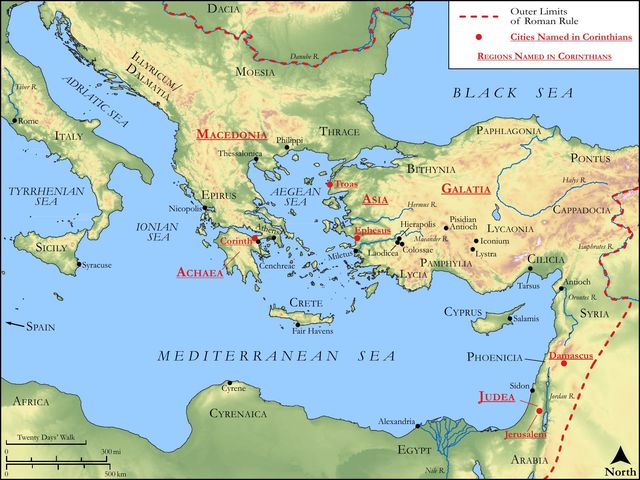
See on the biblical-era maps

Study this verse
Public-domain commentary
Matthew Henry
From his Commentary on the Whole Bible. Henry comments on passages, not single verses — this entry covers 1 Corinthians 11:23–34. His four-level outline is real structure in the source text, so it is rendered as structure.
To rectify these gross corruptions and irregularities, the apostle sets the sacred institution here to view. This should be the rule in the reformation of all abuses.
I.He tells us how he came by the knowledge of it.
He was not among the apostles at the first institution; but he had received from the Lord what he delivered to them, Co1 11:23. He had the knowledge of this matter by revelation from Christ: and what he had received he communicated, without varying from the truth a tittle, without adding or diminishing.
II.He gives us a more particular account of the institution than we meet with elsewhere. We have here an account,
1.Of the author - our Lord Jesus Christ. The king of the church only has power to institute sacraments.
2.The time of the institution: It was the very night wherein he was betrayed; just as he was entering on his sufferings which are therein to be commemorated.
3.The institution itself. Our Saviour took bread, and when he had given thanks, or blessed (as it is in Mat 26:26), he broke, and said, Take, eat; this is my body, broken for you; this do in remembrance of me. And in like manner he took the cup, when he had supped, saying, This cup is the New Testament in my blood; this do, as oft as you drink it, in remembrance of me, Co1 11:24, Co1 11:25. Here observe,
(1.)The materials of this sacrament; both,
[1.]As to the visible signs; these are bread and the cup, the former of which is called bread many times over in this passage, even after what the papists call consecration. What is eaten is called bread, though it be at the same time said to be the body of the Lord, a plain argument that the apostle knew nothing of their monstrous and absurd doctrine of transubstantiation. The latter is as plainly a part of this institution as words can make it. St. Matthew tells us, our Lord bade them all drink of it (Mat 26:27), as if he would, by this expression, lay in a caveat against the papists' depriving the laity of the cup. Bread and the cup are both made use of, because it is a holy feast. Nor is it here, or any where, made necessary, that any particular liquor should be in the cup. In one evangelist, indeed, it is plain that wine was the liquor used by our Saviour, though it was, perhaps, mingled with water, according to the Jewish custom; vide Lightfoot on Mt. 26. But this by no means renders it unlawful to have a sacrament where persons cannot come at wine. In every place of scripture in which we have an account of this part of the institution it is always expressed by a figure. The cup is put for what was in it, without once specifying what the liquor was, in the words of the institution.
[2.]The things signified by these outward signs; they are Christ's body and blood, his body broken, his blood shed, together with all the benefits which flow from his death and sacrifice: it is the New Testament in his blood. His blood is the seal and sanction of all the privileges of the new covenant; and worthy receivers take it as such, at this holy ordinance. They have the New Testament, and their own title to all the blessings of the new covenant, confirmed to them by his blood.
(2.)We have here the sacramental actions, the manner in which the materials of the sacrament are to be used.
[1.]Our Saviour's actions, which are taking the bread and cup, giving thanks, breaking the bread, and giving about both the one and the other.
[2.]The actions of the communicants, which were to take the bread and eat, to take the cup and drink, and both in remembrance of Christ. But the external acts are not the whole nor the principal part of what is to be done at this holy ordinance; each of them has a significancy. Our Saviour, having undertaken to make an offering of himself to God, and procure, by his death, the remission of sins, with all other gospel benefits, for true believers, did, at the institution, deliver his body and blood, with all the benefits procured by his death, to his disciples, and continues to do the same every time the ordinance is administered to the true believers. This is here exhibited, or set forth, as the food of souls. And as food, though ever so wholesome or rich, will yield no nourishment without being eaten, here the communicants are to take and eat, or to receive Christ and feed upon him, his grace and benefits, and by faith convert them into nourishment to their souls. They are to take him as their Lord and life, yield themselves up to him, and live upon him. He is our life, Col 3:4.
(3.)We have here an account of the ends of this institution.
[1.]It was appointed to be done in remembrance of Christ, to keep fresh in our minds an ancient favour, his dying for us, as well as to remember an absent friend, even Christ interceding for us, in virtue of his death, at God's right hand. The best of friends, and the greatest acts of kindness, are here to be remembered, with the exercise of suitable affections and graces. The motto on this ordinance, and the very meaning of it, is, When this you see, remember me.
[2.]It was to show forth Christ's death, to declare and publish it. It is not barely in remembrance of Christ, of what he has done and suffered, that this ordinance was instituted; but to commemorate, to celebrate, his glorious condescension and grace in our redemption. We declare his death to be our life, the spring of all our comforts and hopes. And we glory in such a declaration; we show forth his death, and spread it before God, as our accepted sacrifice and ransom. We set it in view of our own faith, for our own comfort and quickening; and we own before the world, by this very service, that we are the disciples of Christ, who trust in him alone for salvation and acceptance with God.
(4.)It is moreover hinted here, concerning this ordinance,
[1.]That it should be frequent: As often as you eat this bread, etc. Our bodily meals return often; we cannot maintain life and health without this. And it is fit that this spiritual diet should be taken often tool The ancient churches celebrated this ordinance every Lord's day, if not every day when they assembled for worship.
[2.]That it must be perpetual. It is to be celebrated till the Lord shall come; till he shall come the second time, without sin, for the salvation of those that believe, and to judge the world. This is our warrant for keeping this feast. It was our Lord's will that we should thus celebrate the memorials of his death and passion, till he come in his own glory, and the Father's glory, with his holy angels, and put an end to the present state of things, and his own mediatorial administration, by passing the final sentence. Note, The Lord's supper is not a temporary, but a standing and perpetual ordinance.
III.He lays before the Corinthians the danger of receiving unworthily, of prostituting this institution as they did, and using it to the purposes of feasting and faction, with intentions opposite to its design, or a temper of mind altogether unsuitable to it; or keeping up the covenant with sin and death, while they are there professedly renewing and confirming their covenant with God.
1.It is great guilt which such contract. They shall be guilty of the body and blood of the Lord (Co1 11:27), of violating this sacred institution, of despising his body and blood. They act as if they counted the blood of the covenant, wherewith they are sanctified, an unholy thing, Heb 10:29. They profane the institution, and in a manner crucify their Saviour over again. Instead of being cleansed by his blood, they are guilty of his blood.
2.It is a great hazard which they run: They eat and drink judgment to themselves, Co1 11:29. They provoke God, and are likely to bring down punishment on themselves. No doubt but they incur great guilt, and so render themselves liable to damnation, to spiritual judgments and eternal misery. Every sin is in its own nature damning; and therefore surely so heinous a sin as profaning such a holy ordinance is so. And it is profaned in the grossest sense by such irreverence and rudeness as the Corinthians were guilty of. But fearful believers should not be discouraged from attending at this holy ordinance by the sound of these words, as if they bound upon themselves the sentence of damnation by coming to the table of the Lord unprepared. Thus sin, as well as all others, leaves room for forgiveness upon repentance; and the Holy Spirit never indited this passage of scripture to deter serious Christians from their duty, though the devil has often made this advantage of it, and robbed good Christians of their choicest comforts. The Corinthians came to the Lord's table as to a common feast, not discerning the Lord's body - not making a difference or distinction between that and common food, but setting both on a level: nay, they used much more indecency at this sacred feast than they would have done at a civil one. This was very sinful in them, and very displeasing to God, and brought down his judgments on them: For this cause many are weak and sickly among you, and many sleep. Some were punished with sickness, and some with death. Note, A careless and irreverent receiving of the Lord's supper may bring temporal punishments. Yet the connection seems to imply that even those who were thus punished were in a state of favour with God, at least many of them: They were chastened of the Lord, that they should not be condemned with the world, Co1 11:32. Now divine chastening is a sign of divine love: Whom the Lord loveth he chasteneth (Heb 12:6), especially with so merciful a purpose, to prevent their final condemnation. In the midst of judgment, God remembers mercy: he frequently punishes those whom he tenderly loves. It is kindness to use the rod to prevent the child's ruin. He will visit such iniquity as this under consideration with stripes, and yet make those stripes the evidence of his lovingkindness. Those were in the favour of God who yet so highly offended him in this instance, and brought down judgments on themselves; at least many of them were; for they were punished by him out of fatherly good-will, punished now that they might not perish for ever. Note, It is better to bear trouble in this world than to be miserable to eternity. And God punishes his people now, to prevent their eternal woe.
IV.He points out the duty of those who would come to the Lord's table.
1.In general: Let a man examine himself (Co1 11:28), try and approve himself. Let him consider the sacred intention of this holy ordinance, its nature, and use, and compare his own views in attending on it and his disposition of mind for it; and, when he has approved himself to his own conscience in the sight of God, then let him attend. Such self-examination is necessary to a right attendance at this holy ordinance. Note, Those who, through weakness of understanding, cannot try themselves, are by no means fit to eat of this bread and drink of this cup; nor those who, upon a fair trial, have just ground to charge themselves with impenitency, unbelief, and alienation from the life of God. Those should have the wedding-garment on who would be welcome at this marriage-feast-grace in habit, and grace in exercise.
2.The duty of those who were yet unpunished for their profanation of this ordinance: If we would judge ourselves, we should not be judged, Co1 11:31. If we would thoroughly search and explore ourselves, and condemn and correct what we find amiss, we should prevent divine judgments. Note, To be exact and severe on ourselves and our own conduct is the most proper way in the world not to fall under the just severity of our heavenly Father. We must not judge others, lest we be judged (Mat 7:1); but we must judge ourselves, to prevent our being judged and condemned by God. We may be critical as to ourselves, but should be very candid in judging others.
V.He closes all with a caution against the irregularities of which they were guilty (Co1 11:33, Co1 11:34), charging them to avoid all indecency at the Lord's table. They were to eat for hunger and pleasure only at home, and not to change the holy supper to a common feast; and much less eat up the provisions before those who could bring none did partake of them, lest they should come together for condemnation. Note, Our holy duties, through our own abuse, may prove matter of condemnation. Christians may keep Sabbaths, hear sermons, attend at sacraments, and only aggravate guilt, and bring on a heavier doom. A sad but serious truth! O! let all look to it that they do not come together at any time to God's worship, and all the while provoke him, and bring down vengeance on themselves. Holy things are to be used in a holy manner, or else they are profaned. What else was amiss in this matter, he tells them, he would rectify when he came to them.
Historical interpretation
Nineteen Centuries of Reception
8 surviving comments on this verse. Each one is dated, so this reads as a timeline rather than a list.
Select a marker to jump to its quote. Markers stagger vertically where authors wrote within a few decades of each other.
Now concerning the Thanksgiving (Eucharist), thus give thanks. First, concerning the cup: We thank thee, our Father, for the holy vine of David Thy servant, which Thou madest known to us through Jesus Thy Servant; to Thee be the glory for ever. And concerning the broken bread: We thank Thee, our Father, for the life and knowledge which Thou modest known to us through Jesus Thy Servant; to Thee be the glory for ever. Even as this broken bread was scattered over the hills, and was gathered together and became one, so let Thy Church be gathered together from the ends of the earth into Thy kingdom; for Thine is the glory and the power through Jesus Christ for ever. But let no one eat or drink of your Thanksgiving (Eucharist), but they who have been baptized into the name of the Lord; for concerning this also the Lord hath said, Give not that which is holy to the dogs.
But after ye are filled, thus give thanks: We thank Thee, holy Father, for Thy holy name which Thou didst cause to tabernacle in our hearts, and for the knowledge and faith and immortality, which Thou modest known to us through Jesus Thy Servant; to Thee be the glory for ever. Thou, Master almighty, didst create all things for Thy name's sake; Thou gavest food and drink to men for enjoyment, that they might give thanks to Thee; but to us Thou didst freely give spiritual food and drink and life eternal through Thy Servant. Before all things we thank Thee that Thou art mighty; to Thee be the glory for ever. Remember, Lord, Thy Church, to deliver it from all evil and to make it perfect in Thy love, and gather it from the four winds, sanctified for Thy kingdom which Thou hast prepared for it; for Thine is the power and the glory for ever. Let grace come, and let this world pass away. Hosanna to the God (Son) of David! If any one is holy, let him come; if any one is not so, let him repent. Maran atha. Amen. But permit the prophets to make Thanksgiving as much as they desire.
We may not, I say, we may not call into question the truth of the (poor vilified) senses, lest we should even in Christ Himself, bring doubt upon the truth of their sensation; lest perchance it should be said that He did not really "behold Satan as lightning fall from heaven; " that He did not really hear the Father's voice testifying of Himself; or that He was deceived in touching Peter's wife's mother; or that the fragrance of the ointment which He afterwards smelled was different from that which He accepted for His burial; and that the taste of the wine was different from that which He consecrated in memory of His blood. On this false principle it was that Marcion actually chose to believe that He was a phantom, denying to Him the reality of a perfect body.
Being mindful, therefore, of those things that He endured for our sakes, we give You thanks, O God Almighty, not in such a manner as we ought, but as we are able, and fulfil His constitution: "For in the same night that He was betrayed, He took bread" [1 Corinthians 11:23] in His holy and undefiled hands, and, looking up to You His God and Father, "He broke it, and gave it to His disciples, saying, This is the mystery of the new covenant: take of it, and eat. This is my body, which is broken for many, for the remission of sins." In like manner also "He took the cup," and mixed it of wine and water, and sanctified it, and delivered it to them, saying: "Drink all of this; for this is my blood which is shed for many, for the remission of sins: do this in remembrance of me. For as often as you eat this bread and drink this cup, you do show forth my death until I come." Being mindful, therefore, of His passion, and death, and resurrection from the dead, and return into the heavens, and His future second appearing, wherein He is to come with glory and power to judge the quick and the dead, and to recompense to every one according to his works, we offer to You, our King and our God, according to His constitution, this bread and this cup, giving You thanks, through Him, that You have thought us worthy to stand before You, and to sacrifice to You; and we beseech You that You will mercifully look down upon these gifts which are here set before You, O God, who standest in need of none of our offerings. And accept them, to the honour of Your Christ, and send down upon this sacrifice Your Holy Spirit, the Witness of the Lord Jesus' sufferings, that He may show this bread to be the body of Your Christ, and the cup to be the blood of Your Christ, that those who are partakers thereof may be strengthened for piety, may obtain the remission of their sins, may be delivered from the devil and his deceit, may be filled with the Holy Ghost, may be made worthy of Your Christ, and may obtain eternal life upon Your reconciliation to them, O Lord Almighty.
"In like manner also the cup after supper, saying, This cup is the New Covenant in My Blood: this do, as oft as ye drink of it, in remembrance of Me."
What sayest thou? Art thou making a remembrance of Christ, and despisest thou the poor and tremblest not? Why, if a son or brother had died and thou wert making a remembrance of him, thou wouldst have been smitten by thy conscience, hadst thou not fulfilled the custom and invited the poor: and when thou art making remembrance of thy Master, dost thou not so much as simply give a portion of the Table?
But what is it which He saith, "This cup is the New Covenant?" Because there was also a cup of the Old Covenant; the libations and the blood of the brute creatures. For after sacrificing, they used to receive the blood in a chalice and bowl and so pour it out. Since then instead of the blood of beasts He brought in His own Blood; lest any should be troubled on hearing this, He reminds them of that ancient sacrifice.
Old things are passed away and are made new in Christ, so that altar yields to altar, sword to sword, fire to fire, bread to bread, victim to Victim, blood to Blood.
Daniel the disciple of Arsenius used to talk also about a hermit in Scetis, saying that he was a great man but simple in the faith, and in his ignorance he thought and said that the bread which we receive is not in very truth the Body of Christ, but a symbol of His Body. Two of the monks heard what he said but because they knew of his sublime works and labours, they imagined that he had said it in innocence and simple-mindedness; and so they came to him and said unto him, ‘Abba, someone told us something that we do not believe; he said that this bread that we receive is not in very truth the Body of Christ, but a mere symbol.’ He said to them, ‘I said that.’ They begged him, saying, ‘You mustn’t say that, abba; according to what the Catholic Church has handed down to us, even so do we believe, that is to say, this bread is the Body of Christ in very truth, and is not a mere symbol. It is the same as when God took dust from the earth, and made man in His image; just as no one can say that he is not the image of God, so also with the bread of which He said, “This is My Body” is not to be regarded as a merely commemorative thing; we believe that it is indeed the Body of Christ.’ The hermit said, ‘Unless I can be convinced by the thing itself I will not listen to this.’ Then the monks said to him, ‘Let us pray to God all week about this mystery, and we believe that He will reveal the truth to us.’ The hermit agreed to this with great joy, and each went to his cell. Then the hermit prayed, saying, ‘O Lord, you know that it is not out of wickedness that I do not believe, so in order that I may not go astray through ignorance, reveal to me, Lord Jesus Christ, the truth of this mystery.’ The other two brothers prayed to God and said, ‘Lord Jesus Christ, give this hermit understanding about this mystery, and we believe that he will not be lost.’ God heard the prayer of the two monks. When the week was over they came to the church, and the three of them sat down by themselves on one seat, the hermit between the other two. The eyes of their understanding were opened, and when the time of the mysteries arrived, and the bread was laid upon the holy table, there appeared to the three of them as it were a child on the table. Then the priest stretched out his hand to break the bread, and behold the angel of the Lord came down from heaven with a knife in his hand, and he killed the child and pressed out his blood into the cup. When the priest broke off from the bread small pieces, the hermit went forward to receive communion and a piece of living flesh smeared and dripping with blood was given to him. Now when he saw this he was afraid and he cried out loudly, saying, ‘Lord, I believe that the bread is Your Body, and that the cup is Your Blood.’ At once the flesh that was in his hand became bread, and he took it and gave thanks to God. The brothers said to him, ‘God knows the nature of men, and that we are unable to eat living flesh, and so He turneth His Body into bread, and His Blood into wine for those who receive Him in faith.’ Then they gave thanks to God for the hermit, because He had not let Satan destroy him, and the three of them went back to their cells joyfully.
The word cup means nothing other than the new covenant in the Lord.… The grace of suffering was intended by the Lord when the word cup is used. For what did he wish to be understood when he said to the sons of Zebedee, “Can you drink the cup that I am going to drink?” … and “Shall I not drink the cup that the Father gave me?” A stone’s throw from his disciples he is torn away to die for the sins of humanity. This is his cup of suffering. He shows his feelings of human weakness, saying … “Father, if you are willing, take this cup away from me.”.
You speak of 'sagging faith', however. That is quite another matter: In the last resort faith is an act of will, inspired by love. Our love may be chilled and our will eroded by the spectacle of the shortcomings, folly, and even sins of the Church and its ministers, but I do not think that one who has once had faith goes back over the line for these reasons (least of all anyone with any historical knowledge). 'Scandal' at most is an occasion of temptation – as indecency is to lust, which it does not make but arouses. It is convenient because it tends to turn our eyes away from ourselves and our own faults to find a scape-goat. But the act of will of faith is not a single moment of final decision : it is a permanent indefinitely repeated act > state which must go on – so we pray for 'final perseverance'. The temptation to 'unbelief (which really means rejection of Our Lord and His claims) is always there within us. Pan of us longs to find an excuse for it outside us. The stronger the inner temptation the more readily and severely shall we be 'scandalized' by others. I think I am as sensitive as you (or any other Christian) to the 'scandals', both of clergy and laity. I have suffered grievously in my life from stupid, tired, dimmed, and even bad priests; but I now know enough about myself to be aware that I should not leave the Church (which for me would mean leaving the allegiance of Our Lord) for any such reasons: I should leave because I did not believe, and should not believe any more, even if I had never met any one in orders who was not both wise and saintly...
The only cure for sagging of fainting faith is Communion. Though always Itself, perfect and complete and inviolate, the Blessed Sacrament does not operate completely and once for all in any of us. Like the act of Faith it must be continuous and grow by exercise. Frequency is of the highest effect. Seven times a week is more nourishing than seven times at intervals. Also I can recommend this as an exercise (alas! only too easy to find opportunity for): make your communion in circumstances that affront your taste. Choose a snuffling or gabbling priest or a proud and vulgar friar; and a church full of the usual bourgeois crowd, ill-behaved children – from those who yell to those products of Catholic schools who the moment the tabernacle is opened sit back and yawn – open necked and dirty youths, women in trousers and often with hair both unkempt and uncovered. Go to Communion with them (and pray for them). It will be just the same (or better than that) as a mass said beautifully by a visibly holy man, and shared by a few devout and decorous people. (It could not be worse than the mess of the feeding of the Five Thousand – after which [Our] Lord propounded the feeding that was to come.)
Continue studying 1 Corinthians 11:25 across the web’s major study libraries — every link below opens this exact verse, chapter, or book on the destination site.
Read & Compare
 BibleGatewayThis verse in more than 200 translations and 70 languages.
 Bible.comThe YouVersion reader — hundreds of translations, reading plans, and highlights.
 ESV.orgCrossway's official English Standard Version reader.
 NET BibleThe NET translation with 60,000+ translators' notes on every rendering decision.
 STEP BibleTyndale House's free study tool — original text, vocabulary, and scholarly resources.
 BibliaLogos Bible Software's free web reader.
 USCCBThe New American Bible (Revised Edition) with the U.S. bishops' study notes.
Commentaries
 BibleHub CommentariesDozens of classic commentaries on this verse, gathered on one page.
 StudyLightMore than 100 commentary sets — the largest collection on the web.
 BibleRefPlain-English commentary on what this verse means, verse by verse.
 Enduring WordDavid Guzik's free commentary on this chapter, widely used by Bible teachers.
 Bible Study ToolsVerse commentary alongside Greek and Hebrew study aids.
Original Language & Research
- BibleHub InterlinearThe verse word by word — original language, transliteration, and English.
- BibleHub LexiconEvery word's original-language definition and Strong's entry.
 Blue Letter BibleDeep-study tools — Strong's numbers, concordance, and word studies.
 CNTR CollationThe earliest Greek manuscripts of this verse, collated letter by letter.
Sermons, Hymns & Audio


TrulyRandomVerse is not affiliated with these sites and doesn’t control their content. They’re linked because they’re genuinely useful.
Summary
In 1 Corinthians 11:25, the Apostle Paul continues his instruction to the Corinthian church on the proper observance of the Lord's Supper, recounting Jesus' words concerning the cup. This pivotal verse establishes the institution of the new covenant, sealed by Christ's own sacrificial blood, and issues a perpetual command for believers to partake in the Supper as a profound act of remembrance of His atoning work until His return.
Context
ShowHideLiterary Context
This verse is an integral part of Paul's extensive teaching in 1 Corinthians 11:17-34 concerning the proper conduct during the communal gathering of the Corinthian church, specifically their celebration of the Lord's Supper. Paul had received troubling reports of divisions, gluttony, and drunkenness among them, which utterly desecrated the sacred meal and undermined its profound spiritual significance. To rectify these abuses and restore reverence, Paul appeals directly to the tradition he "received from the Lord" (1 Corinthians 11:23), detailing the institution of the Supper by Jesus Himself. Verse 25, following the instruction regarding the bread, focuses on the cup, completing the two elements of the sacrament and emphasizing the covenantal nature of Christ's sacrifice.
Historical & Cultural Context
The Corinthian church, situated in a bustling Greco-Roman city, faced unique challenges. Their communal meals (agape feasts), which preceded the Lord's Supper, were influenced by prevailing social hierarchies. Wealthier members would often eat their fill, while poorer members, arriving later from work, would go hungry, leading to the very divisions and abuses Paul condemns (1 Corinthians 11:20-22). Against this backdrop, Paul reasserts the counter-cultural, unifying nature of the Lord's Supper. Furthermore, the Last Supper itself, from which Paul draws his account, occurred within the framework of a Jewish Passover meal. This deeply significant historical context draws powerful parallels between the Old Covenant deliverance of Israel from Egyptian bondage through the blood of the lamb (Exodus 12) and humanity's ultimate redemption from sin through the blood of Christ, the true Passover Lamb.
Key Themes
ShowHideThe verse profoundly contributes to several major theological themes within 1 Corinthians and the broader New Testament. Foremost is the New Covenant in Christ's Blood, signifying a radical shift from the Old Covenant. Unlike the Mosaic Covenant, which relied on animal sacrifices and legalistic observance, this new covenant is inaugurated and sealed by the singular, perfect, and sufficient sacrifice of Jesus Christ, offering complete forgiveness of sins and direct access to God (Jeremiah 31:31-34). This leads to the theme of Sacrifice and Atonement, as the phrase "in my blood" unmistakably points to Jesus' life poured out on the cross as the ultimate propitiatory and expiatory sacrifice, fulfilling God's righteous demands and providing redemption for all who believe. Finally, the command "this do ye, as oft as ye drink [it], in remembrance of me" establishes the Lord's Supper as a perpetual Remembrance and Proclamation. It is not merely a nostalgic recollection but an active, communal re-presentation of the profound significance of Christ's death, His resurrection, and His promised return. As Paul explicitly states in the subsequent verse, it is a proclamation of His death until He comes.
Exposition and Analysis
ShowHideKey Word Analysis
ShowHideThis word (G1242) signifies a disposition, a contract, or specifically, a devisory will. In biblical usage, it is most often translated as "covenant," denoting a solemn, binding agreement initiated by God, establishing a relationship with humanity on His terms. Here, "new testament" (or new covenant) contrasts sharply with the Old Covenant, highlighting God's gracious initiative to establish a new and superior relationship through Christ's self-sacrifice.
The term (G129) refers literally to blood, but here carries profound theological weight. It signifies the atoning blood of Christ, representing His life poured out as a sacrificial offering. In ancient thought, blood was synonymous with life, and its shedding symbolized the giving of life unto death, particularly in the context of sacrifice for the remission of sins.
This word (G364) means recollection. However, in the context of the Lord's Supper, it implies more than a simple mental recall of a past event. It carries a liturgical and theological sense of "making present" or a re-presentation of the reality of what is remembered, allowing believers to participate in the ongoing power and significance of Christ's sacrifice. It's a dynamic act that brings the past saving event into the present experience of the worshipper.
Verse Breakdown
ShowHide"After the same manner also he took the cup, when he had supped, saying,"
This phrase connects the institution of the cup to the institution of the bread (described in the preceding verse, 1 Corinthians 11:23-24), indicating that both elements are integral to the Supper. The timing "when he had supped" places the cup's institution after the Passover meal itself, signifying its distinct, post-meal significance. Jesus' "saying" introduces the interpretive words that define the meaning of the cup.
"This cup is the new testament in my blood:"
This is the theological core of the verse. The cup, containing wine, is declared to "be" (G2076, estí) the new covenant, not literally transubstantiated into the covenant itself, but representing and embodying it. The covenant is explicitly "in my blood," meaning it is established, ratified, and made effective by the shedding of Jesus' blood on the cross. This blood signifies His sacrificial death, which inaugurates a new relationship between God and humanity, offering forgiveness and reconciliation unlike any previous covenant.
"this do ye, as oft as ye drink [it], in remembrance of me."
This is the command for the ongoing observance of the Supper. The phrase "this do ye" (G4160, poiéō) is an imperative, establishing a perpetual ordinance for believers. "As oft as ye drink [it]" indicates that the Supper is to be a recurring practice, not a one-time event. The ultimate purpose of this observance is "in remembrance of me" (G1519, eis G364, anámnēsis G1699, emós), which, as discussed in the Key Word Analysis, is a dynamic act of recalling and making present the saving reality of Christ's sacrifice.
Literary Devices
ShowHideThe verse employs several significant literary devices that enrich its meaning. Metaphor is central, particularly in the declaration, "This cup is the new testament in my blood." The cup itself is not literally the covenant, but it stands as a powerful symbol and representation of the new covenant established through Christ's sacrifice. This statement also uses Symbolism, where the physical elements of the cup (containing wine) symbolize the new covenant and the blood of Christ. The wine, traditionally associated with joy and celebration, here takes on the profound meaning of the life-giving, atoning blood of the Savior. Furthermore, the concept of "remembrance" (anámnēsis) functions as a form of Sacramental Language, implying that the act of remembering is not merely intellectual recall but a participation in the efficacy and reality of the event being remembered. This dynamic understanding of remembrance elevates the Supper beyond a mere memorial to a living encounter with the saving work of Christ.
Theological and Thematic Connections
ShowHide1 Corinthians 11:25 stands as a foundational text for understanding the nature of the New Covenant and the significance of Christ's sacrifice. It unequivocally declares that the old sacrificial system, which relied on the repeated shedding of animal blood, has been superseded by the singular, perfect, and all-sufficient sacrifice of Jesus Christ. His blood, poured out on the cross, inaugurates a new and better covenant, one that offers complete forgiveness of sins, direct access to God, and the indwelling of the Holy Spirit. This covenant is not based on human merit or adherence to a rigid law but on God's grace and Christ's atoning work, establishing a relationship of grace and faith. The Lord's Supper, therefore, serves as a tangible sign and seal of this new covenant, continually reminding believers of the immense cost of their redemption and the profound depth of God's love.
Reflection and Application
ShowHide1 Corinthians 11:25 calls every believer to a profound and reverent engagement with the Lord's Supper. It is not a casual meal or a mere tradition, but a sacred encounter with the very heart of the gospel. When we partake of the cup, we are called to remember with deep gratitude that our salvation is not earned but freely given through the costly sacrifice of Christ's blood, which sealed the new covenant of grace. This remembrance should stir within us a renewed appreciation for the forgiveness of sins, the reconciliation with God, and the promise of eternal life that are ours in Christ. It also prompts us to examine our hearts, ensuring that we approach this holy meal with humility, unity with fellow believers, and a genuine desire to honor the Lord who gave Himself for us (1 Corinthians 11:28). The Supper is a call to live out the implications of this new covenant daily, walking in purity, love, and obedience, as those who have been bought with a price.
Questions for Reflection
ShowHideFAQ
ShowHideWhat is the "new testament" mentioned in this verse?
ShowHideThe "new testament" (Greek: diathḗkē) refers to the new covenant that God established with humanity through the sacrificial death of Jesus Christ. This new covenant supersedes the Old Covenant (or Mosaic Law) given to Israel, which was characterized by animal sacrifices and a system of laws. Unlike the Old Covenant, which highlighted humanity's inability to perfectly obey God, the new covenant is based on God's grace and provides for the forgiveness of sins, direct access to God, and the indwelling of the Holy Spirit, all made possible by Christ's shed blood. This was prophesied in the Old Testament (e.g., Jeremiah 31:31-34) and fully realized in Christ (e.g., Hebrews 8:6-13).
What does "in remembrance of me" truly mean in the context of the Lord's Supper?
ShowHideThe Greek word for "remembrance" (anámnēsis) is richer than mere mental recall. In a liturgical and theological sense, it implies a "making present" or a re-presentation of the reality of what is remembered. When believers partake "in remembrance of me," they are not simply thinking about a past event; they are actively participating in the ongoing efficacy and power of Christ's sacrifice. It is a dynamic act where the saving work of Christ on the cross is brought into the present experience of the worshipper, allowing them to appropriate its benefits and proclaim its truth. As Paul clarifies in the very next verse, this remembrance is also a proclamation of Christ's death until He comes.
Christ-Centered Fulfillment
ShowHide1 Corinthians 11:25 finds its ultimate fulfillment in the person and work of Jesus Christ, who is the mediator and substance of the new covenant. He is the prophesied "better covenant" (Hebrews 8:6) promised by God, replacing the temporary and insufficient sacrifices of the Old Testament. Jesus, as the true Lamb of God who takes away the sin of the world, offered His own perfect and sinless blood as the once-for-all atonement for humanity's sin, rendering all previous animal sacrifices obsolete (Hebrews 9:12). The cup, representing His blood, signifies the ratification of this new covenant, by which believers receive forgiveness, righteousness, and eternal life, not by works of the law, but by grace through faith in Him. Thus, the Lord's Supper, commanded by Christ Himself, serves as a perpetual reminder of His completed redemptive work, His ongoing presence with His people, and the promised marriage supper of the Lamb when He returns to fully consummate His kingdom.