


1 Corinthians 11:34
Bible text: King James Version (1769 Blayney text) · Public domain
Bible text: King James Version with Strong's numbers · Public domain
Bible text: Berean Standard Bible · Public domain
Bible text: American Standard Version (1901) · Public domain
Bible text: World English Bible, Messianic edition · Public domain
Bible text: Geneva Bible (1599) · Public domain
Bible text: Young's Literal Translation · Public domain
- εἴeiIfG1487CONDConjunction
- δέdenowG1161CONJConjunction
- τιςtisanyoneG5100X-NSMIndefinite pronoun Nominative Singular Masculine
- πεινᾷpeinais hungryG3983V-PAI-3SVerb Present Active Indicative 3rd Singular
- ἐνenatG1722PREPPreposition
- οἴκῳoikōhomeG3624N-DSMNoun Dative Singular Masculine
- ἐσθιέτωesthietōhe should eatG2068V-PAM-3SVerb Present Active Imperative 3rd Singular
- ἵναinaso thatG2443CONJConjunction
- μὴmēnotG3361PRT-NNegative Particle Negative
- εἰςeisforG1519PREPPreposition
- κρίμαkrimajudgmentG2917N-ASNNoun Accusative Singular Neuter
- συνέρχησθεsunerchēstheyou may come togetherG4905V-PNS-2PVerb Present Middle Or Passive Deponent Subjunctive 2nd Plural
- τὰta<the>G3588T-APNDefinite article Accusative Plural Neuter
- δὲdeAndG1161CONJConjunction
- λοιπὰloipathe other thingsG3062A-APNAdjective Accusative Plural Neuter
- ὡςhōsas soon asG5613PRTParticle or Disjunctive
- ἂνanwhenG302PRTParticle or Disjunctive
- ἔλθωelthōI may comeG2064V-2AAS-1SVerb 2nd Aorist Active Subjunctive 1st Singular
- διατάξομαιdiataxomaiI will set in orderG1299V-FDI-1SVerb Future Middle Deponent Indicative 1st Singular
English is a literal word-by-word gloss of the Greek, not the KJV's wording. Why?
This is the original text the KJV's translators worked from — each Greek word with its own literal English meaning in this verse, prepared by scholars at Tyndale House, Cambridge. The KJV translates whole sentences, not word by word, so its wording differs: one Greek word can become several English words, and the KJV may choose “charity” where the gloss reads “love”. Both are faithful — they answer different questions. For the KJV's own rendering, switch to the KJV text.
Details
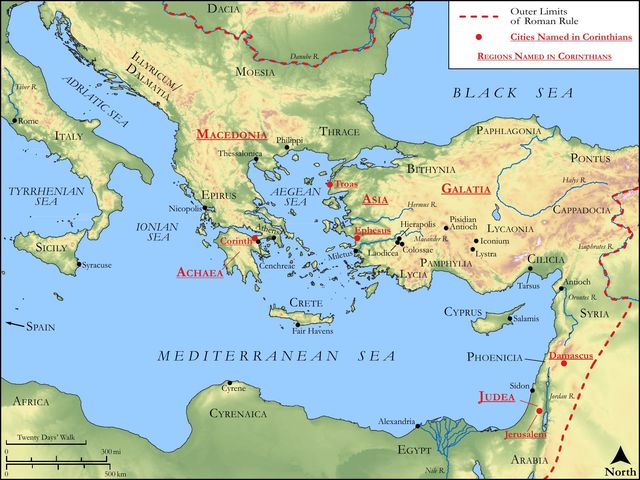
See on the biblical-era maps

Study this verse
Public-domain commentary
Matthew Henry
From his Commentary on the Whole Bible. Henry comments on passages, not single verses — this entry covers 1 Corinthians 11:23–34. His four-level outline is real structure in the source text, so it is rendered as structure.
To rectify these gross corruptions and irregularities, the apostle sets the sacred institution here to view. This should be the rule in the reformation of all abuses.
I.He tells us how he came by the knowledge of it.
He was not among the apostles at the first institution; but he had received from the Lord what he delivered to them, Co1 11:23. He had the knowledge of this matter by revelation from Christ: and what he had received he communicated, without varying from the truth a tittle, without adding or diminishing.
II.He gives us a more particular account of the institution than we meet with elsewhere. We have here an account,
1.Of the author - our Lord Jesus Christ. The king of the church only has power to institute sacraments.
2.The time of the institution: It was the very night wherein he was betrayed; just as he was entering on his sufferings which are therein to be commemorated.
3.The institution itself. Our Saviour took bread, and when he had given thanks, or blessed (as it is in Mat 26:26), he broke, and said, Take, eat; this is my body, broken for you; this do in remembrance of me. And in like manner he took the cup, when he had supped, saying, This cup is the New Testament in my blood; this do, as oft as you drink it, in remembrance of me, Co1 11:24, Co1 11:25. Here observe,
(1.)The materials of this sacrament; both,
[1.]As to the visible signs; these are bread and the cup, the former of which is called bread many times over in this passage, even after what the papists call consecration. What is eaten is called bread, though it be at the same time said to be the body of the Lord, a plain argument that the apostle knew nothing of their monstrous and absurd doctrine of transubstantiation. The latter is as plainly a part of this institution as words can make it. St. Matthew tells us, our Lord bade them all drink of it (Mat 26:27), as if he would, by this expression, lay in a caveat against the papists' depriving the laity of the cup. Bread and the cup are both made use of, because it is a holy feast. Nor is it here, or any where, made necessary, that any particular liquor should be in the cup. In one evangelist, indeed, it is plain that wine was the liquor used by our Saviour, though it was, perhaps, mingled with water, according to the Jewish custom; vide Lightfoot on Mt. 26. But this by no means renders it unlawful to have a sacrament where persons cannot come at wine. In every place of scripture in which we have an account of this part of the institution it is always expressed by a figure. The cup is put for what was in it, without once specifying what the liquor was, in the words of the institution.
[2.]The things signified by these outward signs; they are Christ's body and blood, his body broken, his blood shed, together with all the benefits which flow from his death and sacrifice: it is the New Testament in his blood. His blood is the seal and sanction of all the privileges of the new covenant; and worthy receivers take it as such, at this holy ordinance. They have the New Testament, and their own title to all the blessings of the new covenant, confirmed to them by his blood.
(2.)We have here the sacramental actions, the manner in which the materials of the sacrament are to be used.
[1.]Our Saviour's actions, which are taking the bread and cup, giving thanks, breaking the bread, and giving about both the one and the other.
[2.]The actions of the communicants, which were to take the bread and eat, to take the cup and drink, and both in remembrance of Christ. But the external acts are not the whole nor the principal part of what is to be done at this holy ordinance; each of them has a significancy. Our Saviour, having undertaken to make an offering of himself to God, and procure, by his death, the remission of sins, with all other gospel benefits, for true believers, did, at the institution, deliver his body and blood, with all the benefits procured by his death, to his disciples, and continues to do the same every time the ordinance is administered to the true believers. This is here exhibited, or set forth, as the food of souls. And as food, though ever so wholesome or rich, will yield no nourishment without being eaten, here the communicants are to take and eat, or to receive Christ and feed upon him, his grace and benefits, and by faith convert them into nourishment to their souls. They are to take him as their Lord and life, yield themselves up to him, and live upon him. He is our life, Col 3:4.
(3.)We have here an account of the ends of this institution.
[1.]It was appointed to be done in remembrance of Christ, to keep fresh in our minds an ancient favour, his dying for us, as well as to remember an absent friend, even Christ interceding for us, in virtue of his death, at God's right hand. The best of friends, and the greatest acts of kindness, are here to be remembered, with the exercise of suitable affections and graces. The motto on this ordinance, and the very meaning of it, is, When this you see, remember me.
[2.]It was to show forth Christ's death, to declare and publish it. It is not barely in remembrance of Christ, of what he has done and suffered, that this ordinance was instituted; but to commemorate, to celebrate, his glorious condescension and grace in our redemption. We declare his death to be our life, the spring of all our comforts and hopes. And we glory in such a declaration; we show forth his death, and spread it before God, as our accepted sacrifice and ransom. We set it in view of our own faith, for our own comfort and quickening; and we own before the world, by this very service, that we are the disciples of Christ, who trust in him alone for salvation and acceptance with God.
(4.)It is moreover hinted here, concerning this ordinance,
[1.]That it should be frequent: As often as you eat this bread, etc. Our bodily meals return often; we cannot maintain life and health without this. And it is fit that this spiritual diet should be taken often tool The ancient churches celebrated this ordinance every Lord's day, if not every day when they assembled for worship.
[2.]That it must be perpetual. It is to be celebrated till the Lord shall come; till he shall come the second time, without sin, for the salvation of those that believe, and to judge the world. This is our warrant for keeping this feast. It was our Lord's will that we should thus celebrate the memorials of his death and passion, till he come in his own glory, and the Father's glory, with his holy angels, and put an end to the present state of things, and his own mediatorial administration, by passing the final sentence. Note, The Lord's supper is not a temporary, but a standing and perpetual ordinance.
III.He lays before the Corinthians the danger of receiving unworthily, of prostituting this institution as they did, and using it to the purposes of feasting and faction, with intentions opposite to its design, or a temper of mind altogether unsuitable to it; or keeping up the covenant with sin and death, while they are there professedly renewing and confirming their covenant with God.
1.It is great guilt which such contract. They shall be guilty of the body and blood of the Lord (Co1 11:27), of violating this sacred institution, of despising his body and blood. They act as if they counted the blood of the covenant, wherewith they are sanctified, an unholy thing, Heb 10:29. They profane the institution, and in a manner crucify their Saviour over again. Instead of being cleansed by his blood, they are guilty of his blood.
2.It is a great hazard which they run: They eat and drink judgment to themselves, Co1 11:29. They provoke God, and are likely to bring down punishment on themselves. No doubt but they incur great guilt, and so render themselves liable to damnation, to spiritual judgments and eternal misery. Every sin is in its own nature damning; and therefore surely so heinous a sin as profaning such a holy ordinance is so. And it is profaned in the grossest sense by such irreverence and rudeness as the Corinthians were guilty of. But fearful believers should not be discouraged from attending at this holy ordinance by the sound of these words, as if they bound upon themselves the sentence of damnation by coming to the table of the Lord unprepared. Thus sin, as well as all others, leaves room for forgiveness upon repentance; and the Holy Spirit never indited this passage of scripture to deter serious Christians from their duty, though the devil has often made this advantage of it, and robbed good Christians of their choicest comforts. The Corinthians came to the Lord's table as to a common feast, not discerning the Lord's body - not making a difference or distinction between that and common food, but setting both on a level: nay, they used much more indecency at this sacred feast than they would have done at a civil one. This was very sinful in them, and very displeasing to God, and brought down his judgments on them: For this cause many are weak and sickly among you, and many sleep. Some were punished with sickness, and some with death. Note, A careless and irreverent receiving of the Lord's supper may bring temporal punishments. Yet the connection seems to imply that even those who were thus punished were in a state of favour with God, at least many of them: They were chastened of the Lord, that they should not be condemned with the world, Co1 11:32. Now divine chastening is a sign of divine love: Whom the Lord loveth he chasteneth (Heb 12:6), especially with so merciful a purpose, to prevent their final condemnation. In the midst of judgment, God remembers mercy: he frequently punishes those whom he tenderly loves. It is kindness to use the rod to prevent the child's ruin. He will visit such iniquity as this under consideration with stripes, and yet make those stripes the evidence of his lovingkindness. Those were in the favour of God who yet so highly offended him in this instance, and brought down judgments on themselves; at least many of them were; for they were punished by him out of fatherly good-will, punished now that they might not perish for ever. Note, It is better to bear trouble in this world than to be miserable to eternity. And God punishes his people now, to prevent their eternal woe.
IV.He points out the duty of those who would come to the Lord's table.
1.In general: Let a man examine himself (Co1 11:28), try and approve himself. Let him consider the sacred intention of this holy ordinance, its nature, and use, and compare his own views in attending on it and his disposition of mind for it; and, when he has approved himself to his own conscience in the sight of God, then let him attend. Such self-examination is necessary to a right attendance at this holy ordinance. Note, Those who, through weakness of understanding, cannot try themselves, are by no means fit to eat of this bread and drink of this cup; nor those who, upon a fair trial, have just ground to charge themselves with impenitency, unbelief, and alienation from the life of God. Those should have the wedding-garment on who would be welcome at this marriage-feast-grace in habit, and grace in exercise.
2.The duty of those who were yet unpunished for their profanation of this ordinance: If we would judge ourselves, we should not be judged, Co1 11:31. If we would thoroughly search and explore ourselves, and condemn and correct what we find amiss, we should prevent divine judgments. Note, To be exact and severe on ourselves and our own conduct is the most proper way in the world not to fall under the just severity of our heavenly Father. We must not judge others, lest we be judged (Mat 7:1); but we must judge ourselves, to prevent our being judged and condemned by God. We may be critical as to ourselves, but should be very candid in judging others.
V.He closes all with a caution against the irregularities of which they were guilty (Co1 11:33, Co1 11:34), charging them to avoid all indecency at the Lord's table. They were to eat for hunger and pleasure only at home, and not to change the holy supper to a common feast; and much less eat up the provisions before those who could bring none did partake of them, lest they should come together for condemnation. Note, Our holy duties, through our own abuse, may prove matter of condemnation. Christians may keep Sabbaths, hear sermons, attend at sacraments, and only aggravate guilt, and bring on a heavier doom. A sad but serious truth! O! let all look to it that they do not come together at any time to God's worship, and all the while provoke him, and bring down vengeance on themselves. Holy things are to be used in a holy manner, or else they are profaned. What else was amiss in this matter, he tells them, he would rectify when he came to them.
Historical interpretation
Historical reception
2 surviving comments on this verse. Each one is dated, so this reads as a timeline rather than a list.
Select a marker to jump to its quote. Markers stagger vertically where authors wrote within a few decades of each other.
"And if any man is hungry, let him eat at home." By permitting, he hinders it, and more strongly than by an absolute prohibition. For he brings him out of the church and sends him to his house, hereby severely reprimanding and ridiculing them, as slaves to the belly and unable to contain themselves. For he said not, "if any despise the poor," but, "if any hunger," discoursing as with impatient children; as with brute beasts which are slaves to appetite. Since it would be indeed very ridiculous, if, because they were hungry they were to eat at home.
Yet he was not content with this, but added also another more fearful thing, saying, "that your coming together be not unto judgment:" that ye come not unto chastisement, unto punishment, insulting the Church, dishonoring your brother. "For for this cause ye come together," saith he, "that ye may love one another, that ye may profit and be profited. But if the contrary happen, it were better for you to feed yourselves at home."
This, however, he said, that he might attract them to him the more. Yea, this was the very purpose both of his pointing out the injury that would arise from hence, and of his saying that condemnation was no trifling one, and terrifying them in every way, by the Mysteries, by the sick, by those that had died, by the other things before mentioned.
Then also he alarms them again in another way, saying, "and the rest will I set in order whensoever I come:" with reference either to some other things, or to this very matter. For since it was likely that they would yet have some reasons to allege, and it was not possible to set all to rights by letter, "the things which I have charged you, let them be observed for the present," saith he; "but if ye have any thing else to mention, let it be kept for my coming;" speaking either of this matter, as I said, or of some other things not very urgent. And this he doth that hence too he may render them more serious. For being anxious about his coming, they would correct the error. For the sojourning of Paul in any place was no ordinary thing.
We are given to understand by this that it was too much for him to set forth in a letter the whole manner of proceeding to be observed by the universal church and that what he set in order personally cannot be altered.
Continue studying 1 Corinthians 11:34 across the web’s major study libraries — every link below opens this exact verse, chapter, or book on the destination site.
Read & Compare
 BibleGatewayThis verse in more than 200 translations and 70 languages.
 Bible.comThe YouVersion reader — hundreds of translations, reading plans, and highlights.
 ESV.orgCrossway's official English Standard Version reader.
 NET BibleThe NET translation with 60,000+ translators' notes on every rendering decision.
 STEP BibleTyndale House's free study tool — original text, vocabulary, and scholarly resources.
 BibliaLogos Bible Software's free web reader.
 USCCBThe New American Bible (Revised Edition) with the U.S. bishops' study notes.
Commentaries
 BibleHub CommentariesDozens of classic commentaries on this verse, gathered on one page.
 StudyLightMore than 100 commentary sets — the largest collection on the web.
 BibleRefPlain-English commentary on what this verse means, verse by verse.
 Enduring WordDavid Guzik's free commentary on this chapter, widely used by Bible teachers.
 Bible Study ToolsVerse commentary alongside Greek and Hebrew study aids.
Original Language & Research
- BibleHub InterlinearThe verse word by word — original language, transliteration, and English.
- BibleHub LexiconEvery word's original-language definition and Strong's entry.
 Blue Letter BibleDeep-study tools — Strong's numbers, concordance, and word studies.
 CNTR CollationThe earliest Greek manuscripts of this verse, collated letter by letter.
Sermons, Hymns & Audio


TrulyRandomVerse is not affiliated with these sites and doesn’t control their content. They’re linked because they’re genuinely useful.
Summary
First Corinthians 11:34 concludes Paul's urgent directives regarding the Corinthian church's misuse of the Lord's Supper and associated communal meals, specifically addressing the issue of hunger and disorderly conduct. Paul instructs those who are genuinely hungry to eat at home, thereby separating physical sustenance from the sacred observance and preventing the assembly from becoming a source of divine judgment. He then asserts his apostolic authority, promising to establish further order and regulations upon his personal visit, underscoring his commitment to the church's spiritual health and proper functioning.
Context
ShowHideLiterary Context
This verse serves as the concluding exhortation to Paul's extensive teaching on the proper observance of the Lord's Supper, which begins in 1 Corinthians 11:17. Paul has meticulously detailed the historical institution of the Supper by Christ (1 Corinthians 11:23-26), the solemnity of its purpose, and the severe consequences of partaking unworthily (1 Corinthians 11:27-32). The immediate preceding verses (1 Corinthians 11:33) emphasize the need for mutual waiting and consideration, directly addressing the selfish behavior where some ate abundantly while others went hungry. Verse 34 provides a practical, immediate solution to the physical problem of hunger that was contributing to the disorder, while also signaling Paul's ongoing pastoral oversight.
Historical & Cultural Context
The early Christian church often combined the celebration of the Lord's Supper with a communal meal, known as the "love feast" or agape feast. This practice was rooted in Jewish communal meals and the early church's emphasis on fellowship and sharing. However, in Corinth, a wealthy port city known for its diverse population and social stratification, this practice had devolved into chaos. Wealthier members, arriving early, would consume their own provisions, often excessively, while poorer members, delayed by work, would arrive to find little or nothing left. This created a stark class division within the church, shaming the poor and dishonoring the very unity symbolized by the body of Christ and the Lord's Supper. Paul's instruction to "eat at home" directly addresses this social inequity and the resulting spiritual harm, seeking to restore the dignity and sacredness of the communal gathering.
Key Themes
ShowHideThe overarching theme in 1 Corinthians 11 is order and decorum in worship. Paul consistently emphasizes that Christian gatherings should reflect God's character, which is one of peace and order, not confusion (1 Corinthians 14:33). This verse specifically contributes to the theme of preventing condemnation by ensuring worthy participation in the Lord's Supper, as highlighted in 1 Corinthians 11:29. Furthermore, Paul's concluding statement, "And the rest will I set in order when I come," underscores the theme of apostolic authority and church governance. It demonstrates his ongoing pastoral responsibility and commitment to establishing sound practices that foster unity and spiritual health within the nascent Christian communities he founded.
Exposition and Analysis
ShowHideKey Word Analysis
ShowHideThis word signifies a decision, judgment, or verdict. In this context, it refers to divine judgment or discipline, which could manifest as sickness or even death, as Paul explains in 1 Corinthians 11:30. It is not necessarily eternal damnation but a temporal consequence for irreverent behavior during a sacred act.
This verb means to arrange thoroughly, institute, or prescribe. Paul's use of this word indicates his intention to establish clear, authoritative regulations and practices for the church, ensuring proper conduct and spiritual discipline that aligns with God's will and the church's mission.
Verse Breakdown
ShowHide"And if any man hunger, let him eat at home;"
This clause provides a direct, practical solution to the problem of hunger and gluttony that plagued the Corinthian fellowship meals. Paul separates the physical need for food from the spiritual observance of the Lord's Supper. By instructing hungry individuals to eat before coming to the assembly, he aims to remove the primary source of the disorder, ensuring that the communal gathering remains focused on its sacred purpose rather than personal sustenance. The phrase "at home" (Greek, oîkos') emphasizes the private sphere, distinct from the corporate worship setting.
"that ye come not together unto condemnation."
This is a crucial purpose clause, explaining the why behind the instruction. The disorderly and selfish conduct during the communal meals, particularly the Lord's Supper, was provoking divine judgment (Greek, kríma'). Paul warns that continuing such behavior would lead the entire assembly into a state of incurring God's displeasure, which could manifest in various forms of discipline, as previously mentioned in the chapter. The goal is to prevent the church from bringing judgment upon itself through irreverence and disunity.
"And the rest will I set in order when I come."
This concluding statement asserts Paul's apostolic authority and ongoing pastoral care. "The rest" (Greek, loipoí') refers to any remaining issues or further regulations needed to bring complete order and proper practice to the Corinthian church. Paul indicates that while he has addressed the most pressing concerns in this letter, a personal visit will allow him to implement more detailed instructions and administrative structures, ensuring the long-term spiritual health and orderly functioning of the community.
Literary Devices
ShowHidePaul employs Imperative Mood in "let him eat at home," conveying a direct command and emphasizing the urgency and necessity of the instruction. The phrase "that ye come not together unto condemnation" functions as a Purpose Clause, clearly articulating the severe spiritual consequence that the command is designed to avert. This highlights Paul's pastoral concern for the Corinthians' well-being and their relationship with God. Additionally, Paul's concluding remark, "And the rest will I set in order when I come," serves as a form of Apostolic Assertion or Promise, reinforcing his authority and commitment to the church's spiritual order. It also functions as a Proleptic Statement, anticipating future actions and further guidance, thereby leaving the Corinthians with a sense of ongoing accountability and expectation for his return.
Theological and Thematic Connections
ShowHideThis verse underscores the profound sacredness of corporate worship, particularly the Lord's Supper, and the serious implications of treating it as common. Paul's directive highlights that the assembly of believers is not merely a social gathering but a holy convocation where God's presence is invoked and His holiness must be honored. The warning against "condemnation" reveals God's active involvement in the life of His church, holding believers accountable for their conduct and attitudes, especially when they gather in His name. It teaches that true spiritual fellowship requires self-control, consideration for others, and a deep reverence for the divine ordinances established by Christ.
Reflection and Application
ShowHideFirst Corinthians 11:34 offers enduring wisdom for contemporary believers and churches. It challenges us to examine our attitudes and practices during corporate worship, especially when partaking in the Lord's Supper. The core principle remains: our gatherings should be marked by reverence, order, and genuine unity, not by self-indulgence or behaviors that cause division or shame. We are called to prioritize the spiritual significance of the assembly over personal convenience or physical desires, ensuring that our focus remains on Christ and our fellowship with one another in Him. This requires personal discipline and a selfless consideration for the needs and dignity of every member of the body, preventing any action that might bring dishonor to God or His church.
Questions for Reflection
ShowHideFAQ
ShowHideWhat does Paul mean by "condemnation" in this context?
ShowHideIn 1 Corinthians 11:34, "condemnation" (Greek: kríma) refers to divine judgment or discipline, not necessarily eternal damnation. Paul elaborates on this in 1 Corinthians 11:30, where he states that some Corinthians were sick and even dying because of their unworthy participation in the Lord's Supper. This judgment was a temporal consequence, a form of corrective discipline from God, aimed at bringing them to repentance and preventing eternal condemnation (1 Corinthians 11:32). It underscores the seriousness with which God views the sacredness of His ordinances and the unity of His body.
Why does Paul tell them to "eat at home" if they are hungry?
ShowHidePaul's instruction to "eat at home" addresses a specific problem in the Corinthian church where the communal "love feast" preceding or accompanying the Lord's Supper had become a source of division and gluttony. Wealthier members were eating their fill, sometimes excessively, while poorer members, who might arrive later, went hungry. This behavior dishonored the poor, violated the spirit of Christian fellowship, and desecrated the solemnity of the Lord's Supper. By telling the hungry to eat at home, Paul sought to separate the satisfaction of physical hunger from the sacred act of remembering Christ's sacrifice, thereby restoring order, dignity, and unity to the church's gathering and ensuring that the focus remained on the spiritual purpose of the meal, not on personal feasting.
Christ-Centered Fulfillment
ShowHideWhile 1 Corinthians 11:34 provides practical instructions for church order, its deeper Christ-centered fulfillment lies in how it points to the Lord Jesus as the ultimate source of true spiritual nourishment and unity. The disorder at Corinth stemmed from a failure to properly discern the "body of the Lord" (1 Corinthians 11:29), a failure to recognize Christ's presence in the Supper and in His unified body, the Church. Christ Himself is the "bread of life" (John 6:35), who satisfies our deepest spiritual hunger, making physical hunger secondary in the context of worship. His sacrifice on the cross, commemorated in the Supper, is the very foundation of the new covenant, establishing a community where social distinctions are abolished and all are one in Him (Galatians 3:28). Paul's desire to "set in order" the Corinthian church reflects Christ's own desire for His Church to be holy, without spot or wrinkle (Ephesians 5:27), a unified body that faithfully proclaims His death until He comes (1 Corinthians 11:26). Thus, the call for order and reverence in this verse ultimately serves to magnify Christ, the Head of the Church, and ensure that His people gather in a manner worthy of His name and His redemptive work.