


1 Corinthians 16:5
- ἐλεύσομαιeleusomaiI will comeG2064V-FDI-1SVerb Future Middle Deponent Indicative 1st Singular
- δὲdehoweverG1161CONJConjunction
- πρὸςprostoG4314PREPPreposition
- ὑμᾶςhumasyouG4771P-2APPersonal pronoun Accusative 2nd Plural
- ὅτανhotanwhenG3752CONJConjunction
- ΜακεδονίανMakedonianMacedoniaG3109N-ASF-LNoun Accusative Singular Feminine Location
- διέλθω·dielthōI may have gone throughG1330V-2AAS-1SVerb 2nd Aorist Active Subjunctive 1st Singular
- ΜακεδονίανMakedonianMacedoniaG3109N-ASF-LNoun Accusative Singular Feminine Location
- γὰρgarforG1063CONJConjunction
- διέρχομαιdierchomaiI am going throughG1330V-PNI-1SVerb Present Middle Or Passive Deponent Indicative 1st Singular
English is a literal word-by-word gloss of the Greek, not the KJV's wording. Why?
This is the original text the KJV's translators worked from — each Greek word with its own literal English meaning in this verse, prepared by scholars at Tyndale House, Cambridge. The KJV translates whole sentences, not word by word, so its wording differs: one Greek word can become several English words, and the KJV may choose “charity” where the gloss reads “love”. Both are faithful — they answer different questions. For the KJV's own rendering, switch to the KJV text.
Details
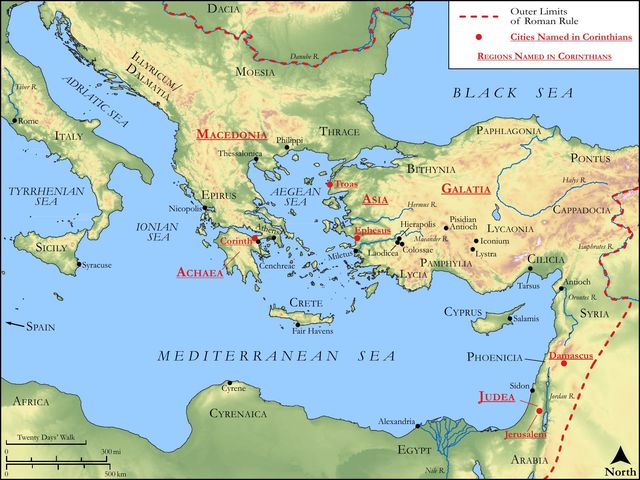
See on the biblical-era map

Study this verse
Public-domain commentary
Matthew Henry
From his Commentary on the Whole Bible. Henry comments on passages, not single verses — this entry covers 1 Corinthians 16:5–9.
In this passage the apostle notifies and explains his purpose of visiting them, concerning which, observe, 1. His purpose: he intended to pass out of Asia, where he now was (vide Co1 16:8, Co1 16:19) and to go through Macedonia into Achaia, where Corinth was, and to stay some time with them, and perhaps the winter, Co1 16:5, Co1 16:6. He had long laboured in this church, and done much good among them, and had his heart set upon doing much more (if God saw fit), and therefore he had it in his thoughts to see them, and stay with them. Note, The heart of a truly Christian minister must be much towards that people among whom he has long laboured, and with remarkable success. No wonder that Paul was willing to see Corinth and stay with them as long as the other duties of his office would permit. Though some among this people despised him, and made a faction against him, doubtless there were many who loved him tenderly, and paid him all the respect due to an apostle and their spiritual father. And is it any wonder that he should be willing to visit them, and stay with them? And as to the rest, who now manifested great disrespect, he might hope to reduce them to a better temper, and thereby rectify what was out of order in the church, by staying among them for some time. It is plain that he hoped for some good effect, because he says he intended to stay, that they might bring him on his journey whithersoever he went (Co1 16:6); not that they might accompany him a little way on the road, but expedite and furnish him for his journey, help and encourage him to it, and provide him for it. He is to be understood of being brought forward in his journey after a godly sort (as it is expressed, Jo3 1:6), so that nothing might be wanting to him, as he himself speaks, Tit 3:13. His stay among them, he hoped, would cure their factious humour, and reconcile them to himself and their duty. Note, It was a just reason for an apostle to make his abode in a place that he had a prospect of doing good. 2. His excuse for not seeing them now, because it would be only by the way (Co1 16:7), en parodō - in transitu - en passant: it would only be a transient visit. He would not see them because he could not stay with them. Such a visit would give neither him nor them any satisfaction or advantage; it would rather raise the appetite than regale it, rather heighten their desires of being together than satisfy them. He loved them so much that he longed for an opportunity to stay with them, take up his abode among them for some length of time. This would be more pleasing to himself, and more serviceable to them, than a cursory visit in his way; and therefore he would not see them now, but another time, when he could tarry longer. 3. We have the limitation of this purpose: I trust to tarry awhile with you, if the Lord permit, Co1 16:7. Though the apostles wrote under inspiration, they did not know thereby how God would dispose of them. Paul had a purpose of coming to Corinth, and staying there, and hoped to do good thereby. This was not a purpose proceeding from any extraordinary motion or impulse of the Spirit of God; it was not the effect of inspiration; for had it been such he could not have spoken of it in this manner. A purpose formed thus in him must have been the purpose of God, signified to him by his Spirit; and could he say he would come to Corinth upon this view only, if God permit, that is, that he would execute God's own purpose concerning himself, with God's permission? It is to be understood then of a common purpose, formed in his own spirit. And concerning all our purposes it is fit we should say, "We will execute them if the Lord permit." Note, All our purposes must be made with submission to the divine providence. We should say, If the Lord will, we shall live, and do this and that, Jam 4:15. It is not in us to effect our own designs, without the divine leave. It is by God's power and permission, and under his direction, that we must do every thing. Heathens have concurred in acknowledging this concern of Providence in all our actions and concerns; surely we should readily own it, and frequently and seriously attend to it. 4. We have his purpose expressed of staying at Ephesus for the present. He says he would stay there till pentecost, Co1 16:8. It is very probable that at the time of writing this epistle he was in Ephesus, from this passage, compared with Co1 16:19, where he says, The churches of Asia salute you. A proper salutation from Ephesus, but hardly so proper had he been at Philippi, as the subscription to this epistle in our common copies has it. "The churches of Macedonia salute you" had been much more properly inserted in the close of a letter from Philippi, than the other. But, 5. We have the reason given for his staying at Ephesus for the present: Because a great door, and effectual, was opened to him, and there were many adversaries, Co1 16:9. A great door and effectual was opened to him; many were prepared to receive the gospel at Ephesus, and God gave him great success among them; he had brought over many to Christ, and he had great hope of bringing over many more. For this reason he determined to stay awhile at Ephesus. Note, Success, and a fair prospect of more, was a just reason to determine an apostle to stay and labour in a particular place. And there were many adversaries, because a great door, and an effectual, was opened. Note, Great success in the work of the gospel commonly creates many enemies. The devil opposes those most, and makes them most trouble, who most heartily and successfully set themselves to destroy his kingdom. There were many adversaries; and therefore the apostle determined to stay. Some think he alludes in this passage to the custom of the Roman Circus, and the doors of it, at which the charioteers were to enter, as their antagonists did at the opposite doors. True courage is whetted by opposition; and it is no wonder that the Christian courage of the apostle should be animated by the zeal of his adversaries. They were bent to ruin him, and prevent the effect of his ministry at Ephesus; and should he at this time desert his station, and disgrace his character and doctrine? No, the opposition of adversaries only animated his zeal. He was in nothing daunted by his adversaries; but the more they raged and opposed the more he exerted himself. Should such a man as he flee? Note, Adversaries and opposition do not break the spirits of faithful and successful ministers, but only enkindle their zeal, and inspire them with fresh courage. Indeed, to labour in vain is heartless and discouraging. This damps the spirits, and breaks the heart. But success will give life and vigour to a minister, though enemies rage, and blaspheme, and persecute. It is not the opposition of enemies, but the hardness and obstinacy of his hearers, and the backslidings and revolt of professors, that damp a faithful minister, and break his heart.
Historical interpretation
Historical reception
2 surviving comments on this verse. Each one is dated, so this reads as a timeline rather than a list.
Select a marker to jump to its quote. Markers stagger vertically where authors wrote within a few decades of each other.
Paul is personally strengthening the admonitions by which he is putting them right. The one from whom they have heard Christian teaching is coming to visit. If so, they will be all the more concerned not to be ashamed when he arrives.
"But I will come to you," saith he, "when I shall have passed through Macedonia." This he had said also above; then however with anger: at least he added, "And I will know not the speech of them that are puffed up, but the power:" but here, more mildly; that they might even long for his coming. Then, that they might not say, "Why is it that you honor the Macedonians above us?" he said not, "When I depart," but, "When I shall have passed through Macedonia; for I do pass through Macedonia."
Continue studying 1 Corinthians 16:5 across the web’s major study libraries — every link below opens this exact verse, chapter, or book on the destination site.
Read & Compare
 BibleGatewayThis verse in more than 200 translations and 70 languages.
 Bible.comThe YouVersion reader — hundreds of translations, reading plans, and highlights.
 ESV.orgCrossway's official English Standard Version reader.
 NET BibleThe NET translation with 60,000+ translators' notes on every rendering decision.
 STEP BibleTyndale House's free study tool — original text, vocabulary, and scholarly resources.
 BibliaLogos Bible Software's free web reader.
 USCCBThe New American Bible (Revised Edition) with the U.S. bishops' study notes.
Commentaries
 BibleHub CommentariesDozens of classic commentaries on this verse, gathered on one page.
 StudyLightMore than 100 commentary sets — the largest collection on the web.
 BibleRefPlain-English commentary on what this verse means, verse by verse.
 Enduring WordDavid Guzik's free commentary on this chapter, widely used by Bible teachers.
 Bible Study ToolsVerse commentary alongside Greek and Hebrew study aids.
Original Language & Research
- BibleHub InterlinearThe verse word by word — original language, transliteration, and English.
- BibleHub LexiconEvery word's original-language definition and Strong's entry.
 Blue Letter BibleDeep-study tools — Strong's numbers, concordance, and word studies.
 CNTR CollationThe earliest Greek manuscripts of this verse, collated letter by letter.
Sermons, Hymns & Audio


TrulyRandomVerse is not affiliated with these sites and doesn’t control their content. They’re linked because they’re genuinely useful.
Summary
In the concluding chapter of his first letter to the Corinthian church, the Apostle Paul outlines his immediate travel plans, indicating his intention to visit them after first passing through Macedonia. This declaration serves to inform the Corinthian believers of his anticipated arrival, providing a practical update on his itinerary while underscoring his pastoral commitment to their spiritual well-being and his strategic approach to missionary work.
Context
ShowHideLiterary Context
1 Corinthians 16 serves as the concluding chapter of Paul's comprehensive letter to the Corinthian church. Following extensive theological instruction, ethical admonitions, and answers to specific questions posed by the Corinthians, Paul shifts to practical matters. This includes instructions regarding the collection for the saints in Jerusalem (1 Corinthians 16:1-4), updates on Timothy's potential visit (1 Corinthians 16:10-11), and Apollos's plans (1 Corinthians 16:12). Within this section, Paul's personal travel arrangements are crucial for the church to anticipate his arrival and prepare for his pastoral oversight, which was often a significant event for early Christian communities.
Historical & Cultural Context
Paul is writing this letter from Ephesus, likely during the latter part of his three-year ministry there (Acts 19:8-10). Travel in the ancient world, particularly by land and sea, was arduous and subject to many variables like weather, banditry, and political stability. Macedonia, a Roman province north of Achaia (where Corinth was located), contained several significant churches Paul had established, such as Philippi, Thessalonica, and Berea. His plan to "pass through Macedonia" before reaching Corinth implies a strategic route, allowing him to visit and minister to these churches first. Apostolic visits were vital for the early church, providing direct teaching, pastoral correction, encouragement, and the strengthening of nascent congregations, making Paul's itinerary a matter of practical importance for the Corinthian believers.
Key Themes
ShowHideThis verse contributes to several key themes within Paul's ministry and the broader New Testament narrative. Firstly, it highlights Apostolic Planning and Strategic Ministry. Paul's communication of his travel plans demonstrates a deliberate, though divinely guided, approach to his missionary endeavors, ensuring he attended to the needs of various churches in a logical sequence. Secondly, it underscores Pastoral Commitment and Personal Presence. Despite the numerous challenges and conflicts Paul addressed in this letter, his unwavering intention to visit Corinth in person reveals his deep pastoral heart and belief in the irreplaceable value of face-to-face interaction for effective spiritual oversight and strengthening the church. This commitment is further emphasized by his later defense of his travel plans in 2 Corinthians 1:15-17, where he clarifies his consistency and truthfulness. Lastly, the verse speaks to the importance of Clear Communication and Trust-Building within Christian relationships, as Paul explicitly states his intentions to set expectations and avoid misunderstandings.
Exposition and Analysis
ShowHideKey Word Analysis
ShowHideThis particle (G1161) serves as a continuative or adversative, often indicating a transition or a slight shift in thought. Here, it introduces Paul's personal plans after discussing the collection, signaling a new, yet related, topic of practical importance. It smoothly transitions the letter from general instructions to specific, personal updates.
The verb (G2064) signifies "to come or go," indicating movement towards a destination. In this context, it expresses Paul's definite intention and future action of arriving at Corinth. The use of this verb emphasizes his personal presence as the culmination of his journey.
This compound verb (G1330), formed from dia (through) and erchomai (to come/go), literally means "to traverse" or "to go through." It clearly indicates that Macedonia is not his final destination but a region he will travel through on his way to Corinth, suggesting a planned journey that includes passage through, and likely ministry within, that region.
Verse Breakdown
ShowHide"Now I will come unto you,"
This initial clause, introduced by the transitional particle "Now," clearly states Paul's firm intention to visit the Corinthian church. The future tense "will come" conveys a definite plan, setting the expectation for his arrival and emphasizing his personal commitment to them.
"when I shall pass through Macedonia:"
This clause specifies the timing and the route of Paul's intended visit. He will not come directly to Corinth but will first undertake a journey through the region of Macedonia. This indicates a strategic itinerary, likely involving ministry and visits to the churches he had previously established there.
"for I do pass through Macedonia."
The repetition of the phrase, introduced by "for" (G1063, gar, indicating a reason or explanation), serves to reinforce the certainty and necessity of this leg of his journey. It clarifies that his passage through Macedonia is not merely a possibility but a definite, planned part of his route, providing the reason or condition for his subsequent arrival in Corinth.
Literary Devices
ShowHideThe most prominent literary device in 1 Corinthians 16:5 is Repetition. The phrase "I do pass through Macedonia" is stated twice, first as a condition ("when I shall pass through Macedonia") and then as a reinforcing explanation ("for I do pass through Macedonia"). This repetition serves to emphasize the certainty and definiteness of Paul's travel plans. It assures the Corinthians that his passage through Macedonia is a fixed part of his itinerary, thereby making his subsequent arrival in Corinth a firm commitment. This rhetorical strategy adds weight to his words, conveying a sense of resolve and transparency in his communication.
Theological and Thematic Connections
ShowHidePaul's communication of his travel plans, seemingly mundane, carries significant theological weight, underscoring the incarnational nature of apostolic ministry and the importance of personal presence in the life of the church. It reflects a theology of ministry that values direct engagement, pastoral oversight, and the building of relationships, rather than merely remote instruction. Paul understood that while letters could convey truth, the physical presence of an apostle provided unique opportunities for teaching, correction, encouragement, and the modeling of Christian life. This verse highlights the strategic and purposeful nature of Paul's missionary journeys, always with the aim of strengthening and maturing the churches.
Reflection and Application
ShowHidePaul's meticulous planning and clear communication regarding his travel to Corinth offer valuable lessons for believers today. In an age of instant digital communication, this verse reminds us of the irreplaceable value of personal presence and face-to-face interaction in building genuine relationships and fostering spiritual growth. Whether in family, church, or community, intentionality in presence—showing up, being available, and investing time—builds trust and strengthens bonds far more deeply than mere words or virtual interactions. Furthermore, Paul's example encourages us to be diligent and strategic in our own commitments and ministries, planning thoughtfully while remaining open to God's sovereign leading. It also challenges us to communicate our intentions clearly and honestly, fostering transparency and avoiding misunderstandings, thereby reflecting Christ's integrity in all our dealings.
Questions for Reflection
ShowHideFAQ
ShowHideWhy was it important for Paul to inform the Corinthians of his travel plans?
ShowHideIt was crucial for several reasons. Firstly, it demonstrated Paul's pastoral care and transparency, allowing the Corinthians to anticipate his arrival and prepare for his visit. In the early church, apostolic visits were significant events for teaching, correction, and encouragement. Secondly, Paul had faced accusations of inconsistency regarding his travel plans in the past (as seen in 2 Corinthians 1:15-20), so clear communication helped to rebuild trust and set accurate expectations. Thirdly, it provided practical information for the church as they might need to arrange hospitality or prepare for specific discussions upon his arrival.
Did Paul's travel plans always go exactly as he initially announced them?
ShowHideNo, not always. While Paul made careful plans, he also remained flexible and submitted to the leading of the Holy Spirit, or was sometimes hindered by circumstances. For instance, his plans to visit Corinth directly were altered, leading to an "unpleasant visit" and a "painful letter" before his final, more positive visit (2 Corinthians 2:1-4 and 2 Corinthians 7:8-9). He often explained these changes, emphasizing that his "yes" was truly "yes" in Christ, even if the timing or route shifted (2 Corinthians 1:18-20). This tension between careful planning and divine sovereignty is a recurring theme in Paul's life and ministry.
Christ-Centered Fulfillment
ShowHideWhile 1 Corinthians 16:5 describes Paul's earthly travel plans, it subtly reflects a deeper, Christ-centered principle of divine presence and intentionality. Just as Paul, the apostle, planned to "come unto" his beloved flock, so too did God the Son, Jesus Christ, intentionally "come unto" humanity. The ultimate fulfillment of such a desire for personal presence is found in the Incarnation, where the eternal Word became flesh and dwelt among us (John 1:14). Christ's journey from heaven to earth was the most profound "passing through" – traversing the chasm between divinity and humanity to bring salvation. Furthermore, Christ's promise to be with His disciples "always, to the end of the age" (Matthew 28:20) and His sending of the Holy Spirit to indwell believers (John 14:16-18) demonstrate an ongoing, intimate divine presence that far surpasses any human visit. Paul's pastoral commitment to be physically present with the Corinthians, despite the difficulties, mirrors the divine commitment of God to be present with His people, ultimately and perfectly realized in Jesus Christ.