


1 Corinthians 16:4
- ἐὰνeanIfG1437CONDConjunction
- δὲdethenG1161CONJConjunction
- ἄξιονaxionsuitableG514A-NSNAdjective Nominative Singular Neuter
- ᾖēit shall beG1510V-PAS-3SVerb Present Active Subjunctive 3rd Singular
- τοῦtouforG3588T-GSNDefinite article Genitive Singular Neuter
- κἀμὲkameme alsoG2532P-1AS + G2532=CONJ
- πορεύεσθαιporeuesthaito goG4198V-PNNVerb Present Middle Or Passive Deponent Infinitive
- σὺνsunwithG4862PREPPreposition
- ἐμοὶemoime myselfG1473P-1DSPersonal pronoun Dative 1st Singular
- πορεύσονταιporeusontaithey will goG4198V-FDI-3PVerb Future Middle Deponent Indicative 3rd Plural
English is a literal word-by-word gloss of the Greek, not the KJV's wording. Why?
This is the original text the KJV's translators worked from — each Greek word with its own literal English meaning in this verse, prepared by scholars at Tyndale House, Cambridge. The KJV translates whole sentences, not word by word, so its wording differs: one Greek word can become several English words, and the KJV may choose “charity” where the gloss reads “love”. Both are faithful — they answer different questions. For the KJV's own rendering, switch to the KJV text.
Details
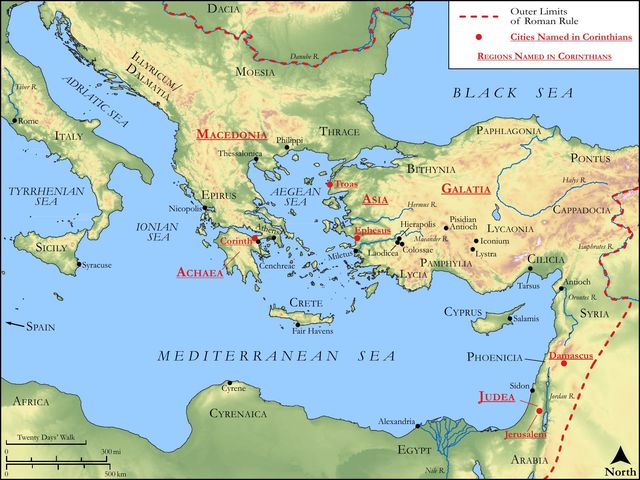
See on the biblical-era map

Study this verse
Public-domain commentary
Matthew Henry
From his Commentary on the Whole Bible. Henry comments on passages, not single verses — this entry covers 1 Corinthians 16:1–4. His three-level outline is real structure in the source text, so it is rendered as structure.
In this chapter Paul closes this long epistle with some particular matters of less moment; but, as all was written by divine inspiration, it is all profitable for our instruction. He begins with directing them about a charitable collection on a particular occasion, the distresses and poverty of Christians in Judea, which at this time were extraordinary, partly through the general calamities of that nation and partly through the particular sufferings to which they were exposed. Now concerning this observe,
I.How he introduces his direction.
It was not a peculiar service which he required of them; he had given similar orders to the churches of Galatia, Co1 16:1. He desired them only to conform to the same rules which he had given to other churches on a similar occasion. He did not desire that others should be eased and they burdened, Co2 8:13. He also prudently mentions these orders of his to the churches of Galatia, to excite emulation, and stir them up to be liberal, according to their circumstances, and the occasion. Those who exceeded most churches in spiritual gifts, and, as it is probable, in worldly wealth (see the argument), surely would not suffer themselves to come behind any in their bounty to their afflicted brethren. Note, The good examples of other Christians and churches should excite in us a holy emulation. It is becoming a Christian not to bear to be outdone by a fellow-christian in any thing virtuous and praise-worthy, provided this consideration only makes him exert himself, not envy others; and the more advantages we have above others the more should we endeavour to exceed them. The church of Corinth should not be outdone in this service of love by the churches of Galatia, which do not appear to have been enriched with equal spiritual gifts nor outward ability.
II.The direction itself, concerning which observe,
1.The manner in which the collection was to be made: Every one was to lay by in store (Co1 16:2), have a treasury, or fund, with himself, for this purpose. The meaning is that he should lay by as he could spare from time to time, and by this means make up a sum for this charitable purpose. Note, It is a good thing to lay up in store for good uses. Those who are rich in this world should be rich in good works, Ti1 6:17, Ti1 6:18. The best way to be so is to appropriate of their income, and have a treasury for this purpose, a stock for the poor as well as for themselves. By this means they will be ready to every good work as the opportunity offers; and many who labour with their own hands for a livelihood should so work that they may have to give to him that needeth, Eph 4:28. Indeed their treasury for good works can never be very large (though, according to circumstances, it may considerably vary); but the best way in the world for them to get a treasury for this purpose is to lay by from time to time, as they can afford. Some of the Greek fathers rightly observe here that this advice was given for the sake of the poorer among them. They were to lay by from week to week, and not bring in to the common treasury, that by this means their contributions might be easy to themselves, and yet grow into a fund for the relief of their brethren. "Every little," as the proverb says, "would make a mickle." Indeed all our charity and benevolence should be free and cheerful, and for that reason should be made as easy to ourselves as may be. And what more likely way to make us easy in this matter than thus to lay by? We may cheerfully give when we know that we can spare, and that we have been laying by in store that we may.
2.Here is the measure in which they are to lay by: As God hath prospered them; ti an euodōtai, as he has been prospered, namely, by divine Providence, as God has been pleased to bless and succeed his labours and business. Note, All our business and labour are that to us which God is pleased to make them. It is not the diligent hand that will make rich by itself, without the divine blessing, Pro 10:4, Pro 10:22. Our prosperity and success are from God and not from ourselves; and he is to be owned in all and honoured with all. It is his bounty and blessing to which we owe all we have; and whatever we have is to be used, and employed, and improved, for him. His right to ourselves and all that is ours is to be owned and yielded to him. And what argument more proper to excite us to charity to the people and children of God than to consider all we have as his gift, as coming from him? Note, When God blesses and prospers us, we should be ready to relieve and comfort his needy servants; when his bounty flows forth upon us, we should not confine it to ourselves, but let it stream out to others. The good we receive from him should stir us up to do good to others, to resemble him in our beneficence; and therefore the more good we receive from God the more we should do good to others. They were to lay by as God had blessed them, in that proportion. The more they had, through God's blessing, gained by their business or labour, their traffic or work, the more they were to lay by. Note, God expects that our beneficence to others should hold some proportion to his bounty to us. All we have is from God; the more he gives (circumstances being considered), the more he enables us to give, and the more he expects we should give, that we should give more than others who are less able, that we should give more than ourselves when we were less able. And, on the other hand, from him to whom God gives less he expects less. He is no tyrant nor cruel taskmaster, to exact brick without straw, or expect men shall do more good than he gives ability. Note, Where there is a willing mind he accepts according to what a man hath, and not according to what he hath not (Co2 8:12); but as he prospers and blesses us, and puts us in a capacity to do good, he expects we should. The greater ability he gives, the more enlarged should our hearts be, and the more open our hands; but, where the ability is less, the hands cannot be as open, however willing the mind and however large the heart; nor does God expect it.
3.Here is the time when this is to be done: The first day of the week, kata mian sabbatōn (Luk 24:1), the Lord's day, the Christian holiday, when public assemblies were held and public worship was celebrated, and the Christian institutions and mysteries (as the ancients called them) were attended upon; then let every one lay by him. It is a day of holy rest; and the more vacation the mind has from worldly cares and toils the more disposition has it to show mercy: and the other duties of the day should stir us up to the performance of this; works of charity should always accompany works of piety. True piety towards God will beget kind and friendly dispositions towards men. This commandment have we from him that he who loveth God love his brother also, Jo1 4:21. Works of mercy are the genuine fruits of true love to God, and therefore are a proper service on his own day. Note, God's day is a proper season on which to lay up for charitable uses, or lay out in them, according as he has prospered us; it is paying tribute for the blessings of the past week, and it is a proper way to procure his blessing on the work of our hands for the next.
4.We have here the disposal of the collections thus made: the apostle would have every thing ready against he came, and therefore gave direction as before: That there be no gatherings when I come, Co1 16:2. But, when he came, as to the disposal of it, he would leave it much to themselves. The charity was theirs, and it was fit they should dispose of it in their own way, so it answered its end, and was applied to the right use. Paul no more pretended to lord it over the purses of his hearers than over their faith; he would not meddle with their contributions without their consent.
(1.)He tells them that they should give letters of credence, and send messengers of their own with their liberality, Co1 16:3. This would be a proper testimony of their respect and brotherly love to their distressed brethren, to send their gift by members of their own body, trusty and tenderhearted, who would have compassion on their suffering brethren, and a Christian concern for them, and not defraud them. It would argue that they were very hearty in this service, when they should send some of their own body on so long and hazardous a journey or voyage, to convey their liberality. Note, We should not only charitably relieve our poor fellow-christians but do it in such a way as will best signify our compassion to them and care of them.
(2.)He offers to go with their messengers, if they think proper, Co1 16:4. His business, as an apostle, was not to serve tables, but to give himself to the word and prayer; yet he was never wanting to set on foot, or help forward, a work of charity, when an opportunity offered. He would go to Jerusalem, to carry the contributions of the church at Corinth to their suffering brethren, rather than they should go without them, or the charity of the Corinthians fail of a due effect. It was no hindrance to his preaching work, but a great furtherance to the success of it, to show such a tender and benign disposition of mind. Note, Ministers are doing their proper business when they are promoting or helping in works of charity. Paul stirs up the Corinthians to gather for the relief of the churches in Judea, and he is ready to go with their messengers, to convey what is gathered; and he is still in the way of his duty, in the business of his office.
Historical interpretation
Historical reception
2 surviving comments on this verse. Each one is dated, so this reads as a timeline rather than a list.
Select a marker to jump to its quote. Markers stagger vertically where authors wrote within a few decades of each other.
Paul is saying that if the collection is generous, he can go too. For if a bishop is going, he ought to take a large amount with him.
"And if it be meet for me to go also, they shall go with me."
Here again he exhorts them to liberality. As thus: "if it be so much," saith he, "as to require my presence also, neither will I decline this." But he did not in the first instance promise this, nor say, "When I am come I will carry it." For he would not have made so much of it, if he had so set it down from the first. Afterwards however he adds it well and seasonably. Here then you have the reason why he did not immediately promise, nor yet altogether hold his peace concerning it: but having said, "I will send," then at length he adds himself also. And here too again he leaves it to their own decision; in saying, "If it be meet for me to go also:" whereas this rested with them, namely, to make their collection large; so large even, as to affect his plans and cause him in person to make the journey.
Continue studying 1 Corinthians 16:4 across the web’s major study libraries — every link below opens this exact verse, chapter, or book on the destination site.
Read & Compare
 BibleGatewayThis verse in more than 200 translations and 70 languages.
 Bible.comThe YouVersion reader — hundreds of translations, reading plans, and highlights.
 ESV.orgCrossway's official English Standard Version reader.
 NET BibleThe NET translation with 60,000+ translators' notes on every rendering decision.
 STEP BibleTyndale House's free study tool — original text, vocabulary, and scholarly resources.
 BibliaLogos Bible Software's free web reader.
 USCCBThe New American Bible (Revised Edition) with the U.S. bishops' study notes.
Commentaries
 BibleHub CommentariesDozens of classic commentaries on this verse, gathered on one page.
 StudyLightMore than 100 commentary sets — the largest collection on the web.
 BibleRefPlain-English commentary on what this verse means, verse by verse.
 Enduring WordDavid Guzik's free commentary on this chapter, widely used by Bible teachers.
 Bible Study ToolsVerse commentary alongside Greek and Hebrew study aids.
Original Language & Research
- BibleHub InterlinearThe verse word by word — original language, transliteration, and English.
- BibleHub LexiconEvery word's original-language definition and Strong's entry.
 Blue Letter BibleDeep-study tools — Strong's numbers, concordance, and word studies.
 CNTR CollationThe earliest Greek manuscripts of this verse, collated letter by letter.
Sermons, Hymns & Audio


TrulyRandomVerse is not affiliated with these sites and doesn’t control their content. They’re linked because they’re genuinely useful.
Summary
In 1 Corinthians 16:4, Paul outlines his conditional involvement in the collection for the saints in Jerusalem, stating that if the offering is substantial enough to warrant it, he would accompany the delegates chosen by the Corinthian church. This verse underscores Paul's commitment to financial integrity, his personal dedication to the unity of the church, and the significant spiritual weight he placed on this act of mutual support between Gentile and Jewish believers.
Context
ShowHideLiterary Context
This verse concludes Paul's detailed instructions regarding the collection for the impoverished believers in Jerusalem, which begins in 1 Corinthians 16:1. Paul had previously established a systematic approach for this offering, urging each believer to set aside funds "on the first day of the week" (1 Corinthians 16:2). He then specified that the Corinthians themselves should choose trustworthy delegates to carry the collected gift, along with letters of commendation (1 Corinthians 16:3). Verse 4 acts as a concluding conditional clause, clarifying Paul's personal role: his participation in the journey would depend on the perceived necessity or significance of the collection. This demonstrates his meticulous planning and his desire for the offering to be handled with utmost transparency and honor, reflecting the principles of good stewardship evident throughout his epistles, particularly in his later appeals for the same collection in 2 Corinthians 8-9.
Historical & Cultural Context
The collection for Jerusalem was a highly significant undertaking for Paul, serving multiple purposes beyond mere financial aid. The church in Jerusalem, often facing economic hardship and persecution, was in great need, and this offering from the predominantly Gentile churches exemplified practical Christian love and solidarity. In the ancient world, the transportation of large sums of money was fraught with danger, making accountability crucial. Paul's offer to accompany the delegates, if "meet," was not a casual suggestion but a serious commitment to ensure the integrity of the process and to mitigate any potential accusations of impropriety, a concern he explicitly addresses in 2 Corinthians 8:20-21. Furthermore, this collection was a powerful symbol of unity, bridging the divide between Jewish and Gentile believers and affirming their shared identity in Christ, a theme central to Paul's ministry (Ephesians 2:11-22).
Key Themes
ShowHideThis verse contributes to several overarching themes within 1 Corinthians and Paul's broader theology. First, it highlights Accountability and Transparency in financial matters, a principle Paul consistently modeled and taught. His willingness to personally oversee the delivery of the funds, if circumstances called for it, underscored the importance of handling sacred trusts with integrity and avoiding any appearance of impropriety (2 Corinthians 8:20). Second, it exemplifies Committed and Self-Sacrificial Leadership. Paul, despite his demanding apostolic duties and extensive travel plans (as hinted at in 1 Corinthians 16:5-9), was prepared to undertake an additional journey for the sake of the church's welfare and unity. This demonstrates a leader willing to go the extra mile for the good of the body of Christ. Finally, the conditional nature of his involvement ("if it be meet") suggests the Significance and Weight of the Offering. It implies that the collection was not a trivial matter but an act of profound spiritual and communal importance, deserving of the highest level of care and oversight, reflecting the deep value Paul placed on acts of generosity and mutual support within the Christian community (Romans 15:25-27).
Exposition and Analysis
ShowHideKey Word Analysis
ShowHideMeaning "deserving, comparable or suitable (as if drawing praise)." This word implies not merely convenience or personal preference, but what is appropriate, fitting, or worthy given the circumstances. Paul's decision to go would be based on whether the collection's size or significance warranted his apostolic presence, emphasizing the dignity and weight of the contribution and the task of its delivery.
Meaning "to traverse, i.e. travel (literally or figuratively; especially to remove (figuratively, die), live, etc.)." This verb signifies movement, a journey, or a departure. In this context, it refers to Paul's physical travel to Jerusalem alongside the chosen delegates, underscoring his willingness to undertake a significant journey for the sake of the collection's integrity and the unity it represented.
A primary preposition denoting union; "with or together (but much closer than μετά or παρά), i.e. by association, companionship, process, resemblance, possession, instrumentality, addition, etc." This word highlights Paul's desire for close association and companionship with the delegates, emphasizing shared responsibility and collective oversight in the handling of the sacred funds. It implies a deeper level of unity and collaboration than a mere parallel journey.
Verse Breakdown
ShowHide"And if it be meet that I go also"
This clause sets up a condition for Paul's involvement. The conjunction "And" (G1161, dé) connects this statement to the preceding instructions, indicating a continuation of the discussion on the collection. "If" (G1437, eán) introduces the conditional element, suggesting uncertainty or a hypothetical scenario. The core of the condition lies in "it be meet" (G5600, ō + G514, áxios), meaning "if it is fitting," "if it is worthy," or "if circumstances make it appropriate." This implies that Paul's decision to join the journey is not arbitrary but contingent upon the scale or importance of the collection, or the perceived need for his apostolic presence to ensure its proper delivery and reception. The inclusion of "I go also" (G2504, kagṓ) emphasizes his potential personal involvement in addition to the delegates.
"they shall go with me"
This clause states the consequence of the condition being met. If it is deemed "meet" for Paul to go, then the delegates chosen by the Corinthians ("they") will travel "with me" (G4862, sýn + G1698, emoí). The preposition "with" (G4862, sýn) denotes a close companionship and shared journey, reinforcing the idea of collective responsibility and mutual accountability in the transportation of the offering. It signifies a unified effort, with Paul lending his apostolic authority and oversight to the process.
Literary Devices
ShowHideThe verse primarily employs a Conditional Clause, introduced by "if it be meet," which sets a specific contingency for Paul's action. This device highlights Paul's Practicality and strategic thinking, as his involvement is not a default but a measured response to the needs and significance of the situation. There is also an element of Emphasis through Paul's willingness to personally participate ("I go also"), underscoring the importance he placed on the collection and its transparent delivery. This willingness to go the extra mile, despite his busy schedule, serves as a form of Ethos, building trust and demonstrating his integrity and commitment to the Corinthian church and the broader body of Christ.
Theological and Thematic Connections
ShowHideThis seemingly simple verse offers profound theological insights into Christian stewardship, leadership, and the unity of the church. Paul's conditional offer to accompany the delegates reveals his deep commitment to integrity and accountability in handling God's resources, setting a high standard for all who manage sacred trusts. It also underscores the spiritual significance of financial giving as an act of worship and solidarity, fostering practical love between diverse communities within the body of Christ. Paul's willingness to undertake a potentially arduous journey for this purpose exemplifies true pastoral care and a dedication to the well-being and reputation of the church.
Reflection and Application
ShowHide1 Corinthians 16:4 provides timeless principles for believers and church leaders today. It challenges us to approach financial stewardship with the utmost integrity and transparency, ensuring that all resources designated for God's work are handled honorably and above reproach. Leaders are called to model this commitment, demonstrating a willingness to go the extra mile to ensure accountability and to protect the reputation of the ministry. Furthermore, the verse reminds us of the profound spiritual value of mutual support within the global body of Christ. Our giving, whether financial or through devoted service, is not merely a transaction but an act of love that strengthens communal bonds, alleviates suffering, and demonstrates the unity of believers across geographical and cultural divides. It encourages us to consider how our contributions, however small, can be part of a larger, significant effort to advance God's kingdom and care for His people.
Questions for Reflection
ShowHideFAQ
ShowHideWhy was Paul's personal involvement in the collection important, and what does "meet" signify?
ShowHidePaul's personal involvement, though conditional, was highly significant for several reasons. Firstly, it demonstrated his commitment to the integrity and transparent delivery of the substantial offering collected from the Gentile churches for the impoverished believers in Jerusalem. In an era without modern banking, transporting large sums of money was risky, and Paul wanted to ensure there was no room for suspicion or accusation of mishandling funds (2 Corinthians 8:20-21). Secondly, his presence would lend apostolic authority and endorsement to the collection, affirming its spiritual importance and the unity it symbolized between Jewish and Gentile believers. The word "meet" (Greek áxios) signifies "worthy," "fitting," or "appropriate." It implies that Paul's decision to go would not be based on mere convenience but on whether the size or significance of the collection, or the circumstances surrounding its delivery, truly warranted his personal presence and oversight. It underscores the weight and dignity of the offering itself.
Christ-Centered Fulfillment
ShowHideWhile 1 Corinthians 16:4 primarily details Paul's practical arrangements for a financial collection, it deeply resonates with Christ's own character and mission, offering a powerful reflection of His self-sacrificial love and commitment to His people. Paul's willingness to go, if "meet," for the sake of unity and integrity within the church, mirrors the ultimate condescension of Christ, who deemed it "meet" and necessary to leave His heavenly glory and "go" to earth to accomplish salvation. Just as Paul was willing to travel to ensure the proper delivery of a gift that fostered unity, Christ Himself is the ultimate gift, given by the Father, whose "going" to the cross ensures the reconciliation of all believers into one body (Ephesians 2:16). Paul's concern for accountability and transparency in handling resources finds its perfect embodiment in Christ, who is the faithful and true steward of all things, perfectly executing the Father's will (Hebrews 3:1-6). The collection itself, an act of mutual support and love between diverse groups of believers, foreshadows the spiritual unity achieved in Christ, where there is "neither Jew nor Gentile, neither slave nor free, nor is there male and female, for you are all one in Christ Jesus" (Galatians 3:28). Thus, Paul's practical arrangements for the Corinthian collection subtly point to the greater, all-encompassing work of Christ, who, by His ultimate "going," made possible the spiritual and communal flourishing of His church.